Opens in a new tab

Justice | Mercy | Faith

Justice | Mercy | Faith

The Worthiness of the Lamb: Revelation 5, Divine Revelation, and the Beauty of God

Difficulty Level: Intermediate-Advanced

Jump to Answers

  1. In Revelation 5, why do the four living creatures and the twenty-four elders appear to sing the new song as though they themselves were the people redeemed to God from every tribe, tongue, people, and nation?
  2. Most Christians know little about earlier and later biblical manuscripts, do not have access to the original Hebrew or Greek texts, and may never compare multiple Bible translations. How, then, can an ordinary believer read the NKJV or any other translation with confidence in the accuracy of the text and its meaning, especially when manuscript differences can affect how a passage is understood?
  3. Everyone already in heaven is worthy in some sense, whether made holy and fit for God’s presence through His act of creation or redeemed and made worthy through the Lamb. What, then, does “worthy” specifically mean in Revelation 5, and why does the task require a kind of worthiness that no other being in heaven or throughout creation possesses?
  4. Jesus was already enthroned when the angel proclaimed the question of who was worthy to open the scroll. Indeed, Jesus had been speaking to John since Revelation 1, and John already knew Him as the crucified and risen Savior, having personally witnessed His ministry and the events of His earthly life. It almost seems that John’s eyes were being opened to perceive the Lamb and understand the significance of what he was witnessing. He knew Jesus had been slain, and he knew salvation was proclaimed in His name. Yet John wept when no one was found worthy. 
  5. “His knowledge is real, but it is not exhaustive. He knows the Savior; he has not yet been shown everything that the Savior’s victory means for the purposes represented by the scroll.” We now possess the completed biblical canon, which gives us answers that John was still receiving as he participated in the unfolding revelation of God. What an extraordinary experience it must have been to know Jesus personally while witnessing the very preparation of the Scriptures we now read! And even with the completed canon, there must still be depths of the Person of Jesus that we will continue to discover, understand, and experience throughout eternity. And eternity is a very long “time”! 😂😊
  6. But what magnificent drama! An angel proclaims, “Who is worthy to open the scroll?” No one in the entire universe is found worthy. John begins to weep. Then, suddenly, an elder announces: “Do not weep. Behold, the Lion of the tribe of Judah, the Root of David, has prevailed to open the scroll and to loose its seven seals.” Was this a trailer for the upcoming movie ever made? 😂 Why would God arrange such a detailed, suspenseful, and dramatic revelation when He could simply have declared that Jesus was worthy? Don’t misunderstand me; It is magnifico, a masterpiece! But it makes me wonder whether God Himself delights in communicating through such extraordinary storytelling. ☺️
  7. This magnificent heavenly drama also reveals something about God’s character: He is not mechanical, cold, or unexpressive. Look at the extraordinary stage of creation! Consider the nebulae, the sun, the star-filled heavens, and the blue sky that transforms into shades of red, pink, orange, gray, and white as clouds move across it. Look at the meadows, flowers, mountains, valleys, and oceans, with their astonishing diversity of life and beauty. Consider humanity itself, with the extraordinary complexity and beauty of the human body. God is not merely a Creator in the functional sense; He is an Artist whose creation displays wisdom, imagination, harmony, and beauty. I do not want to sound merely sentimental, but creation truly is beautiful. And if the work itself is so beautiful, how much more beautiful must be the One who created it!

The Worthiness of the Lamb: Revelation 5, Divine Revelation, and the Beauty of God

Biblical Interpretation | God & His Attributes | Jesus Christ (Christology) | New Testament | Prayer & Worship

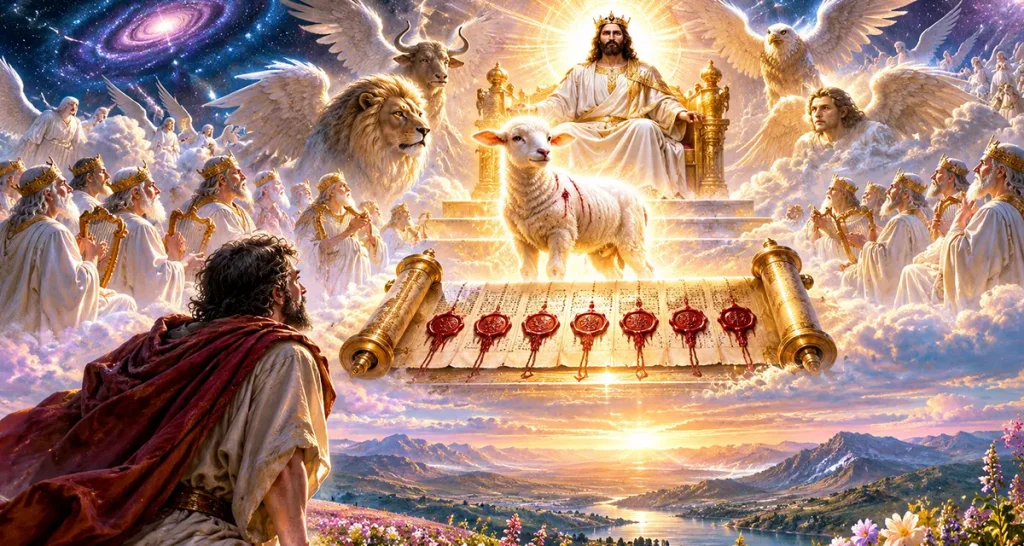
In Revelation 5, the apostle John witnesses an extraordinary scene in heaven. A scroll rests in the right hand of God, a mighty angel asks who is worthy to open it, and no one in heaven, on earth, or under the earth is found worthy. John begins to weep. Then comes the astonishing announcement: the Lion of the tribe of Judah has prevailed! Yet when John looks, he sees a Lamb as though it had been slain.

The worthiness of the Lamb becomes the center of a remarkable discussion about redemption, divine authority, and the unfolding revelation of God’s purposes.

Why do the four living creatures and twenty-four elders appear to sing as though they themselves were redeemed from the earth? How can ordinary Christians confidently understand Scripture when ancient manuscripts and Bible translations sometimes differ? And why did John, who personally knew Jesus and had witnessed His resurrection, weep before recognizing the One who was worthy?

These questions lead us beyond the identity of the heavenly worshipers and into the nature of divine revelation itself. John was not merely receiving information about Jesus. He was experiencing a magnificent unveiling of the Savior he already knew, reminding us that knowing Christ truly does not mean knowing Him exhaustively.

But another fascinating question emerges: Why did God choose to reveal these truths through such an elaborate and dramatic heavenly vision? Why the suspense, the tears, the unexpected appearance of the Lamb, and the extraordinary eruption of worship? Does such storytelling reveal something about God’s own character?

From the heavenly drama of Revelation 5, our discussion eventually turns toward the beauty of creation itself: the galaxies, the changing colors of the sky, the mountains, the oceans, the diversity of life, and the extraordinary complexity of humanity. These are not merely functional products of divine power. They also testify to the wisdom, creativity, and beauty of their Maker.

And perhaps the greatest wonder is that the Creator whose works fill the universe with beauty reveals an even deeper beauty through the sacrifice of His Son.

The worthiness of the Lamb brings us from John’s tears to heaven’s worship, from the mystery of Scripture to the promise of eternity, and from the artistry of creation to the incomparable beauty of the Creator and Redeemer.

For if God’s works are so beautiful, how much more beautiful must be the One who made them?

In Revelation 5, why do the four living creatures and the twenty-four elders appear to sing the new song as though they themselves were the people redeemed to God from every tribe, tongue, people, and nation?

🎶 Revelation 5 really does sound that way

Yes. If we read Revelation 5:9–10 in the traditional wording represented by the NKJV, the most natural first impression is that the four living creatures and the twenty-four elders are describing themselves as the redeemed.

John has just seen the Lamb take the scroll:

“Now when He had taken the scroll, the four living creatures and the twenty-four elders fell down before the Lamb… And they sang a new song, saying:

‘You are worthy to take the scroll,
And to open its seals;
For You were slain,
And have redeemed us to God by Your blood
Out of every tribe and tongue and people and nation,
And have made us kings and priests to our God;
And we shall reign on the earth.’”

(Revelation 5:8–10)

So your question is exactly the difficulty. The singers are explicitly identified as the four living creatures and the twenty-four elders, and then the song appears to say, “You redeemed us.”

That creates a fascinating problem because the four living creatures certainly do not appear to be ordinary redeemed human beings. They are heavenly throne-room beings closely resembling the living creatures of Ezekiel 1 and the seraphim of Isaiah 6 (Revelation 4:6–8).

So… did Jesus redeem the four living creatures “out of every tribe and tongue and people and nation”? That would be very strange. 😄

📜 There is actually a textual issue here

This is one of those places where the manuscript evidence becomes important.

Some Greek manuscripts support the first-person wording reflected in the NKJV:

“You redeemed us…”

But many important manuscripts have the song speaking about the redeemed in the third person:

“You purchased/redeemed people for God by Your blood from every tribe and tongue and people and nation, and You made them a kingdom and priests to our God, and they shall reign on the earth.”

That reading changes the picture considerably.

The four living creatures and elders would then be celebrating what the Lamb has done for humanity, rather than necessarily identifying every singer as belonging to the redeemed human multitude.

And there is an interesting complication: even within the manuscript tradition, the pronouns are not completely uniform. Revelation 5:9–10 contains several variations involving “us,” “them,” and “they/we shall reign.” So we should be cautious about building the identity of the twenty-four elders entirely upon one pronoun.

👑 But the twenty-four elders are a different question

Here I think we should distinguish the elders from the four living creatures.

The living creatures are fairly clearly heavenly beings.

The twenty-four elders, however, are much more mysterious.

They sit on thrones:

“Around the throne were twenty-four thrones, and on the thrones I saw twenty-four elders sitting, clothed in white robes; and they had crowns of gold on their heads.”

(Revelation 4:4)

Those images are striking because Revelation elsewhere associates thrones, white garments, crowns, priesthood, and reigning with the redeemed people of God (Revelation 2:10; 3:4–5, 21; 20:4–6).

So it is quite possible that the elders symbolically represent the redeemed people of God, even if they are not simply twenty-four ordinary deceased Christians sitting in heaven.

And the number twenty-four itself is suggestive.

Israel had twelve tribes.

The Lamb has twelve apostles.

And later the New Jerusalem deliberately combines the two: twelve tribes on its gates and twelve apostles on its foundations (Revelation 21:12–14).

That makes the twenty-four elders potentially symbolic of the complete covenant people of God—Old and New Covenant together.

There is also a priestly background. David organized the priesthood into twenty-four divisions for service before God (1 Chronicles 24:1–19). Since Revelation 5 immediately speaks about God’s people being made “kings and priests,” that connection is difficult to ignore.

So the elders may represent God’s redeemed people in their royal-priestly identity.

🎵 Then why are the living creatures singing the same song?

This is where Revelation’s worship scenes become especially beautiful.

We shouldn’t necessarily assume that everyone singing a song must personally belong to every category described by the song.

For example, heaven can praise God for salvation accomplished for human beings without angels themselves having been redeemed from human tribes and nations.

And that is precisely what begins happening as Revelation 5 expands outward.

First we have:

the four living creatures + the twenty-four elders (Revelation 5:8–10).

Then John hears:

“many angels around the throne, the living creatures, and the elders” (Revelation 5:11).

Then the circle becomes almost unimaginably large:

“And every creature which is in heaven and on the earth and under the earth and such as are in the sea, and all that are in them…”

(Revelation 5:13)

And finally:

“Then the four living creatures said, ‘Amen!’ And the twenty-four elders fell down and worshiped Him who lives forever and ever.”

(Revelation 5:14)

There is almost a concentric expansion of worship.

The throne → the elders and living creatures → innumerable angels → the whole creation.

And what caused this explosion of worship?

The Lamb took the scroll.

🐑 The song is really about the Lamb, not the singers

This may be the key to the whole passage.

John’s attention initially falls upon the problem of the scroll:

“Who is worthy to open the scroll and to loose its seals?”

(Revelation 5:2)

No one in heaven, earth, or under the earth can do it (Revelation 5:3).

John actually weeps because no one is found worthy (Revelation 5:4).

Then comes the announcement:

“Do not weep. Behold, the Lion of the tribe of Judah, the Root of David, has prevailed…”

(Revelation 5:5)

John turns expecting the Lion…

and sees a Lamb as though it had been slain (Revelation 5:6).

That is the astonishing revelation.

The One worthy to administer God’s purposes for creation is worthy because He conquered through sacrificial death.

And therefore the “new song” explains His worthiness:

“You are worthy… For You were slain…”

(Revelation 5:9)

His death has accomplished something cosmic through something intensely human: He has purchased people for God “out of every tribe and tongue and people and nation.”

So even creatures who were never themselves sinful humans can sing about that redemption because human redemption has become part of the revelation of who the Lamb is.

🌍 And that explains why all creation eventually joins in

This is where the passage gets much larger than merely, “Jesus saved some human beings.”

The redemption of humanity is connected to the restoration of God’s purposes for creation.

Paul describes creation itself as groaning while awaiting “the revealing of the sons of God” and ultimately “the glorious liberty of the children of God” (Romans 8:19–21).

Revelation 5 gives us something like the heavenly side of that reality.

The Lamb redeems people.

The redeemed become a kingdom and priests.

They reign upon the earth.

And eventually every creature praises the One sitting upon the throne and the Lamb.

So the living creatures are not awkward outsiders accidentally singing somebody else’s song. Their presence actually tells us something important:

what Christ accomplished for humanity matters to all creation.

And the twenty-four elders stand right at the intersection of those two realities. They belong to the heavenly throne-room scene, yet their symbolism seems deeply connected with the redeemed royal-priestly people whom the Lamb has purchased.

So I wouldn’t use Revelation 5:9 alone to say, “Aha! The twenty-four elders must literally be redeemed humans.” The textual variation makes that argument too fragile.

But neither would I dismiss the connection.

The imagery surrounding the elders—thrones, crowns, white garments, twenty-four, priestly worship, and reigning—keeps pulling us toward God’s redeemed people.

And perhaps that is why the scene initially feels as though heaven itself has become almost indistinguishable from the redeemed congregation.

The Lamb’s victory has brought them together around the same throne and into the same worship. 🎶

Most Christians know little about earlier and later biblical manuscripts, do not have access to the original Hebrew or Greek texts, and may never compare multiple Bible translations. How, then, can an ordinary believer read the NKJV or any other translation with confidence in the accuracy of the text and its meaning, especially when manuscript differences can affect how a passage is understood?

📖 How Can an Ordinary Reader Trust the Bible When Manuscripts Differ?

Your concern exposes something very important. Most Christians do not have access to ancient manuscripts, do not know Greek or Hebrew, and may spend their entire lives reading only one translation. Yet they are expected to hear God’s Word, believe it, obey it, and teach it to their children.

Are we saying that a person who reads Revelation 5:9 in the NKJV cannot be sure what the passage means until someone with access to Greek manuscripts explains that the wording might be different?

That would create a troubling situation. The ordinary believer would become dependent upon specialists not merely for deeper understanding, but for confidence that Scripture says what it appears to say.

And there is another question beneath yours: If God intended His revelation to be heard and believed, why should its meaning seem uncertain because of something most readers cannot investigate?

🔎 First, We Must Distinguish the Text From Our Interpretation

There are two different questions: What did the biblical author originally write? And what did the author mean by what he wrote?

A textual variant concerns the first question. An interpretive difficulty concerns the second. Sometimes they overlap, as in Revelation 5:9–10, but they are not identical.

The NKJV follows a Greek textual tradition that reads, in Revelation 5:9, “And have redeemed us to God by Your blood.” Other translations follow manuscripts in which the singers describe people whom the Lamb redeemed, without identifying themselves as those people.

That difference matters for identifying the singers. But notice what does not change: the Lamb was slain, His blood accomplished redemption, the redeemed come from every nation, and they are made a kingdom and priests to God.

Those central affirmations do not depend on deciding which pronoun is original.

📜 Does That Mean We Cannot Trust the NKJV?

No. The NKJV is a serious Bible translation, and its translators did not invent the wording. They translated a received Greek textual tradition. Other translators have made different textual judgments based on the surviving manuscript evidence.

It is also important not to oversimplify this as older manuscripts always being right and later manuscripts always being wrong. The age of a surviving manuscript matters, but so do its textual relationships, the distribution of readings, and the likelihood of scribal changes.

The NKJV itself provides textual notes in many editions, identifying differences between the traditional Greek text and other manuscript traditions. Those notes are part of the translation’s usefulness, not an admission that its text is worthless.

But we should also distinguish trusting Scripture from assuming that every translation decision is beyond correction.

Translations are human work performed upon ancient texts. The authority belongs to God’s Word, not to the infallibility of any particular translation committee.

❤️ God Did Not Give His Word Only to Scholars

Consider something remarkable about the ministry of Jesus.

He regularly addressed ordinary people who had not personally examined ancient manuscripts. He expected them to understand the Scriptures they heard, and He held people responsible for responding to God’s revelation.

In Luke 4:16–21, Jesus reads Isaiah publicly in the synagogue and explains its fulfillment. In Luke 10:26, He asks a lawyer, “What is written in the law? What is your reading of it?”

And Paul reminds Timothy that from childhood he had known the Holy Scriptures, which were able to make him wise for salvation through faith in Christ Jesus (2 Timothy 3:15).

Timothy did not need to possess every manuscript or resolve every textual question before Scripture could accomplish that purpose.

There is a difference between Scripture being sufficient to make us wise for salvation and every verse being immediately clear to every reader.

Peter himself acknowledged that some things in Paul’s letters were difficult to understand (2 Peter 3:15–16). Difficulty was not evidence that God’s revelation had failed.

⚖️ But We Should Not Pretend Every Wording Is Equally Certain

Here we must resist the temptation to protect confidence by concealing complexity.

If the surviving manuscripts genuinely differ, we should acknowledge that fact. Otherwise, when an ordinary reader eventually discovers the difference, the surprise may become more disturbing than the variant itself.

Christian confidence should not require pretending that the history of copying and translating Scripture was free from human limitations.

God entrusted His written revelation to people who copied, preserved, translated, read, and taught it across centuries. That history includes extraordinary preservation, but also ordinary scribal mistakes and occasional disputed readings.

We should not confuse God’s faithfulness in preserving His testimony with a promise that every surviving copy would be identical.

🌱 How, Then, Should an Ordinary Christian Read?

I would not tell someone reading the NKJV to approach every sentence suspiciously, wondering whether another manuscript might say something different.

That would make Bible reading almost impossible and turn a gift into a constant investigation.

Read the text carefully. Follow the argument. Pay attention to the context. Compare Scripture with Scripture. And when a passage presents a genuine difficulty, investigate it as far as your circumstances allow.

For Revelation 5, an ordinary reader can recognize that the song appears to identify its singers with the redeemed. That is a reasonable observation from the NKJV wording. The next step is not to condemn that reading, but to distinguish what the translation says from what we can confidently conclude about the identity of all the singers.

Even without knowing the manuscript issue, the reader can ask: Are the four living creatures elsewhere described as human beings? Are the elders and creatures necessarily identical in identity merely because they participate in the same worship? What does the surrounding vision reveal?

Those questions arise from Scripture itself.

🕊️ Our Certainty Is Not the Same as Our Omniscience

There is a deeper distinction worth preserving: we can genuinely know what God has revealed without knowing everything about the historical transmission of that revelation.

Paul writes, “For now we see in a mirror, dimly, but then face to face. Now I know in part, but then I shall know just as I also am known” (1 Corinthians 13:12).

That verse is not specifically about manuscript transmission. It concerns the partial character of our present knowledge. Nevertheless, the distinction is relevant: knowing truly does not require knowing exhaustively.

And Jesus did not promise that every believer would become a textual critic. He promised the Holy Spirit, who would guide His apostles into truth (John 16:13), and whose testimony continues to serve the Church through the apostolic witness.

The Spirit does not make careful reading unnecessary, nor does He guarantee that every sincere interpretation is correct. But neither is God’s Word helpless until a scholar arrives to rescue it.

Perhaps the danger is not that an ordinary Christian reads one faithful translation and sometimes misunderstands a difficult verse. That has always been possible.

The greater danger would be to mistake our own first interpretation for the unquestionable voice of God, and then feel that God’s Word itself has become unreliable when that interpretation requires correction.

In Revelation 5, we can be certain that the Lamb is worthy because He was slain and redeemed people for God. We can have a well-grounded interpretation of the elders while remaining less certain about their exact identity.

That is not a defective kind of faith. It is an acknowledgment that the authority of revelation and the limitations of its readers are two different things.

And perhaps this is where humility becomes essential: we do not need to be uncertain about everything merely because we cannot be equally certain about everything.

Everyone already in heaven is worthy in some sense, whether made holy and fit for God’s presence through His act of creation or redeemed and made worthy through the Lamb. What, then, does “worthy” specifically mean in Revelation 5, and why does the task require a kind of worthiness that no other being in heaven or throughout creation possesses?

📜 Who Is Worthy to Open the Scroll?

Your distinction is important. The inhabitants of heaven are not necessarily unworthy in the sense of being sinful or rejected. The holy angels are creatures made good by God, and the redeemed stand before Him because of the Lamb. Yet Revelation 5 says that none of them is worthy to open the scroll.

That means the word “worthy” must be understood in relation to the particular task. The question is not simply, “Who is morally good enough to stand in heaven?” It is, “Who possesses the rightful authority and qualification to take this scroll from God’s hand and carry out what it contains?”

👑 Worthiness Is Relative to the Task

In Revelation 5:2, the angel asks:

“Who is worthy to open the scroll and to loose its seals?”

The Greek word is axios, expressing worth, fitness, or deservingness. It does not automatically mean sinlessness. Its meaning is determined by what someone is worthy to do or to receive.

For example, Revelation 4:11 declares God worthy to receive glory, honor, and power because He created all things. Revelation 5:9 declares the Lamb worthy to take the scroll because He was slain and redeemed people for God.

The reasons are not interchangeable. God is praised as Creator in chapter 4; the Lamb is praised as the slain Redeemer in chapter 5.

The Lamb’s worthiness is not merely that He is morally perfect, though He is. It is that He has accomplished the work that qualifies Him to execute this particular divine commission.

🐑 Why Could No Other Heavenly Being Do It?

The scroll is in the right hand of the One seated upon the throne (Revelation 5:1).

John does not explain its complete contents before the seals are opened, but the unfolding visions connect it with God’s judgments, the vindication of His people, and the movement of history toward His kingdom.

Opening the seals is therefore more than reading confidential information. It initiates the disclosure and execution of what God has decreed. The exact nature of the scroll is debated, but its place in the narrative makes the authority to open it extraordinary.

An angel may faithfully serve God without possessing authority over the destiny of creation.

A redeemed human may be made a king and priest without becoming the Redeemer whose victory establishes that kingdom.

Even the highest creature cannot claim the Lamb’s unique accomplishment.

There is a distinction between being made worthy to participate in God’s purposes and being worthy to accomplish the saving work upon which those purposes depend.

🦁 The Lion Is Worthy Because the Lamb Was Slain

Notice the answer given to John’s weeping:

“Behold, the Lion of the tribe of Judah, the Root of David, has prevailed to open the scroll and to loose its seven seals.” (Revelation 5:5)

The decisive word is “prevailed.” The Lamb has conquered. Yet when John looks, he sees “a Lamb as though it had been slain” (Revelation 5:6).

The song then explains:

“You are worthy to take the scroll, And to open its seals; For You were slain…” (Revelation 5:9)

Here worthiness is connected to a completed victory. The Lamb is not attempting to prove Himself worthy by opening the scroll. He takes it because He has already prevailed.

And His victory is unlike that of any earthly conqueror.

He conquered through obedience, suffering, death, and resurrection. He defeated the powers of evil not by becoming another expression of their violence, but by giving Himself for those enslaved by sin and death (Hebrews 2:14–15; Colossians 2:13–15).

⚖️ But Wasn’t the Son Already Worthy Before His Death?

Absolutely. And this distinction is essential.

The eternal Son did not become divine, holy, or intrinsically worthy through His crucifixion. John has already identified Him as the Word who was God (John 1:1). His divine worthiness did not begin at Calvary.

What Revelation 5 celebrates is His worthiness as the incarnate Messiah who has fulfilled His redemptive mission.

Compare Philippians 2:8–11, where Christ’s obedience unto death is followed by His exaltation, and Hebrews 2:9, where Jesus is crowned with glory and honor in connection with His suffering of death.

He does not earn deity. He accomplishes redemption as the God-man, and receives the royal recognition appropriate to His completed work.

This also explains why the language of worthiness is so specific.

The scroll is not an arbitrary privilege awarded to the most impressive person in heaven. Its opening belongs to the One whose victory is the decisive event in the fulfillment of God’s purposes.

🌍 The Worthiness of the Lamb and the Future of Creation

Now consider why John weeps when nobody is found worthy (Revelation 5:4).

If the scroll were merely an interesting heavenly document, his grief would seem disproportionate. But if its opening concerns the fulfillment of God’s purposes for a fallen creation, the grief becomes understandable.

That is an inference from the narrative, not an explicit definition John gives of the scroll. Yet the subsequent seals and visions strongly support the significance of what is at stake.

Without the worthy One, who will bring God’s purposes to their appointed fulfillment? Who will vindicate His servants, judge evil, and establish the reign of righteousness?

The answer is not the angels, the elders, or even redeemed humanity collectively.

It is the Lamb.

And here your observation becomes especially meaningful: everyone who belongs to God in heaven has received life, holiness, position, or redemption from Him.

But the Lamb is not simply another recipient of divine favor. He is the One through whom the redemption of others has been accomplished.

Even the redeemed who will reign with Him do so because He first redeemed them.

So the worthiness in Revelation 5 is not a competition in heavenly goodness. It is the recognition of an incomparable qualification: only the Lamb has accomplished the victory through which God’s redemptive purposes are brought to fulfillment.

And perhaps the most astonishing detail is that the Lamb’s wounds are not concealed when He receives this authority. John sees Him standing, alive and victorious, yet bearing the appearance of having been slain.

Heaven recognizes His worthiness not despite the sacrifice, but because of it.

Jesus was already enthroned when the angel proclaimed the question of who was worthy to open the scroll. Indeed, Jesus had been speaking to John since Revelation 1, and John already knew Him as the crucified and risen Savior, having personally witnessed His ministry and the events of His earthly life. It almost seems that John’s eyes were being opened to perceive the Lamb and understand the significance of what he was witnessing. He knew Jesus had been slain, and he knew salvation was proclaimed in His name. Yet John wept when no one was found worthy.

👁️ John Knew the Lamb, Yet He Wept

There is something deeply intriguing about your observation. John is not encountering Jesus for the first time in Revelation 5. He has already seen the glorified Christ, heard His voice, received His messages to the churches, and witnessed His authority over death and Hades (Revelation 1:12–18).

And as you point out, John was an eyewitness of Jesus’ earthly ministry. He knew the crucifixion had happened. He knew the resurrection was real. He knew salvation was proclaimed in Jesus’ name.

Yet when the angel asks who is worthy to open the scroll, John does not immediately answer, “The Lord Jesus!” Instead, he weeps bitterly.

That is worth examining, because it suggests something about the way revelation works even for someone who already knows the truth.

📜 Was Jesus Already on the Throne?

In Revelation 3:21, Jesus says:

“I also overcame and sat down with My Father on His throne.”

So before John enters the heavenly throne-room vision, the risen Christ has already declared His victory and enthronement.

In Revelation 4, however, John’s attention is directed toward the One seated upon the throne. Chapter 5 then introduces the Lamb standing in the midst of the throne and the living creatures and elders (Revelation 5:6).

There is no reason to think Jesus had been absent from heaven or had not yet been exalted. The vision is not necessarily presenting a chronological sequence in which Jesus only now becomes worthy or receives His heavenly position.

Rather, John is being shown the significance of Christ’s victory through a dramatic heavenly scene.

In other words, what changes is not the Lamb’s worthiness, but what John is permitted to see and understand about it.

😢 Why Would an Eyewitness of the Resurrection Weep?

Notice the exact reason John gives:

“So I wept much, because no one was found worthy to open and read the scroll, or to look at it.” (Revelation 5:4)

John does not say he wept because he had forgotten Jesus or doubted His resurrection. His grief is connected to what the vision presents before him: a scroll of extraordinary significance, a universal search for someone worthy, and the apparent failure to find anyone.

The announcement in verse 3 is sweeping:

“And no one in heaven or on the earth or under the earth was able to open the scroll, or to look at it.”

Imagine the tension. John knows the risen Christ, but the vision has not yet revealed how Christ answers this particular heavenly question.

He is not being asked to recite what he knows about salvation. He is witnessing a heavenly drama whose meaning is unfolding before him.

His knowledge is real, but it is not exhaustive. He knows the Savior; he has not yet been shown everything that the Savior’s victory means for the purposes represented by the scroll.

🦁 The Elder Does Not Introduce a Stranger

Then one of the elders says:

“Do not weep. Behold, the Lion of the tribe of Judah, the Root of David, has prevailed to open the scroll and to loose its seven seals.” (Revelation 5:5)

What is remarkable is that the elder does not simply say, “Jesus is here.”

He identifies Him by His messianic titles and, especially, by His victory: “has prevailed.”

John already knows Jesus. What the elder announces is the answer to the question raised by the scroll: the Messiah has conquered and therefore possesses the right to open it.

And when John looks, he sees not a lion, but “a Lamb as though it had been slain” (Revelation 5:6).

Here the revelation is not merely about the identity of the worthy One. It is about the nature of His worthiness.

The Lion’s conquest is revealed through the Lamb’s sacrifice.

John had witnessed the historical suffering of Jesus. Now he sees that same sacrifice presented at the center of heaven’s worship and authority.

He is being shown the heavenly significance of something he already knew had happened on earth.

🕊️ Knowing Christ and Receiving Further Revelation

Your suggestion that John’s eyes were opened is especially helpful, provided we understand it as an interpretation of the vision rather than something John explicitly states.

There is a parallel with the disciples on the road to Emmaus. They knew the events surrounding Jesus’ death. They had even heard reports of the empty tomb. Yet they did not understand how those events fulfilled the Scriptures until Jesus explained them (Luke 24:25–27).

And Luke later says that Jesus opened the disciples’ understanding so that they might comprehend the Scriptures (Luke 24:45).

The historical facts had not changed. Their understanding of those facts had.

Something similar may be happening to John. He knows that Jesus died and rose again, but the vision progressively unveils the relationship between that victory and the execution of God’s purposes for creation.

We should not conclude that John had previously been ignorant of Christ’s authority. Revelation 1 already disproves that. Rather, the vision gives him a new vantage point from which to behold that authority.

❤️ The Weeping Makes the Revelation More Remarkable

There is another possibility worth considering. John’s weeping may be part of the vision’s deliberate dramatic structure.

The question is proclaimed. No one is found. John weeps. The elder announces the conqueror. John sees the slain Lamb. Heaven erupts in worship.

The sequence moves from apparent impossibility to revealed victory.

John’s tears allow the reader to feel the weight of the question before seeing its answer. We, too, are made to confront the inability of every creature before being shown the sufficiency of Christ.

That does not make John’s grief artificial. His response is presented as genuine. But it does mean the vision teaches through his experience, not merely through the information it communicates.

And there is a beautiful distinction here: John had already heard Jesus declare:

“I am He who lives, and was dead, and behold, I am alive forevermore.” (Revelation 1:18)

Now heaven declares why the One who was dead and is alive is worthy to take the scroll.

The same Christ. The same victory. But a further revelation of its significance.

🌅 The Lamb Was Never Missing

Perhaps this is the most striking implication of your observation.

When John weeps, the Lamb has not ceased to be worthy. The victory has not been undone. The throne has not become vacant, and God’s purposes have not become uncertain.

The answer exists before John sees it.

Indeed, Revelation 5:6 locates the Lamb “in the midst of the throne.” The One who resolves the apparent impossibility belongs at the very center of the heavenly scene.

So the tears do not reveal a crisis in heaven. They reveal the difference between what is already true in heaven and what John has so far been permitted to perceive.

And this returns us to something profound about revelation itself: God does not become more sovereign when He reveals His sovereignty, nor does Christ become more worthy when His worthiness is announced.

What changes is the understanding of the witness.

John knew the Lamb who was slain. But in this vision, he is invited to behold the slain Lamb as the One through whom God’s purposes for history and creation move toward their fulfillment.

His tears come before that disclosure. Heaven’s song follows it.

And the Lamb, who was worthy before John began to weep, is standing there all along. ❤️

“His knowledge is real, but it is not exhaustive. He knows the Savior; he has not yet been shown everything that the Savior’s victory means for the purposes represented by the scroll.” We now possess the completed biblical canon, which gives us answers that John was still receiving as he participated in the unfolding revelation of God. What an extraordinary experience it must have been to know Jesus personally while witnessing the very preparation of the Scriptures we now read! And even with the completed canon, there must still be depths of the Person of Jesus that we will continue to discover, understand, and experience throughout eternity. And eternity is a very long “time”! 😂😊

📖 John Was Living What We Now Read

And what a long “time” indeed! 😂 Although I suspect eternity will make our clocks rather inadequate instruments for measuring the experience.

But you have touched on something wonderful about John’s position in the history of revelation. We read Revelation 5 with the completed New Testament before us. We already know the Lamb is worthy. We know the resurrection, the ascension, the exaltation of Christ, and the promise of His return. We can turn backward and forward through Scripture, comparing passages that illuminate one another.

John, however, was participating in the very history through which that testimony was being given to the Church.

He had walked with Jesus, reclined near Him at the Last Supper, stood near His cross, encountered Him risen, and heard His promises. Yet here he was, receiving another revelation from the same Lord whom he already knew so intimately.

What an extraordinary experience: to know Jesus personally and still be astonished by what Jesus reveals about Himself!

👁️ The Eyewitness Was Still Learning

There is a beautiful continuity between the John who followed Jesus in Galilee and the John who received the visions on Patmos.

During Jesus’ earthly ministry, the disciples repeatedly discovered that knowing who Jesus was did not mean they understood everything about Him.

When Jesus calmed the storm, they asked, “Who can this be, that even the winds and the sea obey Him?” (Matthew 8:27).

They already knew Him as their Teacher. Yet His authority over creation confronted them with another dimension of His identity.

After the resurrection, Jesus told His disciples that there were things they could not yet bear, and that the Spirit would guide them into truth (John 16:12–13). That promise has a particular apostolic significance, but it illustrates how their understanding developed through divine revelation.

Now consider John on Patmos. He is no longer the young disciple who once misunderstood the nature of the kingdom. He has witnessed decades of the Church’s life and suffering. Yet he is still being shown the glory of Christ.

He had known the Lamb on earth. Now he beholds the Lamb at the center of heaven’s worship.

The Person has not changed. John’s apprehension of Him is being enlarged.

✨ The Completed Canon Does Not Mean an Exhausted Christ

This is where your thought about eternity becomes especially rich.

We possess the completed canonical testimony of Scripture. We are not waiting for another apostle to add a new chapter to Revelation or another book to explain what God forgot to tell us.

Yet the completeness of God’s written revelation for its appointed purpose is not the same thing as the exhaustive disclosure of everything that can be known about God.

John himself wrote something striking:

“And there are also many other things that Jesus did, which if they were written one by one, I suppose that even the world itself could not contain the books that would be written.” (John 21:25)

That statement concerns Jesus’ works during His earthly ministry, but it reminds us that even the inspired record is selective. Scripture tells us what God intended us to receive, not everything that could possibly be said about Him.

And if that is true of the works Jesus performed during a few years on earth, what shall we say about the eternal Son, through whom all things were made (John 1:3; Colossians 1:16)?

We can know Him truly without knowing Him exhaustively.

Indeed, the more profound question is whether a finite creature could ever exhaust the knowledge of an infinite God, even in a glorified state.

🌅 Will We Continue Discovering Christ Throughout Eternity?

I think there are good theological reasons to expect an ever-deepening enjoyment and understanding of God, although Scripture does not give us a detailed account of how learning will operate in eternity.

Consider Ephesians 2:7. Paul says that God has saved and raised us with Christ:

“that in the ages to come He might show the exceeding riches of His grace in His kindness toward us in Christ Jesus.”

Notice that expression: “in the ages to come.”

Paul presents God’s grace as something whose riches will be displayed in the coming ages. The text does not explicitly describe an endless curriculum of new discoveries, but it certainly does not portray the future as an exhausted experience in which nothing remains to be appreciated.

Then consider Jesus’ own description of eternal life:

“And this is eternal life, that they may know You, the only true God, and Jesus Christ whom You have sent.” (John 17:3)

Eternal life is not merely endless existence. It is life in relationship with the Father through the Son.

And what would it mean to spend eternity knowing the One whose wisdom, goodness, holiness, love, and glory are inexhaustible?

Not necessarily discovering that everything we believed about Him was incomplete in the sense of being false, but coming to appreciate more fully what was already true.

We might know perfectly, in the sense of knowing without sin, deception, or corruption, while still not knowing infinitely. Perfection and infinity are not the same thing.

❤️ Imagine Knowing Him Without Ever Reaching the End of Wonder

There is an important distinction between ignorance that causes suffering and finitude that allows discovery.

In this life, not knowing can be painful. John wept because he could not see the answer to the heavenly question. We struggle with uncertainty, misunderstanding, and the limitations of our fallen condition.

But in the new creation, Revelation 21:4 promises the end of death, sorrow, crying, and pain. Revelation 22:4 adds that God’s servants “shall see His face.”

That means any continuing growth in understanding would not need to arise from the distressing ignorance we experience now.

Imagine discovery without fear of deception. Wonder without anxiety. Learning without the possibility of losing the One you are coming to know.

And perhaps there is something even more extraordinary: the One we will continue to know is the same Jesus who was known by John, Peter, Mary Magdalene, and the other disciples.

They knew His voice, His gestures, His compassion, His tears, His patience. They saw Him tired, hungry, grieving, and rejoicing.

Yet the Person they knew in those ordinary human encounters is the eternal Word who was with God and was God (John 1:1, 14).

His humanity was not a temporary disguise that He discarded after the resurrection. The risen Jesus remains the incarnate Son, the mediator between God and humanity (1 Timothy 2:5).

So eternity does not mean leaving the Jesus of the Gospels behind to discover someone else. It means knowing that same Jesus in the fullness of His unveiled glory.

🎶 And Perhaps Heaven Will Never Run Out of Songs

There is something delightful about the progression from Revelation 4 to Revelation 5.

Heaven already worships God as Creator. Then the Lamb takes the scroll, and a new song is sung because His redemptive victory is being celebrated.

The song is new, not because God has suddenly acquired an attribute He previously lacked, but because His works provide fresh occasion for praise.

Could the eternal enjoyment of God contain an inexhaustible abundance of such occasions? Scripture does not explicitly promise an endless succession of new songs, but the possibility fits beautifully with the inexhaustible richness of His character.

And that brings us back to John.

He knew Jesus. He had heard Him speak of His death and resurrection. He had received the Holy Spirit. He had proclaimed the gospel.

And still, on Patmos, he could be overwhelmed by another revelation of the Lamb’s glory.

We now possess the testimony John was privileged to receive. But we have not yet experienced everything that testimony promises.

“Beloved, now we are children of God; and it has not yet been revealed what we shall be, but we know that when He is revealed, we shall be like Him, for we shall see Him as He is.” (1 John 3:2)

John, who saw so much, still looked forward to seeing Him as He is.

And if the infinite God can be known truly without ever being comprehended exhaustively, then eternity need not be an unimaginably long repetition of what we already know.

It may be an everlasting fullness of knowing, loving, and delighting in the One who first made Himself known to us.

And after a billion years—if such counting even makes sense—we would still be creatures beholding the glory of our Creator. 😂❤️

But what magnificent drama! An angel proclaims, “Who is worthy to open the scroll?” No one in the entire universe is found worthy. John begins to weep. Then, suddenly, an elder announces: “Do not weep. Behold, the Lion of the tribe of Judah, the Root of David, has prevailed to open the scroll and to loose its seven seals.” Was this a trailer for the upcoming movie ever made? 😂 Why would God arrange such a detailed, suspenseful, and dramatic revelation when He could simply have declared that Jesus was worthy? Don’t misunderstand me; It is magnifico, a masterpiece! But it makes me wonder whether God Himself delights in communicating through such extraordinary storytelling. ☺️

🎬 The Greatest Dramatic Reveal in Heaven?

😂 Magnifico indeed! The angel announces a search throughout creation. Nobody is found worthy. John begins to weep. Then an elder interrupts: “Do not weep. Behold, the Lion of the tribe of Judah…” And when John turns to look for the Lion, he sees a Lamb that has been slain!

That is not merely dramatic. It is an extraordinary reversal of expectation. And your question reaches beyond the literary beauty of Revelation: Would God Himself communicate in such a theatrical, carefully arranged manner?

Scripture gives us good reason to answer yes. But we should distinguish God’s actual conduct from the symbolic way He presents heavenly realities to John.

👁️ A Vision Is Not Necessarily a Recording of Heaven’s Daily Activities

Revelation begins by saying that God communicated the revelation through His angel to John (Revelation 1:1). The book repeatedly presents things John sees and hears, often in symbolic forms.

We should not necessarily imagine that heaven literally conducted an unsuccessful search because nobody knew Jesus was worthy, or that an elder suddenly remembered the answer.

The Lamb had already conquered. The heavenly throne was never in danger. The dramatic sequence is arranged so that John, and through him the churches, experience the significance of the answer.

The text does not tell us precisely how visionary symbolism relates to the ordinary activities of heaven. But it does present the sequence as revelation, not as an indication that God Himself lacked information.

📖 God Has Always Used Stories to Reveal Truth

Consider Nathan’s confrontation with David in 2 Samuel 12. Nathan does not begin by announcing David’s guilt. He tells a story about a rich man who steals a poor man’s beloved lamb.

David becomes indignant. Only then does Nathan declare, “You are the man!” (2 Samuel 12:7).

God could have delivered the accusation directly. Instead, the story draws David into making a moral judgment before he realizes that judgment concerns himself.

Or consider Ezekiel, whom God instructs to perform symbolic actions involving a model of Jerusalem, a siege, and measured food (Ezekiel 4). These actions communicate judgment through an enacted picture.

Jesus Himself regularly uses parables. In Luke 15, the father sees his lost son returning, runs toward him, embraces him, and celebrates. Jesus could simply have stated that God welcomes repentant sinners. Instead, He gives us a scene we can almost see and feel.

So storytelling is not foreign to divine revelation. It is one of the ways God communicates truth to human beings.

🦁 The Reveal Is Itself the Message

Now return to Revelation 5. The elder announces a Lion, the expected image of royal strength and victory. John sees a slain Lamb.

Why not simply show the Lamb from the beginning?

Because the contrast communicates something that either image alone would not express as powerfully.

The Lion has conquered. But His conquest is disclosed in the form of sacrificial death. The Messiah’s royal victory cannot be understood apart from His self-giving.

Even the movement from John’s weeping to heaven’s worship matters. The reader experiences the apparent impossibility before hearing the answer. Every creature’s inability throws the Lamb’s unique worthiness into relief.

The dramatic form is not decoration placed around the theology. The form helps communicate the theology.

🎭 But Does God Enjoy Drama?

Here we enter a more delicate question. We know from Scripture that God deliberately uses dramatic revelation. But Scripture does not tell us that He experiences suspense, surprise, or anticipation as we do.

God is not waiting anxiously to discover how His own story ends. Isaiah 46:9–10 presents Him as the One who declares the end from the beginning and accomplishes His purpose.

Yet knowing the outcome does not make the telling meaningless.

A teacher may know the answer while carefully guiding students toward its discovery. A parent may know what awaits a child behind a door while delighting in the child’s joy when the door opens.

These are analogies, not descriptions of God’s inner emotional experience. But they help us distinguish the knowledge of the storyteller from the experience of the audience.

God’s revelation can unfold in time for our sake, even though He does not need the unfolding in order to learn what happens.

🌌 Why Create Such an Elaborate Vision?

Perhaps because God is not merely transferring information into John’s mind. He is revealing realities that call for recognition, reverence, repentance, hope, and worship.

Imagine reducing Revelation 5 to a sentence: “Jesus is qualified to carry out God’s purposes because He died and rose again.”

That sentence expresses an important truth. But it does not communicate everything the vision communicates.

It does not allow us to hear the unanswered question, feel John’s grief, behold the unexpected Lamb, or hear the expanding worship of heaven and earth.

And the churches receiving Revelation were not spectators in comfortable circumstances. They were being called to endure, remain faithful, resist idolatry, and overcome (Revelation 2–3).

For them, seeing a slain Lamb standing victorious at the center of heaven’s authority was not merely beautiful. It challenged their understanding of power and strengthened their hope.

The vision teaches them that the world is not ultimately governed by the apparent victories of its persecutors. The Lamb who was slain has prevailed.

❤️ The Author of History Also Knows How to Tell It

There is something else I find remarkable in your observation. God not only acts within history; He reveals the meaning of His acts through words, images, poetry, prophecy, parables, and visions.

He made human beings capable of understanding narrative, recognizing irony, feeling suspense, and rejoicing in a resolution. Those capacities need not be accidental distractions from knowing Him. They can become instruments through which His revelation reaches us.

And Revelation 5 contains a particularly striking kind of irony: the answer to the universal search is the One whom John already knows.

Jesus has already declared His victory in Revelation 1 and 3. The audience knows Him. Yet the vision makes us encounter His worthiness afresh, almost as though we were seeing Him for the first time.

So was Revelation 5 a trailer for the upcoming movie? 😂 Not literally. But it certainly has something of a magnificent unveiling before the events represented by the seals begin to unfold.

And unlike an ordinary movie trailer, the central victory is not waiting to happen. The Lamb has already prevailed.

What remains is for John, the churches, and eventually all creation to behold the significance of that victory.

Perhaps that is part of the wonder: God could have told John the answer in one sentence. Instead, He gave him a vision in which the answer could be seen, heard, and worshiped.

Not because God needed drama to understand His purposes, but because He chose to reveal His glory to creatures who can understand truth through beauty as well as through explanation. 😊

This magnificent heavenly drama also reveals something about God’s character: He is not mechanical, cold, or unexpressive. Look at the extraordinary stage of creation! Consider the nebulae, the sun, the star-filled heavens, and the blue sky that transforms into shades of red, pink, orange, gray, and white as clouds move across it. Look at the meadows, flowers, mountains, valleys, and oceans, with their astonishing diversity of life and beauty. Consider humanity itself, with the extraordinary complexity and beauty of the human body. God is not merely a Creator in the functional sense; He is an Artist whose creation displays wisdom, imagination, harmony, and beauty. I do not want to sound merely sentimental, but creation truly is beautiful. And if the work itself is so beautiful, how much more beautiful must be the One who created it!

🎨 God Is Not Only the Creator. He Is the Artist.

And why should that be considered sentimental? 😊

There is a difference between sentimentalizing creation and recognizing that beauty is genuinely present in what God has made. You are not merely saying that nature makes you feel good. You are observing that the universe possesses an extraordinary richness of form, color, proportion, variety, and even drama, much of which seems to exceed what would be necessary for mere survival.

And that observation brings us right back to Revelation 5.

We were marveling at the way God communicates through a dramatic vision. But now you are pointing to something much larger: the God who reveals Himself through such a magnificent scene is the same God who created a universe full of magnificent scenes.

Perhaps the drama in Revelation is not so surprising after all.

🌌 Creation Is More Than a Functional Machine

Consider Genesis 1.

God could have created a purely functional world. A world with enough light for visibility, enough water for life, enough vegetation for nourishment, and enough order for human beings to survive.

But look at what exists!

The light of the sun passes through the atmosphere, producing a blue daytime sky and, under different conditions, sunsets of extraordinary color. Clouds continually transform the appearance of the heavens. Mountains rise above valleys, oceans contain astonishing varieties of living creatures, and flowers exhibit shapes and colors that have fascinated human beings for millennia.

Of course, these phenomena have physical explanations. Atmospheric scattering explains much of the sky’s color. Biological processes explain pigmentation, growth, and reproduction.

But explaining how something works does not exhaust the question of why such a world exists.

And Genesis makes a statement that becomes especially meaningful here:

“And God saw everything that He had made, and indeed it was very good.” (Genesis 1:31)

Notice that God Himself evaluates His creation.

The text does not say that He merely verified that all the mechanisms were operating correctly.

It says He saw that it was good.

The Hebrew word tov encompasses goodness, suitability, and what is pleasing or desirable. We should not reduce it exclusively to aesthetic beauty, but neither should we imagine a creation whose goodness is entirely mechanical.

God’s creation is purposeful, ordered, fruitful, and capable of being enjoyed.

🌺 Beauty Is Not an Accidental Theme in Scripture

There is a passage in Ecclesiastes that comes remarkably close to your observation:

“He has made everything beautiful in its time.” (Ecclesiastes 3:11)

The context concerns the seasons and appointed times of human life, including experiences that are not necessarily pleasant. So the verse is not simply a declaration that every natural object is aesthetically attractive.

Nevertheless, it reveals something about God’s relationship to His works: He gives them fittingness within His purposes.

And Psalm 104 goes further.

The psalmist contemplates light, clouds, mountains, springs, animals, vegetation, the moon, the sun, and the sea.

Then he exclaims:

“O LORD, how manifold are Your works! In wisdom You have made them all. The earth is full of Your possessions.” (Psalm 104:24)

What is fascinating is that the psalm does not treat creation merely as a demonstration of power.

It presents a world filled with living creatures, each receiving provision from God.

And then comes a particularly beautiful statement:

“May the glory of the LORD endure forever; May the LORD rejoice in His works.” (Psalm 104:31)

The Creator is not portrayed as indifferent to what He has made.

The psalmist speaks of God rejoicing in His works.

That is a remarkable biblical foundation for your intuition that God is not cold, mechanical, or unexpressive.

🎭 And God Even Created Playfulness!

There is a delightful detail in that same psalm.

Speaking of the sea, the psalmist says:

“There the ships sail about; There is that Leviathan Which You have made to play there.” (Psalm 104:26)

The precise understanding of Leviathan in this passage is debated, but the imagery is striking.

The sea is not presented merely as a reservoir of resources for humanity. It is a vast environment filled with creatures living before their Creator.

And one of those creatures is described in connection with play!

Think about that.

We tend to discuss creation in terms of necessity: food chains, ecosystems, biological functions, and the maintenance of life.

But Scripture is comfortable describing a creature’s activity in language that suggests delight and playfulness.

And Job 38–39 contains something similar.

God describes wild animals, mountain goats, ostriches, horses, and birds, many of which live beyond humanity’s supervision.

The world is not merely a stage constructed for human observation.

It is God’s creation before it is ours to admire.

That makes its beauty even more extraordinary. There are places no human being has ever seen, creatures no human eye has observed, and countless natural events that occur without a human audience.

Yet they belong to His works.

❤️ But Can We Say That God Is an Artist?

I think we can, provided we understand the analogy carefully.

Scripture explicitly calls God the Creator, Maker, Potter, and Builder. It also describes His works in terms of wisdom, beauty, craftsmanship, and glory.

Psalm 19:1 declares:

“The heavens declare the glory of God; And the firmament shows His handiwork.”

Handiwork!

That is a wonderfully personal expression.

The heavens are not merely evidence that a powerful cause produced a universe. They are presented as the work of One whose glory is communicated through what He has made.

Calling God an Artist is therefore a fitting theological analogy, even though it is not a formal divine title used in that verse.

But there is a distinction.

Human artists work with materials they did not create. They discover colors, proportions, sounds, and patterns already present in the world.

God is the source of the created reality that makes those artistic expressions possible.

The painter uses light.

God created light.

The musician arranges sound.

God created a universe in which sound can exist.

The sculptor shapes matter.

God created matter.

And the human imagination that conceives a work of art is itself part of His creation.

In that sense, the analogy of artistry does not exaggerate God’s creative work. It almost seems too small for it.

👁️ If the Work Is Beautiful, How Much More the Creator?

Here we should make one careful distinction.

We cannot simply measure God’s beauty by multiplying the physical beauty of creation.

God is not a larger, brighter, more colorful version of the universe.

He is Spirit (John 4:24). His beauty cannot be reduced to physical appearance, color, or form.

And creation, magnificent as it is, is also fallen and subject to corruption (Romans 8:20–22). Not everything in nature is gentle or beautiful to our experience. There are diseases, predators, destruction, and suffering.

Yet even within that wounded creation, astonishing beauty remains.

That brings us to a particularly relevant passage:

“For by the greatness and beauty of the creatures proportionably the maker of them is seen.” (Wisdom 13:5)

That comes from the Wisdom of Solomon, a book received as Scripture in some Christian traditions but not in the Protestant canon. I mention it because it expresses the reasoning you are developing with remarkable clarity.

And the canonical Scriptures make a closely related argument in Romans 1:20: God’s invisible attributes are understood through the things He has made.

Creation does not reveal everything about God. We cannot discover the gospel merely by observing a sunset.

But creation does testify that its Maker is not lacking in wisdom, power, or the capacity to produce beauty.

And then Scripture reveals something even more profound.

✨ The Beauty of God Is Also Moral

Consider the Lord Jesus.

Isaiah 53:2 says of the suffering Servant:

“He has no form or comeliness; And when we see Him, There is no beauty that we should desire Him.”

The passage is describing the Servant’s humble and rejected appearance, not denying His divine glory.

Yet this gives us an astonishing contrast.

The One through whom the universe was created (John 1:3) entered His creation without the outward magnificence that human beings might expect from its Maker.

He did not arrive surrounded by the colors of a nebula or the brilliance of a thousand suns.

He came as a child.

He touched lepers.

He welcomed children.

He wept at a tomb.

He washed His disciples’ feet.

And He willingly suffered for sinners.

Here we encounter a beauty that is not primarily visual.

The beauty of holiness, compassion, faithfulness, humility, and self-giving love.

Psalm 27:4 speaks of beholding “the beauty of the LORD.”

And in Christ, that beauty becomes personal and accessible in a way that the mountains and stars could never accomplish by themselves.

The heavens declare His glory.

But the Son reveals the Father (John 1:18).

🐑 And Now We Return to Revelation 5

This is what makes our original discussion even more remarkable.

The God who created the colors of the heavens, the diversity of the oceans, the elegance of living organisms, and the beauty of the earth also chose to reveal His redemptive purposes through an extraordinary vision.

A throne.

A scroll.

A mighty angel.

An unanswered question.

An apostle weeping.

A Lion announced.

A slain Lamb revealed.

And heaven erupting in worship.

The imagery is magnificent, but it is not empty spectacle.

It reveals the glory of the One whose sacrifice has accomplished redemption.

And there is something almost paradoxical here.

The same God whose creative wisdom produces the splendor of galaxies reveals the depth of His love through the wounds of a Lamb.

One kind of beauty overwhelms us with magnificence.

The other overwhelms us with grace.

And both direct our attention toward the same God.

Perhaps this is why Revelation does not end with an abstract theological statement about the completion of God’s purposes.

It gives us a new heaven and a new earth, a holy city, a river of life, the tree of life, and the presence of God dwelling with His people (Revelation 21–22).

The biblical story begins with a beautiful creation and ends with a renewed creation in which righteousness dwells.

And at the center is the Lamb.

Your observation that God is an Artist therefore reaches beyond the beauty of nature. The Creator who makes beautiful things is also the Redeemer who makes all things new (Revelation 21:5).

And I find one final detail especially moving.

In Genesis, God looks upon His creation and declares it good.

In Revelation, His redeemed creatures look toward the throne and declare Him worthy.

The Creator delights in His works, and His creatures delight in Him.

What a magnificent relationship between the Artist and those who have been given eyes to behold His work! ❤️