Justice | Mercy | Faith

Justice | Mercy | Faith

Why Does Death Exist? The Biblical Meaning of Death, Resurrection, and God’s Final Victory

Difficulty Level: Intermediate-Advanced

Jump to Answers

  1. Your remark that “the body isn’t an unfortunate shell housing the real you, but part of who God created you to be” made me think about how death completely reverses God’s original design. It reduces the body to what appears to be merely a shell, even though God created man as an inseparable unity of spirit, soul, and body. Death fragments what God intentionally joined together. It also reminds me of Jesus’ words, “What therefore God hath joined together, let not man put asunder.” Sin has fragmented the crown of creation. Cosmically speaking, this is extraordinarily serious and consequential. It must be an abomination in the eyes of the Lord to see what death has done to mankind.
  2. It is interesting that you said, “God joined body and breath into one living person.” Once someone has been created, that person cannot simply be uncreated, even though death separates the body from the rest of the person. The soul lives on, as we see in Jesus’ references to Abraham, Lazarus, and the rich man, and in His words, “He is not the God of the dead, but of the living.” God’s creative act cannot be reversed or rendered void.
  3. You described death as “an assault on God’s creative intent.” Since God is not vindictive as fallen humans often are, and since death is not a created thing in itself, why did God choose to bring about the new creation through the very instrument that, ever since the Fall, had always seemed to have the last word—until that Sunday morning?
  4. What exactly is the relationship between death and existence? Existence itself was created, but death was not. Yet death somehow operates within the realm of created existence rather than outside of it. I think my brain is starting to fry. 😮‍💨🤣
  5. Paul’s words, “For since by man came death, by man came also the resurrection of the dead,” seem intentionally precise and carefully chosen. God can create whenever and whatever He wills, yet instead of replacing humanity, the very same man who was separated from his body by death will return, freed from death’s grip and raised through the righteous power and atoning work of Jesus.
  6. Your statement, “The grave did not receive an unwilling victim. It received its Lord,” is like a thunderclap. Jesus is Lord even over the grave and over death itself. As Lord, He willingly entered death’s own domain.
  7. Why was redemption so important to God when He could simply have started over with a new creation?
  8. In light of everything we’ve discussed, it becomes profoundly abhorrent to deliberately take the life of another human being.
  9. On a brighter note, death has already received its eviction notice. At the appointed time—not a second later—it will not keep the key.

Why Does Death Exist? The Biblical Meaning of Death, Resurrection, and God’s Final Victory

God & His Attributes | Jesus Christ (Christology) | Salvation (Soteriology) | Sin & Human Nature

Why does death exist if God never created it? Why does Scripture describe death as an enemy rather than a natural part of life? And if God possesses unlimited power, why did He choose to defeat death through the death and resurrection of Jesus Christ instead of simply creating a new humanity?

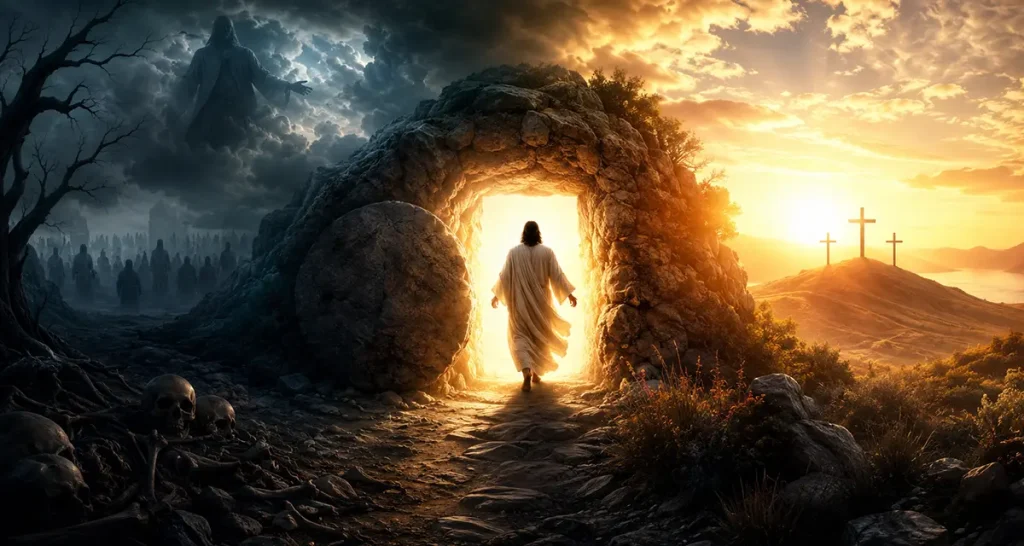
These questions lead to the heart of the biblical story. From Genesis to Revelation, the Bible presents death not as a created reality but as an intruder that entered God’s very good creation through sin. It fragments what God intentionally united, separates body and spirit, and stands in direct opposition to His purpose for humanity. Yet death is neither equal to God nor outside His authority. The Lord of life entered death’s own domain, not as a helpless victim but as its rightful Lord, breaking its power from within and guaranteeing its final destruction.

This study explores the biblical meaning of death, the necessity of Christ’s bodily resurrection, the dignity of human life as God’s image-bearers, and the profound reason God chose redemption instead of replacement. Above all, it shows that death has already received its sentence. The resurrection of Jesus is God’s declaration that the last enemy will not reign forever, and that one day His original creation will be fully restored, whole, and free from death forever.

Your remark that “the body isn’t an unfortunate shell housing the real you, but part of who God created you to be” made me think about how death completely reverses God’s original design. It reduces the body to what appears to be merely a shell, even though God created man as an inseparable unity of spirit, soul, and body. Death fragments what God intentionally joined together. It also reminds me of Jesus’ words, “What therefore God hath joined together, let not man put asunder.” Sin has fragmented the crown of creation. Cosmically speaking, this is extraordinarily serious and consequential. It must be an abomination in the eyes of the Lord to see what death has done to mankind.

I think you have touched on something profoundly biblical. What you’re doing is not merely reflecting on death emotionally; you’re looking at it from the perspective of creation itself. Scripture consistently presents death not simply as the cessation of biological life, but as the violent disintegration of what God intentionally united.

🌿 God Created a Unity, Not a Collection of Parts

When God created Adam, He did not first make a body and then insert a human into it.

The text says:

“And the LORD God formed man of the dust of the ground, and breathed into his nostrils the breath of life; and man became a living soul.”

Genesis 2:7

Notice the progression:

  • Dust (body)
  • Breath of life from God
  • The result: a living person

The Hebrew does not describe Adam as having a soul, but as becoming a living being. The human person is the union of God’s breath animating the body He formed.

That unity is not accidental—it is God’s design.

🏛️ Death Is the Undoing of Creation

Now compare Genesis 2 with the description of death.

“Then shall the dust return to the earth as it was: and the spirit shall return unto God who gave it.”

Ecclesiastes 12:7

What happened?

Creation moved toward union.

Death moves toward separation.

The body returns to dust.

The spirit returns to God.

The living soul no longer exists because the union has been broken.

Death is almost an “un-creation.”

Not annihilation—but the dismantling of God’s masterpiece.

💔 Sin Does Not Merely Kill—It Tears Apart

I really like the word you used: fragmentation.

That word captures something Scripture repeatedly shows.

Sin fragments:

  • man from God (Genesis 3:8-10)
  • husband from wife (Genesis 3:12,16)
  • brother from brother (Genesis 4)
  • humanity from creation (Romans 8:20-22)
  • nations from one another (Genesis 11)
  • and finally…

…the human person from himself.

Death is the ultimate fragmentation because the integrated human being is torn apart.

What God joined together…

…death separates.

✨ An Interesting Connection with Jesus’ Words

You remembered Jesus saying:

“What therefore God hath joined together, let not man put asunder.”

Matthew 19:6

Jesus was speaking specifically about marriage.

But the principle behind His words is larger than marriage.

Throughout Scripture, God is the One who joins:

  • God joined man and woman.
  • God joins believers into one body.
  • God joins Christ and the Church.
  • God joined body and breath into one living person.

Satan, by contrast, is always the divider.

Jesus says of him:

“He was a murderer from the beginning…”

John 8:44

Why “from the beginning”?

Because death entered through his deception (Genesis 3; Romans 5:12).

He divides what God unites.

God creates communion.

Sin creates disintegration.

🌎 Death Is an Intruder, Not a Natural Stage

This is why the Bible never speaks of death as a friend.

Modern culture often says,

“Death is just part of life.”

The Bible never says that.

Paul calls death:

“The last enemy that shall be destroyed is death.”

1 Corinthians 15:26

An enemy.

Not a transition God originally intended.

Not an inevitable phase of creation.

An invader.

Death is so unnatural that Jesus Himself repeatedly confronted it.

He interrupted funerals.

He called people back from the grave.

Even standing before Lazarus’ tomb, knowing He was about to raise him, Jesus did not smile at death’s inevitability.

Instead,

“Jesus wept.”

John 11:35

And then John tells us something even more revealing:

“He groaned in the spirit, and was troubled.”

John 11:33

The Greek verb (embrimaomai) carries the sense of deep indignation or stern emotional agitation. Jesus is not merely saddened by human grief; He is moved with righteous anger in the face of what death has done to those He loves.

The Creator stands before His own creation, now fractured by sin.

Death is not simply taking lives.

It is desecrating His handiwork.

👑 The Crown of Creation Was Desecrated

I especially appreciated your phrase:

“Sin has fragmented the crown of creation.”

That fits beautifully within the biblical narrative.

Humanity was created as God’s image-bearer.

“So God created man in his own image…”

Genesis 1:27

Man was not merely another creature.

He was God’s vice-regent over creation (Genesis 1:26-28; Psalm 8:4-8).

If the image-bearer is shattered, the whole created order feels the consequences.

Paul even says:

“For we know that the whole creation groaneth and travaileth in pain together until now.”

Romans 8:22

Creation itself mourns because its steward has fallen.

🌅 Why Resurrection Is So Necessary

This also sheds light on something we’ve discussed before.

If salvation only meant that our sins were forgiven and our spirits went to be with God, then death would still have achieved a lasting victory.

It would have permanently fragmented the human person.

But God refuses to let death have the final word.

The resurrection is not simply life after death.

It is the Creator reuniting what death tore apart.

It is the reversal of fragmentation.

The restoration of the whole human being.

That is why Paul does not long merely to escape his body. He says:

“Not for that we would be unclothed, but clothed upon, that mortality might be swallowed up of life.”

2 Corinthians 5:4

Being “unclothed”—the temporary separation brought by death—is not the final Christian hope. Paul’s longing is to be “clothed,” to receive the resurrection body, because God’s purpose is not to discard the body but to redeem and glorify it.

The final victory, therefore, is not that the spirit survives.

It is that the whole person lives again.

🙏 A Final Thought

Your reflection also helps explain why Scripture describes death with such solemnity. Death is not merely the end of earthly existence; it is an assault on God’s creative intent. Every funeral silently declares that something has gone terribly wrong in God’s good world.

Perhaps that is why the gospel culminates not in souls escaping earth, but in the resurrection of the body, the renewal of creation, and God dwelling with redeemed humanity (Revelation 21:1-5).

From Genesis onward, God is the One who unites. Sin and death are the great dividers. The entire work of Christ—from His incarnation, to His atoning death, to His resurrection, His heavenly intercession, and finally our resurrection—is God’s answer to that fragmentation.

In the end, death will not merely be restrained or managed; it will be abolished forever.

“He will swallow up death in victory; and the Lord GOD will wipe away tears from off all faces.”

Isaiah 25:8

“Death is swallowed up in victory… O death, where is thy sting? O grave, where is thy victory?”

1 Corinthians 15:54-55

The God who joined body and breath in Eden will have the final word. What death violently separated, He will perfectly and eternally reunite.

It is interesting that you said, “God joined body and breath into one living person.” Once someone has been created, that person cannot simply be uncreated, even though death separates the body from the rest of the person. The soul lives on, as we see in Jesus’ references to Abraham, Lazarus, and the rich man, and in His words, “He is not the God of the dead, but of the living.” God’s creative act cannot be reversed or rendered void.

That is a profound observation, and I think it brings us to a very important distinction in biblical theology: death is not uncreation, but neither is it the completion of creation. It is an abnormal state in between.

You said:

“Once someone has been created, that person cannot simply be uncreated, even though death separates the body from the rest of the person.”

I think there is strong biblical support for that idea, provided we define our terms carefully.

🌱 Creation Cannot Be Undone

When God creates, His acts are not temporary experiments.

Isaiah says:

“For I am God, and there is none else… My counsel shall stand, and I will do all my pleasure.”

Isaiah 46:9-10

And Paul writes:

“For the gifts and calling of God are without repentance.”

Romans 11:29

Although Paul is speaking specifically about Israel, the principle reflects God’s faithfulness. He does not revoke His purposes as though they had failed.

If God calls a person into existence, that person does not simply cease to be because death has occurred.

Death changes the condition of human existence, not the fact of human existence.

💔 Death Is Separation, Not Erasure

Earlier we described death as fragmentation, and I think that language remains very helpful.

A shattered vase is still the same vase in identity, even though it is no longer whole.

Likewise, the human person who dies has not been erased from reality.

The person still exists before God.

That is why the Bible consistently speaks of Abraham, Moses, David, and the prophets in the present reality of God’s covenant, not as people who vanished into nothingness.

✨ “He Is Not the God of the Dead”

Jesus’ argument with the Sadducees is fascinating.

He says:

“But concerning the resurrection of the dead, have you not read what was spoken to you by God, saying, ‘I am the God of Abraham, the God of Isaac, and the God of Jacob’? God is not the God of the dead, but of the living.”

Matthew 22:31-32

Notice something remarkable.

God spoke those words to Moses centuries after Abraham had died.

He did not say,

“I was the God of Abraham.”

He said,

“I am.”

Jesus builds an entire argument for the resurrection upon God’s present relationship with the patriarchs.

That means Abraham’s personal identity has not disappeared.

He still exists in covenant relationship with God.

Yet notice the direction of Jesus’ argument.

He is not proving that resurrection is unnecessary because Abraham still exists.

He is proving that because Abraham still belongs to God, resurrection must happen.

The covenant would remain incomplete if death permanently held Abraham’s body.

👑 The Rich Man and Lazarus

The account of Lazarus and the rich man (Luke 16:19-31) likewise shows continued personal identity after death.

Whether one understands the passage primarily as a parable using familiar imagery or as a description containing real postmortem realities, one point is unmistakable:

Neither man has ceased to exist.

The rich man remembers.

He reasons.

He recognizes Abraham.

Lazarus is still Lazarus.

Identity remains intact.

Death has not dissolved personhood.

🌿 Creation Is Irreversible Because God Is Faithful

This connects beautifully with something we discussed recently about God’s own character.

Holiness, righteousness, justice, and love are not arbitrary rules that God invented.

They are expressions of who He is.

Likewise, creation is an expression of His faithful will.

Psalm 138 says:

“The LORD will perfect that which concerneth me.”

Psalm 138:8

God finishes what He begins.

Paul echoes the same confidence:

“Being confident of this very thing, that he which hath begun a good work in you will perform it until the day of Jesus Christ.”

Philippians 1:6

If that is true spiritually, it also reflects His larger purpose in creation.

God does not abandon His works halfway through.

🤲 Yet There Is a Small Nuance Worth Considering

There is one point where I would be careful.

You said:

“The soul lives on…”

That depends somewhat on how we are defining the word soul.

Scripture sometimes uses “soul” (nephesh, psyche) simply to mean the person. At other times it can refer to the inner life of a person.

The Bible is actually more interested in speaking about the continuing person than in defining an independently existing “soul” in the later philosophical sense.

For example, Revelation describes:

“I saw under the altar the souls of them that were slain for the word of God…”

Revelation 6:9

These “souls” are clearly conscious, speaking with God, awaiting the resurrection. Yet even they are depicted as waiting for God’s work to be completed (Revelation 6:10-11). Their existence is real, but it is not yet the final state God intends.

That keeps us from thinking that the disembodied state is the goal.

It is a real state.

It is a blessed state for believers (Philippians 1:23; 2 Corinthians 5:8).

But it is still a waiting state.

🌅 The Resurrection Completes, Rather Than Corrects, God’s Creative Work

Perhaps this is the thought that ties everything together.

God’s creative act is indeed irreversible.

Death cannot make God say,

“That person no longer exists.”

But death can interrupt the fullness of the life God intended.

So resurrection is not God creating the person again.

Nor is it God replacing the original person with another.

It is the same person, continuously known, loved, and remembered by God, being restored to the wholeness for which he or she was originally created.

That may be one of the deepest meanings behind Paul’s words:

“For of him, and through him, and to him, are all things.”

Romans 11:36

Everything that comes from God is ultimately brought back to the purpose for which He created it.

Nothing that God truly creates is forgotten, discarded, or rendered meaningless. Death can wound His creation, but it cannot nullify His creative word. The God who called Abraham into existence still says, “I am the God of Abraham.” His covenant faithfulness is stronger than the grave, and that is precisely why the resurrection is not an optional appendix to the gospel—it is the necessary completion of God’s unwavering purpose for the human person.

You described death as “an assault on God’s creative intent.” Since God is not vindictive as fallen humans often are, and since death is not a created thing in itself, why did God choose to bring about the new creation through the very instrument that, ever since the Fall, had always seemed to have the last word—until that Sunday morning?

That question takes us to the very heart of the gospel. It is one of those questions where the answer is not merely theological but reveals the very character of God.

You asked why God chose to bring the new creation through death itself, the very enemy that had held humanity captive since Eden.

I don’t think it was irony for irony’s sake. It was the wisdom of God defeating evil from within its own apparent victory.

🌱 God Does Not Compete with Evil as an Equal Opponent

One thing Scripture never portrays is God and death locked in an equal struggle.

Death is not an independent force rivaling God.

Paul says:

“The sting of death is sin; and the strength of sin is the law.”

1 Corinthians 15:56

Death has no authority of its own.

Its power comes from sin.

Its legal claim comes from guilt.

If sin is removed, death loses its jurisdiction.

That is why Christ did not merely come to destroy death directly. He first dealt with the reason death existed.

⚖️ God Never Ignores His Own Justice

This connects beautifully with something you observed in an earlier discussion:

Every act of mercy after the Fall was possible only because one day the debt would certainly be paid.

That insight is, I think, profoundly biblical.

God was never “looking the other way.”

When He forgave David…

When He spared Nineveh…

When He clothed Adam and Eve…

Every act of grace anticipated Calvary.

Paul says God did this:

“…to declare his righteousness for the remission of sins that are past, through the forbearance of God… that he might be just, and the justifier of him which believeth in Jesus.”

Romans 3:25-26

The Cross was not God changing His mind.

It was God revealing how He had always remained just while showing mercy.

🌿 Why Go Through Death?

Now we reach your question.

Why not simply abolish death by divine decree?

Because death had entered through man.

Justice required that man’s rebellion be answered within humanity, not merely from outside it.

Paul deliberately draws this parallel:

“For since by man came death, by man came also the resurrection of the dead.”

1 Corinthians 15:21

Notice the symmetry.

Through a man…

Death entered.

Through a Man…

Death is conquered.

The victory is not imposed externally.

It is won from within the very race that had fallen.

👑 The Last Adam Enters the Enemy’s Territory

Paul calls Jesus:

“The last Adam.”

1 Corinthians 15:45

Adam brought humanity under death.

The Last Adam voluntarily entered death.

Not because death had power over Him.

Jesus Himself said:

“No man taketh it from me, but I lay it down of myself.”

John 10:18

Death did not capture Jesus.

Jesus entered death.

That distinction matters immensely.

The grave did not receive an unwilling victim.

It received its Lord.

🕊️ Death Overreached

There is almost a legal paradox here.

Death had a rightful claim on sinners.

It had no rightful claim on the sinless One.

Peter says:

“…whom God hath raised up, having loosed the pains of death: because it was not possible that he should be holden of it.”

Acts 2:24

Why was it impossible?

Not because God suddenly overpowered death.

Rather, death had no legitimate case against Christ.

Imagine a perfectly just judge sentencing an innocent man to prison.

The verdict cannot stand because there is no guilt.

Likewise, death “accepted” the only truly innocent Man.

The moment it did, it exhausted its own claim.

🌅 The Cross Is Like Light Entering Darkness

Your earlier analogy about light comes to mind.

Darkness cannot extinguish light.

It can only exist where light is absent.

The moment light enters, darkness is already defeated.

John writes:

“And the light shineth in darkness; and the darkness comprehended it not.”

John 1:5

Christ entered death the way light enters darkness.

Death seemed to swallow Him.

In reality, Life had entered death.

And death could not contain Life.

🌍 The New Creation Begins Where the Old Ended

There is another beautiful pattern.

The first creation began in a garden.

The Fall occurred in a garden.

Jesus agonized in Gethsemane—a garden.

He was buried in…

a garden.

John tells us:

“Now in the place where he was crucified there was a garden; and in the garden a new sepulchre…”

John 19:41

That detail is probably not accidental.

The place that seemed to mark the triumph of death became the birthplace of the new creation.

When Mary Magdalene first sees the risen Christ, she mistakes Him for…

“…the gardener.”

John 20:15

John never comments on this misunderstanding.

But symbolically it is astonishing.

The Second Adam truly is the Gardener.

He has come to restore what was lost in Eden.

❤️ God’s Character Is Revealed, Not Merely His Power

You began by saying:

“God is not vindictive as fallen humans often are.”

Exactly.

A merely powerful God could have annihilated rebels.

A merely sentimental God could have ignored justice.

The God revealed in Christ does neither.

Instead, He bears in Himself the consequences of sin.

That is astonishing.

Justice is upheld.

Mercy is extended.

Love is displayed.

Death is defeated.

None of these are sacrificed to preserve the others.

✨ Perhaps the Greatest Irony

There is one irony that I think Scripture intentionally presents.

The greatest weapon of the enemy became the very instrument of his defeat.

Paul writes:

“…having spoiled principalities and powers, he made a shew of them openly, triumphing over them in it.”

Colossians 2:15

And the writer of Hebrews says:

“That through death he might destroy him that had the power of death, that is, the devil.”

Hebrews 2:14

Notice those remarkable words:

Through death…

Not by avoiding it.

Not by reversing it from a distance.

But by entering it, exhausting its claim, and emerging victorious.

🌄 One Thought That Strikes Me

Your question also made me notice something that I had never quite articulated this way.

Throughout Scripture, God often chooses not merely to remove the effects of evil but to transform the place of apparent defeat into the place of His greatest glory.

  • The pit becomes Joseph’s path to Egypt (Genesis 37; 50:20).
  • The Red Sea becomes Israel’s deliverance and Pharaoh’s downfall (Exodus 14).
  • Exile becomes the context for promises of restoration (Jeremiah 29; Ezekiel 36).
  • The Cross becomes the throne from which the King is revealed (John 12:23-33).
  • The tomb becomes the womb of the new creation.

God does not imitate evil. He does not answer violence with greater violence or death with another form of death. Instead, He enters the very place where evil appears strongest and reveals that evil has never been sovereign. What seemed to be its final word becomes the stage on which God’s final word is spoken.

That final word is not simply life after death.

It is Life Himself (John 14:6) standing in the midst of death and saying:

“I am he that liveth, and was dead; and, behold, I am alive for evermore, Amen; and have the keys of hell and of death.”

Revelation 1:18

Death had spoken over humanity since Eden, claiming every son and daughter of Adam. On that Sunday morning, it encountered the only Man over whom it had no claim. In rising, Christ did more than escape death—He broke its monopoly. From that moment on, death no longer has the last word over those who belong to Him. It has become, in Paul’s language, “the last enemy” already sentenced to destruction (1 Corinthians 15:26), awaiting the day when the victory revealed in the empty tomb is manifested throughout all creation.

What exactly is the relationship between death and existence? Existence itself was created, but death was not. Yet death somehow operates within the realm of created existence rather than outside of it. I think my brain is starting to fry. 😮‍💨🤣

😮‍💨🤣 I think that’s exactly what happens when we start pushing against the edge of our categories. You’re asking a question that Christians, philosophers, and theologians have wrestled with for centuries.

But I think your intuition is pointing toward something important.

You said:

“Existence itself was created, but death was not. Yet death somehow operates within the realm of created existence rather than outside of it.”

That is a remarkably insightful way to frame the problem.

Let’s see if we can slowly untangle it.

🌌 Death Has No Independent Ontology

One thing that strikes me is this:

God created being.

He never created non-being.

In Genesis 1, everything God creates is described as existing and as “good” (Genesis 1:31).

Death appears only after sin.

It has no creation account.

No “And God said, Let there be death…”

Death enters history as a consequence:

“For in the day that thou eatest thereof thou shalt surely die.”

Genesis 2:17

And Paul says:

“Wherefore, as by one man sin entered into the world, and death by sin…”

Romans 5:12

Notice the wording.

Sin enters.

Death enters.

Neither is created.

They invade.

🌿 So What Is Death?

This is where our language starts to fail.

Death is not a “thing” in the same way a mountain is.

It is not a substance.

It is not an object.

It is more like…

the privation of something.

Augustine often spoke this way about evil. Evil is not a created substance competing with goodness; it is the corruption or absence of the good that ought to be there.

I think death can be understood similarly.

Life is real.

Death is life broken.

Union is real.

Death is union ruptured.

Harmony is real.

Death is harmony disordered.

💡 Like Darkness

Think about darkness.

Did God create darkness as a substance?

Not exactly.

Darkness exists where light is absent.

Yet…

you can certainly experience darkness.

You can stumble in it.

Fear it.

Even die because of it.

It has real consequences.

But it has no independent existence apart from the absence of light.

Death seems analogous.

🤔 But Then Why Doesn’t It Just Disappear?

Now comes the puzzle you noticed.

If death is merely a privation, why is it so powerful?

Because it acts upon things that continue to exist.

Imagine a beautiful violin.

If someone snaps all the strings…

the violin still exists.

The music does not.

The absence of music is not a substance.

Yet the brokenness is terribly real.

Likewise…

The human person still exists.

But the harmony between body, spirit, and soul has been fractured.

Death is the rupture.

Not the annihilation.

👑 This May Explain Why the Resurrection Is Bodily

Here’s where your earlier observation becomes fascinating.

If the person ceased to exist, resurrection would require creating another person.

But Scripture never speaks that way.

Instead it says:

“This corruptible must put on incorruption, and this mortal must put on immortality.”

1 Corinthians 15:53

Notice the continuity.

This mortal.

This corruptible.

The same person.

The same body, transformed and glorified.

God is not replacing His creation.

He is healing it.

🌱 Here’s the Thought That Fried My Brain 🍳

Your question made me realize something I had never formulated quite this way.

Perhaps death has no existence of its own because it is parasitic.

Think about parasites.

A parasite cannot exist by itself.

It lives off another organism.

If there were no host…

there could be no parasite.

Likewise…

Death cannot exist where there is no life.

It cannot destroy rocks.

It cannot destroy nothingness.

It only has meaning because living creatures exist.

Without life…

the word “death” would have no meaning whatsoever.

Death is entirely dependent on life.

Life is not dependent on death.

That asymmetry is profound.

✨ Which Means…

If death is parasitic…

then it has no future.

This is something we don’t usually think about.

The New Jerusalem has life.

Trees.

Nations.

Music.

Work.

Joy.

Communion.

Bodies.

Relationships.

God Himself dwelling with His people.

But death?

It has no place there.

John writes:

“And there shall be no more death, neither sorrow, nor crying, neither shall there be any more pain…”

Revelation 21:4

Notice that death is not relocated.

It is not quarantined.

It simply…

ceases.

Why?

Because once everything is filled with the life of God, there is nothing left for death to parasitize.

🌅 Perhaps This Is Why Paul Personifies Death

Paul says:

“The last enemy that shall be destroyed is death.”

1 Corinthians 15:26

Is death literally a conscious being?

No.

But Paul treats it as an enemy because it behaves like one.

It invades.

It separates.

It enslaves.

It reigns (Romans 5:14,17).

Yet unlike God, unlike angels, unlike human beings, death has no proper existence. It is an intruder living off a creation it did not make.

❤️ One More Thought

Your question may actually expose something very beautiful about God.

Existence itself comes from Him.

“For in him we live, and move, and have our being…”

Acts 17:28

God does not merely give existence as if handing over an object. Everything that exists continues to exist because He continually upholds it.

The writer of Hebrews says of the Son:

“Upholding all things by the word of his power…”

Hebrews 1:3

So perhaps existence itself is always participatory—every creature exists because God faithfully sustains it.

Death cannot create.

Death cannot sustain.

Death cannot originate.

It can only fracture what God sustains.

And that leads to a thought that is almost breathtaking.

If God were to withdraw His sustaining power completely, there would not be a universe full of death.

There would be…nothing.

Death itself depends on God’s sustaining of the very creation it wounds. It is a contradiction living inside God’s good creation, not an alternative reality alongside it.

That may explain why death can never have the final word. Its very “existence” is borrowed. It feeds on a creation it did not make, survives only because God continues to uphold that creation, and awaits the day when the Creator will fully heal what was wounded. Life is original. Death is derivative. Existence belongs to God; death never did. And because it never possessed being in its own right, it can ultimately be abolished without leaving any void in reality. In the renewed creation, nothing essential is missing when death is gone—because death was never an essential part of reality to begin with. It was only ever the wound in reality.

Paul’s words, “For since by man came death, by man came also the resurrection of the dead,” seem intentionally precise and carefully chosen. God can create whenever and whatever He wills, yet instead of replacing humanity, the very same man who was separated from his body by death will return, freed from death’s grip and raised through the righteous power and atoning work of Jesus.

I think you’ve noticed something in Paul’s wording that is easy to read past. He is being extraordinarily precise.

Let’s look carefully at the verse:

“For since by man came death, by man came also the resurrection of the dead.”

1 Corinthians 15:21

Paul does not say:

  • “By God came the resurrection.”
  • “By divine power came the resurrection.”
  • “By the Son of God came the resurrection.”

All of those statements would be true.

But he deliberately says:

“By man…”

Why?

👤 Paul Is Defending Humanity, Not Merely Divinity

The entire chapter is about the resurrection of human beings.

Paul is answering those who denied that the dead would be raised (1 Corinthians 15:12).

His argument is beautifully symmetrical.

  • Through one man, humanity fell.
  • Through one Man, humanity is restored.

He immediately continues:

“For as in Adam all die, even so in Christ shall all be made alive.”

1 Corinthians 15:22

Adam and Christ stand parallel.

The representative who brought death must be answered by another representative who brings life.

🌿 Jesus Does Not Undo Adam by Bypassing Humanity

This is where your observation becomes so rich.

God certainly possesses the power simply to create new bodies.

He formed Adam from dust.

He created Eve from Adam’s side.

He spoke galaxies into existence.

Power was never the issue.

The issue was redemption.

God did not abandon humanity and start over.

He redeemed humanity from within humanity.

As the author of Hebrews says:

“For verily he took not on him the nature of angels; but he took on him the seed of Abraham.”

Hebrews 2:16

And a few verses earlier:

“Forasmuch then as the children are partakers of flesh and blood, he also himself likewise took part of the same…”

Hebrews 2:14

Why?

Because the victory had to be won as one of us.

⚖️ Justice Is Beautifully Symmetrical

You wrote:

“The very same man who was separated from his body by death will return…”

I think that is exactly the logic Paul is defending.

If the body that died is simply discarded forever, then death has permanently succeeded in part of its work.

Death would have achieved an irreversible fragmentation.

But resurrection says something entirely different.

Death separated.

God reunites.

Death scattered.

God gathers.

Death dismantled.

God restores.

Notice the verbs Jesus Himself uses.

“Marvel not at this: for the hour is coming, in the which all that are in the graves shall hear his voice,

And shall come forth…”

John 5:28-29

Not new people.

The very ones who entered the grave.

🌅 Resurrection Is Almost a Divine Refusal

This makes me think of resurrection in a way I never had before.

Resurrection is God’s refusal to let death define what a human being is.

Death says,

“This is now only a corpse.”

God says,

“No. This is My image-bearer, temporarily awaiting restoration.”

Death says,

“This relationship between body and person is over.”

God says,

“I joined them. I will join them again.”

That echoes something we’ve discussed repeatedly.

God finishes what He begins.

👑 Why Paul Says “Resurrection” Instead of “Immortality”

Here’s another interesting detail.

Paul could have said,

“By man came eternal life.”

Instead he says,

“the resurrection of the dead.”

Why?

Because resurrection addresses the specific injury caused by death.

Death did not merely remove years from our existence.

Death divided what God had united.

Therefore salvation is not complete until that division is healed.

Resurrection is God’s direct answer to death’s specific offense.

❤️ The Victory Is Moral Before It Is Miraculous

You also wrote:

“…raised through the righteous power and atoning work of Jesus.”

I love the order implicit in that sentence.

Christ’s resurrection is never presented in Scripture as raw omnipotence.

It is righteous power.

Peter says:

“…because it was not possible that he should be holden of it.”

Acts 2:24

Not merely because Jesus was stronger.

But because death had no rightful claim over the sinless One.

Likewise, believers are raised because Christ has satisfied justice.

Paul writes:

“Who was delivered for our offences, and was raised again for our justification.”

Romans 4:25

The resurrection is not God ignoring justice.

It is justice fully satisfied, and therefore death’s legal claim exhausted.

🌍 A Thought That Fits Everything We’ve Been Discussing

As we’ve traced the biblical story—from creation, to the Fall, to the Cross, to the resurrection—a pattern has emerged that I find deeply moving.

In Scripture, God rarely solves a problem by abandoning His original design. Instead, He vindicates it.

  • He does not abandon creation; He renews it (Revelation 21:5).
  • He does not abandon humanity; He becomes man (John 1:14).
  • He does not abandon the body; He raises it (1 Corinthians 15:42-44).
  • He does not abandon justice; He fulfills it (Romans 3:25-26).
  • He does not abandon love; He demonstrates it at the Cross (Romans 5:8).

That same pattern is present in 1 Corinthians 15. Paul is not simply announcing that people will live forever. He is declaring that the very humanity that fell in Adam is the humanity that is restored in Christ. Redemption is not God’s replacement plan for a failed creation; it is His triumphant vindication of the creation He declared “very good” (Genesis 1:31).

Perhaps that is why Paul’s words are so carefully chosen. He does not merely say that life comes through Christ, but that “by man came also the resurrection of the dead.” The Son did not save us by acting only for humanity but by acting as humanity—the true and righteous Man, the last Adam. The same human nature that entered the grave in weakness came forth in glory. And because He rose as a man, those who are united to Him can be certain that the same death which fragmented them will one day surrender them whole, restored, and glorified before the Father. That is not merely a display of divine power; it is the triumph of God’s unwavering faithfulness to His original purpose for mankind.

Your statement, “The grave did not receive an unwilling victim. It received its Lord,” is like a thunderclap. Jesus is Lord even over the grave and over death itself. As Lord, He willingly entered death’s own domain.

I have to admit, when I wrote that sentence, I didn’t fully appreciate all of its implications until you expanded on it.

“The grave did not receive an unwilling victim. It received its Lord.”

Your observation unfolds the statement even further.

Jesus did not become Lord after the resurrection.

He entered the grave already as Lord.

That changes everything.

👑 The Lord Entered His Enemy’s Territory

Think about every person who had ever died before Christ.

Death came for them.

Whether Abraham…

Moses…

David…

John the Baptist…

Lazarus (before being raised)…

They all entered death because death had reached them.

But Jesus?

Death never came looking for Him.

He came looking for death.

That is an astonishing reversal.

Jesus Himself declared:

“No man taketh it from me, but I lay it down of myself. I have power to lay it down, and I have power to take it again.”

John 10:18

Death did not summon Christ.

Christ summoned Himself to death.

He entered its domain by His own authority.

🗝️ The Difference Between Entering and Being Taken

There is a subtle but enormous distinction.

We say of ordinary men,

“He died.”

But of Christ, the New Testament repeatedly emphasizes something different.

He gave His life.

“Father, into thy hands I commend my spirit.”

Luke 23:46

Even His final breath is an act of sovereign trust and voluntary surrender.

John records:

“…he bowed his head, and gave up the ghost.”

John 19:30

Notice the order.

He bowed His head.

Then He gave up His spirit.

The Gospels never portray death overpowering Jesus.

Rather, Jesus dismisses His own earthly life at the moment appointed by the Father.

🌌 Death Had Never Received Someone Like This

Imagine death as having swallowed every descendant of Adam.

Every one entered under its claim.

Every one was subject to its sentence.

Then, one Friday afternoon…

Someone arrived whom death had no authority to keep.

Not merely an innocent man.

Its own Lord.

It is almost like a king walking voluntarily into a prison that belongs to rebellious usurpers.

The prison has never had a prisoner who is also its rightful sovereign.

⚖️ Lordship Never Ceased

This is something that Scripture quietly assumes.

Peter writes:

“For to this end Christ both died, and rose, and revived, that he might be Lord both of the dead and living.”

Romans 14:9

Notice Paul’s wording.

Not merely Lord of the living.

But:

“Lord both of the dead and living.”

That verse has always been beautiful.

Now, in light of what we’ve been discussing, it becomes almost overwhelming.

His lordship does not stop at the cemetery gate.

The realm of death is not outside His dominion.

It lies within it.

🌿 This Explains Another Verse

Now Hebrews begins to sound different.

“That through death he might destroy him that had the power of death, that is, the devil.”

Hebrews 2:14

Notice…

Christ did not fight death from heaven.

Nor merely from earth.

He entered the very realm where death exercised its apparent dominion.

Like David entering Goliath’s territory.

Like Daniel entering the lions’ den.

Like Jonah descending into the depths.

Except infinitely greater.

The Lord entered the house of death itself.

🏛️ He Entered as the True High Priest

Something else suddenly comes to mind.

On the Day of Atonement, the high priest entered the Most Holy Place carrying sacrificial blood (Leviticus 16).

No one else could enter.

He entered as the representative of the people.

Likewise, Christ entered death not merely as an individual.

He entered as our representative.

Hebrews says:

“…by his own blood he entered in once into the holy place, having obtained eternal redemption for us.”

Hebrews 9:12

The pattern is striking.

The representative goes where the people cannot.

Then returns.

Only then can the people follow.

🌅 The Grave Was Never Outside God’s Kingdom

I think this may be one of the deepest implications of your thought.

Sometimes we subconsciously imagine death as though it were a kingdom outside God’s reach.

Almost like enemy territory beyond His jurisdiction.

But Scripture never presents it that way.

David says:

“If I ascend up into heaven, thou art there: if I make my bed in hell, behold, thou art there.”

Psalm 139:8

Even Sheol is not beyond God’s presence.

Death is an enemy.

But it is not an independent kingdom.

It is a rebellious province within a universe that has always belonged to its Creator.

✨ Then One Sunday Morning…

This makes the resurrection almost inevitable—not because it was easy, but because of who entered the tomb.

The stone did not imprison Him.

The grave did not own Him.

Death did not master Him.

Rather, the Lord of life had entered death’s domain carrying within Himself a life that death had never encountered before—a human life entirely without sin, perfectly united to the Father, incapable of being held under death’s rightful claim.

Peter therefore says:

“…because it was not possible that he should be holden of it.”

Acts 2:24

Not merely difficult.

Impossible.

❤️ One Thought That Left Me Silent

Your words led me to a connection that I had never noticed quite this way.

Throughout Jesus’ earthly ministry, whenever He entered a place ruled by the consequences of the Fall, that place was transformed.

When He entered the leper’s world, uncleanness did not spread to Him; His holiness spread to the leper (Mark 1:40-42).

When He entered the storm, the sea became calm (Mark 4:39).

When He entered Jairus’ house, death gave way to life (Mark 5:41-42).

When He stood before Lazarus’ tomb, the grave surrendered its captive (John 11:43-44).

And at the Cross, He entered death itself—not as one conquered by it, but as its rightful Lord.

Perhaps that is the pattern all along. In the Old Testament, holiness was often guarded lest uncleanness defile it. But in Christ, holiness advances. Wherever He goes, He is never contaminated by the corruption He encounters. Instead, His life, righteousness, and holiness overcome it. The grave did not make the Lord subject to death. The Lord entered the grave, and from that moment, the grave itself became the place where death’s reign began to unravel forever.

Why was redemption so important to God when He could simply have started over with a new creation?

That may be one of the deepest questions in all of theology.

Not because it asks how God saved us.

It asks why He insisted on saving this creation instead of replacing it.

I don’t think the answer begins with man.

I think it begins with God.

❤️ Redemption Reveals Who God Is

Suppose, for a moment, that after Adam sinned, God simply said:

“This creation has failed. I’ll make another.”

Would He have the power?

Absolutely.

He spoke the universe into existence.

Creating another Adam would have been effortless.

But would it reveal His heart?

I don’t think so.

Throughout Scripture, God is not only revealed as Creator.

He delights in being known as Redeemer.

Israel repeatedly praises Him this way:

“Fear not: for I have redeemed thee, I have called thee by thy name; thou art mine.”

Isaiah 43:1

Notice the personal language.

Not merely,

“I made you.”

But,

“I redeemed you.”

🌱 Creation Displays Power. Redemption Displays Character.

Creation tells us God is omnipotent.

“The heavens declare the glory of God…”

Psalm 19:1

But redemption tells us something creation alone never could.

It reveals:

  • His mercy.
  • His patience.
  • His covenant faithfulness.
  • His justice.
  • His self-giving love.

None of those attributes are invented at the Cross.

They have always belonged to God.

The Cross reveals them in a way an unfallen creation never could.

👑 God Loves His Works

Scripture consistently speaks as though God genuinely delights in what He has made.

After each day of creation:

“And God saw that it was good.”

Genesis 1

Finally:

“And, behold, it was very good.”

Genesis 1:31

Those are not the words of an engineer evaluating a prototype.

They are the words of a Creator delighting in His work.

Imagine an artist whose masterpiece is vandalized.

If he throws it away and paints another, we might admire his skill.

If he painstakingly restores the original…

we admire his love.

🌿 The Potter Does Not Abandon the Clay

Jeremiah often uses the image of the potter.

The potter reshapes the clay.

He does not immediately discard it.

Isaiah says:

“We are the clay, and thou our potter; and we all are the work of thy hand.”

Isaiah 64:8

Notice…

“The work of thy hand.”

God has invested Himself in His creation.

Not because He needed to.

But because He chose to.

✨ Love Seeks Restoration

Think about the parables Jesus told.

The shepherd loses one sheep.

What does he do?

He goes after it.

“Rejoice with me; for I have found my sheep which was lost.”

Luke 15:6

The woman loses one coin.

She searches.

The father loses a son.

He waits.

He runs.

He embraces.

None of those stories end with:

“I’ll just get another sheep.”

“I’ll mint another coin.”

“I’ll have another son.”

That isn’t because replacements are impossible.

It’s because love is directed toward persons, not toward interchangeable units.

🌍 Your Earlier Thought Connects Beautifully Here

A few conversations ago, you said something that has stayed with me.

You said that God poured Himself into creation because He is relational.

I think that insight belongs here.

If creation were merely the manufacture of objects, replacement would be simple.

But if creation is the expression of God’s relational love…

then redemption becomes almost inevitable.

Love restores.

🕊️ The Cross Says This Creation Matters

Paul writes:

“For the earnest expectation of the creature waiteth for the manifestation of the sons of God.”

Romans 8:19

Then:

“The creation itself also shall be delivered from the bondage of corruption…”

Romans 8:21

Notice…

Creation itself.

Not another creation.

This one.

The one subjected to futility.

The one scarred by sin.

God is determined to liberate the very creation that groans.

👤 Then There Is the Incarnation

To me, this may be the strongest answer of all.

If God’s intention had been simply to start over…

why become man?

Why not simply create another humanity?

Instead:

“The Word was made flesh, and dwelt among us…”

John 1:14

The Son did not become an angel.

He did not become an entirely new kind of creature.

He united Himself forever to the humanity that had fallen.

Even after the resurrection…

He remains the God-Man.

Even in heaven…

He bears His glorified human body.

Thomas touches His wounds (John 20:27).

The disciples watch Him eat (Luke 24:42-43).

At His ascension, the incarnate Son does not shed His humanity like a temporary garment. He carries it into the Father’s presence (Acts 1:9-11).

That fact alone tells us redemption was never Plan B.

🌅 I Wonder If the Answer Is Even Deeper

Your question made another thought occur to me.

What if redemption was not important merely because man was valuable?

What if redemption was necessary because God is faithful to Himself?

Think about it.

God speaks.

God creates.

God blesses.

God enters covenant.

If He simply discarded His creation when it rebelled, would that be inconsistent with His power?

No.

Would it be inconsistent with His character?

I think it would.

Not because He owed creation anything.

But because God does not abandon what He freely chooses to love.

Moses hears God proclaim His own name:

“The LORD, The LORD God, merciful and gracious, longsuffering, and abundant in goodness and truth, keeping mercy for thousands, forgiving iniquity and transgression and sin…”

Exodus 34:6-7

This is not a description of how God reacts under pressure.

It is who He is.

Redemption, therefore, is not God becoming merciful.

It is mercy expressing itself.

🌺 A Thought That Left Me Quiet

Your question has made me see creation and redemption almost as two movements of the same divine love.

Creation says:

“I desire you to exist.”

Redemption says:

“I refuse to abandon you to what has corrupted you.”

The first calls us out of nothing.

The second calls us out of death.

Both flow from the same heart.

And perhaps that is why Scripture ends where it does—not with God unveiling a replacement universe, but with Him declaring:

“Behold, I make all things new.”

Revelation 21:5

Notice what He does not say.

He does not say, “Behold, I make all new things.”

He says, “I make all things new.”

That small difference is profound.

It is the language of restoration, not replacement.

The God who once looked upon His creation and called it “very good” has never withdrawn that original purpose. Sin did not persuade Him that His design was mistaken. Instead, through Christ, He undertook the infinitely costly work of bringing that very creation to the destiny He intended from the beginning. Redemption, then, is not simply the rescue of sinners; it is the unwavering faithfulness of the Creator to His own love, His own word, and His own purpose. It reveals that God’s final answer to the ruin of sin is not abandonment but restoration—not because He lacked the power to begin again, but because His love is not the kind that walks away.


In light of everything we’ve discussed, it becomes profoundly abhorrent to deliberately take the life of another human being.

Yes. And I think our discussion actually helps explain why Scripture speaks about murder with such gravity.

Not simply because a law has been broken.

But because an assault has been made upon something that God Himself willed into existence and intends to redeem.

👤 Every Human Life Bears God’s Creative Word

Every human being exists because God said, in effect,

“Let this person be.”

David writes:

“For thou hast possessed my reins: thou hast covered me in my mother’s womb… I will praise thee; for I am fearfully and wonderfully made.”

Psalm 139:13-14

And Job says:

“Thy hands have made me and fashioned me together round about…”

Job 10:8

Every human life is therefore more than biological matter.

It is the work of God’s own hands.

To deliberately take innocent human life is to violently interrupt a life that God Himself called into being.

👑 It Is an Assault on the Image of God

After the flood, when God reestablishes humanity, notice the reason He gives for prohibiting murder:

“Whoso sheddeth man’s blood, by man shall his blood be shed: for in the image of God made he man.”

Genesis 9:6

That verse is remarkable.

God does not say,

“Because human beings are useful.”

Or,

“Because society needs order.”

He says,

“For in the image of God made he man.”

Murder is uniquely grievous because it is directed against an image-bearer.

It is, in a sense, an attack on God’s own work.

💔 Murder Cooperates with the Great Divider

Earlier we described death as the great fragmenter.

Murder is unique because it deliberately embraces that fragmentation.

It willingly becomes an instrument of the very enemy Christ came to destroy.

That helps explain why Jesus says of the devil:

“He was a murderer from the beginning…”

John 8:44

Notice…

Not merely a liar.

A murderer.

Because Satan’s entire work is directed toward undoing God’s creation.

Whenever innocent life is deliberately destroyed, the pattern of the serpent is being repeated.

🌿 Yet Notice the Difference Between God and Man

Here, however, we must make an important distinction.

You said:

“It is very abhorrent to take the life of another human being deliberately.”

Yes.

But why?

Because we are not the Creator.

We do not own life.

Paul says of God:

“For of him, and through him, and to him, are all things…”

Romans 11:36

Life originates in Him.

Not in us.

This is why there is an enormous moral difference between God ending a life and a human ending a life.

When God judges, He is dealing with a life that ultimately belongs to Him, and He never ceases to uphold that person’s existence. He is the righteous Judge of all the earth (Genesis 18:25).

When a human being murders, he is seizing an authority that was never entrusted to him. He attempts to dispose of a life that is not his to dispose of.

✝️ The Cross Makes Murder Even More Horrifying

Then comes the greatest tragedy in history.

Humanity murdered the Author of life.

Peter says to the crowd:

“And killed the Prince of life, whom God hath raised from the dead…”

Acts 3:15

Think about that title.

The Prince or Author of life.

The One through whom all life exists.

Human hands nailed Him to a cross.

If there were ever an act that revealed the full horror of murder, it was this one.

Yet God transformed that greatest crime into the means of the world’s redemption (Acts 2:23; 4:27-28).

That does not lessen the guilt of those who crucified Jesus. Rather, it magnifies the wisdom and sovereignty of God, who brought salvation out of humanity’s darkest act.

🌅 But There Is Another Side That Amazes Me

Our conversation also makes me think about something else.

If God values human life so deeply that He chose redemption instead of replacement…

then every human being you meet is someone whom God has not abandoned.

Whether believer or unbeliever…

young or old…

healthy or sick…

Every person is someone whose existence God continues to sustain (Hebrews 1:3), whose life bears His image (Genesis 1:26-27; James 3:9), and whom death has not erased from His purpose.

That does not mean every person will ultimately be saved; Scripture is clear that people are called to repent and believe the gospel (Mark 1:15; John 3:18). But it does mean that every human life possesses a profound dignity because it is rooted in God’s creative act, not in human achievement or usefulness.

❤️ A Thought That Brings Our Whole Discussion Together

Looking back over everything we’ve explored—from creation, to fragmentation, to redemption, to resurrection—I think there is a thread running through it all.

Murder says, in effect:

“This life is mine to end.”

Redemption says:

“This life is Mine to restore.”

Death says:

“This person is finished.”

God says:

“This person is not beyond My reach.”

That is why murder is so abhorrent in the biblical worldview. It is not merely the ending of biological functions; it is a violent act against one whom God intentionally created in His image and whose existence He continues to sustain. It aligns itself with the work of the great divider rather than with the work of the Creator.

And perhaps this is one of the most moving truths of the gospel: the hands that were stretched out on the Cross were the very hands through which all things were made (John 1:3; Colossians 1:16). Humanity raised those hands in violence. God raised that same Man in glory. From that moment on, the resurrection became God’s declaration that life—not death—has the final word over His creation.

On a brighter note, death has already received its eviction notice. At the appointed time—not a second later—it will not keep the key.

😄 I absolutely love that expression.

“Death has already received its eviction notice.”

That is, in many ways, exactly how the New Testament speaks.

Not as though death is still negotiating its future.

Its future has already been decided.

Only the date of enforcement remains.

👑 The Judgment Has Already Been Rendered

Think of it like a court case.

On Easter morning, the verdict was announced.

Death lost.

It appealed to no higher court.

There is no retrial.

No possibility that the judgment might be overturned.

Paul declares:

“The last enemy that shall be destroyed is death.”

1 Corinthians 15:26

Notice the certainty.

Not might be destroyed.

Not could be destroyed.

Shall be destroyed.

The sentence has been pronounced.

🗝️ Death Is Like a Tenant Awaiting Removal

Your metaphor made me think of another image.

Imagine a house occupied by an unlawful tenant.

The rightful owner has gone to court.

The judge has ruled.

The eviction order has been signed.

From that moment on, the tenant is living on borrowed time.

He may still occupy the house for a short while.

He may still make noise.

He may still frighten the neighbors.

But legally…

he has already lost the property.

That is remarkably similar to the New Testament’s picture of death.

🌅 Christ Already Holds the Keys

Notice what the risen Christ says:

“I am he that liveth, and was dead; and, behold, I am alive for evermore… and have the keys of hell and of death.”

Revelation 1:18

Keys symbolize authority.

Death no longer even possesses its own keys.

Its Lord does.

That is a stunning reversal.

The prison warden no longer controls the prison.

The King does.

⏳ The Delay Is Not Defeat

Sometimes people ask,

“If Christ defeated death, why do people still die?”

That question is understandable.

But Scripture often distinguishes between a victory that has been won and a victory that has been fully manifested.

Think of D-Day and V-E Day during World War II.

The decisive invasion had already taken place.

The outcome was no longer in doubt.

Yet the war continued for a time before final victory was publicly realized.

The resurrection is, if I may borrow that historical analogy carefully, God’s decisive victory over death. The final resurrection and the renewal of all things will be the public manifestation of that victory.

Paul captures this tension beautifully.

Christ is:

“…the firstfruits of them that slept.”

1 Corinthians 15:20

The firstfruits guarantee that the full harvest is coming.

🌿 Death Is Already Dying

Your sentence actually suggests something even more paradoxical.

Since Easter morning…

death itself has begun to die.

Every believer who dies now dies in union with Christ.

Paul can therefore say something that would have sounded impossible before the resurrection:

“O death, where is thy sting? O grave, where is thy victory?”

1 Corinthians 15:55

Death still exists.

But it has lost its sting.

It still separates.

But it cannot separate us from Christ (Romans 8:38-39).

It still claims the body for a season.

But it cannot keep it.

❤️ One Small Detail in Your Metaphor

There is one part of your image that especially moved me.

You wrote:

“At the appointed time, not a second later…”

That echoes the entire biblical story.

God is never late.

Nor is He early.

Paul writes:

“But when the fulness of the time was come, God sent forth his Son…”

Galatians 4:4

Jesus came at the appointed time.

He died at the appointed hour (John 12:23; 17:1).

He rose on the appointed day according to the Scriptures (1 Corinthians 15:3-4).

And just as surely, death’s removal has an appointed day known to the Father.

Peter reminds believers:

“The Lord is not slack concerning his promise… but is longsuffering to us-ward, not willing that any should perish, but that all should come to repentance.”

2 Peter 3:9

The apparent delay is not indecision.

It is mercy.

🌄 One Tiny Adjustment I’d Make to Your Beautiful Metaphor

There’s just one detail I might tweak.

You said:

“Death… will not keep the key.”

After everything we’ve discussed, I almost want to say…

Death won’t even keep the key.

It already surrendered the keys on Sunday morning.

Jesus Himself says He has them (Revelation 1:18).

What death still has—for a little while—is temporary occupancy.

The keys are already on the belt of the risen Christ.

And one day, at the Father’s appointed hour, the rightful Owner will open every grave—not to let death out, but to call His people home.

That is why the Christian hope is so astonishing. We are not waiting to discover whether death will be defeated. We are waiting for the public execution of a sentence that has already been passed. The empty tomb was not merely the escape of one Man from death; it was the legal notice posted on death’s door: “Your occupancy has been terminated. Vacate the premises.” When the trumpet sounds (1 Corinthians 15:52), the eviction will simply be enforced, and the last enemy will disappear forever from God’s renewed creation.