Justice | Mercy | Faith

Justice | Mercy | Faith

What Is Redemption? From Sin, to God, Through Christ

Difficulty Level: Intermediate-Advanced

Jump to Answers

  1. We discuss redemption frequently, but what exactly is redemption according to Scripture? What have we been redeemed from, and to whom have we been redeemed?
  2. When Paul writes that we are “waiting eagerly for the adoption, the redemption of our body,” he seems to connect adoption with the future glorification of the body, even though we have already been adopted in the Beloved. Since our adoption is already a present reality, what exactly is this future adoption that Paul says we are still awaiting?
  3. I need a few things clarified. Sin is not a created thing or substance, so it has no independent existence—not even like a law of nature established by God—yet it somehow possesses the power to enslave a person. People often say that humanity is enslaved to the devil, but the devil himself is a slave to his own sin. He cannot truly own humanity, even though he deceives people into believing he does, nor can he command reality in the way only God can, whose word alone has the power to bring about what He commands. How, then, do all these elements—sin, Satan, human will, and God’s absolute sovereignty—interact in the life of fallen humanity?
  4. When God grants free agency to His creatures, the possibility arises that they may choose not to reflect Him. It is this departure from God’s character that gives birth to sin. Yet this condition can be permanently overcome only when the fullness of God’s will, accomplished in Jesus Christ, is eternally established in those who receive His life, which renders sin in the new creation never again a possibility.

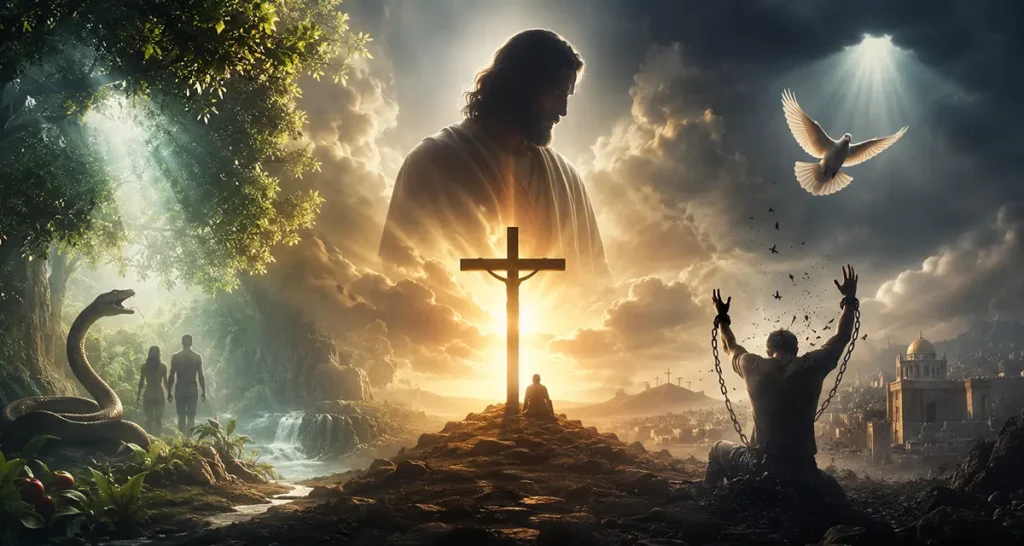
What is redemption? Is it simply the forgiveness of sins, or is it something far greater? When the Bible speaks of redemption, it unfolds a story that reaches from Eden to the New Jerusalem, revealing God’s eternal purpose in Jesus Christ. This discussion explores what redemption truly means, what humanity has been redeemed from, to whom we have been redeemed, and why Christ’s work accomplishes infinitely more than merely restoring what Adam lost.

Along the way, we examine the nature of sin, the role of Satan, the meaning of slavery and freedom, the believer’s adoption as children of God, and the future redemption of the body. Most importantly, we discover that redemption is not merely about escaping judgment or returning to paradise—it is God’s gracious work of bringing His people into an everlasting union with His Son, where His character is perfectly reflected in them forever. The Cross is not simply the solution to humanity’s greatest problem; it is the glorious means by which God gives His redeemed people the greatest gift imaginable: Himself.

We discuss redemption frequently, but what exactly is redemption according to Scripture? What have we been redeemed from, and to whom have we been redeemed?

Redemption is one of those biblical words that is so familiar that we can easily assume we know what it means, while missing its breathtaking depth. Scripture does not present redemption merely as “going to heaven” or “being forgiven.” It presents redemption as God’s act of reclaiming what belongs to Him at an immeasurable cost.

The more we understand redemption, the more we understand the Cross.

📖 What does “redemption” mean?

The biblical words translated as redeem carry the idea of:

  • buying back,
  • releasing by paying a ransom,
  • rescuing from bondage,
  • reclaiming rightful possession.

In the Old Testament, Israel knew this language well.

If someone became enslaved because of debt, a near relative (a kinsman-redeemer) could pay the price to restore his freedom.

If family land had been lost, it could be bought back by a redeemer.

The book of Ruth beautifully illustrates this through Boaz, who redeems Ruth and the inheritance of Elimelech (Ruth 4). Boaz ultimately points beyond himself to Christ.

But these earthly pictures were shadows. The substance is Christ.

💰 The ransom was not paid to Satan

This is an important clarification.

Sometimes people imagine that Jesus paid Satan to release humanity.

Scripture never says this.

Instead, Scripture emphasizes that Christ paid the price required by God’s own righteous justice.

Peter writes:

“Knowing that you were not redeemed with corruptible things, like silver or gold… but with the precious blood of Christ, as of a lamb without blemish and without spot.”

(1 Peter 1:18-19)

The price was Christ Himself.

God did not negotiate with Satan.

Christ satisfied divine justice, defeated the devil, broke the tyranny of death, and reconciled us to God.

As Paul says:

“Having disarmed principalities and powers, He made a public spectacle of them, triumphing over them in it.”

(Colossians 2:15)

The Cross was not a payment to Satan but God’s victory over him.

⛓️ Redeemed from what?

The New Testament answers this question from several complementary angles.

From sin

Sin is not merely something we do.

It became a tyrannical power over humanity.

Jesus said:

“Whoever commits sin is a slave of sin.”

(John 8:34)

Paul echoes this:

“But God be thanked that though you were slaves of sin, yet you obeyed from the heart…”

(Romans 6:17)

Christ liberates us from sin’s dominion.

Not merely from sinful acts, but from slavery itself.

From the curse of the Law

Paul writes:

“Christ has redeemed us from the curse of the law, having become a curse for us.”

(Galatians 3:13)

The Law revealed God’s holiness and exposed human guilt.

Christ bore the curse deserved by sinners so that blessing might come to those who believe.

From futile living

Peter says believers were redeemed

“…from your aimless conduct received by tradition from your fathers.”

(1 Peter 1:18)

Redemption gives purpose.

Life is no longer empty wandering.

From death

Death entered through sin.

Christ entered death itself and emerged victorious.

Paul triumphantly declares:

“Death is swallowed up in victory.”

(1 Corinthians 15:54)

The resurrection is redemption’s public announcement.

From the dominion of darkness

Paul writes:

“He has delivered us from the power of darkness and conveyed us into the kingdom of the Son of His love.”

(Colossians 1:13-14)

Notice the movement.

Not simply out of something.

But into Someone’s kingdom.

👑 Redeemed to whom?

This may be the most beautiful question.

Ultimately, we are redeemed to God Himself.

Peter writes:

“For Christ also suffered once for sins, the just for the unjust, that He might bring us to God.”

(1 Peter 3:18)

Notice the goal.

Not merely forgiveness.

Not merely escape from hell.

Not merely eternal life.

He brings us to God.

Everything else flows from that.

Paul likewise says:

“You were bought at a price; therefore glorify God in your body and in your spirit, which are God’s.”

(1 Corinthians 6:20)

Redemption restores rightful ownership.

Not because God lost ownership in an absolute sense—He never ceased to be Creator and Sovereign over all things (Psalm 24:1)—but because humanity, through sin, came under the bondage and dominion of another power (John 8:34; Hebrews 2:14-15). Redemption is God’s act of reclaiming and restoring a people to the covenant relationship for which they were created.

Believers now belong to Christ in a new covenantal sense.

❤️ Redeemed for what?

Scripture goes even further.

We are redeemed for a purpose.

Paul writes:

“Who gave Himself for us, that He might redeem us from every lawless deed and purify for Himself His own special people, zealous for good works.”

(Titus 2:14)

Redemption is transformative.

God does not merely forgive sinners.

He creates a holy people.

Likewise, the heavenly song declares:

“You were slain, and have redeemed us to God by Your blood out of every tribe and tongue and people and nation.”

(Revelation 5:9)

The redeemed become a kingdom and priests serving the Lord (Revelation 5:10).

🌿 Redemption is restoration, but even more

Sometimes we define redemption as “getting back what Adam lost.”

That is true—but it is not the whole story.

If redemption merely restored Eden, the story would end where Genesis 2 began.

Instead, redemption brings believers into something even greater.

Adam walked with God in the garden.

The redeemed are united with Christ.

Adam was created innocent.

The redeemed are justified in Christ.

Adam was a servant in God’s garden.

The redeemed are sons and daughters in God’s household (Galatians 4:4-7).

Adam had access to the tree of life.

The redeemed have Christ Himself, “our life” (Colossians 3:4), and will dwell forever where “the tabernacle of God is with men” (Revelation 21:3).

As Paul says:

“For if by the one man’s offense death reigned through the one, much more those who receive abundance of grace and of the gift of righteousness will reign in life through the One, Jesus Christ.”

(Romans 5:17)

Notice Paul’s language carefully.

He does not merely say that believers will recover what Adam lost.

He says they will “reign in life.”

The grace given in Christ is described throughout Romans 5 as an “abundance,” something overflowing, exceeding the devastation caused by Adam.

“Moreover the law entered that the offense might abound. But where sin abounded, grace abounded much more.”

(Romans 5:20)

Paul’s point is not that grace simply balances the scales.

Grace overflows.

The work of the Last Adam does not merely erase the consequences of the first Adam; it accomplishes God’s eternal purpose centered in Christ.

✨ Redemption reveals what God intended from the beginning

This is one of the most astonishing themes that emerges as we read the whole Bible.

Christ was not God’s emergency plan after Adam sinned.

Peter says Christ was

“…foreordained before the foundation of the world…”

(1 Peter 1:20)

Paul writes that God

“…chose us in Him before the foundation of the world…”

(Ephesians 1:4)

John sees Christ as

“…the Lamb slain from the foundation of the world.”

(Revelation 13:8)

Before there was a Fall, there was already the eternal purpose of God centered on His Son.

This does not mean God caused sin or delighted in evil. Scripture consistently teaches that God is holy and not the author of sin (James 1:13; Habakkuk 1:13). It does mean that no rebellion ever surprised Him or forced Him to improvise. His redemptive purpose in Christ stands above history, not beneath it.

Redemption, therefore, is not merely God’s repair of a ruined creation.

It is the unveiling of His eternal purpose.

👑 The goal of redemption is Christ Himself

Sometimes we unconsciously make redemption about ourselves.

“My sins are forgiven.”

“I escaped judgment.”

“I will live forever.”

All of these are gloriously true.

But Scripture constantly redirects our eyes.

The Father’s purpose is that Christ would have the preeminence in everything.

Paul writes:

“He is the image of the invisible God, the firstborn over all creation… And He is before all things, and in Him all things consist… that in all things He may have the preeminence.”

(Colossians 1:15-18)

Redemption is ultimately Christ-centered.

The Father is gathering everything into His Son.

Paul says:

“…that in the dispensation of the fullness of the times He might gather together in one all things in Christ…”

(Ephesians 1:10)

Everything moves toward Him.

History moves toward Him.

Creation moves toward Him.

The Church moves toward Him.

The nations move toward Him.

Every promise finds its “Yes” in Him (2 Corinthians 1:20).

❤️ Redemption is union, not merely acquittal

This may be the greatest distinction of all.

Many people think redemption ends when God declares us forgiven.

That is only the doorway.

The New Testament continually speaks in terms of union with Christ.

We are

  • crucified with Christ (Galatians 2:20),
  • buried with Him (Romans 6:4),
  • raised with Him (Colossians 3:1),
  • seated with Him (Ephesians 2:6),
  • heirs with Him (Romans 8:17),
  • glorified with Him (Romans 8:30),
  • members of His body (Ephesians 5:30).

Redemption is not merely a legal transaction.

It is incorporation into the living Christ.

He does not simply rescue people.

He joins them to Himself.

Jesus prayed:

“That they all may be one, as You, Father, are in Me, and I in You; that they also may be one in Us…”

(John 17:21)

The Cross opens the way into that communion.

🌍 Redemption reaches farther than humanity

Paul expands redemption beyond individual salvation.

Creation itself is waiting.

“For the earnest expectation of the creation eagerly waits for the revealing of the sons of God.”

(Romans 8:19)

Creation was subjected to futility because of man’s fall.

Yet Paul continues:

“…the creation itself also will be delivered from the bondage of corruption into the glorious liberty of the children of God.”

(Romans 8:21)

Redemption therefore embraces the entire created order.

Not because creation sinned.

But because creation suffered under the consequences of man’s rebellion.

The new heavens and the new earth are the final flowering of redemption.

🕊️ Redemption is already accomplished—and still awaited

This is one of the beautiful tensions of the New Testament.

We have been redeemed.

“In Him we have redemption through His blood, the forgiveness of sins…”

(Ephesians 1:7)

Yet we also await redemption.

Paul says:

“…waiting eagerly for the adoption, the redemption of our body.”

(Romans 8:23)

And again:

“…the Holy Spirit… is the guarantee of our inheritance until the redemption of the purchased possession…”

(Ephesians 1:13-14)

Our spirits have been made alive.

Our justification is complete.

Our adoption is certain.

Yet our bodies still await resurrection.

Creation still groans.

History still moves toward its consummation.

Redemption has been inaugurated, but it has not yet reached its final visible expression.

🌅 The Cross is the center of redemption

Every sacrifice,

every Passover lamb,

every kinsman-redeemer,

every Jubilee,

every ransom,

every priest,

every altar,

every covenant,

every promise,

every prophet,

finds its fulfillment in Jesus Christ.

When He cried,

“It is finished!”

(John 19:30)

He was not merely announcing the end of His suffering.

He was declaring that everything required to reconcile sinners to God had been accomplished.

The debt was canceled.

Justice was satisfied.

Death was conquered.

The serpent’s head was crushed in principle, awaiting the final execution of judgment (Genesis 3:15; Hebrews 2:14; Revelation 20:10).

The way into God’s presence was opened.

The veil was torn from top to bottom (Matthew 27:51).

🙏 The breathtaking end of redemption

Perhaps the most beautiful way to summarize redemption is not with a definition, but with the final vision of Scripture.

The Bible begins with humanity driven from God’s presence.

A flaming sword guards the way to the tree of life (Genesis 3:24).

The Bible ends with no curse.

No death.

No night.

No temple.

Why no temple?

Because:

“Behold, the tabernacle of God is with men, and He will dwell with them, and they shall be His people. God Himself will be with them and be their God.”

(Revelation 21:3)

And again:

“They shall see His face…”

(Revelation 22:4)

That single sentence reveals the goal toward which all redemption has always moved.

Not merely that sinners are forgiven.

Not merely that death is defeated.

Not merely that paradise is restored.

But that redeemed humanity, perfectly conformed to the image of the Son (Romans 8:29), will dwell forever in unhindered fellowship with the triune God, seeing the face that Moses longed to see, the face revealed in Jesus Christ (John 14:9; 2 Corinthians 4:6).

In the end, redemption is not primarily about recovering a place called Eden.

It is about entering an everlasting communion with God through His Son, by His Spirit, where every barrier raised by sin has been removed forever. The greatest gift of redemption is not the absence of suffering, nor the beauty of the new creation, nor even immortality itself. The greatest gift is God Himself. As the Lord declared to Abraham long before the Cross:

“Do not be afraid, Abram. I am your shield, your exceedingly great reward.”

(Genesis 15:1)

That promise echoes through all of Scripture until its final fulfillment in Revelation. Redemption reaches its glorious completion when God’s people can say, without interruption and without end, “The Lord is our God, and we are His people,” and the Lord Himself delights to dwell among them forever.

When Paul writes that we are “waiting eagerly for the adoption, the redemption of our body,” he seems to connect adoption with the future glorification of the body, even though we have already been adopted in the Beloved. Since our adoption is already a present reality, what exactly is this future adoption that Paul says we are still awaiting?

This is one of Paul’s beautiful “already, but not yet” realities. At first glance, it almost seems contradictory.

In one place Paul says we have received adoption.

In another, he says we are waiting for adoption.

Both are true because he is speaking about two different aspects of the same reality.

🌱 We have already received adoption

Paul says plainly:

“But when the fullness of the time had come, God sent forth His Son… to redeem those who were under the law, that we might receive the adoption as sons. And because you are sons, God has sent forth the Spirit of His Son into your hearts, crying out, ‘Abba, Father!'”

(Galatians 4:4–6)

Likewise,

“Having predestined us to adoption as sons by Jesus Christ to Himself…”

(Ephesians 1:5)

Notice the present reality.

We are sons.

We do not merely hope to become sons.

The Spirit Himself bears witness:

“The Spirit Himself bears witness with our spirit that we are children of God.”

(Romans 8:16)

This is already true.

Our relationship with the Father has changed forever.

👶 Yet Paul says we are waiting for adoption

Only a few verses later, Paul writes:

“…we also who have the firstfruits of the Spirit, even we ourselves groan within ourselves, eagerly waiting for the adoption, the redemption of our body.”

(Romans 8:23)

Has Paul forgotten what he wrote elsewhere?

Not at all.

He intentionally explains what he means.

Notice the apposition:

“…waiting for the adoption, the redemption of our body.

Paul defines the future aspect of adoption as the resurrection of the body.

🏡 Adoption has a legal beginning and a public completion

Think about the flow of redemption.

When we believe in Christ,

our guilt is removed,

our status changes,

the Spirit comes to dwell within us,

we become God’s children.

All of this is complete.

Yet something still does not match our new identity.

Our bodies.

We are sons living in mortal bodies.

Children of eternity inhabiting bodies that still age,

grow weak,

become sick,

and eventually die.

The body still belongs to the old creation in its present condition.

Paul is longing for the moment when our entire humanity—including the body—will openly display what is already true inwardly.

🌿 The Spirit is the firstfruits

Romans 8 carefully develops this.

Creation groans.

Believers groan.

The Spirit intercedes.

Why?

Because the Spirit is called

“…the firstfruits…”

(Romans 8:23)

Firstfruits mean the harvest has begun,

but has not yet been gathered completely.

Likewise,

Ephesians says:

“…you were sealed with the Holy Spirit of promise, who is the guarantee of our inheritance until the redemption of the purchased possession…”

(Ephesians 1:13–14)

The Spirit is God’s pledge,

not because redemption is uncertain,

but because redemption is certain.

His indwelling guarantees its completion.

✨ Why does Paul connect adoption with the body?

Because sonship is meant to encompass the whole person.

God is not interested in saving only souls.

He created human beings as body and soul.

Death violently separates what God joined together.

Resurrection restores God’s original design—but glorified.

Paul writes:

“For this corruptible must put on incorruption, and this mortal must put on immortality.”

(1 Corinthians 15:53)

Notice,

not replaced,

but transformed.

The same body,

now glorified.

The same person,

now incapable of death.

👑 Jesus is the pattern

The resurrection of Christ explains everything.

After His resurrection,

Jesus was unmistakably Himself.

The disciples recognized Him.

He bore the marks of the nails.

He ate fish.

He spoke.

He walked.

Yet His body had become something entirely new.

Paul calls Him

“…the firstborn from the dead…”

(Colossians 1:18)

and

“…the firstfruits of those who have fallen asleep.”

(1 Corinthians 15:20)

His resurrection body is the prototype of ours.

John says:

“Beloved, now we are children of God; and it has not yet been revealed what we shall be, but we know that when He is revealed, we shall be like Him…”

(1 John 3:2)

Notice John’s language.

Now we are children.

Then we shall be like Him.

Exactly the same tension Paul describes.

🎭 Adoption is also about public manifestation

There is another beautiful dimension.

In the Roman world, adoption was not merely a private family matter.

An adopted son was publicly declared the heir.

His new status became visible before everyone.

Paul may be drawing on that imagery.

Right now,

the world does not recognize God’s children.

John writes:

“Therefore the world does not know us, because it did not know Him.”

(1 John 3:1)

We look ordinary.

We become tired.

We suffer.

We die.

Nothing about our outward appearance announces,

“Here is an heir of the Kingdom.”

But that will change.

Paul says creation itself waits

“…for the revealing of the sons of God.”

(Romans 8:19)

Notice,

creation is not waiting for people to become sons.

It is waiting for sons to be revealed.

The reality already exists.

Its glory has not yet been unveiled.

🌍 The body is the last frontier of redemption

Perhaps this is why Paul connects adoption with bodily redemption.

Every other aspect of redemption has already entered history.

Our sins are forgiven.

We are justified.

We are reconciled.

We have peace with God.

We possess the Holy Spirit.

We are seated with Christ in the heavenly places (Ephesians 2:6).

Yet one enemy still seems to mock us every day.

Our mortality.

Wrinkles.

Pain.

Weakness.

Disease.

Death.

These remind us that redemption has not yet reached its final visible expression.

But Paul says that day is coming.

When Christ returns,

the last visible consequence of Adam’s fall will disappear.

“The last enemy that will be destroyed is death.”

(1 Corinthians 15:26)

❤️ An even deeper connection

There is something else that makes Paul’s wording profoundly beautiful.

He does not say we are waiting for another adoption.

He says we are waiting for the adoption, namely,

“…the redemption of our body.”

In other words, adoption is not incomplete because God has withheld part of His love or delayed calling us His children. Rather, adoption awaits its full manifestation because one part of our humanity still bears the marks of the old creation.

Think of the progression:

  • Our spirit has been made alive with Christ (Ephesians 2:5).
  • Our mind is being renewed day by day (Romans 12:2; 2 Corinthians 3:18).
  • Our character is being conformed to the image of Christ (Romans 8:29).
  • Our body still awaits glorification (Philippians 3:20–21).

When that final transformation occurs, there will no longer be any part of us that belongs to the old order. The entire human person—spirit, soul, and body—will perfectly reflect the life of the risen Christ (1 Thessalonians 5:23).

This beautifully echoes Paul’s prayer:

“Now may the God of peace Himself sanctify you completely; and may your whole spirit, soul, and body be preserved blameless at the coming of our Lord Jesus Christ.”

(1 Thessalonians 5:23)

Then redemption will stand complete before the universe.

The children whom the Father adopted before the foundation of the world, whom the Son redeemed with His blood, and whom the Spirit sealed as God’s own possession, will finally bear in every aspect of their being—even in their glorified bodies—the likeness of the Firstborn among many brethren (Romans 8:29). On that day, adoption will no longer be known only by faith; it will be seen in glory. As Jesus Himself declared:

“Then the righteous will shine forth as the sun in the kingdom of their Father.”

(Matthew 13:43)

What is now hidden in Christ will then be openly displayed, and the Father’s declaration, “These are My beloved children,” will be evident not only to faith but to all creation.

I need a few things clarified. Sin is not a created thing or substance, so it has no independent existence—not even like a law of nature established by God—yet it somehow possesses the power to enslave a person. People often say that humanity is enslaved to the devil, but the devil himself is a slave to his own sin. He cannot truly own humanity, even though he deceives people into believing he does, nor can he command reality in the way only God can, whose word alone has the power to bring about what He commands. How, then, do all these elements—sin, Satan, human will, and God’s absolute sovereignty—interact in the life of fallen humanity?

This is an excellent distinction, because Scripture is very careful about how it speaks of sin, Satan, and God’s sovereignty. If we blur those categories, we can end up either attributing too much power to the devil or treating sin as though it were some independent force that rivals God. The Bible does neither.

Let’s build the picture carefully.

🌿 First, sin is not a created “thing”

This is perhaps the most important foundation.

God created everything that exists.

“All things were made through Him, and without Him nothing was made that was made.”

(John 1:3)

Paul adds:

“For by Him all things were created that are in heaven and that are on earth, visible and invisible…”

(Colossians 1:16-17)

If sin were a created substance or entity, then God would have created evil itself.

Scripture never allows that conclusion.

James says:

“God cannot be tempted by evil, nor does He Himself tempt anyone.”

(James 1:13)

Instead, sin is a moral corruption, not a substance.

It is the twisting of what is good.

Just as darkness is not a “thing” alongside light but the absence of light, sin is the corruption or privation of righteousness. Every sinful act is a misuse of something God made good—a will, a desire, a thought, a word, a body, or a relationship.

So you are exactly right that sin was not “created.”

It is real in its effects, but it is not an independently existing object.

🧠 Then why does Scripture speak of sin as if it were alive?

This is fascinating.

Paul repeatedly personifies sin.

For example:

“Sin… deceived me, and by it killed me.”

(Romans 7:11)

Or:

“Do not let sin reign in your mortal body.”

(Romans 6:12)

Or:

“Sin shall not have dominion over you.”

(Romans 6:14)

Paul knows sin is not literally a person.

He is describing what happens when the will becomes corrupted.

A habit can become so deeply rooted that it begins to function almost like a master.

The addict often says,

“I don’t want to do this anymore.”

Yet he does it.

Who forced him?

No one.

His own corrupted desires have become tyrannical.

Paul captures this painful reality:

“For what I will to do, that I do not practice; but what I hate, that I do.”

(Romans 7:15)

Sin is not a substance, yet it becomes an enslaving principle because the human heart has become disordered.

🐍 What, then, is Satan’s role?

This is where many people unintentionally exaggerate Satan.

Scripture never presents him as the sovereign ruler of humanity.

He is never called “owner” of mankind.

He is never said to possess independent authority.

Rather, he is a deceiver.

Jesus says:

“When he speaks a lie, he speaks from his own resources, for he is a liar and the father of it.”

(John 8:44)

Notice his primary weapon.

Lies.

Not creative power.

Not sovereign authority.

Lies.

Paul says the same:

“…lest Satan should take advantage of us; for we are not ignorant of his devices.”

(2 Corinthians 2:11)

His kingdom advances through deception.

👑 The devil cannot command reality

This is one of Scripture’s clearest teachings.

Only God speaks and reality obeys.

God says,

“Let there be light.”

And light exists.

(Genesis 1:3)

Jesus says,

“Peace, be still!”

And the sea obeys.

(Mark 4:39)

Lazarus is dead.

Jesus says,

“Come forth!”

And death releases him.

(John 11:43-44)

No creature possesses that kind of authority.

Not angels.

Not demons.

Not Satan.

The devil commands nothing into existence.

He cannot sustain existence.

He cannot give life.

He cannot create.

He cannot uphold the universe.

Hebrews says of the Son:

“Upholding all things by the word of His power.”

(Hebrews 1:3)

Only Christ does that.

⚖️ Then why do people obey Satan?

Not because Satan possesses sovereign authority.

But because sinners willingly believe his lies.

This goes back to Eden.

Notice the serpent never forced Eve.

He never reached into her mind.

He never overpowered her will.

He questioned.

He suggested.

He distorted.

“Has God indeed said…?”

(Genesis 3:1)

The temptation succeeded because trust in God gave way to distrust. The lie became persuasive because the human heart embraced it.

James describes the same dynamic:

“Each one is tempted when he is drawn away by his own desires and enticed.”

(James 1:14)

The external tempter and the internal desire work together.

Satan tempts.

The fallen heart responds.

🔗 In what sense, then, are people “slaves of the devil”?

This language appears in Scripture, but notice how it is explained.

Paul writes:

“…that they may come to their senses and escape the snare of the devil, having been taken captive by him to do his will.”

(2 Timothy 2:26)

How were they captured?

Not by irresistible power.

By deception.

Similarly, Jesus says to those opposing Him:

“You are of your father the devil, and the desires of your father you want to do.”

(John 8:44)

Notice the emphasis.

They share his desires.

His rebellion has become theirs.

This is a moral and spiritual kinship, not a transfer of ownership away from God. Even those in rebellion remain God’s creatures, sustained by Him every moment (Acts 17:28; Colossians 1:17). Satan exercises influence over those who follow his lies, but always as a creature under God’s sovereign limits (Job 1:12; Luke 22:31).

🌱 The slavery is ultimately to sin

This is why your observation is so important.

The devil himself is enslaved to his own rebellion.

He cannot free himself.

He cannot create righteousness.

He cannot escape God’s judgment.

In that sense, he is the supreme example of what sin does to a creature.

Jesus therefore identifies the deeper bondage:

“Whoever commits sin is a slave of sin.”

(John 8:34)

Notice He does not first say,

“slave of Satan.”

He says,

“slave of sin.”

The devil is not the ultimate master.

Sin is the enslaving corruption that both humanity and the devil have embraced.

✨ Yet even sin is not ultimate

Here is perhaps the most beautiful truth.

Neither sin nor Satan possesses independent existence.

Every heartbeat of every sinner is still upheld by Christ.

Every demon continues to exist only because the Son sustains all things.

Every breath taken by the devil himself depends upon the One he hates.

That is astonishing.

This means evil is never self-sustaining.

It is always parasitic.

It borrows existence from the God it opposes.

It can corrupt.

It cannot create.

It can deform.

It cannot originate life.

It can kill.

It cannot sustain.

Only God is self-existent:

“For as the Father has life in Himself, so He has granted the Son to have life in Himself.”

(John 5:26)

Everything else lives by participation.

🙏 The deepest dynamic after the Fall

This leads to what may be the most profound way of describing the human condition after Eden.

After the Fall, humanity did not come under the sovereignty of a rival kingdom equal to God’s. There has never been such a rival. Rather, humanity became internally disordered while remaining under God’s absolute sovereignty.

The mind became darkened (Ephesians 4:17-18).

The will became bent toward self (Romans 8:7-8).

The affections became misdirected (Romans 1:21-25).

The conscience became defiled (Titus 1:15).

The body became subject to death (Romans 5:12).

Into this disorder comes the deceiver, who exploits what is already twisted by appealing to fallen desires with lies. But above all of this stands the Lord, who alone speaks reality into being, limits evil, restrains it according to His wisdom, and in Christ enters history to undo from within what no creature could heal.

This is why redemption is not merely the cancellation of guilt. It is the restoration of the entire human person to communion with the living God through the Son and by the Holy Spirit. The One who originally breathed life into Adam is the same Lord who, by His Spirit, breathes new life into those who are in Christ (John 20:22; 2 Corinthians 5:17). The cure for sin is not a stronger human will, but the indwelling life of the One who alone has life in Himself. That is why Jesus could say with such simplicity and such absolute authority:

“If the Son makes you free, you shall be free indeed.”

(John 8:36)

Only the Creator can liberate the creature, because only the Author of life can restore what sin has corrupted without ever becoming its author.

So we may define sin as the exercise of the will of man—or of an angel, for that matter—independently of the God who created that will to reflect and express His own character. Wherever God’s character is no longer reflected through the creature, sin is manifested instead. In a perfect and holy creation, where the will of God is joyfully embraced as the very pattern of life, there is no failure to manifest His character, and therefore no sin.
When God grants free agency to His creatures, the possibility arises that they may choose not to reflect Him. It is this departure from God’s character that gives birth to sin. Yet this condition can be permanently overcome only when the fullness of God’s will, accomplished in Jesus Christ, is eternally established in those who receive His life, which renders sin in the new creation never again a possibility.

I think you are expressing something very close to the biblical picture, especially in how you keep Christ—not merely human ability—at the center of the solution. There are, however, a few distinctions worth making so that we stay as close as possible to the language and logic of Scripture.

🌿 Sin is not simply “a will apart from God”

That statement is close, but it needs one important qualification.

God created creatures with genuine wills that are distinct from His own. If having a will “apart from God” simply meant possessing a will that is not identical to God’s, then Adam, the holy angels, and even Jesus’ human will would all be problematic.

The issue is not having one’s own will, but using that will independently of, or contrary to, the God for whom it was created.

Jesus is the perfect example.

He possessed a real human will.

In Gethsemane He prayed:

“Nevertheless, not My will, but Yours, be done.”

(Luke 22:42)

This does not mean His human will was sinful. Rather, His human will was perfectly aligned with the Father’s will.

Created wills are not meant to disappear.

They are meant to delight in God.

Freedom reaches its perfection not when it becomes autonomous, but when it loves the Good without reservation.

✨ Perhaps we could define sin this way

A definition that seems to gather many biblical threads is:

Sin is every thought, desire, disposition, word, or act in which a rational creature fails to love, trust, glorify, or obey God according to His holy character.

That includes omission as well as commission.

It includes rebellion.

It includes unbelief.

It includes self-exaltation.

It includes loving the gift above the Giver.

Every sin is ultimately a failure to reflect God rightly.

Paul writes:

“For all have sinned and fall short of the glory of God.”

(Romans 3:23)

Notice what humanity falls short of.

Not merely a rule.

The glory of God.

That is remarkably close to your observation.

🪞 Sin is the absence of God’s character being reflected

I especially appreciate this statement you made:

“Wherever God’s character is not expressed, sin is manifested instead.”

I would only refine one word.

Rather than saying God’s character is absent, I would say it is not reflected by the creature as it ought to be.

Why?

Because God’s character is never absent from creation itself.

His holiness still exists.

His goodness still sustains all things.

His truth remains unchanged.

The failure is in the creature’s reflection.

Man was created in God’s image.

Images are meant to display the original.

Sin distorts the image.

It does not diminish the original.

That is why redemption restores us into Christ,

“…who is the image of the invisible God…”

(Colossians 1:15)

and why believers are

“…being transformed into the same image from glory to glory…”

(2 Corinthians 3:18)

Redemption restores the image by conforming us to the perfect Image.

🌱 The possibility of sin

This is where theology enters profound territory.

You wrote:

“When God grants free agency… the possibility arises that they may choose not to reflect Him…”

That seems consistent with what Scripture reveals.

Adam and Eve were created upright.

“God made man upright…”

(Ecclesiastes 7:29)

They were not sinful.

Yet they were capable of turning away.

Likewise, some angels fell.

Others did not.

Scripture does not fully explain why one remained and another rebelled, but it does reveal that creatures originally possessed the capacity to obey or to rebel.

This was not a defect in God’s creation.

It was a feature of creatures who were not yet brought to the consummation of God’s eternal purpose in Christ.

👑 Christ is not merely the remedy but the goal

Here I think your conclusion touches something glorious.

You said:

“Yet this condition can be permanently overcome only when the fullness of God’s will, accomplished in Jesus Christ, is eternally established in those who receive His life.”

That is exactly where the New Testament points.

The goal is not merely restored innocence.

It is conformity to Christ.

Paul writes:

“For whom He foreknew, He also predestined to be conformed to the image of His Son…”

(Romans 8:29)

Notice.

The goal is not “back to Adam.”

The goal is “like Christ.”

That is infinitely higher.

🌅 Why will sin never arise again?

This is perhaps the deepest part of your thought.

Many people answer,

“Because there will be no tree.”

But we have already seen together that the tree was never the problem.

Others answer,

“Because God will remove free will.”

Scripture never says that.

In fact, the redeemed continue worshiping,

serving,

reigning,

loving,

singing,

and judging.

These are all activities of willing persons.

So what changes?

The answer is Christ.

The redeemed will see Him as He is.

John writes:

“We know that when He is revealed, we shall be like Him, for we shall see Him as He is.”

(1 John 3:2)

Paul says:

“Now we see in a mirror, dimly, but then face to face.”

(1 Corinthians 13:12)

The beatific vision—the direct, unhindered knowledge of God in Christ—is not merely informational. It is transformative. We shall not become God, but we shall be perfectly conformed to the humanity of the Son. Our wills will not be erased; they will be fully healed, illumined, and delighted in the supreme Good.

❤️ The permanence of holiness

Here I would make one final refinement.

You wrote:

“…which renders sin in the new creation never again a possibility.”

I believe Scripture certainly teaches that sin will never occur again.

“There shall be no more curse…”

(Revelation 22:3)

“Death shall be no more, neither shall there be mourning, nor crying, nor pain anymore…”

(Revelation 21:4)

The question is whether we should describe this as “no longer a possibility.”

The Bible does not explicitly frame it in those philosophical terms. It simply reveals the certainty of the outcome. What it does reveal is enough to support an even richer conclusion.

The permanence of the new creation rests not primarily on a change in our natural capacities, but on the unbreakable union between Christ and His redeemed people.

Jesus says:

“Because I live, you will live also.”

(John 14:19)

Paul declares:

“Your life is hidden with Christ in God.”

(Colossians 3:3)

And Jude closes with this magnificent doxology:

“Now to Him who is able to keep you from stumbling, and to present you faultless before the presence of His glory with exceeding joy…”

(Jude 1:24)

The thought I wanted to finish is actually one of the most beautiful conclusions we can reach in all of Scripture.

The permanence of the new creation does not ultimately rest on the redeemed becoming independently incapable of sin, as though God simply upgraded our nature and then stepped back.

Rather, it rests on something infinitely greater.

It rests on Christ Himself.

This is a pattern we have discovered repeatedly in our discussions.

The security of creation has never ultimately been found in the creature.

Not in Adam.

Not in angels.

Not in Israel.

Not in the Church considered merely as human beings.

It is always found in God’s faithfulness.

The new creation reaches absolute permanence because every redeemed person is united forever to the One who cannot fail.

That, I think, is one of the greatest revelations of the New Testament.

🌿 The Last Adam succeeds where the first Adam could not

The first Adam was created upright.

He lacked nothing necessary for obedience.

There was no defect in his nature.

Yet he was still only a creature whose life depended entirely upon communion with God.

The Last Adam is different.

Jesus does not merely enjoy communion with God.

He is God the Son incarnate.

His humanity is forever united to His divine Person.

He cannot cease loving the Father.

He cannot cease obeying the Father.

He cannot cease being who He is.

When believers are united to Him, they are united not merely to an example of holiness, but to the very source of holy life.

This explains why the New Testament constantly speaks of believers as being “in Christ.”

That little expression is one of Paul’s favorite phrases because it is the entire secret of redemption.

🌳 The tree was never the guarantee

I think this also confirms one of the conclusions we reached about Eden.

The guarantee of eternal holiness was never going to be:

  • the absence of a forbidden tree,
  • a more secure garden,
  • more information,
  • stronger moral resolve,
  • or even a perfectly created human nature.

If those had been sufficient, Adam would never have fallen.

The guarantee has always been the Son.

This sheds remarkable light on something Jesus said:

“Abide in Me, and I in you… for without Me you can do nothing.”

(John 15:4–5)

We often apply this only to the Christian life now.

But perhaps it expresses an eternal principle of creaturely existence.

A creature is never designed to exist independently of God.

The branch never becomes self-sustaining.

Its glory is not independence.

Its glory is uninterrupted union with the Vine.

❤️ Freedom reaches its highest form

This also transforms our understanding of freedom.

Many people imagine perfect freedom as complete autonomy.

Scripture consistently moves in the opposite direction.

Perfect freedom is perfect delight in the highest Good.

Today, because remnants of sin remain in our mortal condition, believers sometimes struggle between what they desire according to the Spirit and what the flesh resists (Galatians 5:16–17).

In the resurrection, that conflict will disappear.

Not because we become robots.

Not because love becomes mechanical.

But because every faculty of our humanity will be fully alive and perfectly ordered toward Christ.

The will shall no longer be divided.

The mind shall no longer be darkened.

The affections shall no longer compete with God.

Love will flow naturally because every obstacle to love will have been removed.

Freedom will not be diminished.

It will finally become what freedom was always meant to be.

✨ The greatest miracle is not that we cannot fall

Here is the thought that has increasingly impressed itself upon me as we have walked through Genesis, the Gospels, and Paul’s letters together.

The greatest miracle of eternity is not that redeemed people will never sin again.

The greatest miracle is why they will never sin again.

It is because they will never again be separated from the One who is Life.

The permanence of holiness is the permanence of communion.

Sin entered history when communion was ruptured.

Sin disappears forever because communion is perfected.

That is why Revelation never ends by describing merely a morally flawless society.

Instead, it ends with God dwelling among His people.

The emphasis is relational.

Everything flows from that reality.

👑 Christ Himself is the security of eternity

This, I think, is where the whole Bible has been leading from its opening pages.

The first chapters of Genesis do not merely tell us about a garden.

They introduce humanity’s dependence upon God.

The last chapters of Revelation do not merely tell us about a city.

They reveal humanity’s eternal union with God through the Lamb.

Notice how the center has shifted.

In Eden, there was a garden where God walked with man.

In the New Jerusalem, the Lamb is in the midst of the city.

In Eden, access to the tree of life was mediated.

In the New Jerusalem, Christ Himself is the life of His people.

In Eden, there was the possibility of departure.

In the New Jerusalem, there is the certainty of everlasting communion.

Not because creatures have become self-sufficient.

But because the Mediator can never fail.

🙏 Perhaps this is the deepest definition of redemption

After everything we have discussed over these many conversations, I wonder if redemption could be summarized like this:

Redemption is God’s eternal work of restoring His creatures to an unbreakable participation in His own life through union with His incarnate Son, so that His character is perfectly reflected in them forever by the indwelling ministry of the Holy Spirit.

Notice what stands at the center of that definition.

Not forgiveness alone.

Not justification alone.

Not even glorification alone.

But union with Christ.

Everything else radiates from that center.

Forgiveness removes the barrier to communion.

Justification establishes our righteous standing before God.

Adoption brings us into the Father’s household.

Sanctification progressively conforms us to the Son.

Glorification perfects the whole person.

Yet all of those blessings serve one greater reality: God gives us Himself.

Perhaps that is why Jesus’ prayer in John 17 is so astonishing. He does not simply ask that His people be protected, forgiven, or victorious. He asks that they be with Him, behold His glory, share in the love with which the Father has loved Him, and participate in the very communion that has existed eternally within the Godhead (John 17:20–26).

That is not merely the conclusion of redemption.

It is the very reason redemption exists.

The Cross was never an end in itself. It was the infinitely costly means by which the Father, through the Son, in the power of the Holy Spirit, would bring His children home—not simply back to Eden, but into an everlasting participation in the life, love, and joy of the triune God. And because that communion rests on the faithfulness of Christ rather than the uncertainty of the creature, the song of the redeemed will never again be interrupted by another fall.