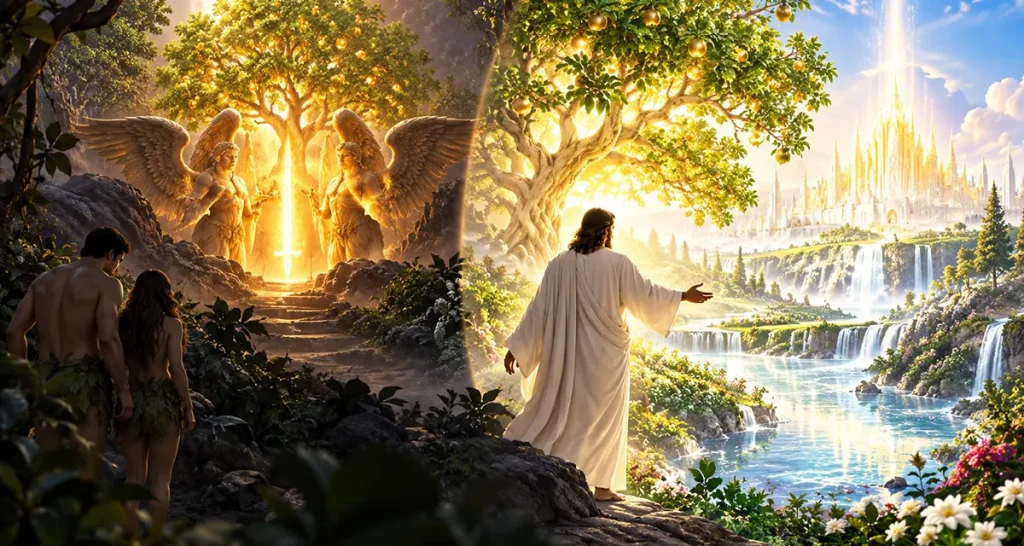
Opens in a new tab

Justice | Mercy | Faith

Justice | Mercy | Faith

The Tree of Life: From Eden’s Guarded Way to Eternal Life in Christ

Difficulty Level: Intermediate-Advanced

Jump to Answers

  1. The cherubim guarded the way to the tree of life in Eden, but Jesus declares that He Himself is “the way” and “the life.” If Jesus is the true source of life and neither can nor needs to be protected, what was the meaning of guarding the way to the tree of life?
  2. Regarding Genesis 3:22, a tree or its fruit cannot be the independent source of life, much less everlasting life. Any life received through a created thing would still remain entirely under God’s authority and could be ended by Him. Yet these are God’s own words: He says that man might “take also of the tree of life, and eat, and live forever.” So what is the real meaning of His statement?
  3. If “the gifts and the calling of God are irrevocable,” and this reflects the deeper principle of God’s faithfulness to what He gives and promises, how could He later forbid Adam from eating the fruit of a tree to which He had already granted access? God does not lie, and everything He truly promises He accomplishes. So what changed after the fall?
  4. Why do the nations need “healing” in Revelation 22:2 if God, through Christ, has already granted eternal life to His children and the New Creation has no more curse, death, sorrow, crying, or pain—and consequently no sickness, illness, or condition requiring treatment? 
  5. What you said is amazing. Even in the New Creation, where we have already been granted eternal life without any threat of interruption—life whose very qualification is that it has no end—our life, though eternally permanent, never ceases to be a gift. Sorry for the redundancy.
  6. And the Giver is Himself the source of eternity, so there can never be a glitch, exhaustion of power, unforeseen failure, or outside intruder capable of meddling with the continuity of life for the redeemed. 

The Tree of Life: From Eden’s Guarded Way to Eternal Life in Christ

Biblical Themes | End Times (Eschatology) | God & His Attributes | Jesus Christ (Christology) | Salvation (Soteriology)

The tree of life appears at both the beginning and the end of Scripture, yet its significance raises profound questions about God’s sovereignty, faithfulness, and the gift of eternal life. Why did God station cherubim to guard the way to the tree of life in Eden if Jesus Himself is the way and the life? Could the fruit of a created tree truly grant everlasting life? And if God’s gifts are irrevocable, why was Adam forbidden access to something God had already given?

These questions lead us from humanity’s expulsion from Eden to the New Creation, where the tree of life reappears and its leaves are for the healing of the nations, even though death, suffering, and the curse have passed away. Through this discussion, we explore the distinction between the gift of life and its divine Giver, the relationship between God’s judgment and His unchanging promises, and the extraordinary security of the redeemed. For even when eternal life has become an everlasting possession, it never ceases to be a gift. Its permanence rests not in any created thing, but in the eternal God whose power cannot diminish, whose faithfulness cannot fail, and whose children can never be separated from His love in Christ.

The cherubim guarded the way to the tree of life in Eden, but Jesus declares that He Himself is “the way” and “the life.” If Jesus is the true source of life and neither can nor needs to be protected, what was the meaning of guarding the way to the tree of life?

There is something fascinating about your observation, especially when we consider that the cherubim were not guarding the tree of life against an enemy who might destroy it. They were guarding the way to the tree of life against humanity, which had just fallen into sin.

And then Jesus comes and declares:

“I am the way, the truth, and the life. No one comes to the Father except through Me.” (John 14:6)

That creates a remarkable contrast. In Eden, the way to life is guarded against man. In Christ, the way to life is opened for man.

But your question goes deeper: If Jesus is Himself the life, and He cannot be threatened or diminished, what exactly needed protection in Eden?

I think we need to distinguish between protecting life itself and protecting access to life. And when we do, something extraordinary emerges about God’s judgment, mercy, and the work of Christ.

🌳 1. The cherubim were not protecting God or His life

Let’s begin with what Genesis actually says:

“So He drove out the man; and He placed cherubim at the east of the garden of Eden, and a flaming sword which turned every way, to guard the way to the tree of life.” (Genesis 3:24)

Notice the precision of the language.

God did not say that the cherubim were to protect the tree from destruction. He specifically appointed them to guard the way to the tree.

Why?

The preceding verse supplies the reason:

“Then the LORD God said, ‘Behold, the man has become like one of Us, to know good and evil. And now, lest he put out his hand and take also of the tree of life, and eat, and live forever’” (Genesis 3:22).

The danger was not that Adam might destroy the tree. The concern was that Adam might eat from it and live forever.

And here we encounter a profound distinction.

The tree of life was not vulnerable to man; man was in a condition in which access to the tree had to be forbidden.

God was not protecting His own existence. He was regulating humanity’s access to something that He had originally made available.

The tree was not the source of God’s life. God is eternally self-existent (Exodus 3:14; Psalm 90:2). The tree was a created provision through which God had chosen to associate life with humanity.

Jesus, however, is not a created provision of life. He is life Himself.

John writes:

“In Him was life, and the life was the light of men.” (John 1:4)

And Jesus says:

“For as the Father has life in Himself, so He has granted the Son to have life in Himself.” (John 5:26)

The distinction is immense.

The tree could give life only according to God’s appointed purpose. Christ possesses life in Himself.

No cherubim could protect Christ’s life because His life is not something that can be taken from Him against His will (John 10:17–18).

🔥 2. Was the prohibition actually an act of mercy?

This is where the account becomes particularly interesting.

We ordinarily think of Adam’s expulsion as punishment, and rightly so. Genesis 3 presents it as a consequence of disobedience.

But what would have happened if fallen Adam had eaten from the tree of life?

Genesis says he would have lived forever.

Now, Scripture does not explain all the implications of that possibility. We should therefore be careful not to claim that eating the fruit would necessarily have made redemption impossible. Genesis does not say that.

Nevertheless, consider the condition in which Adam now existed.

He had sinned. He had become alienated from God. He had introduced death into the human experience (Romans 5:12).

And God prevented him from taking hold of the tree of life in that condition.

This suggests that the exclusion was not merely punitive. It also had a merciful dimension.

God refused to allow fallen humanity to seize perpetual life through the original provision while remaining in its fallen condition.

Notice that God did not destroy the tree of life.

He did not declare that life was no longer available anywhere.

He closed the way.

And that is a very different thing.

A closed way may remain closed forever, or it may be opened again by the One who possesses the authority to open it.

The rest of Scripture reveals which God intended.

✝️ 3. Jesus did not come to protect the way. He came to become the way.

Here is where your observation becomes especially powerful.

In Genesis, cherubim stand between fallen humanity and the tree of life.

In John, Jesus stands before fallen humanity and declares that He is the way and the life.

But the contrast is not simply that the cherubim were restrictive and Jesus is welcoming.

The restriction in Eden was God’s own command. And Jesus did not come to overturn God’s holiness or pretend that sin was no longer a problem.

He came to deal with the very sin that made exclusion necessary.

Paul writes:

“For through Him we both have access by one Spirit to the Father.” (Ephesians 2:18)

And Hebrews explains:

“Therefore, brethren, having boldness to enter the Holiest by the blood of Jesus, by a new and living way which He consecrated for us, through the veil, that is, His flesh” (Hebrews 10:19–20).

Think about the difference.

In Eden, man was prevented from approaching the tree of life.

Through Christ, man is invited to approach God Himself.

But this access is not achieved by removing the seriousness of sin. It is accomplished through Christ’s sacrifice.

The One who is life entered death voluntarily so that those condemned to death might receive life.

And unlike Adam, who stretched out his hand toward what God had forbidden, Christ submitted Himself entirely to the Father’s will (Philippians 2:8).

There is a striking reversal here:

Adam sought to take what was forbidden. Christ gave Himself so that life could be received as a gift.

👼 4. The cherubim appear again, but their function reveals something important

There is another connection worth examining.

After Eden, cherubim appear prominently in Israel’s worship.

God commanded Moses to make two cherubim over the mercy seat of the ark of the covenant (Exodus 25:18–22).

Cherubim were also woven into the veil separating the Holy Place from the Most Holy Place (Exodus 26:31–33).

Consider the imagery.

In Eden, cherubim guarded the way to the tree of life.

In the tabernacle, cherubim appeared at the boundary of the place associated with God’s holy presence.

In both settings, sinful humanity could not simply approach on its own terms.

Yet God Himself established a way for Israel’s high priest to enter the Most Holy Place, under carefully prescribed conditions and with sacrificial blood (Leviticus 16).

The cherubim did not mean that God was afraid of human intrusion.

They signified that access to the holy God was governed by God’s holiness and His appointed means of approach.

Now consider what happened when Jesus died:

“Then, behold, the veil of the temple was torn in two from top to bottom; and the earth quaked, and the rocks were split.” (Matthew 27:51)

The veil bearing the imagery of cherubim was torn.

We should not say that this literally removed the cherubim from Eden or that the temple veil was identical to Eden’s guarded entrance. Scripture does not make those identifications.

But the theological correspondence is difficult to miss.

The barrier associated with restricted access to God’s presence was opened through the death of Christ.

And notice who accomplished it.

Not Adam.

Not Moses.

Not the high priest.

Christ Himself.

The One who needed no protection from cherubim accomplished what no human being could accomplish by passing through death and rising again.

🌿 5. The tree of life returns, but the cherubim are no longer guarding its way

Now we reach what may be the most beautiful part of this entire connection.

The tree of life does not disappear from Scripture.

It returns in Revelation.

John writes:

“In the middle of its street, and on either side of the river, was the tree of life, which bore twelve fruits, each tree yielding its fruit every month. The leaves of the tree were for the healing of the nations.” (Revelation 22:2)

And later:

“Blessed are those who do His commandments, that they may have the right to the tree of life, and may enter through the gates into the city.” (Revelation 22:14)

There is a textual variation in Revelation 22:14: some manuscripts read “those who wash their robes” rather than “those who do His commandments.” Both readings appear in major English translations, but the broader context unmistakably associates entrance into the city with those who belong to God and have been cleansed.

Now compare the scenes.

Genesis 3 Revelation 22
The way is guarded The way is opened
Humanity is expelled from the garden. The redeemed enter the city.
Cherubim guard access to the tree. Access to the tree is granted.
Sin and death have entered human existence. The curse is removed, and God’s servants see His face.

And here is a detail that deserves attention.

Revelation still contains angels. Angels have not become unnecessary. They serve God throughout the book, and angels are even stationed at the gates of the New Jerusalem (Revelation 21:12).

But there is no flaming sword turning every way to prevent the redeemed from approaching the tree of life.

Why?

Because the condition that necessitated humanity’s exclusion has been dealt with.

Revelation 22:3 declares:

“And there shall be no more curse, but the throne of God and of the Lamb shall be in it, and His servants shall serve Him.”

The tree is present. God’s holiness remains. Angels are present. Human beings are present.

What has changed is not God’s character.

What has changed is humanity’s condition and its relationship to God through the Lamb.

That is extraordinary.

The same holy God who expelled Adam now welcomes redeemed humanity into His eternal presence.

And He has not compromised His holiness by doing so.

❤️ 6. The most remarkable reversal: The Life that was inaccessible came looking for us

There is one final implication of your question that I find particularly moving.

In Eden, fallen humanity was driven away from the tree of life.

But in the incarnation, the One who is life came into the world of fallen humanity.

John writes:

“And the Word became flesh and dwelt among us, and we beheld His glory, the glory as of the only begotten of the Father, full of grace and truth.” (John 1:14)

Consider what that means.

Adam could not return to the tree.

So the Son of God came to Adam’s descendants.

And He did not come surrounded by cherubim wielding flaming swords to keep sinners away.

He ate with tax collectors and sinners (Matthew 9:10–13). He touched lepers (Mark 1:40–42). He received those who came to Him in faith (John 6:37).

Yet His holiness was never diminished by His proximity to sinners.

And then something astonishing happened.

The One who is life allowed sinful men to arrest Him, condemn Him, and crucify Him.

He who could summon more than twelve legions of angels chose not to do so (Matthew 26:53).

Here the contrast with Eden becomes even sharper.

In Eden, angelic guardians prevented fallen man from approaching the tree of life.

At Calvary, the Son of God refused angelic deliverance so that fallen man might receive eternal life.

He was not helpless. He was obedient.

Jesus explained:

“No one takes it from Me, but I lay it down of Myself. I have power to lay it down, and I have power to take it again.” (John 10:18)

The cherubim guarded a way that fallen man was forbidden to enter.

Christ opened a way that fallen man could never have opened for himself.

And He accomplished it not by escaping death, but by entering death and overcoming it.

🌅 7. The protection was never about God’s vulnerability, but about His holy purpose for humanity

This brings us back to your original question.

What was the meaning of that protection when Jesus cannot and does not need protection?

The cherubim were not protecting Jesus, nor were they defending divine life against some possible threat.

They were enforcing a divine boundary concerning humanity’s access to life.

And that boundary reveals something important about God: He does not grant eternal life independently of His righteousness, holiness, and purposes.

The way to life cannot be taken by force, seized through human ingenuity, or obtained in defiance of God’s will.

It must be given.

That is why Jesus’ declaration in John 14:6 is so significant.

He does not merely say, “I know the way.”

He says, “I am the way.”

He does not merely say, “I can show you where life is.”

He says, “I am … the life.”

And He does not merely reopen access to something Adam once possessed. He brings redeemed humanity into the fullness of life with God, with the promise of resurrection and glorification (John 11:25–26; 1 Corinthians 15:49–54).

There is an important distinction here: Scripture never explicitly identifies the tree of life in Eden as Jesus Himself. The tree is a created reality, while Christ is the eternal Son. The connection is theological, not an assertion that they are literally the same thing.

Yet the relationship between them is profound.

The tree of life was a gift of God.

Jesus is the divine Giver of life.

And in the final creation, the gift and the Giver are both present.

Perhaps the deepest irony is this:

At the beginning, God stationed cherubim to prevent fallen humanity from reaching the tree of life. At the cross, the Son of God voluntarily surrendered His own life so that fallen humanity could live forever.

And at the end, there is no need for a flaming sword to keep the redeemed away.

Not because God has become less holy, but because through Christ, those who enter have been made fit to dwell in His presence.

The God who once said, in effect, “You may not approach the tree in this condition,” is the same God who declares:

“And let him who thirsts come. Whoever desires, let him take the water of life freely.” (Revelation 22:17)

The story begins with a guarded way to life and ends with an invitation to receive life freely.

And standing at the center of that history is Jesus Christ, who is Himself the way and the life.

Regarding Genesis 3:22, a tree or its fruit cannot be the independent source of life, much less everlasting life. Any life received through a created thing would still remain entirely under God’s authority and could be ended by Him. Yet these are God’s own words: He says that man might “take also of the tree of life, and eat, and live forever.” So what is the real meaning of His statement?

You are pressing on something essential in Genesis 3:22. And I think your objection exposes a weakness in the way we sometimes explain the tree of life.

If we say that eating its fruit would have given Adam everlasting life, we immediately face the difficulty you identified: How could anything created possess the power to make a creature live forever, independently of the Creator?

It cannot.

And the difficulty becomes even more serious because, as you observed, these are not Adam’s words, nor the serpent’s words. They are God’s own words.

“Then the LORD God said, ‘Behold, the man has become like one of Us, to know good and evil. And now, lest he put out his hand and take also of the tree of life, and eat, and live forever’” (Genesis 3:22).

God Himself identifies a genuine consequence associated with eating from the tree. We cannot dismiss His statement as merely symbolic language without examining what He meant.

But neither should we attribute to the tree an independent power that belongs to God alone.

🌳 The tree could be an instrument of life without being its source

We should begin by distinguishing between the source of life, the means through which life is sustained, and the authority that determines its duration.

God alone is the ultimate source of life.

Paul declares:

“For in Him we live and move and have our being.” (Acts 17:28)

This is not limited to our initial creation. Our continued existence depends upon God.

Colossians 1:17 says concerning Christ:

“And He is before all things, and in Him all things consist.”

Nothing created possesses an independent existence that can escape the sustaining authority of God.

Therefore, if Adam had eaten from the tree of life, whatever life resulted would still have depended entirely upon God.

But that does not mean God could not have appointed a created thing as an effective means of sustaining human life.

Consider ordinary food.

Bread cannot create life. Yet God has designed the human body to depend upon nourishment. The fact that bread is created does not make its life-sustaining function imaginary.

Jesus acknowledged both realities when He quoted Deuteronomy 8:3:

“Man shall not live by bread alone, but by every word that proceeds from the mouth of God.” (Matthew 4:4)

Bread really nourishes, but it does not sustain life independently of God.

The tree of life may have functioned according to a similar principle, though with an extraordinary purpose established by God.

Nevertheless, there is a limitation to this explanation: Genesis never tells us the mechanism by which the tree was associated with living forever.

We know what God said about its consequence. We do not know how that consequence would have been accomplished.

And we should resist inventing a supernatural biological property for the fruit merely to fill that silence.

🔥 But why would God prevent something He could simply annul?

This is where your observation becomes especially penetrating.

If God retains absolute authority over the life of every creature, why station cherubim to prevent Adam from eating?

Why not allow him to eat and, if necessary, simply terminate the life that the fruit supposedly prolonged?

Certainly, God could do so.

Nothing in Genesis suggests that eating from the tree would place Adam beyond God’s jurisdiction.

So the cherubim cannot be explained as a precaution against God losing control over Adam’s existence.

That would contradict the entire biblical understanding of God’s sovereignty.

Instead, I think we should consider another possibility.

The prohibition may have been necessary not because God lacked the power to reverse the result, but because He had established an order that He intended to uphold.

God frequently accomplishes His purposes through appointed means, even when He possesses the power to act without them.

He could have prevented Adam from approaching the tree simply by speaking.

He could have removed the tree.

He could have made its fruit inaccessible.

Instead, He appointed cherubim to guard the way.

That choice tells us something about divine government, although Genesis does not explain all its reasons.

God was not struggling against the tree’s power. He was administering His own creation according to His will.

And this brings us to a distinction that matters greatly.

⚖️ Does “live forever” necessarily mean possessing eternal life?

We often use everlasting life and eternal life interchangeably, but Scripture allows us to distinguish between endless duration and the fullness of life found in communion with God.

Jesus said:

“And this is eternal life, that they may know You, the only true God, and Jesus Christ whom You have sent.” (John 17:3)

Eternal life in this sense is not merely existence without an expiration date.

It is life in relationship with God through His Son.

Genesis 3:22, however, does not explicitly describe this New Testament fullness of eternal life.

The Hebrew expression translated “live forever” is וָחַי לְעֹלָם (vachai le’olam), meaning to live indefinitely or forever.

In its immediate context, the expression concerns Adam’s continued life following his disobedience.

It does not say that the fruit could forgive sin, reconcile Adam to God, or restore the righteousness he had lost.

That distinction is crucial.

An unending existence is not necessarily the same thing as redeemed, glorified life in communion with God.

After all, Scripture speaks of an enduring existence even in the context of final judgment (Matthew 25:46).

Consequently, we should not assume that eating from the tree would have accomplished everything that Christ accomplishes in salvation.

Genesis does not make that claim.

It speaks of living forever, but it does not explain all the conditions or characteristics of that continued existence.

🕊️ Could the words describe a divine provision rather than an intrinsic power?

Here I think we approach the heart of your question.

God says that Adam might eat and live forever.

But He does not say:

“The tree possesses life independently of Me.”

Nor does He say:

“Once Adam eats, even I cannot cause him to die.”

Those conclusions are not present in the text.

The statement can be understood as describing the consequence of accessing a provision that God Himself established.

In other words, the fruit’s effectiveness would depend upon the divine order that gave it meaning.

Consider another biblical example.

When Moses lifted up the bronze serpent, those who looked at it lived (Numbers 21:8–9).

Was there healing power inherent in bronze?

No.

Yet the healing was real, and God had specifically appointed that means.

Interestingly, centuries later, Hezekiah destroyed the bronze serpent because the Israelites had begun burning incense to it (2 Kings 18:4).

A created instrument associated with God’s saving work had become an object of misplaced religious devotion.

The distinction between instrument and source had been lost.

I would not say the tree of life functioned exactly like the bronze serpent. Genesis gives us no basis for that certainty.

But the example demonstrates that Scripture can attribute a genuine result to a created means without attributing independent divine power to that means.

🌿 The tree of life in Revelation complicates the question even further

There is another detail that prevents us from reducing the tree to a mere symbol.

The tree of life reappears in Revelation 22:2.

Yet in that same chapter, God declares that the curse is gone and His servants will dwell in His presence (Revelation 22:3–5).

Why would a tree of life still be present when redeemed humanity already possesses eternal life through Christ?

If its purpose were simply to keep people from dying, would glorified humanity require repeated consumption of its fruit to remain alive?

Scripture does not say that.

Indeed, Revelation 21:4 has already declared that death will be no more.

This suggests that the tree of life has a significance beyond what we might call a supernatural nutritional supplement.

It belongs to the order of life that God gives and sustains.

Its presence communicates the abundance, accessibility, and perpetuity of life under God’s reign.

And yet Revelation describes actual fruit, not merely an abstract theological concept.

We should therefore be careful in both directions: neither reducing the tree to an empty symbol nor assigning it powers that Scripture reserves for God.

✨ What, then, did God actually mean in Genesis 3:22?

I would put the conclusion this way:

God was declaring that Adam must not continue to have access to the life-sustaining provision He had established in Eden after Adam had entered the condition of sin and death.

That reading preserves the natural force of God’s words.

It acknowledges that eating from the tree had a real consequence.

But it does not suggest that God created something capable of overriding His sovereignty.

There is, however, one further question we cannot settle conclusively from Genesis alone.

Was eating from the tree a means of indefinitely sustaining Adam’s mortal bodily life, or did it confer a lasting condition of life through a single act of eating?

The text does not specify.

And that matters because we sometimes construct elaborate explanations about Adam becoming permanently immortal after one bite, or about needing to eat repeatedly to avoid death, when neither mechanism is explicitly revealed.

We can affirm the consequence God described without claiming to know its operation.

❤️ One more consideration: God’s words were followed by God’s action

Perhaps the most important feature of Genesis 3:22–24 is the relationship between God’s declaration and His subsequent action.

God does not merely announce a theological principle.

He acts to prevent a specific possibility.

He expels Adam.

He stations the cherubim.

He guards the way.

That sequence strongly suggests that the possibility God described was real within the order He had established.

Yet the entire event remains under His authority.

And here your objection helps us avoid a serious theological error.

The tree of life did not possess a power that God needed to restrain because He could not overcome it. God restrained Adam’s access to a provision whose effectiveness existed only by God’s own will.

The deeper mystery, then, is not how a created fruit could overpower death.

It is why God chose to associate human life with a tree in the first place, and why He preserved that imagery all the way to the New Jerusalem.

Perhaps this is one of the great lessons of both Eden and the New Creation: human beings were never intended to possess life as an autonomous property, independent of their Creator.

Even in an unfallen world, life was received.

Even in the redeemed world, life remains a gift.

And the tree of life, appearing at both ends of Scripture, witnesses to that enduring dependence.

The fruit never made God unnecessary. It testified that life was His to give.

If “the gifts and the calling of God are irrevocable,” and this reflects the deeper principle of God’s faithfulness to what He gives and promises, how could He later forbid Adam from eating the fruit of a tree to which He had already granted access? God does not lie, and everything He truly promises He accomplishes. So what changed after the fall?

Now we have reached a more difficult question than whether the fruit could sustain life. You are asking about the faithfulness of God to His own word.

And that changes the direction of our examination considerably.

God did not merely create a tree and allow Adam to discover it. He expressly gave humanity permission to eat from the trees of the garden.

“And the LORD God commanded the man, saying, ‘Of every tree of the garden you may freely eat; but of the tree of the knowledge of good and evil you shall not eat, for in the day that you eat of it you shall surely die.’” (Genesis 2:16–17)

The tree of life was not excluded from that original permission.

Then, after Adam sinned, God declared that Adam must not take from the tree of life, and He actively prevented him from doing so (Genesis 3:22–24).

So your question is unavoidable: If God had already given access, how could He withdraw it without contradicting His own faithfulness?

And bringing Romans 11:29 into the discussion makes the tension even more interesting:

“For the gifts and the calling of God are irrevocable.” (Romans 11:29)

🌳 Was the original permission an irrevocable promise?

We need to examine exactly what God gave Adam.

Genesis 2:16 says, “Of every tree of the garden you may freely eat.”

This is a genuine divine authorization. Adam did not have to earn permission to eat. The garden was God’s generous provision for him.

But was that authorization also an unconditional promise that Adam would retain access to every permitted tree forever, regardless of what happened afterward?

That is something the text does not say.

There is an important distinction between the truthfulness of a divine gift and the permanence of every arrangement associated with that gift.

For example, God gave Israel the land of Canaan as an inheritance. Yet He also warned that disobedience would lead to exile (Deuteronomy 28:63–64).

When exile came, God had not lied about giving the land. Nor had His covenant purposes been abandoned.

The people lost their enjoyment of a genuine gift because they violated the conditions governing their life in the land.

And remarkably, God continued to affirm His covenant faithfulness even while His people experienced exile (Leviticus 26:44–45).

The distinction is not that God casually takes back what He gives. Rather, His gifts exist within the purposes and relationships He establishes.

However, we must be careful with the comparison. Genesis does not explicitly call Adam’s permission to eat from the trees a covenant, nor does it spell out every condition governing access to the tree of life.

We can recognize a relationship between obedience, death, and access to life without pretending that Genesis supplies a fully developed covenant document.

⚖️ Romans 11:29 is not a declaration that every benefit God gives is permanently possessed

Paul’s words are particularly important here because we should not weaken them simply to solve our difficulty in Genesis.

When Paul says that God’s gifts and calling are irrevocable, he is discussing God’s relationship with Israel.

Immediately before that statement, he writes:

“Concerning the gospel they are enemies for your sake, but concerning the election they are beloved for the sake of the fathers.” (Romans 11:28)

And then comes his declaration concerning God’s irrevocable gifts and calling.

Paul’s argument is that Israel’s unbelief has not made God unfaithful to His covenant purposes. God has not abandoned His promises to the patriarchs.

In fact, the entire discussion in Romans 9–11 concerns the question of whether God’s word has failed.

Paul states:

“But it is not that the word of God has taken no effect.” (Romans 9:6)

Therefore, Romans 11:29 is not a universal statement that every blessing, privilege, or permission God has ever granted must remain available under every circumstance.

It concerns the reliability of God’s election and covenant calling.

Yet the principle you are defending remains absolutely valid: God cannot be unfaithful to what He has truly promised.

Paul says in Titus 1:2 that God cannot lie.

And Hebrews 6:18 declares that it is impossible for God to lie.

Consequently, if God had unconditionally promised Adam perpetual access to the tree of life, withdrawing that access would indeed create a serious theological problem.

But Genesis does not record such a promise.

It records permission to eat, together with a warning that disobedience would bring death.

🔥 What changed? Not God’s faithfulness, but Adam’s standing before God

This, I think, is the central distinction.

Before the fall, Adam lived in obedience to the command governing his life in Eden.

After the fall, he had violated that command.

God had said that eating from the forbidden tree would bring death.

If Adam could now secure perpetual life through another tree while remaining in his fallen condition, how would that relate to the sentence God had already pronounced?

Genesis does not explain the mechanics, but its narrative deliberately places these two realities beside each other.

God announces death as the consequence of disobedience.

Then God prevents Adam from eating from the tree of life and living forever.

The relationship is too direct to ignore.

God’s original generosity did not cancel His warning, and His subsequent judgment did not make His original generosity false.

In fact, allowing Adam to eat from the tree in a way that defeated the announced judgment would raise a different question about God’s faithfulness.

Would God then be acting consistently with His own warning that Adam would die?

Of course, this does not mean that God was trapped between two competing obligations. It means that the permission and the prohibition must be read together as parts of the same divine government.

God did not change His mind about whether life was good.

He did not discover an unforeseen danger.

He did not realize that He had given Adam too much freedom.

Adam’s disobedience brought about the very condition against which God had warned him.

And God dealt with that condition truthfully.

🕊️ But did God revoke the gift, or did He suspend access to it?

Here I would make a further distinction, though I would not insist upon it beyond what Scripture allows.

Genesis does not say that God destroyed the tree of life.

It says He guarded the way to it.

That is significant.

The tree remained part of God’s creation. What changed was Adam’s ability to approach and eat from it.

We could therefore speak of the withdrawal of access rather than the destruction of the gift.

But we should not use that distinction to escape the difficulty too easily. From Adam’s perspective, a gift that can no longer be accessed has certainly been withdrawn from his enjoyment.

The important question is whether that access had been promised unconditionally.

And Genesis gives us no reason to conclude that it had.

Moreover, the tree of life reappears in Revelation 22, where access is associated with the redeemed.

This does not necessarily establish that the very same physical tree was preserved from Eden until the New Creation. Scripture does not explain that continuity.

But it does establish something beautiful about God’s purpose.

The tree of life is not abandoned as an image of divine generosity.

It returns in a creation where the curse has been removed.

The prohibition in Genesis is not the final word concerning humanity’s access to life.

✝️ Christ reveals that God’s faithfulness was never abandoned

Now consider how this relates to Christ.

God warned Adam that disobedience would bring death.

Death came.

God did not deny the consequences of sin in order to save humanity.

Instead, the Son of God entered human history, took upon Himself our condition, and bore our sins.

Peter writes:

“Who Himself bore our sins in His own body on the tree, that we, having died to sins, might live for righteousness—by whose stripes you were healed.” (1 Peter 2:24)

Notice the extraordinary correspondence.

In Eden, Adam disobeyed concerning a tree, and death entered human history.

At Calvary, Christ obeyed unto death upon a tree, and through Him the way to eternal life was opened.

Paul develops the underlying relationship in Romans 5:18–19, contrasting Adam’s disobedience with Christ’s obedience.

God’s faithfulness is displayed not by pretending that Adam’s sin never happened, but by providing redemption without denying His own righteousness.

Romans 3:26 describes God as both just and the justifier of the one who has faith in Jesus.

That is essential.

God does not have to become less truthful in order to become merciful. His mercy operates in perfect agreement with His truth.

And here we return to the concern you raised about irrevocable gifts.

God’s purpose to give life was not defeated by Adam’s sin.

But the way humanity would receive that life was now inseparable from redemption through Christ.

🌅 Perhaps the most important distinction is between a gift and a promise about its duration

Consider this carefully.

If I give someone food, the gift is real even though the food will eventually be consumed.

If I grant someone access to my home, the invitation is genuine even though it does not necessarily confer an everlasting right of entry.

Those human illustrations are imperfect, particularly because God’s faithfulness exceeds ours infinitely.

But they reveal a logical distinction.

A gift does not automatically include every possible guarantee concerning its duration, use, or conditions.

Those guarantees must come from the giver’s actual words.

And this is precisely why we must pay such close attention to Genesis 2.

God said Adam could freely eat.

He did not say Adam could never lose access.

He also said that disobedience would bring death.

When Adam disobeyed, God acted consistently with the warning He had already given.

Therefore, the change was not in God’s truthfulness, nor in His original goodness.

The change was in Adam’s relationship to the divine order in which the gift had been given.

And there is something even more profound here.

God’s faithfulness is not measured merely by whether He continues to give us everything He once permitted us to enjoy.

It is measured by whether He remains true to everything He has said, including His warnings, His judgments, His promises, and His purposes of mercy.

That is why the God who barred Adam from the tree of life can also be the God who opens access to life through Christ without the slightest contradiction.

The first action upholds the truth of His judgment.

The second fulfills His purpose of redemption.

Both proceed from the same unchanging God.

And perhaps that is the most important thing to preserve in this discussion: God did not have to revoke His own truth to deal with Adam’s sin. He remained faithful both when He closed the way and when, through Christ, He opened it.

Why do the nations need “healing” in Revelation 22:2 if God, through Christ, has already granted eternal life to His children and the New Creation has no more curse, death, sorrow, crying, or pain—and consequently no sickness, illness, or condition requiring treatment?

You have identified a genuine tension in Revelation 22:2, and it becomes even more striking when we read the verse alongside the promises immediately surrounding it.

John writes:

“The leaves of the tree were for the healing of the nations.” (Revelation 22:2)

But only a few verses earlier, he has already declared:

“And God will wipe away every tear from their eyes; there shall be no more death, nor sorrow, nor crying. There shall be no more pain, for the former things have passed away.” (Revelation 21:4)

And immediately after mentioning the healing leaves, John says:

“And there shall be no more curse.” (Revelation 22:3)

So what exactly remains to be healed?

If Christ has already accomplished redemption, if His people have been raised incorruptible, and if the curse itself has disappeared, it would seem contradictory to imagine the nations still suffering from illnesses that require treatment.

I think the answer lies partly in what John means by healing, but also in how we understand the tree of life in the completed New Creation.

🌿 1. Healing does not necessarily imply the continuing presence of disease

The Greek word translated healing in Revelation 22:2 is θεραπεία (therapeia).

It is related to the English word therapy, and its range of meaning includes care, treatment, and healing. In other contexts, related Greek usage can also concern service or attendance.

In Revelation 22:2, however, the natural meaning is healing. We should not simply replace it with “service” to make the theological difficulty disappear.

But there is an important distinction between healing as the removal of an existing disease and healing as the establishment or expression of complete well-being.

Consider the difference between a physician curing a sick person and the continuing condition of health that follows.

We ordinarily associate healing with a disease that must first exist. Yet the result of healing is precisely the absence of disease.

Could John’s language be describing the completed restoration of the nations rather than a perpetual medical process?

I think that is a strong possibility.

In that reading, the leaves do not imply that diseases continue to arise in eternity. They represent the healing and restoration that God has accomplished.

The nations are no longer wounded, divided, corrupted, or subject to the curse.

They have been made whole.

And the tree stands as a visible testimony to that wholeness.

However, we must recognize that Revelation does not explicitly explain whether the leaves symbolize accomplished restoration or serve some continuing positive function in the life of the nations.

We should not claim certainty where John has left the mechanism unexplained.

🌍 2. Why does John say “nations” rather than simply “people”?

This is especially interesting.

John does not say that the leaves are for the healing of individual believers.

He says they are for the healing of the nations.

The Greek word is ethnōn, from ethnos, commonly referring to nations or peoples.

And the nations have already appeared in Revelation 21:

“And the nations of those who are saved shall walk in its light, and the kings of the earth bring their glory and honor into it.” (Revelation 21:24)

Notice that these are not nations continuing in rebellion against God.

They walk in the light of the New Jerusalem.

And Revelation 21:27 explicitly excludes everything that defiles, causes an abomination, or makes a lie.

Only those written in the Lamb’s Book of Life enter.

Therefore, when John speaks of the healing of the nations, we should not imagine sinful political societies continuing to wage wars, spread disease, and oppress one another while receiving periodic treatments from the tree of life.

That would contradict the surrounding description.

Instead, the expression may point to something much larger than individual bodily health.

Throughout human history, the nations have been marked by violence, idolatry, injustice, alienation, and death.

Even Israel, the nation chosen to bear God’s revelation, experienced these realities.

But Revelation presents a final order in which the nations walk together in God’s light.

The divisions produced by sin no longer govern their relationships.

Their healing is complete.

And this connects beautifully with Revelation 7:9, where John sees a multitude from every nation, tribe, people, and tongue standing before the throne and before the Lamb.

The nations are not erased from God’s redemptive purpose.

Their peoples are gathered into worship.

The healing of the nations may therefore describe the complete restoration of humanity in its communal existence, not merely the absence of physical illness.

There is a distinction worth preserving here: Scripture does not explicitly tell us that every historical nation-state continues as a separate political institution in eternity. The language of nations can communicate the redeemed diversity of humanity without requiring us to imagine the continuation of present governmental structures.

🌳 3. The tree of life is not presented as an emergency medical facility

Here we return to our earlier discussion about the tree of life in Eden.

In Genesis 3, God prevented Adam from eating from the tree and living forever.

In Revelation 22, the tree is accessible, bearing fruit continually, with leaves for the healing of the nations.

But consider the condition of the redeemed.

Paul writes:

“For this corruptible must put on incorruption, and this mortal must put on immortality.” (1 Corinthians 15:53)

The resurrection does not merely extend mortal life indefinitely.

It transforms the condition of the redeemed.

And Paul declares:

“So when this corruptible has put on incorruption, and this mortal has put on immortality, then shall be brought to pass the saying that is written: ‘Death is swallowed up in victory.’” (1 Corinthians 15:54)

If the redeemed have already put on immortality, it would be strange to suppose that their immortality depends upon repeated medical intervention.

Their life is secure in Christ.

The tree cannot be a backup system designed to prevent God’s promise from failing. 😄

Neither can the leaves possess some independent power necessary to maintain what Christ has already accomplished.

That would return us to the difficulty you raised about Genesis 3:22.

A created tree cannot be the ultimate guarantor of everlasting life.

God alone sustains His creation, and the eternal life of His children is grounded in Christ.

Therefore, the tree’s presence in Revelation should be understood within the abundance and completeness of God’s provision, not as evidence of deficiencies in redemption.

📖 4. Ezekiel helps explain why John uses this imagery

There is a particularly important Old Testament background to Revelation 22.

In Ezekiel 47, the prophet sees a river flowing from the temple, bringing life wherever it goes.

Along its banks grow trees whose leaves do not wither and whose fruit does not fail.

God says:

“Their fruit will be for food, and their leaves for medicine.” (Ezekiel 47:12)

Does that sound familiar?

John’s vision of the river of life and the tree of life draws heavily upon Ezekiel’s imagery.

But there is an important difference between the two visions.

Ezekiel describes waters bringing healing to a devastated landscape, including the healing of waters associated with the Dead Sea (Ezekiel 47:8–9).

The vision portrays God’s life-giving presence transforming what had been barren and lifeless.

John takes up that imagery in Revelation, but places it within the completed New Creation.

And in Revelation, the curse is gone.

The river proceeds from the throne of God and of the Lamb.

The tree of life flourishes.

The nations are healed.

We should therefore consider the possibility that John is using the prophetic language of healing to communicate the final accomplishment of what Ezekiel anticipated.

Ezekiel sees life overcoming devastation. John sees a creation in which devastation has been overcome.

This does not require every detail of Ezekiel’s vision to function identically in Revelation. John’s vision develops the imagery within the greater revelation of the Lamb and the New Jerusalem.

✨ 5. Does “healing” describe an ongoing process or an accomplished condition?

Here is the central interpretive difficulty.

Revelation 22:2 says the leaves are for the healing of the nations.

The wording expresses their purpose or function.

It does not explicitly say that the nations are continually becoming sick and then being cured.

Nor does it explicitly say that the leaves are merely commemorative symbols of healing already completed.

Both conclusions go beyond the wording if stated absolutely.

But the surrounding context gives us strong reasons to reject the idea of recurring sickness.

Revelation 21:4 says there will be no more pain.

Revelation 22:3 says there will be no more curse.

And Revelation 21:27 excludes all defilement.

These declarations govern how we understand the healing imagery.

Whatever the leaves accomplish or signify, they cannot reasonably be understood as remedies for a continuing cycle of disease, suffering, and decay in the completed New Creation.

That would make the final restoration less complete than Scripture declares it to be.

One possibility is that the leaves signify the perpetual fullness of the health and peace that God has established.

Another is that John describes the final restoration of the nations through an image of healing, without intending us to construct a chronological sequence in which redeemed nations first enter the New Creation still diseased and only afterward become healthy.

I find the second possibility particularly compelling because Revelation frequently presents realities through overlapping visions rather than a strictly sequential description of every event.

The healing imagery can portray the completed work of restoration even while the vision depicts the means and blessings associated with that restoration.

❤️ 6. The New Creation is not a place where Christ’s redemption needs supplementation

This, I think, is the theological concern at the center of your question.

If the nations still need healing because they remain afflicted, what has become of Christ’s completed work?

And if the redeemed still depend upon a created tree to avoid illness or death, what does that imply about the eternal life God has already granted them?

We must not explain Revelation 22 in a way that diminishes Revelation 21.

The promise is not that God will continually treat our suffering.

The promise is that suffering itself will cease.

Not that God will continually rescue us from death.

Death itself will be no more.

Not that the curse will become manageable.

The curse will be removed.

The tree of life belongs to that completed reality.

Its leaves do not compete with Christ’s work. They appear within the world made new through His victory.

And here is something especially beautiful.

In Revelation 22:1, the river of life proceeds from the throne of God and of the Lamb.

The life-giving imagery is explicitly connected to God’s sovereign presence and the Lamb’s reign.

Nothing suggests that life originates independently in the tree.

The river, the tree, the fruit, and the leaves all belong to the abundance of life under God.

The center of the vision is not botanical immortality.

It is the throne of God and of the Lamb.

🌅 7. Perhaps “healing” is the language of a world that remembers what it has overcome

There is one final thought, though I would present it as a theological reflection rather than something Revelation explicitly states.

The word healing carries meaning because something was once broken.

The nations of the New Creation have a history.

Humanity has known rebellion, violence, disease, oppression, and death.

But the final vision does not erase the significance of redemption.

It presents a world in which everything that once corrupted human life has been overcome.

Perhaps the leaves of the tree of life communicate that reality: the nations that once suffered under the curse now enjoy complete restoration.

Not because they remain sick.

But because they have been healed.

And this distinction is important.

A healed person does not have to remain wounded in order for the healing to be real.

Indeed, the absence of the wound is evidence of the healing.

In the same way, the nations do not need to remain afflicted for Revelation’s language to be meaningful.

Their restored condition is the testimony.

Yet the tree of life remains, bearing fruit continually.

God’s provision is not exhausted.

His generosity does not diminish.

And His redeemed creation does not return to the conditions from which it was delivered.

So I would resist interpreting Revelation 22:2 as teaching that illness survives into eternity. The immediate context strongly opposes that reading.

Rather, John presents the healing of the nations as part of the fullness of the New Creation, drawing upon the prophetic imagery of Ezekiel and the tree of life in Genesis.

There is no contradiction between the nations being healed and the declaration that there will be no more pain, sickness, or curse.

The healing belongs to the accomplishment of that very promise.

And perhaps the most remarkable detail is that the tree of life, once inaccessible to fallen humanity, now appears in a city whose gates are never shut (Revelation 21:25).

The tree is no longer guarded against the redeemed.

The nations are no longer alienated.

The curse is no longer present.

And the Lamb, who accomplished their redemption, reigns forever.

The leaves are not evidence that redemption remains unfinished. They belong to the vision of a redemption so complete that nothing remains to be cursed.


What you said is amazing. Even in the New Creation, where we have already been granted eternal life without any threat of interruption—life whose very qualification is that it has no end—our life, though eternally permanent, never ceases to be a gift. Sorry for the redundancy.

No need to apologize for the redundancy! 😄 In fact, I think the repetition brings out something extraordinary: Our eternal life will never cease to be a gift, even though it will never cease.

And there is a beautiful distinction here between the permanence of the gift and our perpetual dependence upon the Giver.

🌿 Eternal life without independent existence

Think about what you have just observed.

In the New Creation, the redeemed will possess eternal life. Not provisional life, not life under probation, not life that must be renewed because its guarantee might expire.

God has promised it, and His promise cannot fail.

Jesus declares:

“And I give them eternal life, and they shall never perish; neither shall anyone snatch them out of My hand.” (John 10:28)

That promise is not weakened by the passage of time. After a million years, it will be just as certain as it was when Christ first gave it.

And yet, after those million years, we will not have become self-existent beings.

We will still be creatures.

Christ will still be the Creator and Sustainer of all things (Colossians 1:16–17).

Eternal life does not mean that we eventually graduate from dependence upon God. It means that our dependence upon Him will never again be threatened by death.

This is remarkable because we ordinarily associate dependence with vulnerability.

In our present condition, depending upon something often means being exposed to the possibility of losing it.

But in the New Creation, dependence upon God will not be a source of insecurity. It will be the very reason our life is secure.

God is not an unreliable source from which we must eventually become independent to guarantee our survival.

He is the One whose faithfulness guarantees that survival.

✨ The gift remains a gift even after it becomes an everlasting possession

Consider another aspect of this.

When God grants eternal life, He does not merely lend it to us temporarily. Scripture describes it as an inheritance.

Peter speaks of:

“An inheritance incorruptible and undefiled and that does not fade away, reserved in heaven for you.” (1 Peter 1:4)

An inheritance can truly belong to its recipient without becoming independent of the one who established it.

Our eternal life is genuinely ours because God has given it to us.

But it never becomes ours in the sense that we have acquired the divine attribute of self-existence.

That belongs to God alone.

And this means something rather wonderful: The certainty that eternal life can never be lost does not diminish its character as grace.

We sometimes think that once a gift is permanently received, it becomes merely a possession.

But eternal life is different.

Its permanence is itself part of the gift.

Its incorruptibility is part of the gift.

Its everlasting security is part of the gift.

Even our inability to die in the resurrection is not an achievement that makes God unnecessary. It is the fulfillment of what God has promised.

Paul says:

“For this corruptible must put on incorruption, and this mortal must put on immortality.” (1 Corinthians 15:53)

Notice that immortality is something we put on. It is not something we originally possessed by nature.

And having put it on, we will never need to take it off.

❤️ An eternity in which gratitude never becomes obsolete

There is another implication I find especially moving.

In our present lives, we thank God for what He has given us, but we often do so in the awareness that these blessings are temporary.

Health may fail. Strength diminishes. Our earthly lives end.

But in the New Creation, gratitude will not arise from the fear of losing what we have.

We will not worship God because we are anxious that He might withdraw eternal life if we neglect Him.

We will worship Him because we know Him, love Him, and rejoice in His goodness.

Revelation 22:3–4 says:

“His servants shall serve Him. They shall see His face, and His name shall be on their foreheads.”

That is not the picture of creatures desperately trying to maintain their eligibility for life.

It is the picture of redeemed people enjoying the presence of the One who has given them life forever.

And there is no expiration date on that relationship.

🌅 The Creator remains the Creator, and the redeemed remain His beloved creatures

Perhaps this is the deepest implication of your observation.

Eternity will not gradually erase the distinction between God and humanity.

We will be glorified, but we will not become God.

We will be immortal, but we will not become self-existent.

We will be perfected, but we will never become the source of our own perfection.

And none of those distinctions will diminish our joy.

On the contrary, the very fact that our eternal life remains God’s gift means that our security rests upon something infinitely greater than ourselves.

Jesus says:

“Because I live, you will live also.” (John 14:19)

Notice the relationship.

Our life is assured because His life is assured.

We do not have to develop an independent immortality to escape the possibility of death.

Our future is bound to the living Christ.

And because His life cannot end, His promise concerning ours cannot fail.

That brings us back to the tree of life.

In Revelation 22, the tree continues to bear fruit, and the river of life continues to flow from the throne of God and of the Lamb.

We should not insist that these images describe a biological mechanism by which immortality is maintained. Scripture does not explain them that way.

But they beautifully express something about the eternal order: life remains inseparable from God’s presence and generosity.

The gift is irrevocable, the life is everlasting, and the Giver remains eternally the Giver.

And perhaps the most astonishing part is that this dependence will never feel like a limitation.

In this world, we often seek independence because dependence can expose us to disappointment, betrayal, and loss.

But in eternity, we will know the One upon whom we depend without the distortions of sin and unbelief.

There will be no suspicion that His generosity might run out.

No fear that His patience might expire.

No uncertainty about whether His promises will endure.

And no need to secure ourselves against Him.

What an extraordinary reversal of Eden, where humanity reached for something in disobedience, apparently persuaded that God’s provision was insufficient.

In the New Creation, we will possess everything necessary for everlasting life, yet we will never need to become independent of God.

We will have life forever, not because we have ceased to need Him, but because He will never cease to be faithful.

And your repetition captures that beautifully: eternally permanent, eternally given.

The two truths do not compete. They belong together.

And the Giver is Himself the source of eternity, so there can never be a glitch, exhaustion of power, unforeseen failure, or outside intruder capable of meddling with the continuity of life for the redeemed.

Exactly! 😄 And what makes this so extraordinary is that the security of our eternal life rests not merely upon the power of God, but upon who God eternally is.

There is no source of life behind Him, no authority above Him, no force outside His dominion, and no possibility of His existence being interrupted.

♾️ The Giver cannot be exhausted

We might even refine the expression “the source of eternity.” God is not merely the source of something called eternity, as though eternity existed independently of Him.

He is the eternal God.

“Before the mountains were brought forth, or ever You had formed the earth and the world, even from everlasting to everlasting, You are God.” (Psalm 90:2)

Everything created depends upon Him, but He depends upon nothing created.

And this is what makes the permanence of our life so wonderfully different from anything we experience now.

A human promise may fail because the person who made it dies, loses the ability to fulfill it, changes intentions, or encounters circumstances beyond their control.

None of those possibilities applies to God.

His power cannot diminish. His knowledge cannot become inadequate. His faithfulness cannot deteriorate. His purposes cannot be defeated by an unforeseen development.

As James 1:17 declares, with Him there is “no variation or shadow of turning.”

The passing of eternity cannot make God less capable of sustaining what He has promised.

A billion years will not diminish His power by even the smallest degree. Nor will the endless ages that follow.

🛡️ There is no intruder outside God’s sovereignty

Your mention of an outside intruder is especially interesting because it brings us back to Jesus’ words in John 10.

“And I give them eternal life, and they shall never perish; neither shall anyone snatch them out of My hand.” (John 10:28)

Jesus continues:

“My Father, who has given them to Me, is greater than all; and no one is able to snatch them out of My Father’s hand.” (John 10:29)

Notice that Jesus does not merely say that no enemy has yet succeeded.

He declares that no one is able to snatch His sheep from the Father’s hand.

That is a statement about ability, not simply about historical success.

And it is grounded in the greatness of the Father.

The promise does not depend upon God successfully defending His children against an equally powerful adversary.

There is no such adversary.

Even Satan is a creature, not an independent counterpart to God.

And in the New Creation, the devil has already been judged (Revelation 20:10).

There will be no continuing cosmic struggle in which the redeemed must wonder whether God’s victory can be reversed.

The victory is complete.

❤️ Even the redeemed will no longer be a source of rebellion

But there is another dimension worth considering.

You mentioned an outside intruder. Yet in Eden, the catastrophe did not originate from a failure of God’s power to sustain life.

It involved the disobedience of human beings who were created good.

So what guarantees that the redeemed will not repeat Adam’s rebellion?

Here the promise of glorification becomes essential.

God does not merely bring us into a better environment while leaving our fallen condition unchanged.

He completes His work in us.

John writes:

“We know that when He is revealed, we shall be like Him, for we shall see Him as He is.” (1 John 3:2)

And Paul speaks of the resurrection body being raised in incorruption and glory (1 Corinthians 15:42–44).

Our final security is therefore not simply that evil will be kept outside the city.

God will have completed His transforming work within those who inhabit it.

The redeemed will not be eternally struggling against a sinful nature, hoping that they never make another catastrophic choice.

Revelation 21:27 excludes everything that defiles, while Revelation 22:3 declares that the curse will be no more.

The final creation is not Eden with a more sophisticated security system. 😄

It is the consummation of God’s redemptive purpose in Christ.

🌿 Eternity will not be maintained by emergency intervention

And this returns us to your earlier observation about the tree of life.

In the New Creation, God will not be continually repairing a defective system of immortality.

There will be no unexpected depletion of divine resources.

No interruption in the flow of life.

No possibility that the redeemed will somehow outlast the provisions of their Creator.

The river of life flowing from the throne of God and of the Lamb (Revelation 22:1) beautifully expresses the inexhaustible abundance of life in God’s presence.

We should not understand the river as a literal supply line without which God might run out of power to sustain His children. Rather, the imagery directs our attention to the One from whom every blessing proceeds.

And here is the profound distinction:

Our eternal life is not self-sustaining, but it is eternally secure.

Those statements are not contradictory.

Our dependence is permanent because we remain creatures.

Our security is permanent because the One upon whom we depend is eternally faithful.

And perhaps this is why Paul’s words in Romans 8:38–39 are so fitting:

“For I am persuaded that neither death nor life, nor angels nor principalities nor powers, nor things present nor things to come, nor height nor depth, nor any other created thing, shall be able to separate us from the love of God which is in Christ Jesus our Lord.”

Notice the comprehensiveness of that declaration.

Paul includes things present and things to come.

He includes spiritual powers.

And then he encompasses everything else within creation.

No created thing can separate God’s people from His love in Christ.

Why?

Because the security of that relationship does not ultimately reside in creation.

It resides in the Creator.

And the Creator is not subject to the limitations of anything He has made.

So yes, your conclusion follows beautifully from the biblical promises.

The redeemed will never need to wonder whether eternity itself might somehow malfunction.

The God who gives eternal life is not merely powerful enough to begin it. He is eternally sufficient to sustain it.

And there is something particularly wonderful about this: God does not have to keep becoming faithful throughout eternity. He simply is faithful, eternally.

Our everlasting future rests upon His unchanging character.

The life will never end because the Giver will never fail.