Justice | Mercy | Faith

Justice | Mercy | Faith

The Veil Removed: From “Let There Be Light” to Seeing God Face to Face

Difficulty Level: Advanced

Jump to Answers

  1. “Now the Lord is the Spirit; and where the Spirit of the Lord is, there is liberty” (2 Corinthians 3:17). The context appears to concern the ability to perceive and embrace the truth of God without the obscurity represented by Moses’ veil and with the unveiling that comes through turning to Christ. Why does Paul choose the language of liberty to describe this reality? What dimensions does this freedom carry beyond its ordinary meaning?
  2. You mentioned the ability to perceive Christ, yet Paul says that the veil is removed only in Christ. What exactly does this mean? Is there also a veil that prevents people from truly seeing Jesus Himself? And if the veil can only be removed in Christ, while the veil itself hinders the recognition of Christ, how do we resolve that apparent tension?
  3. It seems that God, according to His own wise purpose, withheld the fullness of this ability to perceive until Christ came. It was His liberty to give it from the very first encounter with Adam after the fall. What should we make of that divine timing?
  4. A veil, by its very nature, does not completely block sight. It allows one to perceive what lies beyond it, though imperfectly and without full clarity. Could this image also describe humanity’s understanding of God before Christ—seeing truly, yet through shadows, promises, and partial revelation?
  5. God told Moses, “You cannot see My face,” and yet Paul writes that God has shone in our hearts “to give the light of the knowledge of the glory of God in the face of Jesus Christ.” How should we understand the relationship between these two declarations? In what sense does Christ reveal what Moses longed to see?
  6. Would it be fair to say that from the promise of the Seed of the woman until Christ declared, “It is finished,” the revelation of God was already present and progressively unfolding, yet the fullness of both the revelation and the heart’s capacity to apprehend it awaited their appointed fulfillment in Christ?
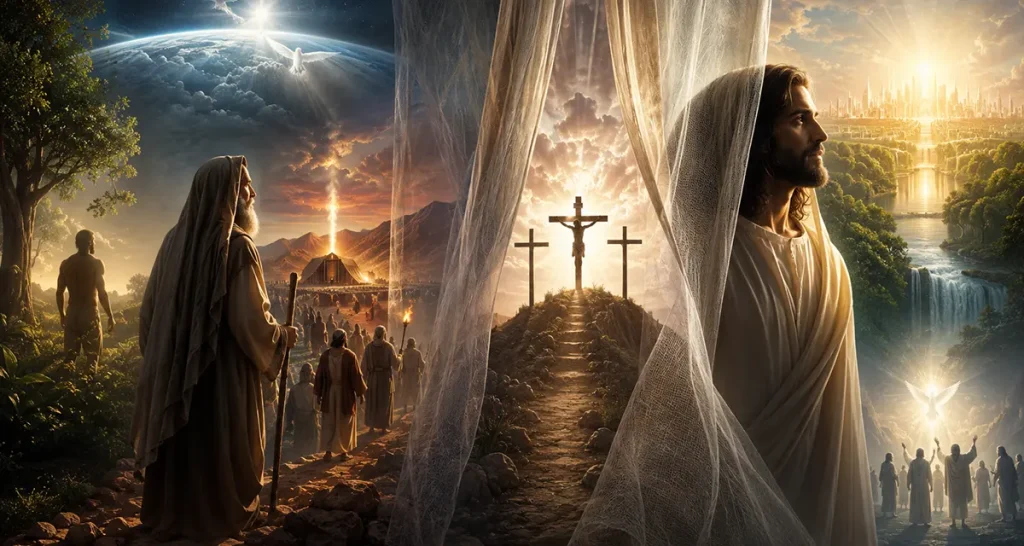
  7. It is remarkable to observe how the biblical story progresses from “Let there be light” to the unveiling of God’s glory in Christ. The veil appears to grow thinner through the centuries as revelation advances, ultimately reaching its climactic expression at the Cross and finding its final fulfillment when God’s people see Him face to face. The coherence of this unfolding plan, carried forward without error, detour, or delay and arriving at precisely the moment God ordained, is extraordinary.
  8. The Spirit hovered over the face of the earth before the first declaration of light, and it is the same Spirit who preserved that light through the ages. Though often seen through promises, shadows, and veils, the light continued to grow brighter, from the first glimmers of dawn to the full brightness of noon, when the glory of God shone in the face of Jesus Christ and illuminated human hearts for salvation. And it is that same Spirit who will yet bring forth the dawn of the New Creation.
  9. Father, Son, and Spirit—never apart and always working in unison. There is no work left to be done for Their own sake, They graciously direct Their work toward the creation They made, sustain, and redeem.

The Veil Removed: From “Let There Be Light” to Seeing God Face to Face

Biblical Themes | Covenants & Promises | God & His Attributes | Holy Spirit | Jesus Christ (Christology) | Prophecy & Fulfillment

What did Paul mean when he wrote, “Where the Spirit of the Lord is, there is liberty” (2 Corinthians 3:17)? Why did he connect freedom with the removal of Moses’ veil? And if the veil is taken away only in Christ, how were believers before the Cross able to know God?

This discussion follows the biblical theme of the veil from Genesis to Revelation. Beginning with the Spirit hovering over the waters before the first command, “Let there be light,” we explore how God progressively revealed Himself through promises, covenants, prophets, sacrifices, and shadows until the fullness of His glory shone in the face of Jesus Christ.

Along the way, we consider the relationship between revelation and spiritual perception, the significance of the Cross as the great unveiling of God’s heart, the work of the Holy Spirit throughout redemptive history, and the unity of the Father, Son, and Spirit in bringing creation toward its ultimate destiny.

Far from being a collection of disconnected events, Scripture presents a single, coherent story in which the veil grows thinner with every stage of revelation until Christ declares, “It is finished.” Yet even this is not the final chapter. The same Spirit who was present at creation continues His work until the day when faith becomes sight, every remaining veil is removed, and the redeemed behold the face of God in the New Creation.

From the first light of Genesis to the eternal light of the Lamb, this conversation traces the unfolding glory of God’s redemptive purpose and the liberty found in seeing Him as He truly is.

“Now the Lord is the Spirit; and where the Spirit of the Lord is, there is liberty” (2 Corinthians 3:17). The context appears to concern the ability to perceive and embrace the truth of God without the obscurity represented by Moses’ veil and with the unveiling that comes through turning to Christ. Why does Paul choose the language of liberty to describe this reality? What dimensions does this freedom carry beyond its ordinary meaning?

Yes, I think you are noticing something very important in the flow of Paul’s argument.

The verse is often read as if Paul suddenly changes subjects and starts talking about freedom from sin in a general sense. That truth is certainly biblical (John 8:32, Galatians 5:1), but in the immediate context of 2 Corinthians 3, “liberty” has a more specific meaning connected to the removal of the veil and the ability to behold God’s glory.

📖 The Context of the Veil

Paul is comparing two situations:

  1. Israel under the old covenant.
  2. The believer who has turned to Christ.

He writes:

“But their minds were blinded. For until this day the same veil remains unlifted in the reading of the Old Testament, because the veil is taken away in Christ.”

— 2 Corinthians 3:14

And:

“Nevertheless when one turns to the Lord, the veil is taken away.”

— 2 Corinthians 3:16

Then comes the statement:

“Now the Lord is the Spirit; and where the Spirit of the Lord is, there is liberty.”

— 2 Corinthians 3:17

The liberty therefore appears immediately after the removal of the veil.

Paul’s thought is something like:

Veil = obscurity, blindness, inability to perceive.

Spirit = unveiled access, understanding, perception, transformation.

🔓 Liberty from What?

The word “liberty” (Greek: eleutheria) means freedom, but freedom from a restraint or bondage.

In this context it is not merely political freedom or freedom of action.

It is freedom from everything the veil represented:

  • Spiritual blindness
  • Hardness of heart
  • Inability to perceive Christ
  • Distance from God’s glory
  • Dependence on external regulations without inward transformation

The veil prevented clear sight.

The Spirit removes the obstruction.

Therefore liberty is the freedom to see.

👀 Freedom as Unveiled Vision

Notice the next verse:

“But we all, with unveiled face, beholding as in a mirror the glory of the Lord, are being transformed into the same image from glory to glory, just as by the Spirit of the Lord.”

— 2 Corinthians 3:18

This explains verse 17.

The liberty is immediately described as having an unveiled face before God.

Moses had to veil his face.

Believers do not.

Moses entered God’s presence, but Israel could not gaze steadily upon the glory reflected in him (2 Corinthians 3:7).

The Christian, however, is invited to look directly at Christ.

Liberty is therefore the freedom of access and perception.

✨ More Than Intellectual Understanding

Yet Paul means more than merely understanding doctrines correctly.

The veil was not primarily over the eyes but over the heart.

“Their minds were blinded.”

— 2 Corinthians 3:14

The Spirit liberates the heart to embrace the truth it sees.

Many people can understand facts about Christ.

Only the Spirit can free the heart to recognize His glory.

This is why Paul elsewhere writes:

“For it is the God who commanded light to shine out of darkness, who has shone in our hearts to give the light of the knowledge of the glory of God in the face of Jesus Christ.”

— 2 Corinthians 4:6

The liberty is the freedom to know God truly.

🌅 A Deeper Meaning

There may be an even richer layer here.

Truth itself liberates because reality liberates.

A man in darkness is constrained by illusion.

A man who sees reality is free to walk according to reality.

Jesus said:

“And you shall know the truth, and the truth shall make you free.”

— John 8:32

The connection is striking.

The Spirit unveils Christ.

Christ is the Truth (John 14:6).

Seeing Him as He truly is frees us from falsehood, distorted ideas of God, self-deception, and ultimately from every lie that keeps the soul in bondage.

🙏 The Beauty of Paul’s Thought

So in this passage, liberty is not primarily the freedom to do whatever one wishes.

It is the freedom that comes from standing unveiled before God.

It is the freedom of a heart no longer blinded.

It is the freedom to behold Christ without obstruction.

It is the freedom to know the truth rather than shadows.

And because the glory is now seen in the face of Christ, that liberty does not merely inform us—it transforms us.

The sequence is beautiful:

The veil is removed → Christ is seen → liberty is experienced → transformation follows. (2 Corinthians 3:16-18)

In that sense, Paul is saying that the Spirit does not merely give information about God. He liberates a person into the very experience of God’s reality and glory, something the veil could never provide. ✨

You mentioned the ability to perceive Christ, yet Paul says that the veil is removed only in Christ. What exactly does this mean? Is there also a veil that prevents people from truly seeing Jesus Himself? And if the veil can only be removed in Christ, while the veil itself hinders the recognition of Christ, how do we resolve that apparent tension?

That is exactly the tension Paul wants us to feel.

If the veil is removed in Christ, but the veil itself prevents us from seeing Christ, then how can anyone ever come to Christ in the first place?

At first glance it sounds circular.

🤔 The Apparent Conundrum

Paul says:

“The same veil remains unlifted in the reading of the Old Testament, because the veil is taken away in Christ.”

— 2 Corinthians 3:14

And:

“When one turns to the Lord, the veil is removed.”

— 2 Corinthians 3:16

But if I am veiled, how can I turn?

And if I cannot truly see Christ until the veil is removed, how can I know to turn toward Him?

The answer lies in understanding that Paul is not describing a person completely incapable of seeing anything about Christ. Rather, he is describing a person incapable of seeing Christ’s glory for what it truly is.

👀 Seeing Jesus vs Seeing His Glory

Many people saw Jesus.

The Pharisees saw Him.

Judas saw Him.

Pilate saw Him.

The crowds saw Him.

Yet they did not truly see Him.

John writes:

“He was in the world, and the world was made through Him, and the world did not know Him.”

— John 1:10

And later:

“Though He had done so many signs before them, they still did not believe in Him.”

— John 12:37

The problem was not visual.

The problem was spiritual perception.

They saw a carpenter.

They heard a teacher.

Some saw a threat.

Some saw a political disappointment.

Very few saw the glory of the Son.

As John says:

“We beheld His glory, the glory as of the only begotten of the Father.”

— John 1:14

Not everyone who looked at Jesus beheld His glory.

🔥 The Burning Bush Analogy

Think of Moses before the burning bush.

Many shepherds may have passed bushes every day.

But when God opened Moses’ attention, he said:

“I will now turn aside and see this great sight.”

— Exodus 3:3

The bush was visible before he approached.

But its significance was not.

Likewise, Christ may be preached, read about, discussed, and even admired while His true identity remains hidden behind the veil.

✨ What Actually Removes the Veil?

Here we reach one of Paul’s deepest themes.

The veil is removed not by human cleverness but by divine revelation.

Consider:

“For God, who commanded the light to shine out of darkness, has shined in our hearts…”

— 2 Corinthians 4:6

Paul deliberately echoes Genesis.

At creation God said:

“Let there be light.”

— Genesis 1:3

The blind heart does not manufacture light.

God creates it.

This is why Jesus told Peter:

“Flesh and blood has not revealed this to you, but My Father who is in heaven.”

— Matthew 16:17

Peter already saw Jesus physically.

What the Father gave him was sight of who Jesus truly was.

🕊️ The Veil Is Over the Heart

Notice Paul’s language:

“Their minds were blinded.”

— 2 Corinthians 3:14

And:

“A veil lies on their heart.”

— 2 Corinthians 3:15

The veil is not primarily over Christ.

The veil is over us.

Christ is not hidden because He is unwilling to be known.

The blindness lies in the observer.

A blind man standing before the sun does not see darkness because the sun failed to shine.

He sees darkness because he cannot perceive the light.

❤️ The Mystery of Turning

This leads to something beautiful.

Paul does not describe turning to the Lord and the removal of the veil as two events separated by a long process.

They occur together.

The moment the sinner turns, the veil is removed.

The moment the veil is removed, the sinner sees.

The moment he sees, he turns more fully.

Scripture often presents these realities as intertwined.

Think of Lydia:

“The Lord opened her heart to heed the things spoken by Paul.”

— Acts 16:14

Paul preached.

Lydia listened.

The Lord opened her heart.

All three happened together.

🌅 The Deeper Resolution

I think the deepest resolution of the conundrum is that Christ is never completely hidden from anyone.

Enough light is given that a person may encounter Him.

Yet apart from the Spirit, the glory contained in that light remains unrecognized.

The veil does not make Christ absent.

The veil prevents Christ from being seen as infinitely beautiful, true, and worthy.

When the Spirit removes the veil, Jesus is no longer merely a historical figure, a prophet, a moral teacher, or even a theological concept.

Suddenly the soul sees what was there all along.

This is why Paul does not say that Christ becomes glorious.

He says we behold His glory (2 Corinthians 3:18).

The glory was already there.

The miracle is that our eyes are finally opened to it. 👑✨

And perhaps that is why conversion so often feels, in retrospect, less like discovering a new Christ and more like discovering the Christ who had been standing before us all along. As the disciples on the road to Emmaus later realized, Jesus had been walking with them the entire time, yet they did not recognize Him until their eyes were opened (Luke 24:13-32). The problem was never His presence. It was their perception. 🙏🏻

It seems that God, according to His own wise purpose, withheld the fullness of this ability to perceive until Christ came. It was His liberty to give it from the very first encounter with Adam after the fall. What should we make of that divine timing?

Yes, and you are touching on something that runs throughout the whole biblical story.

The ability to see God clearly, to know Him intimately, and to behold His glory unveiled was not something humanity possessed after the fall. God could have granted that fullness immediately if He had so willed. Nothing outside of Him prevented it.

As Paul says:

“He has mercy on whom He wills, and whom He wills He hardens.”

— Romans 9:18

And Jesus says:

“No one knows the Son except the Father. Nor does anyone know the Father except the Son, and the one to whom the Son wills to reveal Him.”

— Matthew 11:27

The revelation of God is always a gift.

🕰️ Why Not Immediately After the Fall?

The question naturally becomes: Why wait?

Paul speaks repeatedly of a mystery hidden and later revealed:

“The mystery which has been hidden from ages and from generations, but now has been revealed to His saints.”

— Colossians 1:26

And:

“In other ages was not made known to the sons of men, as it has now been revealed by the Spirit.”

— Ephesians 3:5

This does not mean God had no dealings with people before Christ.

Abraham knew God.

Moses knew God.

David knew God.

The prophets knew God.

Yet all of them knew Him through promises, shadows, types, sacrifices, covenants, and prophetic glimpses.

They knew truly, but not with the fullness that came in Christ.

👑 The Son Is the Revelation

This is where the issue becomes very important.

The liberty Paul describes is not merely liberty to understand facts.

It is liberty flowing from the unveiling of God’s face in Christ.

Before Christ, that revelation had not yet entered history.

John writes:

“No one has seen God at any time. The only begotten Son, who is in the bosom of the Father, He has declared Him.”

— John 1:18

And Jesus says:

“He who has seen Me has seen the Father.”

— John 14:9

God was not merely withholding information.

The climactic revelation had not yet occurred.

The incarnation itself had not yet happened.

The cross had not yet happened.

The resurrection had not yet happened.

History was moving toward the moment when God would reveal Himself in the most complete manner possible.

🔥 Yet God Was Already Giving Light

At the same time, Scripture carefully avoids the idea that God left previous generations in complete darkness.

For example:

“Abraham rejoiced to see My day, and he saw it and was glad.”

— John 8:56

And Moses:

“Esteeming the reproach of Christ greater riches than the treasures in Egypt.”

— Hebrews 11:26

And the prophets:

“Searching what, or what manner of time, the Spirit of Christ who was in them was indicating.”

— 1 Peter 1:10-11

The light was already shining.

But it was dawn, not noon.

🌅 The Liberty of God and the Timing of God

I think your statement gets very close to Paul’s thought:

“It was His liberty to give it from the very first encounter with Adam after the fall.”

Indeed, nothing compelled God to reveal Himself progressively.

Nothing forced Him to take thousands of years.

Nothing obligated Him to structure redemption through covenants, sacrifices, prophets, kings, exile, restoration, incarnation, cross, resurrection, and Pentecost.

These were choices of divine wisdom.

Paul calls this:

“The dispensation of the fullness of the times.”

— Ephesians 1:10

God was not reacting to history.

He was authoring it.

✨ A Further Thought

There may be an even deeper reason.

The glory seen in Christ is not merely the glory of divine power.

It is the glory of divine character.

The cross reveals something that Adam in Eden had never seen.

Moses never saw it fully.

David never saw it fully.

Even the angels seem to gaze into these things with wonder (1 Peter 1:12).

At Calvary we see not merely that God is holy, righteous, powerful, and eternal.

We see how holy love behaves when confronted with rebellion.

We see justice and mercy embracing.

We see the Creator giving Himself for His creatures.

That revelation could not be displayed before the historical accomplishment of the cross.

So perhaps God delayed the full unveiling not because He was unwilling to reveal Himself, but because He intended to reveal something so magnificent that history itself had to be prepared as the stage upon which it would be displayed.

As Paul says:

“For it is the God who commanded light to shine out of darkness, who has shone in our hearts to give the light of the knowledge of the glory of God in the face of Jesus Christ.”

— 2 Corinthians 4:6

Notice the destination of all revelation: not simply knowledge, not merely liberty, but “the glory of God in the face of Jesus Christ.”

That face was always the goal toward which all previous revelation was moving. 🌟👑🙏

And in that sense, the liberty of 2 Corinthians 3 is not merely freedom from blindness. It is the freedom to behold what previous ages longed to see but only saw from afar (Hebrews 11:13; Matthew 13:17). The veil is removed because the Reality to which all the shadows pointed has finally appeared.

A veil, by its very nature, does not completely block sight. It allows one to perceive what lies beyond it, though imperfectly and without full clarity. Could this image also describe humanity’s understanding of God before Christ—seeing truly, yet through shadows, promises, and partial revelation?

👀 The Veil as Partial Vision

I think there is a great deal of truth in that observation, though we should make a careful distinction.

A veil is not a wall.

A veil does not completely hide.

It conceals while still allowing some perception.

You can recognize a person behind a veil, but not with clarity. Features are softened. Details are obscured. Reality is present but not fully apprehended.

That image fits remarkably well with much of the Old Testament revelation.

🌅 They Saw Truly, But Not Fully

The saints before Christ did not know a false God.

Abraham did not worship a distortion.

Moses did not encounter an illusion.

David did not sing to an unknown deity.

They knew the true God.

Yet what they knew was partial compared with what was later revealed in Christ.

The writer of Hebrews opens with exactly this contrast:

“God, who at various times and in various ways spoke in time past to the fathers by the prophets, has in these last days spoken to us by His Son.”

— Hebrews 1:1-2

Notice that God truly spoke before.

But the revelation through the Son is presented as the climax and fulfillment of all previous revelation.

🔥 Moses as an Example

Think about Moses himself.

He knew God more intimately than almost anyone in the Old Testament.

Yet when he asked:

“Please, show me Your glory.”

— Exodus 33:18

God replied:

“You cannot see My face; for no man shall see Me, and live.”

— Exodus 33:20

Moses heard God’s name proclaimed.

He witnessed God’s acts.

He saw God’s glory pass by.

But he still did not see the fullness.

There remained a kind of veil.

Not because Moses was deceived, but because the revelation was not yet complete.

✨ Christ Removes More Than Ignorance

This is where Paul’s argument becomes astonishing.

He does not merely say that Christ provides additional information.

He says Christ reveals the very face of God.

“Who is the image of the invisible God.”

— Colossians 1:15

“He who has seen Me has seen the Father.”

— John 14:9

Before Christ, people knew God’s power.

They knew His holiness.

They knew His justice.

They knew His covenant faithfulness.

They knew His mercy.

But all those rays were scattered.

In Christ the rays converge into one blazing sun.

🪞 A Reflection of This Appears Elsewhere

Interestingly, Paul later uses a similar image:

“For now we see in a mirror, dimly, but then face to face.”

— 1 Corinthians 13:12

Even now our knowledge is not perfect.

We truly know Christ, yet we still await greater clarity.

So there is a progression:

  1. Before Christ: seeing through the veil of promise, type, sacrifice, prophecy, and shadow.
  2. After Christ’s coming: seeing God’s glory in the face of Jesus Christ (2 Corinthians 4:6).
  3. In the age to come: seeing Him face to face (1 Corinthians 13:12; Revelation 22:4).

Each stage is real sight.

Each stage increases in clarity.

🌿 Yet There Is Another Layer

Paul’s veil in 2 Corinthians 3 is not only a veil of incomplete revelation.

It is also a veil over the heart.

This is important.

The Old Testament itself already revealed Christ in shadow and promise.

Jesus said:

“These are they which testify of Me.”

— John 5:39

And:

“If you believed Moses, you would believe Me; for he wrote about Me.”

— John 5:46

Therefore the problem was not merely that the revelation was veiled.

The deeper problem was that many hearts remained veiled.

The same Scriptures that led Abraham to faith could be read by others without seeing the One to whom they pointed.

❤️ Your Observation and Its Implications

I would therefore say that before Christ humanity saw God somewhat as one sees a beloved figure through a veil.

The figure was real.

The outline was true.

The voice could be heard.

The character could be discerned.

But the face was not yet fully visible.

Then Christ came.

Not to reveal a different God, but to reveal the God who had always been there.

In that sense, the Incarnation is not the introduction of God to humanity. It is the lifting of the veil from the face that had been speaking from behind it all along.

Which makes Jesus’ words even more breathtaking:

“Before Abraham was, I AM.”

— John 8:58

The One whom Abraham dimly saw, Moses longed to see, David sang about, and the prophets anticipated is the very One who finally stood before them unveiled. 👑✨

And yet, as wonderful as that unveiling is, Scripture says an even greater one still awaits us:

“They shall see His face.”

— Revelation 22:4

If the coming of Christ was the lifting of a veil, the New Creation may be the complete removal of every remaining obstruction between God and His redeemed people. 🙏🌟

God told Moses, “You cannot see My face,” and yet Paul writes that God has shone in our hearts “to give the light of the knowledge of the glory of God in the face of Jesus Christ.” How should we understand the relationship between these two declarations? In what sense does Christ reveal what Moses longed to see?

✨ One of the Most Beautiful Connections in Scripture

What you are noticing is not accidental. Paul is intentionally bringing together themes that stretch from Sinai to Christ.

Consider the two statements side by side:

“You cannot see My face; for no man shall see Me, and live.”

— Exodus 33:20

And:

“For it is the God who commanded light to shine out of darkness, who has shone in our hearts to give the light of the knowledge of the glory of God in the face of Jesus Christ.”

— 2 Corinthians 4:6

At first they seem almost contradictory.

Moses cannot see God’s face.

Yet Paul speaks of God’s glory in the face of Jesus Christ.

What happened?

👑 Moses Asked for What Humanity Longed For

When Moses said:

“Please, show me Your glory.”

— Exodus 33:18

he was asking for the deepest possible revelation of God.

God’s response was not a refusal of relationship but a declaration of limitation.

Moses, as a fallen man in his mortal condition, could not bear the direct fullness of God’s unveiled glory.

Thus God placed him in the cleft of the rock and allowed him only a partial revelation (Exodus 33:21-23).

Moses received a true revelation.

But not the fullness he desired.

🌅 Then Comes Jesus

What is astonishing is that the New Testament does not say God became less glorious.

Nor does it say humanity became naturally capable of beholding infinite deity.

Instead, God reveals Himself through the incarnate Son.

John writes:

“And the Word became flesh and dwelt among us, and we beheld His glory.”

— John 1:14

Notice the wonder of this.

The same glory Moses longed to see is now encountered in the humanity of Christ.

The glory has not diminished.

It has become approachable.

🔥 The Face Moses Could Not See

This is where many theologians and believers through the centuries have paused in amazement.

Moses was told:

“You cannot see My face.”

Yet Jesus says:

“He who has seen Me has seen the Father.”

— John 14:9

The implication is breathtaking.

The face Moses could not behold directly is revealed through the Son.

Not because Jesus is less than God.

But because Jesus is God revealing Himself in a form humanity can truly encounter.

As Paul says:

“Who being the brightness of His glory and the express image of His person.”

— Hebrews 1:3

🕊️ The Face of God Is Not Merely Features

Of course, Scripture is not primarily talking about physical features.

God is spirit (John 4:24).

When Moses asked to see God’s face, he was asking for the direct revelation of God’s person and glory.

Likewise, when Paul speaks of:

“the glory of God in the face of Jesus Christ”

he means that in Christ we see who God truly is.

His character.

His heart.

His holiness.

His mercy.

His justice.

His love.

His wisdom.

His humility.

His very being.

❤️ The Cross Reveals Something Moses Never Saw

Moses saw the Red Sea open.

Moses saw Sinai tremble.

Moses saw manna from heaven.

Moses saw God’s glory reflected.

But Moses never stood beneath the cross.

He never witnessed what Paul calls:

“the glory of God in the face of Jesus Christ.”

At Calvary, God reveals not only His power but His heart.

There we see holiness that does not compromise.

Justice that does not bend.

Love that does not abandon.

Mercy that does not deny truth.

All united in one Person.

🌟 An Even Deeper Possibility

There is a thought that has moved many believers.

When God told Moses:

“You cannot see My face”

that was not necessarily God’s final word to humanity.

It was God’s word to humanity in its present condition.

The whole story of redemption moves toward reversing that distance.

The Bible ends with these words:

“They shall see His face.”

— Revelation 22:4

What Moses could not do on Sinai becomes the inheritance of the redeemed in the New Creation.

Not because God’s glory became smaller.

Not because God changed.

But because through Christ, humanity is transformed and brought into a relationship capable of bearing that vision.

🙏 From Sinai to the New Jerusalem

There is a remarkable progression:

  • At Sinai, “You cannot see My face.”
  • In the Gospels, “He who has seen Me has seen the Father.”
  • In the New Creation, “They shall see His face.”

The story moves from prohibition, to revelation, to consummation.

And at the center of it all stands Jesus Christ.

Which means that when Paul speaks of “the glory of God in the face of Jesus Christ,” he is not merely giving us a theological statement. He is declaring that the longing implicit in Moses’ request has finally found its answer.

The glory Moses asked to see is revealed in Christ, and through Christ it will one day be seen without any veil at all. 👑✨

Perhaps that is why Jesus could say:

“Blessed are the pure in heart, for they shall see God.”

— Matthew 5:8

Not merely understand Him.

Not merely hear about Him.

But see Him. The desire of Moses, the hope of the prophets, and the destiny of the redeemed all meet in that promise. 🌿📖👑


Would it be fair to say that from the promise of the Seed of the woman until Christ declared, “It is finished,” the revelation of God was already present and progressively unfolding, yet the fullness of both the revelation and the heart’s capacity to apprehend it awaited their appointed fulfillment in Christ?

🌱 Yes, But With an Important Nuance

I would answer: yes, but not absolutely.

The revelation was there from the very beginning, and God was already giving hearts to apprehend it. Otherwise Abel, Enoch, Noah, Abraham, Moses, David, and the prophets could never have believed.

Yet the revelation was not yet complete, and the fullness of what God intended to reveal had not yet entered history.

So there were really two limitations:

  1. The limitation of the human heart.
  2. The limitation of the stage of redemptive revelation.

📖 The Seed Was Already Christ

The promise appears immediately after the fall:

“And I will put enmity between you and the woman, and between your seed and her Seed; He shall bruise your head, and you shall bruise His heel.”

— Genesis 3:15

Looking back, we see Christ.

But imagine standing beside Adam and Eve.

How much could they have understood?

A Deliverer would come.

The serpent would be defeated.

Humanity would be rescued.

But the incarnation?

The cross?

The resurrection?

Pentecost?

The New Creation?

These were hidden within the promise like an oak tree hidden within an acorn.

The revelation was true, but not yet unfolded.

🔥 The Saints Already Saw Something

This is why Hebrews 11 is so remarkable.

These men and women believed realities they could not fully explain.

“These all died in faith, not having received the promises, but having seen them afar off were assured of them.”

— Hebrews 11:13

Notice that phrase:

“having seen them afar off.”

That sounds very much like your veil imagery.

They truly saw.

But they saw from a distance.

They saw outlines.

They saw shadows.

They saw promises.

They did not yet see the finished work.

👑 Then Comes “It Is Finished”

When Jesus cried:

“It is finished!”

— John 19:30

something changed in history itself.

The object of faith was no longer only future.

The Lamb had actually been sacrificed.

The victory over sin had actually been won.

The righteousness of God had actually been displayed.

The heart of God had actually been revealed in history.

What Abraham saw from afar now stood in full daylight.

🕊️ The Heart and the Revelation Meet

Perhaps another way to put it is this:

Before Christ, God gave enough light for faith.

After Christ, He gave the fulfillment toward which that faith had always been reaching.

Consider Jesus’ words:

“Many prophets and righteous men desired to see what you see, and did not see it, and to hear what you hear, and did not hear it.”

— Matthew 13:17

The prophets were not blind unbelievers.

They truly knew God.

Yet they longed for a greater unveiling.

❤️ The Deepest Thing Happening

I think what you are getting at is something even deeper.

The issue was never merely information.

From Genesis onward, God was progressively revealing Christ.

But what humanity most needed was not simply more data.

Humanity needed a revelation powerful enough to win back the heart’s trust.

The serpent’s attack in Eden was ultimately an attack on God’s character.

“God is not as good as He appears.”

The entire history of redemption moves toward the cross, where God answers that accusation forever.

There the heart of God is displayed openly.

There His justice and love are seen together.

There His glory shines most brightly.

✨ A Beautiful Way to Say It

So I would say:

From the promise of the Seed to “It is finished,” revelation was always present, and God was already granting faith to His people.

But until Christ came, neither the revelation nor the human apprehension had reached their intended fullness.

The saints before the cross truly knew God.

The saints after the cross know the same God.

But they know Him through the unveiled face of Jesus Christ, in whom all the scattered rays of previous revelation finally converge.

Or as the writer of Hebrews says:

“God… has in these last days spoken to us by His Son.”

— Hebrews 1:1-2

Not because God had been silent before, but because the Son is the final and fullest interpretation of everything God had been saying from the beginning. 🌟

And perhaps that is why Jesus could say:

“When I am lifted up from the earth, will draw all peoples to Myself.”

— John 12:32

The cross does not merely accomplish salvation. It unveils the heart of God in a way that nothing before it ever could. The Seed promised in Eden and the cry “It is finished” are the two ends of the same revelation. Between them stands the long story of God teaching humanity to recognize the face that had been speaking to them all along. 👑🙏✨

It is remarkable to observe how the biblical story progresses from “Let there be light” to the unveiling of God’s glory in Christ. The veil appears to grow thinner through the centuries as revelation advances, ultimately reaching its climactic expression at the Cross and finding its final fulfillment when God’s people see Him face to face. The coherence of this unfolding plan, carried forward without error, detour, or delay and arriving at precisely the moment God ordained, is extraordinary.

🌅 From “Let There Be Light” to “They Shall See His Face”

Yes. And what is striking is that Scripture itself seems to invite us to see that very progression.

The first recorded words of God are:

“Let there be light.”

— Genesis 1:3

And the final vision of redeemed humanity is:

“They shall see His face.”

— Revelation 22:4

Between those two statements lies the entire drama of redemption.

The God who created physical light is gradually revealing the deeper light of His own being.

📖 The Unfolding of the Light

At first there is only a promise.

“He shall bruise your head.”

— Genesis 3:15

Then covenants.

Then sacrifices.

Then priests.

Then prophets.

Then kings.

Then types and shadows.

Then the tabernacle.

Then the temple.

Then promises of a coming Servant, King, Prophet, Shepherd, Redeemer.

The picture becomes clearer and clearer.

Not because God is learning what He intends to do, but because humanity is being led through the unveiling.

It is as if every century removes another layer of the veil.

🔥 The Astonishing Consistency

What amazes me is exactly what you mentioned: there are no detours.

Human beings constantly take detours.

Israel does.

The kings do.

The priests do.

The disciples do.

The nations do.

Yet God’s purpose never does.

Joseph’s betrayal becomes preservation.

Egyptian slavery becomes Exodus.

The wilderness becomes preparation.

David’s throne becomes the framework for the Messiah.

The exile becomes purification.

The Roman Empire becomes the roads by which the Gospel spreads.

What appears chaotic from below is perfectly ordered from above.

As Isaiah records:

“Declaring the end from the beginning,
And from ancient times things that are not yet done,
Saying, ‘My counsel shall stand,
And I will do all My pleasure.'”

— Isaiah 46:10

✨ The Cross as the Great Unveiling

The Cross is not merely another event in the story.

It is the place where everything converges.

The promise to Adam.

The ram for Isaac.

The Passover lamb.

The sacrifices.

The priesthood.

The temple.

The prophets.

The suffering servant.

The son of David.

All roads lead there.

This is why Jesus could say:

“It is finished.”

— John 19:30

Not “It has begun.”

Not “A possibility has been created.”

But “It is finished.”

The reality toward which all revelation had been moving had finally appeared.

👑 Yet Even the Cross Is Not the End

And this is where your observation becomes especially beautiful.

The Cross is the climax of revelation in history, but not the end of revelation in experience.

Even now Paul says:

“For now we see in a mirror, dimly.”

— 1 Corinthians 13:12

The veil is removed in Christ.

Yet our sight is still not complete.

We know truly, but not exhaustively.

We see genuinely, but not perfectly.

The final step still awaits:

“Beloved, now we are children of God; and it has not yet been revealed what we shall be, but we know that when He is revealed, we shall be like Him, for we shall see Him as He is.”

— 1 John 3:2

🌟 The Faithfulness of God Through the Ages

Perhaps one of the strongest evidences of divine authorship in Scripture is this unified movement.

Over roughly fifteen centuries of writing, through shepherds, kings, prophets, fishermen, priests, and apostles, the story never loses its center.

The light introduced in Genesis never goes out.

It grows brighter.

The promise never changes.

It unfolds.

The destination never moves.

It approaches.

Until finally John sees a city needing neither sun nor moon:

“For the glory of God illuminated it. The Lamb is its light.”

— Revelation 21:23

The story begins with God saying, “Let there be light.”

It ends with creation living forever in that light.

And between those two points stands Jesus Christ, who could say:

“I am the light of the world.”

— John 8:12

The progression is so coherent because it is ultimately not the story of humanity searching for God. It is the story of God steadily, patiently, and flawlessly revealing Himself until every promise finds its “Yes” and “Amen” in Christ (2 Corinthians 1:20). 🌅👑✨

And one day, faith itself will reach its destination. The light that first shone into the darkness of Genesis will no longer be seen through promises, symbols, Scripture pages, or even faith. It will be seen directly in the face of the Lamb. 🙏📖🌟

The Spirit hovered over the face of the earth before the first declaration of light, and it is the same Spirit who preserved that light through the ages. Though often seen through promises, shadows, and veils, the light continued to grow brighter, from the first glimmers of dawn to the full brightness of noon, when the glory of God shone in the face of Jesus Christ and illuminated human hearts for salvation. And it is that same Spirit who will yet bring forth the dawn of the New Creation.

🕊️ The Spirit and the Journey of Light

That is a profoundly biblical way of tracing the story.

The opening verses of Scripture tell us:

“The earth was without form, and void; and darkness was on the face of the deep. And the Spirit of God was hovering over the face of the waters.”

— Genesis 1:2

Then comes the divine command:

“Let there be light.”

— Genesis 1:3

The Spirit is present at the threshold of creation, and light immediately follows.

When we read the rest of Scripture, it is difficult not to see a pattern emerging.

🌅 The Spirit Preserving the Light

After the fall, darkness enters the human story, yet the light never goes out.

The promise to the woman.

The preservation of Noah.

The calling of Abraham.

The faithfulness shown to Israel.

The voices of the prophets.

The psalms of David.

The temple and sacrifices.

Again and again, light continues shining in a dark world.

And behind all of it stands the Spirit.

Peter writes concerning the prophets:

“Holy men of God spoke as they were moved by the Holy Spirit.”

— 2 Peter 1:21

And concerning Christ:

“The Spirit of Christ who was in them was indicating…”

— 1 Peter 1:11

The light was not self-sustaining.

The Spirit was carrying the revelation forward through the centuries.

🔥 The Noon of Revelation

Your image of noon is beautiful because it captures something Scripture itself teaches.

The prophets spoke of dawn.

The promises pointed eastward.

Then Christ arrived.

John says:

“The true Light which gives light to every man coming into the world.”

— John 1:9

And Jesus declares:

“I am the light of the world.”

— John 8:12

What had been seen through promises and shadows now stood openly before humanity.

The sun had not changed.

The horizon had.

And the Spirit who hovered over the waters now rests upon Christ:

“The Spirit of the Lord shall rest upon Him.”

— Isaiah 11:2

“The Spirit descending from heaven like a dove, and He remained upon Him.”

— John 1:32

The same Spirit who was present at the first creation is present at the unveiling of the new one.

❤️ Shining Into Human Hearts

Paul then takes the Genesis language and applies it to salvation:

“For it is the God who commanded light to shine out of darkness, who has shone in our hearts…”

— 2 Corinthians 4:6

Notice what he is doing.

Creation begins with darkness and light.

Conversion begins with darkness and light.

The God who spoke light into existence now shines light into human hearts.

And this work is accomplished through the Spirit.

As you observed earlier, the veil is removed and the heart is enabled to behold Christ.

The Spirit does not merely illuminate truths.

He illuminates the Truth.

🌍 The Spirit and the New Creation

And then the story reaches its final horizon.

Just as the Spirit hovered over the old creation before light appeared, so He is the guarantee of the coming creation.

Paul writes:

“He who has prepared us for this very thing is God, who also has given us the Spirit as a guarantee.”

— 2 Corinthians 5:5

And:

“Having believed, you were sealed with the Holy Spirit of promise, who is the guarantee of our inheritance.”

— Ephesians 1:13-14

The Spirit is not merely a witness to the future.

He is the firstfruits of it.

The coming age has already begun to dawn within God’s people.

✨ A Beautiful Symmetry

There is a remarkable symmetry here:

  • The Spirit hovers over the darkness before the first light.
  • The Spirit preserves the light through the shadows of redemptive history.
  • The Spirit reveals the Light of the world in Christ.
  • The Spirit shines that light into human hearts.
  • The Spirit prepares creation for its final renewal.
  • The Spirit welcomes the coming King.

The Bible closes with these words:

“The Spirit and the bride say, ‘Come!'”

— Revelation 22:17

The Spirit who appears at the beginning of Genesis also appears at the end of Revelation.

He stands, as it were, at both horizons of Scripture.

👑 From Genesis to Revelation

What is especially moving is that the Spirit’s ministry is never to draw attention to Himself as an end.

Just as at creation He prepares the stage for the divine light, throughout redemption He continually directs attention toward the Son.

Jesus said:

“He will glorify Me.”

— John 16:14

So the movement of Scripture can almost be described this way:

The Spirit hovered over the darkness until the first light shone.

The Spirit carried the promises through the long dawn of history.

The Spirit unveiled the glory of God in the face of Jesus Christ.

The Spirit now shines that glory into believing hearts.

And the Spirit will not cease His work until the whole creation is filled with the light of God and the Lamb, and the redeemed finally see His face.

That is not merely a cycle of light. It is a single, uninterrupted purpose of God stretching from Genesis 1:2 to Revelation 22:5, carried forward by the same faithful Spirit at every stage. 🕊️🌅👑✨

“The city had no need of the sun or of the moon to shine in it, for the glory of God illuminated it. The Lamb is its light.”

— Revelation 21:23

The first light illuminated a world. The final Light will illuminate eternity. 🌟🙏

Father, Son, and Spirit—never apart and always working in unison. There is no work left to be done for Their own sake, They graciously direct Their work toward the creation They made, sustain, and redeem.

Yes, and I think Scripture would largely affirm what you are saying, while adding an important refinement.

God does not work because He lacks.

God does not create because He is lonely.

God does not redeem because He is incomplete.

God does not love because He needs affection returned.

Before creation existed, the Father, Son, and Spirit already enjoyed perfect fullness of life, love, joy, and glory.

Jesus speaks of:

“My glory which You have given Me, for You loved Me before the foundation of the world.”

— John 17:24

Before there were angels, stars, or human beings, there was already perfect love between the Father and the Son in the fellowship of the Spirit.

Nothing could be added to that.

Nothing could improve it.

Nothing could complete it.

🕊️ Never Apart

One of the beautiful themes of Scripture is that the Persons of the Trinity are never acting independently or competitively.

At creation:

  • The Father speaks (Genesis 1:1).
  • The Spirit hovers (Genesis 1:2).
  • The Son is the Word through whom all things are made (John 1:1-3; Colossians 1:16).

At the incarnation:

  • The Father sends the Son (John 3:16-17).
  • The Son comes willingly (Hebrews 10:5-7).
  • The Spirit overshadows Mary (Luke 1:35).

At Christ’s baptism:

  • The Son stands in the water.
  • The Spirit descends like a dove.
  • The Father speaks from heaven.

Matthew 3:16-17

At the cross:

“Christ… through the eternal Spirit offered Himself without spot to God.”

— Hebrews 9:14

Even there all three are present.

And in salvation:

“According to the foreknowledge of God the Father, in sanctification of the Spirit, for obedience and sprinkling of the blood of Jesus Christ.”

— 1 Peter 1:2

One work.

One purpose.

One will.

Three Persons.

🌟 Creation Is the Overflow, Not the Supply

I particularly like your phrase that They are always working for creation.

That is essentially true, provided we remember that God’s ultimate purpose remains God’s own glory.

Not because He is self-centered in a creaturely sense, but because His glory is the highest reality that exists.

Paul writes:

“For of Him and through Him and to Him are all things, to whom be glory forever.”

— Romans 11:36

Creation benefits because God reveals His glory.

Salvation benefits because God reveals His glory.

The New Creation benefits because God reveals His glory.

God’s glory and creation’s good are never competitors.

They are united.

The greatest gift God can give creation is Himself.

❤️ Why Does God Act?

This leads to a wonderful thought.

God’s works are not attempts to gain something.

They are expressions of what He already is.

He creates because He is Creator.

He loves because He is love (1 John 4:8).

He reveals because He is light (1 John 1:5).

He gives because He is good (Psalm 119:68).

He saves because He is merciful (Ephesians 2:4-5).

His actions flow from His nature.

🌅 The Eternal Movement of Divine Love

There is another beautiful implication.

The Father has eternally loved the Son.

The Son has eternally delighted in the Father.

The Spirit eternally proceeds in the fellowship and life of God.

Creation did not begin love.

Creation was invited into a love already existing.

Jesus prayed:

“That the love with which You loved Me may be in them, and I in them.”

— John 17:26

That is astonishing.

Redemption is not God creating a new love.

It is God bringing creatures into the eternal love that has always existed within the Trinity.

✨ Yet There Is One Thing God “Works For”

I would only gently modify one phrase:

“there is no work left to be done for Their own sake.”

In one sense that is absolutely true. God lacks nothing and gains nothing.

Yet Scripture also speaks of God acting for His name’s sake, for His glory, and for the praise of His grace.

“I, even I, am He who blots out your transgressions for My own sake.”

— Isaiah 43:25

“For My own sake, for My own sake, I will do it.”

— Isaiah 48:11

Not because God needs glory.

Rather because His glory is the truth of who He is.

He acts so that reality is known, displayed, and enjoyed.

👑 The Final Picture

In the end, Father, Son, and Spirit are indeed never apart and never divided.

The Father plans.

The Son accomplishes.

The Spirit applies.

Yet even those distinctions are only aspects of one harmonious work.

And what is remarkable is that all of redemptive history—from the hovering Spirit over the waters, to the Word becoming flesh, to the Lamb upon the throne, to the Spirit and the Bride saying “Come”—is not God striving to become something.

It is God freely and joyfully sharing what He has always been.

The universe is not the source of divine love. It is the recipient of it. 🕊️👑✨

“Father, I desire that they also whom You gave Me may be with Me where I am, that they may behold My glory.”

— John 17:24

That may be one of the deepest summaries of the whole story: the Triune God bringing creation into the enjoyment of the glory and love that Father, Son, and Spirit have shared from all eternity. 🌅❤️👑