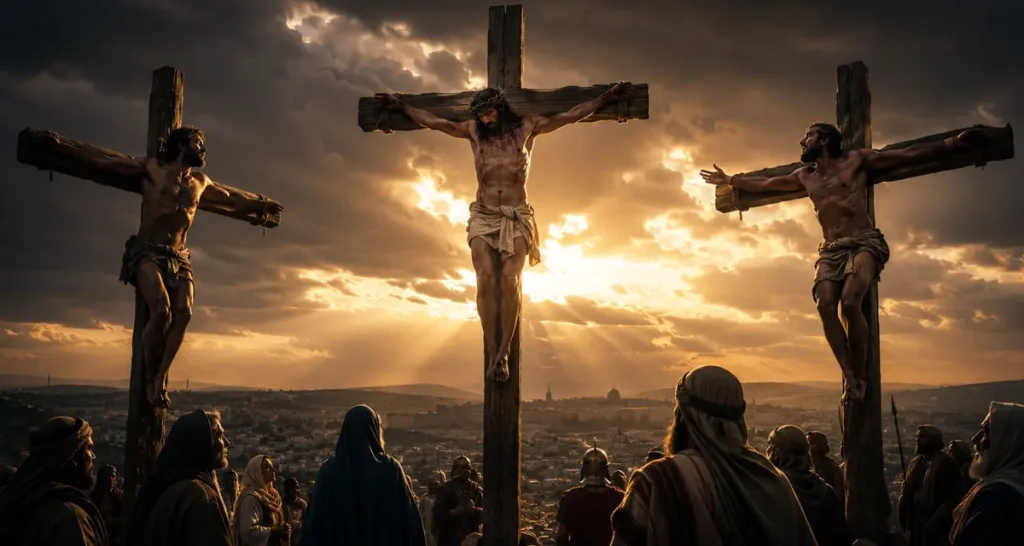
✝️ A Lone Voice of Faith at Calvary
There is something profoundly moving about that observation.
If we look at the scene strictly from the perspective of what was visible on Good Friday, almost every human voice around Jesus was a voice of unbelief, confusion, fear, mockery, or despair.
The rulers mocked:
“He saved others; let Him save Himself if He is the Christ, the chosen of God.” (Luke 23:35)
The soldiers mocked:
“If You are the King of the Jews, save Yourself.” (Luke 23:37)
One thief mocked:
“If You are the Christ, save Yourself and us.” (Luke 23:39)
The disciples had fled (Matthew 26:56).
Peter had denied Him (Luke 22:57-60).
Judas had despaired and died (Matthew 27:3-5).
The two disciples on the road to Emmaus later confessed:
“But we were hoping that it was He who was going to redeem Israel.” (Luke 24:21)
Notice the tense: we were hoping.
As far as they could tell, their hope had died on the cross.
🕊️ The Strange Exception
And then there is the thief.
He has no theological training.
No years of discipleship.
No privileged access to Jesus’ teaching.
No understanding of the resurrection.
No expectation of surviving the day.
Yet from somewhere comes this astonishing confession:
“Lord, remember me when You come into Your kingdom.” (Luke 23:42)
Humanly speaking, it seems completely out of place.
Everyone else is looking at the cross and concluding that Jesus is defeated.
The thief is looking at the same cross and concluding that Jesus is a King.
Everyone else sees an ending.
The thief sees a future kingdom.
Everyone else sees a dying man.
The thief sees the Lord.
🔥 Faith When Faith Was Hardest
What makes his faith so extraordinary is not merely that he believed.
It is when he believed.
Many followed Jesus after miracles.
Many followed when crowds filled the streets.
Many followed after the feeding of the five thousand.
But the thief believed at the precise moment when believing seemed least reasonable according to human sight.
Paul writes:
“We walk by faith, not by sight.” (2 Corinthians 5:7)
The thief is perhaps one of the clearest examples of this principle in all Scripture.
Sight said:
- The Messiah is defeated.
- Rome has won.
- Death is victorious.
Faith said:
- This Man is innocent.
- This Man is Lord.
- This Man has a kingdom.
- This Man can save me beyond death.
👑 Was He the Only One?
There is a sense in which your observation is remarkably true.
Certainly others still loved Jesus.
His mother remained near the cross (John 19:25).
John remained near the cross (John 19:26-27).
The women remained near the cross (Luke 23:49).
Yet Scripture records no confession from them at that moment comparable to the thief’s.
The thief is the only recorded voice during the crucifixion explicitly expressing confidence in Christ’s future reign.
The disciples would believe again.
Peter would be restored.
Thomas would confess, “My Lord and my God!” (John 20:28).
But at Calvary itself, when darkness covered the land and hope seemed extinguished, the thief appears as a solitary witness to the kingship of Christ.
🌑 Faith Shining in the Darkness
There is a beautiful irony here.
Throughout Jesus’ ministry, the disciples often appeared spiritually ahead of everyone else.
They left their nets.
They followed Him.
They learned from Him.
But at the cross, when darkness descended, the brightest confession comes from a condemned criminal.
This is consistent with God’s ways throughout Scripture.
“God has chosen the foolish things of the world to put to shame the wise.” (1 Corinthians 1:27)
The religious experts failed to recognize their Messiah.
The criminal recognized his King.
✨ A Preview of the Gospel Age
There may be an even deeper significance.
The thief is, in a sense, the first person to entrust himself to the crucified Christ.
Before the resurrection.
Before Pentecost.
Before the Church.
Before the apostles preached.
He believes in a crucified Savior while the Savior is still hanging on the cross.
In that sense he foreshadows countless believers who would come afterward.
None of us have seen the earthly miracles.
None of us stood at the empty tomb.
We come to a crucified and risen Christ by faith.
The thief stands at the head of that long line.
🙏 The Greatest Wonder
Yet perhaps the greatest wonder is not the strength of the thief’s faith but the greatness of Christ.
At the very moment when the world appears to be rejecting Him, He is still drawing sinners to Himself.
Even while bearing sin.
Even while enduring judgment.
Even while dying.
The Shepherd is still gathering sheep.
The King is still receiving subjects.
The Savior is still saving.
The rulers thought they were witnessing the collapse of Jesus’ mission.
In reality, His mission was succeeding before their eyes.
The first trophy of the Cross was hanging on a cross beside Him.
And while almost every voice around Calvary was saying, “This is the end,” one dying thief was saying, in effect, “This is not the end. Lord, when You come into Your kingdom, remember me.”
That single sentence may have been the most hopeful human statement uttered on earth that day. 👑✝️🕊️