Yes—with an important qualification, I think we can, and Revelation itself seems deliberately to lead us there.
Not that God is eternally suffering, weak, or literally slain. Rather, what the slain Lamb reveals about God’s character is not a temporary attitude God adopted for the emergency of redemption. The self-giving love, holiness, mercy, faithfulness, and willingness to bear the cost of reconciliation revealed at Calvary truly reveal who God is.
And Revelation places that Lamb astonishingly close to the very center of divine sovereignty.
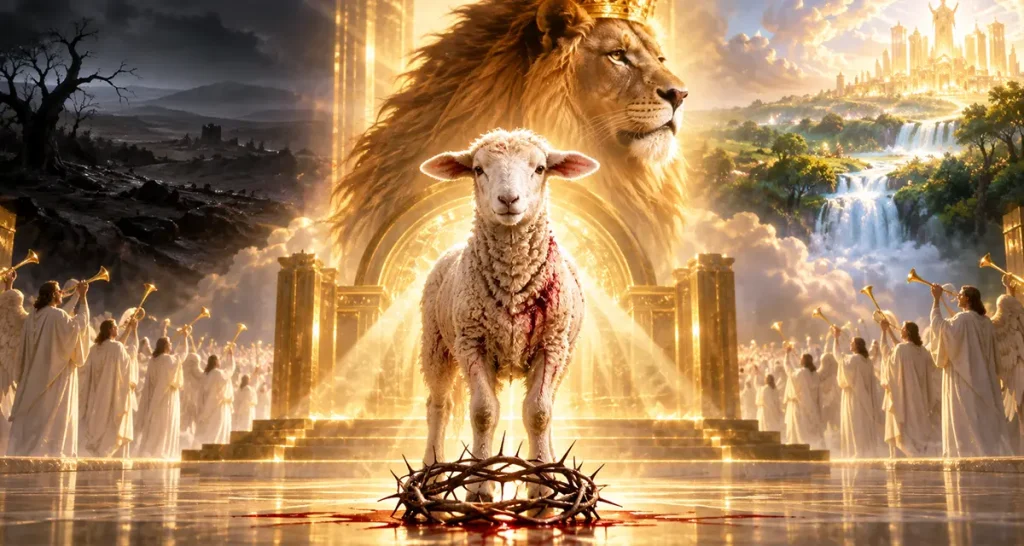
“And I looked, and behold, in the midst of the throne and of the four living creatures, and in the midst of the elders, stood a Lamb as though it had been slain.”
— Revelation 5:6
That location matters.
🐑 The Lamb is “in the midst of the throne”
John does not see the Lamb somewhere far beneath the throne as merely the servant who accomplished the unpleasant work necessary for God to reign.
He sees Him in the midst of the throne.
And later Revelation gives us this remarkable expression:
“For the Lamb who is in the midst of the throne will shepherd them and lead them to living fountains of waters.”
— Revelation 7:17
Think about those images together:
throne — Lamb — slain — shepherd.
Sovereignty.
Sacrifice.
Tenderness.
Authority.
They are not competing descriptions.
They meet in Christ.
And therefore the throne tells us not merely that God rules, but the Lamb tells us what the God who rules is like.
❤️ Calvary did not persuade God to become loving
This distinction is essential.
If we misunderstand the Cross, we could imagine something like:
The Father is fundamentally wrathful, but Jesus is compassionate, so Jesus sacrifices Himself and thereby persuades the Father to become merciful.
Scripture gives us almost the opposite movement:
“For God so loved the world that He gave His only begotten Son…”
— John 3:16
The Cross originates in God’s love.
And Paul says:
“God was in Christ reconciling the world to Himself.”
— 2 Corinthians 5:19
The Lamb does not reveal a character different from the One sitting upon the throne.
He reveals Him.
That takes us straight back to Jesus:
“He who has seen Me has seen the Father.”
— John 14:9
Therefore, when we look at the slain Lamb, we are not seeing merely what Jesus is like while wondering whether the Father is somehow different.
We are seeing the heart of God expressed through the incarnate Son.
🔥 And this changes how we understand divine power
We often unconsciously imagine that God’s “real” nature is displayed most fully in omnipotence.
He creates galaxies.
Commands angels.
Raises the dead.
Judges nations.
Shakes heaven and earth.
Certainly these reveal God.
But the Cross tells us something that sheer power cannot tell us.
What will Omnipotence do with omnipotence?
That is the deeper question.
A tyrant might possess tremendous power.
The possession of power tells you very little about the character of its possessor.
Then John sees the One possessing universal authority:
“a Lamb as though it had been slain.”
— Revelation 5:6
Now we know something astonishing about divine omnipotence.
Infinite power belongs to infinite goodness.
There is no hidden monster behind God’s love.
There is no darker personality behind Jesus whom we will someday discover.
There is no point at which we get behind the Lamb and discover that God is actually less beautiful than Christ revealed Him to be.
Jesus is
“the brightness of His glory and the express image of His person.”
— Hebrews 1:3
That is tremendously comforting.
👑 The throne and the Cross interpret one another
And I think this may be one of the great theological revelations of Revelation.
If we had only the throne, we might know that God is sovereign.
If we had only the Cross, detached from the throne, we might imagine sacrificial love as noble but ultimately powerless.
Revelation joins them.
The One who gives Himself is sovereign.
And:
The Sovereign One is self-giving.
Neither truth cancels the other.
The Lamb has seven horns—symbolically perfect power—and seven eyes (Revelation 5:6). He is certainly not powerless.
Yet He remains:
“the Lamb who was slain.”
— Revelation 5:12
His sacrifice and His sovereignty belong to the same Person.
🌩️ But the slain Lamb is also the Judge
And here we need the qualification.
We should not turn “the heart of God is revealed in the slain Lamb” into the idea that God therefore never judges, opposes, or destroys evil.
Revelation absolutely will not allow that.
It gives us the startling expression:
“the wrath of the Lamb.”
— Revelation 6:16
At first that sounds almost contradictory.
Wrath… of a Lamb?
But it actually protects what we are saying.
The One who judges evil is the same One who was slain for sinners.
Therefore God’s judgment does not arise because He is indifferent to His creatures.
The Judge bears wounds.
The One executing judgment is the One who gave Himself for His enemies.
That makes His judgment more solemn, not less.
The Lamb shows us that God’s love is not sentimental permissiveness toward evil. His love is holy.
The God who loves His creation also opposes what destroys it.
🌱 Even His victory aims at restoration
And look where Revelation ultimately goes.
It does not end with God celebrating destruction.
It ends with:
“Behold, I make all things new.”
— Revelation 21:5
Notice:
Not merely, “I make new things.”
“I make all things new.”
The biblical story begins with God’s delight in creation:
“Then God saw everything that He had made, and indeed it was very good.”
— Genesis 1:31
And ends with creation healed, death abolished, curse removed, God dwelling with humanity:
“And God will wipe away every tear from their eyes; there shall be no more death…”
— Revelation 21:4
And:
“There shall be no more curse…”
— Revelation 22:3
And then comes that remarkable phrase:
“the throne of God and of the Lamb shall be in it.”
— Revelation 22:3
There it is again.
At the end of everything, the Lamb has not disappeared.
God does not say, “Redemption is finished; we no longer need this Lamb imagery. Now you may see what I am really like.”
The throne remains:
“the throne of God and of the Lamb.”
That is significant.
🤯 Perhaps this takes us even deeper
The Cross happened in history.
God is not eternally being crucified.
But the character revealed through the Cross is eternal.
Jesus did not become loving at Bethlehem.
He did not become self-giving at Calvary.
Calvary revealed in human history the love that belongs eternally to God.
John can therefore say simply:
“God is love.”
— 1 John 4:8
And immediately explain what that means:
“In this the love of God was manifested toward us, that God has sent His only begotten Son into the world…”
— 1 John 4:9
Notice the relationship:
God is love → God sends the Son.
The event reveals the Being.
This means the slain Lamb gives us a window into something unimaginably deep:
Calvary is not an aberration in God’s character caused by our sin.
Our sin supplied the terrible historical circumstances in which that character was displayed.
But the love displayed there originates in God Himself.
❤️ So yes: the throne has the character revealed by the Lamb
I would phrase your conclusion something like this:
At the heart of God’s throne is not merely unlimited power, but the holy, self-giving love revealed in the slain Lamb. The Cross shows us the character of the One who possesses all power.
And that changes how we read almost everything.
When God creates — the Lamb tells us something about the Creator.
When God commands — the Lamb tells us something about the Lawgiver.
When God disciplines — the Lamb tells us something about the Father.
When God judges — the Lamb tells us something about the Judge.
When God reigns — the Lamb tells us what kind of King reigns.
We must allow all Scripture to tell us what God’s love, holiness, wrath, justice, and sovereignty mean. But we never need to move past Christ to discover the Father’s real character.
“He who has seen Me has seen the Father.”
— John 14:9
And perhaps that is why Revelation’s vision is so profound.
John looks toward the center of ultimate reality.
He sees the throne.
And in the midst of the throne he sees a Lamb bearing the marks of having been slain (Revelation 5:6).
The universe is not ultimately governed by arbitrary power.
It is governed by the God whose power has the character revealed at Calvary.
And this Lamb is not going to be replaced when redemption is over. At the end, when death is gone, tears are wiped away, the curse has disappeared, and creation has finally reached its intended fullness, John still calls it:
“the throne of God and of the Lamb.”
— Revelation 22:3
That is a remarkably beautiful answer to the question, “What is the heart of the God who sits upon the throne?” ❤️