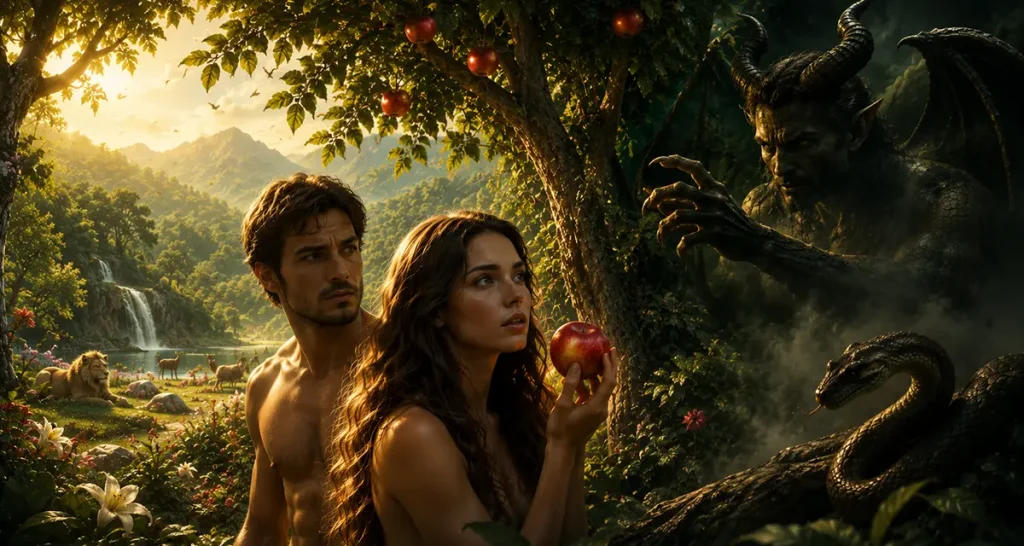
Your observation exposes one of the deepest ironies of the Fall. The tragedy was not merely that Adam and Eve disobeyed a command. It was that they believed a created thing could give them what only the Creator possesses. And, as you rightly point out, we have been repeating that same error ever since.
🌳 The Great Exchange
Notice the sequence in Genesis.
God had already given mankind an astonishing position:
“Then God said, ‘Let Us make man in Our image, according to Our likeness; let them have dominion over the fish of the sea, over the birds of the air, and over the cattle, over all the earth…'” (Genesis 1:26)
Adam was not a slave wandering in a wilderness. He was God’s image-bearer, placed in a garden prepared by God Himself.
Then,
“The LORD God took the man and put him in the garden of Eden to tend and keep it.” (Genesis 2:15)
The garden was already full of abundance. Adam’s work was not punishment but joyful stewardship. He cultivated what God had planted. He ruled over what God had entrusted.
Even the forbidden tree stood inside territory already under Adam’s stewardship.
Think about that.
The serpent was essentially saying,
“You have dominion over all this… but there is one thing God is withholding.”
The temptation was never about fruit.
It was about trust.
🍎 The Fruit Had No Magical Properties
This is important.
The Bible never suggests the fruit possessed supernatural power.
Nothing in Genesis says the fruit contained divine essence.
Nothing says it could actually make someone a god.
The serpent simply asserted:
“For God knows that in the day you eat of it your eyes will be opened, and you will be like God, knowing good and evil.” (Genesis 3:5)
The irony is painful.
They already bore God’s image (Genesis 1:26-27).
They already walked with Him.
They already ruled creation.
They already possessed everything necessary for life.
Yet they reached for something created expecting it to produce what only communion with God could sustain.
That pattern has never changed.
💰 We Still Believe Created Things Can Do What Only God Can
Paul describes humanity this way:
“…they exchanged the truth of God for the lie, and worshiped and served the creature rather than the Creator, who is blessed forever. Amen.” (Romans 1:25)
Notice the exchange.
The issue is not merely worshiping statues.
It is expecting creation to provide what belongs exclusively to God.
Money promises security.
Success promises significance.
Relationships promise ultimate fulfillment.
Knowledge promises control.
Technology promises transcendence.
Power promises freedom.
Pleasure promises satisfaction.
Religion itself can promise righteousness apart from Christ.
Every age has its fruit.
The object changes.
The lie remains identical.
👑 They Wanted What They Already Had—But Independently
The serpent’s words are incredibly subtle.
He does not deny God.
He reframes God.
God becomes the obstacle instead of the source.
The temptation was not,
“Reject God.”
It was,
“Become what God is without depending on Him.”
That is the essence of autonomy.
Not simply independence.
But defining reality apart from the Creator.
It is remarkable that God had already declared,
“Let Us make man in Our image…” (Genesis 1:26)
Yet Satan whispers,
“You can become like God.”
He offered as a future achievement what was already a present gift.
The difference was relational.
One is received.
The other is seized.
🌱 The Tree Was Never the Center of the Garden
Sometimes we unconsciously imagine Eden as revolving around the forbidden tree.
Genesis does not.
The emphasis is on God’s generosity.
“And out of the ground the LORD God made every tree grow that is pleasant to the sight and good for food.” (Genesis 2:9)
Then God says,
“Of every tree of the garden you may freely eat…” (Genesis 2:16)
Only afterward comes the prohibition.
One tree.
Everything else was invitation.
Yet the serpent succeeded in making abundance disappear behind a single restriction.
That is astonishingly familiar.
How often do we stand surrounded by God’s mercies yet fix our eyes on the one thing withheld?
You mentioned this in an earlier discussion:
“…she began looking at the one thing she lacked.”
That is exactly the serpent’s strategy.
Shift attention from abundance to absence.
🪞 The Fall Was a Failure of Vision Before It Was a Failure of Action
Genesis tells us:
“So when the woman saw that the tree was good for food, that it was pleasant to the eyes, and a tree desirable to make one wise…” (Genesis 3:6)
Nothing about the tree changed.
What changed was her perception.
Faith sees creation through God’s word.
Unbelief judges God’s word through creation.
That reversal is catastrophic.
Instead of saying,
“God has spoken; therefore this tree is not for me,”
she says,
“This tree looks good; therefore perhaps God’s word should be questioned.”
Appearances became the judge of revelation.
✝️ Christ Faced the Same Temptation—and Won
This is why the temptation of Jesus is so significant.
Satan again points to created realities.
Bread.
The kingdoms of the world.
The pinnacle of the temple.
Each temptation offered something good detached from trusting the Father (Matthew 4:1-11).
Jesus answers every time,
“It is written…”
Where Adam interpreted God’s word through the fruit,
Jesus interpreted every visible circumstance through God’s word.
The second Adam succeeded where the first Adam failed (Romans 5:12-19; 1 Corinthians 15:45-49).
🌿 A Sobering Reflection
Perhaps one of the greatest lessons of Eden is this:
Creation is a magnificent gift.
But creation was never designed to replace communion with the Creator.
The fruit could nourish Adam’s body.
It could never transform his nature.
Only the God who breathed life into him could do that (Genesis 2:7).
The deepest irony, then, is exactly what you observed.
Adam was already the steward of the tree.
He was already the lord of creation under God.
Yet he believed one small piece of the creation he governed could elevate him above the God who had given him everything.
That is the madness of sin.
And it is still ours whenever we expect anything created—whether possessions, achievements, relationships, ideologies, experiences, or even religious performance—to give us what is found only in knowing God through Jesus Christ.
As Paul declares,
“For in Him dwells all the fullness of the Godhead bodily; and you are complete in Him…” (Colossians 2:9-10).
The serpent said, “Take, and you will become.”
The gospel says, “Receive Christ, because in Him you already possess the fullness for which your soul was created.” That is why Paul can say elsewhere, “He who did not spare His own Son… how shall He not with Him also freely give us all things?” (Romans 8:32). The answer to the lie of Eden is not found in a different fruit, but in the Son, “in whom are hidden all the treasures of wisdom and knowledge” (Colossians 2:3). In Him, the restless reaching of Eden finally comes to rest.