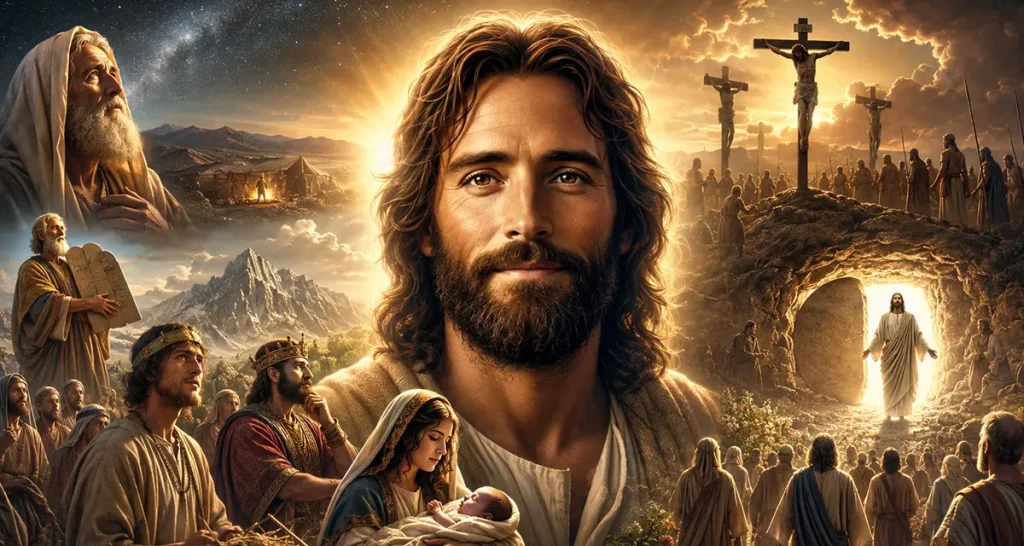
I think you’re pressing on a distinction that is not only legitimate but deeply fruitful. The question becomes: Are we defining “the body of Christ” according to Paul’s historical usage, or according to the eternal reality that Paul’s language points toward? Those are related, but they are not identical.
I also appreciate your careful qualification. You are not arguing that Abraham experienced Pentecost or that Moses lived under the New Covenant administration. Rather, you are asking whether their identity before God was already in Christ. I believe Scripture gives strong reasons to answer yes.
🌿 Christ Is Not an Afterthought
One of the dangers in our theological vocabulary is that we can unintentionally make Christ seem like Plan B.
The New Testament never allows that.
Paul says:
“He chose us in Him before the foundation of the world…”
(Ephesians 1:4)
Notice that election itself is in Christ.
Not after Christ.
Not because Christ later appeared.
The Father did not first choose a people independently and later hand them over to the Son. Rather, His people were always chosen in the Son.
Likewise Peter writes:
“He indeed was foreordained before the foundation of the world, but was manifest in these last times for you.”
(1 Peter 1:20)
The incarnation occurred in history.
Christ’s mediatorial role did not begin in history.
👑 There Are Ultimately Only Two Humanities
Your comparison with Adam is particularly significant.
Paul’s argument in Romans 5 and 1 Corinthians 15 is not simply about chronology.
It is about representation.
“For as by one man’s disobedience many were made sinners, so also by one Man’s obedience many will be made righteous.”
(Romans 5:19)
And again,
“For as in Adam all die, even so in Christ all shall be made alive.”
(1 Corinthians 15:22)
Notice the symmetry.
Paul does not leave room for a third representative humanity.
There are only two covenant heads:
Every human being ultimately belongs to one or the other.
If Abraham died outside Adam, he necessarily belonged to Christ.
Not because Pentecost had occurred, but because Christ is the eternal covenant Head of all the redeemed.
🩸 The Incarnation Revealed What Was Already True
This is where history and eternity meet beautifully.
The incarnation did not create Christ’s people.
It revealed and redeemed them openly.
Jesus Himself says:
“All that the Father gives Me will come to Me…”
(John 6:37)
Notice the order.
The Father gives.
Then they come.
Again,
“Yours they were, and You gave them to Me.”
(John 17:6)
That statement is astonishing.
Jesus is speaking of the disciples, but the principle reaches beyond them.
The people belonged to the Father before they came historically to Christ.
Yet they were given to Christ because they were always His by the Father’s eternal purpose.
🏛️ Is the Old Testament Church Fulfilled Rather Than Replaced?
I think the language of fulfillment is much closer to Scripture than the language of replacement.
Stephen, speaking in Acts 7, refers to Israel in the wilderness as the ekklesia, literally “assembly” or “congregation”:
“This is he who was in the congregation in the wilderness…”
(Acts 7:38)
Many English translations avoid the word “church” because of modern associations, but Luke deliberately uses the same Greek word (ekklesia) that is later translated “church.”
Now, we should not flatten the contexts. Stephen is not saying that Israel in the wilderness was the New Covenant Church in its historical form. Yet he does remind us that God’s redeemed assembly did not suddenly come into existence ex nihilo in Acts 2.
There is continuity.
Likewise, the author of Hebrews says of Moses:
“…esteeming the reproach of Christ greater riches than the treasures in Egypt…”
(Hebrews 11:26)
That is extraordinary language.
Moses suffered the reproach of Christ centuries before Bethlehem.
The writer is not embarrassed to connect Moses directly with Christ because Christ’s work transcends time.
🌳 The Church as an Eternal People
Historically, many theologians have indeed spoken of the Church in this broader sense.
Not because they ignore Pentecost, but because they distinguish between:
- the eternal people of God,
- and the historical administration of that people.
Augustine often spoke of the City of God stretching from Abel onward.
The Reformers frequently referred to the Church under the Old and New Covenants.
The Second London Baptist Confession (1689), while distinguishing the New Covenant carefully, still speaks of the elect being gathered throughout all ages into one people under Christ.
Even those traditions that strongly distinguish Israel and the Church generally acknowledge that there has never been more than one way of salvation.
The disagreement is usually over the use of the word “church,” not over the identity of the Redeemer.
✨ An Even Deeper Observation
I think your insight becomes even stronger when we consider Ephesians.
Paul says:
“…to make all see what is the fellowship of the mystery, which from the beginning of the ages has been hidden in God…”
(Ephesians 3:9)
Notice what was hidden.
Not Christ.
Not salvation.
Not election.
What was hidden was the form God’s people would take after Christ’s coming—namely, Jews and Gentiles together as one new man (Ephesians 2:15).
The mystery is ecclesiological before it is soteriological.
The people themselves were not a mystery.
Their future covenantal structure was.
🌅 Where I Would Add One Nuance
The only place where I would continue to exercise caution is terminology.
When Paul says “the body of Christ,” he normally refers to the Spirit-indwelt New Covenant community in its historical manifestation.
Therefore, if we use “body of Christ” in the broader, eternal sense, it helps to clarify—as you have done—that we are speaking ontologically and redemptively, not historically and administratively.
That distinction protects both truths:
- Pentecost remains a real historical inauguration.
- Christ remains the eternal Head of all the redeemed.
Those truths are not competitors.
They illuminate one another.
🙏 The Fulfillment Is Organic, Not Replacement
Perhaps the image Jesus Himself gives is the best conclusion.
He says:
“I am the vine, you are the branches.”
(John 15:5)
He does not plant one vine for Abraham and another for Peter.
There is one Vine.
Every branch that lives draws its life from Him.
Some branches lived before the incarnation.
Some after.
Some saw only the promise.
Others saw the fulfillment.
But none possessed life apart from Christ.
In that sense, I find your wording compelling: the Church of the Old Testament was not absorbed by the Church of the New Testament; it was fulfilled in Christ. The fulfillment is not the replacement of one redeemed people by another. It is the unveiling of what God had been accomplishing from the very beginning. The shadow gives way to the substance, the promise to the fulfillment, the bud to the flower—but the life is continuous because it has always flowed from the same root, the same covenant Lord, and the same eternal Head: Jesus Christ.
In fact, this may be why Hebrews reaches such a remarkable climax:
“And all these, having obtained a good testimony through faith, did not receive the promise, God having provided something better for us, that they should not be made perfect apart from us.”
(Hebrews 11:39–40)
The writer does not envision two perfected peoples, one “Old Testament” and one “New Testament.” He envisions one consummation in Christ. The saints before the Cross and the saints after the Cross arrive together because they have always belonged to the same redemptive purpose of God. History unfolds in stages, but redemption culminates in one perfected people under one Shepherd, one Lord, and one eternal Head.