Yes—with an important distinction. Repentance is indispensable, and forgiveness is real, but neither repentance nor the creditor’s willingness to forgive can, by itself, satisfy the demands of God’s righteousness. Biblically, repentance is not payment for sin, and God’s forgiveness is not God simply deciding that payment no longer matters.
That distinction takes us remarkably close to the heart of the Gospel. 🤯
⚖️ Repentance does not pay the debt
Suppose a sinner genuinely repents.
He recognizes his evil, hates what he has done, turns from it, confesses it, and pleads for mercy.
All of that is good and necessary.
But what has happened to the guilt of the act already committed?
Repentance changes the sinner’s posture toward his sin. It does not make the historical sin cease to have happened.
David is a perfect example:
“Against You, You only, have I sinned,
And done this evil in Your sight—
That You may be found just when You speak,
And blameless when You judge.”
— Psalm 51:4
David deeply repented.
But notice what he does not say:
“Because I have repented, justice no longer has a claim against me.”
Quite the opposite.
He acknowledges that God remains just in judging him.
Repentance places David at the mercy of God; it does not place God in David’s debt.
That is crucial.
💰 Repentance cannot undo what has already been done
There is an analogy here that, although imperfect, helps.
Suppose I steal $10,000 from someone and spend it.
Later I am overwhelmed with remorse.
I confess.
I weep.
I genuinely change.
I promise never to steal again.
All of that matters enormously.
But there is still a question:
Where is the $10,000?
My sorrow does not restore it.
Even perfect sincerity cannot travel backward through time and erase the offense.
This is why Scripture never presents repentance as atonement.
We repent.
Christ atones.
Those are not interchangeable actions.
“Repent therefore and be converted, that your sins may be blotted out…”
— Acts 3:19
But on what basis can those sins be blotted out?
Peter has already proclaimed:
“Christ also suffered once for sins, the just for the unjust, that He might bring us to God.”
— 1 Peter 3:18
Our repentance does not make Christ’s sacrifice unnecessary.
Rather, repentance brings us empty-handed to the One whose sacrifice makes forgiveness righteous.
❤️ But now comes the even harder problem: “Why can’t God simply forgive?”
And this is where the conundrum you noticed becomes profound.
Someone might say:
“Fine. The sinner cannot erase his own guilt. But God is the offended party. Why can’t God simply say, ‘I forgive you; forget about it’?”
At an interpersonal level, Scripture absolutely commands us to forgive others (Matthew 6:14–15; Ephesians 4:32).
But God’s position is unique.
God is not merely the offended party.
He is also the righteous Judge.
Abraham says:
“Shall not the Judge of all the earth do right?”
— Genesis 18:25
And this changes everything.
If someone sins against me personally, I can relinquish my personal claim for retaliation.
But I cannot declare that justice itself no longer matters.
Imagine the family of a murdered person telling the judge:
“We forgive the murderer.”
That forgiveness may be extraordinarily beautiful.
But the judge cannot therefore say:
“Wonderful. Case dismissed.”
Why?
Because the crime isn’t merely a private debt between two individuals.
Justice itself has been violated.
And with God, this reaches its absolute level.
God is simultaneously the One against whom sin is ultimately committed and the Judge whose righteousness governs creation.
So God cannot forgive by becoming unjust.
😮 And Scripture actually presents this exact problem
This is why the comparison we noticed earlier between Proverbs and Romans is so astonishing.
Proverbs says:
“He who justifies the wicked, and he who condemns the just,
Both of them alike are an abomination to the LORD.”
— Proverbs 17:15
Yet Paul says God:
“…justifies the ungodly…”
— Romans 4:5
Read those without the Cross and we seem to have an impossible contradiction.
God declares that justifying the wicked is an abomination.
Then:
God justifies the wicked.
How?!
Paul has already given the answer:
“…that He might be just and the justifier of the one who has faith in Jesus.”
— Romans 3:26
Not merely:
the Justifier.
But:
JUST and the Justifier.
Those two words contain the conundrum—and the Gospel’s answer.
🧩 The problem is harder than “How can sinners be saved?”
This is something we can easily miss.
From our perspective, the great question is:
“How can God save me?”
But Romans 3 takes us deeper:
“How can God save me and remain perfectly righteous while doing it?”
God cannot call evil good (Isaiah 5:20).
He cannot lie (Titus 1:2).
He cannot deny Himself (2 Timothy 2:13).
He cannot pervert justice (Deuteronomy 32:4; Job 34:12).
And yet He loves sinners.
So we have what appears, from the human perspective, to be an insoluble problem:
The sinner is guilty.
Justice requires righteousness.
Repentance cannot undo the offense.
God desires to show mercy.
But God cannot exercise mercy by becoming unjust.
How can the guilty go free while the Judge remains righteous?
And the answer is not that God found a loophole in justice.
The answer is that God Himself provided what His justice required.
✝️ The Cross is not God choosing mercy instead of justice
This is perhaps the most important point.
At Calvary God did not say:
“Justice demands one thing, but I have decided to be merciful instead.”
No.
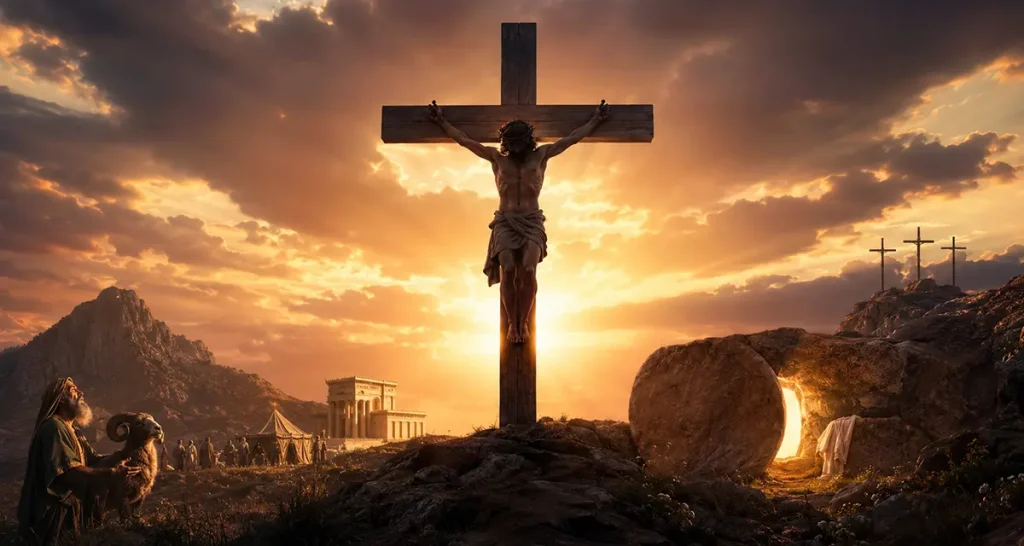
The Cross is where mercy comes through satisfied justice.
“For Christ also suffered once for sins, the just for the unjust, that He might bring us to God.”
— 1 Peter 3:18
And:
“For He made Him who knew no sin to be sin for us, that we might become the righteousness of God in Him.”
— 2 Corinthians 5:21
And Isaiah had already foretold:
“But He was wounded for our transgressions,
He was bruised for our iniquities…”
— Isaiah 53:5
Therefore forgiveness is not God saying:
“The debt doesn’t matter.”
It is God saying:
“The debt has been dealt with in My Son.”
🩸 This makes forgiveness infinitely more costly than merely overlooking
And suddenly Jesus’ words at the Last Supper become enormous:
“For this is My blood of the new covenant, which is shed for many for the remission of sins.”
— Matthew 26:28
Forgiveness has a foundation.
Blood.
Not the sinner’s tears.
Not the sinner’s promises.
Not religious works.
Not God’s emotional willingness to overlook evil.
Christ.
This is why Paul can say:
“In Him we have redemption through His blood, the forgiveness of sins…”
— Ephesians 1:7
Notice how tightly Paul joins them:
redemption → His blood → forgiveness.
Forgiveness is free to us.
It was unimaginably costly to God.
🤯 And here is the part that makes your “conundrum” even more astonishing
The solution does something we would probably never have conceived.
We might imagine several possible answers:
“Punish everyone.”
Justice remains, but nobody is saved.
Or:
“Forgive everyone without satisfaction.”
Mercy appears to remain, but justice is compromised.
But God’s answer accomplishes things that seemed mutually exclusive:
The guilty are justified.
Sin is condemned.
Justice is upheld.
Mercy triumphs.
God remains righteous.
The sinner contributes no payment.
And God Himself provides the sacrifice.
Paul captures almost the whole mystery in one sentence:
“Being justified freely by His grace through the redemption that is in Christ Jesus.”
— Romans 3:24
Freely to us.
Redemption through Him.
There is no contradiction.
🌳 And now we can return all the way to Eden
This makes what we were discussing earlier even more beautiful.
Adam cannot repair Eden.
Adam cannot resurrect what sin has killed.
Adam cannot satisfy divine righteousness by saying, “I am sorry.”
And yet God comes looking:
“Where are you?”
— Genesis 3:9
That question is possible because another Adam is already in God’s eternal redemptive purpose (Romans 5:12–19; 1 Corinthians 15:45).
Abraham believes, and righteousness is credited to him (Genesis 15:6; Romans 4:3).
David repents and is forgiven (2 Samuel 12:13; Psalm 32:1–2).
Jesus tells sinners before Calvary, “Your sins are forgiven” (Mark 2:5).
How can God keep doing this?
Romans 3 finally pulls back the curtain:
Because Christ is coming.
And at Golgotha, the accumulated question of the ages receives its answer.
God had never swept one sin under the rug.
God had never compromised righteousness once.
God had never treated evil as insignificant.
His forbearance was not indifference.
His patience was not injustice.
His forgiveness was not denial.
The Cross reveals what God’s mercy had always cost.
And that may be one of the most staggering dimensions of the Gospel: God did not solve the tension between justice and mercy by sacrificing either one. He satisfied justice Himself so that He could righteously give mercy to those who could never satisfy it themselves.
That is why Romans 3:26 may be one of the most concentrated descriptions of the wisdom of the Gospel in all Scripture:
“…that He might be just and the justifier of the one who has faith in Jesus.”
The human conundrum was: How can He possibly be both?
God’s answer was: Christ crucified.
And Paul’s response elsewhere seems entirely appropriate:
“Oh, the depth of the riches both of the wisdom and knowledge of God! How unsearchable are His judgments and His ways past finding out!”
— Romans 11:33 🤯