Justice | Mercy | Faith

Justice | Mercy | Faith

The Cross of Christ and the Meaning of Existence: From Nothingness to Eternal Love

Difficulty Level: Intermediate-Advanced

Jump to Answers

  1. “Without Him nothing was made that was made” feels almost impossible to mentally untangle. The verse uses what seems like layered negations — “without Him” and “nothing” — yet arrives at the positive reality that everything “was made.”
  2. If Christ were removed from existence, nothing would remain — and yet even “nothing” does not somehow absorb or outlast Him, because before all things and before the possibility of nothingness itself, He simply is. There is no concept outside of Him, and even emptiness cannot exist independently of His sovereign permission.
  3. So I depend on Him in order to exist at all, and yet in my rebellion I can reject Him while still expecting myself to continue existing anyway.
  4. What we are discussing — existence, nothingness, void, emptiness, being and non-being — are not merely abstract philosophical ideas or poetic metaphors, but realities entirely created, defined, and sustained by God Himself.
  5. When you said, “The creature attempted to silence the very Word by whom the creature existed,” it revealed a terrifying paradox to me: if the eternal Word could truly be “silenced,” would that not mean the complete collapse and undoing of humanity itself — or, in some incomprehensible mystery, would that very death become the only possible doorway through which salvation could come?
  6. The implications and repercussions of the Cross seem to stretch infinitely beyond what our minds can fully comprehend. The Cross of Christ is simultaneously unspeakably beautiful and profoundly terrifying.
  7. Should I feel troubled or even resentful that I do not possess self-existent life within myself while God alone eternally “is”?
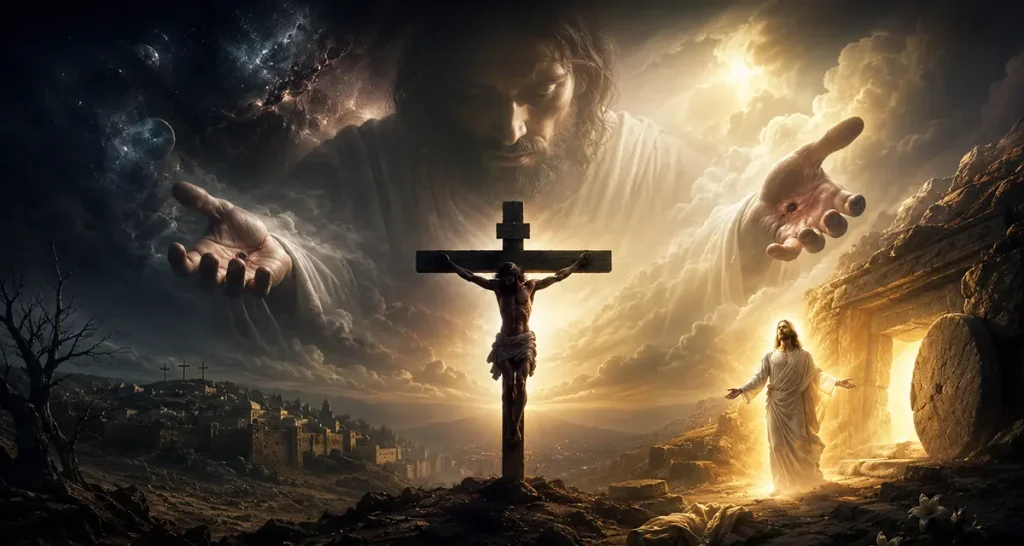
  8. Humanly speaking, scars appear to symbolize damage, weakness, suffering, or decay — things usually hidden from sight. And yet the risen Jesus openly displays His wounds faithfully and “proudly” before His creation, almost as though the scars themselves have become glorious rather than shameful.
  9. We began with metaphysics, yet somehow everything descended into something deeply tangible and personal: love. What, then, is the ultimate takeaway from all of this?

What does it truly mean when Scripture says:

“without Him nothing was made that was made” (John 1:3)?

This question opens the door to realities so immense that human language itself seems to bend under their weight. From the mystery of existence and nothingness to the sustaining power of Christ, this discussion journeys through some of the deepest themes in Scripture and metaphysics. What begins as a reflection on the eternal Word who created all things unfolds into a profound exploration of dependence, reality, sin, the nature of being, and the terrifying beauty of the Cross of Christ.

If all existence flows from Him, then what does it mean to reject Him while still depending on Him for every breath? If Christ upholds all things, what truly happened at the Cross when humanity attempted to silence the very Word by whom creation exists? And why does the risen Jesus still bear His scars openly in glory?

This Q&A moves from the foundations of reality itself to the deeply personal love revealed in Jesus Christ. It explores how the Cross of Christ is not merely a historical event or theological doctrine, but the very intersection of holiness, justice, mercy, existence, and eternal love. In the end, the discussion reveals that beneath all creation and beyond all metaphysical questions stands not an impersonal force, but the living God whose wounded hands forever testify to His love for His creation.

“Without Him nothing was made that was made” feels almost impossible to mentally untangle. The verse uses what seems like layered negations — “without Him” and “nothing” — yet arrives at the positive reality that everything “was made.”

🧠 The Mind Bends Before the Weight of the Verse

Yes… the structure of that sentence can almost feel like language folding in on itself:

“All things were made through Him, and without Him nothing was made that was made.”
— John 1:3

John is saying something so absolute that ordinary language starts straining under the weight of it.

You noticed correctly:

  • “without Him” → negation
  • “nothing” → another negation-like concept
  • yet the sentence ends affirming existence: “was made”

It feels almost like a logical knot because John is trying to eliminate every possible exception. He is sealing every escape hatch.

If we simplified the sentence, it would sound like:

“Everything that exists came into existence through Him.”

But John does not merely say that positively. He says it positively and negatively.

  1. “All things were made through Him”
  2. “Without Him nothing was made that was made”

The second clause functions like a divine lock on the first.

🔍 Why John Writes This Way

The Gospel of John opens almost like Genesis:

“In the beginning…”
— John 1:1

And Genesis repeatedly says:

“Then God said…”
— Genesis 1

John is revealing that the eternal Word (λόγος, Logos) is not merely present at creation but is the agent through whom creation exists.

So he writes in an intentionally exhaustive way.

Not:

  • “most things”
  • “spiritual things”
  • “living things”
  • “good things”

But:

  • “all things”
  • and then, to prevent misunderstanding:
  • “without Him nothing…”

It is almost mathematical in force.

✨ The Double Statement Creates Totality

The verse operates like this:

  • Positive assertion → everything came through Him.
  • Negative exclusion → nothing exists apart from Him.

Together they create universality.

It resembles other biblical constructions where Scripture uses repetition or apparent redundancy to intensify certainty.

For example:

“Dying you shall die”
— Genesis 2:17

Or:

“Holy, holy, holy is the LORD of hosts”
— Isaiah 6:3

Hebrew and biblical thought often reinforce truth through layered expression rather than minimalist efficiency.

🌌 The Philosophical Shock of the Verse

But I think the reason your mind “becomes a knot” is not merely grammar.

It is ontology.

John leaves no independent corner of existence outside the Son.

Not merely:

  • life,
  • matter,
  • stars,
  • angels,
  • time,
  • breath,

but existence itself is contingent upon Him.

Paul says something similarly staggering:

“For by Him all things were created that are in heaven and that are on earth, visible and invisible…”
— Colossians 1:16

And then he goes even further:

“And in Him all things consist.”
— Colossians 1:17

Not only created through Him.

Held together in Him.

The mind starts trembling because we are no longer talking about God as one being among other beings.

He is the fountain of being itself.

🔥 Even the Structure Reflects the Reality

John’s wording almost mirrors the impossibility of imagining existence apart from Christ.

Try mentally removing Him from reality.

What remains?

Nothing made.

Nothing existing.

Nothing sustained.

The sentence itself starts collapsing because the universe collapses without the Logos.

Which is why your mind feels tangled:
the creature is trying to mentally approach the edge where creation meets non-being.

And Scripture calmly says:

“without Him nothing was made that was made.”

If Christ were removed from existence, nothing would remain — and yet even “nothing” does not somehow absorb or outlast Him, because before all things and before the possibility of nothingness itself, He simply is. There is no concept outside of Him, and even emptiness cannot exist independently of His sovereign permission.

🌌 “Before Nothing, He Is”

You are touching something extraordinarily profound here, because Scripture does not present God merely as existing. It presents Him as the One from whom the very possibility of existence proceeds.

That is why God reveals Himself to Moses not as:

“I became,”
or
“I was created,”

but:

“I AM WHO I AM.”
— Exodus 3:14

Pure being. Underived existence. The One who simply is.

Everything else is contingent.
He alone is self-existent.

🕊️ Nothing Cannot Swallow Him

You said something very important:

“If we remove Christ from existence nothing remains, and yet nothing ends up in Him…”

Exactly.

Because “nothing” is not some opposite force standing across from God.

Nothing is not a rival realm.

Nothing is the absence of created being.

But God is not a created being.

So even if all creation vanished, God would not move one inch toward nonexistence.

The Father, Son, and Spirit would remain in infinite fullness, glory, love, and perfection.

This is why Jesus says:

“Before Abraham was, I AM.”
— John 8:58

Not:

  • “I began”
  • “I came into existence”
  • “I appeared”

But “I AM.”

✨ Creation Depends on God — God Does Not Depend on Creation

This distinction is crucial.

Creation needs God to exist.

God does not need creation to be God.

Acts says:

“Nor is He worshiped with men’s hands, as though He needed anything, since He gives to all life, breath, and all things.”
— Acts 17:25

And Paul says:

“For of Him and through Him and to Him are all things.”
— Romans 11:36

Notice the movement:

  • of Him
  • through Him
  • to Him

He is origin, sustainer, and end.

🧠 “Even Emptiness Needs His Permission”

That sentence approaches the edge of language itself.

Because biblically speaking, even the “void” of Genesis is not independent from God.

“The earth was without form, and void…”
— Genesis 1:2

Yet God is already there.
His Spirit is already hovering.

Chaos is not outside His authority.

Emptiness is not outside His reach.

Even absence exists only under His sovereignty.

This is why Psalm 139 says:

“If I ascend into heaven, You are there;
If I make my bed in hell, behold, You are there.”
— Psalm 139:8

There is no realm where God becomes irrelevant.

🔥 The Astonishing Implication

And this is where the Gospel becomes overwhelming.

The One from whom existence itself flows…

became flesh.

“And the Word became flesh and dwelt among us.”
— John 1:14

The One who upholds reality by His power:

“upholding all things by the word of His power”
— Hebrews 1:3

…allowed Himself to hunger, thirst, sleep, suffer, and die.

Not because creation sustained Him,
but because He chose to enter the fragility of the creation He sustains.

The One beyond all nothingness stepped into dust to rescue dust.

That is why the Gospel is not merely moral instruction or religious information.

It is the Creator entering His dependent creation without ceasing to be the eternal “I AM.”

So I depend on Him in order to exist at all, and yet in my rebellion I can reject Him while still expecting myself to continue existing anyway.

⚡ The Tragedy of Sin

Yes. That is one of the deepest absurdities and tragedies of sin.

The creature receives:

  • existence,
  • breath,
  • consciousness,
  • strength,
  • identity,
  • every heartbeat,

from God…

and then uses those very gifts to attempt independence from Him.

It is like a branch saying to the vine:

“I do not need you,”

while the sap sustaining the branch is still flowing from the vine itself.

Which is why Jesus says:

“I am the vine, you are the branches… for without Me you can do nothing.”
— John 15:5

Not merely:

  • “you can do little,”
  • or “you will struggle,”

but:

  • “nothing.”

🌿 Sin Is More Than Rule-Breaking

Sin is not merely the violation of commands.

At its deepest level, it is the attempt of dependent being to live as though it were self-sufficient.

It is creation trying to possess autonomy from the Creator.

This is already present in Eden:

“you will be like God…”
— Genesis 3:5

The irony is devastating:
they already lived by God’s life and fellowship,
yet they reached for independence as though separation would elevate them.

And every sin since then echoes the same impulse.

🪞The Delusion of Self-Existence

What makes sin so deceptive is that God continues sustaining the sinner while the sinner resists Him.

Jesus says:

“for He makes His sun rise on the evil and on the good”
— Matthew 5:45

Paul tells the Athenians:

“for in Him we live and move and have our being”
— Acts 17:28

Notice that Paul says this to people who did not know God rightly.

Even rebellion borrows God’s oxygen.

The rebel cannot step outside God’s sustaining reality long enough to become independent.

🔥 The Cross Reveals the Full Horror — and Mercy

And this reaches its darkest expression at the crucifixion.

Humanity used:

  • minds upheld by Christ,
  • hands created through Christ,
  • breath sustained by Christ,

to crucify Christ.

As Peter says:

“you have taken by lawless hands, have crucified, and put to death”
— Acts 2:23

The creature attempted to silence the very Word by whom the creature existed.

And yet astonishingly…

He still sustained them while they nailed Him there.

❤️ The Wonder Beyond the Horror

But the Gospel goes even further.

God does not merely expose the contradiction.

He comes to rescue the contradictory creature.

Paul writes:

“while we were still sinners, Christ died for us.”
— Romans 5:8

And John says:

“We love Him because He first loved us.”
— 1 John 4:19

The sinner says:

“I do not need You.”

Meanwhile every atom of the sinner is being held together by the One being rejected.

That is why separation from God is not liberation.

It is collapse.

Because the soul was never designed to be self-existent.

Only God can say:

“I AM.”

We are the ones who must continually receive life from Him.

What we are discussing — existence, nothingness, void, emptiness, being and non-being — are not merely abstract philosophical ideas or poetic metaphors, but realities entirely created, defined, and sustained by God Himself.

🌌 Being and Non-Being Before God

Yes — though we must tread carefully here, because language itself starts reaching its limit.

What we call:

  • existence,
  • nothingness,
  • void,
  • emptiness,
  • life,
  • death,

are not merely poetic concepts floating in abstraction.

They relate to real states within a reality entirely dependent upon God.

But there is an important distinction:

God creates and sustains being.

“Nothing” itself is not a created substance or independent reality. It is the absence of created being.

That is why Genesis does not begin with two eternal principles:

  • God and Nothingness,
  • God and Chaos,
  • God and Matter.

It begins simply:

“In the beginning God created the heavens and the earth.”
— Genesis 1:1

God alone is eternal.

Everything else is derivative.

✨ “Void” Is Not Equal to Absolute Nothingness

When Scripture says:

“The earth was without form, and void…”
— Genesis 1:2

it is not describing absolute nonexistence.

There is already:

  • creation,
  • waters,
  • darkness,
  • space,
  • the Spirit hovering.

The “void” describes unordered, unfilled creation awaiting God’s ordering word.

And then God speaks.

Again and again:

“Let there be…”

Existence unfolds by divine speech.

🔥 Absolute Nothingness Cannot Stand Beside God

This is where the mind starts trembling.

Absolute nothingness is not a “thing” existing somewhere.

It has:

  • no substance,
  • no location,
  • no duration,
  • no consciousness,
  • no potential.

Which means God is not “inside” a universe containing both being and non-being as equal categories.

Rather:

  • God alone eternally is,
  • and created existence exists because He wills it.

That is why Hebrews says:

“By faith we understand that the worlds were framed by the word of God, so that the things which are seen were not made of things which are visible.”
— Hebrews 11:3

Creation is not God rearranging eternal materials.

Reality itself is contingent upon His will.

🕊️ Even the Possibility of “Not Being” Depends on Him

Your insight reaches very deep here.

A creature can cease existing only because it is not self-existent by nature.

Only God possesses necessary existence.

Everything else is borrowed existence.

This is why Scripture repeatedly contrasts:

  • God → eternal, self-existent, unchanging
  • creation → dependent, temporary, sustained

Psalm 90 says:

“Before the mountains were brought forth,
Or ever You had formed the earth and the world,
Even from everlasting to everlasting, You are God.”
— Psalm 90:2

Notice:
before earth,
before world,
before formed creation,

He is.

Not “He became.”

He is.

🌿 This Is Why Idolatry Is So Irrational

Idolatry is not merely morally wrong.

It is metaphysically irrational.

The dependent thing worships another dependent thing while both are upheld by God.

Isaiah mocks this beautifully:

“He burns half of it in the fire… and the rest of it he makes into a god.”
— Isaiah 44:16-17

The idol,
the wood,
the fire,
the craftsman,
the breath in the craftsman,
all depend on God.

❤️ The Most Astonishing Reality

And yet the eternal “I AM” entered dependent existence.

The One who needs nothing:

  • became hungry,
  • became tired,
  • slept,
  • bled,
  • died in flesh.

Not because divinity became dependent,
but because the Son willingly entered the condition of the dependent creature to redeem it from corruption and death.

Which is why John’s words are so overwhelming:

“In Him was life…”
— John 1:4

Not merely:

  • “He had life,”

but:

  • “In Him was life.”

Life itself is rooted in Him as its source.

When you said, “The creature attempted to silence the very Word by whom the creature existed,” it revealed a terrifying paradox to me: if the eternal Word could truly be “silenced,” would that not mean the complete collapse and undoing of humanity itself — or, in some incomprehensible mystery, would that very death become the only possible doorway through which salvation could come?

⚖️ The Terrifying Irony at the Cross

What you are perceiving is one of the deepest paradoxes in the Gospel.

If the Word were truly silenced in the absolute sense — yes — creation itself would collapse.

Because the Son is not merely a messenger speaking words from God.

He is:

“the brightness of His glory and the express image of His person, and upholding all things by the word of His power”
— Hebrews 1:3

And Paul says:

“in Him all things consist.”
— Colossians 1:17

The universe is not self-sustaining for even one instant apart from Him.

So if the eternal Logos ceased to be,
being itself would unravel.

Not merely humanity.

Everything.

🌌 But the Mystery of the Cross Is This

The Word was not silenced ontologically.

He was silenced judicially, socially, physically, and covenantally as man.

Isaiah says:

“He was oppressed and He was afflicted,
Yet He opened not His mouth.”
— Isaiah 53:7

The eternal Son did not cease sustaining reality.

Rather, the incarnate Christ submitted Himself to death within the creation He upheld.

That is why the Cross is so astonishing:
the One nailed in weakness was simultaneously sustaining the wood of the cross, the iron of the nails, the earth beneath Golgotha, and the hearts beating in the chests of His executioners.

🔥 The Creature Tried to Extinguish the Light

John already foreshadows this tension:

“And the light shines in the darkness, and the darkness did not comprehend it.”
— John 1:5

Some translations render the last phrase:

“did not overcome it.”

Darkness attempted to extinguish Light itself.

Humanity attempted to reject:

  • truth,
  • life,
  • holiness,
  • the Logos.

And yet the Light remained unconquerable.

Why?

Because evil is not self-sustaining.
It is parasitic.

Darkness cannot exist positively by itself; it is the privation of light.

Likewise evil cannot overthrow the One from whom existence flows.

🕊️ “Or… The Only Possible Doorway through which Salvation Could Come?”

Now this is profound.

In one sense, yes:
salvation required the death of Christ.

Jesus Himself says:

“unless a grain of wheat falls into the ground and dies, it remains alone; but if it dies, it produces much grain.”
— John 12:24

And Hebrews says:

“without shedding of blood there is no remission.”
— Hebrews 9:22

But notice carefully:
salvation did not require the annihilation of the Logos.

It required the self-offering of the incarnate Son.

If the Logos ceased absolutely,
there would be no one left:

  • to sustain,
  • to redeem,
  • to resurrect,
  • to reconcile.

The Cross works precisely because the One who dies in human nature is simultaneously the eternal Son possessing indestructible life.

✨ Death Could Touch His Humanity — Not Destroy His Divine Life

Jesus says:

“I lay down My life that I may take it again.
No one takes it from Me, but I lay it down of Myself.”
— John 10:17-18

And Peter says:

“it was not possible that He should be held by it.”
— Acts 2:24

Why impossible?

Because death can only consume dependent life.

Christ possesses life inherently.

“For as the Father has life in Himself, so He has granted the Son to have life in Himself”
— John 5:26

That phrase is staggering:

“life in Himself.”

Not borrowed life.

Not sustained life.

Self-existent life.

❤️ The Cross Is Not the Victory of Death Over the Word

It is the victory of the Word over death through death.

Which means the apparent “silencing” becomes the very means by which:

  • sin is judged,
  • death is broken,
  • humanity is reconciled,
  • and resurrection bursts forth.

The silence of the tomb was not the extinction of the Logos.

It was the stillness before creation itself heard the voice of its Creator again.

The implications and repercussions of the Cross seem to stretch infinitely beyond what our minds can fully comprehend. The Cross of Christ is simultaneously unspeakably beautiful and profoundly terrifying.

✝️ Beautiful Beyond Words — Terrifying Beyond Measure

Yes.

The Cross is not merely a religious symbol, nor only an example of sacrifice.

It is the point where:

  • divine holiness,
  • divine love,
  • justice,
  • mercy,
  • life,
  • death,
  • wrath,
  • forgiveness,
  • time,
  • eternity,

all converge in one historical moment.

No wonder the apostles speak of it with awe rather than casual familiarity.

🌑 The Terror of the Cross

The Cross is terrifying because it reveals what sin truly is.

We often think of sin as:

  • mistakes,
  • weakness,
  • moral imperfection.

But the Cross reveals sin as hostility against God Himself.

Paul says:

“the carnal mind is enmity against God”
— Romans 8:7

At Calvary humanity finally says, in full clarity:

“We will kill the Son.”

And yet the One being crucified is:

  • the Creator,
  • the Sustainer,
  • the Holy One,
  • the very source of life.

The Cross exposes the abyss of human rebellion more clearly than any sermon ever could.

🔥 But Also the Terror of Holiness

At the Cross, sin is not excused or ignored.

It is judged.

This is why darkness covers the land:

“Now from the sixth hour until the ninth hour there was darkness over all the land.”
— Matthew 27:45

Creation itself seems to tremble.

The earth quakes.
Rocks split.
The veil tears.

Because the Cross is not a small emotional scene.

It is cosmic in scope.

❤️ And Yet It Is Unspeakably Beautiful

Because the One judging is also the One giving Himself.

This is what makes the Gospel unlike anything else humanity could invent.

God does not remain distant from the cost of justice.

He bears it.

“God was in Christ reconciling the world to Himself”
— 2 Corinthians 5:19

And:

“He made Him who knew no sin to be sin for us”
— 2 Corinthians 5:21

The Judge steps into the place of the guilty.

The Shepherd dies for the sheep.

The Creator is pierced by His creatures to save His creatures.

🌌 The Cross Is Bigger Than Human Categories

That is why every attempt to reduce the Cross to:

  • mere morality,
  • politics,
  • martyrdom,
  • symbolism,
  • emotional inspiration,

always feels painfully insufficient.

The Cross touches realities deeper than human philosophy can fully map.

Peter says angels desire to look into these things:

“things which angels desire to look into.”
— 1 Peter 1:12

Even heavenly beings stand in awe before redemption.

🕊️ The Beauty and Terror Belong Together

And perhaps this is important:
the beauty exists because of the terror.

If sin were small,
the Cross would not be glorious.

If holiness were light,
the sacrifice would not be astonishing.

If judgment were unreal,
grace would not shine so brightly.

The horror magnifies the love.

✨ The Lamb Slain Before the Foundation of the World

Scripture even speaks of Christ as:

“the Lamb slain from the foundation of the world.”
— Revelation 13:8

Meaning the Cross is not an emergency reaction from God.

It stands at the center of His redemptive purpose.

And somehow — this is overwhelming to even contemplate — the scars of Christ remain after resurrection.

Thomas is invited to touch them:

“Reach your finger here, and look at My hands…”
— John 20:27

The glorified Christ still bears the marks.

Almost as though eternity itself will forever testify:

  • to the horror of sin,
  • and to the immeasurable love of God.

Should I feel troubled or even resentful that I do not possess self-existent life within myself while God alone eternally “is”?

🌿 The Temptation Beneath the Question

That question reaches all the way back to Eden.

The serpent’s whisper was essentially:

“Why should God alone possess what belongs to God?”
— Genesis 3:5 (implicit idea)

At the center was not merely fruit.

It was dependence.

The creature was tempted to resent creaturehood itself.

To resent:

  • limitation,
  • dependence,
  • trust,
  • receiving life rather than possessing it inherently.

And honestly, part of fallen humanity still feels that pull.

Not always openly, but subtly:

  • “Why must I need?”
  • “Why must I depend?”
  • “Why can’t I be sufficient in myself?”

✨ But Dependence Is Not Inferiority

This is crucial.

In Scripture, dependence is not presented as humiliation.

It is the natural and beautiful order of reality.

The Son Himself, in the incarnation, says:

“the Son can do nothing of Himself, but what He sees the Father do”
— John 5:19

And again:

“I do not seek My own will but the will of the Father who sent Me.”
— John 5:30

Now this is astonishing:
the eternal Son is not less glorious because of loving communion with the Father.

Relationship and dependence within divine love are not defects.

🌌 Self-Existent Life Belongs Properly to God Alone

God’s self-existent life is not a privilege unfairly withheld from creatures.

It is part of what it means for Him to be God.

If multiple beings possessed absolute self-existent existence independently,
there would no longer be one ultimate source of reality.

But Scripture declares:

“Hear, O Israel: The LORD our God, the LORD is one!”
— Deuteronomy 6:4

There is one uncaused Cause.
One eternal “I AM.”

Everything else is gift.

❤️ The Astonishing Part Is Not That We Depend

The astonishing part is that God shares life with us at all.

He was not lonely.
Not incomplete.
Not lacking joy before creation.

And yet He creates beings capable of:

  • fellowship,
  • love,
  • thought,
  • beauty,
  • worship,
  • participation in His life.

Peter even says something staggering:

“that through these you may be partakers of the divine nature”
— 2 Peter 1:4

Not becoming God by essence,
but sharing in communion with Him.

🔥 The Real Danger Is Resenting Dependence

Because resentment of dependence eventually becomes the desire for autonomy from God.

And autonomy from the source of life is death.

Not because God is petty,
but because separation from Life itself inevitably produces corruption.

A branch detached from the vine does not die because the vine is vindictive.

It dies because it was never designed for independent existence.

🕊️ Creaturehood Is Not a Curse

The Cross itself proves this beautifully.

God did not merely tolerate humanity.

The Son became human.

Forever.

After resurrection He does not discard humanity like temporary clothing.

Christ remains:

  • the incarnate Son,
  • the glorified Man,
  • the mediator between God and men.

“For there is one God and one Mediator between God and men, the Man Christ Jesus”
— 1 Timothy 2:5

So creaturehood itself is not shameful.

Sin is.

Dependence is not the problem.

Alienation is.

✨ The Final Paradox

The one who insists:

“I will exist by myself”

moves toward emptiness.

But the one who says:

“In You is life”

discovers fullness.

Jesus says:

“whoever loses his life for My sake will find it.”
— Matthew 16:25

The deepest freedom is not self-existence.

It is joyful union with the One who eternally is.

Humanly speaking, scars appear to symbolize damage, weakness, suffering, or decay — things usually hidden from sight. And yet the risen Jesus openly displays His wounds faithfully and “proudly” before His creation, almost as though the scars themselves have become glorious rather than shameful.

✨ The Astonishing Glory of the Wounds

From a merely human perspective, yes, scars usually speak of:

  • injury,
  • vulnerability,
  • violence,
  • weakness,
  • mortality.

We instinctively hide them because they remind us of what was broken.

And yet the risen Christ does the opposite.

He presents His wounds openly.

Not with shame.
Not with embarrassment.
Not as defects to conceal.

But as eternal testimony.

🕊️ The Wounds Were Not Erased by Resurrection

This is one of the most staggering details in the Gospel accounts.

Jesus rises in glory:

  • death defeated,
  • body transformed,
  • corruption gone.

And still:

“He showed them His hands and His side.”
— John 20:20

And to Thomas:

“Reach your finger here, and look at My hands…”
— John 20:27

The scars remain,
yet no longer as signs of defeat.

They have been transfigured into signs of victory.

🔥 In Fallen Humanity, Wounds Usually Mean Loss

Our scars often testify to:

  • things stolen,
  • innocence violated,
  • failure,
  • decay,
  • regret.

But Christ’s wounds are different.

His wounds are voluntary.

“No one takes it from Me, but I lay it down of Myself.”
— John 10:18

That changes everything.

The scars of Christ are not marks of helpless victimhood.

They are marks of self-giving love.

❤️ The Cross Reversed the Meaning of the Scar

What should have represented ultimate humiliation became the revelation of ultimate glory.

This is why Revelation portrays the exalted Christ astonishingly as:

“a Lamb as though it had been slain”
— Revelation 5:6

Even in heavenly glory,
the Lamb bears the identity of the slain One.

Not because heaven failed to heal Him.

But because the Cross eternally reveals who God is.

🌌 The Scars Reveal God’s Character

The wounds say forever:

  • “This is how far My love went.”
  • “This is what redeemed you cost.”
  • “I did not save you from a distance.”

And perhaps most astonishingly:
the omnipotent God is not ashamed to be known by His suffering for His creatures.

✨ “Proudly” — But in a Holy Sense

Your wording is striking.

Not pride in the sinful human sense,
but there is indeed something like holy openness and willing display.

Jesus does not hide the wounds because:

  • love is not shameful,
  • sacrifice is not shameful,
  • redemption is not shameful.

Paul says:

“God forbid that I should boast except in the cross of our Lord Jesus Christ”
— Galatians 6:14

The Cross becomes the believer’s boast because it reveals the deepest beauty of God.

🌿 The Wounds Also Heal Fear

Think of the disciples after resurrection.

They are terrified,
ashamed,
scattered by failure.

And what does Jesus show them first?

Not power.
Not judgment.

His wounds.

Almost as though He is saying:

“Yes, you abandoned Me.
Yes, humanity crucified Me.
And yet here I am, alive, loving you still.”

The wounds become peace.

🔥 The Greatest Reversal

Humanity usually associates invulnerability with glory.

God reveals glory through sacrificial love.

That changes everything.

The risen Christ is not glorious despite the scars.

In some mysterious and eternal way,
the scars participate in His glory because they reveal the radiance of divine love more deeply than untouched strength ever could.

We began with metaphysics, yet somehow everything descended into something deeply tangible and personal: love. What, then, is the ultimate takeaway from all of this?

🌌 The Takeaway: Reality Is Personal

We began speaking about:

  • being and non-being,
  • existence,
  • the Logos,
  • the impossibility of independent life,
  • the sustaining power of Christ.

Immense metaphysical realities.

But Scripture never leaves those truths suspended in abstraction.

They descend into relationship.

The One who upholds existence says:

“Come to Me…”
— Matthew 11:28

The One through whom galaxies hold together washed feet.

The One before whom non-being collapses touched lepers.

The One who possesses life in Himself allowed wounds in His hands for the sake of creatures dependent upon Him.

❤️ The Final Truth Is Not Cold Ontology but Love

This is perhaps the greatest surprise in Scripture.

At the bottom of reality is not:

  • chaos,
  • impersonal force,
  • blind mechanism,
  • abstract energy.

But personal, self-giving love.

John writes:

“God is love.”
— 1 John 4:8

Not merely:

  • “God loves,”

but:

  • “God is love.”

And the Cross becomes the visible unveiling of that eternal reality.

✨ Dependence Is Meant to Lead to Communion

Our dependence on God is not intended to humiliate us.

It is meant to draw us into fellowship with Him.

Like a child depending on a loving father.
Like branches abiding in the vine.
Like creation continually upheld by its Creator.

Jesus says:

“Abide in Me, and I in you.”
— John 15:4

Reality itself is structured relationally.

Sin fractures communion.
Redemption restores communion.

🔥 The Cross Reveals Both What Sin Is and What God Is

The Cross tells us:

  • sin is more horrifying than we imagined,
  • but God’s love is deeper than we imagined.

Humanity said:

“Crucify Him.”

God answered:

“Father, forgive them.”
— Luke 23:34

That does not minimize justice.
It magnifies mercy.

🌿 The Christian Life Is Therefore Not Mere Rule-Keeping

It is learning to live truthfully within reality.

Truthfully meaning:

  • I am not self-existent.
  • I am upheld by God.
  • My life is gift.
  • My purpose is found in Him.
  • Separation from Him is death.
  • Communion with Him is life.

Which is why Jesus says:

“I have come that they may have life, and that they may have it more abundantly.”
— John 10:10

🕊️ And Perhaps the Deepest Takeaway of All

The One who least needed us desired us anyway.

Not because He lacked fullness,
but because love gives.

The Creator who would remain eternally complete without creation chose:

  • to create,
  • to sustain,
  • to redeem,
  • to dwell among His creatures.

And the scars remain forever as witness that His love was not theoretical.

So the final takeaway is not merely:

“God exists.”

Nor even:

“God sustains existence.”

But:

The foundation of reality has a face, a voice, wounded hands, and a heart turned toward His creation.