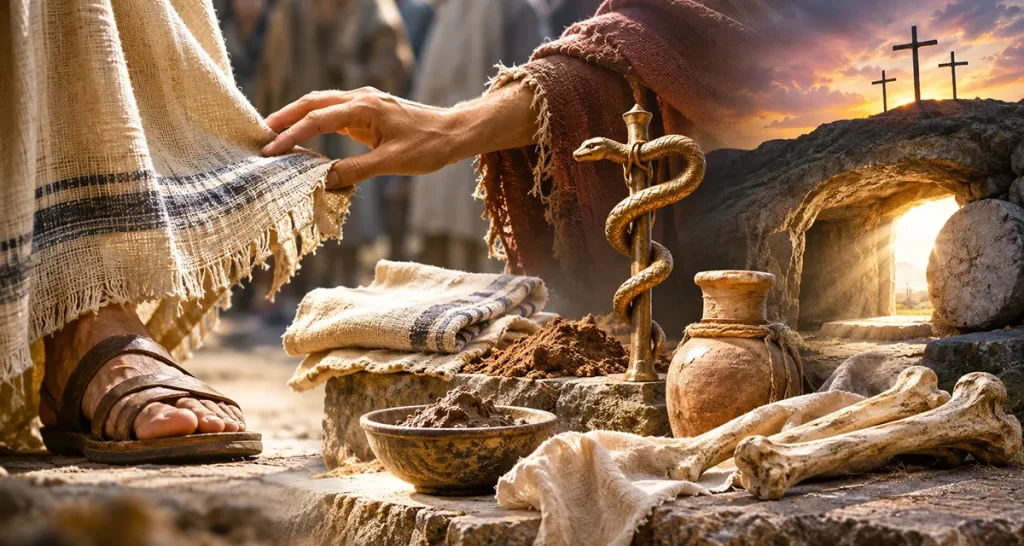
And you are being reverent! 😊 In fact, I think your question takes the incarnation more seriously than we sometimes do.
Because you are asking something rather astonishing:
Did the eternal Son of God enter the ordinary material world so completely that even the matter composing His human body participated in the same natural processes as the rest of creation?
And if so, what happened to the blood He shed, the tears He wept, and the countless particles of matter exchanged between His body and His environment?
There is a profound theological question here, but also a remarkably ordinary biological one.
🧬 Was Jesus made of the same matter as we are?
The Christian understanding of the incarnation gives us every reason to answer yes.
Jesus did not possess a human-looking body made from some special heavenly substance.
He was truly human.
John tells us:
“And the Word became flesh and dwelt among us.” (John 1:14)
And Hebrews 2:14 is even more explicit:
“Inasmuch then as the children have partaken of flesh and blood, He Himself likewise shared in the same.”
Notice the emphasis on sharing our flesh and blood.
Not something resembling our flesh and blood.
Not an alternative kind of humanity.
The same human nature that belongs to those He came to redeem.
Now, Scripture does not discuss atoms, molecular structures, or cellular biology.
But given what we know about human bodies, it is entirely reasonable to understand Jesus’ body as composed of the same kinds of ordinary matter as ours.
Carbon, hydrogen, oxygen, nitrogen, calcium, iron, and the other elements that constitute human life.
There is no biblical reason to suppose that His oxygen atoms were somehow different from ours.
And this has an important implication.
Jesus ate ordinary food.
He drank ordinary water.
He breathed ordinary air.
His body participated in the material processes necessary for genuine human life.
The Creator was sustained, according to His humanity, by the creation He Himself sustains according to His divinity (Colossians 1:17).
What an extraordinary mystery! 🥹
✨ But wasn’t His body holy?
Absolutely.
And here we must distinguish between holiness and material composition.
When Gabriel announced Jesus’ conception to Mary, he said:
“Therefore, also, that Holy One who is to be born will be called the Son of God.” (Luke 1:35)
Jesus was holy from conception.
But His holiness did not depend upon possessing a different category of atoms.
It depended upon who He was.
The eternal Son had assumed a complete human nature, without sin.
His body was truly His body.
His blood was truly His blood.
His humanity belonged personally to the Son of God.
Yet that does not require the chemical elements composing His body to possess properties different from those found elsewhere in creation.
Consider something similar, although not identical.
The temple in Jerusalem was holy.
But the stones composing it were not necessarily chemically different from stones used in ordinary buildings.
Their holiness concerned their consecration and relationship to God.
In Christ’s case, the relationship is infinitely greater.
His humanity was not merely consecrated for divine service.
It was personally united to the eternal Son.
The holiness of Jesus’ humanity was real, but it was not a special chemical property.
🌱 Then what happened to the matter His body released?
Now we arrive at the fascinating consequence of your reasoning.
If Jesus possessed a genuinely human body, then ordinary biological processes would have occurred.
He would have shed skin cells.
He would have perspired.
He would have exhaled carbon dioxide and water vapor.
He would have eliminated bodily waste.
These are not irreverent observations.
They are consequences of affirming that the Son truly entered human biological existence.
And yes, under ordinary natural processes, matter released from His body could have returned to the environment.
Water from His perspiration could evaporate.
Organic material could decompose.
Elements could eventually participate in other natural processes and living organisms.
There is no biblical teaching that atoms once incorporated into Jesus’ earthly body became permanently exempt from the ordinary processes of creation.
But we should make an important distinction here.
The atoms are not intrinsically divine.
Yet while incorporated into His living human body, they belonged to the genuine humanity of the incarnate Son.
Their significance arose from that relationship, not from a transformation of their atomic nature.
And once material was separated from His body, Scripture gives us no general rule that it retained a permanent supernatural quality.
🩸 But His blood presents an especially delicate question
Here I want to be particularly careful, because the blood of Christ occupies a central place in the New Testament’s understanding of redemption.
Peter calls it:
“The precious blood of Christ, as of a lamb without blemish and without spot.” (1 Peter 1:19)
And Paul writes:
“In Him we have redemption through His blood, the forgiveness of sins.” (Ephesians 1:7)
Now imagine the blood shed during His scourging and crucifixion.
That was genuine human blood.
Its cells and plasma were composed of ordinary biological material.
But it was the blood of Jesus Christ.
And the identity of the person who shed it is inseparable from its redemptive significance.
We must therefore avoid two opposite errors.
One would be to treat His blood as though it were merely an ordinary biological fluid, with no special significance beyond its material composition.
The other would be to treat it as though each separated drop necessarily contained an independent supply of divine power.
Neither conclusion adequately reflects the New Testament.
His blood is precious because it is the blood of the incarnate Redeemer, voluntarily shed in His sacrificial death.
Its saving efficacy comes from Christ and His accomplished sacrifice, not from an unusual molecular composition.
And this distinction becomes especially important when we speak of the blood being recycled through nature.
As a matter of physical biology, the material components of blood exposed to the environment would ordinarily undergo natural processes.
But the New Testament does not tell us precisely what happened to every drop of blood Jesus shed.
We should not invent an account of its physical preservation or disappearance.
Nor should we confuse the physical fate of shed blood with the permanent efficacy of His sacrifice.
Hebrews 10:12 tells us that Christ offered one sacrifice for sins forever.
That sacrifice does not cease to be effective because material processes occur in the created world.
🌍 The Creator entered the circulation of His own creation
There is something remarkable about your observation that deserves further attention.
Consider the ordinary cycle of water.
Water evaporates, condenses, falls as rain, enters rivers, is consumed by living creatures, and eventually returns to the environment.
During His earthly life, Jesus drank water that existed long before His incarnation.
His body incorporated that water into its biological processes.
And some of that water would ordinarily have returned to the environment.
In other words, the incarnate Son participated in the material exchanges of the world He created.
This does not mean creation became divine.
But it means that His humanity was not isolated from creation.
He did not inhabit a sealed biological system.
He lived in the same physical world as everyone around Him.
And that is one reason the incarnation is so astonishing.
God did not merely visit creation as an external observer.
The Son became a creature according to His assumed human nature, while remaining the uncreated Creator according to His divine nature.
He experienced human dependence without ceasing to be the One upon whom everything depends.
🤔 But does this change our earlier discussion about sacred objects?
I think it sharpens it considerably.
Suppose a piece of cloth genuinely contained a trace of Jesus’ blood.
We could say that the trace was historically and physically associated with the incarnate Son.
That would make it extraordinary in historical and religious significance.
But could we conclude that its atoms had become permanently holy in a way that distinguished them from all other atoms?
Scripture does not establish that.
And your reasoning exposes an interesting problem with assuming that physical contact automatically transmits permanent holiness.
If every particle that touched Jesus acquired such a property, then what would happen when those particles entered the environment?
Would water molecules that passed through His body remain permanently sacred?
Would the air He exhaled become holy?
Would the plants that absorbed matter once associated with His body acquire some degree of holiness?
And would that holiness continue as the matter moved through other living organisms?
We would have to construct an entire theology of sacred matter and its transmission.
Yet Scripture provides no such teaching.
That does not mean God could never sanctify an object.
It means that the holiness of Christ cannot be understood as a physical substance that spreads automatically through material contact.
❤️ And the resurrection makes the distinction even more important
Now consider something else.
Jesus’ body was not abandoned to corruption.
Peter, quoting Psalm 16, declares:
“Nor will You allow Your Holy One to see corruption.” (Acts 2:27)
The resurrection concerns the actual body of Jesus.
He did not simply receive an unrelated replacement body.
Luke 24:39 records His invitation to the disciples to examine Him:
“Behold My hands and My feet, that it is I Myself.”
There is continuity between the crucified Jesus and the risen Jesus.
But we must distinguish His body itself from every particle that might have been shed during His earthly life.
The resurrection does not require that every skin cell, every molecule of perspiration, or every drop of blood previously separated from His body be gathered back together.
Indeed, ordinary human bodies constantly exchange matter throughout life.
Personal and bodily continuity cannot be reduced to retaining an identical collection of atoms.
And this is relevant not only to Jesus but also to our future resurrection.
Paul teaches that our bodies will be raised in glory (1 Corinthians 15:42–44).
Our hope is not that God must recover every atom that ever belonged to us.
Our hope is that the God who created us can raise us bodily, preserving our identity while transforming our condition.
🌿 One final distinction: matter is not the source of holiness
There is something deeply Christian in recognizing the ordinary material composition of Jesus’ body.
It protects the reality of His humanity.
And it also protects the distinction between Creator and creation.
Jesus did not need extraordinary atoms to be holy.
He was holy because of who He is.
His blood did not need extraordinary chemistry to be precious.
It was precious because of whose blood it was and what He accomplished through shedding it.
His garments did not need to contain divine particles for God to work a miracle when a woman touched them.
The living Christ was present and acting.
And perhaps that is where our earlier discussion about relics, sacred objects, and superstition finds a clearer foundation.
The significance of matter associated with Jesus is real, but its significance must not be confused with an inherent divinity of the matter itself.
I would not dismiss the historical importance of a genuine physical trace of Jesus.
Nor would I deny God’s freedom to use such an object for His purposes.
But I would hesitate to attribute permanent supernatural properties to it without revelation establishing that claim.
And your question brings us to a rather beautiful realization:
The atoms composing Jesus’ earthly body belonged to the same creation as ours.
Yet the person who assumed that body is the One through whom all those atoms came into existence (John 1:3).
He did not become holy by possessing special matter. Ordinary matter received an extraordinary dignity by becoming the humanity of the eternal Son.
That is a much greater wonder than imagining that His body was composed of heavenly elements. 😊