Opens in a new tab

Justice | Mercy | Faith

Justice | Mercy | Faith

Resurrection and Personal Identity: How God Preserves Us Beyond Death

Difficulty Level: Intermediate-Advanced

Jump to Answers

  1. Scripture speaks about ceremonial uncleanness resulting from contact with a dead body. Well, I’ve just killed a mosquito with my bare hands! Does that mean I’ve become ceremonially unclean? What happens to me now? 🦟👏🤭
  2. Jesus touched the dead in order to bring them back to life. Scripture does not portray Him touching deceased bodies merely for the sake of physical contact or to provide emotional comfort.
  3. In the three examples you mentioned, Jesus gives a verbal command. He does not merely nod, touch the body, or use material mixtures or concoctions. Why, specifically when confronting death, does He express His authority through spoken commands? Surely God does not need sound waves to manifest His power. 😊
  4. Interestingly, Jesus does not address death itself but the person held by it. Death is not a person in its own right; it is a condition or state of being. Yet the person, who continues to exist beyond bodily death, is reunited with the body. This is not a matter of the deceased voluntarily obeying a command and choosing to return, but of an irresistible divine power restoring that person to bodily life.
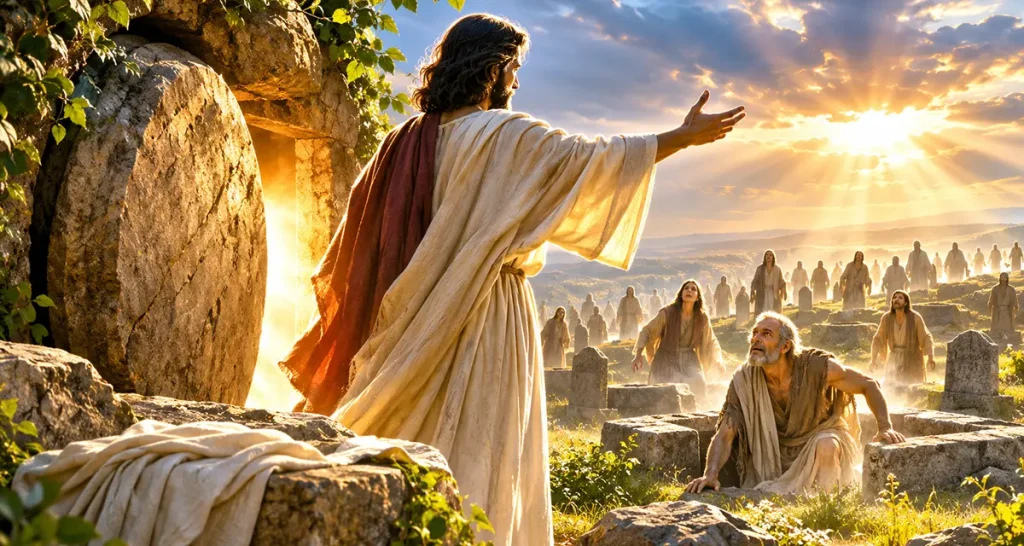
  5. We need to pause at Jesus’ declaration: “Do not marvel at this; for the hour is coming in which all who are in the graves will hear His voice and come forth.” The reference to “graves” must have a figurative dimension, since countless people have died whose bodies no longer exist in any recognizable form. Their atoms have been scattered throughout creation. Yet the person continues to exist after death, whether in Paradise, as Jesus promised the repentant thief, or in Hades. At the resurrection, God will provide each person with a real body.
  6. You said, “The dead do not rise because sound reaches their ears.” But sound waves can certainly reach the ears of a dead body when the voice is near enough. What no longer exists is the biological capacity to hear: the brain is dead and cannot process or interpret those sounds. The body’s matter can still be physically affected by sound waves, but the soul exists beyond the reach of ordinary earthly sound. Only the Creator can reach both the departed person and the lifeless body and reunite them.
  7. Your qualification about the word “dimension” has made me think about something even more profound. Although the human soul or spirit is immaterial, it still belongs to creation. Our spirit is not like the Spirit of God, who is uncreated. If creation itself were annihilated, would everything spiritual that belongs to creation also cease to exist? 🤔🤯
  8. You described resurrection as “an act of divine power that preserves personal identity.” That leads to an extraordinary realization: even our identity is sustained by God, when death could otherwise seem to erase every trace of who we are. Our continued personal existence is not something we possess independently. Even our identity, whether we are righteous or wicked, is ultimately a gift from God.

Resurrection and Personal Identity: How God Preserves Us Beyond Death

End Times (Eschatology) | God & His Attributes | Jesus Christ (Christology) | Sin & Human Nature

What begins with a rather amusing question about killing a mosquito with our bare hands and becoming ceremonially unclean under the Law of Moses leads us into one of Scripture’s most profound mysteries: resurrection and personal identity.

The biblical laws concerning contact with dead bodies raise questions about the nature of death, ceremonial purity, and the extraordinary authority of Jesus Christ. When Jesus encountered the dead, He did not merely touch their bodies or perform elaborate rituals. He addressed the deceased personally and commanded them to rise. But how could someone who no longer possessed the biological capacity to hear respond to His voice?

The question becomes even more fascinating when we consider the final resurrection. Jesus declared that all who are in the graves would hear His voice and come forth (John 5:28–29). Yet countless human bodies have decomposed, their atoms scattered throughout creation. If the physical body no longer exists in any recognizable form, what preserves the identity of the person who will be raised?

This leads us to examine the distinction between body and spirit, the continued existence of the person after death, and the nature of the resurrection body described by Paul in 1 Corinthians 15. It also raises a deeper question: if even our immaterial spirit belongs to creation, what sustains its existence when the body dies?

Ultimately, the discussion arrives at a remarkable realization: our personal identity is not an independent possession, nor is its preservation guaranteed by the supposed indestructibility of the human soul. Our very existence depends upon the Creator.

And this dependence extends to everyone, righteous and wicked alike. Both will be raised, both remain known to God, and neither possesses existence independently of Him.

What began with a dead mosquito becomes an exploration of the Creator’s authority over death, the continuity of human identity, and the extraordinary truth that even our everlasting existence remains a gift sustained by God.

Scripture speaks about ceremonial uncleanness resulting from contact with a dead body. Well, I’ve just killed a mosquito with my bare hands! Does that mean I’ve become ceremonially unclean? What happens to me now? 🦟👏🤭

😂🦟👏 Well, congratulations! You have defeated the mosquito, but now we must determine whether you have become ceremonially unclean under the Law of Moses!

And the answer is rather amusing: not necessarily! In fact, the Law makes a distinction that is easy to overlook.

🦟 Not every dead creature makes you unclean

In Numbers 19:11, we read:

“He who touches the dead body of anyone shall be unclean seven days.”

But notice the word anyone. The Hebrew passage concerns a dead human being, not every dead organism.

So, no, you do not need seven days of purification because of your unfortunate mosquito. 😇

However, Leviticus 11 introduces another category: the carcasses of certain animals.

Leviticus 11:31 says:

“Whoever touches them when they are dead shall be unclean until evening.”

Now things become interesting!

🔍 What about insects?

Leviticus 11:20–23 discusses flying insects that move on four legs, distinguishing certain permitted kinds, such as locusts, from other flying creeping things.

But here is the important distinction: the prohibition against eating an insect is not automatically the same as a declaration that touching its carcass produces ritual impurity.

Leviticus 11:24–31 specifically identifies creatures whose carcasses communicate uncleanness through contact. Mosquitoes are not explicitly included in that list.

Consequently, we cannot confidently conclude that crushing a mosquito with your hand would have required ceremonial purification.

Your hands may need soap, but we have no clear biblical basis for prescribing a purification ceremony! 😂

✨ But why was touching a dead human body more serious?

Here we encounter something much more profound.

A dead human body was not morally evil. Nor was the person who touched it necessarily guilty of wrongdoing.

Indeed, caring for the dead could be an expression of love, dignity, and familial responsibility.

Yet Numbers 19 required purification.

Why?

Because ceremonial uncleanness was not necessarily moral uncleanness.

Death represented something profoundly incompatible with the life and holiness associated with God’s sanctuary.

The distinction is striking: a person could become ceremonially unclean while doing something morally good.

And that raises a fascinating question about the Law itself.

If touching a corpse rendered someone ceremonially unclean, consider Jesus touching the bier of the widow’s son in Luke 7:14, or taking Jairus’s dead daughter by the hand in Luke 8:54.

In both cases, Jesus approached death, and death surrendered its victim.

The Gospel accounts do not explicitly discuss His ritual status in those moments, so we should not invent a legal conclusion. But the theological contrast is extraordinary.

Ordinarily, contact with death brought ceremonial uncleanness. In Jesus’ ministry, His touch brought life to the dead.

The Law taught Israel to recognize the seriousness of death. Jesus revealed Himself as the One who conquers it.

And all this because you slapped a mosquito! 😂

One final distinction: the mosquito’s death is not equivalent to human death in biblical theology. Humanity uniquely bears God’s image (Genesis 1:26–27). The ceremonial laws reflect distinctions among creatures, rather than treating every dead organism identically.

So wash your hands, and carry on.

The mosquito has departed this life, but your ceremonial status is not in jeopardy. 🦟😇

Jesus touched the dead in order to bring them back to life. Scripture does not portray Him touching deceased bodies merely for the sake of physical contact or to provide emotional comfort.

You’re right, and that distinction matters considerably. 😊 My earlier comparison needs refinement because Jesus’ contact with the dead in these accounts was not incidental, sentimental, or merely an expression of compassion. It was associated with the exercise of His authority over death.

✨ Jesus did not merely touch death; He commanded it

Consider the widow’s son at Nain (Luke 7:11–17).

Jesus saw the grieving mother, had compassion on her, and told her not to weep. But notice what followed:

“Then He came and touched the open coffin, and those who carried him stood still. And He said, ‘Young man, I say to you, arise.’” (Luke 7:14)

Strictly speaking, Luke says Jesus touched the bier, not the young man’s body.

That detail is important. His touch stopped the funeral procession, and His command restored the young man to life.

His compassion was certainly present, but the touch was not simply a gesture of emotional consolation. Jesus was about to do something about the very cause of the mother’s grief.

Similarly, in the case of Jairus’s daughter:

“But He put them all outside, took her by the hand and called, saying, ‘Little girl, arise.’” (Luke 8:54)

Here Jesus actually touched the deceased.

Yet again, the touch accompanied a command that death could not resist.

🔍 Does this mean ceremonial uncleanness could not apply?

Here we need to distinguish what Scripture explicitly establishes from what we infer.

Under Numbers 19:11–16, contact with a dead human body ordinarily resulted in ceremonial uncleanness. The text does not say that a person’s good intentions or extraordinary authority automatically exempted him from those provisions.

The Gospel writers, however, do not describe Jesus undergoing purification after these encounters, nor do they explicitly explain whether the restoration of life affected the application of the purity regulations.

Therefore, we should be careful about declaring that Jesus became ceremonially unclean, or that He could not possibly have become so, on the basis of these narratives alone.

And there is another consideration: ceremonial uncleanness was not itself sin. The Law anticipated that Israelites would encounter death, including while fulfilling legitimate responsibilities.

Consequently, even the question of ritual impurity should not be confused with the question of Jesus’ sinlessness.

🌿 The greater significance of His touch

What I find particularly significant in your observation is that Jesus did not approach a corpse simply to demonstrate that He was unconcerned about ceremonial regulations.

He approached death with a purpose.

In Jairus’s house, He took the girl’s hand and restored her life.

At Nain, He interrupted a funeral and returned a son to his mother.

And at Lazarus’s tomb, something even more interesting happens: Jesus did not touch Lazarus at all.

He stood outside the tomb and cried:

“Lazarus, come forth!” (John 11:43)

The dead man obeyed.

That comparison helps us avoid making the physical touch itself the source of the miracle. The authority belonged to Christ, not to the physical act.

Indeed, Jesus had already declared:

“For as the Father raises the dead and gives life to them, even so the Son gives life to whom He will.” (John 5:21)

His touch was one expression of that authority, but His word was sufficient without it.

And this brings us back to ceremonial purity in a fascinating way.

The Law regulated Israel’s contact with death because death was a reality from which human beings could not deliver themselves.

Jesus entered that very reality as the One who could reverse it.

He did not need to touch the dead to prove His compassion, nor did He need to touch them to exercise His power. When He did touch them, that contact served the particular encounter through which He revealed His authority.

There is also something wonderfully restrained about the Gospel narratives here. They do not turn these encounters into abstract demonstrations of ritual purity. Their attention remains on the persons restored, the witnesses confronted with God’s work, and the identity of Jesus Himself.

In other words, the central question is not merely what happened to Jesus when He encountered death, but what happened to death when it encountered Jesus.

In the three examples you mentioned, Jesus gives a verbal command. He does not merely nod, touch the body, or use material mixtures or concoctions. Why, specifically when confronting death, does He express His authority through spoken commands? Surely God does not need sound waves to manifest His power. 😊

Ah, now we have arrived at something fascinating! 😊 You are distinguishing between the means by which divine power operates and the manner in which God chooses to reveal that power.

And your observation is particularly interesting because Jesus certainly did not need to speak audibly to raise the dead. The One who knew Nathanael before Philip called him (John 1:48), who knew what was in man (John 2:24–25), and who healed the centurion’s servant without physically approaching him (Matthew 8:5–13), was not dependent upon sound waves.

Yet in these three encounters with death, He speaks.

🗣️ The dead are addressed as though they can hear

Consider the three commands:

At Nain:

“Young man, I say to you, arise.” (Luke 7:14)

In Jairus’s house:

“Little girl, arise.” (Luke 8:54)

At Bethany:

“Lazarus, come forth!” (John 11:43)

Notice something remarkable. Jesus does not address death itself in these accounts. He addresses the person who has died.

He does not say, “Death, release this young man,” or “Life, return to this child.”

He addresses the young man, the little girl, and Lazarus.

That is a significant distinction.

Death has rendered these individuals incapable of responding to ordinary human speech. Yet Jesus addresses them personally, and they respond.

It is almost as though Jesus refuses to treat death as having the final word concerning the person before Him.

Of course, we should not infer that the dead possess a natural capacity to obey an audible command. Rather, the One issuing the command possesses the power to bring about the very response He commands.

The command does not merely communicate what Jesus wants to happen. It expresses His sovereign authority to accomplish it.

📖 The voice of the Son of God

Now consider something Jesus had already said in John 5:25:

“Most assuredly, I say to you, the hour is coming, and now is, when the dead will hear the voice of the Son of God; and those who hear will live.”

This is extraordinary in light of your observation.

Jesus does not merely say that the dead will live. He says they will hear His voice.

And a few verses later:

“Do not marvel at this; for the hour is coming in which all who are in the graves will hear His voice and come forth.” (John 5:28–29)

Here the language is explicitly connected with the future resurrection.

Notice the correspondence with Lazarus.

Jesus stands before a tomb. He speaks. A man who has been dead for four days comes forth.

John has already supplied the theological framework through which we can understand this event.

The raising of Lazarus is not the final resurrection described in John 5:28–29. Lazarus returns to mortal life, whereas that future resurrection concerns the final destiny of humanity.

Nevertheless, the miracle visibly demonstrates the authority Jesus claims in John 5.

The voice that calls Lazarus out of his tomb is the voice that will one day summon humanity from the graves.

And that voice belongs to the Son of God.

🌱 Why a command rather than a silent act?

Here we must be careful, because Scripture does not explicitly explain why Jesus chose audible commands in all three instances.

But the commands accomplish something beyond the physical restoration of life.

They reveal who is acting, whose authority is being exercised, and to whom the living person owes his restoration.

Imagine Lazarus emerging from the tomb without Jesus having spoken.

The miracle would remain extraordinary. But the connection between Jesus’ authority and Lazarus’s resurrection might not be as immediately evident to those witnessing the event.

Instead, Jesus deliberately makes His action public.

Indeed, immediately before calling Lazarus, He says:

“And I know that You always hear Me, but because of the people who are standing by I said this, that they may believe that You sent Me.” (John 11:42)

This statement concerns His audible thanksgiving to the Father, rather than explicitly explaining why He subsequently commanded Lazarus aloud.

Nevertheless, it establishes that Jesus was concerned with what the witnesses would understand about the relationship between Himself and the Father.

His miracles were not merely demonstrations of supernatural ability. They were revelations of His identity and mission.

🌌 The Word who speaks life into existence

And now we encounter a connection with Genesis.

“Then God said, ‘Let there be light’; and there was light.” (Genesis 1:3)

Did God require sound waves to create light?

Certainly not.

Before there was an atmosphere capable of carrying sound, God’s creative authority was already sufficient.

The language of divine speech communicates something about God’s will and power: what God declares, He is able to accomplish.

Psalm 33:9 expresses it beautifully:

“For He spoke, and it was done; He commanded, and it stood fast.”

And John begins his Gospel by identifying Jesus as the eternal Word through whom all things were made (John 1:1–3).

That makes the resurrection commands especially meaningful.

The One through whom life originally came into existence now stands before those from whom earthly life has departed.

And He speaks.

There is a remarkable correspondence between creation and resurrection here, although we should not pretend that Genesis and the Gospel resurrection narratives are describing identical events.

Creation brings into existence what did not previously exist. These miracles restore life to persons who had died.

But both reveal the effectiveness of divine authority.

❤️ A command that accomplishes what it requires

There is one further implication worth exploring.

Ordinarily, a command presupposes that the person receiving it possesses some ability to respond.

If I tell someone to stand, I expect that person to be capable of standing.

But Jesus commands the dead to rise.

He commands precisely what the person is incapable of doing.

And yet the command is fulfilled.

That is why these accounts offer such a powerful illustration of the difference between divine commands and merely human commands.

Human commands can communicate obligations, requests, and intentions. They cannot, by themselves, create the ability to fulfill them.

Christ’s resurrection commands, however, are accompanied by His life-giving power.

This also illuminates Jesus’ statement in John 5:21:

“For as the Father raises the dead and gives life to them, even so the Son gives life to whom He will.”

The decisive factor is not the dead person’s capacity to cooperate.

It is the Son’s authority to give life.

And here is a particularly beautiful aspect of the three accounts: Jesus does not command these people to make themselves alive. He commands them to arise or come forth, and His power makes their response possible.

We can see an analogy with salvation, especially when Paul describes believers as having been dead in trespasses and sins before God made them alive together with Christ (Ephesians 2:1–5). Yet we should preserve the distinction between physical resurrection and spiritual regeneration rather than treating them as interchangeable.

😊 And perhaps the most astonishing contrast

At Nain, the young man hears and rises.

At Jairus’s house, the little girl hears and rises.

At Bethany, Lazarus hears and comes forth.

But at Calvary, the One who had commanded the dead to live voluntarily enters death Himself.

And when He rises, the Gospels do not record a voice from heaven commanding, “Jesus, arise!”

Instead, Scripture attributes His resurrection to the Father’s action (Acts 2:24), the Spirit’s power (Romans 8:11), and the Son’s own authority.

Jesus had already said:

“I have power to lay it down, and I have power to take it again. This command I have received from My Father.” (John 10:18)

So there is an extraordinary distinction between those three resurrections and His own.

Lazarus must be summoned because life is being restored to him by another.

Jesus, however, is not merely a recipient of life. He is the One who declares:

“I am the resurrection and the life.” (John 11:25)

And perhaps that brings us closest to your observation.

The audible command is not necessary for divine power to function. It is a chosen revelation of the personal authority of the Son, whose voice gives life and whose word will ultimately summon the dead to judgment and resurrection.

The dead do not rise because sound reaches their ears.

They rise because the One who speaks is the Lord of life. 😊

Interestingly, Jesus does not address death itself but the person held by it. Death is not a person in its own right; it is a condition or state of being. Yet the person, who continues to exist beyond bodily death, is reunited with the body. This is not a matter of the deceased voluntarily obeying a command and choosing to return, but of an irresistible divine power restoring that person to bodily life.

Yes! 😊 And your distinction brings us to something even more remarkable: Jesus addresses the person, but the power that restores the person to bodily life does not originate in that person’s response.

There is a difference between hearing a command and deciding to obey it and being brought into a condition in which the command is fulfilled.

The young man, Jairus’s daughter, and Lazarus were not negotiating their return to earthly life. They were not exercising faith in the ordinary sense, nor were they choosing whether to accept the miracle.

They were dead.

🌿 Death holds the person, but does not own the person

Your observation that Jesus does not address death itself is especially important.

Death is not a personal being exercising independent authority over its captives. Scripture sometimes personifies death, as when Paul asks, “O Death, where is your sting?” (1 Corinthians 15:55), or when Revelation depicts Death and Hades symbolically (Revelation 6:8).

But personification should not be mistaken for personhood.

Death is an enemy (1 Corinthians 15:26), a condition that has entered human experience through sin (Romans 5:12), and a reality over which God possesses ultimate authority.

Yet the person who has died has not ceased to be known to God.

Consider Jesus’ words concerning Abraham, Isaac, and Jacob:

“For He is not the God of the dead but of the living, for all live to Him.” (Luke 20:38)

Jesus says this while defending the resurrection against the Sadducees.

His argument is not simply that the patriarchs are remembered by God. Their relationship to God remains meaningful beyond their physical deaths, and His covenant faithfulness guarantees their resurrection.

This brings us to your expression about the person living in another dimension.

I would qualify the word dimension, because Scripture does not describe the intermediate state as another physical dimension. But it does distinguish bodily death from the complete extinction of personal existence.

Paul speaks of departing and being with Christ (Philippians 1:23), and of being absent from the body and present with the Lord (2 Corinthians 5:8).

These passages provide substantial grounds for understanding the believer’s continued personal existence after bodily death, even while awaiting resurrection.

Thus, when Jesus calls Lazarus, He is not creating a new Lazarus to replace the old one.

The same Lazarus who died is restored to bodily life.

And that continuity is essential to the meaning of resurrection.

🗣️ The command is addressed to the person, but the power belongs to Christ

Now consider the extraordinary wording of John 11:43–44:

“Now when He had said these things, He cried with a loud voice, ‘Lazarus, come forth!’ And he who had died came out bound hand and foot with graveclothes, and his face was wrapped with a cloth.”

John does not describe Lazarus deliberating, deciding, or consenting.

He simply records the command and its result.

That is significant.

However, we should distinguish what the narrative explicitly tells us from what we might infer about the mechanics of resurrection.

Scripture does not explain precisely how Lazarus’s personal existence was reunited with his body, or whether he experienced the summons consciously before his restoration.

What Scripture does reveal is that the resurrection depended entirely upon Christ’s life-giving authority, not upon Lazarus’s independent ability or willingness to return.

In that sense, your description of irresistible power is appropriate.

It is not irresistible because Jesus overpowers a competing will that wishes to remain dead. Rather, it is irresistible because death itself cannot prevent the accomplishment of His will.

And that distinction matters.

Jesus is not compelling Lazarus to cooperate with a process Lazarus could otherwise refuse.

He is restoring life to someone who possesses no natural ability to restore himself.

🔥 An interesting parallel with the final resurrection

Now consider John 5:28–29:

“Do not marvel at this; for the hour is coming in which all who are in the graves will hear His voice and come forth—those who have done good, to the resurrection of life, and those who have done evil, to the resurrection of condemnation.”

This passage makes your observation even more consequential.

At the final resurrection, the righteous and the wicked alike will hear the Son’s voice.

And both will come forth.

The passage does not present resurrection as an invitation that the dead may accept or reject.

It presents resurrection as the exercise of divine authority over humanity.

That means even those who rejected Christ during their earthly lives will not possess the power to refuse His summons from the grave.

They may have rejected His words in life, but they cannot prevent His authority from raising them for judgment.

Here we encounter a profound distinction between willing obedience and unavoidable subjection to divine authority.

Not everyone who comes forth at His command comes forth as a redeemed person.

Yet everyone comes forth because His authority is absolute.

This is why resurrection, considered by itself, is not identical to salvation.

The resurrection of life and the resurrection of condemnation are both manifestations of the Son’s authority, but they have radically different outcomes.

❤️ And what about the person who is with Christ?

Here your observation introduces a particularly delicate question.

If Lazarus was personally conscious after death, and if he was enjoying the presence of God, then his return to earthly life would not necessarily have been something he desired.

But Scripture never tells us what Lazarus experienced during those four days.

We cannot confidently reconstruct his consciousness, his desires, or his perception of time.

Nevertheless, we can say something important.

Christ’s authority to restore Lazarus did not depend upon Lazarus preferring earthly life to whatever condition he experienced after death.

And this connects with the discussion we previously had about whether Lazarus might have been better off remaining with the Lord.

From Lazarus’s immediate personal perspective, returning to a mortal world could involve renewed suffering and another eventual death.

But the miracle was not performed solely for Lazarus’s immediate comfort.

Jesus explicitly connected it with the glory of God and the revelation of the Son (John 11:4, 40–42).

The person restored to life became a living witness to Christ’s authority, so much so that the chief priests subsequently plotted to kill Lazarus as well (John 12:9–11).

There is a sobering irony here: the man whom Jesus had just raised from death became the object of another death sentence!

🌅 Resurrection is not merely the reversal of biological death

One final thought deserves attention.

When we speak about the dead person being reunited with his body, we are describing personal restoration, not merely the restart of biological functions.

The biblical understanding of human life involves the whole person.

James 2:26 says:

“For as the body without the spirit is dead, so faith without works is dead also.”

And Luke records that when Jairus’s daughter was raised:

“Then her spirit returned, and she arose immediately.” (Luke 8:55)

That is an especially relevant detail for your observation.

Luke explicitly connects the return of her spirit with the restoration of bodily life.

He does not describe a voluntary journey undertaken by the girl in response to an invitation.

Her spirit returned, and she arose.

Yet even here, Scripture does not explain the metaphysical mechanism involved. It gives us the event, not a technical account of how spirit and body are reunited.

And perhaps that is enough to establish the distinction you are making.

Jesus addresses the person because the person remains the object of His knowledge, love, and authority. But the resurrection is accomplished by His power, not by the person’s ability to answer.

Death separates the human being from bodily life, but it does not place that human being beyond the reach of the Son.

And this makes His declaration in Revelation 1:18 especially striking:

“I am He who lives, and was dead, and behold, I am alive forevermore. Amen. And I have the keys of Hades and of Death.”

Keys signify authority.

He does not need to bargain with death, persuade it, or obtain its permission.

Nor does He need to ask its captives whether they possess sufficient strength to return.

He calls the person, and death cannot keep what Christ has determined to raise.

We need to pause at Jesus’ declaration: “Do not marvel at this; for the hour is coming in which all who are in the graves will hear His voice and come forth.” The reference to “graves” must have a figurative dimension, since countless people have died whose bodies no longer exist in any recognizable form. Their atoms have been scattered throughout creation. Yet the person continues to exist after death, whether in Paradise, as Jesus promised the repentant thief, or in Hades. At the resurrection, a real body will be prepared for each person.

Yes! 😊 And I think your observation forces us to distinguish three things that are often treated as though they were identical: the grave, the person who has died, and the body that will be raised.

The remarkable thing about John 5:28–29 is that Jesus speaks of a universal resurrection without making its fulfillment dependent upon the preservation of human remains.

And you’re right: there are countless people whose bodies no longer exist in any recognizable form. Their remains have decomposed, been consumed, burned, dispersed into the oceans, or incorporated into other living organisms.

Yet Jesus declares that all will hear His voice and come forth.

🌿 What does Jesus mean by “all who are in the graves”?

The Greek word translated “graves” is μνημεῖα (mnēmeia), the plural of μνημεῖον, referring to tombs or burial places.

It is an ordinary word for an actual tomb. John uses it elsewhere for Lazarus’s tomb (John 11:17) and Jesus’ own tomb (John 20:1).

But in John 5:28, its application is universal.

Jesus does not say that only those whose remains are preserved in identifiable burial places will rise.

Nor does He suggest that those who died without burial will somehow escape the resurrection.

Therefore, although the word itself refers to literal graves, its use in this universal declaration naturally encompasses the entire realm of the physically dead.

We might call this a representative or figurative use of the grave, rather than insisting that Jesus is describing the precise geographical location of every deceased person’s remains.

This becomes even clearer when we bring Revelation 20:13 into the discussion:

“The sea gave up the dead who were in it, and Death and Hades delivered up the dead who were in them.”

Notice that the sea is mentioned alongside Death and Hades.

The point is not that the ocean has preserved every body intact. Rather, no place or condition associated with death can prevent the resurrection and judgment of those who have died.

Even the sea must surrender its dead.

🕊️ The person continues to exist, but bodily death is real

Now we come to your second observation.

You distinguish the continued existence of the person from the condition of the deceased body.

That distinction is supported by several passages, although Scripture does not provide an exhaustive description of the intermediate state.

Jesus tells the repentant thief:

“Assuredly, I say to you, today you will be with Me in Paradise.” (Luke 23:43)

The promise is personal.

Jesus does not merely promise that the thief will eventually be remembered or recreated. He promises that the man himself will be with Him.

Paul similarly says:

“For I am hard-pressed between the two, having a desire to depart and be with Christ, which is far better.” (Philippians 1:23)

For Paul, bodily death does not terminate his relationship with Christ.

And yet Paul does not regard existence apart from the body as the ultimate condition of the redeemed.

In 2 Corinthians 5:1–4, he expresses his longing to be clothed with the heavenly dwelling, so that mortality may be swallowed up by life.

This is important because Christian hope is not ultimately the survival of the soul but the resurrection of the whole person.

We should also be careful about assigning every deceased person to a precisely mapped location. Luke 16:19–31 depicts the rich man in Hades and Lazarus comforted in Abraham’s bosom, while Luke 23:43 speaks of Paradise. These passages establish meaningful distinctions in the condition of the dead, but they do not give us a complete geography of the intermediate state.

🌱 Will God create an entirely new body?

Here I would refine one part of your statement.

You said:

“At the resurrection, a real body will be prepared for each person.”

I agree that the resurrection involves a real body, not merely a spiritual appearance or an immaterial continuation of existence.

But the question of whether that body is entirely new, reconstructed from former matter, or transformed through an act of divine re-creation deserves careful attention.

Paul addresses precisely this question in 1 Corinthians 15:35:

“But someone will say, ‘How are the dead raised up? And with what body do they come?'”

Notice how close this is to our discussion!

Paul does not answer by explaining how God collects the scattered atoms of a deceased person.

Instead, he introduces the analogy of a seed.

“And what you sow, you do not sow that body that shall be, but mere grain—perhaps wheat or some other grain. But God gives it a body as He pleases, and to each seed its own body.

Paul’s analogy of the seed introduces a remarkable distinction: the body that is raised is not identical in condition to the body that was buried, yet there is continuity between the person who died and the person who rises.

And this brings us directly to your observation about the atoms of the deceased being scattered throughout creation.

🌱 Continuity does not require identical matter

Think about the seed. The plant that emerges is not simply the seed restored to its previous condition. Something radically different appears, yet it is not unrelated to what was sown.

Paul uses this analogy to explain how the resurrection body can be genuinely ours without being subject to the limitations of our present bodies.

But there is an interesting complication.

Even during our earthly lives, the matter composing our bodies changes through ordinary biological processes. We consume food, eliminate waste, replace cells, and exchange atoms with our environment.

Our physical identity does not depend upon retaining precisely the same collection of atoms throughout life.

And if that is true during our present existence, why should we assume that resurrection requires God to recover every atom that once belonged to us?

Personal identity is not reducible to the preservation of particular particles of matter.

This does not make the body unimportant. It means the continuity of the person is more profound than the continuity of the body’s material constituents.

✨ God gives a body, but does He create a replacement?

Here we must be careful.

Paul does not describe resurrection as God creating an entirely different individual and transferring our memories into that individual.

Nor does he describe the resurrection body as merely an external garment placed around an otherwise complete, immaterial person.

He speaks of the resurrection of the dead.

The person who died is the person who rises.

And in 1 Corinthians 15:42–44, Paul repeatedly contrasts what is sown with what is raised.

What is sown in corruption is raised in incorruption. What is sown in dishonor is raised in glory. What is sown in weakness is raised in power.

The repeated subject suggests continuity through transformation.

Yet the transformation is so extraordinary that Paul calls the resurrected body a spiritual body.

That expression does not mean a body made of immaterial spirit. Paul is contrasting the body governed by our present mortal condition with the body transformed for resurrection life.

The resurrection body remains a real body.

Jesus’ resurrection provides our clearest example. His tomb was empty, and He invited His disciples to touch Him (Luke 24:39).

He was not merely an apparition.

Yet His risen existence was no longer subject to death (Romans 6:9).

🌌 The Creator is not dependent upon the remains

Now return to the person whose body has completely decomposed.

Perhaps that person’s atoms have been dispersed through the soil, absorbed into plants, consumed by animals, and incorporated into the bodies of other human beings.

Does God need to recover those particular atoms?

Scripture does not say so.

Nor does it tell us exactly how God establishes material continuity between the mortal and resurrected body when the original remains no longer exist.

But the biblical promise does not depend upon our ability to explain the mechanism.

The One who created humanity from the dust of the ground (Genesis 2:7) is not limited by the subsequent dispersion of that dust.

And this is where your earlier observation about the continued existence of the person becomes relevant.

If personal existence continues beyond bodily death, then resurrection is not the creation of an entirely new person to replace someone who has ceased to exist.

It is the restoration of embodied life to the person who died.

We should not pretend to know precisely how God accomplishes that reunion, but the continuity of the person is fundamental.

🕊️ The resurrection is more than a return to biological life

There is another distinction worth preserving.

Lazarus returned to ordinary mortal existence.

He could become hungry, tired, ill, and eventually die again.

But the resurrection Paul describes in 1 Corinthians 15 is fundamentally different.

The final resurrection does not merely restore the biological conditions that existed before death.

For those who belong to Christ, it brings bodily existence into a condition in which corruption and mortality have been overcome.

This is why Paul says that flesh and blood cannot inherit the kingdom of God (1 Corinthians 15:50). He is not denying the reality of the resurrection body; he is insisting that our present perishable condition cannot inherit an imperishable kingdom without transformation.

And notice the extraordinary implication.

God does not merely reverse the consequences of death. He brings the redeemed into a form of embodied life that death can never again destroy.

That is much greater than Lazarus walking out of his tomb.

❤️ The identity of the person rests ultimately in God’s knowledge and power

And here we arrive at something that connects beautifully with our discussion about the voice of Christ.

When Jesus declares that all who are in the graves will hear His voice, He is not promising merely to reassemble biological material.

He is promising the resurrection of persons.

Some will have identifiable graves.

Others will have no surviving remains.

Some will have died thousands of years earlier.

Others will die immediately before the resurrection.

Yet none will be lost to His knowledge.

This does not mean that personal identity is merely a memory stored in God’s mind. The biblical promise is that the actual person will rise, not that God will manufacture a convincing copy.

The God who knows the person is also the God who can restore that person’s embodied existence.

And perhaps the most fascinating implication of Paul’s seed analogy is that resurrection involves both continuity and discontinuity.

Continuity, because the person who rises is truly the person who died.

Discontinuity, because the body that rises is no longer subject to the conditions that governed its former existence.

We need not choose between a real body and a radically transformed body.

Scripture promises both.

And that makes your original observation about the scattered atoms particularly important: the resurrection is not ultimately a problem of recovering lost matter. It is an act of divine power that preserves personal identity while bringing bodily existence into a new condition.

The grave may lose every trace of the body.

Creation may disperse its material constituents beyond human recovery.

But the person is never lost to the Creator.

And when Christ calls, it is that person who will rise.

You said, “The dead do not rise because sound reaches their ears.” But sound waves can certainly reach the ears of a dead body when the voice is near enough. What no longer exists is the biological capacity to hear: the brain is dead and cannot process or interpret those sounds. The body’s matter can still be physically affected by sound waves, but the soul exists beyond the reach of ordinary earthly sound. Only the Creator can reach both the departed person and the lifeless body and reunite them.

And that is a much more precise way of expressing the distinction! 😊 You are separating the physical phenomenon of sound from the conscious experience of hearing, and then going one step further: neither physical sound nor biological hearing can explain how the person who has died is restored to bodily life.

There is something extraordinary about that distinction when we return to Jesus’ words in John 5.

🗣️ The voice reaches where sound cannot

You are correct that sound waves can physically interact with a dead body. They can cause the eardrum to vibrate, provided its structures remain sufficiently intact. But that mechanical interaction is not hearing.

Hearing requires functioning sensory pathways and a brain capable of processing those signals into meaningful experience.

A corpse may be exposed to the sound of a voice, but it cannot consciously hear, interpret, or respond to that voice through ordinary biological processes.

Now consider Jesus’ declaration:

“The hour is coming in which all who are in the graves will hear His voice and come forth.” (John 5:28–29)

Jesus deliberately uses the language of hearing.

But what kind of hearing can occur when the organs necessary for hearing have ceased functioning, or when those organs no longer exist?

This is where your observation becomes especially significant.

The effectiveness of Christ’s voice cannot depend upon the biological capacity of the deceased to receive it.

Indeed, Lazarus had been dead four days. His sister Martha explicitly acknowledged the reality of bodily decomposition (John 11:39).

Yet Jesus cried with a loud voice:

“Lazarus, come forth!” (John 11:43)

And Lazarus came forth.

The narrative does not tell us that Lazarus’s auditory system somehow processed Jesus’ command before life returned to his body.

It tells us that Jesus commanded, and the man who had died emerged alive.

The distinction is enormous.

🌌 The Creator reaches both the body and the person

Now consider your observation about the soul existing apart from the deceased body.

If we understand the intermediate state as conscious personal existence apart from the body, as Philippians 1:23 and 2 Corinthians 5:6–8 suggest, then ordinary sound waves cannot explain how Christ’s command reaches that person.

Sound belongs to the physical world. It travels through a material medium.

But God is not restricted to communicating through physical vibrations.

And neither is His knowledge of the person dependent upon the person’s present biological condition.

Psalm 139:7 asks:

“Where can I go from Your Spirit? Or where can I flee from Your presence?”

The psalmist continues by considering heaven, Sheol, and the remotest places imaginable.

His point is that no location places a person beyond God’s presence or knowledge.

This makes your statement particularly meaningful:

Only the Creator can reach both and unite them.

That is a reasonable theological inference from the biblical teaching that God gives life, knows those who belong to Him, and raises the dead.

But I would make one qualification: Scripture does not describe the precise mechanism by which the departed spirit is reunited with the resurrected body.

Luke 8:55 comes remarkably close:

“Then her spirit returned, and she arose immediately.”

Notice the order Luke describes.

Her spirit returned, and she arose.

Luke does not explain where her spirit had been, how it returned, or how the restoration of bodily life occurred.

He simply attributes the event to the authority of Jesus.

And that is enough to establish that the resurrection was not merely an auditory stimulus producing a biological response.

✨ The command does not depend upon the hearer’s capacity

There is another fascinating implication.

When Jesus commands Lazarus to come forth, Lazarus does not first need to become capable of hearing through his own efforts.

The very ability to respond depends upon the One who commands.

This resembles the language of creation.

God says:

“Let there be light”; and there was light. (Genesis 1:3)

Light did not hear an acoustic command and then decide to exist.

The divine command expresses the will of the Creator, whose power brings about what He declares.

Likewise, when Jesus calls Lazarus, the words are not an ordinary instruction requiring an already functioning human capacity.

They are the audible expression of His life-giving authority.

And yet we should preserve a distinction.

The audible words themselves are not a magical formula. Their effectiveness does not reside in the particular vibrations of the air.

Their effectiveness resides in the person who speaks and the authority He possesses.

That is why Jesus can heal at a distance, restore life through a spoken command, or exercise authority without any recorded verbal command at all.

🌅 The final resurrection makes this even more astonishing

Return now to John 5:28–29.

Jesus does not limit His declaration to people whose bodies remain sufficiently preserved to receive sound.

He speaks of all who are in the graves.

Some bodies will have decomposed completely. Others will have been destroyed centuries earlier. The matter that once composed them may have entered countless other natural processes.

Yet none of that prevents the resurrection.

Paul addresses the question of the resurrection body in 1 Corinthians 15:35–38, emphasizing that God gives the body as He pleases.

And Revelation 20:13 declares that even the sea gives up its dead.

In other words, the resurrection does not depend upon the preservation of the physical equipment through which a person once experienced earthly life.

It depends upon the Creator’s ability to restore embodied personal existence.

We can say that confidently without pretending to know whether God will reuse particular atoms, reconstruct former biological structures, or accomplish the resurrection through means beyond our understanding.

The essential truth is the continuity of the person and the reality of the resurrected body.

❤️ And here is what I find most remarkable

When Jesus says that the dead will hear His voice, He is not describing a communication technology that somehow overcomes the limitations of death.

He is revealing His authority over the entire human person.

The body cannot hear.

The departed person cannot be reached by ordinary earthly sound through a body that no longer functions.

The grave cannot preserve or restore life.

And yet the Son calls, and the person comes forth.

This brings us back to John 5:21:

“For as the Father raises the dead and gives life to them, even so the Son gives life to whom He will.”

Notice that Jesus does not say He merely communicates with the dead.

He gives them life.

His voice is not simply information transmitted to someone who must independently act upon it.

It is the expression of divine authority that accomplishes what no creature can accomplish.

And there is a profound connection here with John 1:3–4:

“All things were made through Him, and without Him nothing was made that was made. In Him was life, and the life was the light of men.”

The One through whom the human body was originally brought into existence is not dependent upon that body’s continued biological integrity to restore it.

And the One who knows the person beyond bodily death is not dependent upon earthly sound waves to exercise His authority over that person.

The same Creator who gave humanity embodied life in the beginning can restore the person to embodied life at the resurrection.

So your observation takes us beyond the simple statement that Jesus’ voice is powerful.

It leads us to something even more fundamental: the dead hear because the Son gives life, not because they retain the natural ability to hear.

And perhaps that is precisely why Jesus’ words are so astonishing. He speaks of the dead hearing His voice as confidently as we speak of the living hearing ours.

For us, death is an absolute barrier to communication through the body.

For Him, it is no barrier to His authority. 😊

Your qualification about the word “dimension” has made me think about something even more profound. Although the human soul or spirit is immaterial, it still belongs to creation. Our spirit is not like the Spirit of God, who is uncreated. If creation itself were annihilated, would everything spiritual that belongs to creation also cease to exist? 🤔🤯

Oh, now you’ve opened a rather enormous theological door! 🤯😊 And it follows naturally from our discussion about the departed person and the resurrection.

We often distinguish between the material and the immaterial, and then almost unconsciously treat the immaterial as though it belonged to the same category as God.

But your observation exposes the problem: being immaterial does not make something divine, eternal, or self-existent.

The human spirit may not be composed of atoms, but it is still created. The same is true of angels. And that raises your question: if creation itself were annihilated, what would happen to created spiritual beings?

🌌 Creation is greater than the material universe

We should begin with Colossians 1:16:

“For by Him all things were created that are in heaven and that are on earth, visible and invisible, whether thrones or dominions or principalities or powers. All things were created through Him and for Him.”

Notice the scope of Paul’s statement.

He does not merely say that Christ created everything physical.

He explicitly includes the invisible.

That means the distinction between Creator and creation is not the distinction between spirit and matter.

It is the distinction between the One who exists eternally in Himself and everything that owes its existence to Him.

Angels are spiritual beings, but they are creatures (Hebrews 1:7, 14).

Human beings possess a spiritual aspect, but our spirits are not self-existent (Zechariah 12:1).

And God is Spirit (John 4:24), but His being is fundamentally different from the being of created spirits.

The word spirit does not erase that distinction.

An angel is not a smaller version of God, any more than a human soul is a fragment of God’s own substance.

God does not create other gods by creating spiritual beings.

🔥 Immortality is not the same as self-existence

Now we reach a particularly important distinction.

Something may continue to exist forever without possessing the power to sustain its own existence.

Consider 1 Timothy 6:16, where Paul describes God as the One:

“who alone has immortality, dwelling in unapproachable light.”

Yet Jesus teaches that the righteous will enter eternal life (Matthew 25:46), and Paul speaks of believers putting on immortality at the resurrection (1 Corinthians 15:53–54).

How can God alone possess immortality if redeemed human beings will also be immortal?

The distinction concerns the nature and source of immortality.

God possesses life inherently. He does not receive existence from another.

Created beings possess life derivatively. Whatever permanence they enjoy depends upon God.

This is why Acts 17:28 is so significant:

“For in Him we live and move and have our being.”

Paul is addressing human existence generally, not merely the biological functions of our bodies.

Our existence is dependent upon God.

And that dependence does not disappear when the body dies.

A departed human spirit is no more self-sustaining than a living human body.

Its continued existence depends upon the Creator.

🌿 If creation were annihilated, would spirits disappear too?

Here we need to distinguish two possibilities.

If by creation we mean the physical universe alone, its destruction would not necessarily entail the destruction of immaterial creatures.

The Bible distinguishes heaven and earth, visible and invisible things. We cannot simply assume that the dissolution of physical matter would automatically extinguish spiritual beings.

But if by creation we mean absolutely everything God has created, then yes.

If God annihilated the entirety of creation, every created spirit would cease to exist along with every material thing.

Not because spirits are made of matter.

Not because they inhabit physical space.

But because they belong to creation.

Only God would remain, because only God exists independently of creation.

That conclusion follows from the very meaning of total annihilation and from the biblical distinction between Creator and creature.

However, we should distinguish God’s ability to end created existence from His revealed intention.

Scripture does not teach that God intends to annihilate all creation.

Indeed, the biblical expectation is quite different.

🌅 God promises renewal, not the extinction of everything created

Consider Revelation 21:1:

“Now I saw a new heaven and a new earth, for the first heaven and the first earth had passed away.”

Peter similarly describes the present heavens and earth undergoing judgment and speaks of new heavens and a new earth (2 Peter 3:10–13).

There is considerable theological discussion about whether this means the complete replacement of the present physical cosmos or its radical transformation.

But the larger biblical picture points toward God’s purpose to establish a renewed creation in which righteousness dwells.

Romans 8:19–23 is particularly relevant because Paul speaks of creation itself being delivered from bondage to corruption.

That language strongly suggests liberation and renewal rather than the ultimate disappearance of everything God has made.

And notice something else.

The resurrection of the body is itself a testimony that God’s purpose is not simply to discard material creation and preserve immaterial souls.

He intends to redeem human beings as embodied creatures.

🕊️ But what about the Holy Spirit?

Now we come to the distinction you made between our spirit and God’s Spirit.

This is essential.

The Holy Spirit is not one of the invisible beings included among the creatures of Colossians 1:16.

He is God.

Acts 5:3–4 associates lying to the Holy Spirit with lying to God, and 1 Corinthians 2:10–11 describes the Spirit searching even the deep things of God.

The Spirit is not a created intelligence who happens to possess extraordinary powers.

He shares the divine nature.

Therefore, if every created thing ceased to exist, the Holy Spirit would not cease to exist.

Neither would the Father nor the Son.

The triune God existed before creation and does not require creation to sustain His life.

This brings us to a fascinating consequence.

God would lose nothing essential to His own being if creation ceased to exist.

He would not become less God.

He would not become incomplete.

He would not lose His capacity to love, because the Father, Son, and Holy Spirit eternally share divine life and love.

Creation is not necessary for God to be God.

And yet He freely chose to create.

❤️ The extraordinary dependence of eternal life

Now consider what this means for our salvation.

We sometimes speak of eternal life as though God gives us a possession that thereafter exists independently of Him.

Almost as though immortality were a substance deposited into the human soul.

But Scripture describes eternal life as inseparably related to Christ.

John writes:

“And this is the testimony: that God has given us eternal life, and this life is in His Son.” (1 John 5:11)

Notice where eternal life is located.

Not in an autonomous spiritual capacity that God has transferred to us.

Life is in His Son.

And John continues:

“He who has the Son has life; he who does not have the Son of God does not have life.” (1 John 5:12)

This does not mean the believer has no genuine personal existence or that eternal life is merely a metaphor.

It means our life remains grounded in Christ.

Even in eternity, we will never graduate from dependence upon God.

We will not eventually become self-existent beings.

We will always be creatures.

And perhaps this is one of the most beautiful implications of your question.

Our eternal security does not rest upon the supposed indestructibility of the human soul.

It rests upon the faithfulness of the God who has promised us eternal life.

Jesus says:

“And I give them eternal life, and they shall never perish; neither shall anyone snatch them out of My hand.” (John 10:28)

The assurance is not that our spirits possess some independent property that makes their destruction metaphysically impossible.

The assurance is that Christ gives life and will not fail to preserve those who belong to Him.

✨ The Creator remains Creator even in eternity

There is one final implication that deserves some thought.

When we receive glorified bodies, when corruption puts on incorruption, and when death is finally defeated, we will not cross the boundary separating creation from the Creator.

We will be perfected creatures, not transformed into deity.

Our relationship with God will be perfected, but our dependence upon Him will not be abolished.

And this is not a deficiency.

Dependence upon God is not the unfortunate condition from which salvation finally liberates us.

It is the proper condition of every creature.

Sin corrupts that dependence by persuading us that autonomy is desirable.

Redemption restores us to the life for which we were created.

So the answer to your question is both simple and astonishing:

If absolutely everything created were annihilated, no created spirit would remain. Only the uncreated God would exist.

But the God who does not need creation has freely chosen to create, redeem, and promise everlasting life to His people.

And the everlasting life He promises is not independence from Him.

It is everlasting communion with Him.

Perhaps the most astonishing thing is that the One who alone possesses life in Himself has chosen to share that life with creatures who could never sustain their own existence for even a moment without Him. 🤯

You described resurrection as “an act of divine power that preserves personal identity.” That leads to an extraordinary realization: even our identity is sustained by God, when death could otherwise seem to erase every trace of who we are. Our continued personal existence is not something we possess independently. Even our identity, whether we are righteous or wicked, is ultimately a gift from God.

And that takes our discussion one step deeper! 😊 We began with the question of how God restores a body whose atoms have been scattered throughout creation. Then we considered how the departed spirit continues to exist. But now you are pointing to something even more fundamental: even the continuity of the person is not an independent possession. It depends upon God.

And your inclusion of both the righteous and the wicked is particularly important.

God does not sustain only those who love Him. Even those who reject Him owe their existence, their individuality, and their continued identity to Him.

🌌 Even our identity is not self-existent

Consider Paul’s declaration in Acts 17:28:

“For in Him we live and move and have our being.”

We usually apply this to our dependence upon God for life. But notice how comprehensive the statement is.

Not merely our breathing, movement, or biological functions, but our very being.

And our identity belongs to that being.

I am not merely a collection of atoms arranged in a particular configuration. Neither am I an autonomous spiritual entity whose existence is guaranteed by some inherent indestructibility.

I am a creature.

And whatever constitutes my continued personal existence is ultimately dependent upon the Creator.

Colossians 1:17 takes this even further:

“And He is before all things, and in Him all things consist.”

Paul is speaking about Christ.

The One through whom all things were created is also the One in whom all things hold together.

This includes the visible and invisible creation mentioned in Colossians 1:16.

The preservation of our identity is therefore part of God’s sustaining work, not an exception to it.

Scripture does not explain the metaphysical mechanism by which personal identity persists, but it leaves no room for imagining that a created spirit becomes self-sufficient simply because the body has died.

🕊️ The wicked are sustained by the God they reject

Now this is where your observation becomes rather sobering.

Suppose a person spends an entire lifetime denying God, opposing His will, and refusing His grace.

That person nevertheless continues to exist by God’s sustaining power.

Jesus teaches that the Father:

“makes His sun rise on the evil and on the good, and sends rain on the just and on the unjust.” (Matthew 5:45)

The immediate context concerns God’s generosity toward His enemies and His instruction that we love ours.

But the principle reveals something about God’s relationship with fallen humanity.

His providential care is not restricted to those who acknowledge Him.

And the dependence runs deeper than sunlight and rain.

The person who rejects God cannot reject dependence upon God.

He can reject God’s authority morally, but he cannot become independent of God’s sustaining power ontologically.

That distinction is essential.

Rebellion against God does not transform a creature into an independent being.

Even the capacity to rebel exists within a life that God sustains.

Of course, this does not make God the moral author of the rebellion. The distinction between sustaining a creature’s existence and approving that creature’s actions must be preserved.

But it does mean that no creature can escape the Creator-creature relationship merely by refusing to acknowledge it.

⚖️ Judgment requires the preservation of personal identity

Now consider what this means for the resurrection of the wicked.

Jesus says in John 5:28–29 that all will come forth, some to the resurrection of life and others to the resurrection of condemnation.

But who is being judged?

Not an imitation of the person who lived.

Not a newly created individual who happens to possess the memories of someone who died.

The person who is raised is the person who lived.

Otherwise, the moral continuity between earthly life and divine judgment would be compromised.

Paul writes:

“For we must all appear before the judgment seat of Christ, that each one may receive the things done in the body, according to what he has done, whether good or bad.” (2 Corinthians 5:10)

The one appearing before Christ is accountable for the life that same person lived.

This requires personal continuity across death and resurrection.

And that continuity, as you have observed, is itself dependent upon God.

There is an extraordinary implication here.

Even those who face judgment cannot claim that their continued existence is something they possess independently of their Judge.

Their resurrection is an act of divine authority.

Their personal identity is preserved by the Creator.

Their accountability rests upon the fact that they remain the very persons who lived and acted.

We should distinguish this from settling every question about the final fate of the wicked. Christians differ over the interpretation of eternal punishment and final destruction. But the biblical teaching that the wicked are raised for judgment is unmistakable.

❤️ Identity is a gift, but righteousness is not identical to existence

There is another distinction worth making.

You said that our identity, righteous or wicked, is a gift of God.

Yes, insofar as we mean that God gives and sustains our personal existence.

But we should not confuse the gift of personal identity with the moral condition of that identity.

God creates persons, but He does not create their wickedness as though evil were a necessary component of their individuality.

Genesis 1:27 describes humanity as created in God’s image.

Genesis 1:31 declares the original creation very good.

Sin enters the human story as corruption and rebellion, not as an essential ingredient of personhood.

This means that our identity as creatures is more fundamental than our condition as sinners.

And that has enormous implications for redemption.

When God saves a sinner, He does not need to destroy the person and manufacture another individual.

He redeems and transforms the person who has sinned.

Paul can therefore say:

“Therefore, if anyone is in Christ, he is a new creation; old things have passed away; behold, all things have become new.” (2 Corinthians 5:17)

The person is genuinely transformed, yet remains the same person.

The new creation does not abolish personal continuity.

It restores the creature through the grace of the Creator.

🌱 And even our memories are not the foundation of our identity

Here is another interesting consequence.

We often associate personal identity with memory.

I know who I am because I remember my past, recognize my relationships, and possess a continuous sense of self.

But consider someone who suffers profound memory loss.

Has that person ceased to be the individual he or she was before?

Certainly not.

Memory is important to our experience of identity, but it cannot be the ultimate foundation of identity.

Likewise, during deep unconsciousness, we do not cease to be ourselves simply because we are not presently aware of ourselves.

And when death interrupts our bodily existence, God does not lose track of who we are.

Jesus says:

“But the very hairs of your head are all numbered.” (Matthew 10:30)

His immediate purpose is to reassure His disciples of the Father’s intimate knowledge and care.

But the statement also illustrates how completely the Creator knows His creatures.

Our identity does not depend upon our uninterrupted ability to remember ourselves.

We remain known to God even when we cannot know ourselves.

That does not answer every philosophical question about consciousness and personal identity, but it places our ultimate security somewhere far more dependable than our own mental capacities.

✨ The astonishing difference between being preserved and being redeemed

Now we reach what may be the most important distinction arising from your observation.

God sustains the existence of both the righteous and the wicked.

But sustaining existence is not the same as granting salvation.

The wicked person’s continued existence does not mean that person enjoys reconciled fellowship with God.

And the believer’s eternal life is more than the mere continuation of personal consciousness.

Jesus defines eternal life relationally in John 17:3:

“And this is eternal life, that they may know You, the only true God, and Jesus Christ whom You have sent.”

That is something far greater than simply continuing to exist.

It is knowing God through Christ.

So we can distinguish between two realities.

Existence is a gift of the Creator to His creatures. Eternal life is the gift of God in Christ to those whom He redeems.

Both depend upon God.

Neither makes the creature independent.

But they are not the same gift in their meaning or purpose.

And this returns us to the resurrection.

The righteous and the wicked will both be raised by the authority of Christ.

Yet their resurrection does not lead to the same destiny.

The same divine power that preserves personal identity across death will bring every person before the Son.

For the redeemed, that resurrection completes the salvation already begun in Christ.

For the wicked, it brings them before the judgment of the One whose sustaining power they have never escaped.

🌅 The person is never independent of the Creator

And now I think we can express your observation even more precisely.

God does not merely preserve the information necessary to reconstruct our identity.

He preserves us.

Our continued existence, our individuality, and our eventual resurrection all depend upon Him.

That does not mean we can fully explain what constitutes personal identity or how God sustains it beyond bodily death.

But it does mean that death cannot make us inaccessible to the One upon whom our existence has always depended.

And perhaps this is why Jesus’ declaration in John 5 is so extraordinary.

He does not need to search creation for the lost identity of someone who died thousands of years ago.

That person was never lost to Him.

He does not need to discover who belongs to which scattered collection of atoms.

He knows His creatures.

And when He summons the dead, the very persons who lived will rise.

What strikes me most is that this makes our creatureliness permanent.

Even in glory, even after resurrection, even when death is no more, we will never possess existence independently of God.

Our identity will remain a gift, and our everlasting life will remain dependent upon the faithfulness of the Giver.

The righteous will rejoice in that dependence.

The wicked may have resisted it.

But neither has ever existed for a single moment apart from the sustaining power of the Creator.