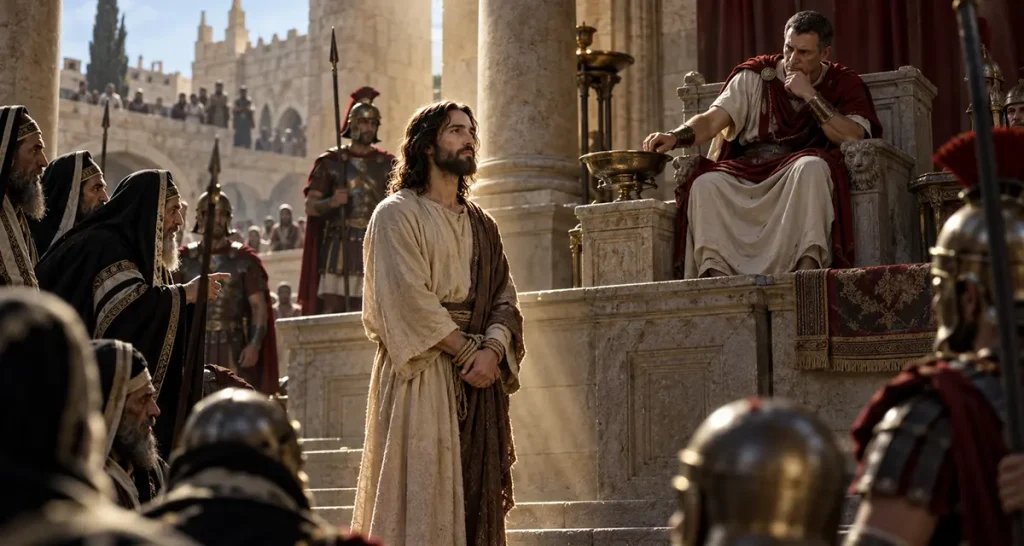
⚖️ The Judge Standing Before the Judge
Yes, exactly. The irony is enormous.
Pilate thinks Jesus’ life is in his hands, but his own breath is being sustained by the Man standing in front of him. Pilate says, in effect, “Do You not realize I have power to crucify You, and power to release You?” And Jesus answers:
John 19:11
“You could have no power at all against Me unless it had been given you from above.”
That sentence quietly turns the whole courtroom upside down.
Pilate believes he is evaluating Jesus. Rome believes it is managing a political disturbance. The religious leaders believe they are finally removing a threat. The soldiers believe they are handling another condemned man.
But in reality, everyone is being revealed.
Pilate’s cowardice is revealed.
The leaders’ envy and hatred are revealed.
Rome’s brutality is revealed.
The world’s rebellion is revealed.
And Jesus’ sovereign obedience is revealed.
So yes, in one sense, Jesus is on trial. But in the deeper sense, humanity is on trial before Him.
👑 The Prisoner Who Holds the Authority
What makes the scene almost unbearable is that Jesus is not merely saying, “God allowed you to have power.” That is true, but there is more.
Because Jesus is the eternal Son. He is not a helpless victim trapped under Pilate’s machinery. He is the One through whom all things were made.
John 1:3
“All things were made through Him, and without Him nothing was made that was made.”
So Pilate’s chair, Pilate’s lungs, Pilate’s political office, Pilate’s nervous conscience, Pilate’s wife’s dream, the Roman Empire, the wood of the cross, the iron in the nails, the soldiers’ hands, the breath of the crowd crying “Crucify Him!” — all of it exists because the Son upholds creation.
That is why the scene is so astonishing.
Pilate says, “I have power.”
Jesus says, “Only because it was given.”
And the One saying that is not merely a prophet trusting God. He is the Son who shares divine authority with the Father.
So yes, we can say carefully: the authority Pilate uses against Jesus exists only because God grants it, and the Son willingly submits to it in order to accomplish redemption.
That does not make Pilate innocent. It makes the irony deeper.
🩸 Sovereignty Does Not Cancel Guilt
This is where Scripture is very careful. Jesus’ death is not an accident. It is not plan B. It is not the result of God losing control for a weekend.
Peter says this at Pentecost:
Acts 2:23
“Him, being delivered by the determined purpose and foreknowledge of God, you have taken by lawless hands, have crucified, and put to death.”
Both things are true in the same sentence.
Jesus was delivered by the determined purpose and foreknowledge of God.
And human beings acted with lawless hands.
God’s plan does not make their sin righteous. Their sin does not make God’s plan uncertain.
That is the mystery of the cross: human evil is real, responsible, and wicked; yet God is so sovereign that even the worst evil ever committed becomes the very means by which He saves sinners.
Not because evil becomes good.
But because God is Lord even over evil.
😂 The Irony Is Almost Holy Comedy
You said, “It is not funny, but the isolated scene is.” I understand exactly what you mean.
It is not comedy in the light sense. It is not funny as mockery. It is that deep biblical irony where the proud think they are winning while they are walking into the very revelation of their own emptiness.
Like Pharaoh saying, “Who is the LORD?” right before the LORD answers with plagues, sea, judgment, and deliverance.
Like Goliath mocking David while the stone is already coming.
Like the builders rejecting the stone that becomes the chief cornerstone.
Pilate stands there thinking, “This man’s fate depends on me.”
But the truth is closer to: “Pilate, your fate depends on what you do with Him.”
That is the great reversal.
Jesus is bound, but He is free.
Pilate is seated in judgment, but he is enslaved by fear.
Jesus is silent, but His silence speaks.
Pilate speaks, but his words expose him.
Jesus is condemned, but He is righteous.
The world condemns its Maker, and the Maker uses that condemnation to redeem the world.
That is irony with eternal weight.
🧍 Pilate Is Not as Powerful as He Looks
Pilate is such a tragic figure because he knows enough to be afraid, but not enough to bow.
He repeatedly says he finds no fault in Jesus. He tries to release Him. He is disturbed. He is politically pressured. He hears that Jesus made Himself the Son of God, and John says:
John 19:8
“Therefore, when Pilate heard that saying, he was the more afraid.”
That is fascinating.
Pilate is not simply a cold Roman machine. Something is happening in his conscience. He senses that this is not normal. This prisoner is not like other prisoners.
Yet Pilate still chooses self-preservation.
He fears Caesar more than righteousness.
He fears the crowd more than truth.
He fears losing position more than condemning innocence.
So when Jesus says, “You could have no power at all against Me unless it had been given you from above,” He is not flattering Pilate. He is reducing Pilate’s imagined sovereignty to its proper size.
Pilate has authority, yes.
But borrowed authority.
Temporary authority.
Accountable authority.
That is a terrifying thing for every ruler, judge, pastor, parent, teacher, employer, government, and human being with influence.
Authority is never ultimate when it belongs to a creature.
🔥 The Whole World Is Exposed at the Cross
You said, “Pilate thought Jesus was on trial, when he and the whole world is on trial by condemning the Creator that came to save them.”
That is exactly the kind of sentence that should make us pause.
Because the cross reveals what humanity does when God comes near in humility.
If God comes with thunder, we tremble.
If God comes with law, we break it.
If God comes with prophets, we ignore them.
If God comes in flesh, meek and lowly, healing the sick, raising the dead, forgiving sinners, speaking truth — we crucify Him.
That is the human verdict on God apart from grace.
Not because Jesus was obscure.
Not because He lacked holiness.
Not because He failed to love.
Not because He was violent or corrupt.
But because His light exposed darkness.
John 3:19
“And this is the condemnation, that the light has come into the world, and men loved darkness rather than light, because their deeds were evil.”
So yes, at the cross, Jesus is condemned by the world, but the world is also condemned by its own verdict.
The innocent One stands before sinners, and sinners declare Him guilty.
That is the insanity of sin.
🕊️ Yet He Came to Save the Ones Condemning Him
And here is where the irony becomes mercy.
Jesus is not standing there merely to expose Pilate, Rome, Israel’s leaders, and the world. He is standing there to save guilty people from the judgment they deserve.
That is what makes the cross so staggering.
The Creator is condemned by His creatures, and instead of immediately ending the scene in judgment, He bears judgment.
He could have unmade the courtroom.
He could have silenced the crowd.
He could have called twelve legions of angels, as He told Peter:
Matthew 26:53
“Or do you think that I cannot now pray to My Father, and He will provide Me with more than twelve legions of angels?”
But He does not.
Why?
Because He is not trapped. He is giving Himself.
John 10:18
“No one takes it from Me, but I lay it down of Myself.”
That is why John 19 is so powerful. Jesus is not dragged to the cross as though heaven has lost control. He walks there as the obedient Son, the true King, the Lamb of God, the High Priest, and the sacrifice.
Pilate’s authority is real, but subordinate.
The leaders’ guilt is real, but not victorious.
The cross is evil, but not chaotic.
Jesus is condemned, but not defeated.
👑 The Condemned King Is the True King
The inscription over the cross says:
John 19:19
“JESUS OF NAZARETH, THE KING OF THE JEWS.”
Pilate probably means it partly as political mockery and partly as a jab at the religious leaders. But again, irony. He writes better theology than he understands. 😂
The sign is true.
The crucified Man is King.
But His kingdom does not expand like Rome. It does not conquer through coercion, greed, fear, or bloodlust. His kingdom advances through truth, sacrifice, resurrection, Spirit-given witness, and redeemed people.
Rome crucifies to preserve power.
Jesus is crucified to redeem enemies.
That is the difference between the kingdoms of men and the kingdom of Christ.
One says, “I will kill to keep my throne.”
The other says, “I will give My life to save My people.”
✨ The Final Irony
So yes, the scene is profoundly ironic.
Pilate thinks Jesus is under his authority.
But Pilate’s authority is under God.
The leaders think they are protecting God’s honor.
But they are rejecting God’s Son.
The crowd thinks Barabbas is being released instead of Jesus.
But Jesus is dying for Barabbas-like people.
Rome thinks crucifixion displays weakness.
But the cross becomes the throne of divine victory.
Satan thinks the death of Christ is triumph.
But through death, Christ destroys the one who had the power of death.
Hebrews 2:14
“That through death He might destroy him who had the power of death, that is, the devil.”
That is the holy reversal.
The Judge lets Himself be judged.
The King lets Himself be mocked.
The Creator lets His creatures nail Him to wood He created.
The Life enters death.
And by doing so, He opens eternal life.
So yes, Pilate thought Jesus was on trial.
But the cross revealed the truth: every human throne, every human court, every human conscience, every human kingdom, and every human heart stands before Him.