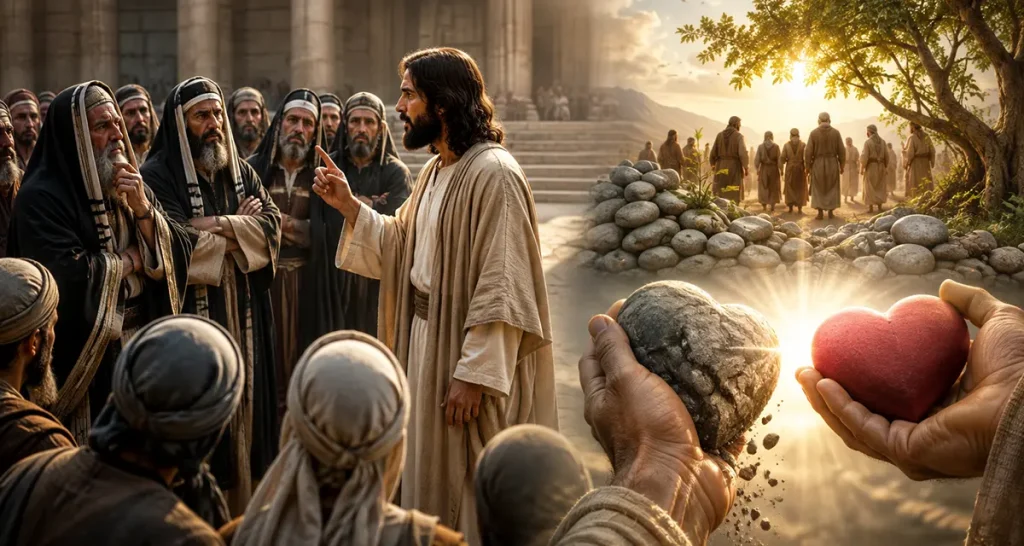
Matthew 23 is one of the most carefully constructed indictments in all of Scripture. Jesus is not venting frustration or calling people names. Every accusation is specific, justified, and rooted in the Law, the Prophets, and their observable conduct. It is, in effect, a public covenant lawsuit against Israel’s religious leadership.
What makes the chapter even more sobering is that Jesus speaks these words “to the multitudes and to His disciples” while the scribes and Pharisees are present (Matthew 23:1–2). The people who had been taught to revere these leaders are now hearing the Messiah expose them before everyone.
Let’s look at each accusation.
🎭 1. They taught the truth but did not live it
Jesus begins surprisingly.
“The scribes and the Pharisees sit in Moses’ seat. Therefore whatever they tell you to observe, that observe and do, but do not do according to their works; for they say, and do not do.” (Matthew 23:2–3)
This is remarkable.
Jesus does not reject Moses’ teaching. Nor does He tell the people to disregard everything the Pharisees teach.
Instead, He distinguishes between:
- the authority of God’s Word,
- and the hypocrisy of those handling it.
Their greatest failure is not ignorance.
It is inconsistency.
They know the truth.
They teach the truth.
They refuse to submit to the truth.
James later expresses the same principle:
“But be doers of the word, and not hearers only, deceiving yourselves.” (James 1:22)
🪨 2. They made serving God unbearably heavy
“For they bind heavy burdens, hard to bear, and lay them on men’s shoulders; but they themselves will not move them with one of their fingers.” (Matthew 23:4)
The Law itself was never the problem.
The Pharisees had surrounded God’s commandments with hundreds of human traditions and detailed regulations.
Instead of helping people know God…
they buried them beneath religious performance.
Ironically, Jesus later says:
“Come to Me, all you who labor and are heavy laden, and I will give you rest… For My yoke is easy and My burden is light.” (Matthew 11:28–30)
The contrast is intentional.
The Pharisees increased burdens.
Jesus removed them.
👀 3. Their religion existed to impress people
Jesus gives concrete examples.
“They make their phylacteries broad and enlarge the borders of their garments.” (Matthew 23:5)
Phylacteries contained portions of Scripture.
The tassels reminded Israel of God’s commandments (Numbers 15:38–40).
Neither practice was wrong.
The problem was motivation.
They enlarged these visible symbols to advertise their spirituality.
Everything became a performance.
Jesus had already warned earlier:
“Take heed that you do not do your charitable deeds before men, to be seen by them.” (Matthew 6:1)
Their audience was no longer God.
It was the crowd.
👑 4. They loved status more than service
Jesus lists their favorite things:
- best seats,
- places of honor,
- public greetings,
- impressive titles.
(Matthew 23:6–10)
Their identity depended on recognition.
Jesus completely reverses the kingdom’s values.
“He who is greatest among you shall be your servant.” (Matthew 23:11)
The kingdom measures greatness by humility.
The Pharisees measured greatness by visibility.
🚪 5. They shut people out of God’s kingdom
Perhaps this is the most frightening accusation.
“But woe to you… For you shut up the kingdom of heaven against men; for you neither go in yourselves, nor do you allow those who are entering to go in.” (Matthew 23:13)
Imagine holding the key to a hospital during an epidemic…
and locking the doors.
That is Jesus’ picture.
Their influence prevented others from recognizing the Messiah.
Instead of leading Israel to Christ…
they stood between Israel and Christ.
🌍 6. They made converts… to themselves
“You travel land and sea to win one proselyte, and when he is won, you make him twice as much a son of hell as yourselves.” (Matthew 23:15)
This is astonishing.
Jesus is not condemning evangelism.
He is condemning corrupt discipleship.
They produced followers who inherited their hypocrisy rather than God’s truth.
The result was religion without repentance.
👨⚖️ 7. They manipulated God’s commands
Jesus exposes their dishonest casuistry.
They had created elaborate distinctions:
“If someone swears by the temple…”
“If someone swears by the gold…”
“If someone swears by the altar…”
(Matthew 23:16–22)
These distinctions conveniently allowed them to evade obligations.
Instead of honoring God’s intent…
they exploited loopholes.
Jesus calls them:
“Blind guides” (Matthew 23:16)
because they had become experts in technicalities while missing truth.
⚖️ 8. They obsessed over tiny details while ignoring God’s heart
One of Jesus’ most famous statements:
“You pay tithe of mint and anise and cummin, and have neglected the weightier matters of the law: justice and mercy and faith.” (Matthew 23:23)
Notice something beautiful.
Jesus does not tell them to stop tithing.
He says:
“These you ought to have done, without leaving the others undone.”
The issue is proportion.
They carefully counted herbs…
while neglecting justice.
Their priorities were upside down.
Micah had already summarized what God desired:
“He has shown you, O man, what is good… to do justly, to love mercy, and to walk humbly with your God.” (Micah 6:8)
🦟 9. They filtered gnats but swallowed camels
“Blind guides, who strain out a gnat and swallow a camel!” (Matthew 23:24)
This is almost humorous.
The gnat was one of the smallest ceremonially unclean animals.
The camel was the largest.
Jesus paints a ridiculous picture.
Imagine someone obsessively filtering microscopic impurities…
while swallowing the largest possible impurity.
That was their religion.
Microscopic precision.
Massive blindness.
🧼 10. They cleaned the outside but not the inside
“You cleanse the outside of the cup and dish, but inside they are full of extortion and self-indulgence.” (Matthew 23:25)
Their concern was appearance.
Jesus’ concern was the heart.
This echoes what God has always said.
“Man looks at the outward appearance, but the LORD looks at the heart.” (1 Samuel 16:7)
⚰️ 11. They were whitewashed tombs
Perhaps the most unforgettable metaphor.
“You are like whitewashed tombs which indeed appear beautiful outwardly, but inside are full of dead men’s bones and all uncleanness.” (Matthew 23:27)
Whitewashing tombs before Passover made them visible so travelers would not accidentally become ceremonially unclean (Numbers 19:16).
Jesus turns that image against them.
Beautiful exterior.
Death inside.
They looked spiritually alive…
while spreading spiritual death.
🩸 12. They honored dead prophets while preparing to kill the living One
They proudly declared:
“If we had lived in the days of our fathers, we would not have been partakers with them in the blood of the prophets.” (Matthew 23:30)
Jesus answers:
“You are proving yourselves to be their sons.”
Why?
Because while condemning their ancestors…
they were plotting the murder of the greatest Prophet ever sent.
Indeed, within days they would hand Him over to be crucified (Matthew 26:3–4, 57–68).
🐍 13. They belonged to the same rebellious lineage
Jesus concludes:
“Serpents, brood of vipers! How can you escape the condemnation of hell?” (Matthew 23:33)
This is not merely a statement about their present conduct.
It is about the trajectory of their hearts.
They were completing the long history of rejecting God’s messengers.
Jesus immediately says:
“Therefore, indeed, I send you prophets, wise men, and scribes: some of them you will kill and crucify…” (Matthew 23:34)
The book of Acts confirms this prediction. The apostles, Stephen, and many early believers suffered persecution at the hands of the same religious establishment (Acts 7:51–60; Acts 12:1–3).
🌿 The deepest accusation
If we step back, all thirteen accusations flow into one central charge.
The Pharisees had turned a God-given ministry into a self-serving institution.
They were entrusted to shepherd Israel, teach God’s Word, and prepare the people for the coming Messiah. Instead, they used their position to exalt themselves, burden consciences, distort God’s commands, and ultimately reject the very One to whom the Scriptures pointed (John 5:39–40).
This explains why Jesus’ rebuke is so severe. “To whom much is given, from him much will be required” (Luke 12:48). Those who had the greatest light bore the greatest responsibility.
Yet even after this devastating indictment, Jesus does not end with triumph over His enemies but with sorrow:
“O Jerusalem, Jerusalem, the one who kills the prophets and stones those who are sent to her! How often I wanted to gather your children together, as a hen gathers her chicks under her wings, but you were not willing!” (Matthew 23:37)
The Judge speaks with tears. His denunciation is not the outburst of wounded pride but the grief of the Shepherd whose flock has refused His voice. That is what makes Matthew 23 so profound: the strongest words of judgment in Jesus’ ministry are spoken by the same Savior who still longs to gather and save.