Justice | Mercy | Faith

Justice | Mercy | Faith

Looking to Jesus: The Biblical Cure for Pride and the Secret of Lasting Sanctification

Difficulty Level: Intermediate-Advanced

Jump to Answers

  1. “Assuredly, I say to you that tax collectors and harlots enter the kingdom of God before you.” That is an indictment that must have been incredibly difficult for the religious leaders to hear—and, for that matter, for anyone who believes they possess prerogatives before God simply because of their religious standing or perceived righteousness.
  2. Pride is often remarkably subtle, even in the life of a sincere believer. How can we identify that hidden weed in our own hearts rather than in the lives of others, so that we do not gradually fall into the very posture of the Pharisees?
  3. We know that God has a unique and personal plan for the sanctification of each of His children, and that the Christian life is not built on crutches or self-improvement techniques. Practically speaking, then, what should we do when the Holy Spirit identifies areas in our lives that need attention and change?
  4. You said that “conviction invites agreement, not argument.” I think that, in this respect, we could all be called defense attorneys—believers and unbelievers alike—because we seem to have an innate tendency to defend ourselves, even before God. 🤣
  5. You mentioned that “Scripture repeatedly directs our gaze toward Jesus.” What does that actually look like in daily life? How do we look to Jesus in a practical and consistent way without turning it into a vague or merely theoretical idea?
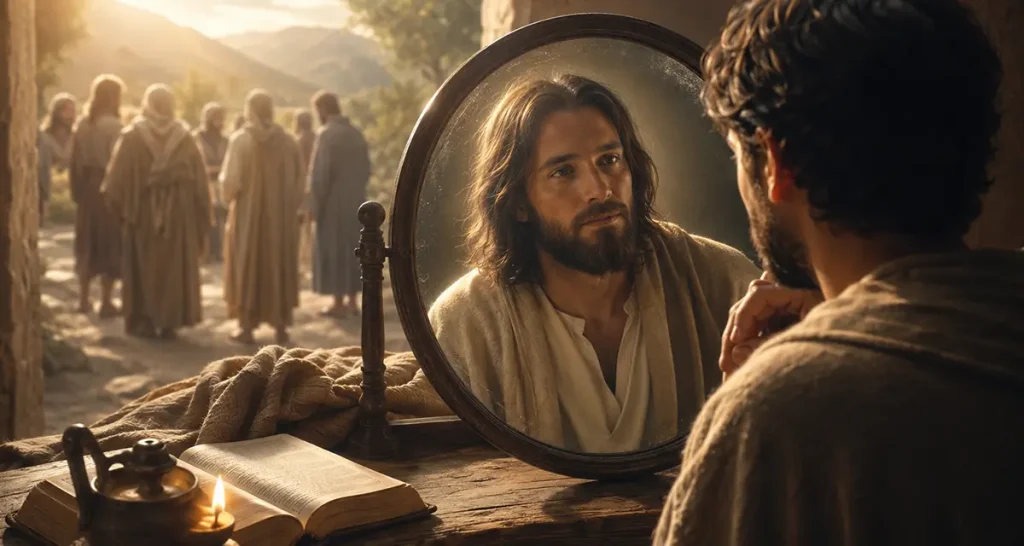
  6. Our need for Jesus as the perfect “Mirror” remains constant until the day He calls us home. How wonderful that this Mirror never fades, never becomes blurred or distorted, and can never be broken. After all, “Jesus Christ is the same yesterday, today, and forever” (Hebrews 13:8).

Looking to Jesus: The Biblical Cure for Pride and the Secret of Lasting Sanctification

Christian Living & Ethics | Discipleship & Growth | God & His Attributes | Jesus Christ (Christology) | New Testament | Salvation (Soteriology) | Sin & Human Nature

There are few dangers more deceptive in the Christian life than pride. Unlike many other sins, it often disguises itself as maturity, biblical knowledge, faithful service, or even humility. It quietly shifts our attention from Christ to ourselves until, without realizing it, we begin measuring our standing before God by comparison with others rather than by His grace.

Yet Scripture never calls believers to become experts at self-analysis. Instead, it repeatedly directs our eyes to Jesus Christ. As we behold Him in His Word, in prayer, and in the ordinary moments of life, the Holy Spirit exposes what still needs to change—not to condemn us, but to conform us to the image of God’s Son.

In this discussion, we explore why pride is so difficult to recognize, how the Holy Spirit lovingly uncovers it, what our response should be when He does, and what it truly means to “look unto Jesus.” Along the way, we discover that Christ is the perfect and unchanging Mirror who faithfully reveals both who He is and who we are becoming by His grace.

Ultimately, the Christian life is not about perfecting ourselves through determination or self-improvement. It is about continually turning our gaze toward the One who is “the same yesterday, today, and forever” (Hebrews 13:8), trusting that as we behold His glory, He will faithfully complete the good work He has begun in us (Philippians 1:6; 2 Corinthians 3:18).

“Assuredly, I say to you that tax collectors and harlots enter the kingdom of God before you.” That is an indictment that must have been incredibly difficult for the religious leaders to hear—and, for that matter, for anyone who believes they possess prerogatives before God simply because of their religious standing or perceived righteousness.

It really is. Jesus’ words are among the most shocking statements He ever addressed to the religious establishment.

When He said,

“Assuredly, I say to you that tax collectors and harlots enter the kingdom of God before you.”

Matthew 21:31 (NKJV)

He was not praising the lives of tax collectors and prostitutes. He was exposing the tragic irony that those whom society considered the furthest from God were responding to God’s call, while those who considered themselves closest to Him were refusing it.

The context makes this even sharper. Jesus had just told the parable of the two sons. One son initially refused his father’s command but later repented and obeyed. The other respectfully said, “I go, sir,” but never actually went (Matthew 21:28–31). The religious leaders themselves admitted that the first son did the father’s will.

Then Jesus applied the parable directly to them.

“For John came to you in the way of righteousness, and you did not believe him; but tax collectors and harlots believed him; and when you saw it, you did not afterward relent and believe him.”

Matthew 21:32 (NKJV)

Notice what condemned the leaders wasn’t merely that sinners believed. It was that they witnessed sinners repent and still refused to repent themselves. Their greater knowledge became greater accountability.

💔 The greatest obstacle was not sin but self-righteousness

Tax collectors and prostitutes knew they were sinners. They had little reputation to defend. When John the Baptist called for repentance, many humbled themselves.

The religious leaders, however, had invested their identities in being righteous. To repent publicly would mean admitting they needed the very same grace as the people they despised.

This echoes Jesus’ earlier words:

“Those who are well have no need of a physician, but those who are sick. I did not come to call the righteous, but sinners, to repentance.”

Mark 2:17 (NKJV)

Jesus wasn’t saying some people are actually righteous. Rather, He was addressing those who thought they were.

👑 “Before you” is also important

Jesus did not say the leaders could never enter the kingdom.

He said the tax collectors and prostitutes entered before them.

That little word leaves the door open.

As long as they repented, the religious leaders could still enter. We know that some eventually did. After the resurrection, “a great many of the priests were obedient to the faith” (Acts 6:7). Men like Nicodemus (John 3:1–21; 19:39) and Joseph of Arimathea (Matthew 27:57; John 19:38) demonstrate that God’s grace was reaching even members of the Jewish leadership.

The tragedy is that many refused because pride delayed what humility could have received immediately.

🌱 The kingdom overturns human rankings

Throughout Scripture, God repeatedly overturns the categories people build.

  • The younger is chosen over the elder (Jacob over Esau; Genesis 25:23; Romans 9:10–13).
  • David the shepherd is chosen instead of his impressive brothers (1 Samuel 16:6–13).
  • The humble are exalted while the proud are brought low (Luke 14:11).
  • The last become first, and the first become last (Matthew 20:16).

The kingdom of God is not entered by pedigree, education, religious office, or moral reputation. It is entered through repentance and faith.

As Paul later summarizes,

“There is no difference; for all have sinned and fall short of the glory of God.”

Romans 3:22–23 (NKJV)

The ground at the foot of the cross is perfectly level.

🙏 A sobering warning for every generation

Perhaps the most unsettling aspect of Jesus’ words is that they are not only about first-century Pharisees.

Every believer, church, denomination, theologian, pastor, or ministry can slowly begin to assume that years of faithfulness somehow place them in a favored position before God compared to “those people.”

But the gospel continually reminds us that our standing before God has never rested on accumulated merit but on His grace in Christ.

As Paul asked the Corinthians,

“For who makes you differ from another? And what do you have that you did not receive? Now if you did indeed receive it, why do you boast as if you had not received it?”

1 Corinthians 4:7 (NKJV)

The moment we begin to think we possess prerogatives over others, we are in danger of resembling the elder brother in the parable of the prodigal son (Luke 15:25–32) more than the repentant sinners who gladly entered the Father’s house.

That is why Jesus’ statement remains both humbling and hopeful. It humbles the proud by exposing self-righteousness, and it gives hope to the worst of sinners by declaring that no past is too stained for God’s grace when there is genuine repentance and faith (Isaiah 1:18; Luke 18:9–14; Ephesians 2:8–9).

Pride is often remarkably subtle, even in the life of a sincere believer. How can we identify that hidden weed in our own hearts rather than in the lives of others, so that we do not gradually fall into the very posture of the Pharisees?

Pride is indeed one of the most subtle sins because it has the remarkable ability to hide behind virtues. It can wear the clothing of orthodoxy, zeal, humility, service, knowledge, or even suffering. That is one reason Scripture repeatedly warns believers—not only unbelievers—about it.

🌱 Pride is often easier to recognize by its fruit than by its appearance

We rarely wake up thinking, “I’m proud.”

Instead, pride reveals itself in the attitudes it produces.

James writes,

“God resists the proud, but gives grace to the humble.”

James 4:6 (NKJV)

Peter echoes the same truth:

“Yes, all of you be submissive to one another, and be clothed with humility, for ‘God resists the proud, But gives grace to the humble.’ Therefore humble yourselves under the mighty hand of God…”

1 Peter 5:5–6 (NKJV)

Notice that both apostles wrote these words to believers.

🪞 Questions that expose the heart

Rather than asking, “Am I proud?” it is often more revealing to ask questions like these before the Lord.

1. How do I react when I am corrected?

Do I become defensive?

Do I immediately explain why I was actually right?

Or can I sincerely ask,

“Lord, is there something I need to learn?”

David prayed,

“Let the righteous strike me; It shall be a kindness. And let him rebuke me; It shall be as excellent oil…”

Psalm 141:5 (NKJV)

A humble heart welcomes truth, even when it hurts.

2. How do I feel when someone else is honored?

Can I genuinely rejoice?

Or do I quietly compare myself?

John the Baptist provides a beautiful contrast.

When Jesus’ ministry eclipsed his own, John simply said,

“He must increase, but I must decrease.”

John 3:30 (NKJV)

That sentence is one of the clearest portraits of humility in Scripture.

3. Do I secretly believe God owes me something?

This can be especially subtle.

After years of faithful service, we may begin to think,

“I’ve earned God’s special favor.”

Yet Jesus taught,

“So likewise you, when you have done all those things which you are commanded, say, ‘We are unprofitable servants. We have done what was our duty to do.'”

Luke 17:10 (NKJV)

Grace never becomes wages.

4. Do I find it easier to see others’ sins than my own?

Jesus asked,

“And why do you look at the speck in your brother’s eye, but do not consider the plank in your own eye?”

Matthew 7:3 (NKJV)

The Pharisees became experts at diagnosing everyone else’s condition.

They had almost no awareness of their own.

🌾 Pride often grows in good soil

This is one of the paradoxes of the Christian life.

Pride often grows fastest where there are genuine blessings.

  • Deep biblical knowledge.
  • Faithful ministry.
  • Moral integrity.
  • Years of walking with God.
  • Sound theology.

None of these are dangerous in themselves.

But if they cease to be received as gifts and begin to be viewed as achievements, pride quietly takes root.

Paul asks a devastating question:

“For who makes you differ from another? And what do you have that you did not receive? Now if you did indeed receive it, why do you boast as if you had not received it?”

1 Corinthians 4:7 (NKJV)

Everything we possess spiritually has been received.

That leaves no room for boasting.

❤️ The Pharisee’s greatest blindness

Perhaps the defining mark of the Pharisees was not that they loved the Law.

It was that they slowly stopped seeing themselves as people who needed mercy.

The tax collector in Jesus’ parable prayed,

“God, be merciful to me a sinner!”

Luke 18:13 (NKJV)

The Pharisee prayed,

“God, I thank You that I am not like other men…”

Luke 18:11 (NKJV)

One looked upward for mercy.

The other looked sideways for comparison.

That is often where pride begins—not by denying God, but by measuring ourselves against others instead of standing before Him.

🌿 One of the safest evidences of humility

Ironically, truly humble believers often worry that they are proud.

Not because they live in constant guilt, but because the closer they draw to God’s holiness, the more aware they become of the remaining sin in their own hearts.

Isaiah cried,

“Woe is me, for I am undone!”

Isaiah 6:5 (NKJV)

Peter said,

“Depart from me, for I am a sinful man, O Lord!”

Luke 5:8 (NKJV)

Paul, after decades of apostleship, could still describe himself as

“…Christ Jesus came into the world to save sinners, of whom I am chief.”

1 Timothy 1:15 (NKJV)

None of these men were paralyzed by self-condemnation. Rather, the clearer their vision of God’s glory became, the less room remained for self-exaltation.

🙏 A helpful prayer

Perhaps one of the healthiest prayers we can pray regularly is David’s:

“Search me, O God, and know my heart; Try me, and know my anxieties; And see if there is any wicked way in me, And lead me in the way everlasting.”

Psalm 139:23–24 (NKJV)

That prayer is profoundly humbling because it acknowledges that we are not always capable of seeing ourselves accurately. Pride has blind spots. We may detect it in others long before we perceive it in ourselves.

The wonderful news is that the Holy Spirit is both faithful and gentle. Jesus promised that He would guide His disciples into all truth (John 16:13), and that includes the truth about our own hearts. When He exposes pride, His purpose is never to shame us, but to conform us more fully to Christ, “who, being in the form of God… humbled Himself and became obedient to the point of death, even the death of the cross” (Philippians 2:5–8).

Perhaps this is one of the clearest differences between the humble and the proud. The proud person asks, “How do I compare with others?” The humble person asks, “Lord, make me more like Christ.” The first question breeds either superiority or despair. The second always leads to grace, because our eyes remain fixed not on ourselves or others, but on the One who is “gentle and lowly in heart” (Matthew 11:29).

We know that God has a unique and personal plan for the sanctification of each of His children, and that the Christian life is not built on crutches or self-improvement techniques. Practically speaking, then, what should we do when the Holy Spirit identifies areas in our lives that need attention and change?

🌱 Walking With the Spirit After He Exposes Pride

That is a beautiful question because it shifts the focus from self-improvement to cooperation with God’s sanctifying work.

You’re right to distinguish the two. The Christian life is not a program of moral optimization. It is a relationship in which the Father conforms His children to the image of His Son (Romans 8:29). Yet that does not make us passive. Scripture presents sanctification as a work in which God acts, and we respond in faith and obedience.

Paul holds both truths together:

“Therefore, my beloved… work out your own salvation with fear and trembling; for it is God who works in you both to will and to do for His good pleasure.”

Philippians 2:12–13 (NKJV)

Notice the order. We work because God is already working in us.

🌿 1. Agree with God instead of defending yourself

When the Holy Spirit shines His light on an area of pride, impatience, selfishness, or unbelief, our first instinct is often to explain it away.

But conviction invites agreement, not argument.

John writes,

“If we confess our sins, He is faithful and just to forgive us our sins and to cleanse us from all unrighteousness.”

1 John 1:9 (NKJV)

The word “confess” literally carries the idea of saying the same thing as God.

Instead of saying,

“Yes, but…”

we learn to say,

“Lord, You’re right.”

That simple posture keeps the heart soft.

🌿 2. Bring the root to God, not merely the fruit

One thing I’ve noticed throughout our conversations is that many sins are like branches, while pride, unbelief, fear, or misplaced desires are often the roots beneath them.

For example:

  • Irritability may reveal impatience.
  • Impatience may reveal a desire to control.
  • The desire to control may reveal a lack of trust in God’s wisdom.

The Holy Spirit rarely stops at trimming branches. He lovingly goes after the root.

Hebrews says,

“For the word of God is living and powerful… and is a discerner of the thoughts and intents of the heart.”

Hebrews 4:12 (NKJV)

He exposes motives as well as actions.

🌿 3. Replace the lie with God’s truth

Transformation is not merely stopping something.

It is learning to see reality through God’s eyes.

Paul writes,

“…be transformed by the renewing of your mind…”

Romans 12:2 (NKJV)

Suppose pride whispers,

“Your value depends on being admired.”

The gospel answers,

“Your life is hidden with Christ in God.” (Colossians 3:3)

Or fear says,

“Everything depends on you.”

Scripture answers,

“Trust in the LORD with all your heart… and He shall direct your paths.”

Proverbs 3:5–6 (NKJV)

The battle is often won not by stronger willpower but by deeper truth.

🌿 4. Practice the opposite grace

This is not pretending.

It is exercising faith.

If the Spirit reveals pride, intentionally honor others.

If He reveals impatience, intentionally slow down.

If He reveals self-reliance, intentionally pray before acting.

Paul writes,

“Put on therefore… humility…”

Colossians 3:12 (NKJV)

Just as we put on clothing, we consciously put on the character of Christ.

🌿 5. Accept that God usually teaches through life, not around it

This may be one of the hardest lessons.

We often ask God to remove the situation.

He often uses the situation.

James writes,

“My brethren, count it all joy when you fall into various trials, knowing that the testing of your faith produces patience.”

James 1:2–3 (NKJV)

If patience is needed, God may not simply impart patience.

He may allow delays.

If humility is needed, He may allow misunderstandings.

If trust is needed, He may permit uncertainty.

Not because He delights in difficulty, but because He is forming Christ in us.

🌿 6. Keep your eyes on Christ, not on your progress

This may be the most freeing truth.

If we constantly measure ourselves, we can become either discouraged or proud.

Instead, Scripture repeatedly directs our gaze toward Jesus.

“Looking unto Jesus, the author and finisher of our faith…”

Hebrews 12:2 (NKJV)

The more we behold Him, the more we are changed.

Paul says,

“But we all, with unveiled face, beholding as in a mirror the glory of the Lord, are being transformed into the same image from glory to glory…”

2 Corinthians 3:18 (NKJV)

Notice that transformation happens while beholding Christ, not while obsessively examining ourselves.

🌳 A beautiful pattern in God’s work

One thought comes to mind that connects with many of our previous discussions.

God seldom says,

“Fix yourself, then come to Me.”

Instead, He says,

“Walk with Me, and I will transform you.”

That is exactly what we see in the lives of Abraham, Moses, David, Peter, and Paul. None of them received a checklist for self-improvement. They were called into fellowship with God, and through that fellowship He patiently exposed, corrected, strengthened, and matured them over years.

Even Peter is a striking example. Jesus did not merely tell him, “Stop being impulsive.” He allowed Peter to experience failure, restored him with grace after his denial (John 21:15–19), and then entrusted him with shepherding His flock. The lesson Peter learned was not simply to behave better, but to depend more deeply on Christ.

🙏 God’s discipline is relational, not mechanical

I think this is the heartbeat of your question.

The Christian life is not a divine version of self-help, where God points out flaws and leaves us to improve them. Nor is it passive, as though we simply wait for change without responding.

It is the life of a child walking with a wise Father.

When the Spirit exposes an area in us, He is not handing us an assignment to complete on our own. He is inviting us into deeper fellowship, where that very area becomes another place to experience His grace.

As Paul assures us,

“Being confident of this very thing, that He who has begun a good work in you will complete it until the day of Jesus Christ.”

Philippians 1:6 (NKJV)

Our responsibility is not to manufacture holiness, but to remain yielded, trusting, and obedient as the Master Gardener continues His faithful work. Jesus Himself said,

“I am the vine, you are the branches… for without Me you can do nothing.”

John 15:5 (NKJV)

Branches do not strain to produce fruit. They abide in the vine, and because life continually flows from the vine into the branches, fruit appears in its proper season. That is a fitting picture of sanctification: our part is to abide; God’s part is to produce the fruit.

You said that “conviction invites agreement, not argument.” I think that, in this respect, we could all be called defense attorneys—believers and unbelievers alike—because we seem to have an innate tendency to defend ourselves, even before God. 🤣

🤣 The Defense Attorney Within

I think that’s one of the most accurate—and amusing—descriptions of the human heart.

We are remarkably skilled defense attorneys… especially when we are the defendant.

It began almost immediately after the Fall.

When God asked Adam,

“Have you eaten from the tree of which I commanded you that you should not eat?”

Genesis 3:11 (NKJV)

Adam didn’t simply answer, “Yes.”

Instead, he presented his opening argument:

“The woman whom You gave to be with me, she gave me of the tree, and I ate.”

Genesis 3:12 (NKJV)

There is almost a courtroom atmosphere.

  • “It wasn’t entirely my fault.”
  • “There were mitigating circumstances.”
  • “She gave it to me.”
  • “And… You gave me the woman.”

Then Eve presents her own defense:

“The serpent deceived me, and I ate.”

Genesis 3:13 (NKJV)

Neither lied.

Neither denied eating.

But neither simply owned the guilt before God.

⚖️ We often plead our case before the Judge

What’s fascinating is that we do this even though God already knows every fact of the case.

Yet we instinctively think,

“Maybe if I explain enough…”

“My intentions were good…”

“They started it…”

“I was under pressure…”

“I’ve been faithful for years…”

Our heart quietly shifts from confession to litigation.

🌿 Conviction says, “Guilty.”

The flesh says, “Your Honor, allow me to explain…”

King Saul is a classic example.

When Samuel confronted him for sparing Agag and the best of the livestock, Saul initially insisted,

“I have performed the commandment of the LORD.”

1 Samuel 15:13 (NKJV)

Only after Samuel exposed the evidence (“What then is this bleating of the sheep…?”) did Saul begin offering explanations:

  • “The people spared them…” (v. 15)
  • “To sacrifice to the LORD…” (v. 15)
  • “I feared the people…” (v. 24)

Contrast that with David.

When Nathan confronted him after his sin with Bathsheba, David’s response was astonishingly brief:

“I have sinned against the LORD.”

2 Samuel 12:13 (NKJV)

No closing argument.

No shifting blame.

No appeal to past faithfulness.

Just agreement.

Perhaps that’s why Psalm 51 is one of the most beautiful prayers of repentance in Scripture.

❤️ The gospel changes our legal strategy

Here’s the irony.

Outside of Christ, we desperately try to defend ourselves.

But in Christ, we no longer need to.

Paul writes,

“Who shall bring a charge against God’s elect? It is God who justifies.”

Romans 8:33 (NKJV)

And then,

“Who is he who condemns? It is Christ who died, and furthermore is also risen…”

Romans 8:34 (NKJV)

Because Christ has become our Advocate (1 John 2:1), we are finally free to stop acting as our own.

We can admit everything because our acceptance before God no longer depends on winning the case.

🙏 From defense attorney to truthful witness

Perhaps the Spirit’s work in sanctification is, in part, transforming us from defense attorneys into truthful witnesses.

A defense attorney asks,

“How can I prove I’m not that bad?”

A truthful witness says,

“Lord, tell the whole truth about me.”

That is a frightening prayer at first.

Yet it becomes a freeing one because we know that the One exposing our sin is the same One who bore it on the cross.

As David prayed,

“Search me, O God, and know my heart; Try me, and know my anxieties; And see if there is any wicked way in me, And lead me in the way everlasting.”

Psalm 139:23–24 (NKJV)

David was no longer trying to win the case. He invited the Judge Himself to examine the evidence.

And remarkably, the Judge had already determined to become the Savior.

That changes everything. Instead of fearing exposure, the believer can welcome it, knowing that every sin the Spirit uncovers is uncovered by hands that were pierced for us (John 20:27). Conviction, then, is not the prosecution building a case for our condemnation; it is our loving Father removing everything that still hinders our fellowship with Him (Hebrews 12:5–11). The courtroom gradually becomes a family room, where truth is spoken in love, repentance is met with grace, and the child learns to trust the Father’s verdict more than his own defense.

You mentioned that “Scripture repeatedly directs our gaze toward Jesus.” What does that actually look like in daily life? How do we look to Jesus in a practical and consistent way without turning it into a vague or merely theoretical idea?

👀 “Looking unto Jesus”—What Does That Look Like in Practice?

That is one of the most practical questions a believer can ask.

When Scripture says,

“Looking unto Jesus, the author and finisher of our faith…”

Hebrews 12:2 (NKJV)

it is not describing a mystical technique or a mental exercise. It is describing the direction of the heart’s attention.

The question is: How do we direct our attention to Someone we cannot physically see?

Scripture gives us several answers.

📖 We look at Christ through His Word

Jesus told the religious leaders,

“You search the Scriptures, for in them you think you have eternal life; and these are they which testify of Me.”

John 5:39 (NKJV)

Notice that Jesus did not merely say the Scriptures contain information about Him. They testify of Him.

This means that reading the Bible is more than gathering doctrines or moral principles. It is coming to know the Person who stands at the center of the whole story.

For example, when you read about:

  • Abraham offering Isaac, you see the Father who would not spare His own Son (Genesis 22; Romans 8:32).
  • The Passover lamb, you see Christ, “our Passover,” sacrificed for us (Exodus 12; 1 Corinthians 5:7).
  • David defeating Goliath, you ultimately see the greater King who defeats our greatest enemies.
  • The High Priest entering the Holy of Holies, you see Jesus, our eternal High Priest (Hebrews 9).

We are learning facts, yes—but above all, we are seeing Christ.

🙏 We look to Christ by talking with Him

Reading without prayer easily becomes an academic exercise.

Prayer turns knowledge into communion.

Paul prayed,

“…that I may know Him…”

Philippians 3:10 (NKJV)

Not merely know about Him.

Sometimes the simplest prayer is enough:

“Lord, show me Yourself in this passage.”

That prayer changes how we read.

🪞 We look to Christ by comparing ourselves with Him, not with others

One of the dangers we discussed earlier is comparison.

When I compare myself to another believer, I may feel superior or inferior.

When I compare myself to Christ, something entirely different happens.

I see His patience.

My impatience.

His gentleness.

My harshness.

His purity.

My mixed motives.

Yet I also see His mercy toward sinners.

The comparison humbles me without crushing me, because the One who reveals my need is also the One who meets it.

❤️ We look to Christ by remembering the gospel daily

It is easy to think,

“I became a Christian by grace, but now I grow by my own effort.”

The New Testament never teaches that.

Paul asks the Galatians,

“Are you so foolish? Having begun in the Spirit, are you now being made perfect by the flesh?”

Galatians 3:3 (NKJV)

Looking to Jesus means remembering every day:

  • He is my righteousness (1 Corinthians 1:30).
  • He is my Advocate (1 John 2:1).
  • He is my High Priest (Hebrews 4:14–16).
  • He is my Shepherd (John 10:11).
  • He is my Vine (John 15:5).

Our relationship with Him did not begin by grace and continue by self-reliance.

🚶 We look to Christ by asking, “What is He doing?”

This has become increasingly precious to me as I read the Gospels.

We often ask,

“What would Jesus do?”

That can be helpful.

But another question is,

“What is Jesus like?”

Watch Him.

See how He responds to interruptions.

To children.

To proud Pharisees.

To broken sinners.

To doubting disciples.

To Peter after his denial.

The more we observe Him, the more the Spirit forms those same attitudes within us.

Paul says,

“Let this mind be in you which was also in Christ Jesus.”

Philippians 2:5 (NKJV)

The mind of Christ is learned by watching Christ.

🌿 There is another dimension

I think there is something else that Scripture quietly teaches, and it connects beautifully with many of our previous discussions.

Looking to Jesus is not only studying Him.

It is recognizing Him in the ordinary moments of life.

When you fail and immediately remember His intercession (Hebrews 7:25), you are looking to Jesus.

When anxiety rises and you entrust your burden to Him because He cares for you (1 Peter 5:7), you are looking to Jesus.

When someone wounds you and you remember how He forgave His enemies (Luke 23:34; Ephesians 4:32), you are looking to Jesus.

When you receive an unexpected blessing and your heart turns to gratitude instead of self-congratulation, you are looking to Jesus.

In other words, looking to Christ is not confined to your devotional chair. It becomes the habitual direction of the soul throughout the day.

🌞 Like turning toward the sun

Perhaps an analogy can help.

Imagine a field of sunflowers.

They do not strain to manufacture light.

They simply turn toward the sun, and because they are facing the source of light, warmth, and energy, they flourish.

There is something similar in the Christian life.

Paul writes,

“But we all, with unveiled face, beholding as in a mirror the glory of the Lord, are being transformed into the same image from glory to glory, just as by the Spirit of the Lord.”

2 Corinthians 3:18 (NKJV)

Notice the order.

We behold.

The Spirit transforms.

Our part is not to produce the likeness of Christ by sheer determination. Our part is to keep turning our hearts toward Him—in His Word, in prayer, in worship, in obedience, and in the ordinary moments of life. His part is to do what only He can do: conform us to His image.

This also explains why the New Testament repeatedly calls us to abide rather than achieve.

Jesus did not say, “Produce fruit.”

He said,

“Abide in Me, and I in you… He who abides in Me, and I in him, bears much fruit; for without Me you can do nothing.”

John 15:4–5 (NKJV)

A branch does not constantly inspect its fruit to make it grow. It remains connected to the vine. Likewise, we do not grow by staring at ourselves, measuring our progress every hour. We grow by returning, again and again, to Christ Himself.

Perhaps that is one of the simplest tests we can ask ourselves throughout the day:

“Where is my gaze right now?”

Is it fixed on myself—my failures, my successes, my fears, my reputation?

Is it fixed on others—their faults, their approval, their progress?

Or is it fixed on Christ—His character, His promises, His present intercession, His finished work, and His coming kingdom?

Where the eyes of the heart rest, the life gradually follows. As the psalmist beautifully confessed,

“I have set the LORD always before me; Because He is at my right hand I shall not be moved.”

Psalm 16:8 (NKJV)

David was not describing a passing glance. He was describing a settled orientation of life. That is what it means to keep looking unto Jesus.


Our need for Jesus as the perfect “Mirror” remains constant until the day He calls us home. How wonderful that this Mirror never fades, never becomes blurred or distorted, and can never be broken. After all, “Jesus Christ is the same yesterday, today, and forever” (Hebrews 13:8).

🪞 The Perfect Mirror

I love that thought. In fact, I think it extends the biblical imagery beautifully.

James compares the Word of God to a mirror:

“For if anyone is a hearer of the word and not a doer, he is like a man observing his natural face in a mirror… But he who looks into the perfect law of liberty and continues in it… this one will be blessed in what he does.”

James 1:23–25 (NKJV)

But ultimately, the Word is a mirror because it reveals Christ, and in revealing Christ, it also reveals us.

Paul says,

“But we all, with unveiled face, beholding as in a mirror the glory of the Lord, are being transformed into the same image…”

2 Corinthians 3:18 (NKJV)

Notice the sequence.

We behold His glory.

We discover our need.

The Spirit transforms our lives.

The mirror is not primarily for self-inspection; it is for Christ-inspection.

✨ An unchanging reflection

Your observation immediately brought another verse to mind:

“Jesus Christ is the same yesterday, today, and forever.”

Hebrews 13:8 (NKJV)

Every earthly mirror eventually deteriorates.

  • It gathers dust.
  • It scratches.
  • It loses clarity.
  • It can even shatter.

Not so with Christ.

His holiness never diminishes.

His love never cools.

His wisdom never needs revision.

His mercy never runs dry.

His truth never requires correction.

Every time we look to Him, we are looking into the same perfect character that Peter saw, that John leaned upon, that Paul proclaimed, and that we will behold face to face.

🌱 That also protects us from discouragement

There’s another comforting implication.

Our own “mirror”—our perception of ourselves—is terribly unreliable.

Some days we think too highly of ourselves.

Other days we think too poorly.

Our emotions fluctuate.

Our self-assessment changes.

Our memories are selective.

But Christ never changes.

So the standard of holiness never moves, and neither does the source of grace.

That means we are not chasing a moving target.

We are growing into the likeness of the One who never changes.

❤️ One more thought

I wonder if this is why the Christian life can never outgrow the gospel.

We don’t begin by looking to Jesus and then graduate to looking at ourselves.

We don’t eventually say,

“I’ve learned enough. Now I can evaluate myself accurately.”

No.

The longer we walk with Him, the more we need that perfect Mirror.

Ironically, mature believers usually spend less time admiring their own reflection and more time admiring Christ’s.

Like the moon has no light of its own but reflects the light of the sun, the believer’s life increasingly reflects Christ. The moon never outgrows its dependence on the sun; if the sun’s light were withdrawn, the moon would immediately go dark. In the same way, we never outgrow our dependence on Christ. Every act of love, every victory over sin, every glimpse of holiness is not self-generated but the result of abiding in Him (John 15:4–5).

Perhaps that is one of the sweetest realities of eternity. Even in glory, we will never stop looking to Christ—not because we will still struggle with sin, but because He will forever be the inexhaustible delight of the redeemed. The mirror will never fade because the One reflected is infinite. As John writes,

“Beloved, now we are children of God; and it has not yet been revealed what we shall be, but we know that when He is revealed, we shall be like Him, for we shall see Him as He is.”

1 John 3:2 (NKJV)

Our transformation reaches its completion not when we finally become independent of the Mirror, but when, by His grace, we are perfectly conformed to the image that the Mirror has faithfully reflected all along.