Opens in a new tab

Justice | Mercy | Faith

Justice | Mercy | Faith

Lambs and Fish in the Gospels: Why Do These Humble Creatures Keep Appearing Around Jesus?

Difficulty Level: Intermediate-Advanced

Lambs and Fish in the Gospels: Why Do These Humble Creatures Keep Appearing Around Jesus?

Biblical Themes | Discipleship & Growth | Jesus Christ (Christology) | New Testament | Types of Christ

Lambs and fish appear again and again around Jesus in the Gospels. At first, that may seem like nothing more than the natural world of first-century Israel: shepherds tended flocks on the land, fishermen worked the waters of Galilee, and Jesus taught using the ordinary things His hearers knew. But why do these two remarkably inoffensive and unimpressive creatures receive such prominence in His story?

Neither possesses the qualities we normally associate with greatness. Lambs are vulnerable and dependent; fish are ordinary creatures gathered in nets and served as food. Yet Jesus fills His teaching and ministry with them. He is identified as the Lamb of God and the Good Shepherd. His people are His sheep. He calls fishermen and makes them fishers of men. He multiplies fish to feed the hungry, fills empty nets, and after conquering death, stands on the shore preparing bread and fish for His wet and tired friends.

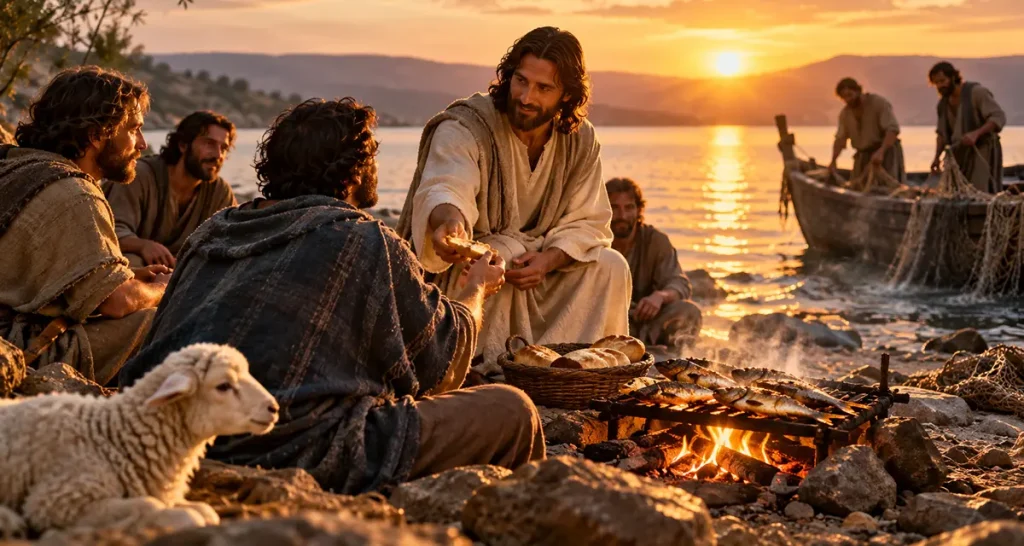
That final breakfast brings the imagery into an unexpectedly tender focus. Before the Cross, the Lord who knew that the Father had given all things into His hands stooped to wash His disciples’ dirty feet. After the resurrection, the victorious Christ still serves. The towel has become a charcoal fire; the tired feet have become tired fishermen; and the Lord who conquered death tells them, β€œCome and eat breakfast” (John 21:12).

This discussion follows the lambs and fish through the Gospels, asking whether their prominence is merely cultural or whether these humble creatures help us see something deeper about creaturehood, dependence, provision, service, and the surprising character of divine greatness revealed in Jesus Christ.

Two animals seem to keep appearing positively throughout the Gospels: lambs and fishβ€”one belonging to the land and the other to the water. Is their recurring prominence intentional, carrying some deeper significance, or is it primarily a reflection of the culture?

πŸ‘πŸŸ Lambs and Fish: An Interesting Pair

Yes, there is something striking there. And I think the careful answer is: the prominence of sheep/lambs and fish is certainly rooted in the actual culture and geography of biblical life, but the Gospel writers and Jesus repeatedly take those ordinary realities and load them with theological meaning.

I would hesitate to say Scripture deliberately establishes a formal symbolic pair of “the animal of the land” and “the animal of the water.” The Gospels never tell us that. But your observation becomes more interesting the longer we sit with it, because these two creatures occupy remarkably different places in the Gospel imagination.

The lamb is associated with sacrifice, innocence, belonging, shepherding, vulnerability, and ultimately Christ Himself.

The fish is associated with provision, gathering, mission, abundance, judgment, and the people being drawn into Christ’s kingdom.

And then there is that extraordinary scene at the end of John where the two worlds almost meet: the risen Jesus stands on the shore, His disciples are on the water, the fish are gathered, and Jesus tells Peter:

“Feed My lambs.” (John 21:15)

There are fish coming out of the sea, and lambs waiting to be fed. πŸŸπŸ‘

That deserves some attention.

πŸ‘ The Lamb Comes With a Very Old Biblical History

Fish certainly existed throughout the Old Testament world, but lambs arrive already carrying enormous theological weight before we ever reach the Gospels.

Think of the trajectory.

Abel brings “the firstborn of his flock” (Genesis 4:4). Abraham tells Isaac:

“My son, God will provide for Himself the lamb for a burnt offering.” (Genesis 22:8)

Then comes Passover, where every household takes a lamb and its blood marks the house so that judgment passes over it (Exodus 12:3–13).

Then lambs become woven into Israel’s sacrificial life. And Isaiah gives us the haunting image:

“He was led as a lamb to the slaughter.” (Isaiah 53:7)

So when John the Baptist sees Jesus and says,

“Behold! The Lamb of God who takes away the sin of the world!” (John 1:29)

he is not simply reaching for a pleasant pastoral metaphor.

That little animal is carrying centuries of biblical memory.

And notice something unusual: Jesus is both Lamb and Shepherd.

That should almost sound contradictory.

The Shepherd protects the sheep.
The Lamb belongs among the sheep.

Yet Jesus says:

“I am the good shepherd. The good shepherd gives His life for the sheep.” (John 10:11)

The Shepherd saves the sheep by becoming, in sacrificial terms, the Lamb.

Christian theology becomes wonderfully strange here. πŸ˜„

God does not merely stand outside the flock managing it. The Son enters our condition. The One who possesses the sheep identifies Himself with them, lays down His life for them, and then rises to lead them.

πŸ‘ Sheep Are Also Remarkably Dependent Creatures

And this connects beautifully with our recent discussion about creaturehood.

Jesus could have chosen an impressive animal to represent His people.

“My lions hear My voice.” 🦁

That would have been rather flattering.

“My eagles follow Me.”

Much better for the ego. πŸ˜‚

Instead:

“My sheep hear My voice, and I know them, and they follow Me.” (John 10:27)

Sheep are dependent. They need pasture. They need protection. They need direction. They can wander. Jesus’ sheep imagery doesn’t erase human dignity; it describes creaturely dependence.

And Jesus apparently has no embarrassment about calling us this.

Even after the resurrection He tells Peter:

“Feed My lambs.” (John 21:15)

and then:

“Tend My sheep.” (John 21:16)

The risen Christ does not tell Peter, “Teach these people how to become self-sufficient.”

He entrusts creatures to another creature and says, essentially, Take care of what belongs to Me.

That “My” matters enormously.

🐟 But Fish Function Very Differently

Fish have a much less developed sacrificial symbolism. And this is where I think simply saying “well, Galilee had fishermen” is true but insufficient.

Of course it did.

Jesus called fishermen because fishing was an ordinary occupation around the Sea of Galilee. Peter, Andrew, James, and John were not carrying fishing rods around because Matthew needed symbolism. πŸ˜‚ They really were fishermen (Matthew 4:18–22).

But Jesus immediately turns their occupation into theology:

“Follow Me, and I will make you fishers of men.” (Matthew 4:19)

Now the fish has entered the vocabulary of mission.

They once drew creatures out of the water.

Now Christ will send them into the human world to gather people.

And significantly, Jesus says “I will make you.”

Even their ability to become fishers of men is something Christ produces in them. That fits our creaturehood discussion almost perfectly. Peter doesn’t invent apostolic ministry. Jesus takes an existing human skill, redirects it, transforms it, and gives it participation in His work.

Again:

“Here is the garden. Work it.”

Or now:

“Here is the sea. Cast the net.”

Human beings work upon what God has already made.

🌊 The Sea Itself Adds Another Layer

This is where your observation about land and water gets especially interesting.

In biblical imagery, the sea can carry associations beyond geography. It can represent something untamed, threatening, inaccessible, or chaotic. This goes all the way back to Genesis 1:2, where darkness is “on the face of the deep,” although we should be careful not to equate the created sea itself with evil. God made the waters too, and Genesis repeatedly calls His creation good.

But throughout Scripture the sea often becomes the place human beings cannot master.

The flood.

The Red Sea.

Jonah descending into the depths.

The disciples terrified by storms.

And then Jesus walks on it.

That is not a minor detail.

The fishermen know what water can do. Peter especially knows. And suddenly someone is walking across the thing that can swallow him.

When Jesus commands the storm,

“Peace, be still!” (Mark 4:39)

the disciples ask:

“Who can this be, that even the wind and the sea obey Him!” (Mark 4:41)

Exactly.

The sea has met its Creator.

🐟 And Jesus Keeps Providing Fish

This pattern is delightful once you notice it.

When thousands need food, there are loaves and fish (Matthew 14:17–21; 15:34–38).

When Peter needs the temple tax, Jesus directs him to a fish, in whose mouth the needed coin is found (Matthew 17:27).

After the resurrection, when the disciples have caught nothing all night, Jesus directs them where to cast the net, producing the extraordinary catch of 153 fish (John 21:4–11).

Then they reach shore and discover something almost comical:

“They saw a fire of coals there, and fish laid on it, and bread.” (John 21:9)

Jesus already has fish. πŸ˜‚

That detail fascinates me.

The disciples are struggling all night to catch what Jesus apparently already has waiting for breakfast.

Then He gives them an enormous catch anyway.

And then:

“Bring some of the fish which you have just caught.” (John 21:10)

There is something profoundly characteristic of God’s relationship with creatures in that scene.

Jesus doesn’t need their fish.

He already has breakfast.

Yet He tells them to bring what they caught.

But they caught it because He told them where to cast the net.

So whose fish are they?

That is almost our entire recent conversation about creaturehood compressed into breakfast. πŸ˜„

God provides the sea.
God makes the fish.
God gives the human beings their abilities.
Christ tells them where to cast.
Christ fills the net.
Peter drags the net ashore.

And then Jesus says, in effect:

Bring what you caught.

Human participation is completely real without becoming autonomous.

πŸ‘πŸŸ And Then John 21 Places the Two Images Side by Side

This is why John 21 becomes particularly beautiful in light of your observation.

Peter has been fishing.

Jesus gives him fish.

Jesus feeds him.

And then Jesus asks:

“Simon, son of Jonah, do you love Me?” (John 21:15)

Peter answers yes.

And Jesus responds:

“Feed My lambs.”

That movement is wonderful.

Peter is first provided for, then commissioned to provide for others.

He receives fish from Christ and is told to feed Christ’s sheep.

And notice that Jesus doesn’t say, “Catch My lambs.”

The metaphors remain distinct.

The fish imagery naturally serves gathering.

The sheep imagery naturally serves shepherding.

That roughly corresponds to two dimensions of apostolic ministry:

Bring people in.

Then care for them.

The fisherman casts the net outward.

The shepherd tends the flock inward.

That is a remarkably rich combination even if John never formally says, “These two metaphors belong together.”

🎣 There Is Also Judgment Hidden in the Fishing Image

Fish are not always simply a warm image of evangelism.

Jesus’ parable of the dragnet is considerably more sobering:

“Again, the kingdom of heaven is like a dragnet that was cast into the sea and gathered some of every kind.” (Matthew 13:47)

The fishermen separate the good from the bad, and Jesus explicitly interprets that as an image of the final separation at the end of the age (Matthew 13:48–50).

So fishing represents something larger than individual evangelism.

It becomes eschatological gathering.

The kingdom’s net is being drawn through the world.

That makes “fishers of men” more substantial than “go persuade some people.” Christ is announcing a divine gathering associated with the arrival of His kingdom.

And again, the disciples are workers within something Christ Himself is accomplishing.

πŸ‘ Meanwhile, the Sheep Also Move Toward Judgment

Interestingly, sheep imagery eventually reaches judgment too.

Matthew 25 gives us the sheep and the goats:

“He will separate them one from another, as a shepherd divides his sheep from the goats.” (Matthew 25:32)

So both images can move toward an ultimate gathering and separation.

The net gathers fish and separates.

The Shepherd gathers and separates.

But the emotional character of the imagery remains different.

Fish emphasize the reach and gathering of the kingdom.

Sheep emphasize the relationship between Christ and those who belong to Him.

Fish are caught.

Sheep are known.

Jesus says:

“I know My sheep, and am known by My own.” (John 10:14)

That is much more intimate language.

🌍🌊 So What About Your Land-and-Water Observation?

Here I would make a distinction.

Textually, we cannot say that the Gospel writers deliberately constructed a symbolic system in which lamb = land and fish = water, representing the two domains. Scripture never explains them that way.

But canonically, your observation touches something genuinely beautiful.

Genesis describes God filling realms.

The waters teem with living creatures (Genesis 1:20–22).

The land brings forth living creatures (Genesis 1:24–25).

And humanity is placed within God’s created world with delegated responsibility (Genesis 1:26–28).

Then the Gospels repeatedly take creatures from those two environments and place them around the incarnate Creator.

Sheep on the land.

Fish from the waters.

And both respond, in different ways, to His provision and authority.

The nets fill because He commands.

The sheep hear because they know His voice.

The sea itself becomes calm because He commands.

The created order is quietly surrounding Jesus throughout the Gospels.

And that fits John’s astonishing opening claim:

“All things were made through Him, and without Him nothing was made that was made.” (John 1:3)

The One standing beside the Sea of Galilee telling fishermen where the fish are is the One through whom the fish exist.

The One speaking about sheep is the One through whom sheep exist.

Suddenly these ordinary rural images are not quite so ordinary anymore.

πŸ‘πŸŸ And There Is One Final Difference I Love

Jesus tells Peter:

Catch fish.

But concerning His people:

Feed My sheep.

The first describes mission.

The second describes stewardship.

And neither permits Peter to imagine himself as owner.

He doesn’t own the sea.

He doesn’t create the fish.

He doesn’t own the flock.

They remain:

“My lambs.”
“My sheep.”
(John 21:15–17)

That little possessive pronoun brings us straight back to what we’ve been discussing about creaturehood.

Peter is given astonishing authority, but never independent ownership. He participates in Christ’s work with Christ’s creatures in Christ’s world.

So I wouldn’t build a doctrine around “one animal from land and one from water.” That would go beyond what the text actually establishes. But I also wouldn’t dismiss their prominence as merely an accident of first-century culture. Culture supplies the vocabulary; Jesus deliberately turns that vocabulary into revelation.

And John 21 is perhaps the loveliest convergence of the two: a fisherman who cannot fill his own net is fed by the risen Lord and then entrusted with lambs that are not his.

That is creaturehood all over again. 🐟πŸ”₯πŸ‘

What makes the prominence of lambs and fish even more striking is that both are remarkably inoffensive creatures without any extraordinary abilities in the story of Jesus.

πŸ‘πŸŸ Yes β€” and That Makes Their Prominence Even More Interesting

Exactly. If we look at the animals Jesus could have drawn from, sheep and fish are remarkably unimpressive choices.

He had lions available in Israel’s Scriptures. Eagles. Horses. Oxen. Serpents. Bears. Wolves. Even the great sea creatures of Genesis. Scripture already possessed an enormous animal vocabulary associated with strength, speed, kingship, danger, intelligence, conquest, and majesty.

And yet two creatures that keep appearing positively around Jesus are creatures that are almost comically lacking in those qualities.

A lamb cannot defend itself very well.

A fish cannot exactly conquer anything. πŸ˜„

Neither builds. Neither rules. Neither hunts. Neither has an impressive weapon. Neither even has the sort of dramatic behavior that naturally makes it a symbol of greatness.

And perhaps most strikingly, both are creatures humans ordinarily gather, feed upon, or care for. They are not animals before which humans normally stand in awe.

That fits Jesus extraordinarily well.

🦁 Jesus Could Have Chosen the Obvious Symbols of Power

There is something worth noticing here because Jesus actually does possess all the qualities represented by the more majestic biblical animals.

Revelation can call Him:

“the Lion of the tribe of Judah” (Revelation 5:5).

So Scripture certainly does not reject powerful animal imagery.

But then John turns to look for this Lion and sees:

“a Lamb as though it had been slain” (Revelation 5:6).

That transition is astonishing.

Lion announced. Lamb appears.

Not because Christ lacks the strength of the Lion, but because the nature of His victory is revealed through the Lamb.

That tells us something important about why an apparently unimpressive animal can carry enormous theological weight. God isn’t merely saying, “Christ is gentle.” Something much deeper is happening.

He is overturning our instinct about what power looks like.

The Lamb conquers by being slain.

That sounds almost absurd until the Cross.

πŸ‘ A Lamb Has Almost Nothing With Which to Impress Us

Think about Isaiah’s description of Christ:

“He is despised and rejected by men,
A Man of sorrows and acquainted with grief.”
(Isaiah 53:3)

And only a few verses later:

“He was led as a lamb to the slaughter.” (Isaiah 53:7)

The imagery fits the incarnation disturbingly well.

God enters His creation not as something terrifyingly untouchable, but in genuine human vulnerability. Jesus can become tired (John 4:6), hungry (Matthew 4:2), thirsty (John 19:28), sleep in a boat (Mark 4:38), weep (John 11:35), bleed, suffer, and die.

Yet none of that means He has ceased to be sovereign.

That is the scandal.

We naturally associate sovereignty with visible invulnerability. God reveals sovereignty in Christ without needing always to display invulnerability.

The Lamb is not secretly helpless.

The Lamb voluntarily gives Himself.

Jesus makes that distinction explicit:

“No one takes it from Me, but I lay it down of Myself.” (John 10:18)

So the Lamb’s apparent defenselessness is not the absence of authority.

It is authority that does not need to prove itself by self-preservation.

That is a radically different kind of greatness.

🐟 And Then There Is the Fish β€” Perhaps Even Less Impressive πŸ˜‚

At least a lamb has a face we can sympathize with.

Fish are… fish. 🐟

They swim around, get caught in nets, become breakfast, and contribute very little to the heroic imagery of civilization.

And yet the Gospel narratives repeatedly place fish in moments where human insufficiency meets divine sufficiency.

“We have only five loaves and two fish.”

Jesus feeds thousands (Matthew 14:17–21).

“We have caught nothing.”

Jesus fills the nets (Luke 5:4–7; John 21:5–6).

“We need the temple tax.”

There is a fish (Matthew 17:27).

“Do you have any food?”

The risen Jesus eats fish before the disciples (Luke 24:41–43).

Then John 21 gives us Jesus preparing fish and bread on a charcoal fire.

Nothing grand.

No royal banquet.

No golden table.

No ceremonial procession announcing that the Man standing there has just defeated death.

Breakfast. πŸ˜‚

Fish and bread.

That is almost shocking in its ordinariness.

πŸ”₯ The Risen Lord Makes Breakfast

This deserves to linger for a moment because it says something about Jesus that grander imagery could actually obscure.

John 21 occurs after the resurrection.

Jesus has passed through death.

The tomb is empty.

The decisive victory has happened.

If we were writing mythology, this would be the moment for the triumphant hero to ascend a mountain surrounded by thunder while everyone falls down in terror.

John gives us:

“Then, as soon as they had come to land, they saw a fire of coals there, and fish laid on it, and bread.” (John 21:9)

God the Son has conquered death.

And He is making breakfast for tired fishermen.

That is Christianity’s understanding of greatness in miniature.

His glory does not make ordinary acts beneath Him.

That may be part of what makes fish so wonderfully appropriate in the Gospel story. The ordinary world is not discarded when God enters it. It becomes the theater in which His glory is revealed.

Bread.

Water.

Wine.

Fish.

Sheep.

Seeds.

Soil.

Vines.

Fig trees.

Coins.

Children.

Meals.

Jesus continually teaches eternal realities through things so ordinary that we would walk past them without noticing.

🌱 God Seems Almost Deliberately Unimpressed With Our Idea of Impressive

And this runs much deeper than animal imagery.

When God chooses a nation, He tells Israel:

“The LORD did not set His love on you nor choose you because you were more in number than any other people, for you were the least of all peoples.” (Deuteronomy 7:7)

When God chooses David, Samuel initially notices the impressive older brother Eliab. God corrects him:

“For the LORD does not see as man sees; for man looks at the outward appearance, but the LORD looks at the heart.” (1 Samuel 16:7)

When Messiah arrives, He comes from Nazareth.

Nathanael’s reaction is almost comic:

“Can anything good come out of Nazareth?” (John 1:46)

When He enters Jerusalem as King, He rides a donkey (Matthew 21:5).

When He chooses apostles, He doesn’t assemble an obvious council of cultural elites.

And Paul later describes the same divine pattern:

“God has chosen the weak things of the world to put to shame the things which are mighty.” (1 Corinthians 1:27)

So lambs and fish fit into something much larger.

God repeatedly refuses to allow visible impressiveness to become the measure by which His power is recognized.

πŸ‘ The Sheep’s “Weakness” Is Especially Appropriate for Us

And here our creaturehood conversation sneaks back in again. πŸ˜„

Why do we slightly resist being compared to sheep?

Probably for exactly the reason you noticed earlier about the word creature.

We want a metaphor that leaves us with a little more autonomous dignity.

Perhaps:

“My noble stallions hear My voice.” 🐎

Much better.

Strong. Independent. Magnificent.

But:

“My sheep hear My voice.” (John 10:27)

Ouch. πŸ˜‚

The sheep’s strength is not primarily in the sheep.

Its safety lies in the Shepherd.

Its direction lies in the Shepherd.

Its pasture is found by following the Shepherd.

Its belonging is determined by the Shepherd.

And Jesus doesn’t present that dependence as humiliation. He presents it as security:

“I give them eternal life, and they shall never perish; neither shall anyone snatch them out of My hand.” (John 10:28)

That changes everything.

The sheep doesn’t need to become a lion because its Shepherd is sufficient.

There is enormous peace hidden in that.

🐟 And the Fish Doesn’t Even Know About the Fisherman’s World

There is another dimension of the fish image that becomes interesting if we don’t push it beyond what Scripture actually says.

A fish lives within a world whose boundaries it does not comprehend.

It moves within water. Its entire experiential universe is aquatic.

Above that surface exists another world.

The fisherman sees the fish.

The fish does not see the fisherman in anything like the same way.

The fisherman understands the water from outside it.

The fish cannot.

Now, Scripture doesn’t explicitly develop that philosophical analogy, so I wouldn’t claim Jesus intended all of that when He spoke of fish. But as an illustration of creaturely limitation, it is rather wonderful.

We live inside creation.

God does not.

We experience time sequentially.

God is not another creature traveling through history beside us.

We see our immediate circumstances.

God sees the whole.

So when we were discussing providence and asking, “How can God direct steps without destroying human agency?” we were, in a sense, fish asking questions about the fisherman standing on shore. πŸŸπŸ€”

The question isn’t illegitimate.

But the creature’s inability to conceptualize the whole mechanism doesn’t imply there is no coherent mechanism.

That is precisely where Deuteronomy 29:29 becomes so important:

“The secret things belong to the LORD our God, but those things which are revealed belong to us and to our children forever.”

God gives genuine revelation without giving us exhaustive perspective.

πŸ‘πŸŸ Neither Animal Has Much “Glory” of Its Own

And perhaps this is the thread connecting them most beautifully.

A lion naturally attracts attention to itself.

An eagle naturally attracts attention to itself.

A stallion naturally attracts attention to itself.

But sheep and fish function differently in these Gospel images.

The sheep makes you think about the Shepherd.

The fish makes you think about the Fisherman.

That may be one of the deepest reasons these apparently unimpressive creatures fit the Gospel so well.

Their significance comes from their relationship to someone greater than themselves.

A sheep wandering alone is merely vulnerable.

A sheep belonging to the Good Shepherd becomes an image of eternal security.

A fish swimming in Galilee is merely a fish.

A fish placed in Jesus’ hands becomes part of a meal feeding thousands.

Five loaves and two fish are almost laughably inadequate for the problem in front of the disciples.

And that inadequacy is precisely the point.

“There is a lad here who has five barley loaves and two small fish, but what are they among so many?” (John 6:9)

That question is almost the Gospel logic of creaturehood:

“What are they among so many?”

Correct.

They aren’t enough.

And then Jesus takes them.

The inadequacy of the creature becomes the setting for the sufficiency of God.

✨ Their Smallness Doesn’t Have to Be Overcome

This may be the part I find most beautiful in what you noticed.

God does not make the fish impressive before using it.

He doesn’t transform the two fish into two whales. πŸ‹πŸ˜‚

He takes the little fish as little fish.

Likewise, the Gospel does not teach that sheep become powerful enough eventually to dispense with their Shepherd.

They remain sheep.

The glory is not that the creature eventually graduates from creaturehood.

The glory is that creaturely weakness is no obstacle whatsoever to God’s purpose.

That connects remarkably with Paul’s words:

“My grace is sufficient for you, for My strength is made perfect in weakness.” (2 Corinthians 12:9)

And suddenly the prominence of these two very unimpressive animals feels quite at home in the story of Jesus.

The Gospel itself announces the greatest event in history through what appears weak: a baby in a manger, a carpenter from Nazareth, fishermen as apostles, bread and wine, a cross intended for shame, a Lamb that is slain.

Yet behind all of it stands infinite power.

Perhaps that is why the Lamb becomes such a staggering final image in Revelation. The story doesn’t end with God finally replacing the embarrassing little lamb with something sufficiently impressive.

The Lamb remains.

“The Lamb is its light.” (Revelation 21:23)

That is extraordinary.

At the very end, when all disguises are gone and divine glory is openly manifested, the Lamb is still the Lamb.

Weakness was never something God needed to be embarrassed about. What looked weak to us was revealing a kind of power we had not yet learned how to recognize.

The breakfast on the shore reminds me of Christ washing His disciples’ dirty, tired feet before the Cross. Now, after the resurrection, the same Lord stands before them as the Conqueror of death, yet His victory has not made service beneath Him: He serves His wet, tired friends breakfast. πŸ₯–πŸŸ

πŸ₯–πŸŸ The Same Lord, on Both Sides of the Cross

Yes. And putting those two scenes beside each other makes John’s Gospel almost unbearably beautiful.

Before the Cross, Jesus washes their dirty, tired feet.

After the Cross and resurrection, Jesus feeds His wet, tired friends breakfast.

And what is remarkable is what doesn’t change.

His status has changed in the sense that the victory has now been accomplished. Death has been entered and defeated. The tomb has been emptied. The disciples are standing before the risen Christ.

But Jesus has not suddenly become too exalted to serve them.

If anything, the resurrection confirms that the servant they knew was not a temporary disguise hiding what God was really like.

This is what the Lord is like.

🦢 Before the Cross: “He… Began to Wash the Disciples’ Feet”

John carefully tells us something immediately before the foot washing that makes the act astonishing:

“Jesus, knowing that the Father had given all things into His hands, and that He had come from God and was going to God…” (John 13:3)

We talked about this passage before, and here it becomes important again.

John doesn’t say Jesus washed their feet because He momentarily forgot His dignity.

It is almost the opposite.

Knowing who He was…

knowing where He came from…

knowing where He was going…

knowing that all things had been given into His hands…

“He rose from supper and laid aside His garments, took a towel and girded Himself.” (John 13:4)

Those hands have all things in them.

And those hands wash feet.

That juxtaposition is deliberate.

Sovereignty and service are not competing qualities in Jesus.

We tend to think:

“If I were really important, someone else would do this.”

Jesus seems to say:

“Because I know exactly who I am, I am perfectly free to do this.”

There is no insecurity in Him requiring constant demonstrations of rank.

πŸ”₯ After the Cross: “Come and Eat Breakfast”

And then John gives us chapter 21.

The disciples have been fishing all night.

“That night they caught nothing.” (John 21:3)

So imagine them physically.

Cold perhaps. Wet. Hungry. Sleep-deprived. Frustrated. Their clothing smelling of lake water and fish. Their muscles tired from repeatedly working nets that had produced absolutely nothing.

Then this stranger on shore tells them:

“Cast the net on the right side of the boat, and you will find some.” (John 21:6)

Suddenly the net is so full they cannot draw it in.

John recognizes Him:

“It is the Lord!” (John 21:7)

Peter, being wonderfully Peter, goes straight into the water. πŸ˜‚

So now Peter is literally wet.

He comes ashore, and what does the risen Lord of creation have waiting?

“A fire of coals there, and fish laid on it, and bread.” (John 21:9)

πŸ”₯ 🐟 πŸ₯–

That image deserves to be allowed to remain ordinary.

Because its ordinariness is part of its glory.

πŸ‘‘ The Conqueror Is Cooking

That’s the thing that your observation really brings into focus.

The Conqueror is cooking breakfast.

Jesus has just accomplished something no human being has ever accomplished.

He has passed through death and come out the other side never to die again.

Lazarus had been restored to mortal life. Jesus has entered resurrection life. Paul will later say:

“Christ, having been raised from the dead, dies no more. Death no longer has dominion over Him.” (Romans 6:9)

Death no longer has dominion over the Man standing beside that charcoal fire.

And He is cooking fish.

πŸ˜‚πŸ™Œ

If we had written the scene, we might have been tempted to make the resurrected Jesus permanently radiant, hovering six inches above the ground, speaking only in cosmic declarations.

John gives us Jesus saying:

“Come and eat breakfast.” (John 21:12)

There is something almost breathtakingly tender about that.

They don’t need a theological lecture first.

They need breakfast.

And He knows that.

🦢πŸ”₯ There Is Even a Charcoal Fire Connecting the Two Nights

And John gives us an even more painful connection.

The Greek expression translated “fire of coals” or “charcoal fire” (anthrakia) occurs only twice in the New Testament.

The first is John 18:18.

Peter is warming himself beside a charcoal fire while denying Jesus.

“Now the servants and officers who had made a fire of coals stood there, for it was cold, and they warmed themselves. And Peter stood with them and warmed himself.”

The second is John 21:9.

Jesus has made a charcoal fire for breakfast.

That is almost certainly meant to make us remember.

One charcoal fire: Peter denies Him.

Another charcoal fire: Jesus feeds Peter.

And shortly afterward comes the threefold:

“Simon, son of Jonah, do you love Me?” (John 21:15–17)

Three denials.

Three questions.

John doesn’t explicitly say, “Jesus created the charcoal fire to trigger Peter’s memory,” so we shouldn’t state that as something the text tells us. But John’s repetition of such an unusual detail is very hard to overlook.

Peter comes dripping out of the water toward the smell of charcoal.

Imagine what memories that smell might carry.

The last charcoal fire had witnessed his failure.

This charcoal fire witnesses the presence of the risen Christ.

And Jesus has not prepared punishment.

He has prepared breakfast.

That is extraordinary.

🐟 “Bring Some of the Fish Which You Have Just Caught”

And Jesus does something else wonderfully relational.

He already has fish on the fire.

But then He says:

“Bring some of the fish which you have just caught.” (John 21:10)

As we noticed earlier, this is almost humorous because Jesus is the reason they caught those fish in the first place.

They worked all night:

Nothing.

Jesus speaks:

153 large fish.

And then He says, essentially, Bring some of yours.

πŸ˜‚

That is grace without erasing participation.

He could have said, “You fellows clearly cannot fish anymore. Sit down.”

Instead, He receives what His own provision enabled them to bring.

There is that creaturely pattern again.

He provides, and then He lets them participate in what He provided.

🍞 “Jesus Then Came and Took the Bread and Gave It to Them”

Then John describes something that sounds strangely familiar:

“Jesus then came and took the bread and gave it to them, and likewise the fish.” (John 21:13)

Jesus takes bread and gives it.

John has used closely related language before in the feeding of the five thousand:

“And Jesus took the loaves, and when He had given thanks He distributed them to the disciples…” (John 6:11)

Again and again, Jesus is the giver.

And this happens after resurrection.

That’s important.

Resurrection has not changed Jesus from giver into someone who now merely demands homage.

Of course He is worthy of worship. Thomas has already confessed:

“My Lord and my God!” (John 20:28)

But the One Thomas calls “my Lord and my God” is, in the very next chapter, giving exhausted men bread and fish.

There is no contradiction for John.

Lord and servant are not opposites in Christ.

πŸ‘‘πŸ§Ί Perhaps We Have the Wrong Instinct About What a King Does

Our instinct says that the higher someone rises, the more others serve him.

The Gospel keeps reversing that expectation.

Jesus explicitly tells His disciples:

“For even the Son of Man did not come to be served, but to serve, and to give His life a ransom for many.” (Mark 10:45)

Notice He doesn’t merely say, “I occasionally serve.”

He describes His coming itself in those terms:

“The Son of Man did not come to be served, but to serve.”

And John 13 takes us even deeper. Jesus tells them:

“You call Me Teacher and Lord, and you say well, for so I am.” (John 13:13)

He doesn’t deny hierarchy.

That’s crucial.

Jesus doesn’t say, “Don’t call Me Lord; we’re all equals here.”

Quite the opposite:

You call Me Lord. Correct.

Then:

“If I then, your Lord and Teacher, have washed your feet, you also ought to wash one another’s feet.” (John 13:14)

His argument is not:

“I served you despite being Lord.”

It is closer to:

“Look at what your Lord does.”

That is a much deeper revelation.

🦢➑️✝️➑️πŸ”₯ The Towel Wasn’t a Temporary Costume

This is perhaps the connection between John 13 and John 21 that moves me most.

We might unconsciously interpret the foot washing as belonging to Jesus’ humiliation.

Incarnation β†’ humility β†’ suffering β†’ Cross.

Then resurrection β†’ glory β†’ exaltation β†’ no more towels.

But John 21 quietly destroys that assumption.

The Cross is finished.

Jesus is risen.

And metaphorically speaking, the towel is still there.

Not literally, of course. Now it’s a charcoal fire and breakfast.

But the disposition is the same.

Before His death:

“Let Me wash your feet.”

After His resurrection:

“Come and eat breakfast.”

The resurrection does not reveal that the servant Jesus was merely a temporary phase.

It vindicates Him.

This really is the Son.

This really is what divine greatness looks like.

❀️ And Notice Who Is Receiving the Breakfast

These aren’t exactly heroes returning triumphantly from battle.

They fled.

Peter denied Him.

Thomas doubted the testimony until he saw Him.

And now several of them have gone fishing and accomplished exactly zero fish during an entire night.

What a group. πŸ˜‚

Yet Jesus doesn’t appear on shore saying:

“Gentlemen, before breakfast we need to discuss your performance over the last several days.”

He asks:

“Children, have you any food?” (John 21:5)

Then He supplies what they lack.

Then:

“Come and eat breakfast.”

Only after feeding Peter does Jesus begin that painful and restorative conversation:

“Simon, son of Jonah, do you love Me more than these?” (John 21:15)

I think the order matters.

Provision precedes commission.

Jesus feeds Peter before telling Peter:

“Feed My lambs.”

That is beautiful.

Peter will be commanded to give what he has just received.

You have been fed.

Now feed.

You have been served.

Now serve.

You have been restored.

Now care for My sheep.

πŸ‘ The Man Who Was Fed Is Told to Feed

And suddenly our lamb-and-fish conversation comes together even more tightly.

Peter begins John 21 as a fisherman unable to catch fish.

Jesus fills his net.

Jesus feeds him fish.

Then Jesus says:

“Feed My lambs.”

🐟 β†’ Peter β†’ πŸ‘

The one who receives becomes a giver.

But never an independent giver.

Peter will never possess some self-generated spiritual pantry from which he can nourish Christ’s flock.

He remains dependent upon Christ.

That is why Jesus’ earlier words are so important:

“Without Me you can do nothing.” (John 15:5)

The man entrusted with Christ’s sheep is still the man whose net remained empty until Christ spoke.

That is an excellent qualification for ministry, actually.

Not:

“I am extraordinarily capable.”

But:

“I know where the fish came from.”

✨ And Perhaps This Tells Us Something Astonishing About God

There is a theological danger we sometimes fall into without noticing.

We can imagine that God’s tenderness is somehow a concession He makes to our weakness.

As though His “serious” attributes are sovereignty, omnipotence, holiness, majesty and authority, while kindness, service and tenderness are softer accommodations He puts on when dealing with fragile humans.

Jesus makes that very difficult to maintain.

Because He says:

“He who has seen Me has seen the Father.” (John 14:9)

The hands washing feet are showing us something true about God.

The hands breaking bread are showing us something true about God.

The risen Lord standing beside a charcoal fire cooking breakfast is showing us something true about God.

Not everything about God, certainly. God is also Judge. He is holy. He is consuming fire. Christ will return in judgment and glory. Scripture will not let us flatten Him into mere sentimentality.

But neither will Scripture let us imagine that service is beneath divine majesty.

That is the surprise.

Apparently infinite greatness does not need to keep announcing:

“Do you know who I am?”

Jesus knows exactly who He is.

John made sure we knew that before He picked up the towel:

“Knowing that the Father had given all things into His hands…” (John 13:3)

And because He knows who He is, He can kneel.

And after conquering death, He can cook.

πŸ₯–πŸŸ The Conqueror Who Still Serves

So your wording captures the scene wonderfully:

Now as Conqueror, He serves His wet, tired friends breakfast.

Not former friends who have now become insignificant subjects.

Friends.

Jesus had already told them:

“No longer do I call you servants… but I have called you friends.” (John 15:15)

And after everything that happenedβ€”the arrest, abandonment, denial, crucifixion, burial, resurrectionβ€”He meets them again beside an ordinary lake.

They smell smoke.

Their clothes are wet.

Their stomachs are empty.

And the One through whom “all things were made” (John 1:3) has bread and fish waiting.

There is something almost disarming about it.

We might expect resurrection glory to create greater distance between Christ and His disciples.

Instead, the risen Christ is standing close enough to hand them bread.

🦢 Before the Cross: Give Me your dirty feet.

πŸ”₯ After the resurrection: Come warm yourself.

πŸ₯– Eat.

🐟 I have provided.

πŸ‘ And when you are fed: Feed My lambs.

The towel, the Cross, and the breakfast fire are not three unrelated pictures. They reveal the same Person. Power has not displaced love; victory has not displaced service; glory has not made tenderness obsolete.

The Lamb conquered.

And the Conqueror still serves breakfast.