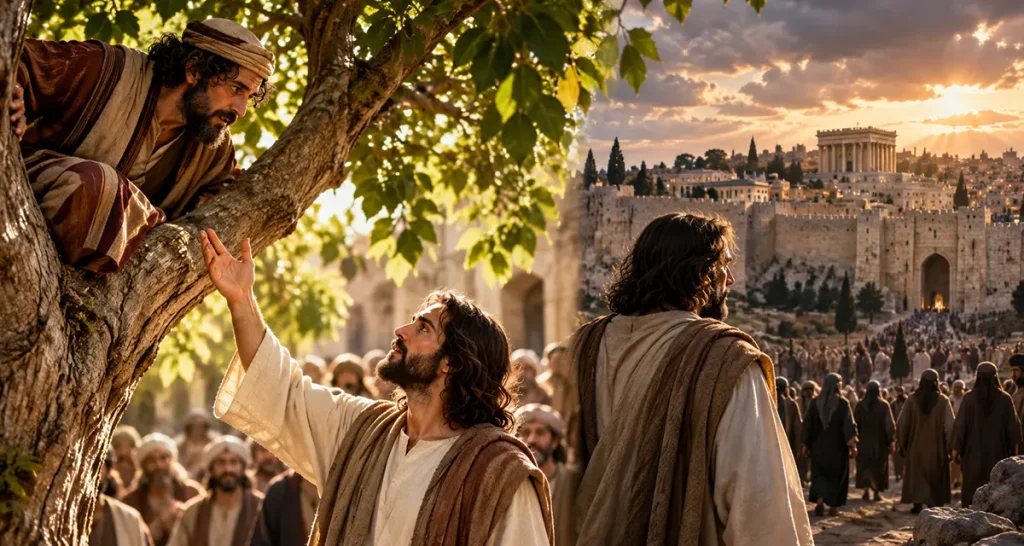
Yes! That biological analogy becomes almost painfully appropriate here. The apparent “fit” seems perfect: the Prince of Peace comes to Jerusalem, the city called to righteousness and peace—and instead of recognition and activation, there is rejection. Why? Because the problem is not with the “key.” The problem is with the receptor. ❤️🩹
Jerusalem had the correct religious architecture, vocabulary, Scriptures, sacrifices, expectations, promises, and history. But those things could not by themselves produce the inward recognition of the One to whom they pointed.
Jesus says exactly that as He approaches the city:
“If you had known, even you, especially in this your day, the things that make for your peace! But now they are hidden from your eyes.”
— Luke 19:42
That last phrase is crucial:
“hidden from your eyes.”
The Prince of Peace is physically present, yet the city cannot perceive the things belonging to its peace.
🧬 The “binding site” was there, but something was profoundly wrong
Using our protein analogy carefully—not as a literal theological mechanism—we might expect:
Jerusalem + Messiah → recognition → righteousness + peace.
Everything appears complementary.
Jerusalem had been prepared historically for precisely this arrival.
The prophets had spoken of Zion.
The temple was there.
The Scriptures were there.
The sacrifices were there.
The Davidic promises were there.
Messianic expectation was there.
And now the Son of David Himself arrives.
Yet instead of activation:
rejection.
That tells us something enormously important about fallen humanity:
External correspondence is insufficient when the internal condition is disordered.
Jesus had already diagnosed this problem:
“These people draw near to Me with their mouth,
And honor Me with their lips,
But their heart is far from Me.”
— Matthew 15:8; cf. Isaiah 29:13
The religious structures could remain recognizable while the heart for which those structures existed had become alienated from God.
That’s rather like having an apparently appropriate receptor whose binding site has been conformationally altered. The ligand is not defective. Its identity hasn’t changed. But the receptor no longer recognizes what it was meant to receive.
Sin has done something analogous—not molecularly, of course—but spiritually and morally to humanity.
🔑 Christ did not fail to fit Jerusalem
This distinction matters tremendously.
We shouldn’t conclude:
“Perhaps Jesus wasn’t what Jerusalem was expecting.”
Well, historically, He certainly violated many of their expectations! But the deeper theological problem was not a deficiency in Christ.
John puts it brutally:
“He came to His own, and His own did not receive Him.”
— John 1:11
That is almost the entire paradox in one sentence.
He came to what belonged to Him.
There should have been correspondence.
Yet:
“His own did not receive Him.”
And John has already told us why this happens at the deepest level:
“And the light shines in the darkness, and the darkness did not comprehend it.”
— John 1:5
Here again is our earlier discussion about light.
The problem isn’t that the Light is insufficiently luminous.
The problem is darkness.
🏙️ Jerusalem had become unable to recognize what its own symbols meant
This may be the most tragic dimension.
The temple was supposed to point toward God dwelling with His people.
The sacrifices pointed toward reconciliation.
The priesthood mediated access.
The Davidic throne anticipated God’s King.
The prophets anticipated restoration.
Jerusalem represented God’s dwelling, kingdom, righteousness, and peace.
Then the reality toward which all those things pointed walked through the gate.
And the guardians of many of the symbols rejected the Reality.
Jesus’ confrontation over the temple makes this particularly sharp:
“My house is a house of prayer, but you have made it a ‘den of thieves.'”
— Luke 19:46; cf. Isaiah 56:7; Jeremiah 7:11
The structure remained.
The activity remained.
The sacrifices remained.
The religious vocabulary remained.
But something had become terribly disordered.
It is possible, then, to become so attached to the sign that when the Reality signified by it arrives, we defend the sign against Him.
😮
That is essentially what happens with some of the leadership.
❤️ And now Zacchaeus becomes the astonishing contrast
This is where the placement of Zacchaeus immediately before Jerusalem becomes even more interesting.
If we continue your analogy, Zacchaeus appears to be the least compatible receptor imaginable.
Chief tax collector.
Rich.
Socially despised.
Publicly classified as a sinner.
Nothing about him screams:
“Ideal site for messianic visitation!” 😂
Jerusalem, meanwhile, appears perfectly prepared:
Temple. Scripture. Priesthood. Covenant history. Worship. Davidic identity.
Yet what happens?
Jesus says to Zacchaeus:
“Today salvation has come to this house…”
— Luke 19:9
Then shortly afterward He says concerning Jerusalem:
“…you did not know the time of your visitation.”
— Luke 19:44
What a contrast!
The sinner receives the visitation.
The holy city does not recognize its visitation.
So outward suitability cannot explain salvation.
And Zacchaeus cannot boast:
“Obviously Jesus chose my house because I was spiritually superior to Jerusalem.”
😂 Absolutely not.
Something had happened to Zacchaeus that cannot be explained merely by his outward condition.
Which brings us directly back to:
“…and the one to whom the Son wills to reveal Him.”
— Matthew 11:27
🕊️ The Spirit must make the heart receptive
Your protein analogy becomes especially helpful here if we shift from merely binding to conformational change.
Some proteins must undergo conformational changes before certain interactions or activities become possible. Again, theology shouldn’t be reduced to biochemistry, but the analogy is fruitful.
Fallen humanity doesn’t merely need Christ presented externally.
Something must happen within us.
God promised:
“I will give you a new heart and put a new spirit within you; I will take the heart of stone out of your flesh and give you a heart of flesh.”
— Ezekiel 36:26
And then:
“I will put My Spirit within you and cause you to walk in My statutes…”
— Ezekiel 36:27
There is the divine “activation,” if we want to retain the analogy.
Not:
God finds naturally compatible people.
But:
God makes the unwilling heart alive and responsive to Himself.
Paul describes this as God shining light internally:
“For it is the God who commanded light to shine out of darkness, who has shone in our hearts…”
— 2 Corinthians 4:6
Notice again: God acts upon the heart.
And Jesus tells Nicodemus:
“Unless one is born again, he cannot see the kingdom of God.”
— John 3:3
Not merely:
“The kingdom needs to become more visible.”
The King can literally stand before Nicodemus.
Nicodemus needs new birth to see.
That is extraordinary.
🌿 The deepest mismatch was not between Jesus and Jerusalem
It was between Jerusalem’s calling and Jerusalem’s heart.
Jerusalem was called to righteousness.
But fallen humanity cannot produce God’s righteousness from itself.
Jerusalem was called to peace.
But humanity estranged from God cannot manufacture reconciliation with God.
Jerusalem was called to receive God’s King.
But the fallen heart naturally wants sovereignty for itself.
And here we return to our earlier discussion of Eden.
The serpent’s temptation was essentially:
determine for yourself → possess for yourself → live as though independent of God (Genesis 3:1–6).
Then the King arrives.
And what does a heart committed to autonomous rule naturally do when the rightful King appears?
It doesn’t say:
“Wonderful! Someone has finally arrived to take my sovereignty away.” 😂
It resists.
John expresses the underlying anthropology:
“And this is the condemnation, that the light has come into the world, and men loved darkness rather than light…”
— John 3:19
There’s the failed “binding.”
Not intellectual incompatibility.
Not insufficient evidence.
Not a defective Messiah.
Love is disordered.
The heart does not naturally recognize as desirable the One for whom it was actually made.
And that is why grace must do more than present Christ.
Grace must open the eyes to behold Christ as He truly is.
❤️ And suddenly Jesus’ tears make profound sense
“He saw the city and wept over it…”
— Luke 19:41
The Prince of Peace stands before the city associated with peace and says, essentially:
“Your peace is here—and you cannot see it.”
That is tragedy at an almost cosmic level.
But then the Gospel becomes even more astonishing.
The rejected Prince of Peace does not respond:
“Very well. If Jerusalem doesn’t want Me, I’m leaving.”
He continues toward the Cross.
And there, through the rejection itself:
“…having made peace through the blood of His cross.”
— Colossians 1:20
😮
The Prince of Peace is rejected by the city of peace—and through that rejection He accomplishes peace.
The failed human “binding” does not frustrate God’s eternal purpose.
God takes humanity’s No to His Son and, without making their evil good or excusing their guilt, incorporates even that rejection into His saving Yes.
That is why Peter can later say in that very city:
“Him, being delivered by the determined purpose and foreknowledge of God, you have taken by lawless hands…”
— Acts 2:23
And then—this is almost too beautiful—what happens in Jerusalem at Pentecost?
The Spirit comes.
Peter preaches Christ.
“Now when they heard this, they were cut to the heart…”
— Acts 2:37
There is the change we were looking for.
The city that could physically see Jesus and reject Him now contains thousands whose hearts are pierced by the proclamation of that same Jesus.
And about three thousand receive the word (Acts 2:41).
So Jerusalem itself demonstrates the principle:
Christ externally present does not automatically produce faith.
Christ revealed by the Spirit transforms the heart.
The “binding site,” to borrow your analogy, did not need a better Christ.
It needed a new heart. ❤️