Opens in a new tab

Justice | Mercy | Faith

Justice | Mercy | Faith

❤️ Jesus Raises Jairus’ Daughter: The Miracle, the Tenderness, and the Ordinary Needs of Life

Difficulty Level: Intermediate

❤️ Jesus Raises Jairus’ Daughter: The Miracle, the Tenderness, and the Ordinary Needs of Life

Christian Living & Ethics | Jesus Christ (Christology) | New Testament

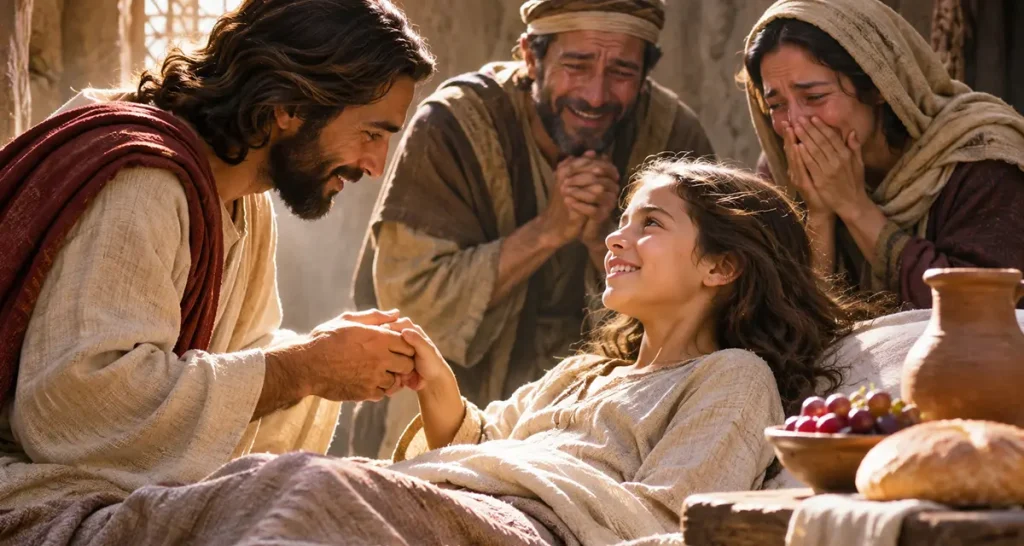
When Jesus raises Jairus’ twelve-year-old daughter from the dead, Mark records an almost unexpected instruction: “And said that something should be given her to eat” (Mark 5:43).

Why mention food immediately after such an extraordinary miracle? Death has just been overcome, a grieving family has received their daughter back, and everyone is overwhelmed with astonishment. Wouldn’t this be the perfect moment for an impromptu worship service, an outpouring of thanksgiving, and the glorification of God’s holy name?

Yet Jesus directs their attention to something remarkably ordinary: the little girl needs to eat.

And there is another touching detail. Before raising her, Jesus takes the lifeless child by the hand. He certainly does not need physical contact to restore her life, yet He approaches her with tenderness and dignity. She is not merely a corpse awaiting a miracle, but a little girl worthy of His personal attention.

The contrast becomes even more striking when we consider her parents. First, they are overwhelmed by the prospect of losing their daughter. Then, after Jesus restores her life, they are so overwhelmed with amazement that we can almost imagine them momentarily forgetting her ordinary needs! Their attention shifts from grief to astonishment, while Jesus remains attentive to the child throughout.

The One who possesses authority over death is not too great to take a little girl’s hand, nor too occupied with His own glory to remember that she needs dinner.

This raises a beautiful question about worship, obedience, compassion, and the way we respond to God’s extraordinary works. Could preparing a meal for a hungry child be, at that particular moment, a more fitting expression of devotion than organizing a celebration?

In this discussion of Jesus raising Jairus’ daughter, we explore how divine power and personal tenderness meet in the same encounter, why ordinary human needs remain important after extraordinary miracles, and how our gratitude toward God finds expression not only in praise but also in loving obedience.

Sometimes the most astonishing revelation of God’s character is found not only in the miracle itself, but in what Jesus does immediately afterward.

In Mark 5:43, after raising Jairus’ daughter from the dead, Jesus “commanded them strictly that no one should know it, and said that something should be given her to eat.” Why does Mark mention food immediately after such an extraordinary miracle? What does this seemingly ordinary instruction have to do with the astonishing event that has just taken place? 😇

That little detail is extraordinary, isn’t it? 😇

A twelve-year-old girl has just been raised from the dead. Her parents are overwhelmed with astonishment. Jesus has accomplished something beyond human power, and then, almost unexpectedly, He says, give her something to eat!

Why food? Why now? And why would Mark consider such an ordinary instruction important enough to preserve in the account of such an extraordinary miracle?

I think there is something wonderfully revealing here about Jesus, about life, and about the way God cares for His creatures.

🌿 The miracle is extraordinary, but the girl is still an ordinary human being

Notice the sequence in Mark 5:41–43.

Jesus takes the girl by the hand and speaks to her:

“Little girl, I say to you, arise.” (Mark 5:41)

She immediately rises and walks. Mark specifically tells us she is twelve years old, and everyone is overcome with amazement.

And then Jesus commands that she be given something to eat.

The One who has just overcome death does not overlook the ordinary needs of the living.

Think about that!

Jesus has restored her life, but He does not treat her as a demonstration of His power. She is not merely the subject of a miracle, or an object lesson for the witnesses.

She is a little girl.

And little girls need to eat. 😊

There is something profoundly personal about that instruction. Everyone is astonished by what Jesus has done, but Jesus turns their attention toward what the child needs.

The parents are overwhelmed by the miracle. Jesus directs them back to their responsibility as parents.

He has given their daughter back to them. Now they must care for her.

🍞 Why not simply restore her without the need for food?

Here we encounter an interesting distinction.

Jesus certainly possesses the power to sustain life without ordinary nourishment. The One who multiplied bread for thousands could have supplied everything the girl’s body required.

But that is not what He chooses to do.

He restores her to ordinary human life, a life in which eating, sleeping, growing, and depending upon others remain necessary.

This is important because resurrection to mortal life is not the same as resurrection to glorified, immortal life.

The girl was restored to the life she had before her death. She would continue growing, eating, and eventually facing death again, unless some other divine intervention occurred.

Her resurrection was real, but it was not yet the final resurrection promised to God’s people.

And the instruction to feed her fits that reality beautifully.

God’s power does not make ordinary creaturely dependence meaningless.

Indeed, consider how God ordinarily sustains us. He gives rain, soil, harvests, animals, and the labor of human hands. He could nourish us directly, but He has made us creatures who receive life through His provision.

As Jesus teaches in Matthew 6:11:

“Give us this day our daily bread.”

Even after witnessing the power of God over death, the girl still needs her daily bread.

And Jesus remembers it.

❤️ The compassion of Jesus does not end when the miracle is accomplished

There is another dimension that I find particularly moving.

Imagine being Jairus.

You have begged Jesus to come because your daughter is dying. Then someone arrives with the terrible news:

“Your daughter is dead. Why trouble the Teacher any further?” (Mark 5:35)

Jesus answers:

“Do not be afraid; only believe.” (Mark 5:36)

Then He enters the house, takes your daughter’s hand, and gives her back to you alive.

How would you respond?

Would you cry? Embrace her? Fall at Jesus’ feet? Perhaps all three at once!

And in the middle of that overwhelming moment, Jesus brings everyone back to a simple, immediate necessity: the child needs food.

There is no suggestion that Jesus is impatient with their astonishment. Mark tells us that they were overcome with great amazement, which is entirely understandable.

But Jesus is not so occupied with displaying His divine authority that He forgets the person who has received His mercy.

This is something we repeatedly encounter in His ministry.

When He feeds the multitudes, He does not merely teach them spiritual truth. He recognizes their physical hunger (Mark 6:34–44; 8:1–3).

When He encounters the widow of Nain, He raises her only son and gives him back to his mother (Luke 7:11–15).

And when He Himself rises from the dead, He eats in the presence of His disciples (Luke 24:41–43), demonstrating the bodily reality of His resurrection.

Of course, these accounts have different purposes. We should not assume that the girl’s meal was specifically intended as proof of resurrection, though her ability to eat would certainly be consistent with her genuine restoration to life.

What connects these passages is the wonderful fact that the Lord of life takes bodily existence seriously.

He created human beings as embodied creatures, and He does not despise the ordinary conditions of that existence.

🌱 Jesus gives life, but He does not abolish our responsibilities

Now here is something else worth considering.

Jesus could have personally provided the food.

He could have performed another miracle and placed bread before the child.

But He doesn’t.

He commands that someone give her something to eat.

Notice the beautiful division of responsibility.

Only Jesus could raise the dead girl. But those around her could feed her.

He does what they cannot do, and then directs them to do what they can.

This resembles another resurrection account, although the circumstances differ.

When Jesus raises Lazarus, He commands:

“Loose him, and let him go.” (John 11:44)

Jesus gives Lazarus life. The people standing nearby are instructed to remove his graveclothes.

They cannot raise Lazarus, but they can unwrap him.

Similarly, Jairus and his household cannot restore the girl’s life, but they can provide her with food.

We should be careful not to claim that Mark explicitly presents this as a general doctrine of divine and human cooperation. He does not explain the command that way.

Nevertheless, the pattern is striking.

Divine intervention does not necessarily eliminate human responsibility. Sometimes it restores the very possibility of fulfilling it.

Jairus could do nothing to reverse his daughter’s death.

But now he can care for his living daughter again.

What an extraordinary gift, not only to receive her back but to be able to resume the ordinary responsibilities of loving her!

✨ The Lord who conquers death also cares about dinner

There is one more thought that makes this passage especially beautiful to me.

We often divide life into the sacred and the ordinary.

We expect to encounter God’s glory in miracles, resurrection, visions, and extraordinary demonstrations of power.

But eating?

Preparing a meal?

Making sure a child has enough food?

Those seem like minor details compared with raising someone from the dead.

Yet Jesus places them together in the same encounter.

He does not say that because the girl has experienced something extraordinary, her ordinary needs have become unimportant.

Quite the opposite.

The miracle has restored her to a world where she can once again enjoy those ordinary gifts.

And perhaps that is part of what makes the instruction so moving.

Before this moment, Jairus was facing the unimaginable sorrow of never feeding his daughter again, never hearing her voice, never watching her grow.

Now she is alive.

She can walk.

She can eat.

She can sit at the family table again.

The miracle is not diminished by the meal. The meal is one of the beautiful consequences of the miracle.

And this brings us to a fascinating contrast: Jesus raises the child with a command that only divine authority could make effective, yet immediately afterward gives a command that any caring parent can obey.

One command defeats death.

The other provides dinner.

And both come from the same Lord. ❤️

Perhaps this is why Mark’s seemingly incidental detail deserves our attention. It reminds us that the purpose of God’s power is not merely to astonish human beings but also to accomplish His good purposes for them.

The passage does not tell us everything Jesus intended by the instruction. But it does show us something unmistakable about Him.

The One who possesses authority over death is attentive to the needs of a hungry twelve-year-old girl.

And that is no small revelation of His character.

If I had witnessed such a miracle, I would probably have said, “Let us give thanks to the Lord and bless His holy name, because this little girl has been restored to life! Let us have an impromptu worship service!” But Jesus, instead of calling everyone to celebrate, simply says, “Give her something to eat.”

😂 And that is precisely what makes this encounter so wonderfully revealing!

You would be ready to organize a worship service, call the neighbors, sing praises, and perhaps invite everyone to hear what the Lord has done.

And Jesus says, “Give her something to eat.” (Mark 5:43)

😇 When our response to God differs from God’s immediate concern

There is something worth examining here, because your proposed response is not wrong!

Giving thanks to God for raising a child from the dead would be entirely appropriate. In fact, throughout the Gospels, people glorify God when they witness His mighty works.

When Jesus raises the widow’s son at Nain, Luke records:

“Then fear came upon all, and they glorified God.” (Luke 7:16)

So worship is certainly a fitting response to resurrection.

But notice what happens in Jairus’s house.

Jesus does not first direct their attention toward celebrating what He has done. He directs their attention toward caring for the person for whom He has done it.

And there is something deeply instructive in that distinction.

We might become so overwhelmed by the manifestation of God’s power that we temporarily forget the very person who has received His mercy.

Not because we are indifferent, but because we are astonished!

Yet Jesus is not distracted by the miracle. He knows exactly what has happened, and He knows what must happen next.

The girl needs food.

🍞 Could feeding her be an act of worship?

Now this is where your observation becomes particularly interesting. 😊

We tend to think of worship as something we do toward God: praising Him, thanking Him, singing, praying, proclaiming His works.

And rightly so.

But Scripture also teaches us that our response to God includes what we do toward others.

Jesus says:

“And whoever gives one of these little ones only a cup of cold water in the name of a disciple, assuredly, I say to you, he shall by no means lose his reward.” (Matthew 10:42)

Consider what Jesus teaches in Matthew 25:31–40, where He identifies acts of mercy toward those in need as acts done unto Him.

Feeding the hungry, welcoming strangers, clothing the naked, and visiting the sick are not presented as insignificant activities beside the supposedly more spiritual work of worship.

They are expressions of a life that recognizes and honors the Lord.

Now, we should be careful here. Jesus does not explicitly call feeding Jairus’s daughter an act of worship. His instruction is practical and immediate.

But the connection is worth considering.

What if, in that particular moment, the most appropriate way to honor the Lord who had restored the girl was to obey Him by feeding her?

Imagine Jairus responding:

“Lord, first we must gather everyone and celebrate this extraordinary miracle!”

And Jesus answering:

“But your daughter is hungry.”

Of course, that conversation never occurred. Yet it illustrates something important.

Our enthusiasm for honoring God must never become an excuse for neglecting what He has actually commanded us to do.

And this brings us remarkably close to something Jesus teaches elsewhere.

❤️ Mercy is not a distraction from devotion

In Matthew 12:1–8, the Pharisees criticize Jesus’ disciples for plucking grain on the Sabbath because they are hungry.

Jesus responds by directing their attention to the meaning of God’s law and reminding them of the divine priority of mercy.

The problem was not that the Pharisees took worship or Sabbath observance seriously.

The problem was that their understanding of religious observance had become distorted enough to condemn people whom God had not condemned.

And here is the connection with Jairus’s daughter.

We might be tempted to imagine that the most spiritual response to a resurrection must be something visibly religious.

A prayer service.

A hymn.

A public declaration of God’s glory.

But Jesus gives a very ordinary command.

Feed the child.

The ordinary act becomes an expression of obedience precisely because the Lord has commanded it.

And there is a distinction here that deserves our attention.

Feeding someone is not a substitute for worshiping God. Nor does every act of kindness automatically constitute worship in the fullest biblical sense.

But obedience, mercy, gratitude, and worship belong together. They are not competing obligations.

Indeed, Romans 12:1 presents the offering of our bodies to God as living sacrifices, describing a life of consecration rather than limiting our service to moments of formal religious activity.

🌿 When we become so occupied with the miracle that we forget its recipient

Now consider the scene once more.

The parents have just witnessed something unimaginable.

Their daughter was dead.

Now she is walking.

Mark tells us that they were overcome with great amazement (Mark 5:42).

Their astonishment is understandable. Who could remain composed after witnessing such a thing?

Yet Jesus seems to move immediately from the extraordinary to the ordinary.

And perhaps that is precisely where we can learn something about our own spiritual lives.

Sometimes we become so absorbed in what God has done that we neglect what His work now requires of us.

We celebrate deliverance but overlook the needs of the delivered.

We rejoice over someone’s conversion but fail to help that person grow.

We praise God for restoring a family but forget that the family must now learn to live together faithfully.

We thank Him for healing someone but neglect the practical care that person still needs.

And I think this is where your initial instinct to organize an impromptu worship service becomes such a useful contrast.

There is nothing wrong with your instinct!

The Lord deserves praise.

But the Lord who deserves our praise is also the Lord who commands our obedience.

And sometimes obedience is less dramatic than praise.

Sometimes it involves preparing a meal.

🥹 The girl is not merely evidence of the miracle

There is another danger that Jesus’ instruction helps us recognize.

When something extraordinary happens to someone, we can become so fascinated by the event that the person almost disappears behind it.

Imagine everyone crowding around the girl.

They want to see her.

They want to hear what happened.

They want to understand how someone who was dead could now be alive.

Perhaps they would ask her questions she could not possibly answer.

But Jesus does not turn her into a spectacle.

He has already restricted who may witness the miracle, and afterward He strictly commands that the event not be publicized (Mark 5:37, 43).

Then He directs attention to her immediate need.

She is not there to satisfy everyone’s curiosity.

She is not there to provide a public testimony on demand.

She is a child who has just been restored to her family.

And she needs to eat.

Jesus does not allow the greatness of the miracle to eclipse the dignity of the person.

This connects beautifully with your later observation about Jesus taking her hand.

Before the resurrection, He treats her lifeless body with tenderness.

After the resurrection, He treats her living body with care.

In neither condition is she merely an object through which His power is displayed.

✨ Perhaps the worship service has already begun

Now here is a thought I find especially moving.

What if Jairus obeyed Jesus immediately?

What if he turned to his household and asked someone to prepare food for his daughter?

Would that be less pleasing to the Lord than gathering everyone to sing?

Not necessarily.

In fact, at that moment, it would be obedience to the very One they wanted to honor.

And perhaps this is the deeper spiritual lesson we can draw from the encounter.

We must be careful not to become so occupied with expressing our devotion to God that we neglect the particular obedience He asks of us.

Jesus makes a similar point in Luke 6:46 when He challenges those who acknowledge Him as Lord but do not do what He says.

Our confession of His lordship must find expression in our conduct.

The father who had fallen at Jesus’ feet begging for his daughter’s life (Mark 5:22–23) could now express his gratitude by caring for the daughter Jesus had restored.

There would be time to marvel.

There would be time to give thanks.

There would be time to remember this extraordinary day for the rest of their lives.

But right now, their daughter needed something to eat.

And I cannot help thinking about how easily we might have missed that need while preparing our magnificent celebration of God’s goodness. 😂

Perhaps one of the most beautiful ways Jairus could have honored Jesus at that moment was simply to bring his little girl a plate of food.

Not because worship was unimportant, but because the Lord whom he worshiped had just told him what to do.

And there is something wonderfully sobering about that: the God who raises the dead is also concerned with how we care for the living.


And then there is the tenderness of Jesus taking the little girl by the hand. He did not need to touch her to raise her from the dead, and yet He chose to do so. She was already a lifeless body, but still a little girl, and Jesus treated her with such dignity, gentleness, and personal tenderness. 🥹

🥹 Yes. And what makes that gesture even more moving is that Jesus takes her hand before she comes back to life.

Not afterward, when she can recognize Him, respond to His touch, or express gratitude.

He takes the hand of a dead child.

And as you observed, He does not need to.

❤️ The hand that death could not resist

Mark tells us:

“Then He took the child by the hand, and said to her, ‘Talitha, cumi,’ which is translated, ‘Little girl, I say to you, arise.’” (Mark 5:41)

Consider the extraordinary contrast.

Jesus is about to exercise authority over death itself. He does not require physical contact to accomplish that. We know this from other miracles, including His healing of the centurion’s servant from a distance (Matthew 8:5–13).

His word is sufficient.

And yet He reaches for her hand.

Why?

Mark does not explicitly explain the gesture, so we should be careful not to assign Jesus a motive that the text does not state.

But the gesture itself tells us something about the manner in which He exercises His authority.

He does not approach the dead girl merely as a problem to solve or a demonstration of power to perform.

He approaches her personally.

She is not simply a corpse lying on a bed.

She is Jairus’s daughter. A twelve-year-old child whose life has been interrupted, whose parents are grieving, and whose body still deserves to be treated with dignity.

And here is something especially significant: her dignity did not disappear when her life ended.

She was created in the image of God (Genesis 1:26–27). Death had taken her life, but it had not made her remains something contemptible.

Jesus does not recoil from her.

He takes her hand.

🌿 The holiness that does not recoil from death

There is another dimension to this encounter that a Jewish audience would have recognized.

According to Numbers 19:11, contact with a dead human body brought ceremonial uncleanness for seven days.

This was not because the deceased person was morally evil or undeserving of affection. Ceremonial uncleanness was a matter of ritual status, not a judgment on someone’s human worth.

Nevertheless, touching a corpse was religiously significant.

And Jesus deliberately takes her hand.

We should distinguish what Mark explicitly says from what we infer. Mark does not stop to discuss the purity laws or explain their application here.

But the contrast is remarkable.

Under the Mosaic law, contact with death ordinarily rendered the living person ceremonially unclean.

Here, the living Christ touches the dead, and the dead child lives.

Death does not have the final word in this encounter.

The One who touches her possesses authority to reverse what no human being can reverse.

And He exercises that authority with extraordinary gentleness.

🥹 “Little girl, arise.”

Even the words Jesus chooses deserve attention.

Mark preserves the Aramaic expression Talitha, cumi.

He could have simply reported that Jesus commanded the girl to rise. Instead, he preserves the words and then translates them for his readers.

There is something intimate about hearing the actual expression Jesus spoke in that room.

No dramatic declaration to impress the mourners.

No elaborate ceremony.

No attempt to make the occasion more spectacular than it already is.

Just a hand extended to a child and a command spoken with absolute authority.

And notice that Jesus does not address death as an abstract enemy in this moment.

He addresses the girl.

“Little girl, I say to you, arise.”

The command is personal. He is calling her back to life.

This reminds me of His encounter with the widow’s son at Nain:

“Young man, I say to you, arise.” (Luke 7:14)

And with Lazarus:

“Lazarus, come forth!” (John 11:43)

In each case, Jesus addresses the person whom death has rendered unable to respond.

Yet His word accomplishes what it commands.

🍞 From holding her hand to feeding her

And now your two observations come together beautifully.

Jesus takes her hand when she is dead.

He commands that she be fed when she is alive.

Both actions surround the extraordinary moment of resurrection with ordinary expressions of human tenderness.

He touches her when she cannot feel His touch, and He provides for her hunger when she can feel it again.

Think about the continuity of His care.

Her condition changes completely. She passes from death to life.

But Jesus’ regard for her does not change.

She was worthy of dignified treatment before He raised her, and she remains worthy of attentive care afterward.

That is a profound lesson for how we understand human dignity.

We do not become valuable only when we are conscious, productive, responsive, or capable of returning affection.

Our dignity is not something we earn through our abilities.

And death itself does not give the living permission to treat a human body with contempt.

There is a reason Scripture treats burial with such seriousness, and why even the body of Jesus was carefully wrapped and laid in a tomb (John 19:38–42).

The body matters because the person matters.

✨ What kind of Lord is this?

I keep returning to something in your observation.

Jesus could have stood at the doorway and commanded the girl to live.

He could have raised her without entering the room.

He could have performed the miracle in a way that left everyone trembling before an overwhelming display of divine power.

Instead, He enters the room, approaches the child, takes her hand, and speaks to her.

And afterward, He remembers her food.

The astonishing thing is not merely that Jesus possesses such power.

It is the character of the One who possesses it.

We sometimes imagine divine majesty and personal tenderness as qualities that must be balanced against each other, as though exercising supreme authority might leave little room for gentleness.

But in Jesus they are not competing qualities.

His tenderness does not diminish His authority, and His authority does not diminish His tenderness.

This is the same Jesus who says:

“He who has seen Me has seen the Father.” (John 14:9)

Which means that we should not regard His tenderness as merely a pleasant feature of His human personality, disconnected from the revelation of God.

In the incarnate Son, we are seeing the character of the Father revealed.

And there is something almost overwhelming about realizing that the God who has authority to summon the dead back to life is not too great to take a little girl’s hand.

Nor is He too occupied with His own glory to remember that she needs dinner.

The resurrection is astonishing.

But the hand, the words, and the food reveal something equally worthy of our contemplation: the resurrection was performed by Someone who cared for the girl, not merely by Someone who had power over death. 🥹

There is something wonderfully revealing in Jesus’ instruction to give the girl something to eat. At first, her parents were overwhelmed with grief and fear at the death of their daughter. Then, after Jesus raised her, they were so overwhelmed by what He had done that they almost seemed to forget about their daughter and her immediate needs! 😂

😂 Exactly! And what a remarkable reversal!

Before Jesus arrives, their daughter occupies their entire attention because she is dying.

After Jesus raises her, the miracle occupies their attention so completely that Jesus has to direct them back to their daughter!

Of course, Mark doesn’t explicitly say they forgot about her. But their overwhelming astonishment, followed immediately by Jesus’ instruction to feed her, certainly makes your observation delightful to contemplate.

❤️ The same daughter, two overwhelming emotions

Think about what these parents have experienced in such a short time.

First, Jairus is desperate. His daughter is at the point of death, and he falls at Jesus’ feet pleading for help (Mark 5:22–23).

Then comes the dreadful announcement that she has died.

Jesus tells him not to fear, but to believe.

And finally, the unimaginable happens. His daughter stands up and begins walking!

What a succession of emotions!

Grief, fear, helplessness, hope, astonishment, and joy.

And in the midst of it all, Jesus appears to be the only person in the room who is not overwhelmed.

Everyone else is astonished by the restoration of life. Jesus is already attending to the responsibilities that restored life brings.

That is quite a contrast.

🍞 The Lord who never loses sight of the person

There is something else in your observation that deserves attention.

Before the miracle, the parents are understandably absorbed in their daughter’s suffering.

After the miracle, they are understandably absorbed in Jesus’ power.

But Jesus never loses sight of the girl.

He sees her in death, takes her hand, and calls her to rise.

Then He sees her in life and directs that she be fed.

Their attention shifts dramatically. His care remains constant.

And that is not a criticism of the parents. Their reactions are deeply human and understandable.

Rather, it reveals something beautiful about the Lord.

We are creatures who can be overwhelmed by circumstances, whether sorrowful or joyful.

Sometimes grief consumes our attention.

Sometimes even joy does!

But Jesus is neither bewildered by death nor distracted by His victory over it.

He knows what the child needs before and after the miracle.

😇 And perhaps there is a gentle lesson for us

I can almost imagine the scene.

The parents are crying, embracing one another, staring at their daughter, looking at Jesus, perhaps wondering whether they are dreaming.

Meanwhile, the little girl has just returned to life and is standing there.

And Jesus, with perfect composure:

“Someone get this child something to eat.”

😂

There is a wonderful tenderness in the imagined scene, even though Scripture does not describe their precise reactions beyond their amazement.

But your observation also touches something serious.

We can become so absorbed in God’s extraordinary works that we overlook the ordinary responsibilities those works place before us.

And sometimes we can become so occupied with celebrating God’s goodness that we momentarily neglect the very people to whom He has shown that goodness.

That is why this little instruction is so valuable.

It brings the miracle back into the household.

Back into family life.

Back into the ordinary responsibilities of parents toward their child.

And perhaps one of the most touching consequences of the resurrection is something Mark never describes, but which Jesus’ command makes possible.

A father and mother who thought they would never again feed their daughter now have the privilege of preparing her next meal.

Yesterday, feeding her might have seemed like an ordinary responsibility. Now it is an extraordinary privilege.

And the Lord who gave them that privilege reminds them to exercise it.

What a beautiful way for the account to end: not with a crowd celebrating the miracle, but with a living little girl who needs dinner. 🥹