🔥 Yes. And this takes us much deeper than “Jesus was angry about corruption”
I think you have put your finger on the more difficult question.
The Father was not absent.
He had not failed to notice what was happening in Jerusalem.
The same God who judged Nadab and Abihu immediately (Leviticus 10:1–3), judged Korah’s rebellion dramatically (Numbers 16:31–35), confronted Eli’s house (1 Samuel 2:27–36), and repeatedly sent prophets against corrupt worship certainly saw every transaction taking place in His Temple.
Yet the heavens remained quiet.
No fire fell.
No earthquake opened the courtyard.
No angel drove out the merchants.
And then the Son walked in.
That changes how we should read the event.
The question isn’t merely:
Why did Jesus intervene when the Father didn’t?
It is closer to:
Was the Father’s intervention now taking place through the Son?
And the Gospel of John gives an extraordinarily strong answer: yes.
👑 “The Son can do nothing of Himself”
This is one of the most important controls on how we understand the cleansing.
Jesus later says:
“The Son can do nothing of Himself, but what He sees the Father do; for whatever He does, the Son also does in like manner.” (John 5:19)
That statement prevents us from imagining the Temple scene as:
Father: tolerating the situation.
Son: becoming frustrated and deciding to do something about it.
That would introduce precisely the kind of division within God that John’s Gospel systematically excludes.
Jesus continues:
“For the Father loves the Son, and shows Him all things that He Himself does.” (John 5:20)
And then:
“For as the Father raises the dead and gives life to them, even so the Son gives life to whom He will.” (John 5:21)
The Son’s action is not independent competition with the Father.
It is the Father’s work manifested through the Son.
This reaches an extraordinary statement later:
“He who has seen Me has seen the Father.” (John 14:9)
So when Jesus walks into the Temple, we should not imagine:
The Father watched corruption for years and finally Jesus lost patience.
Rather:
The Father who had been watching His house has sent His Son, and now the Father’s judgment upon that corruption becomes historically visible in the Son’s action.
🤯 That makes “My Father’s house” much heavier
Now listen again:
“Do not make My Father’s house a house of merchandise!” (John 2:16)
Jesus doesn’t say:
“God is going to hear about this.” 😄
Nor:
“I will ask My Father to deal with you.”
Nor even:
“You should stop doing this because the Law forbids corruption.”
He acts.
That is remarkable.
And when challenged, He doesn’t retreat into:
“I was merely expressing my personal religious convictions.”
They ask:
“What sign do You show to us, since You do these things?” (John 2:18)
They recognize that His behavior constitutes a claim to authority.
And Jesus answers with His resurrection:
“Destroy this temple, and in three days I will raise it up.” (John 2:19)
John explains:
“He was speaking of the temple of His body.” (John 2:21)
In other words, the ultimate validation of His authority to cleanse the Father’s Temple is bound up with who He is.
🏛️ But does the Son actually possess authority over the Father’s house?
Yes—and John’s Gospel gives us an astonishing theological framework for saying so without confusing Father and Son.
Jesus says:
“The Father loves the Son, and has given all things into His hand.” (John 3:35)
Later:
“For the Father judges no one, but has committed all judgment to the Son.” (John 5:22)
And then Jesus tells us why:
“that all should honor the Son just as they honor the Father.” (John 5:23)
That is enormous.
The Father does not guard His authority against the Son.
That would take us right back into the pagan conception we were discussing with Cronus—the father protecting his sovereignty from the son.
Scripture gives us almost the exact opposite.
The Father gives.
“The Father loves the Son, and has given all things into His hand.” (John 3:35)
And the Son doesn’t seize what the Father gives.
He receives.
He obeys.
He glorifies the Father.
And eventually Paul describes the Son delivering the kingdom to the Father (1 Corinthians 15:24–28).
There is no rivalry.
🕊️ So the Father’s apparent “nothing” is not actually nothing
This, I think, is where your question becomes particularly beautiful.
You said:
the Father knew, saw what was happening, could intervene as He did before and until Jesus, nothing?
Exactly.
But perhaps we are looking for the Father’s intervention in the wrong place.
We are expecting:
corruption → heaven opens → Father acts
while the Gospel is showing us:
corruption → Son enters Temple → Father is acting through the Son.
Jesus says:
“The Father who dwells in Me does the works.” (John 14:10)
That doesn’t erase the Son’s agency. Jesus genuinely acts.
But His action perfectly manifests the Father’s will.
So the Temple cleansing is not:
Jesus doing what the Father failed to do.
It is:
the Father doing through the incarnate Son what He had appointed the Son to do.
And now Malachi 3 becomes almost explosive.
⚡ “The Lord… will suddenly come to His temple”
Malachi had announced:
“And the Lord, whom you seek, will suddenly come to His temple.” (Malachi 3:1)
And what happens when He comes?
“But who can endure the day of His coming? And who can stand when He appears? For He is like a refiner’s fire…” (Malachi 3:2)
Then:
“He will purify the sons of Levi…” (Malachi 3:3)
That is extraordinary against the Gospel scene.
Israel might have expected divine intervention to come from heaven upon the Temple.
Instead, one day a Man from Nazareth walks through its gates.
No lightning.
No pillar of fire.
No earthquake.
No audible voice from Sinai.
Just Jesus.
And then tables start going over.
😳
What if that is the divine visitation?
Not the Father absent while Jesus takes matters into His own hands.
The Father has sent the Son.
👨👦 The Son is not an outsider defending the Father’s property
This distinction matters enormously.
We could accidentally imagine Jesus as a faithful son coming home, discovering that people have vandalized Dad’s house, becoming furious and defending Dad’s property while Dad is somewhere else.
But Johannine Christology won’t allow that picture.
The Son is not merely God’s most loyal servant.
John has already told us:
“In the beginning was the Word, and the Word was with God, and the Word was God.” (John 1:1)
And:
“All things were made through Him, and without Him nothing was made that was made.” (John 1:3)
Then:
“The Word became flesh and dwelt among us.” (John 1:14)
So the One entering the Temple is the One through whom the materials constituting that Temple ultimately exist.
The stones exist through Him.
The animals exist through Him.
The merchants exist through Him.
The priests exist through Him.
Jerusalem exists through Him.
And the covenantal history that produced the Temple is moving toward its fulfillment in Him.
Colossians later expresses the cosmic reality:
“All things were created through Him and for Him.” (Colossians 1:16)
So His authority there is vastly greater than that of a reformer.
⚖️ And Jesus specifically says that judgment has been entrusted to Him
This may be the decisive piece.
You are asking:
Why didn’t the Father intervene?
Jesus tells us something surprising:
“For the Father judges no one, but has committed all judgment to the Son.” (John 5:22)
That doesn’t mean the Father ceases to be the source and standard of judgment. The next verses preserve the complete unity of Father and Son.
But it does mean that the Father’s judgment is executed through the Son.
Jesus says:
“and has given Him authority to execute judgment also, because He is the Son of Man.” (John 5:27)
That puts the Temple cleansing into a much larger trajectory.
The One overturning tables in John 2 is the same One who will say in John 5 that the Father has entrusted judgment to Him.
And ultimately the same Christ appears in Revelation as the executor of final judgment (Revelation 19:11–16).
The Temple cleansing is therefore almost like a small historical preview.
Not final judgment.
Not indiscriminate destruction.
But judicial authority becoming visible.
❤️🔥 And yet notice how restrained that judgment is
This is important too.
Given what God had done at other moments of covenantal corruption, the remarkable thing isn’t merely that Jesus acted physically.
It is how limited the action was.
Compare:
Nadab and Abihu — fire consumes them (Leviticus 10:1–2).
Korah’s rebellion — the earth opens (Numbers 16:31–33).
Uzzah — immediate death (2 Samuel 6:6–7).
But in the Temple:
tables overturned.
coins scattered.
animals driven out.
merchants expelled.
Nobody is described as being killed.
That is interesting.
The Lord has indeed come to His Temple.
But this is not yet the final visitation of wrath.
There is warning in the action.
There is judgment.
There is authority.
But there is also extraordinary restraint.
Because something else is about to happen.
🐑 The Judge is going to absorb judgment
And here the whole scene turns upside down.
The One who has authority to cleanse the Temple will soon be condemned by the authorities associated with that religious order.
The One who drives sacrificial animals out will become the Lamb.
The One who declares judgment upon corruption will bear judgment for sinners.
The One who says:
“Take these things away!” (John 2:16)
will shortly hear:
“Away with Him, away with Him! Crucify Him!” (John 19:15)
That verbal correspondence is striking even if we should not force it into a formal literary parallel.
They will cast Him out.
Hebrews emphasizes that Jesus suffered “outside the gate” (Hebrews 13:12).
So something astonishing is happening in the larger story:
The Judge enters the Temple and cleanses it.
Then the corrupt world turns upon the Judge.
And instead of immediately destroying them, He gives Himself for them.
That is why the cleansing cannot be separated from the cross.
🌿 The Father’s patience was therefore not indifference
This also answers the troubling part of your question:
If the Father saw all of this, why wait?
Scripture repeatedly distinguishes divine patience from divine approval.
Paul says:
“the goodness of God leads you to repentance.” (Romans 2:4)
Peter similarly explains that divine delay reflects patience rather than inability (2 Peter 3:9).
The Temple’s corruption existing for some period does not mean God approved it.
And then, “when the fullness of the time had come”:
“God sent forth His Son…” (Galatians 4:4)
That expression matters beyond the Temple specifically.
God’s answer to the world’s corruption ultimately isn’t a sequence of increasingly dramatic interventions from heaven.
His answer is the Son.
Hebrews begins:
“God, who at various times and in various ways spoke in time past to the fathers by the prophets, has in these last days spoken to us by His Son.” (Hebrews 1:1–2)
That is exactly the transition we are looking at.
Previously:
God sends prophets to His people.
Now:
God sends the Son.
Previously:
“Thus says the LORD.”
Now the Son says:
“But I say to you.” (Matthew 5:22, 28, 32, etc.)
Previously:
prophets condemn corruption in God’s house.
Now:
the Son enters His Father’s house and acts.
🏠 There is an even deeper sonship dimension
Hebrews gives us a useful distinction:
“Moses indeed was faithful in all His house as a servant…” (Hebrews 3:5)
But:
“Christ as a Son over His own house…” (Hebrews 3:6)
That distinction is enormous.
Moses has authority as servant.
Christ has authority as Son.
A prophet could stand outside the corruption and announce:
“God will judge this.”
Jesus can enter and begin exercising that judgment because the Father has entrusted authority to the Son.
And still Jesus remains perfectly obedient.
This is the paradox of biblical sonship:
His obedience does not imply lack of authority.
And:
His authority does not imply independence from the Father.
Jesus possesses enormous authority precisely within the perfect communion of Father and Son.
“I and My Father are one.” (John 10:30)
🤯 Which brings us back to something from our earlier discussion
We were contrasting the divine Father-Son relationship with the mythological world in which father and son become competitors for power.
Here that contrast becomes almost startling.
Imagine authority as something scarce.
Then the Father giving the Son authority would mean:
Father loses → Son gains.
But Scripture refuses that framework.
The Father gives judgment to the Son so:
“that all should honor the Son just as they honor the Father.” (John 5:23)
The Son’s glorification glorifies the Father (John 13:31–32; 17:1).
The Son acts according to the Father (John 5:19).
The Father works through the Son (John 14:10).
The Son seeks the Father’s glory (John 8:49–50).
There is no competition of wills, no guarding of territory, no divine insecurity.
So when Jesus cleanses the Temple, we are not watching two divine centers of authority where one remained passive and the other became active.
We are seeing the astonishing unity Jesus describes:
“My Father has been working until now, and I have been working.” (John 5:17)
✨ So what was really going on?
Much more than a Temple reform.
The Father had not ignored His corrupted house.
The Father had sent the Son.
The Son had not independently seized authority over the Father’s house.
The Father had entrusted authority to Him.
Jesus was not merely defending a religious building.
The true Temple had arrived at the temporary Temple.
The cleansing was not an attempt to preserve the old order indefinitely.
It was simultaneously purification, prophetic judgment, and announcement that the old order was approaching fulfillment.
And the physical intervention was not a contradiction of Jesus’ gentleness.
It was a controlled manifestation of the judicial authority the Father had given Him.
There is therefore something almost breathtaking about the apparent silence of heaven during the incident.
We might look upward and ask:
“Father, are You seeing what they have done to Your house? Why aren’t You doing something?”
And John’s Gospel seems to turn our face away from the sky and toward the Man standing in the courtyard.
Look at Him.
The Father is doing something.
“He who has seen Me has seen the Father.” (John 14:9)
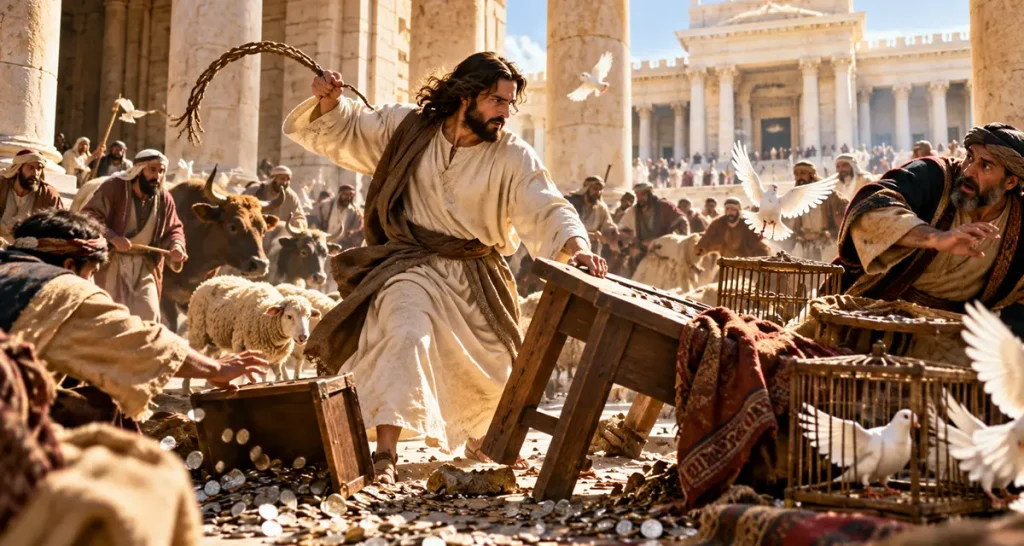
The whip of cords, the fleeing animals, the overturned tables, the scattered coins, the command “Take these things away,” and the declaration “My Father’s house” are not the Son compensating for the Father’s inactivity.
They are part of the Father’s visitation of His people in the person and work of His Son.
And there is an even more sobering implication.
The Temple authorities thought the great question was:
“Who authorized You to do this?”
But the real question was:
“Do we recognize God when He comes to His own house?”
John had already given us the tragic answer before the scene ever happened:
“He came to His own, and His own did not receive Him.” (John 1:11)
That may be the deepest drama taking place among all those overturned tables.