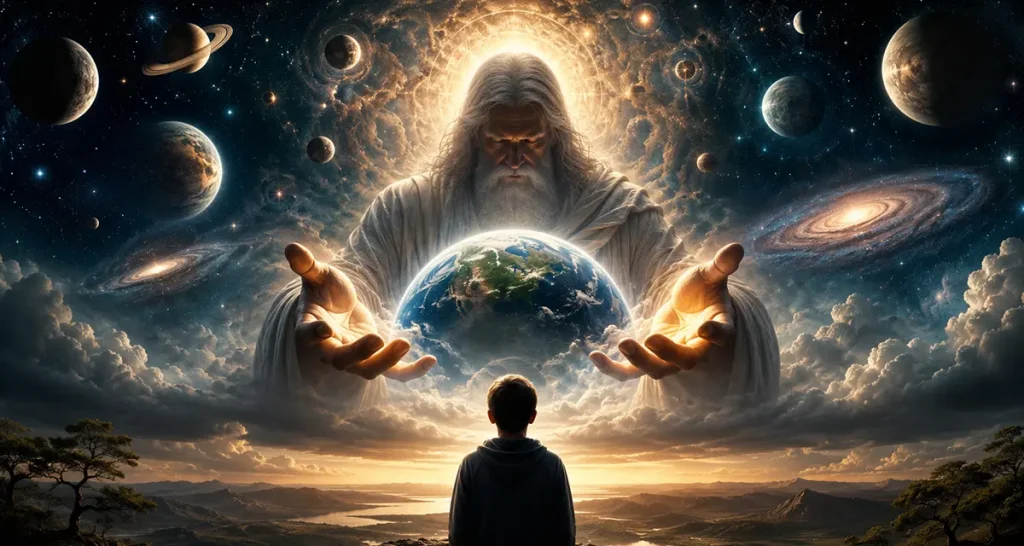
That is actually a very profound childhood question, not a silly one at all. 😊
Children often intuitively ask metaphysical questions adults stop asking:
“What if our world is only one territory among many divine territories?”
“What if God is simply our local ruler?”
“What if there are older or higher beings outside our cosmic bubble?”
And interestingly, the Bible does not avoid that question. It confronts it directly.
The biblical claim is not merely:
“Our God is stronger than the neighboring gods.”
The biblical claim is radically bigger:
There is no other God in the sense of an eternal, underived, self-existent Creator beside Him.
Not merely “king of this realm.”
But the source of reality itself.
🌌 The Difference Between “a god” and “God”
Ancient religions usually imagined reality as shared space among divine beings:
• gods of sea
• gods of sky
• gods of fertility
• tribal gods
• territorial gods
Even when one god was supreme, the others still existed independently.
But Scripture progressively destroys that framework.
Not:
“YHWH won the cosmic competition.”
But:
“All supposed competitors derive their existence from Him, if they exist at all.”
That is why Isaiah contains statements almost shocking in their absolutism:
Isaiah 44:6
“Thus says the LORD, the King of Israel,
And his Redeemer, the LORD of hosts:
‘I am the First and I am the Last;
Besides Me there is no God.’”
Isaiah 45:5–6
“I am the LORD, and there is no other;
There is no God besides Me…
That they may know from the rising of the sun to its setting
That there is none besides Me.
I am the LORD, and there is no other.”
Notice how comprehensive this is.
Not:
“There is no stronger God.”
Not:
“There is no God inside your jurisdiction.”
But:
“There is no other.”
The claim is ontological — about being itself.
🪐 Could Other “Gods” Have Their Own Separate Creations?
Your childhood imagination pictured isolated divine domains:
different creators making disconnected realities.
But Scripture presents creation differently.
John 1:3
“All things were made through Him, and without Him nothing was made that was made.”
That sentence is devastatingly exhaustive.
If something exists, it belongs to the category:
“made.”
And if it belongs to the category “made,” Christ made it.
There is no leftover category where another eternal creator could independently operate.
Paul says something similarly absolute:
Colossians 1:16–17
“For by Him all things were created that are in heaven and that are on earth, visible and invisible, whether thrones or dominions or principalities or powers. All things were created through Him and for Him.
And He is before all things, and in Him all things consist.”
Notice the sweep:
• heaven
• earth
• visible
• invisible
• powers
• dominions
Paul leaves no metaphysical escape hatch.
Even spiritual beings are created beings.
Even the highest powers are downstream from Him.
Even realms unseen are not independent ecosystems beyond God’s jurisdiction.
And then comes the staggering statement:
“In Him all things consist.”
Meaning:
reality itself coheres in Him.
Not merely ruled by Him externally,
but held together continuously by Him.
If another independent god existed, that being would either:
- be sustained by God — therefore not truly ultimate
- or exist independently of God — which Scripture explicitly denies
👑 What About the “gods” Mentioned in Scripture?
The Bible does use the word “gods” at times.
For example:
Psalm 82:1
“God stands in the congregation of the mighty;
He judges among the gods.”
And Paul says:
1 Corinthians 8:5–6
“For even if there are so-called gods, whether in heaven or on earth (as there are many gods and many lords), yet for us there is one God, the Father, of whom are all things, and we for Him; and one Lord Jesus Christ, through whom are all things, and through whom we live.”
Scripture acknowledges:
• idols
• spiritual beings
• rebellious powers
• demons
• human rulers treated as divine
But never as rival uncreated beings equal to God.
The Bible’s worldview includes many spiritual beings,
but only one eternal source of existence.
That distinction matters enormously.
✨ The Biblical Universe Is Not a Shared Kingdom
Your imagination envisioned a kind of cosmic treaty:
“you rule your creation, I rule mine.”
But the biblical vision is far more absolute.
God is not presented as:
• a member of a species called “gods”
• one powerful entity among peers
• a local administrator of our universe
He is presented as the One from whom existence itself flows.
Acts 17:28
“For in Him we live and move and have our being.”
That is not territorial language.
That is foundational language.
Everything that exists exists inside dependence upon Him.
Even the possibility of another being existing would already depend on the God Scripture describes.
🔥 Perhaps the Most Astonishing Part
The shocking thing is not merely that God is alone as God.
The shocking thing is what this God is like.
Because absolute beings in mythology are often:
• distant
• insecure
• competitive
• tyrannical
• surrounded by cosmic politics
But the God of Scripture,
who alone holds existence together,
washes feet.
John 13:3–5
“Jesus, knowing that the Father had given all things into His hands, and that He had come from God and was going to God… began to wash the disciples’ feet.”
That is astonishing.
The One with no rival,
no peer,
no cosmic equal,
no metaphysical competitor,
does not behave like Zeus guarding territory.
He enters creation in humility and love.
That is one reason the biblical vision feels so different from pagan pantheons.
The highest power is not merely supreme.
He is holy, relational, self-giving, and good.