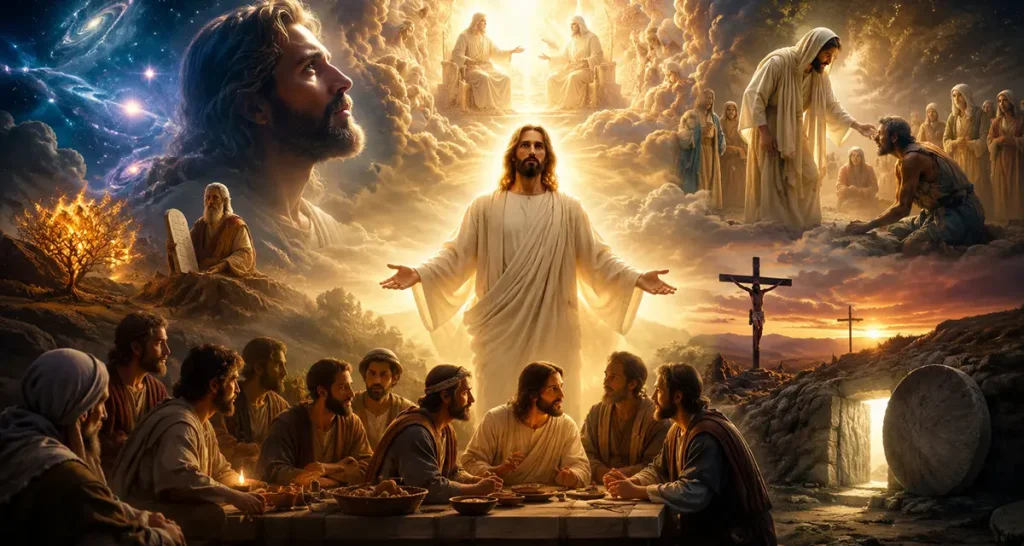
Your question touches one of the deepest moments in John’s Gospel. Jesus is not asking to become something He was not. Rather, He is asking that what has been veiled in His incarnation now be openly manifested again in the completion of His mission. This distinction is essential because, as you observed, God cannot become more glorious than He already is.
The passage reads:
📖 John 17:5
“And now, O Father, glorify Me together with Yourself, with the glory which I had with You before the world was.” (John 17:5)
Notice that Jesus does not ask, “Give Me glory.” He asks to be glorified with the glory that He already had before creation.
That immediately tells us two things:
- The Son possessed divine glory eternally.
- His incarnation involved the concealment—not the loss—of that glory.
Paul describes this mystery beautifully.
📖 Philippians 2:6-8
“Who, being in the form of God, did not consider it robbery to be equal with God, but made Himself of no reputation, taking the form of a bondservant… He humbled Himself and became obedient to the point of death, even the death of the cross.”
The Son never ceased to be God. He willingly accepted the condition of a servant. The eternal glory remained His, but it was hidden beneath genuine humanity.
Think of the Transfiguration.
📖 Matthew 17:2
“He was transfigured before them. His face shone like the sun, and His clothes became as white as the light.”
Nothing new was added to Christ there.
For one brief moment, the veil was pulled back.
Peter later understood this.
📖 2 Peter 1:16-17
“We were eyewitnesses of His majesty. For He received from God the Father honor and glory…”
Notice the language.
The Father did not manufacture glory.
He bore witness to the Son’s glory.
That leads to an important distinction.
✨ Glory is not always something given; often it is something revealed.
In Scripture, the Hebrew kabod and the Greek doxa carry ideas of weight, splendor, honor, reputation, majesty, and manifestation.
Sometimes “glorify” means to honor.
Sometimes it means to reveal someone’s true greatness.
Sometimes it means to publicly vindicate.
The context determines the meaning.
When sinful people glorify God, they obviously contribute nothing to His essence.
📖 Psalm 29:2
“Give unto the LORD the glory due to His name.”
We are recognizing what is already true.
Likewise,
📖 Revelation 4:11
“You are worthy, O Lord, to receive glory and honor and power…”
God does not become more worthy because heaven worships Him.
Creation simply acknowledges reality.
The same principle applies within the Trinity, although at an infinitely higher level.
🔥 The Father glorifies the Son
Throughout John’s Gospel, the Father glorifies the Son.
📖 John 8:54
“It is My Father who honors Me…”
📖 John 13:31-32
“Now the Son of Man is glorified, and God is glorified in Him. If God is glorified in Him, God will also glorify Him in Himself, and glorify Him immediately.”
Notice the mutual language.
The Father glorifies the Son.
The Son glorifies the Father.
Neither gains anything.
Rather, each perfectly manifests the other’s glory.
This mutual glorification reflects the eternal love and unity within the Godhead.
❤️ Glorification inside the Trinity is the perfect revelation of divine beauty
The Father eternally delights in the Son.
The Son eternally delights in the Father.
The Spirit eternally bears witness to both.
Jesus says,
📖 John 17:24
“For You loved Me before the foundation of the world.”
Before there were angels…
Before there was time…
Before there was creation…
There already existed perfect love.
Perfect honor.
Perfect delight.
Perfect communion.
Glorification, then, is not God improving God.
It is God eternally rejoicing in God.
🕊️ What about the Holy Spirit?
The Spirit also glorifies the Son.
Jesus explicitly says so.
📖 John 16:13-14
“He will glorify Me, for He will take of what is Mine and declare it to you.”
Again, the Spirit does not increase Christ’s deity.
Rather, He reveals Christ.
He opens blind eyes.
He causes believers to see the beauty of the Son.
Without the Spirit, people see merely a carpenter from Nazareth.
With the Spirit, they confess:
📖 Matthew 16:16-17
“You are the Christ, the Son of the living God.”
And Jesus immediately answers:
“Flesh and blood has not revealed this to you, but My Father who is in heaven.”
Notice how beautifully the Trinity works together.
The Father reveals.
The Spirit illuminates.
The Son is revealed.
Each Person glorifies the others without competition.
🌅 Why, then, did Jesus pray this prayer?
Because something unprecedented was about to happen.
The eternal Son had descended into the deepest humiliation imaginable.
Isaiah foresaw this.
📖 Isaiah 52:14
“His visage was marred more than any man…”
Paul summarizes the descent.
📖 Philippians 2:8-11
“He humbled Himself and became obedient to the point of death, even the death of the cross. Therefore God also has highly exalted Him and given Him the name which is above every name…”
This exaltation does not mean the Son became more divine.
Nor does it mean He received a higher ontology than before.
Rather, the incarnate, crucified, risen Messiah is publicly enthroned before the entire universe.
The One who appeared weak is revealed to be Lord.
The One crowned with thorns is crowned with everlasting glory.
The One rejected by men is confessed by every knee.
That is glorification.
👑 There is one more profound dimension
John’s Gospel repeatedly links the Cross itself with Christ’s glorification.
That seems almost paradoxical.
📖 John 12:23-24
“The hour has come that the Son of Man should be glorified… Unless a grain of wheat falls into the ground and dies, it remains alone…”
📖 John 12:32
“And I, if I am lifted up from the earth, will draw all peoples to Myself.”
The very event that looked like utter shame was, in God’s wisdom, the supreme revelation of His glory.
Why?
Because nowhere else are God’s attributes displayed together with such perfection.
At the Cross we see:
- His holiness judging sin (Romans 3:25-26).
- His justice satisfied (Romans 3:26).
- His mercy extended to sinners (Ephesians 2:4-5).
- His love demonstrated beyond measure (Romans 5:8).
- His wisdom defeating evil through apparent weakness (1 Corinthians 1:18-25).
- His faithfulness fulfilling His promises (Luke 24:44-46).
The Cross did not make God glorious.
It unveiled the glory that had always belonged to Him.
🙏 A beautiful conclusion
Perhaps the key to your question is this:
Humans glorify God by recognizing His glory.
The Father glorifies the Son by eternally delighting in Him, bearing witness to Him, vindicating Him, and publicly manifesting His divine majesty.
The Son glorifies the Father by perfectly revealing who the Father is (John 1:18; John 14:9).
The Holy Spirit glorifies the Son by making Him known to the world (John 16:14).
None of the three Persons adds anything to the divine nature, because the divine nature is already infinitely perfect, complete, and immutable (Malachi 3:6; James 1:17).
Within the Trinity, glorification is not the increase of glory but the eternal expression, manifestation, and mutual delight of the infinite glory that each divine Person fully possesses in the one undivided essence of God. Thus, when Jesus prayed, “Father, glorify Me together with Yourself,” He was asking that, through His death, resurrection, ascension, and exaltation, the glory that had been His with the Father before the world existed would once again shine openly before heaven, earth, and every creature—not because He lacked it, but because the time had come for the incarnate Son to be revealed in the fullness of who He eternally is.