That is indeed a sobering thought, and Scripture repeatedly confirms it.
But I would phrase it carefully:
The closer one comes to God’s light, the more serious it becomes to turn away from that light.
Not because God becomes less merciful, but because rejection is measured against revelation.
📖 The Principle of Greater Light, Greater Responsibility
Jesus Himself taught this principle:
“For everyone to whom much is given, from him much will be required.”
— Luke 12:48
And again:
“If I had not come and spoken to them, they would have no sin, but now they have no excuse for their sin.”
— John 15:22
Notice what Jesus means.
The sin existed already.
But the responsibility increased because the light increased.
The issue is not that knowledge creates evil.
The issue is that knowledge exposes the heart.
🔥 The Arithmetic of Revelation
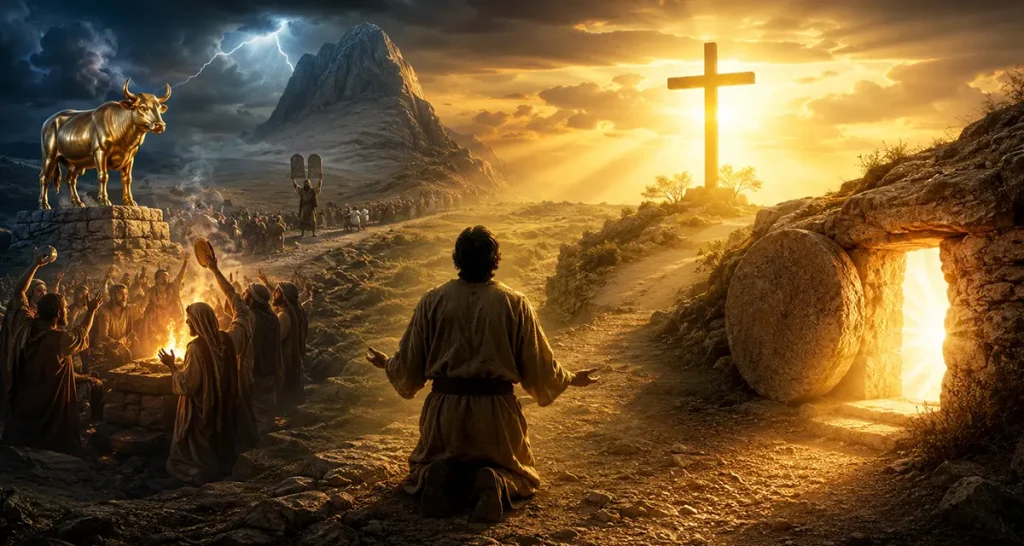
A pagan worshiping Baal in distant lands had never seen Sinai.
Israel had.
A pagan had never crossed the Red Sea.
Israel had.
A pagan had never eaten manna.
Israel had.
A pagan had never heard the covenant read aloud by Moses.
Israel had.
Therefore when Israel turned away, they were not merely acting in ignorance.
They were rejecting known truth.
This is why Amos says:
“You only have I known of all the families of the earth; therefore I will punish you for all your iniquities.”
— Amos 3:2
That verse sounds almost backwards.
We might expect:
“You only have I known, therefore I will excuse you.”
Instead God says:
“Therefore I will discipline you.”
Why?
Because covenant privilege brings covenant responsibility.
🌞 Light Does Not Change the Heart—It Reveals It
An interesting pattern appears throughout Scripture.
The same light that softens one heart hardens another.
Consider Pharaoh.
Each plague revealed more of God’s power.
Yet Pharaoh became increasingly hardened (Exodus 7–14).
Then consider Moses.
The same God who hardened Pharaoh’s resistance drew Moses into deeper worship.
The difference was not the light.
The difference was the response to the light.
This is why Jesus says:
“This is the condemnation, that the light has come into the world, and men loved darkness rather than light.”
— John 3:19
Light does not create darkness.
It exposes it.
⚖️ Why Israel Sometimes Appears Worse Than the Nations
This is one of the shocking themes of the prophets.
There are moments when God says Israel became worse than the pagans around them.
For example:
“You were more corrupt than they in all your ways.”
— Ezekiel 16:47
Why?
Not because Israel possessed a more evil nature than other nations.
But because Israel sinned against greater privilege.
Imagine two people rejecting a gift.
One has only heard rumors about the giver.
The other has lived in the giver’s house, eaten at his table, and experienced his kindness for years.
The outward action may look similar.
The relational meaning is very different.
💔 The Tragedy of Familiarity
There is another danger.
What is familiar can become common.
Israel grew accustomed to things that should have produced awe.
The cloud.
The tabernacle.
The sacrifices.
The covenant.
The promises.
Eventually many treated holy things as ordinary things.
The sons of Eli are a frightening example.
They ministered around sacred things daily and yet:
“The sons of Eli were corrupt; they did not know the LORD.”
— 1 Samuel 2:12
Think about that.
They worked in the tabernacle.
They handled sacrifices.
They knew the rituals.
Yet Scripture says they did not know the Lord.
Physical proximity is not the same as spiritual attachment.
🌿 But There Is Another Arithmetic
Here is where we must be careful not to stop at the terrifying side.
There is another equation running throughout Scripture.
The closer one comes to God in faith, the more one is transformed into His likeness.
Paul writes:
“But we all, with unveiled face, beholding as in a mirror the glory of the Lord, are being transformed into the same image.”
— 2 Corinthians 3:18
The same proximity that increases responsibility also increases transformation when accompanied by faith.
The sun that hardens clay melts wax.
The issue is not the sun.
The issue is what is being exposed to it.
👑 The Ultimate Arithmetic
Perhaps the deepest formula is this:
Privilege + unbelief = greater accountability.
Privilege + faith = greater conformity to Christ.
This is why Judas and John are such striking contrasts.
Both walked with Jesus.
Both heard the same sermons.
Both saw the same miracles.
Both sat at the same table.
One became the beloved disciple who leaned on Christ’s breast (John 13:23).
The other betrayed Him for thirty pieces of silver (Matthew 26:14-16).
The difference was not proximity.
It was what each did with the One to whom he was brought near.
🙏 A Final Thought
The terrifying thing is not that closeness to God makes people worse.
Closeness to God never corrupts.
Rather, closeness to God exposes what is truly there.
When faith responds, the result is life, joy, holiness, and transformation.
When unbelief responds, the result is hardening, because the person is now resisting clearer and clearer revelation.
That is why Israel’s history is both a warning and an invitation.
A warning because one can live among holy things and yet drift from God.
An invitation because the very God whose light exposes the heart is also the God who heals the heart.
As James writes:
“Draw near to God and He will draw near to you.”
— James 4:8
The answer to greater light is not retreat from the light. It is surrender to it. For the same presence that judges hypocrisy is the presence that transforms those who cling to Him in faith. ✨📖🙏