Opens in a new tab

Justice | Mercy | Faith

Justice | Mercy | Faith

🌊 God’s Sovereignty: Are We Pawns in the Story He Is Writing?

Difficulty Level: Intermediate-Advanced

🌊 God’s Sovereignty: Are We Pawns in the Story He Is Writing?

Faith & Doubt | God & His Attributes | Jesus Christ (Christology) | Suffering & God's Providence

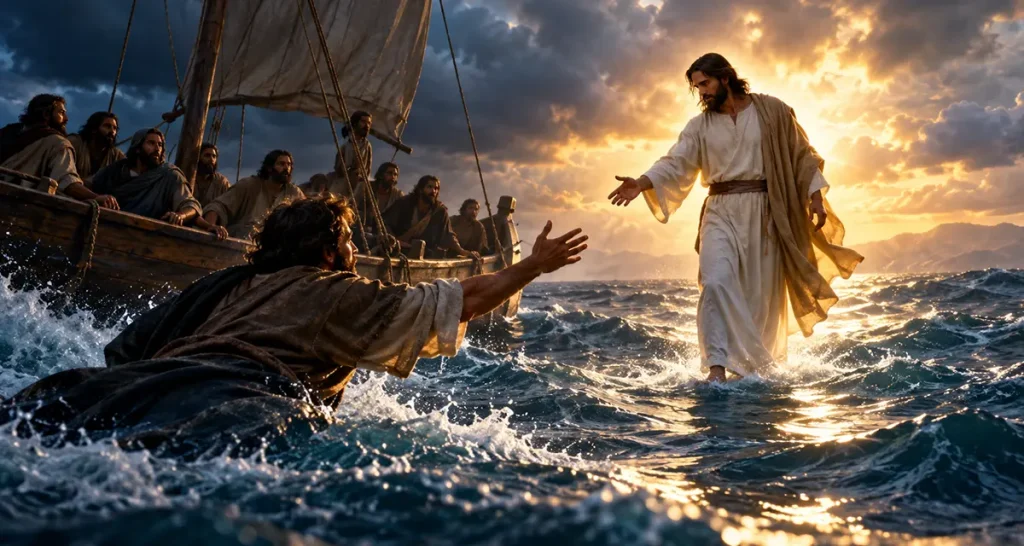
Why did Jesus walk on water? Unlike many of His miracles, which responded to immediate human needs, this extraordinary display of power might initially appear unnecessary, perhaps even an act of showing off divine authority. Yet the circumstances reveal something far more profound. Jesus deliberately sent His disciples across the sea, knowing they would encounter a contrary wind, struggle against the waves, and eventually need His help. Nothing took Him by surprise. He knew their circumstances, saw their distress, and remained sovereign over the entire event.

But this raises a difficult question about God’s sovereignty: If God knows the beginning and the end, directs our steps, and governs the unfolding story of humanity, are we merely pawns in a divine plan? Are our struggles, decisions, and experiences simply instruments serving purposes we cannot understand?

Scripture reveals a very different picture. God’s sovereignty does not diminish human dignity, eliminate responsibility, or turn His creatures into disposable pieces on a cosmic chessboard. The same Lord who governs creation also loves, teaches, guides, disciplines, rescues, and sustains those He has made. His providence is never separated from His character, and His authority is never divorced from His goodness.

From Jesus walking on the sea to the astonishing promises of adoption, inheritance, and eternal fellowship with God, this discussion explores the relationship between God’s sovereignty, human responsibility, divine providence, and personal love.

And perhaps the greatest surprise is this: If being a pawn means being known, loved, redeemed, cared for, and ultimately welcomed into the King’s eternal kingdom as His own child and heir, then what a blessed pawn that would be! πŸ™ƒ

But the truth is even greater. God does not merely move us through His story. In Christ, He graciously makes us participants in His purposes and heirs of His promises.

Why did the miracle of Jesus walking on water need to be performed and recorded in Scripture when it could appear to be an unnecessary display, perhaps even a flaunting of divine power?

🌊 Walking on Water: A Miracle That Seems Almost Unnecessary

Your question touches on something rather unusual about Jesus’ miracles. Most of them respond to an identifiable human need. Someone is blind, and Jesus restores sight. Someone is paralyzed, and Jesus enables him to walk. A crowd is hungry, and Jesus feeds them. Someone is dead, and Jesus calls him back to life.

But walking on water?

Nobody asked Jesus to do it. Nobody was waiting on the other side of the lake demanding proof of His identity. He could have remained on the mountain until morning, walked around the lake, or simply appeared at His destination. He had already demonstrated authority over nature by calming a storm (Mark 4:35–41).

Instead, He deliberately approaches His disciples by walking across the sea.

And what makes your question particularly interesting is that the miracle initially accomplishes the opposite of what we might expect from a reassuring demonstration of divine power.

It terrifies the disciples!

Matthew 14:26 records:

β€œAnd when the disciples saw Him walking on the sea, they were troubled, saying, β€˜It is a ghost!’ And they cried out for fear.”

If the purpose were merely to impress them, it was a rather peculiar way of doing so. πŸ˜‚

Yet when we examine the circumstances, especially the details Mark includes, something much deeper emerges.

πŸ”οΈ 1. The Miracle Begins With Jesus Alone on the Mountain

Matthew 14:22–23 tells us that Jesus made His disciples get into the boat and go ahead of Him while He dismissed the crowds.

Then He went up the mountain to pray.

This detail matters because the disciples were not wandering into trouble through disobedience. They were exactly where Jesus had instructed them to be.

Meanwhile, the wind became contrary, and the boat was battered by the waves.

Mark adds an extraordinary observation:

β€œThen He saw them straining at rowing, for the wind was against them.” (Mark 6:48)

Think about the situation.

Jesus is on land, the disciples are far out on the water, darkness has fallen, and the wind is working against them.

Yet Jesus sees them.

The narrative does not explain precisely how He sees them, whether naturally or supernaturally. But Mark wants us to know that their struggle was not hidden from Him.

And here is the first distinction between a display of power and a revelation of divine character.

Jesus does not walk on the sea because He needs to demonstrate that He can.

He walks on the sea in the context of coming to disciples who are struggling.

The miracle is not disconnected from their circumstances, even though they did not request it.

But there is something more puzzling.

πŸ‘£ 2. Why Did Jesus Intend to Pass Them By?

Mark 6:48 contains a detail that Matthew does not mention:

β€œAnd He would have passed them by.”

Now that is strange!

Jesus sees His disciples struggling against the wind, walks across the water toward them, and apparently intends to pass them.

What kind of rescue operation is that? 😳

There are two important possibilities to consider.

One is that Mark is simply describing Jesus’ apparent direction of travel. He was walking past the boat, and the disciples saw Him.

But there is another interpretation, one that connects this episode to the Old Testament.

In Exodus 33:18–23, Moses asks God to show him His glory. God responds by arranging for His glory to pass before Moses.

In 1 Kings 19:11, Elijah is told to stand on the mountain because the Lord is about to pass by.

In both passages, the language of passing by is associated with divine self-revelation.

Could Mark be deliberately using similar language?

Many interpreters believe so, particularly because walking upon the sea also recalls Old Testament descriptions of God’s unique authority over creation.

Consider Job 9:8:

β€œHe alone spreads out the heavens, And treads on the waves of the sea.”

Notice the subject.

God alone.

Job is not describing a prophet receiving miraculous assistance. He is describing the Creator exercising authority over the creation He made.

Psalm 77:19 offers another striking parallel:

β€œYour way was in the sea, Your path in the great waters, And Your footsteps were not known.”

The sea, which humans cannot command and cannot cross on foot, is no obstacle to God.

Now consider what the disciples are witnessing.

They are not merely seeing a man perform an extraordinary physical feat.

They are seeing Jesus do something Scripture associates with the Lord Himself.

If Mark’s wording intentionally evokes those Old Testament appearances, then Jesus passing by is not a theatrical gesture. It is a revelation of His identity.

There is a difference between showing off power and making oneself known.

And that distinction changes how we understand the entire miracle.

✨ 3. Jesus Does Not Announce His Power. He Announces Himself.

When the disciples cry out in fear, Jesus immediately speaks.

Matthew 14:27 records:

β€œBe of good cheer! It is I; do not be afraid.”

The Greek expression translated “It is I” is egō eimi, literally “I am.”

We should be careful here. In ordinary Greek, the expression can simply mean “It is me.” It does not automatically constitute an explicit declaration of the divine name in every context.

Nevertheless, given the extraordinary setting and the Old Testament background, the words may carry a deeper resonance.

Jesus does not say, “Look at what I can do!”

He says, in effect, “It is Me. Do not be afraid.”

The disciples’ security is connected not simply to His ability to overcome the sea but to His presence.

And this is particularly important because the wind has not necessarily stopped when Jesus first speaks.

His assurance precedes the calming of their circumstances.

There is something wonderfully consistent about Jesus here. His disciples are frightened by the very One who has come to them, because they do not yet recognize Him.

Their interpretation of what they see is wrong, even though their observation is correct.

They really do see someone walking on the sea.

But they conclude that it is a ghost.

They have the evidence before their eyes, yet they misunderstand its meaning.

Which brings us to Peter.

🚢 4. Peter Reveals That the Miracle Is Not About Spectacle

Matthew alone records Peter’s remarkable request:

β€œLord, if it is You, command me to come to You on the water.” (Matthew 14:28)

And Jesus answers with one word:

β€œCome.” (Matthew 14:29)

Now consider the implications.

If Jesus were merely displaying His extraordinary abilities, Peter’s participation would seem unnecessary.

But Jesus allows Peter to experience something that belongs entirely outside normal human capacity.

Peter walks on the water.

Not because Peter has acquired divine power or developed some previously undiscovered human ability, but because Jesus has called him.

The command precedes the action.

And Peter’s ability to walk on the water is dependent upon the authority of the One who commanded him.

This is where the miracle becomes particularly revealing.

The same sea that supports Peter while he walks toward Jesus becomes the place where Peter begins to sink when fear overwhelms him.

Matthew 14:30–31 says:

β€œBut when he saw that the wind was boisterous, he was afraid; and beginning to sink he cried out, saying, β€˜Lord, save me!’ And immediately Jesus stretched out His hand and caught him.”

Jesus does not need to calm the sea before rescuing Peter.

He simply reaches out His hand.

That is a remarkable picture of His authority.

The water remains water. Peter remains human. The wind remains dangerous. Yet none of these circumstances prevents Jesus from accomplishing His purpose.

We should not conclude that Peter sank because faith operates like a supernatural force that mechanically keeps someone afloat. The miracle depends on Jesus, not on Peter generating sufficient confidence.

Peter’s fear exposes his weakness, but Jesus’ response reveals His faithfulness.

And notice that Jesus does not leave Peter in the water to teach him a lesson about insufficient faith.

He rescues him first and corrects him afterward.

There is no unnecessary cruelty in His instruction.

πŸ“– 5. Mark Tells Us Why the Miracle Was Necessary

Here we arrive at what I consider the most revealing detail in the entire account.

Mark 6:51–52 says:

β€œThen He went up into the boat to them, and the wind ceased. And they were greatly amazed in themselves beyond measure, and marveled. For they had not understood about the loaves, because their heart was hardened.”

Wait a moment.

What do the loaves have to do with walking on water?

Everything, apparently!

Mark deliberately connects the two miracles.

Earlier, Jesus had fed five thousand men, besides women and children, with five loaves and two fish.

The disciples had personally participated in distributing the food. They had seen the multiplication and collected the leftovers.

Yet Mark tells us that they had not understood what the miracle revealed.

They had witnessed the power without fully recognizing the Person.

And that is precisely the problem.

The feeding of the multitude revealed Jesus’ extraordinary provision. Walking on the sea revealed His authority over the natural order in another way.

The two miracles belong together because both disclose something about who Jesus is.

Consider the Old Testament background.

God fed Israel with manna in the wilderness (Exodus 16).

God made a way through the sea (Exodus 14).

God rules the waters and provides bread for His people.

Now Jesus feeds the multitude in a deserted place and walks upon the sea.

The parallels do not require us to assume that the disciples immediately understood every theological implication. Mark explicitly tells us they did not.

But the Gospel invites its readers to recognize what the disciples were still struggling to comprehend.

The One who provided bread in the wilderness and the One who rules the waters is revealing Himself in Jesus.

The miracle is therefore not an isolated demonstration of supernatural ability. It belongs to the unfolding revelation of Christ’s identity.

❀️ 6. Why Would God Reveal Himself in Such an Extraordinary Way?

This returns us to your original concern about flaunting power.

There is a genuine moral distinction between using power to attract admiration and revealing power so that others may know the truth.

Jesus Himself makes that distinction elsewhere.

When Satan tempts Him to throw Himself from the pinnacle of the temple, Jesus refuses (Matthew 4:5–7).

He will not create an artificial crisis merely to demonstrate that God can protect Him.

That would be presumption, not faith.

And when Herod hopes to see Jesus perform a miracle, Jesus refuses to satisfy his curiosity (Luke 23:8–9).

Jesus is not an entertainer.

He does not perform miracles simply because someone wants to see something spectacular.

Indeed, John 6:15 tells us that after the feeding miracle, Jesus withdrew because the crowd intended to take Him by force and make Him king.

He actively avoids the kind of public attention that might turn His miracles into instruments of political popularity.

So why walk on water?

Because the context is entirely different.

He is not responding to a challenge from Satan, satisfying Herod’s curiosity, or seeking the admiration of a crowd.

He is approaching His own disciples, whose understanding of His identity remains incomplete.

And the outcome is significant.

Matthew 14:33 records:

β€œThen those who were in the boat came and worshiped Him, saying, β€˜Truly You are the Son of God.’”

That is the climax of Matthew’s account.

Not the walking.

Not the wind.

Not even Peter’s rescue.

The recognition of Jesus.

Of course, we should distinguish the Gospel’s theological presentation from what the disciples fully understood at that precise moment. Their confession was genuine, but their understanding of Jesus’ identity would continue to deepen, especially through His death and resurrection.

Still, Matthew clearly presents worship and confession as the culmination of the event.

πŸŒ… 7. An Unnecessary Miracle, or a Necessary Revelation?

There is one final distinction worth considering.

Jesus did not need to walk on water in order to reach the disciples. His divine power was not constrained by geography, transportation, or the weather.

Nor should we claim that He was obligated to perform this particular miracle to establish His identity. God was free to reveal Himself in whatever manner He chose.

In that sense, the miracle was not necessary.

But once we recognize its revelatory purpose, it ceases to appear arbitrary.

The disciples needed to understand more than the fact that Jesus could provide food, heal disease, and calm storms.

They needed to understand who was standing before them.

And that knowledge would become especially important when they eventually saw Him arrested, humiliated, and crucified.

The One who walked upon the sea would later allow Himself to be bound by soldiers.

The One whom the wind obeyed would remain silent before His accusers.

The One who could rescue Peter from drowning would not rescue Himself from the cross.

Not because His power had diminished, but because His mission required willing obedience to the Father (John 10:17–18; Philippians 2:6–8).

That contrast is extraordinary.

The miracles establish that Jesus’ suffering cannot simply be explained by helplessness.

He possesses authority, yet He willingly submits to suffering.

And perhaps that is why your question about flaunting power deserves serious attention.

A person who flaunts power wants others to recognize his superiority. Jesus reveals His authority so that others may recognize who He is, trust Him, and understand the salvation He came to accomplish.

There is also a beautiful contrast between the beginning and the end of this particular episode.

At first, the disciples see Jesus walking on the sea and cry out in terror.

At the end, they are worshiping Him.

The same Person. The same divine authority.

But their understanding has changed.

And perhaps that is one of the most important reasons the event needed to be recorded: not because Jesus needed to prove that He could walk where human beings cannot, but because the disciples, and eventually the readers of the Gospel, needed to discover who was walking toward them.

Jesus deliberately sent His disciples across the sea to a place where He knew they would encounter trouble, struggle against the wind, and eventually need His help. Nothing came as a surprise to Him. He was writing the story, and everything, including the sea, the wind, the boat, and His disciples, was under His control and within His reach.

🌊 Jesus Sent Them Into the Storm, Not Away From His Care

And that makes the whole episode even more remarkable. Jesus was not responding to an unforeseen emergency. He deliberately sent His disciples into a situation where they would encounter difficulty, while He remained physically separated from them.

Matthew 14:22 is quite emphatic:

β€œImmediately Jesus made His disciples get into the boat and go before Him to the other side, while He sent the multitudes away.”

Notice that Matthew does not merely say Jesus permitted them to leave. He made them get into the boat.

They were obeying Him.

And their obedience placed them directly in the path of a contrary wind.

Now, Scripture does not explicitly say that Jesus sent them out for the purpose of encountering the storm. That is an inference. But given what the Gospels reveal about His knowledge, authority, and intentions, it is reasonable to understand the event as occurring within His deliberate providential care.

And this raises a fascinating distinction: Jesus did not have to prevent the storm to demonstrate that He was in control of it.

He could have arranged a perfectly calm crossing. He could have accompanied them from the beginning. He could have stopped the wind while remaining on the mountain.

Instead, He allowed them to struggle.

Why?

πŸ‘€ He Was Absent From Their Sight, but They Were Never Outside His Sight

Mark 6:48 says:

β€œThen He saw them straining at rowing, for the wind was against them.”

I find this detail particularly moving in light of your observation.

From the disciples’ perspective, Jesus was absent. They were alone in the boat, struggling against forces beyond their control.

From Jesus’ perspective, they were never lost, forgotten, or beyond His reach.

And there is something important about the timing.

Jesus did not immediately come to them when the wind began resisting their progress. Mark places His approach around the fourth watch of the night, approximately between 3 and 6 in the morning.

They had been struggling for some time.

The text does not explain why Jesus waited, and we should be careful not to invent a specific reason. Nevertheless, the delay itself teaches us something about the difference between divine care and immediate deliverance.

Being under God’s care does not mean being spared every struggle. Nor does a delay in deliverance mean that God has lost control.

This connects beautifully with the providence we have been discussing in Proverbs 16:9:

β€œA man’s heart plans his way, But the LORD directs his steps.”

The disciples had a destination, and Jesus Himself had given them that destination.

But they did not control the journey.

They could row. They could navigate. They could exercise every skill they possessed as fishermen. Yet they could not command the wind.

Their responsibility was real, but their sovereignty was nonexistent.

And Jesus was sovereign over both their destination and the circumstances through which they would reach it.

πŸ•ŠοΈ The One Who Wrote the Story Entered the Story

Your expression, “He is writing the story,” brings us to something even deeper.

Jesus is not merely observing the unfolding circumstances from a privileged position.

He is personally involved in them.

He sends the disciples, withdraws to pray, sees their struggle, comes toward them, speaks to their fear, rescues Peter, and enters the boat.

What an extraordinary combination of sovereignty and personal involvement!

He could have exercised His authority from a distance. We know that from other miracles, such as the healing of the centurion’s servant (Matthew 8:5–13).

But here He comes to them.

And notice that He does not remove the disciples from the sea. He joins them in the boat, and the wind ceases (Matthew 14:32).

That detail does not establish a universal pattern for how God will intervene in every trial. But it reveals something about Jesus’ character: His sovereign authority is not detached from those He loves.

The Creator who commands the elements is also the Teacher who reaches out His hand to a frightened disciple.

πŸ€” But Does Knowing the Outcome Make the Struggle Unnecessary?

Here is where your observation introduces a profound theological tension.

If Jesus knew what would happen, knew the disciples would struggle, knew Peter would sink, and knew He would rescue him, why allow any of it?

We could ask the same question about many events in Scripture.

Jesus knew Lazarus was sick, yet He delayed going to Bethany (John 11:5–6). His delay was not indifference. John specifically places Jesus’ love for Martha, Mary, and Lazarus immediately before describing that delay.

And Jesus eventually explains that the circumstances would serve the glory of God and strengthen the disciples’ faith (John 11:4, 15).

The disciples in the boat were also learning something that could not be reduced to an intellectual lesson.

They already knew Jesus could perform miracles.

But now they were personally experiencing their dependence upon Him in circumstances where their own abilities were insufficient.

Peter could never have discovered what it meant to be rescued from sinking while remaining comfortably seated in the boat.

Yet we must avoid turning this into the claim that suffering is always necessary for learning or that God deliberately causes every hardship to teach a lesson. Scripture gives us no permission to make such sweeping conclusions.

What we can say about this particular event is that Jesus used their difficulty to reveal Himself more fully.

And that revelation was worth recording.

✨ Nothing Was Beyond His Reach

There is one more thought in your observation that deserves attention: “All was under His control and within reach.”

We often imagine divine control primarily as the ability to stop something from happening.

But Scripture presents a much richer understanding of God’s providence.

His sovereignty includes His ability to permit events, govern their boundaries, sustain His creatures through them, and accomplish His purposes without surrendering His authority.

In the boat, the disciples encountered a wind they could not control.

Jesus encountered the same wind, but it presented no obstacle to Him.

The sea that threatened their progress became the very path by which He approached them.

Think about that.

What stood between the disciples and their destination did not stand between Jesus and His disciples.

The obstacle was real for them. It was not an obstacle for Him.

And this is where I would refine your statement slightly. Jesus is indeed the sovereign Lord of the story, but His sovereignty does not make the disciples’ struggle imaginary or their actions meaningless. Their rowing was real. Their exhaustion was real. Their fear was real. Peter’s sinking was real.

The Author’s knowledge of the story did not eliminate the reality of what His disciples experienced within it.

In fact, their genuine experience was part of what made His revelation meaningful.

And perhaps the most striking thing is that Jesus did not rebuke the disciples for being in the storm. He had sent them there.

He addressed their fear and their incomplete understanding of Him.

That distinction matters enormously.

Sometimes we assume that difficult circumstances indicate that we have wandered away from God’s will.

But here the disciples were precisely where Jesus had told them to go.

The contrary wind was not evidence that they had taken the wrong direction.

And the Lord who sent them across the sea was neither surprised by the wind nor prevented by it from reaching them.

He did not need to supervise the storm anxiously, wondering whether His plan would survive the night.

He held the sea, the boat, the wind, and His disciples within His authority.

And when He came to them, He did not announce a complicated explanation of providence.

He simply said, “It is I; do not be afraid.”

The assurance was not that the sea had become harmless.

It was that He was there.

But for some, this understanding of God’s sovereignty and providence could make us appear to be mere pawns in a story He is writing. Yet that is not the Jesus, not God. How, then, do we reconcile God’s absolute sovereignty over the unfolding story with the genuine agency, dignity, and significance of those who participate in it?

β™ŸοΈ Are We Participants in God’s Story, or Pawns on His Chessboard?

That is precisely the tension we must confront when we say that God is writing the story. Because if we are not careful, a beautiful affirmation of divine providence can become a rather disturbing picture of God.

Imagine the disciples struggling against the wind while Jesus, knowing exactly what would happen, watches from the mountain. If we describe the event carelessly, it can sound as though He deliberately arranged their distress to create an opportunity for a spectacular entrance.

And that would make the disciples little more than props in His demonstration of power.

But as you said, that is not Jesus, and that is not God.

The difficulty is that we cannot resolve the tension simply by denying that Jesus knew what would happen or that He possessed authority over the circumstances. Scripture will not allow us to do that either.

We need to distinguish between God governing a story and God treating the people within it as instruments without dignity, agency, or significance.

Those are profoundly different things.

❀️ 1. God’s Sovereignty Is Not Separated From His Character

Here is where I believe we must begin.

When we speak about divine sovereignty, we sometimes treat it as an abstract attribute: God can do whatever He wants because He possesses unlimited power.

That statement, although it recognizes His authority, is incomplete.

God’s sovereignty is never exercised independently of His holiness, righteousness, wisdom, goodness, and love.

He does not become loving on some occasions and sovereign on others. He is always both.

Psalm 145:17 declares:

β€œThe LORD is righteous in all His ways, Gracious in all His works.”

Notice the comprehensive language: all His ways and all His works.

Therefore, whatever we understand about God’s providential government must remain consistent with His character.

And Jesus gives us the clearest revelation of that character.

In John 14:9, He tells Philip:

β€œHe who has seen Me has seen the Father.”

That means we cannot imagine a cold, calculating sovereign behind the compassionate Jesus revealed in the Gospels.

The Father is not manipulating human beings while the Son tries to protect them from His decisions.

Jesus reveals the Father’s character, not an exception to it.

So when we return to the disciples struggling on the sea, we must understand Jesus’ authority through the character He consistently demonstrates.

The same Jesus who sends them into the boat is the One who sees their distress, comes to them, and immediately reaches out to save Peter.

His sovereignty and compassion are not competing motivations.

They belong to the same Person.

πŸ‘€ 2. A Pawn Has No Personal Significance. A Human Being Does.

A pawn on a chessboard has no intrinsic worth. Its significance comes entirely from its usefulness to the player.

It can be sacrificed without moral concern because it has no life, dignity, will, or personal relationship with the one moving it.

But human beings are not created that way.

Genesis 1:26–27 tells us that humanity was created in God’s image.

That distinction is foundational.

God did not create human beings merely as disposable instruments for accomplishing His purposes. He created persons capable of knowing Him, loving Him, responding to Him, and exercising meaningful responsibility within His creation.

And their dignity does not disappear when they become involved in His providential purposes.

Consider Abraham.

God promises him a son, but Abraham must live through years of waiting, uncertainty, and difficult decisions.

Abraham is not merely an object being transported toward a predetermined outcome.

He believes, questions, obeys, sometimes fails, intercedes for others, and grows in his understanding of God.

Genesis 18:17 is particularly revealing:

β€œAnd the LORD said, β€˜Shall I hide from Abraham what I am doing?’”

What an extraordinary question!

God owes Abraham no explanation in the sense of being accountable to him as an equal.

Yet God chooses to disclose His intentions and involves Abraham in a conversation about justice.

Abraham then intercedes concerning Sodom.

God permits him to speak, reason, and appeal to divine righteousness.

This is hardly the relationship of a chess player to a pawn.

It is the relationship of the Creator with a creature whom He has dignified with genuine moral agency and communion.

And the distinction becomes even more remarkable in Jesus.

He does not merely command His disciples.

He teaches them, answers their questions, corrects their misunderstandings, shares His purposes with them, and eventually calls them friends.

John 15:15:

β€œNo longer do I call you servants, for a servant does not know what his master is doing; but I have called you friends, for all things that I heard from My Father I have made known to you.”

Now consider that statement in relation to your concern.

The sovereign Lord deliberately shares His purposes with those who belong to Him.

He does not abolish their dependence. He deepens their relationship.

🧭 3. God’s Certain Purpose Does Not Make Human Actions Meaningless

This is perhaps the most difficult part of the discussion.

If God already knows the outcome, and His purposes cannot ultimately fail, in what sense are our decisions genuinely meaningful?

We have encountered this question before in Proverbs 16:9.

β€œA man’s heart plans his way, But the LORD directs his steps.”

The proverb does not say that the human heart merely imagines it is planning.

The planning is real.

Nor does it say that God simply watches human decisions unfold and then adjusts His plans accordingly.

His direction is real.

Both statements stand together.

And Scripture repeatedly refuses to sacrifice one truth to preserve the other.

Consider Joseph.

Genesis 50:20:

β€œBut as for you, you meant evil against me; but God meant it for good, in order to bring it about as it is this day, to save many people alive.”

Notice that Joseph does not say his brothers only appeared to intend evil.

They genuinely intended it.

Their jealousy, betrayal, and cruelty were their own.

Yet God was accomplishing a good purpose through the same history.

The brothers were not innocent because God governed the outcome.

And Joseph was not merely a pawn because God intended to preserve lives through him.

His suffering mattered. His decisions mattered. His integrity mattered. His forgiveness mattered.

There is a particularly important distinction here:

God’s ability to accomplish His purposes through human actions does not mean He morally approves of every action He governs.

The brothers’ evil remained evil.

God’s purpose remained good.

The same event could involve different intentions without those intentions becoming morally equivalent.

Of course, this does not explain the entire mechanism by which divine sovereignty and human agency coexist.

Christian theological traditions differ over precisely how God’s decree, foreknowledge, permission, and human freedom relate.

But Scripture gives us strong grounds for affirming both divine providence and genuine human responsibility, even when the philosophical reconciliation remains difficult.

🌊 4. Return to the Boat: Jesus Does Not Treat His Disciples as Puppets

Now let us apply these distinctions to the miracle.

Jesus commands the disciples to cross the sea.

They obey.

The wind opposes them.

They row.

Jesus sees them.

He comes.

They become afraid.

He speaks.

Peter asks permission to come to Him.

Jesus answers.

Peter steps out of the boat.

He becomes afraid and begins to sink.

He cries for help.

Jesus rescues him.

Look at the number of genuine human actions within that sequence!

Jesus does not simply move His disciples from one location to another as though they were pieces on a board.

He engages them as persons.

Peter’s request is especially significant.

Jesus did not initially command Peter to leave the boat. Peter proposed it.

Jesus responded to Peter’s request with an invitation.

And Peter acted.

Whatever we conclude about the relationship between divine foreknowledge and human freedom, Matthew portrays a genuine interaction between Jesus and Peter.

There is command, response, trust, fear, failure, rescue, and correction.

This is a relationship, not a mechanical process.

But there is something else.

Jesus does not need Peter to succeed in walking on the water for His own authority to remain intact.

Peter’s failure does not threaten Jesus’ sovereignty.

Nor does Jesus discard Peter when he fails.

He catches him.

A chess player might sacrifice a pawn to win the game.

Jesus does not sacrifice Peter to preserve His plan. He exercises His power to preserve Peter.

That is a very different picture of sovereignty.

✝️ 5. At the Cross, the Sovereign Lord Gives Himself

And here, I think, we encounter the deepest answer to your concern.

What happens when God’s providential purpose involves the greatest suffering in human history?

The crucifixion.

Acts 2:23 describes Jesus as:

β€œHim, being delivered by the determined purpose and foreknowledge of God, you have taken by lawless hands, have crucified, and put to death.”

There it is again.

Divine purpose and human responsibility in the same sentence.

God’s purpose is certain.

The actions of those who crucified Jesus are genuinely wicked.

But something makes this event unlike any ordinary illustration of a sovereign ruler using his subjects to accomplish an objective.

The One who possesses divine sovereignty is Himself the One who bears the suffering.

In the incarnation, the eternal Son becomes human.

He does not remain safely outside the human condition while demanding that His creatures bear all the costs of His purposes.

He enters our condition, experiences hunger, exhaustion, rejection, betrayal, anguish, and death.

And He does so willingly.

John 10:18:

β€œNo one takes it from Me, but I lay it down of Myself. I have power to lay it down, and I have power to take it again.”

This does not remove every question about why God permits suffering.

Nor does it mean that every instance of suffering is directly analogous to the cross.

But it decisively challenges the image of God as a detached chess player who treats human lives as expendable pieces.

At Calvary, the sovereign Lord is not merely directing history toward redemption.

He is personally accomplishing redemption at His own cost.

That changes the moral picture profoundly.

🌱 6. But Does God Ever Use People for His Purposes?

We should not evade this question either.

Yes, God uses people to accomplish His purposes.

Scripture is quite explicit about that.

He raises up Moses to deliver Israel, calls Jeremiah as a prophet, appoints Paul as an apostle, and works through countless individuals whose names are never recorded.

But there is a distinction between using someone and using someone up.

We sometimes hear the expression “God uses people” and unconsciously import the meaning of human exploitation into it.

When humans exploit others, they reduce persons to instruments of their own advantage.

God has no such need.

Acts 17:25 declares:

β€œNor is He worshiped with men’s hands, as though He needed anything, since He gives to all life, breath, and all things.”

That is crucial.

God does not need human beings to supply something He lacks.

His purposes do not arise from deficiency.

He is not dependent upon us for power, knowledge, satisfaction, or completion.

Therefore, when God calls someone into His purposes, He is not exploiting a resource necessary for His own survival or advancement.

He is granting a creature the extraordinary dignity of participating in what He is accomplishing.

Ephesians 2:10 describes believers as God’s workmanship, created in Christ Jesus for good works.

The works are prepared by God, yet believers genuinely walk in them.

God’s preparation does not erase human participation.

It establishes its place within His purposes.

And this leads to an important distinction between God’s ultimate purpose and our experience of participating in it.

God may know the whole story.

We do not.

But our limited knowledge does not make our choices meaningless.

Nor does God’s unlimited knowledge make us insignificant.

πŸ•ŠοΈ 7. Providence Is Not the Opposite of Personal Care

There is one final difficulty that I do not think we should dismiss too quickly.

What about people whose lives seem to consist of suffering without an obvious rescue?

The disciples were eventually delivered from the storm.

Peter was caught before he drowned.

But other faithful servants of God experienced imprisonment, persecution, deprivation, and death.

Hebrews 11 deliberately places miraculous deliverances alongside believers who suffered terribly without receiving deliverance in this life.

We cannot therefore make the walking-on-water episode into a universal promise that Jesus will always intervene before circumstances become unbearable.

That would be inconsistent with Scripture and cruel to those whose experiences are very different.

The deeper assurance is not that every earthly story will have the ending we desire.

It is that God’s final purposes are not defeated by the suffering of His people.

Romans 8:28 speaks of God working all things together for good for those who love Him and are called according to His purpose.

But Paul goes on to define that good in relation to conformity to Christ (Romans 8:29), and later acknowledges tribulation, distress, persecution, famine, nakedness, peril, and sword (Romans 8:35).

Providence does not mean that those things are unreal.

It means they cannot ultimately separate God’s people from His love in Christ.

And here is where the pawn analogy finally breaks down.

A pawn has no relationship with the player.

Its value is exhausted by its contribution to the game.

But in Scripture, the relationship between God and His people is itself part of the purpose.

God is not merely moving us toward an outcome.

He is bringing His people into communion with Himself.

Jesus’ prayer in John 17:24 makes that astonishingly clear:

β€œFather, I desire that they also whom You gave Me may be with Me where I am, that they may behold My glory which You have given Me.”

What does Jesus desire?

Not merely that His followers perform their assigned tasks successfully.

He desires that they be with Him.

That they behold His glory.

That they share in the life and love He reveals.

The goal is not simply the completion of a divine project.

It includes the people themselves.

And that returns us to the boat.

Jesus did not merely send the disciples across the sea to accomplish a logistical objective.

He was forming people who would know Him, trust Him, and eventually bear witness to Him.

Their experience mattered because they mattered to Him.

Perhaps we should therefore be cautious with the expression “God is writing the story.” It is true as an affirmation of His sovereign providence, but it can mislead if we imagine that created persons are merely fictional characters without genuine agency.

God is not an author who needs to invent characters to entertain Himself. He is the Creator who gives real existence, dignity, responsibility, and relationships to those He has made.

He knows the end from the beginning, yet He genuinely engages His creatures within history.

And the remarkable thing about Jesus walking on the sea is not simply that He controlled the circumstances.

It is that the One who controlled the circumstances cared personally for those experiencing them.

He did not regard their fear as insignificant merely because He knew the outcome.

He came to them.

That is sovereignty expressed through love, not sovereignty competing with love.

But if being a pawn means being taught by God, receiving His grace, being loved, guided, watched over, cared for, disciplined, rescued, saved, and raised by Him; if it means participating in the greatest story ever written, being adopted as His child, becoming an heir with Christ, and receiving the promise of dwelling with God for all eternity, then what a blessed pawn that one is! πŸ™ƒ

β™ŸοΈ The Most Blessed Pawn in History! πŸ™ƒ

Well, when you put it that way, I suspect the other pieces on the chessboard would be demanding the same treatment! πŸ˜‚

And you’ve turned the analogy on its head beautifully.

A pawn ordinarily exists for the benefit of the player. But in your description, the Player is the One who gives the pawn life, sustains it, teaches it, protects it, corrects it, rescues it, and promises it an inheritance beyond anything it could have imagined.

And here is the astonishing part: the King does not merely sacrifice pieces to secure His victory. He sacrifices Himself to secure their redemption.

Romans 8:32 captures that extraordinary generosity:

β€œHe who did not spare His own Son, but delivered Him up for us all, how shall He not with Him also freely give us all things?”

Yet I think there is an even more remarkable transformation hidden in your playful description.

πŸ‘‘ The Pawn Becomes an Heir

A pawn never becomes the chess player’s child. It never receives an inheritance. It never sits at the table with the king.

But Scripture describes precisely that kind of elevation for those who belong to Christ.

Romans 8:16–17:

β€œThe Spirit Himself bears witness with our spirit that we are children of God, and if children, then heirsβ€”heirs of God and joint heirs with Christ, if indeed we suffer with Him, that we may also be glorified together.”

Notice the progression.

We are not merely preserved for God’s purposes. We are adopted into His family.

We are not merely permitted to serve. We are promised an inheritance.

And we are not merely spectators of Christ’s glory. We are promised participation in His glorification, without ever ceasing to be creatures dependent upon Him.

Even the discipline you mentioned belongs to this relationship.

Hebrews 12:6 says:

β€œFor whom the LORD loves He chastens, And scourges every son whom He receives.”

A chess player does not discipline a pawn because he loves it. He simply moves it or removes it.

But a father disciplines his child because the child’s character and future matter.

And then comes the promise that almost overwhelms the analogy.

Revelation 22:3–5 describes God’s servants dwelling in His presence, seeing His face, and reigning forever and ever.

The ones who were entirely dependent upon the King are invited to reign with Him!

Not as independent sovereigns, of course, but as redeemed participants in His eternal kingdom.

❀️ And the King Knows Every One of Them

There is something else in your description that deserves attention.

You mentioned being watched, guided, cared for, and saved.

Jesus says in John 10:27–28:

β€œMy sheep hear My voice, and I know them, and they follow Me. And I give them eternal life, and they shall never perish; neither shall anyone snatch them out of My hand.”

That is far more personal than any chess analogy can accommodate.

The King knows His own.

And their security rests ultimately not in their ability to anticipate His next move, but in His faithfulness to them.

Which brings us back to the disciples on the sea.

They did not know what Jesus was doing on the mountain. They did not know when He would come. They did not know how the night would end.

But He knew where they were.

He saw them struggling.

And He came.

The difference between their knowledge and His was enormous. The difference between their power and His was immeasurable.

Yet that inequality did not make the relationship exploitative.

It made His care all the more extraordinary.

And perhaps that is the delightful irony of your observation: if being a pawn means belonging to a King who loves me, redeems me at His own cost, makes me His child, and promises me eternal fellowship with Him, then the problem is no longer being a pawn. The problem is that the word “pawn” has become far too small to describe what I have been given. πŸ™Œ

As Paul writes in 1 Corinthians 3:22–23:

β€œAll are yours. And you are Christ’s, and Christ is God’s.”

What an astonishing reversal.

We begin by worrying that we are merely pieces belonging to God.

And discover that, in Christ, God has graciously made us heirs of an inheritance beyond our comprehension.

The King does not need His pawns. But He loves His children.

And He has determined to bring them home.