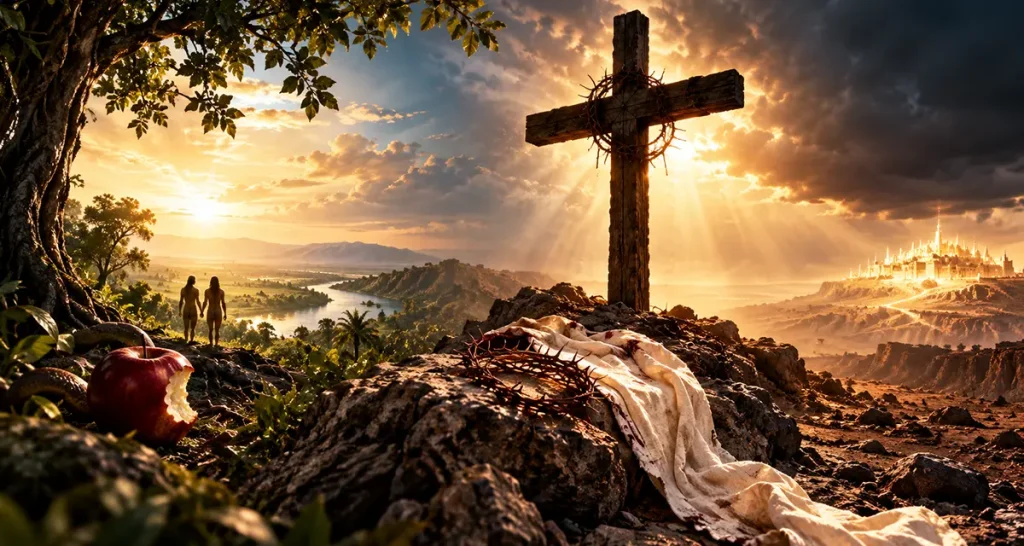
Opens in a new tab

Justice | Mercy | Faith

Justice | Mercy | Faith

God’s Redemption: Could He Have Saved Humanity Without the Cross?

Difficulty Level: Intermediate-Advanced

Jump to Answers

  1. In Hebrews 10:12, we read: “But this Man, after He had offered one sacrifice for sins forever, sat down at the right hand of God.” It is remarkable that the author emphasizes “this Man” rather than His divine identity when speaking of the sacrifice through which redemption was accomplished. The distinction seems especially significant considering that the One who offered Himself is none other than the eternal Son of God.
  2. Scripture leaves no room for doubt that humanity’s redemption could only originate from God and be accomplished by Him. Yet Hebrews emphasizes the humanity of Christ in His sacrificial work. So who actually redeemed humanity: God or Man?
  3. You stated that “God, in His divine nature, cannot die.” But why, ontologically, would God be unable to die and raise Himself again if He is omnipotent in the fullest sense of everything that word means when applied to Him? Wouldn’t such an inability appear to place a limitation upon His all-powerful nature?
  4. By the same reasoning, angels cannot die, since the capacity for death was not built into their created nature. This suggests that death is not a universal condition of existence but something specific to the nature and design God assigned to His creatures. 
  5. Earlier, when discussing the reversal of Adam’s disobedience, you said that accomplishing it through another act of divine power “would certainly have been within God’s power.” But there seems to be a contradiction in that reasoning. Having the power to do something does not necessarily mean that it ought to be done, even when speaking of God’s omnipotence. More importantly, if an action would contradict God’s own nature, then it is not genuinely possible for Him, regardless of how we imagine His power. God cannot deny Himself. Perhaps I am philosophizing too much.
  6. Following this discussion, I am beginning to question whether “immortal” is even the most appropriate way to describe God, except when we use the term from the perspective of our own derived and dependent existence. Immortality is meaningful in relation to mortality, death, and the possibility of life’s ending. But these are categories belonging to created existence, particularly in light of the death introduced into humanity through Adam’s fall. From everlasting to everlasting, God is not merely immortal; He is. God is life. I understand why Scripture and theology use the language of immortality in reference to Him, but it seems that, in its essential meaning, this vocabulary belongs exclusively to creatures rather than to the One from whom all life originates.
  7. God is not a magician. But couldn’t He have genuinely erased Adam’s transgression by recreating everything anew? I recognize that such an alternative may not be consistent with His revealed character and purposes, but I am considering it for the sake of theological discussion and a deeper understanding of God’s power, righteousness, and freedom. ☺️
  8. One thing seems certain to me: I likely would never have come to know the Savior I know today if God had simply recreated everything from the beginning without the cross. Whatever other possibilities we might imagine, Scripture reveals the way God actually chose to accomplish our redemption.  I trust that His choice was the best; He gave His only Son to die for me. 

God’s Redemption: Could He Have Saved Humanity Without the Cross?

God & His Attributes | Jesus Christ (Christology) | Salvation (Soteriology)

The redemption of humanity through Jesus Christ stands at the center of the Christian faith. Yet the familiar declaration that Christ died for our sins invites questions that reach far beyond the necessity of forgiveness. Who actually redeemed humanity: God or Man? Why did the eternal Son assume a human nature capable of suffering and death? And if God is omnipotent, could He have reversed Adam’s disobedience by simply recreating everything anew?

These questions lead us into a deeper examination of God’s nature, His immortality, His righteousness, and the relationship between divine power and divine will. If God cannot deny Himself, then His omnipotence cannot be understood as the ability to act contrary to His own character. But does that mean the cross was the only possible means of redemption? Or are we attempting to explore possibilities that Scripture has not revealed?

As the conversation develops, another distinction emerges: God is not merely an immortal being whose life cannot end. He is the source of life itself. Created beings receive and depend upon life, while God exists eternally and independently of His creation. Yet this same God, in the Person of His eternal Son, entered human mortality and accomplished redemption through His own death and resurrection.

The discussion eventually moves beyond the question of what God could have done to consider what He actually chose to do. Perhaps God could have created another world, but would we then have known Him as the Savior who gave His only Son for us?

What begins as an inquiry into the necessity of the cross becomes a personal reflection on the revelation of God’s character through redemption. For whatever questions remain about hypothetical alternatives, Scripture reveals the Savior who loved us and gave Himself for us.

And perhaps the greatest wonder is not merely that God accomplished our redemption, but that through the cross we have come to know the Redeemer Himself.

In Hebrews 10:12, we read: “But this Man, after He had offered one sacrifice for sins forever, sat down at the right hand of God.” It is remarkable that the author emphasizes “this Man” rather than His divine identity when speaking of the sacrifice through which redemption was accomplished. The distinction seems especially significant considering that the One who offered Himself is none other than the eternal Son of God.

There is something profoundly significant about that expression, “this Man.” And it becomes even more remarkable when we consider who the author of Hebrews has already established this Man to be.

He is not introducing Jesus as merely a human being who accomplished something extraordinary. He has already declared Him to be the eternal Son, the Creator of all things, the radiance of God’s glory, and the One who upholds all things by the word of His power (Hebrews 1:2–3).

Yet when the author comes to the decisive accomplishment of redemption, he directs our attention to the Man who offered Himself as a sacrifice.

That distinction deserves careful attention because it brings us into the very heart of the Incarnation, the priesthood of Christ, and the astonishing relationship between His deity and His humanity.

✝️ The Eternal Son Accomplished Redemption as Man

Let’s read the passage in its immediate context.

Hebrews 10:11–12

“And every priest stands ministering daily and offering repeatedly the same sacrifices, which can never take away sins. But this Man, after He had offered one sacrifice for sins forever, sat down at the right hand of God.”

Notice the contrast.

The author is comparing the Levitical priests with Jesus Christ. The priests stand; Christ sits. They offer repeatedly; Christ offers once. Their sacrifices cannot take away sins; His sacrifice accomplishes what theirs could never accomplish.

But there is another contrast that can easily escape our attention.

The priests were men, and the One who surpassed their entire priesthood was also a Man.

The author is not contrasting human priests with a divine being who simply bypassed humanity. He is contrasting human priests whose sacrifices were insufficient with the incarnate Son whose sacrifice was sufficient forever.

That is extraordinary!

God did not redeem humanity by disregarding its nature. The eternal Son entered humanity and accomplished redemption within the very nature that needed redemption.

Consider Hebrews 2:14:

“Inasmuch then as the children have partaken of flesh and blood, He Himself likewise shared in the same, that through death He might destroy him who had the power of death, that is, the devil.”

Notice the necessity expressed here.

He shared in flesh and blood so that through death He might accomplish His victory.

The Son of God did not become human merely to make Himself visible or approachable. He became human to accomplish something that required genuine humanity.

God, in His divine nature, cannot die (1 Timothy 6:16). But the Son, having assumed a true human nature, could genuinely suffer and die.

And because the One who died is the eternal Son, His death possesses a significance that no ordinary human death could possess.

We must preserve both truths.

He could die because He was truly Man. The One who died was none other than God the Son.

The divine nature did not cease to live or become mortal. Rather, the divine Person experienced death according to the human nature He had assumed.

This is why the Incarnation is not an incidental detail in redemption. It is essential to the way God chose to accomplish it.

🩸 Why Redemption Required a Human Representative

There is another dimension here that takes us back to Adam.

Paul makes a remarkable statement in Romans 5:19:

“For as by one man’s disobedience many were made sinners, so also by one Man’s obedience many will be made righteous.”

Observe the deliberate symmetry.

One man disobeyed.

One Man obeyed.

Humanity’s ruin came through the disobedience of Adam, and humanity’s redemption comes through the obedience of Jesus Christ.

Paul could have emphasized that God would reverse Adam’s disobedience through an act of divine power. That would certainly have been within God’s power.

Instead, he emphasizes the obedience of another Man.

Why?

Because redemption is not merely the cancellation of a penalty. It includes the restoration of humanity’s relationship with God through the obedience of its righteous representative.

Adam was a man who owed obedience to God and failed.

Jesus was a Man who owed obedience according to His assumed human condition and fulfilled it perfectly.

Hebrews 5:8–9 tells us:

“Though He was a Son, yet He learned obedience by the things which He suffered. And having been perfected, He became the author of eternal salvation to all who obey Him.”

The author does not mean that Jesus was previously disobedient or morally imperfect. Rather, His obedience was lived out and brought to completion through the actual experiences and sufferings of His human life.

The eternal Son did not need to learn obedience as God. Yet as the incarnate Son, He truly experienced what it meant to obey under suffering.

And this leads to a profound consideration.

The humanity that disobeyed God in Adam is the humanity in which Christ rendered perfect obedience to God.

Not fallen humanity in the sense of possessing Adam’s sinful corruption, for Jesus was without sin (Hebrews 4:15), but genuine humanity, sharing our flesh and blood.

Redemption was accomplished not by abandoning humanity, but by the Son entering it and acting as its faithful representative.

👑 The Man Who Sat Down at God’s Right Hand

Now we arrive at what I find especially striking about Hebrews 10:12.

The author does not stop with the sacrifice.

He tells us what happened afterward.

“But this Man, after He had offered one sacrifice for sins forever, sat down at the right hand of God.”

Think about the significance of that statement.

The One who sat down at God’s right hand is the same incarnate Son who offered Himself.

He did not discard His humanity after completing the sacrifice, as though it were a temporary instrument that had served its purpose.

He remains truly human in His exaltation.

This is one of the most astonishing consequences of the Incarnation.

The Son who was eternally with the Father became Man, died as Man, rose bodily from the dead, ascended into heaven, and now reigns as the glorified God-Man.

Hebrews 2:9 says:

“But we see Jesus, who was made a little lower than the angels, for the suffering of death crowned with glory and honor.”

The One who was made lower than the angels for the suffering of death is now crowned with glory and honor.

And notice something else.

Hebrews 10:12 does not simply describe the reward of an obedient Man. It describes the completion of a priestly work.

The Levitical priests stood because their ministry continued.

Christ sat because His sacrifice was finished.

His sitting is not inactivity. Hebrews 7:25 tells us that He continues to intercede for those who come to God through Him.

But His intercession does not require another sacrifice.

The sacrifice is complete.

The redemption accomplished through His death does not need supplementation.

The Man who offered Himself has taken His seat.

And the seat is at the right hand of God!

🔥 Why the Author’s Emphasis Is Even More Remarkable

There is a beautiful literary and theological movement within Hebrews itself.

At the beginning of the epistle, the author writes:

Hebrews 1:3

“When He had by Himself purged our sins, sat down at the right hand of the Majesty on high.”

Here, the subject is the Son who is the brightness of God’s glory and the express image of His person.

Then, in Hebrews 10:12, the author returns to the same accomplishment:

“But this Man, after He had offered one sacrifice for sins forever, sat down at the right hand of God.”

The two passages describe the same exalted Redeemer.

In chapter 1, our attention is directed toward His divine identity.

In chapter 10, our attention is directed toward His priestly sacrifice, accomplished in His humanity.

Yet the One sitting at God’s right hand is the same Person throughout.

This is not a movement from God to someone other than God. It is the revelation of what the eternal Son accomplished by becoming Man.

There is also a textual detail worth mentioning. The Greek expression in Hebrews 10:12 is more literally “but this one” or “but He.” The word Man in the NKJV makes explicit the contrast with the priests, but it is not a separate Greek noun in this verse.

That qualification matters because we should not build an argument solely upon the English wording. Nevertheless, the theological significance of Christ’s humanity is unmistakable throughout Hebrews, especially in chapters 2, 4, 5, 7, and 10.

In fact, Hebrews 8:3 says:

“For every high priest is appointed to offer both gifts and sacrifices. Therefore it is necessary that this One also have something to offer.”

And Hebrews 10:5 identifies the provision:

“Sacrifice and offering You did not desire, But a body You have prepared for Me.”

The body was not incidental.

It was the body in which the Son obeyed, suffered, and offered Himself.

Hebrews 10:10 brings the thought together:

“By that will we have been sanctified through the offering of the body of Jesus Christ once for all.”

The eternal Son accomplished an eternal redemption through the offering of His real human body.

❤️ The Humanity of Our Redeemer Is Not a Temporary Arrangement

Now consider what this means for those whom Christ has redeemed.

Our salvation is not merely secured by someone who once experienced humanity and then returned to a purely divine existence.

Our salvation is secured by One who continues to share our human nature, now glorified and free from death.

Paul writes in 1 Timothy 2:5:

“For there is one God and one Mediator between God and men, the Man Christ Jesus.”

Notice that Paul speaks of Christ as Man in connection with His continuing mediation.

This is after the resurrection and ascension.

The Mediator is still the Man Christ Jesus.

And Hebrews 4:15 reminds us:

“For we do not have a High Priest who cannot sympathize with our weaknesses, but was in all points tempted as we are, yet without sin.”

His humanity is not a historical curiosity. It belongs to His continuing priestly ministry.

He knows human weakness, not merely by divine omniscience, which He has always possessed, but also by having genuinely experienced human life.

He knows hunger, fatigue, sorrow, suffering, temptation, and death.

And now, having conquered death, He represents His people before the Father.

This does not mean His divine nature is somehow less important to redemption. Quite the opposite. His humanity and deity cannot be separated into two independent redeemers.

The One who saves is a single divine Person, Jesus Christ, acting through the human nature He assumed, without ever ceasing to be God.

🌅 A Man Has Entered Where Humanity Could Never Enter by Its Own Merit

There is one final implication that I think brings tremendous weight to your observation.

Hebrews does not merely tell us that a Man offered an acceptable sacrifice.

It tells us that this Man entered the heavenly sanctuary.

Hebrews 9:24 declares:

“For Christ has not entered the holy places made with hands, which are copies of the true, but into heaven itself, now to appear in the presence of God for us.”

And Hebrews 6:19–20 describes Jesus as our forerunner who has entered behind the veil.

A forerunner is someone who goes ahead of others.

This means Christ’s exaltation is not unrelated to the destiny of those He redeems.

He is the firstfruits of the resurrection (1 Corinthians 15:20–23), and His people await the transformation of their bodies to be conformed to His glorious body (Philippians 3:20–21).

What Adam lost through disobedience, Christ has not merely recovered in some minimal sense. He has opened the way to a glorified human existence in communion with God.

And here is the astonishing thing:

The eternal Son did not need humanity to possess divine glory. Yet He assumed humanity, redeemed it, and brought His glorified human nature into the presence of the Father.

That is the glory of the Incarnation and the accomplishment of redemption.

And it also helps explain why the author of Hebrews repeatedly insists upon the completeness of Christ’s sacrifice.

The One who sat down is not waiting for His sacrifice to become sufficient.

He is not waiting for humanity to produce something that will complete His work.

He has already accomplished what no priest, no sacrifice, and no sinful human being could accomplish.

This brings us back to Hebrews 10:14:

“For by one offering He has perfected forever those who are being sanctified.”

What a remarkable combination of truths!

Those who are being sanctified are still undergoing transformation. Yet the offering by which they are accepted before God is already complete.

And the One who accomplished that offering is the Man Christ Jesus, the eternal Son made flesh.

God did not simply announce humanity’s redemption from heaven. The Son became Man, accomplished redemption through His own obedient life and sacrificial death, and entered heaven as our victorious representative.

The One who sits at the Father’s right hand is not merely the God who created humanity.

He is also the Man who redeemed it.

And He will never cease to be either.

Scripture leaves no room for doubt that humanity’s redemption could only originate from God and be accomplished by Him. Yet Hebrews emphasizes the humanity of Christ in His sacrificial work. So who actually redeemed humanity: God or Man?

The answer is God redeemed humanity, and He accomplished that redemption as Man. But we need to be careful here, because simply saying that Jesus is both God and Man, although absolutely true, does not yet explain the relationship between the One who redeems and the nature through which redemption was accomplished.

Your observation brings us to a distinction that Scripture requires us to preserve: Who is the Redeemer, and how did He accomplish redemption?

✝️ God Alone Is the Redeemer

Consider how emphatically God speaks through Isaiah.

Isaiah 43:11

“I, even I, am the LORD, And besides Me there is no savior.”

And Isaiah 44:6:

“Thus says the LORD, the King of Israel, And his Redeemer, the LORD of hosts: ‘I am the First and I am the Last; Besides Me there is no God.’”

God does not merely claim to be humanity’s greatest Redeemer. He claims an exclusivity that leaves no room for another independent source of salvation.

And this creates a remarkable situation when we arrive at the New Testament.

Jesus Christ is called our Redeemer. He forgives sins, gives eternal life, conquers death, and receives the worship due to God.

If Jesus were merely a man, even a perfectly obedient man, how could He accomplish what God declares belongs exclusively to Himself?

A sinless creature could obey God perfectly. But perfect obedience would not, by itself, make that creature the divine source of salvation for humanity.

And Scripture does not present Christ as an independent creature accomplishing a work that God could not accomplish Himself.

Instead, Paul writes:

2 Corinthians 5:19

“That is, that God was in Christ reconciling the world to Himself, not imputing their trespasses to them.”

Notice who is acting.

God was reconciling the world to Himself.

The initiative is God’s. The authority is God’s. The reconciliation is God’s work.

And yet, the same passage tells us that Christ was made sin for us, though He knew no sin (2 Corinthians 5:21).

God is the Redeemer, and Christ is not someone separate from the divine identity who independently supplies salvation.

He is God the Son, who became flesh.

🩸 But God Redeemed Us Through Genuine Humanity

Now we encounter the other side of the question.

If God alone redeems, why was the Incarnation necessary?

Why did the Son take a human body, live in obedience, suffer, and die?

Hebrews 2:17 tells us:

“Therefore, in all things He had to be made like His brethren, that He might be a merciful and faithful High Priest in things pertaining to God, to make propitiation for the sins of the people.”

The author connects His humanity directly to His priestly ministry.

He had to be made like His brethren.

Not because His deity was insufficient, but because the redemption God determined to accomplish involved a true human representative who could offer Himself in death.

Here we must distinguish the Person from His natures.

The Person who offered Himself was God the Son.

The nature in which He suffered and died was His humanity.

We cannot say that a merely human person redeemed us, because Jesus is not a human person existing independently of the eternal Son.

Neither can we say that His humanity was an illusion or a costume worn by God.

His human nature was real. His suffering was real. His death was real.

But the One who experienced these things was the eternal Son Himself.

This is why Acts 20:28 contains such a striking expression, in the textual reading reflected by the NKJV:

“Shepherd the church of God which He purchased with His own blood.”

God purchased the church with His own blood!

Does God possess blood according to His divine nature? No.

Yet the Son who is God truly possesses human blood through the Incarnation.

The statement is possible because the divine and human natures belong to one and the same Person.

The blood is human blood.

The Person whose blood was shed is God the Son.

And therefore, the redemption accomplished through that blood is God’s own redemptive act.

👑 So Who Sat Down at God’s Right Hand?

Now we can return to Hebrews 10:12 with greater precision.

“But this Man, after He had offered one sacrifice for sins forever, sat down at the right hand of God.”

Who sat down?

The eternal Son, now incarnate and glorified.

Who offered the sacrifice?

The same eternal Son.

Through which nature could He offer Himself in suffering and death?

His human nature.

And who possesses the divine authority and sufficiency to redeem?

God.

We are not speaking about two redeemers cooperating with each other, one divine and the other human.

We are speaking about one Redeemer, one divine Person, who acts through both His divine and human natures according to what belongs to each.

That distinction matters enormously.

Otherwise, we could unintentionally divide Christ into two persons: a human Jesus who obeys and dies, and a divine Son who subsequently gives that obedience and death saving value.

But Scripture never divides Him this way.

The One who obeyed is the One who created.

The One who suffered is the One through whom all things were made.

The One who died is the One who said:

“I am the resurrection and the life.” (John 11:25)

And the One who rose is the same Jesus who was crucified.

❤️ God Did Not Delegate Redemption to Someone Else

This is perhaps the most important implication of your question.

God did not look upon fallen humanity and commission an otherwise independent, righteous human being to accomplish redemption on His behalf.

He sent His own Son.

Romans 8:3 says:

“For what the law could not do in that it was weak through the flesh, God did by sending His own Son in the likeness of sinful flesh, on account of sin: He condemned sin in the flesh.”

Notice Paul’s language.

God did.

How?

By sending His own Son.

Where was sin condemned?

In the flesh.

There is no competition between divine action and human obedience here. The obedience of Jesus is itself the obedience of the incarnate Son through whom God accomplishes His saving purpose.

And we should not overlook the Father or the Holy Spirit in this work. The Father sends the Son, the Son willingly offers Himself, and Hebrews 9:14 speaks of Christ offering Himself without spot to God through the eternal Spirit.

Redemption is the work of the triune God, accomplished through the incarnate Son.

🌅 The Astonishing Answer

There is something almost overwhelming about this.

Humanity sinned against God.

Humanity owed obedience to God.

Humanity stood under judgment.

And God Himself provided the obedient Man.

But He did something even more extraordinary than providing a righteous representative.

God the Son became that representative.

He did not cease to be the offended God when He became the obedient Man. Nor did He cease to be the eternal Son when He submitted to the Father in His human life.

And here we must be careful not to confuse the Father with the Son. The Father did not become incarnate or die on the cross. The Son did. Yet the Son is no less God than the Father.

This is why the question, “Was humanity redeemed by God or by Man?” cannot ultimately be answered by choosing one to the exclusion of the other.

If we say only by Man, we lose the divine identity of the Redeemer.

If we say only by God, in a way that excludes Christ’s genuine humanity, we lose the human obedience, sacrifice, and priestly representation that Scripture makes essential to His work.

The answer is that God redeemed us through the human obedience, suffering, death, and resurrection of God the Son incarnate.

And this is where Hebrews becomes particularly beautiful.

The author can begin his epistle by describing the Son as the One through whom God made the worlds (Hebrews 1:2), and later describe that same Son as the One who offered Himself as our sacrifice.

The Creator became the Redeemer without ceasing to be the Creator.

The eternal Son became Man without ceasing to be God.

And the Man who offered Himself is not someone other than the God who alone can save.

He is the very Son of God through whom God has accomplished our redemption.

So the humanity of Christ does not compete with God’s exclusive claim to be the Redeemer.

It reveals the astonishing manner in which God chose to fulfill that claim.

God did not merely redeem man.

God became Man to redeem man.

You stated that “God, in His divine nature, cannot die.” But why, ontologically, would God be unable to die and raise Himself again if He is omnipotent in the fullest sense of everything that word means when applied to Him? Wouldn’t such an inability appear to place a limitation upon His all-powerful nature?

Your question presses into something much deeper than whether God possesses enough power to overcome death. You are asking why we should say that God cannot die at all, especially when Scripture declares Him to be almighty and also declares that Christ died and rose again.

And there is a tension worth examining: if God is omnipotent, why should death be outside His possibilities? Could He not enter death and then, by His own power, raise Himself? And if we answer that He cannot, are we imposing a limitation upon the very One for whom nothing is impossible?

The answer depends on what we understand death to be, what it means for God to exist, and what omnipotence actually entails.

🔥 Is God’s Immortality a Limitation or a Perfection?

Consider Paul’s description of God in 1 Timothy 6:16:

“Who alone has immortality, dwelling in unapproachable light, whom no man has seen or can see, to whom be honor and everlasting power. Amen.”

The expression “alone has immortality” is particularly important. Paul is not merely saying that God happens to live forever, as though He possesses an extraordinarily durable life that nothing has yet managed to terminate.

He is identifying immortality as belonging to God in a unique way.

Created beings may live forever because God sustains them. God, however, does not receive His existence from anyone. He is not sustained by a reality more fundamental than Himself.

Acts 17:25 says that God is not served by human hands as though He needed anything, since He gives life and breath and all things.

God is not merely alive. He is the source of life.

And here is where the ontological question becomes important.

Death, as Scripture ordinarily describes it in relation to human beings, involves the termination of bodily life. In James 2:26, the body without the spirit is dead.

But God, according to His divine nature, is not a bodily organism whose life depends upon the union of physical components.

John 4:24 declares that God is Spirit.

Consequently, the death of a human body cannot be applied to the divine nature in the same manner.

Yet there is a deeper reason than God’s incorporeality.

God is not a being who possesses life as something that can be taken away. His existence is underived, eternal, and independent.

When God reveals Himself to Moses, He says:

“I AM WHO I AM.” (Exodus 3:14)

Christian theology has traditionally understood this declaration, alongside other passages, as consistent with God’s self-existence.

He does not merely continue existing.

His existence depends upon nothing outside Himself.

Therefore, to say that the divine nature could cease to exist would not describe a temporary condition from which God might recover. It would contradict what we mean when we speak of the self-existent God.

⚡ But Does Omnipotence Mean God Can Do Absolutely Anything?

Here we must distinguish between an inability arising from weakness and something that is incompatible with God’s own nature.

Scripture itself says that there are things God cannot do.

Hebrews 6:18 says:

“It is impossible for God to lie.”

And 2 Timothy 2:13 says:

“He cannot deny Himself.”

These statements are remarkable because Scripture does not treat them as embarrassments to God’s omnipotence.

Instead, they are assurances of His perfection and faithfulness.

God cannot lie, not because He lacks sufficient power to produce false words, but because falsehood contradicts His perfectly truthful nature.

Likewise, God cannot cease to be God.

But notice the distinction.

Omnipotence means that God possesses unlimited power to accomplish everything that is genuinely possible and consistent with His nature. It does not mean that contradictions become coherent realities simply because we attach God’s name to them.

For example, can God be eternally self-existent and simultaneously cease to exist?

Those descriptions contradict one another when applied to the same nature in the same respect.

It is not a question of whether God has enough power to accomplish the contradiction.

The contradiction does not describe an intelligible accomplishment.

However, your question introduces an important complication.

Dying and rising again are not, in themselves, contradictory.

Human beings die, and Scripture promises their resurrection.

So we cannot simply say that death and resurrection are logically incompatible.

We must ask something more precise: what would it mean for God to die according to His divine nature?

✝️ Did God Actually Die on the Cross?

This is where the Incarnation becomes indispensable.

The New Testament does not hesitate to attribute Christ’s death to the divine Son.

Paul writes in 1 Corinthians 2:8 that the rulers of this age crucified “the Lord of glory.”

And Jesus declares in Revelation 1:17–18:

“I am the First and the Last. I am He who lives, and was dead, and behold, I am alive forevermore.”

Think about that!

The One who identifies Himself as the First and the Last declares that He was dead.

We should not weaken that statement merely to protect a theological formulation.

The Son of God truly died.

But the question is whether His death meant that His divine nature ceased to exist or ceased to possess life.

Scripture gives us no reason to conclude that it did.

Rather, the Incarnation allows us to understand how the eternal Son could genuinely experience human death without the extinction of His divine existence.

Jesus possessed a real human body and a real human soul.

At His death, His human body died. His human life underwent the separation associated with death.

But His divine nature did not perish.

The Person who died was God the Son, and He died according to His humanity.

This distinction is not intended to make His death less real.

It explains how His death could be real without implying that the source of all existence had ceased to exist.

And here is a particularly important consideration: the death of Jesus was not the temporary nonexistence of Jesus.

Even in ordinary human death, Scripture does not teach that the person simply becomes nonexistent.

Christ’s death was a genuine human death, not the annihilation of His Person.

🌅 Could God Die and Raise Himself?

Now we can address your question more directly.

Jesus actually says something remarkably close to what you are proposing.

In John 10:17–18, He declares:

“Therefore My Father loves Me, because I lay down My life that I may take it again. No one takes it from Me, but I lay it down of Myself. I have power to lay it down, and I have power to take it again.”

Notice that Jesus does not merely say that the Father will restore His life.

He claims authority to take it again.

And this is extraordinary because He speaks of the same life He willingly lays down.

The resurrection is attributed to the Father in passages such as Acts 2:24 and Romans 6:4. It is also associated with the Spirit in Romans 8:11.

Yet Jesus Himself claims authority over the laying down and taking up of His life.

So, in an important sense, God the Son did die and rise by divine power.

The crucial distinction is that His death occurred according to His human nature, while the divine power by which He rose was never extinguished.

We should also notice that John 10:18 speaks of authority received from the Father. Christ’s resurrection is not a display of independence from the Father, but of the united divine work in which the incarnate Son participates.

Your question therefore identifies something important: the claim that God cannot die must never be used to deny that God the Son genuinely experienced death.

The Christian confession is not that someone merely human died while God remained uninvolved.

It is that the eternal Son personally entered human death without ceasing to be the living God.

🌌 What If the Divine Nature Itself Could Die?

Here is where the question becomes particularly difficult.

Suppose we propose that God could temporarily cease to exist and subsequently restore Himself to existence.

Who would perform the restoration?

If God had truly ceased to exist, there would be no existing divine agent to exercise the power of resurrection.

Nor would divine power remain as an independent force capable of bringing God back. God’s power is not a separate entity that survives Him.

And if God remained in existence in some respect throughout the experience, then He would not have ceased to exist absolutely.

This is why the proposal encounters an ontological contradiction rather than merely an extraordinary exercise of power.

But there is another possibility we should distinguish.

What if by “God dying” we mean not annihilation, but God undergoing a condition analogous to human death while remaining personally existent?

That is precisely where the Incarnation gives us an answer.

God the Son assumed a nature capable of death and genuinely underwent death in that nature.

He did not have to make the divine nature mortal to experience human mortality.

Indeed, Philippians 2:6–8 describes the One who existed in the form of God taking the form of a bondservant, coming in the likeness of men, and becoming obedient to the point of death.

Notice the movement.

He did not cease to be God in order to become Man.

He took upon Himself genuine humanity.

And in that humanity He died.

❤️ The Difference Between God’s Inability to Die and His Victory Over Death

There is one final distinction I would make, because it changes how we understand the cross.

We sometimes imagine immortality as an exceptionally powerful resistance to death.

A creature might be so strong that no enemy could kill it.

But divine immortality is not simply invulnerability.

It belongs to God’s eternal, self-existent life.

Jesus says in John 5:26:

“For as the Father has life in Himself, so He has granted the Son to have life in Himself.”

Within the context of John’s Gospel, this statement concerns the Son’s possession of life and His authority to give life and execute judgment. In classical Trinitarian theology, it also bears upon the Son’s eternal relationship to the Father.

The Son does not merely survive death through superior strength.

He is the One through whom life itself is given.

And yet He entered death as Man.

That means His victory over death was not simply a demonstration that God is stronger than death.

It was the victory of the incarnate Son who truly entered the condition from which humanity needed deliverance.

Hebrews 2:14 tells us that He shared in flesh and blood so that through death He might destroy the one who had the power of death.

He conquered death not by remaining outside the human experience of it, but by entering it without surrendering His divine life.

And this brings us to the heart of your challenge.

When I said that God, in His divine nature, cannot die, I was making a claim about the nature of God’s existence, not about the limits of His saving power.

But that claim must be expressed carefully.

It would be wrong to conclude that because God is immortal, God cannot personally experience death under any circumstances.

The cross proves otherwise.

What God cannot do is cease to be the self-existent God. What God the Son actually did was assume a mortal human nature, lay down His human life, and take it again.

And perhaps the most astonishing part is this: the One who sustained the existence of the world even during His crucifixion was the very One hanging upon the cross.

Colossians 1:17 says that in Him all things consist.

Scripture does not tell us that the universe ceased to be sustained while Jesus lay in the tomb.

The divine Son did not stop being the source of life when His human body died.

This is not a way of diminishing His death. It is what makes His death so astonishing.

The Author of life entered death without ceasing to be the Author of life.

And the question your observation leaves us with is profound: the miracle is not that omnipotence somehow managed to survive death. It is that the immortal Son of God truly experienced death in the humanity He had made His own, and by that very death accomplished our redemption.

By the same reasoning, angels cannot die, since the capacity for death was not built into their created nature. This suggests that death is not a universal condition of existence but something specific to the nature and design God assigned to His creatures.

Yes, and your observation introduces an important distinction into our discussion: the inability to die does not necessarily mean that a being possesses life inherently. Angels illustrate that distinction particularly well.

God is immortal by nature, possessing life in Himself. Angels, by contrast, are created beings whose continued existence depends upon God. Yet Scripture presents them as beings who do not undergo death in the manner human beings do.

So we have two very different grounds for immortality: one belonging to the Creator, the other to creatures according to the nature and continued existence God has given them.

👼 Angels and the Nature of Death

Jesus makes a particularly interesting statement in Luke 20:35–36 when discussing the resurrection:

“But those who are counted worthy to attain that age, and the resurrection from the dead, neither marry nor are given in marriage; nor can they die anymore, for they are equal to the angels and are sons of God, being sons of the resurrection.”

Notice His reasoning.

The resurrected cannot die anymore, and Jesus compares their condition to that of the angels.

This strongly suggests that angels do not possess the kind of mortality characteristic of our present human condition.

But there is something worth considering.

Angels are not immortal because they are self-existent. They did not exist eternally alongside God. Colossians 1:16 includes the invisible orders of creation among the things created through Christ and for Him.

Therefore, their continued existence is dependent upon the Creator, even though their nature is not subject to ordinary biological death.

An angel cannot die as a human being dies, because an angel does not possess a mortal human body whose biological life can end.

Yet this does not make angels indestructible in the same ontological sense that God is.

God could cease sustaining a creature’s existence if He willed. Whether He ever does so to angels is a different question, and Scripture gives us no basis for claiming that He will annihilate them.

This is especially interesting when we consider fallen angels.

They are subject to judgment, but Scripture does not describe their punishment as ordinary physical death. Matthew 25:41 speaks of the everlasting fire prepared for the devil and his angels.

Their rebellion does not turn them into mortal biological organisms.

Their moral condition has changed, but Scripture does not indicate that their fundamental created nature has become mortal.

🌿 Death Is Related to the Nature of the Creature

Now your observation about divine design becomes particularly significant.

Not every creature experiences death in the same way.

Plants die, but Scripture does not describe their death in precisely the same theological terms as human death.

Animals die, possessing biological life that can cease.

Human beings die, but Scripture presents human death as involving more than the cessation of biological activity. The body returns to dust, while the human person remains accountable before God (Ecclesiastes 12:7; Hebrews 9:27).

Angels, being spiritual creatures, are not described as subject to bodily death.

And God, being the self-existent Creator, possesses life that cannot cease.

Thus, death is not one universal mechanism imposed identically upon every kind of existence.

It is meaningful only in relation to the kind of life a being possesses.

And this leads to a fascinating implication concerning Adam.

🍎 Was Adam Created Mortal or Immortal?

Here we must be especially careful.

Genesis tells us that Adam was formed from the dust of the ground and received life from God (Genesis 2:7).

Unlike God, Adam did not possess life inherently.

He was dependent upon God from the beginning.

Yet God warned him:

“For in the day that you eat of it you shall surely die.” (Genesis 2:17)

And after the fall, God prevented access to the tree of life, lest man eat and live forever (Genesis 3:22–24).

This suggests that Adam’s original condition should not be understood as absolute, inherent immortality.

He was capable of death, but death was not presented as the intended outcome of faithful human life.

His continued life was dependent upon God’s provision.

And here is an important distinction: being capable of dying is not the same as being destined to die.

Adam was not God. His life was received, sustained, and dependent.

But he was not created under the sentence of death that followed his disobedience.

Paul later declares:

“Therefore, just as through one man sin entered the world, and death through sin, and thus death spread to all men, because all sinned.” (Romans 5:12)

The entrance of death into humanity’s history is connected with sin.

Yet the very possibility of death belongs to the vulnerability of created human life, rather than to any limitation in God’s power.

✝️ The Son Assumed a Nature Capable of Death

And now we return to Christ.

The eternal Son did not become an angel.

Hebrews 2:16–17 emphasizes His identification with humanity and His being made like His brethren.

Why is this significant?

Because the nature He assumed was capable of suffering and dying.

He did not assume humanity merely to communicate with human beings. Angels could communicate with human beings, as Scripture repeatedly demonstrates.

He assumed humanity to accomplish redemption through a genuinely human life and death.

Hebrews 2:9 says that Jesus was made a little lower than the angels “for the suffering of death.”

There is a remarkable connection here.

The One who is superior to angels by His eternal divine identity (Hebrews 1) entered a human condition described as lower than theirs, specifically in connection with suffering death (Hebrews 2).

He entered the vulnerability of our nature without becoming sinful.

And this tells us something important about the Incarnation.

God did not need to make His divine nature capable of dying. He assumed a created human nature in which death was possible.

The Person who died was the eternal Son, but the death He experienced was genuinely human death.

🔥 But There Is an Important Difference Between Angels and God

Your comparison also helps us refine our earlier discussion about omnipotence.

An angel cannot die in the ordinary human sense because its nature is not constituted for biological death.

God cannot die according to His divine nature because His life is eternal, self-existent, and underived.

These are not identical reasons.

An angel’s continued existence is contingent upon God’s will.

God’s existence is not contingent upon anything.

So although both are described as immortal, their immortality belongs to fundamentally different categories.

And the resurrected believer introduces a third category.

According to Luke 20:36, those raised into the life of the coming age cannot die anymore.

Yet they remain creatures, dependent upon God.

Their immortality is neither the self-existence of God nor simply the spiritual constitution of angels.

It is the glorified life bestowed through resurrection.

Paul describes this transformation in 1 Corinthians 15:53:

“For this corruptible must put on incorruption, and this mortal must put on immortality.”

Notice that immortality is something the resurrected human being receives.

It is not something humanity possesses independently.

And this is where your observation becomes especially fruitful.

The capacity for death belongs to the nature and condition of the creature; the ultimate authority over life and death belongs to God.

One further distinction matters, however. We should not conclude that God designed human beings for death simply because their created nature was capable of it. Genesis presents death as a judgment upon human sin, while resurrection presents immortality as God’s victorious gift.

There is something extraordinary about the destiny of redeemed humanity.

We are not going to become angels.

We are not going to become self-existent like God.

We will remain human beings, but human beings whose glorified nature is no longer subject to death.

And the pattern of that existence is already revealed in Jesus Christ.

Romans 6:9 declares:

“Knowing that Christ, having been raised from the dead, dies no more. Death no longer has dominion over Him.”

The same human nature in which the Son truly died has been raised beyond the reach of death.

This brings us to a distinction that deserves to remain in view: mortality is not identical with creatureliness. Angels are creatures, yet they do not die as humans do. Resurrected believers will remain creatures, yet they will never die again.

Therefore, death is not an unavoidable consequence of being created. It belongs to particular forms and conditions of created life.

And that makes Christ’s resurrection even more significant.

He did not merely restore human life to the condition it possessed before death.

He brought His humanity into a glorified condition in which death can never occur again.

The Redeemer entered a nature capable of dying and emerged victorious in that same humanity, now glorified forever.

Earlier, when discussing the reversal of Adam’s disobedience, you said that accomplishing it through another act of divine power “would certainly have been within God’s power.” But there seems to be a contradiction in that reasoning. Having the power to do something does not necessarily mean that it ought to be done, even when speaking of God’s omnipotence. More importantly, if an action would contradict God’s own nature, then it is not genuinely possible for Him, regardless of how we imagine His power. God cannot deny Himself. Perhaps I am philosophizing too much.

No, I don’t think you are philosophizing too much. 😄 In fact, you have identified a weakness in my earlier statement, and it is worth correcting because the distinction you are making reaches into the relationship between God’s omnipotence, His nature, His will, and the necessity of Christ’s redemption.

When I said that reversing Adam’s disobedience through a direct act of divine power “would certainly have been within God’s power,” I was assuming a possibility that I had not established from Scripture.

And your objection is important: we cannot move from God’s possession of unlimited power to the conclusion that every conceivable alternative is genuinely possible for God.

But I would take your observation one step further, while also making a distinction that may complicate it.

🔥 God’s Power Cannot Be Separated from Who God Is

Consider Paul’s statement in 2 Timothy 2:13:

“If we are faithless, He remains faithful; He cannot deny Himself.”

This is an extraordinary declaration.

Paul does not say that God chooses not to deny Himself, although He possesses the ability to do so.

He says He cannot deny Himself.

The impossibility is rooted in God’s own identity.

Likewise, Hebrews 6:18 speaks of the impossibility of God lying.

These are not restrictions imposed upon God by something greater than Himself. They express the perfection of His nature.

God’s omnipotence is not an independent faculty that can be detached from His holiness, truthfulness, righteousness, or wisdom.

We sometimes reason about divine power as though God possessed an enormous collection of abilities and then selected which ones to exercise.

But God is not a collection of competing attributes.

His power is holy power.

His wisdom is righteous wisdom.

His love is truthful love.

His freedom is the freedom of the God who cannot deny Himself.

Therefore, God’s omnipotence never creates a possibility for Him to act contrary to His own nature.

And this is where your objection to my earlier statement becomes particularly relevant.

If God’s redemption of humanity must be consistent with His righteousness, then we cannot casually suggest that He could have accomplished redemption by simply disregarding the moral reality of Adam’s disobedience.

Romans 3:25–26 is especially significant here.

Paul explains that God presented Christ as a propitiation through His blood, demonstrating His righteousness, so that He might be:

“Just and the justifier of the one who has faith in Jesus.”

Notice that God does not abandon His justice in order to justify sinners.

He remains just while justifying.

And that is not an incidental feature of redemption.

It reveals the character of the Redeemer.

⚖️ Could God Have Simply Reversed Adam’s Disobedience?

Now we come to the difficult question.

Suppose God had simply declared Adam’s disobedience undone.

Would that have been redemption?

There is a difference between forgiving an offense and declaring that the offense never occurred.

God can forgive sin, but His forgiveness does not transform historical disobedience into historical obedience.

Adam actually disobeyed.

The event happened.

Its moral significance cannot be erased by pretending otherwise.

And God, who is truth, cannot make a false judgment about what occurred.

But perhaps someone might propose a different alternative: God could forgive Adam without requiring the obedience and sacrifice of Christ.

Here we must proceed carefully.

Scripture reveals that God chose to redeem through Christ, and it explains why that redemption is righteous, fitting, and sufficient.

But does Scripture explicitly demonstrate that every conceivable alternative form of redemption would necessarily contradict God’s nature?

That is a more difficult claim.

And I would hesitate to make it without qualification.

We know that God cannot deny Himself.

We know that God cannot act unjustly.

We know that the redemption He accomplished through Christ perfectly expresses His righteousness, love, wisdom, and faithfulness.

But we must distinguish between what Scripture establishes as necessary within God’s revealed saving purpose and what we can prove to be the only metaphysically possible means of redemption.

For example, Jesus prayed in Gethsemane:

“O My Father, if it is possible, let this cup pass from Me; nevertheless, not as I will, but as You will.” (Matthew 26:39)

And in Mark 14:36 He says:

“Abba, Father, all things are possible for You. Take this cup away from Me; nevertheless, not what I will, but what You will.”

These statements are particularly relevant to our discussion.

Jesus acknowledges the Father’s power while submitting Himself entirely to the Father’s will.

Yet He also speaks of the possibility of the cup passing from Him.

We should not flatten the passage into a philosophical formula, but neither should we overlook the tension.

In Matthew 26:42, Jesus prays:

“O My Father, if this cup cannot pass away from Me unless I drink it, Your will be done.”

The movement from the first prayer to the second is striking.

The issue is not whether God lacks power.

It is whether the cup can pass consistently with the Father’s saving purpose.

And Jesus submits Himself to that purpose.

🌿 God’s Will Is Not an Obstacle to His Omnipotence

Here I think your observation becomes especially fruitful.

We often speak as though God’s will limits His power.

But that formulation is misleading.

God’s will is not an external restraint upon His omnipotence.

It is the will of the omnipotent God Himself.

He does not first possess unlimited power and then encounter His own character as an obstacle.

Rather, the God who possesses unlimited power is the same God whose nature is perfectly holy, righteous, truthful, and good.

This means that His refusal to act contrary to Himself is not a failure of omnipotence.

It is the expression of His perfection.

And there is another distinction worth making.

Not everything God does is necessary merely because it is consistent with His nature.

For example, God did not need to create the world in order to be God.

Creation is an act of divine freedom.

Yet once God freely establishes a covenant or makes a promise, His faithfulness means He will not contradict His own word.

Titus 1:2 speaks of God as the One “who cannot lie.”

So we should distinguish between what God’s nature necessarily excludes and what His freely established purposes make certain.

This distinction matters for redemption.

God was not compelled by some external necessity to create Adam.

Nor was He obligated by anything outside Himself to redeem fallen humanity.

But having purposed redemption in Christ, He would not accomplish that purpose through an act inconsistent with His own righteousness.

✝️ The Cross Was Not an Arbitrary Selection from God’s Possibilities

And now we return to the heart of our earlier discussion.

When we say that God could have redeemed humanity by another means, we may unintentionally make the cross appear to be one option among several equally suitable alternatives.

As though God surveyed a collection of possible redemption strategies and happened to select the Incarnation and crucifixion.

But Scripture does not present redemption that way.

Peter writes in 1 Peter 1:18–20 that believers were redeemed through the precious blood of Christ, who was foreordained before the foundation of the world.

And Revelation 13:8, depending on how its final phrase is understood, also connects the Lamb and the foundation of the world.

The cross was not an emergency measure devised after Adam’s failure.

It belongs to God’s eternal redemptive purpose.

Ephesians 1:4–7 likewise connects God’s purpose before the foundation of the world with redemption through Christ’s blood.

Therefore, we should be cautious about treating alternative redemptions as though they were established possibilities.

Scripture reveals one redemptive purpose, centered upon one Redeemer.

And that purpose is not merely effective.

It is perfectly consistent with who God is.

❤️ But Does God’s Nature Make the Cross Absolutely Necessary?

Here is where I would preserve one important distinction from your argument.

You are right that God’s omnipotence cannot make self-contradiction possible.

But it does not automatically follow that every action God has chosen was the only action consistent with His nature.

We would need to demonstrate that an alternative necessarily contradicts His holiness, justice, truthfulness, or some other divine perfection.

Otherwise, we risk turning God’s free decisions into necessities of His nature.

For example, God could have refrained from creating humanity altogether without denying Himself.

And Scripture does not suggest that God was obligated to redeem fallen humanity.

The question of whether He could have redeemed through some other means is more difficult.

Christian theologians have historically disagreed about whether the Incarnation and cross were absolutely necessary for redemption or necessary because of the particular saving purpose God freely established.

Scripture gives us firm ground for saying that Christ’s sacrifice was necessary to accomplish the redemption God revealed and purposed.

It gives us less explicit ground for claiming that we can demonstrate the impossibility of every other conceivable divine arrangement.

That is not a weakness in Scripture.

It is a reminder of the limits of our knowledge concerning God’s eternal counsel.

Deuteronomy 29:29 says:

“The secret things belong to the LORD our God, but those things which are revealed belong to us and to our children forever.”

We should not convert our ignorance of alternatives into proof that alternatives exist.

But neither should we convert that ignorance into proof that no alternatives could ever have existed.

The revealed cross is certain. The supposed alternatives are speculative.

And this is where I think your correction to my earlier statement is entirely justified.

I should not have said, without qualification, that reversing Adam’s disobedience by another act of divine power would certainly have been within God’s power.

A more careful statement would be:

God possesses all power, but Scripture does not authorize us to assume that every imaginable alternative to Christ’s redemptive work was genuinely possible or consistent with His nature and purpose.

And perhaps the deepest implication of your observation is that we should stop imagining God’s omnipotence as though it were an ability to do things independently of who He is.

God does not possess power that is greater than His righteousness.

Nor does His righteousness stand above His power.

He is perfectly and indivisibly both.

Consequently, when we look at the cross, we are not observing divine power reluctantly submitting to divine justice, or divine love finding a way around divine holiness.

We are seeing the one God acting consistently with Himself.

And that brings an added significance to Paul’s words in Romans 3:26.

God is “just and the justifier.”

He does not become less just in order to justify.

He does not become less loving in order to judge sin.

And He does not deny Himself in order to save us.

The cross reveals a redemption in which God remains entirely faithful to Himself while extending mercy to those who had been unfaithful to Him.

That is far more profound than simply saying that God had the power to save.

He saved as the God He eternally is.

Following this discussion, I am beginning to question whether “immortal” is even the most appropriate way to describe God, except when we use the term from the perspective of our own derived and dependent existence. Immortality is meaningful in relation to mortality, death, and the possibility of life’s ending. But these are categories belonging to created existence, particularly in light of the death introduced into humanity through Adam’s fall. From everlasting to everlasting, God is not merely immortal; He is. God is life. I understand why Scripture and theology use the language of immortality in reference to Him, but it seems that, in its essential meaning, this vocabulary belongs exclusively to creatures rather than to the One from whom all life originates.

Ah, now we are reaching a distinction that goes beyond whether God can die. You are questioning whether immortality is even an adequate category for describing God’s existence. And I think there is something substantial in that observation, although Scripture itself gives us a reason to retain the word.

Your statement, “God is not merely immortal; He is,” deserves careful consideration. You are not denying that God lives eternally. You are suggesting that the very language of immortality presupposes a relationship to mortality that does not belong to God in the first place.

In other words, we call God immortal because we understand life in relation to death. But God does not understand His existence by contrast with death. He simply is.

That is a meaningful theological distinction.

🌿 Immortality Describes What Cannot Happen; God’s Name Reveals Who He Is

Consider the word immortal itself.

It is a negative description. It tells us that someone is not subject to death.

But this raises an interesting question: Why should the absence of death be the defining characteristic of the One who is the source of all life?

For creatures, immortality is meaningful because mortality is either part of their present condition or something from which they are distinguished.

A resurrected human being is immortal because death can no longer occur.

An angel is described as incapable of dying in Luke 20:36 because angelic existence is unlike our present mortal condition.

But God?

God does not possess an existence that needs protection from death. Nor does He receive an everlasting continuation of life as a gift.

God does not escape mortality. Mortality was never a possibility belonging to His divine existence.

And even that statement is expressed negatively, because we are still defining God in relation to something that does not belong to Him.

Now consider Exodus 3:14:

“And God said to Moses, ‘I AM WHO I AM.’”

God does not introduce Himself as the One who cannot die.

He identifies Himself as the One who is.

We should be careful not to make Exodus 3:14 a complete philosophical definition of divine existence. In context, God is revealing His identity and assuring Moses of His faithful presence.

Nevertheless, the declaration is consistent with the biblical testimony that God’s existence is not derived, sustained, or measured by the conditions of created life.

And this is where your expression becomes particularly striking:

God is not merely the One whose life never ends. He is the One whose existence has no beginning, no dependency, and no possibility of cessation.

Even “eternal life” does not describe God in precisely the same way that it describes the redeemed.

We receive eternal life.

God is its source.

🔥 But Scripture Actually Calls God Immortal

Here we must introduce an important qualification.

Paul writes in 1 Timothy 6:15–16:

“He who is the blessed and only Potentate, the King of kings and Lord of lords, who alone has immortality, dwelling in unapproachable light.”

The Greek word translated “immortality” is athanasia (ἀθανασία), literally expressing deathlessness.

And Paul makes an extraordinary claim: God alone possesses immortality.

But wait.

We have already discussed angels, who cannot die in the ordinary human sense. We have also discussed resurrected believers, who will never die again.

How, then, can Paul say that God alone possesses immortality?

The distinction between inherent and derived life becomes essential.

God alone possesses immortality independently.

Angels continue to exist because God created and sustains them.

The redeemed will live forever because God grants them everlasting life.

God does not receive immortality from anyone.

Therefore, Scripture uses the same general vocabulary while distinguishing radically different realities.

And this actually supports much of your observation.

The word “immortality” is appropriate to God because Scripture uses it, but the reality it describes in God is not identical to the immortality of creatures.

So I would not say that the vocabulary belongs exclusively to creatures, because Paul explicitly applies it to God.

But I would agree that the creaturely understanding of immortality cannot simply be transferred to God without qualification.

Indeed, Paul’s statement may be deliberately emphasizing the very distinction you are making.

God alone possesses life in a way that no creature does.

🌌 God Is Not One Living Being Among Other Living Beings

There is another implication here that I think is particularly important.

When we speak about God and creatures, we often use the same words.

God lives.

Angels live.

Human beings live.

Animals live.

But does the word “life” describe precisely the same kind of reality in each case?

Obviously not.

A plant possesses life, but not in the manner of an animal.

An animal possesses life, but not in the manner of a human being.

An angel possesses life, but not in the manner of a biological creature.

Yet even these differences remain within creation.

God is not simply another member of the category of living beings, distinguished by having more power, greater intelligence, and unlimited duration.

He is the Creator upon whom every living being depends.

Acts 17:28 declares:

“For in Him we live and move and have our being.”

Notice the asymmetry.

We exist in dependence upon Him.

He does not exist in dependence upon us or anything else.

And this is why the biblical declaration that God is life carries such extraordinary weight.

Jesus says in John 14:6:

“I am the way, the truth, and the life.”

He does not merely claim to possess life or know the way to life.

He identifies Himself as the life.

Similarly, John 1:4 declares:

“In Him was life, and the life was the light of men.”

The life that belongs to the eternal Word is not a gift received from creation.

Creation receives life through Him.

This is a fundamental difference between Creator and creature.

We are alive because God gives life. God does not become alive by receiving life.

And even saying that God “has life” can sound insufficient if we imagine life as a possession separable from Him.

In classical Christian theology, this is expressed by saying that God is not merely a being who happens to possess existence. His existence is underived and belongs inseparably to who He is.

That is a theological formulation, rather than a phrase Scripture states in precisely those philosophical terms, but it seeks to preserve the biblical distinction between Creator and creation.

🌅 Death Did Not Introduce a New Possibility for God

Your observation about the fall introduces another dimension.

You said that mortality concerns death, which entered after Adam’s disobedience.

Romans 5:12 explicitly connects the entrance of death into the human condition with sin.

But we should distinguish human death under Adam from every possible use of the word death throughout creation. Scripture does not explicitly establish that no biological organism could die before Adam sinned.

Nevertheless, the central point remains.

Humanity’s experience of death belongs to the created order and its history.

God’s existence does not.

Before Adam sinned, God was not less immortal.

After Adam sinned, God did not become more immortal.

And when Christ conquered death, God did not acquire a new attribute.

He remained who He eternally is.

This exposes an interesting limitation in our vocabulary.

When we say that God is immortal, we describe Him from the standpoint of creatures who know what death means.

When God declares, “I AM,” He is not defining Himself through the creature’s experience of mortality.

We are describing His life by what cannot happen to it.

He reveals Himself as the One who is.

These are not contradictory descriptions, but they are not equally comprehensive.

✝️ And Yet the One Who Is Entered Human Death

Now the Incarnation becomes even more astonishing in light of your distinction.

The eternal Son, who possesses divine life without beginning or end, assumed a human nature capable of death.

This means that death did not become a possibility within the divine nature.

Rather, the Son entered a created condition in which death could genuinely be experienced.

And we should appreciate the significance of this without imagining that the Incarnation changed God’s eternal being.

John 1:14 declares:

“And the Word became flesh and dwelt among us.”

The Word did not cease to be the Word.

He became flesh.

And in that flesh He died.

The divine Person who eternally is truly experienced death according to His assumed humanity.

That is why Revelation 1:18 is so remarkable:

“I am He who lives, and was dead, and behold, I am alive forevermore.”

The One who is the First and the Last can truthfully say that He was dead.

Not because His divine existence was interrupted.

But because the eternal Son genuinely entered human mortality.

And here we must distinguish something else.

The resurrection did not restore divine life to the Son. It restored His human body to life, now glorified beyond the possibility of death.

The divine life had never ceased.

The human life had truly undergone death.

The same Person is the subject of both realities.

❤️ Immortality Is True of God, but It Does Not Exhaust the Truth

I think the strongest form of your observation would be this:

God is rightly called immortal because Scripture uses that language. But immortality, understood merely as the absence or impossibility of death, is an inadequate description of the fullness of God’s eternal existence.

And I would go even further.

When we say that a resurrected believer is immortal, we are describing a gift.

When we say that an angel cannot die, we are describing a characteristic of its created existence.

When we say that God alone possesses immortality, we are describing something that belongs inherently to His divine being.

The same word is being used, but the ontological foundations are entirely different.

Perhaps this is why Psalm 90:2 speaks so powerfully:

“Before the mountains were brought forth, Or ever You had formed the earth and the world, Even from everlasting to everlasting, You are God.”

Notice that the psalmist does not merely say that God has lived for an extraordinarily long time.

He says, “You are God.”

Before creation, He is God.

Throughout creation, He is God.

Beyond the present order, He remains God.

Nothing is added to His existence by the creation of life, and nothing is subtracted from it by the entrance of death.

And that brings us to what I think is the most important insight in your observation.

Immortality answers the question of whether life can end. God’s self-existence addresses the more fundamental question of why He exists at all.

For creatures, the answer to that question lies outside themselves.

For God, there is no cause outside Himself.

We are because He gives us existence.

He is.

And perhaps this is where our language reaches its limit. We can correctly call Him immortal, eternal, everlasting, and living. Scripture itself gives us these words.

But none of them should lead us to imagine that God is simply a creature whose life has been extended infinitely.

He is not a participant in life on the same terms as creation.

He is the living God, from whom all created life comes, upon whom all created life depends, and whose own existence is neither received nor sustained.

So I would preserve your expression, with one biblical qualification:

God is immortal, as Scripture declares. But He is not immortal as creatures are or will become immortal.

And your final phrase remains the more fundamental affirmation:

God is life.

God is not a magician. But couldn’t He have genuinely erased Adam’s transgression by recreating everything anew? I recognize that such an alternative may not be consistent with His revealed character and purposes, but I am considering it for the sake of theological discussion and a deeper understanding of God’s power, righteousness, and freedom. ☺️

Ah, now you are making an important distinction! ☺️ You are not proposing that God should pretend Adam never sinned, nor that He should pronounce an unjust verdict. You are asking whether the Creator could exercise His creative power to remove the fallen reality altogether and bring forth a new creation, rather than redeem the existing one through the Incarnation and sacrifice of Christ.

And your opening remark, “God is not a magician,” is particularly relevant. A magician produces an appearance. God creates reality. When God said, “Let there be light,” light actually existed (Genesis 1:3). There was no illusion, no sleight of hand, and no rearrangement of appearances.

So why could God not simply create everything anew?

We should distinguish two possibilities, because they lead us in different directions.

🌍 Could God Destroy the Fallen Creation and Begin Again?

In terms of creative power, there is no reason to think God lacks the ability to create another world.

God was not obligated to create this particular world in the first place. Genesis 1:1 presents creation as the work of His will, and Revelation 4:11 declares that all things exist because of His will.

But notice something.

If God destroyed Adam and created another man, He would not have reversed Adam’s transgression.

He would have destroyed the transgressor and created someone else.

The original act of disobedience would still have occurred. Adam would still have been the man who disobeyed God, even if Adam no longer existed.

A new creation would not, by itself, constitute the redemption of the original creation.

And that is where the question becomes fascinating.

God could create another innocent man. But that innocent man would not be Adam restored. He would be another man.

God could create another garden. But that garden would not mean the first rebellion never happened.

The problem is not that God lacks sufficient creative power. It is that creating something new and redeeming someone who has sinned are not identical accomplishments.

🌱 But What If God Recreated Adam Himself?

Now we arrive at the more difficult possibility.

Suppose God did not destroy Adam and replace him with another person.

Suppose He transformed Adam completely.

He removed his corruption, restored his innocence, renewed his heart, and gave him a nature that would never again rebel.

Would that be within God’s creative power?

We have a remarkable biblical reason to take this proposal seriously.

God actually promises to recreate fallen human beings.

Consider Ezekiel 36:26–27:

“I will give you a new heart and put a new spirit within you; I will take the heart of stone out of your flesh and give you a heart of flesh. I will put My Spirit within you and cause you to walk in My statutes, and you will keep My judgments and do them.”

God does not merely command sinners to improve themselves.

He promises to transform them.

And Paul writes in 2 Corinthians 5:17:

“Therefore, if anyone is in Christ, he is a new creation; old things have passed away; behold, all things have become new.”

So the idea of God recreating fallen humanity is not foreign to Scripture.

It is central to salvation!

But there is a decisive qualification.

Paul says, “if anyone is in Christ.”

The new creation is accomplished through union with the Redeemer.

And this returns us to the question you are raising: Why does God accomplish the recreation of sinners through Christ’s redemptive work rather than simply performing that transformation without the cross?

⚖️ Would Removing Sin Also Remove the Guilt of Sin?

Here we encounter a distinction between moral corruption and moral guilt.

Suppose Adam disobeyed God yesterday.

Today, God transforms Adam so completely that he will never sin again.

Adam is now righteous in his desires and conduct.

But what about yesterday?

The transformation of Adam’s character does not automatically settle the moral significance of his previous disobedience.

We encounter something similar in human relationships.

A person who commits a serious wrong may later undergo a genuine transformation. We may rejoice in that transformation, but the transformation itself does not mean the wrong never occurred.

However, we must be careful not to carry this analogy too far.

God is not bound to administer forgiveness according to the limitations of human legal systems.

He is the righteous Judge and the One against whom sin is ultimately committed.

The real theological question is whether God could forgive the offense while directly recreating the offender, without the satisfaction accomplished through Christ.

And here I would resist claiming more than Scripture reveals.

Scripture teaches that God actually forgives and renews sinners through Christ.

It does not provide us with a complete account of every conceivable alternative divine action.

But neither does it authorize us to assume that an alternative would necessarily be consistent with His justice.

The possibility cannot be established merely by appealing to omnipotence.

That returns us to your earlier observation: God cannot deny Himself.

✝️ Why Redeem Rather Than Replace?

There is something particularly beautiful about God’s revealed decision.

He does not simply discard the humanity that rebelled and create another humanity unrelated to the first.

Instead, He enters the history of the humanity that sinned.

Paul describes Christ as the last Adam in 1 Corinthians 15:45.

And Romans 5:19 declares:

“For as by one man’s disobedience many were made sinners, so also by one Man’s obedience many will be made righteous.”

Notice that God does not merely erase the consequences of Adam’s failure.

He answers disobedience with obedience.

He answers condemnation with justification.

He answers death with resurrection.

And He accomplishes this within the very human history in which rebellion occurred.

This is not simply returning the world to its original condition.

It is bringing redeemed humanity into a condition that surpasses Adam’s original experience.

Adam could disobey.

The glorified redeemed will never again be subject to sin and death (Revelation 21:4; 22:3).

And there is an additional wonder.

God does not accomplish this by eliminating humanity’s identity.

The redeemed are not replaced by unrelated creatures.

They are restored and transformed.

Their histories are not made fictitious. Their sins are forgiven. Their lives are renewed.

Their redemption does not depend upon pretending that they were never sinners.

It depends upon the saving work of Christ.

🔥 Does the Cross Reveal Something a Simple Recreation Would Not?

Now we approach a question that I think deserves considerable attention.

If God had simply recreated Adam without any history of redemption, we might have known His creative power.

We might have known His authority to transform what He made.

But would we have known His mercy toward the guilty in the same way?

Would we have known His patience with rebels?

Would we have witnessed the obedience of the incarnate Son unto death?

Would we have seen divine love expressed through self-giving sacrifice?

Romans 5:8 says:

“But God demonstrates His own love toward us, in that while we were still sinners, Christ died for us.”

Notice the word demonstrates.

The cross does not merely accomplish something.

It reveals something.

It reveals the love of God toward sinners through the actual death of Christ.

And Romans 3:25–26 similarly connects Christ’s sacrifice with the demonstration of God’s righteousness.

The cross reveals both divine love and divine justice.

But here we should make another distinction.

The fact that the cross reveals God’s character does not mean that God needed the cross in order to become loving, merciful, or righteous.

God was eternally holy and loving before creation.

The cross reveals these perfections within the history of redemption.

It does not create them.

Nor should we suggest that God needed human sin in order to have an opportunity to display mercy.

God does not depend upon evil to complete His character.

🌅 Perhaps the Question Is Not Whether God Could Start Again

There is a passage that introduces a remarkable perspective.

In Revelation 21:5, the One seated on the throne declares:

“Behold, I make all things new.”

Notice what He says.

Not merely, “I make new things.”

But, “I make all things new.”

That distinction is suggestive, although we should not build an entire doctrine upon the wording alone.

The biblical vision of redemption is not simply the replacement of a failed project.

It is the renewal of creation under the reign of God.

Romans 8:21 speaks of creation itself being delivered from the bondage of corruption into the glorious liberty of the children of God.

And Revelation 22:3 declares that there shall be no more curse.

The history that began with Adam’s disobedience does not end with God abandoning His creation.

It ends with God overcoming sin, death, and the curse.

And that brings us back to the distinction between a magician and the Creator.

A magician makes something appear to disappear.

God does not need to manipulate appearances.

He can genuinely forgive guilt, genuinely transform sinners, genuinely raise the dead, and genuinely renew creation.

Yet Scripture reveals that He accomplishes these things through Jesus Christ.

Not because He lacks the power to create.

Not because the cross somehow supplies a deficiency in His divine nature.

But because redemption is not merely the production of a new reality. It is God’s righteous and merciful dealing with the existing reality of sin and the sinners He has chosen to save.

And there is one more thought worth preserving.

We should not say too quickly that God could have accomplished redemption without the cross, because Scripture does not establish that possibility.

But we should also avoid declaring, without sufficient biblical warrant, that we have fully demonstrated why no other means could ever have been consistent with God’s nature.

What we can say is that God has revealed the way He actually chose, and that way is perfectly consistent with His character.

The Creator who could speak a universe into existence chose to enter His creation, bear the consequences of human rebellion, and bring forth a new humanity through the death and resurrection of His Son.

And perhaps this is the most striking contrast in the entire discussion:

God did not treat Adam’s sin as something that could simply be ignored. Nor did He treat Adam himself as something that could simply be thrown away.

He dealt with the sin, and He came to save the sinner.

Not by pretending the first creation had never fallen, but by bringing the fallen into a new creation through Christ.

One thing seems certain to me: I likely would never have come to know the Savior I know today if God had simply recreated everything from the beginning without the cross. Whatever other possibilities we might imagine, Scripture reveals the way God actually chose to accomplish our redemption.  I trust that His choice was the best; He gave His only Son to die for me.

There is something deeply moving in what you just said, especially in the words “the Savior I know today.” Because you are no longer considering redemption merely as a theological problem requiring a solution. You are considering the Person whom you have come to know through that solution.

And that changes the direction of our discussion considerably.

We began by asking whether God, being omnipotent, could have reversed Adam’s disobedience by some other means. We examined whether such alternatives could be consistent with His nature, His righteousness, and His will.

But now you are observing something that no hypothetical alternative can take away from us: the redemption God actually accomplished has revealed His character to us in a way we would not otherwise have experienced.

❤️ The Cross Reveals the Savior, Not Merely the Salvation

Consider what Jesus says in John 15:13:

“Greater love has no one than this, than to lay down one’s life for his friends.”

Now consider Romans 5:8:

“But God demonstrates His own love toward us, in that while we were still sinners, Christ died for us.”

There is a remarkable progression between these passages.

Jesus speaks of the greatest expression of love in laying down one’s life for friends.

Paul tells us that Christ died for us while we were still sinners.

And Romans 5:10 goes further, describing our former condition as enemies who were reconciled to God through the death of His Son.

We did not approach God as deserving friends who had earned His sacrifice.

He came to us while we were estranged from Him.

And this is where your observation becomes personal.

If God had simply erased Adam’s transgression and recreated humanity, we might have known Him as Creator. We might have known His goodness, wisdom, generosity, and power.

But would we have known Him as the Savior who willingly suffered for those who had rebelled against Him?

Not through that same history.

We might have known that God was loving.

But we would not have witnessed this particular demonstration of His love.

We might have known that God was merciful.

But we would not have known mercy through the pierced hands of the crucified Christ.

And we might have known that God was righteous.

But we would not have witnessed the extraordinary declaration of Romans 3:26: that He is both just and the justifier of the one who has faith in Jesus.

The cross did not make God loving. It revealed how far His love would go in accomplishing our redemption.

✝️ God Did Not Merely Give Us Something; He Gave His Son

Your reference to the Father’s gift brings us naturally to John 3:16:

“For God so loved the world that He gave His only begotten Son, that whoever believes in Him should not perish but have everlasting life.”

Notice that the verse does not begin with the greatness of humanity’s need, although that need is desperate.

It begins with the love of God.

And the measure of that love is expressed through the gift of His Son.

This does not mean that the Father loved us while the Son reluctantly endured what the Father demanded. Jesus Himself declares in John 10:18 that He lays down His life willingly.

The Father gives the Son, and the Son gives Himself.

The Holy Spirit also participates in this saving work, as Hebrews 9:14 tells us.

Redemption is not an act in which one divine Person must persuade another to become merciful.

It is the work of the one God whose love is revealed through the willing sacrifice of the incarnate Son.

And here is something worth considering.

God did not give His Son because humanity was valuable enough to deserve Him. The gift reveals the extraordinary generosity of God’s love toward humanity, which He had already created in His image.

There is a difference.

If the cross were merely God’s response to something deserving in us, then our attention would eventually return to ourselves.

But Scripture directs our attention toward Him.

“In this is love, not that we loved God, but that He loved us and sent His Son to be the propitiation for our sins.” (1 John 4:10)

John does not explain God’s love by beginning with our worthiness.

He begins with God’s initiative.

And that is why the cross reveals so much about the One who saves.

🌿 Would We Have Known the Same God?

Here I would make one distinction that I think actually strengthens your observation.

If God had created another world without the fall and without the cross, He would not have been a different God.

His character would not have changed.

His holiness, love, wisdom, and goodness would have remained eternally perfect.

But our knowledge of Him would have been different.

We know God not only through statements about His attributes but also through His actions in history.

Israel knew God as the One who delivered them from Egypt.

Abraham knew Him as the One who provided.

David knew Him as the One who forgave and restored.

And the Church knows Him as the Father who sent His Son, the Son who gave Himself, and the Spirit who brings us into the life secured through that redemption.

These are not different gods.

They are different revelations of the same living God through His dealings with His creatures.

And the cross stands at the center of the revelation given to us.

Paul writes in 2 Corinthians 4:6:

“For it is the God who commanded light to shine out of darkness, who has shone in our hearts to give the light of the knowledge of the glory of God in the face of Jesus Christ.”

What a remarkable connection to our discussion!

The God who commanded light to exist in Genesis is the God who gives us the knowledge of His glory through Jesus Christ.

The Creator reveals Himself through the Redeemer.

And the One whom we know through redemption is the very One who made us.

👑 Was the Cross the Best Way?

You said something that deserves particular care:

“Whatever other possibilities we might imagine, Scripture reveals the way God actually chose to accomplish our redemption.  I trust that His choice was the best”

I understand what you mean, and there is strong biblical reason to trust the perfection of God’s wisdom.

Romans 11:33 declares:

“Oh, the depth of the riches both of the wisdom and knowledge of God! How unsearchable are His judgments and His ways past finding out!”

Yet I would distinguish between two statements.

One is that God’s chosen way of redemption is perfectly wise, righteous, and good.

Scripture gives us every reason to affirm that.

The other is that we can demonstrate that the cross was the best among all conceivable alternatives.

That would require knowledge of alternatives that God has not revealed.

But we do not need that knowledge to trust His wisdom.

And perhaps that is where our earlier discussion about omnipotence finds its proper place.

We do not need to imagine a collection of possible redemptions and then evaluate whether God selected the most efficient one.

We know the redemption He accomplished.

We know the Savior He gave.

We know the righteousness and mercy revealed through His sacrifice.

And we know that the One who chose this way is perfectly wise.

Our confidence rests not in our ability to compare God’s decision with hypothetical alternatives, but in the character of the God who made that decision.

🌅 The Savior We Know Will Always Be the Crucified and Risen Lord

There is one final consideration that makes your statement even more profound.

The cross is not merely something that happened in the past and will eventually become irrelevant once redemption is complete.

In Revelation 5:6, John sees:

“And I looked, and behold, in the midst of the throne and of the four living creatures, and in the midst of the elders, stood a Lamb as though it had been slain.”

Think about that image.

The Lamb is standing.

He is alive.

He is victorious.

And yet He is presented as the Lamb who was slain.

Heaven does not celebrate a Savior whose sacrifice has been forgotten.

The redeemed worship the One who purchased them by His blood (Revelation 5:9).

The victory does not erase the sacrifice from the identity by which Christ is known and praised.

And this means that the Savior you know today is not merely the Savior you will remember from your earthly life.

He is the Savior you will behold in glory.

The knowledge will become greater, clearer, and free from the limitations that now affect our understanding.

But the One you will behold is the same Jesus who gave Himself for you.

And I think this brings us to something particularly beautiful about your observation.

We began by considering whether God could simply recreate humanity.

But the redemption He actually accomplished has given us more than renewed existence.

It has brought us into a relationship with the One who loved us and gave Himself for us.

Paul expresses that personally in Galatians 2:20:

“The Son of God, who loved me and gave Himself for me.”

Notice the singular.

Not merely humanity.

Not merely the world.

Me.

Paul knew that Christ’s sacrifice was sufficient for the redemption of all who believe. Yet he did not lose the personal wonder of being loved by the Son of God.

And neither should we.

There may be questions about divine possibilities that we will never fully answer.

There may be depths in God’s eternal wisdom that remain beyond our comprehension.

But the cross is not a hypothetical possibility.

It happened.

The Son was given.

The sacrifice was offered.

The resurrection followed.

And the Savior who accomplished it is alive forevermore.

Perhaps that is the deepest meaning of your statement: you would not exchange the Savior you have come to know for an imagined world in which redemption was unnecessary.

Not because sin was good, or because suffering was desirable, or because God needed evil in order to reveal Himself.

But because, in the world that actually exists, God has revealed His love through the gift of His Son.

And that revelation has become precious to you.

There is a difference between knowing that God could save and knowing the God who saved you.

The cross has given us the latter.