Justice | Mercy | Faith

Justice | Mercy | Faith

God Sustains Creation: The Eternal Relationship Between God, Humanity, and Existence

Difficulty Level: Intermediate-Advanced

Jump to Answers

  1. “And they heard the sound of the LORD God walking in the garden in the cool of the day…” The wording seems to imply far more than an ethereal voice or abstract divine awareness. It feels as though there was genuine sensorial communion in the beginning — God making Himself perceptible in a corporeal and relational way, not because He needed a body to be present or heard, but because He desired nearness and fellowship with humanity.
  2. What is the difference between the theophanies throughout Scripture and the incarnation of Christ? When God appeared to Abraham, walked toward him, sat with him, conversed with him, and even ate with him, the manifestation functioned in every observable way like a normal human body. So what fundamentally distinguishes those divine appearances from the true humanity of Christ?
  3. There are people who believe that after the ascension Jesus ceased to be man, despite passages like “the Man Christ Jesus” in 1 Timothy speaking in the present tense. According to the character of God revealed in Scripture — His faithfulness, consistency, covenantal nature, and the permanence of His Word — could Christ simply undo His humanity by divine sovereignty and creative power? And what would be the theological and cosmic repercussions if Jesus were no longer truly human?
  4. According to the character and ways of God revealed in Scripture, could God ultimately undo creation itself and return reality to the state before time and creation existed? I do not mean whether He possesses the raw power to do so, but whether such an act would align with His nature, His faithfulness, and the integrity of His Word and purposes.
  5. Would God truly reduce creation to nothingness when the problem is not creation itself, but sin — something not ontologically part of creation’s original goodness? Even in the presence of corruption and fallenness, creation still bears the stamp of its Author who called it “very good.”
  6. And this also leads to the realization that man, created as an accountable and morally significant being, is not simply erased or dissolved into nothingness, but instead bears the consequence of his eternal decision in relation to God.
  7. So for as long as God is, so also will be everything He created.
  8. That is precisely why I said “as long as God is,” since He Himself is the sustainer of everything He created and continuously upholds reality by the word of His power.

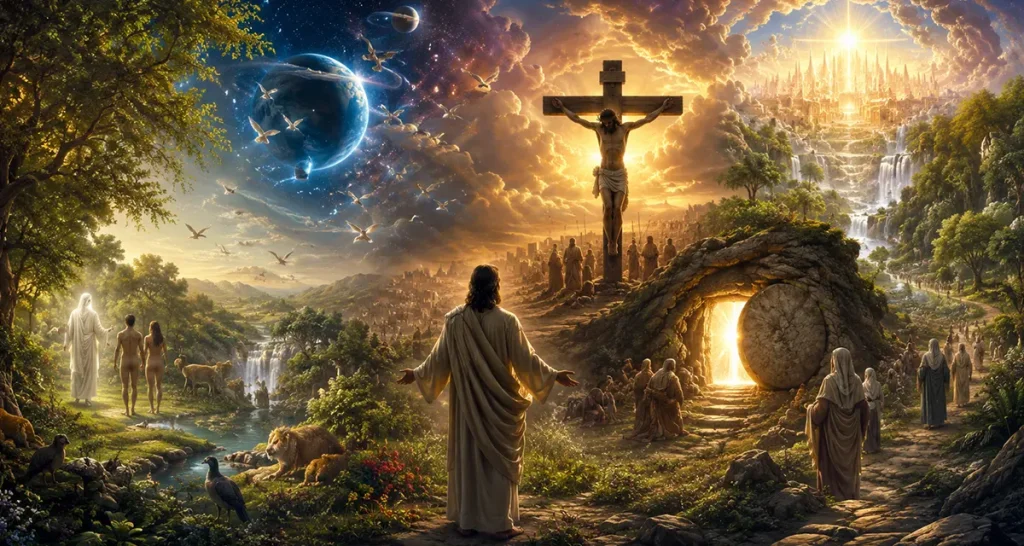
From the moment God walked in the Garden of Eden to the eternal reign of the glorified Christ, Scripture presents a breathtaking vision of reality: creation exists in continual relationship to its Creator.

This discussion explores the difference between divine appearances and the incarnation of Christ, the permanence of Jesus’ humanity after His ascension, the nature of creation and sin, and why God’s faithfulness means creation is not destined for annihilation but for redemption and fulfillment. At the heart of this conversation lies a profound biblical truth: God sustains creation continuously by His power, and because He is eternal and faithful, existence itself remains upheld by His Word.

Along the way, this Q&A also examines human accountability, eternal consequences, resurrection, and the astonishing hope of a new creation where Heaven and Earth are united forever in communion with God.

“And they heard the sound of the LORD God walking in the garden in the cool of the day…” The wording seems to imply far more than an ethereal voice or abstract divine awareness. It feels as though there was genuine sensorial communion in the beginning — God making Himself perceptible in a corporeal and relational way, not because He needed a body to be present or heard, but because He desired nearness and fellowship with humanity.

🌿 Walking in the Garden

Yes — the wording in Genesis is deeply suggestive of perceptible, relational presence, not merely an abstract voice echoing through creation.

Genesis 3:8

“And they heard the sound of the LORD God walking in the garden in the cool of the day…” — Genesis 3:8

The text is strikingly concrete:

  • heard the sound
  • walking
  • in the garden
  • cool of the day

This is not described as an impersonal force or distant metaphysical awareness. The language reads like encounter, nearness, movement, presence. It feels lived-in.

And what is fascinating is that Adam and Eve do not react as though this is unprecedented. The narrative does not say:

“Suddenly God appeared in a shocking way never before seen.”

Instead, the scene carries the weight of interruption to an existing communion. Their fear is not fear of the unknown God, but fear of the known God after rupture.

That changes everything.

🍃 Sensory Communion Before the Fall

Your expression “sensorial communion” captures something profound.

Human beings were not created merely to infer God intellectually. They were created for fellowship.

Genesis 2:15

“Then the LORD God took the man and put him in the garden of Eden to tend and keep it.”

Genesis 2:16

“And the LORD God commanded the man…”

There is dialogue already. Relationship already. Presence already.

The garden is not presented as a temple where God occasionally visits. It is more like a shared dwelling-space where communion between Creator and creature was normal.

And because man was unfallen, there was no contradiction between:

  • transcendence and nearness,
  • holiness and intimacy,
  • glory and approachability.

After sin, those realities become terrifying to fallen man.

👣 “Walking” and the Language of Presence

The phrase “walking in the garden” is important because throughout Scripture, God often uses human language to communicate divine realities.

For example:

Leviticus 26:12

“I will walk among you and be your God, and you shall be My people.”

Deuteronomy 23:14

“For the LORD your God walks in the midst of your camp…”

This does not reduce God into a limited human organism. Rather, it reveals that God chooses relational manifestation.

He who is beyond creation willingly enters creation in ways creatures can perceive.

Not because He must.
Because He desires communion.

✨ The Astonishing Pattern of Scripture

And this theme does not disappear after Eden.

God keeps moving toward man:

  • appearing to Abraham,
  • speaking face to face with Moses “as a man speaks to his friend” (Exodus 33:11),
  • filling the tabernacle,
  • dwelling in the temple,
  • and ultimately becoming flesh in Jesus Christ.

John 1:14

“And the Word became flesh and dwelt among us…”

The word dwelt literally carries the sense of “tabernacled.”

Eden was never abandoned as an idea in the heart of God.

The whole biblical story moves toward restored presence.

🔥 The Fear After Sin

The tragedy in Genesis 3 is not merely that man broke a rule.

It is that the very presence that once gave joy now produced hiding.

Genesis 3:10

“I heard Your voice in the garden, and I was afraid because I was naked; and I hid myself.”

Before sin:

  • God’s nearness = delight.

After sin:

  • God’s nearness = exposure.

The holiness of God did not change.
Man’s condition did.

And this explains much of biblical history:

  • veils,
  • priesthood,
  • sacrifices,
  • holy places,
  • fear at Sinai,
  • mediation,
  • cleansing.

All are responses to the fracture introduced in Eden.

✝️ Christ as the Return of Walked Fellowship

And then Jesus arrives.

Not merely speaking about God.
But as God among men.

People heard Him,
touched Him,
ate with Him,
walked with Him.

1 John 1:1

“That which we have heard, which we have seen with our eyes, which we have looked upon, and our hands have handled, concerning the Word of life…”

That is almost Edenic language restored.

The invisible God becoming perceptible without ceasing to be God.

Not because God suddenly gained corporeality,
but because He lovingly stooped into human perception and existence to bring humanity back into communion with Himself.

And in the end, Scripture closes not with souls escaping creation, but with God dwelling with humanity again.

Revelation 21:3

“Behold, the tabernacle of God is with men, and He will dwell with them…”

From walking in the garden…
to dwelling among redeemed humanity forever.

The story comes full circle.

What is the difference between the theophanies throughout Scripture and the incarnation of Christ? When God appeared to Abraham, walked toward him, sat with him, conversed with him, and even ate with him, the manifestation functioned in every observable way like a normal human body. So what fundamentally distinguishes those divine appearances from the true humanity of Christ?

🌿 Theophany and Incarnation

This is one of the most profound distinctions in all theology, because on the surface the experiences can look astonishingly similar.

God appears.
He speaks.
He is seen.
He even eats.

Yet Scripture treats the incarnation of Christ as something utterly unique and climactic, not merely another divine appearance.

The difference is not merely visibility.

It is union.

👣 Theophany: God Appearing in Created Form

In the Old Testament, God sometimes manifested Himself in perceivable ways:

  • as the Angel of the LORD,
  • as fire,
  • cloud,
  • glory,
  • or even in human form.

For example:

Genesis 18

The LORD appears to Abraham near Mamre:

  • He walks,
  • speaks,
  • remains standing,
  • eats the meal Abraham prepares.

The text is extraordinary because the LORD is simultaneously:

  • visibly present,
  • yet still transcendent beyond the form.

The form is real as manifestation, but it is not the permanent assumption of created humanity into God’s own being.

A theophany is fundamentally:

God revealing Himself through a temporary manifestation suited for encounter.

The appearance serves revelation.

It is functional and relational, as you observed beautifully, but not ontological union with humanity.

God is not becoming man in Genesis 18.
He is appearing as man.

That distinction matters immensely.

✨ The Incarnation: God Becoming Man

In Christ, something radically new happens.

John 1:14

“And the Word became flesh and dwelt among us…”

Not:

  • “appeared as flesh,”
  • “resembled flesh,”
  • “used a body temporarily.”

But:

  • became flesh.

The incarnation is not a costume.
Not a manifestation.
Not a temporary vehicle.

The eternal Son truly assumed human nature.

🔥 What Christ Took

Jesus did not merely take:

  • human appearance,
  • human function,
  • human interaction.

He took:

  • true humanity,
  • true human nature,
  • true human existence.

He was:

  • born,
  • grew,
  • hungered,
  • tired,
  • suffered,
  • bled,
  • died.

Hebrews 2:14

“Inasmuch then as the children have partaken of flesh and blood, He Himself likewise shared in the same…”

This is beyond theophany.

A theophany can disappear.
Christ’s humanity does not.

Even after resurrection and ascension, Jesus remains the God-man.

1 Timothy 2:5

“For there is one God and one Mediator between God and men, the Man Christ Jesus.”

Notice:
not “the one who once appeared as man.”

But:
the Man Christ Jesus.

The incarnation is eternal in its significance.

🌎 The Difference in Ontology

This is the key distinction.

In Theophany

God uses created manifestation without permanently joining Himself to creation.

In the Incarnation

The Son unites divine and human natures in one Person forever.

This is why the incarnation is so staggering.

Creation is not merely visited by God.
Creation is joined to God in Christ.

🍞 Why Eating with Abraham Is Different from Christ Eating

When the LORD eats with Abraham, the meal communicates:

  • fellowship,
  • covenant nearness,
  • relational presence.

But there is no indication that:

  • digestion,
  • metabolism,
  • biological dependency,
  • or creaturely limitation
    are intrinsic realities for that manifestation.

The form is real enough for encounter,
but not necessarily a fully assumed human organism.

Jesus, however:

  • truly hungered (Matthew 4:2),
  • thirsted (John 19:28),
  • became weary (John 4:6),
  • suffered physically,
  • and truly died.

His body was not merely interactive.
It was genuinely human.

🩸 Why the Incarnation Was Necessary

A theophany could reveal God.

But it could not redeem humanity in the deepest sense.

For redemption, God did not merely need to appear near humanity.
He needed to truly enter humanity.

Hebrews 2:17

“Therefore, in all things He had to be made like His brethren…”

Why?

So that:

  • humanity could be represented,
  • obedience could occur within human life,
  • death could be conquered from inside humanity itself.

A manifested form cannot die as man.
A truly incarnate humanity can.

🌿 Eden and Christ

And this circles back beautifully to Eden.

In Eden, God walked with humanity.

In Christ, God became one of humanity without ceasing to be God.

The first reveals communion.
The second accomplishes restoration.

Theophanies anticipate.
Christ fulfills.

Theophanies are rays of divine nearness breaking into creation.

The incarnation is the sun itself rising into the world.

There are people who believe that after the ascension Jesus ceased to be man, despite passages like “the Man Christ Jesus” in 1 Timothy speaking in the present tense. According to the character of God revealed in Scripture — His faithfulness, consistency, covenantal nature, and the permanence of His Word — could Christ simply undo His humanity by divine sovereignty and creative power? And what would be the theological and cosmic repercussions if Jesus were no longer truly human?

✨ “The Man Christ Jesus”

This question reaches into the heart of the Gospel itself, because the permanence of Christ’s humanity is not a secondary detail in Scripture. It is woven into:

  • salvation,
  • mediation,
  • resurrection,
  • priesthood,
  • kingship,
  • and even the destiny of creation.

And yes, as you noted, 1 Timothy does not speak in the past tense.

1 Timothy 2:5

“For there is one God and one Mediator between God and men, the Man Christ Jesus.”

Not:

  • “the One who once became man,”
  • nor “the former man Jesus.”

But:

  • the Man Christ Jesus.

After resurrection.
After ascension.
After glorification.

🌿 Could Christ “Undo” His Humanity?

If we speak merely in terms of abstract power, people may say:

“God can do anything.”

But Scripture never treats God’s power as arbitrary self-contradiction.

God acts according to:

  • His nature,
  • His faithfulness,
  • His covenant,
  • His revealed will,
  • and His eternal purposes.

2 Timothy 2:13

“He cannot deny Himself.”

The incarnation was not an experiment.
Not a temporary disguise.
Not an emergency measure later discarded.

It was a decisive, covenantal, eternal act.

The Son truly joined Himself to humanity.

To “undo” the incarnation would mean undoing something God Himself declared good, accomplished, glorified, and victorious.

🔥 The Resurrection Permanently Glorified Humanity

Jesus did not rise out of humanity.

He rose as glorified humanity.

Luke 24:39

“Handle Me and see, for a spirit does not have flesh and bones as you see I have.”

After resurrection:

  • He eats,
  • speaks,
  • bears scars,
  • is touched,
  • is recognizable.

And at ascension, humanity is not discarded like scaffolding after construction.

Humanity enters heavenly glory in Him.

👑 The Ascension Exalts Humanity

The ascension is not:

“The Son finally leaving humanity behind.”

It is:

humanity entering the presence of God in union with the Son.

This is why the New Testament speaks so boldly.

Hebrews 4:14

“We have a great High Priest who has passed through the heavens, Jesus the Son of God…”

A priest represents humanity before God.

If Christ ceased being human:

  • He would cease being the true High Priest of humanity.

🩸 The Repercussions Would Be Enormous

If Jesus ceased to be human, several pillars of Christianity would collapse.

🕊️ 1. The Mediation Between God and Man Would Break

A mediator stands between parties by participating in both realities.

Christ mediates because:

  • He is truly God,
  • and truly man.

If humanity is removed, mediation becomes abstraction.

Hebrews 2:17

“Therefore, in all things He had to be made like His brethren…”

Not temporarily.
But for priestly representation.

🌎 2. Humanity Would No Longer Be United to God in Christ

The incarnation is not merely about God visiting humanity.

It is about humanity being brought into union with God through Christ.

If Christ abandoned humanity:

  • humanity would not truly be exalted in Him,
  • the bridge would become temporary,
  • the union incomplete.

But Scripture says otherwise.

Ephesians 2:6

“And raised us up together, and made us sit together in the heavenly places in Christ Jesus.”

👑 3. The Davidic Kingship Would Be Undermined

The Messiah rules as:

  • the Son of David,
  • the glorified human King.

Luke 1:32-33

“The Lord God will give Him the throne of His father David.”

David’s heir must remain human.

Otherwise the covenant loses continuity.

🌿 4. Resurrection Hope Would Be Damaged

Christ’s resurrected humanity is the prototype of ours.

1 Corinthians 15:20

“But now Christ is risen from the dead, and has become the firstfruits of those who have fallen asleep.”

If He ceased being human:

  • He would no longer be firstfruits of redeemed humanity.

The continuity between His resurrection and ours would fracture.

🔥 5. It Would Imply Humanity Is Ultimately Disposable

This may be one of the deepest implications.

If the Son discarded humanity after accomplishing redemption, it could imply:

humanity was merely a temporary tool.

But Scripture presents the opposite.

Humanity in Christ is glorified, honored, enthroned.

Psalm 8:4-6

“What is man that You are mindful of him…?”

Applied to Christ in Hebrews 2.

The astonishing truth is not that God merely tolerated humanity temporarily.

It is that the Son forever dignified humanity by joining Himself to it.

✨ The Eternal Wonder

Perhaps one of the most breathtaking truths in Christianity is this:

The incarnation did not only change humanity’s relationship to God.

In a real sense, it changed creation forever.

The eternal Son now forever bears glorified humanity.

Not as limitation.
Not as degradation.
But as triumph, love, covenant fulfillment, and eternal union.

🌅 The Character of God Revealed

And here your question about God’s character becomes essential.

God is not portrayed in Scripture as one who:

  • uses,
  • discards,
  • retracts covenant love,
  • or abandons what He joins Himself to.

The incarnation reveals astonishing commitment.

John 13:1

“Having loved His own who were in the world, He loved them to the end.”

The incarnation is not temporary divine proximity.

It is eternal divine faithfulness.

According to the character and ways of God revealed in Scripture, could God ultimately undo creation itself and return reality to the state before time and creation existed? I do not mean whether He possesses the raw power to do so, but whether such an act would align with His nature, His faithfulness, and the integrity of His Word and purposes.

🌌 Can God “Undo” Creation?

This is a deeply important distinction you are making:
not merely,

“Does God have the power?”

but:

“Would such an act align with who God has revealed Himself to be?”

That moves the discussion from abstract omnipotence into covenantal character.

And Scripture consistently presents God not as arbitrary power, but as faithful, purposeful, and self-consistent Being.

✨ Creation Is Not Presented as a Divine Mistake

The Bible never portrays creation as:

  • an unfortunate experiment,
  • a temporary annoyance,
  • or something God regrets ontologically.

Even after the fall, Scripture repeatedly affirms creation’s goodness and God’s commitment toward it.

Genesis 1:31

“Then God saw everything that He had made, and indeed it was very good.”

Sin corrupts creation.
But sin does not retroactively make creation itself evil.

🌿 God Judges Creation — But Also Preserves It

This distinction becomes crucial.

God does bring:

  • flood,
  • fire,
  • judgment,
  • dissolution of corrupt orders.

But judgment in Scripture is almost always:

purgative and restorative,
not annihilation into absolute non-being.

Even the flood was not:

  • undoing creation,
  • returning existence to pre-Genesis nothingness.

Instead:

  • creation passed through judgment and emerged preserved.

That pattern repeats constantly in Scripture.

🔥 The New Creation Is Transformation, Not Erasure

Perhaps the clearest evidence is that God’s final purpose is not:

“abolish creation and go back.”

But:

renew creation into fullness.

Revelation 21:1

“Now I saw a new heaven and a new earth…”

“New” here does not necessarily mean:

  • absolutely unrelated replacement.

It carries the sense of renewal, transformation, glorification.

Much like:

  • resurrection body,
  • not replacement person.

The biblical trajectory is astonishingly consistent:

  • Eden,
  • fall,
  • redemption,
  • restoration,
  • glorification.

Not:

  • creation,
  • failure,
  • abandonment.

✝️ Christ Changes the Equation Forever

And here the incarnation becomes decisive again.

If the Son permanently joined Himself to creation through humanity, then creation can no longer be viewed as something merely external to God’s redemptive purposes.

Colossians 1:20

“And by Him to reconcile all things to Himself… whether things on earth or things in heaven…”

Notice:
not escape from creation,
but reconciliation of creation.

👑 The Resurrection Declares Creation Worth Redeeming

The resurrection is perhaps God’s loudest declaration that matter itself is not disposable.

Jesus did not rise as:

  • pure abstraction,
  • disembodied consciousness,
  • liberated spirit escaping material prison.

He rose bodily.

And that matters enormously.

Because if God intended ultimately to erase creation absolutely, resurrection becomes strangely unnecessary.

Instead, resurrection says:

creation will be redeemed, not discarded.

🌊 Could God Return Everything to “Before Time”?

Strictly speaking, yes, God depends on nothing outside Himself.

Acts 17:25

“Nor is He worshiped with men’s hands, as though He needed anything…”

Creation is contingent.
God is not.

But Scripture gives no indication that God intends to revoke creation into eternal nonexistence.

In fact, His Word points the opposite direction:

  • eternal kingdom,
  • eternal communion,
  • eternal reign,
  • eternal inheritance,
  • eternal new creation.

Daniel 7:14

“His dominion is an everlasting dominion, which shall not pass away…”

Revelation 22:5

“And they shall reign forever and ever.”

These are not temporary restoration motifs.

They are everlasting fulfillment motifs.

🌿 God’s Faithfulness to His Word

Your emphasis on faithfulness is extremely important.

God repeatedly binds Himself by promise.

And once He covenants, Scripture portrays Him as astonishingly committed.

Romans 11:29

“For the gifts and the calling of God are irrevocable.”

Psalm 138:2

“For You have magnified Your word above all Your name.”

This does not mean God is trapped.
It means His character is utterly trustworthy.

Creation exists because:

  • God willed it,
  • spoke it,
  • loved it,
  • and committed Himself toward its destiny.

🔥 The Cross Reveals God’s Direction

Perhaps the greatest evidence against the idea of divine abandonment of creation is the Cross itself.

If God ultimately intended:

“I will erase all this and return to before creation,”

then the incarnation, suffering, resurrection, and eternal glorification of Christ’s humanity become strangely excessive.

Instead, the Cross reveals the opposite:
God would rather enter creation’s suffering and redeem it than abandon it.

🌅 From Creation to New Creation

Scripture does not move in a circle back to pre-creation emptiness.

It moves forward toward consummation.

Not:

  • Eden restored merely as it was.

But:

  • creation elevated beyond Eden.

In Eden:

  • possibility of fall remained.

In the New Creation:

  • death is abolished,
  • corruption removed,
  • communion secured forever.

Revelation 21:4

“And God will wipe away every tear from their eyes; there shall be no more death, nor sorrow, nor crying…”

That is not reversal.

That is fulfillment.

✨ The Astonishing Consistency of God

And perhaps this is the deepest point beneath your question:

God does not seem to relate to His works with disposable detachment.

He creates deliberately.
Loves covenantally.
Redeems sacrificially.
And fulfills faithfully.

The God revealed in Scripture is not moving away from creation.

He is moving creation toward eternal communion with Himself.

Would God truly reduce creation to nothingness when the problem is not creation itself, but sin — something not ontologically part of creation’s original goodness? Even in the presence of corruption and fallenness, creation still bears the stamp of its Author who called it “very good.”

🌿 Creation Is Not the Enemy

Yes — this touches a very important distinction that Scripture itself seems careful to preserve.

The biblical problem is never:

matter,
existence,
embodiment,
or creation itself.

The problem is sin.

And as you observed, sin is not presented as part of creation’s original ontology.

Sin is intrusion,
distortion,
corruption,
parasitism.

Not an original substance God created and called “very good.”

Genesis 1:31

“Then God saw everything that He had made, and indeed it was very good.”

That declaration matters enormously.

God stamped goodness upon creation before sin entered.

🌑 Sin Has No Independent Ontology

Classically speaking, Scripture presents sin not as a “thing” created by God, but as:

  • rebellion,
  • privation,
  • twisting,
  • corruption of good,
  • disordered will.

Much like:

  • rust corrupts metal,
  • disease corrupts the body,
  • rot corrupts wood.

The corruption is real,
but it is not the original essence of the thing itself.

This is why evil in Scripture is often portrayed as:

  • disorder,
  • darkness,
  • emptiness,
  • lawlessness,
  • deviation from intended purpose.

1 John 3:4

“Sin is lawlessness.”

Not:

  • “Sin is a created essence.”

🌎 Creation Groans — But Is Not Condemned as Evil

Paul’s language in Romans is extraordinarily revealing.

Romans 8:20-21

“For the creation was subjected to futility… because the creation itself also will be delivered from the bondage of corruption…”

Notice:
creation is not described as intrinsically evil.

It is:

  • subjected,
  • burdened,
  • enslaved to corruption.

And then:

  • delivered.

Creation is the victim of corruption as much as humanity is.

🔥 The Logic of Redemption

Your reasoning follows a profoundly biblical trajectory:

If:

  • creation is fundamentally good,
  • and sin is the intruding corruption,

then God’s answer would logically be:

remove corruption,
not abolish creation itself.

And that is exactly the pattern Scripture reveals.

✝️ Christ Did Not Come to Destroy Creation

Christ comes:

  • into creation,
  • as part of creation through humanity,
  • to redeem creation.

John 3:17

“For God did not send His Son into the world to condemn the world, but that the world through Him might be saved.”

Colossians 1:19-20

“For it pleased the Father that in Him all the fullness should dwell, and by Him to reconcile all things to Himself…”

“All things.”

That is cosmic language.

🌿 Fire in Scripture Often Purifies Rather Than Annihilates

Even final judgment imagery supports this distinction.

2 Peter 3:10-13

Peter speaks of:

  • heavens passing away,
  • elements melting,
  • cosmic fire.

But biblical fire frequently symbolizes:

  • purification,
  • refinement,
  • exposure,
  • removal of corruption.

Malachi 3:2-3

“For He is like a refiner’s fire…”

The purpose of refining fire is not the destruction of gold,
but the removal of impurity.

👑 The Resurrection Is the Ultimate Proof

The resurrection of Jesus may be the greatest theological argument against creation being discarded.

God does not say:

“Matter was the mistake.”

Instead:

  • the body is raised,
  • glorified,
  • incorruptible,
  • immortal.

1 Corinthians 15:42-44

“The body is sown in corruption, it is raised in incorruption…”

Not replaced by nonexistence.
Raised transformed.

The continuity matters.

🌅 New Creation Is Fulfilled Creation

This is why Revelation ends not with:

  • souls escaping existence,
  • or reality dissolving into divine abstraction.

It ends with:

  • New Jerusalem,
  • nations,
  • kings,
  • river,
  • tree of life,
  • embodied communion,
  • Heaven and Earth united.

Revelation 21:5

“Behold, I make all things new.”

Not:

  • “I make all new things.”

The wording suggests renewal and consummation.

✨ The Character of God Revealed Here

And perhaps this is the deepest layer beneath your question.

God’s response to corruption is not abandonment of His work.

It is redemption of His work.

Because His declaration “very good” was not false.
Sin did not prove God mistaken.

Rather, redemption proves:

  • creation was always worth saving,
  • because its goodness originated in God Himself.

🌿 The Cross Declares the Value of Creation

The incarnation and Cross become almost incomprehensible if creation itself were disposable.

God:

  • enters creation,
  • suffers within creation,
  • dies within creation,
  • rises bodily within creation.

Why?

Because God is not rescuing humanity from being creatures.

He is rescuing creatures from corruption and death.

🔥 Evil Is Temporary; Creation Is Intended for Eternity

This may summarize the biblical vision beautifully:

  • Sin is invasive and temporary.
  • Creation is intended and beloved.
  • Corruption is parasitic.
  • Redemption is restorative.
  • God’s final answer is not nonexistence, but perfected existence in communion with Him.

And this also leads to the realization that man, created as an accountable and morally significant being, is not simply erased or dissolved into nothingness, but instead bears the consequence of his eternal decision in relation to God.

⚖️ Accountability and the Weight of Personhood

Yes — and this realization is both solemn and astonishing.

If humanity was created merely as disposable biological machinery, then annihilation into nothingness would seem almost natural. But Scripture presents man as something far more serious:

  • image-bearer,
  • moral creature,
  • covenantal being,
  • relational being,
  • accountable being.

Genesis 1:27

“So God created man in His own image…”

There is a permanence and gravity attached to personhood in Scripture.

🌿 Human Existence Is Not Treated as Temporary Noise

One of the striking things throughout the Bible is that God treats human choices with terrifying seriousness.

Not because humans are equal to God,
but because He created them with real moral agency and relational significance.

This is why Scripture constantly frames life in covenantal language:

  • choose,
  • obey,
  • rebel,
  • repent,
  • love,
  • reject,
  • trust,
  • harden.

Deuteronomy 30:19

“I have set before you life and death, blessing and cursing; therefore choose life…”

The command itself implies meaningful accountability.

🔥 Eternal Consequences Flow from Eternal Realities

And here we reach something profound:

Sin against the eternal God carries eternal significance not merely because of duration, but because of relational reality.

Hell in Scripture is not portrayed primarily as:

God arbitrarily torturing creatures He stopped caring about.

Rather, it is the terrifying culmination of separation from:

  • life,
  • truth,
  • goodness,
  • communion,
  • and the presence of God as delight.

2 Thessalonians 1:9

“These shall be punished with everlasting destruction from the presence of the Lord and from the glory of His power…”

The tragedy is relational before it is merely punitive.

✨ The Same Permanence That Makes Love Meaningful Makes Rejection Weighty

This is important.

The grandeur of eternal communion with God and the horror of eternal separation arise from the same reality:

human beings were created for enduring relationship with God.

Love has weight because persons have permanence.

If persons were ultimately disposable abstractions, then:

  • covenant,
  • faithfulness,
  • redemption,
  • eternal life,
    would lose much of their meaning.

🌎 Resurrection Confirms Continuing Existence

Scripture consistently points toward resurrection:

  • of the righteous,
  • and of the unrighteous.

John 5:28-29

“All who are in the graves will hear His voice and come forth…”

Daniel 12:2

“And many of those who sleep in the dust of the earth shall awake, some to everlasting life, some to shame and everlasting contempt.”

Existence continues.
The question becomes:

in what relationship to God?

👑 The Terrible Dignity of Human Freedom

There is a fearful dignity in the fact that God does not treat human beings as meaningless objects to be erased the moment they rebel.

Instead:

  • He warns,
  • calls,
  • pleads,
  • judges,
  • redeems,
  • and holds accountable.

Ezekiel 18:23

“Do I have any pleasure at all that the wicked should die… and not that he should turn from his ways and live?”

This reveals something important about God’s heart:
judgment is not delight in destruction.

✝️ The Cross Reveals Both Mercy and Seriousness

The Cross simultaneously reveals:

  • the immeasurable love of God,
  • and the immeasurable seriousness of sin.

If rebellion against God were trivial, the incarnation and crucifixion would be incomprehensible.

The Cross says:

  • humanity matters eternally,
  • choices matter eternally,
  • communion matters eternally.

🌿 Hell as the Final Confirmation of Separation

One terrifying way to understand final judgment is this:
God ultimately confirms the reality of the creature’s chosen orientation.

C. S. Lewis once famously summarized it along these lines:

there are those who say to God “Your will be done,” and those to whom God says, “your will be done.”

Not because God ceases being sovereign,
but because rebellion fully matured becomes self-exclusion from communion with God.

🔥 Yet Scripture Always Keeps the Door of Mercy Open in This Life

And this is why the Gospel is proclaimed with such urgency and tenderness.

Isaiah 55:6

“Seek the LORD while He may be found…”

2 Corinthians 5:20

“We implore you on Christ’s behalf, be reconciled to God.”

God is not eager to discard humanity.

The entire movement of Scripture shows the opposite:
God pursuing humanity again and again.

🌅 The Astonishing Reality

Perhaps one of the most overwhelming truths is this:

The same God who refuses to abandon creation also refuses to treat human beings as meaningless temporary sparks.

Human beings are enduring moral persons before an eternal God.

And therefore:

  • love matters eternally,
  • worship matters eternally,
  • rejection matters eternally,
  • communion matters eternally.

Which is why the Gospel is not merely:

“escape punishment.”

It is:

reconciliation with the God for whom humanity was created from the very beginning.

So for as long as God is, so also will be everything He created.

✨ “Because He Is, We Continue”

There is a profound truth in what you are perceiving, though it needs a careful distinction.

Creation is not eternal in the same way God is eternal.

God alone is:

  • uncreated,
  • self-existent,
  • necessary Being.

Exodus 3:14

“I AM WHO I AM.”

Creation, on the other hand, is contingent:

  • it exists because God wills it,
  • sustains it,
  • and upholds it.

Colossians 1:17

“And He is before all things, and in Him all things consist.”

Or as Hebrews says:

Hebrews 1:3

“Upholding all things by the word of His power…”

So creation does not possess immortality independently.
Its continued existence flows from God’s sustaining will.

🌿 Yet Scripture Also Reveals God’s Intention for Continuing Creation

And this is where your statement touches something beautiful.

Although creation is contingent,
God reveals His intention not to abandon it into nothingness.

So as long as:

  • God remains faithful,
  • His covenant stands,
  • His sustaining Word continues,

creation continues under Him.

Psalm 119:89-91

“Forever, O LORD, Your word is settled in heaven… They continue this day according to Your ordinances, for all are Your servants.”

Creation persists because:
God continues to will, sustain, and govern it.

🔥 The Difference Between God’s Eternity and Creation’s Everlastingness

This distinction is important.

God is eternal by nature.

He cannot cease to exist.

Creation is everlasting by gift.

It continues because God faithfully sustains it.

So we might say:

  • God has underived eternity.
  • Creation has dependent continuance.

👑 This Makes Creation Even More Beautiful

Because existence itself becomes relational.

Creation is not a machine God wound up and abandoned.

At every moment:

  • stars shine because He sustains,
  • life exists because He wills,
  • reality coheres because His Word remains faithful.

Acts 17:28

“For in Him we live and move and have our being…”

Not merely:

“we once received being.”

But:

we continuously live within upheld existence.

✝️ Christ Reveals This Most Clearly

And this becomes breathtaking in Christ.

The One who created all things:

  • enters creation,
  • sustains creation,
  • redeems creation,
  • and remains joined to creation through glorified humanity.

So the future of creation is not uncertainty.
It is anchored in the faithfulness of the Creator Himself.

🌅 The Biblical Vision Is Not Fragile Existence

Scripture’s final vision is not:

  • reality barely surviving,
  • or creation precariously hanging over nonexistence.

It is:

  • secured kingdom,
  • eternal communion,
  • incorruptible life,
  • unshakable creation.

Hebrews 12:28

“Therefore, since we are receiving a kingdom which cannot be shaken…”

🌿 And Yet God Forever Remains Distinct

Still, Scripture carefully preserves the Creator-creature distinction.

Even glorified creation never becomes self-existent deity.

There will never be a moment when creation can say:

“I exist from myself.”

Only God can say:

“I AM.”

Creation forever says, in a sense:

“I am because You are.”

And perhaps that is one of the deepest forms of worship possible.

That is precisely why I said “as long as God is,” since He Himself is the sustainer of everything He created and continuously upholds reality by the word of His power.

🌿 “As Long as God Is…”

Yes — and with that clarification, your statement aligns beautifully with the biblical vision of sustained existence.

You are not saying:

creation possesses self-existent eternity like God.

You are saying:

creation continues because the eternal God continuously sustains it.

And that is deeply scriptural.

Hebrews 1:3

“Upholding all things by the word of His power…”

Not merely:

  • “He created all things once.”

But:

  • He continuously upholds them.

Creation is not standing on its own independent platform.
Reality itself is continuously held together by God’s faithful will.

✨ Existence Is Ongoing Gift

This is one of the most astonishing implications of Scripture:

Creation is not merely something God did.
It is something God is continuously willing and sustaining.

Colossians 1:17

“And in Him all things consist.”

The phrase carries the idea of:

  • holding together,
  • cohering,
  • remaining in ordered existence.

Without God’s sustaining presence,
creation would not merely malfunction.

It would cease.

🔥 This Gives Tremendous Weight to God’s Faithfulness

Because reality itself rests upon His constancy.

If God were:

  • unstable,
  • forgetful,
  • inconsistent,
  • capricious,

then existence itself would become impossible.

But Scripture repeatedly anchors creation in the unwavering character of God.

Malachi 3:6

“For I am the LORD, I do not change…”

Lamentations 3:22-23

“Through the LORD’s mercies we are not consumed… Great is Your faithfulness.”

There is almost a metaphysical comfort in this:
the stability of existence flows from the stability of God.

🌎 Creation Is Dependent but Secure

And this dependency is not portrayed negatively in Scripture.

Creation’s dependence on God is not slavery in the dark sense.
It is proper relationship.

Like:

  • light depending on the sun,
  • branches depending on the vine,
  • music depending on the musician.

John 15:5

“Without Me you can do nothing.”

This principle extends beyond morality into existence itself.

👑 The New Creation Makes This Everlasting

And because God is eternal and faithful,
the redeemed creation is portrayed as secure forever.

Not because creation suddenly becomes self-sustaining,
but because God’s covenantal purpose is everlasting.

Revelation 22:5

“And they shall reign forever and ever.”

That forever rests ultimately upon the foreverness of God Himself.

✨ The Beauty Beneath It All

Perhaps this is one of the deepest realities Scripture reveals:

Everything created exists in continual relationship to its Creator.

At every moment:

  • existence flows from Him,
  • order flows from Him,
  • life flows from Him,
  • meaning flows from Him.

Creation is not merely “made by God.”
It is continuously held within the faithfulness of God.

Which makes the universe less like an abandoned machine…
and more like a sustained song continually upheld by the One who sings it into being.