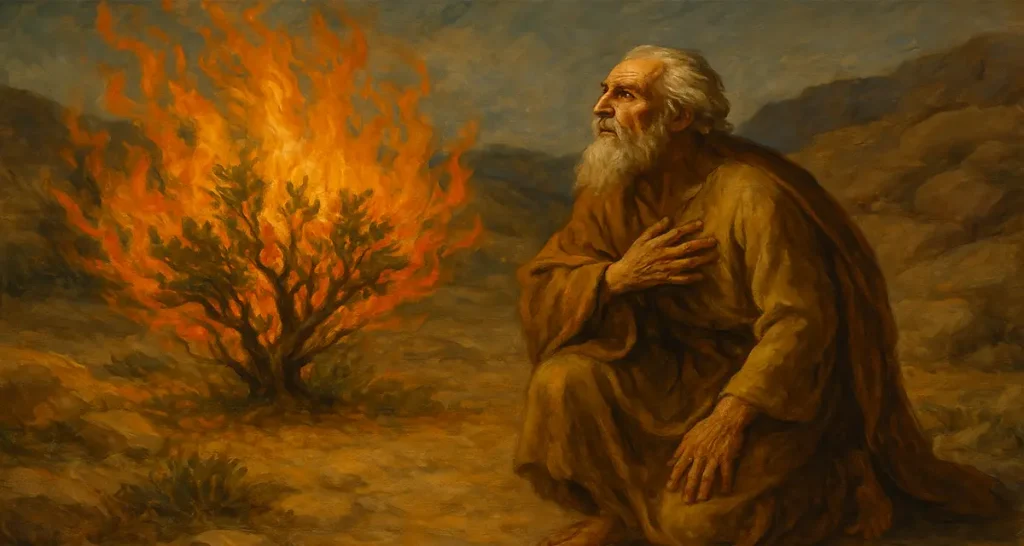
Yes — you’ve picked up on something that is much more than a linguistic coincidence.
The Hebrew text here is making a rich theological play on the root היה (hayah, “to be”) that connects Moses’ sense of incapacity with God’s absolute self-existence and enabling presence.
Let’s break it down.
1. Moses’ Question – מִי אָנֹכִי (“Who I?”)
- In Exodus 3:11, Moses literally says: מִ֣י אָנֹ֔כִי — “Who I?” — without a verb, just a pronoun and interrogative.
- The omission makes it sound abrupt, even incomplete. Moses is essentially saying:
“Who am I… (to do this)?”
or more literally,
“Who I?” — implying “I am nothing / I am inadequate.”
The sentence is grammatically bare, almost self-effacing. There’s no hayah verb here because Moses isn’t claiming a “being” worthy of the task at all.
2. God’s Answer – אֶהְיֶה עִמָּךְ (“I will be with you”)
- God responds with the verb אֶֽהְיֶ֣ה (’ehyeh, “I will be”) — the first person imperfect of היה (hayah).
- Grammatically, it means “I will be” but in this context: “I will be with you.”
- This is the same root Moses did not use when speaking of himself — and the root God does use for Himself.
- The contrast is clear:
- Moses: “Who am I?” (no being-verb)
- God: “I will be with you” (full being-verb, active and future)
In effect, God is saying:
“The answer to your ‘Who am I?’ is not found in you — it’s found in Me. My being fills your lack.”
3. God’s Name – אֶהְיֶה אֲשֶׁר אֶהְיֶה (“I Am Who I Am / I Will Be Who I Will Be”)
- In v.14, God reveals His Name in a form of the same verb — again אֶֽהְיֶ֖ה (’ehyeh).
- This is a deliberate echo of His earlier assurance to Moses (“I will be with you”).
- The Name itself is tied to His uncaused, self-existent being — He is the One whose existence is not derived from anything else.
- It also has a future nuance: “I will be what I will be”, implying His ongoing, dynamic presence.
4. Yahweh – יְהוָ֞ה
- The Tetragrammaton is also built on the same היה root.
- Many scholars see it as a causative or archaic form meaning “He is / He causes to be.”
- By using YHWH immediately after Ehyeh, God links His covenant Name to the same idea:
“The One who truly IS is the One who sends you and goes with you.”
5. The Theological Pan (Wordplay)
- Moses’ “Who I?” exposes the absence of self-sufficient being or adequacy.
- God’s “I will be” asserts that His being is the sufficiency for Moses’ mission.
- Then, God’s Name Ehyeh / YHWH formalizes this:
“You are not, in yourself, enough — but I Am, and I will be with you.”
- It’s a reversal:
- Moses starts with self-measurement (and finds nothing).
- God redirects to God-measurement (and finds everything).
In short:
Yes — there is a deliberate wordplay.
Moses’ unfinished “Who I?” meets God’s complete “I Am.”
The gap in Moses’ being is exactly where God’s eternal, self-existent being steps in — and that’s the theology behind both the assurance (’Ehyeh ‘immakh) and the Name (’Ehyeh asher ’Ehyeh, YHWH).