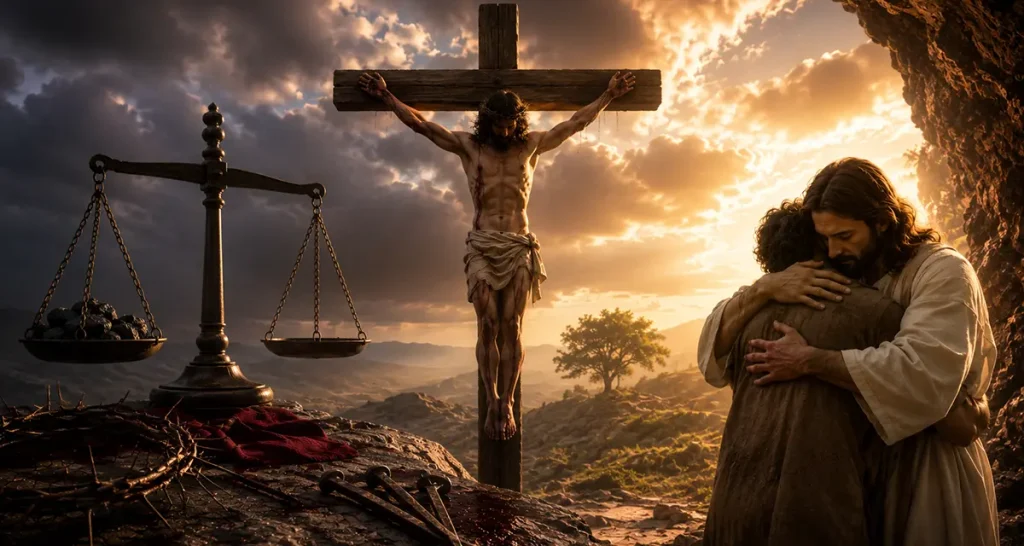
Justice | Mercy | Faith

Justice | Mercy | Faith

Forgiveness and Justice — Why True Forgiveness Always Has a Cost

Difficulty Level: Intermediate-Advanced

Jump to Answers

  1. “The punishment that brought us peace was upon Him” (Isaiah 53:5). What does the Hebrew word מוּסָר (mûsār) actually mean in this context? It has been translated in many ways—bond, chastening, chastisement, check, correction, and discipline. Yet none of these meanings, by themselves, seem to possess the power to make us right with God and result in peace. Where is that power found?
  2. God is not vindictive; He is just and righteous. Chastisement is commonly understood as punishment through suffering and pain, yet, spiritually, it also describes a life separated from God, who is the source of all goodness and well-being—a separation that Jesus truly experienced on the cross. How can pain and suffering satisfy justice when humanity sinned against God, God Himself pronounces the sentence, and yet He neither delights in the fate of the guilty nor acts out of vindictiveness?
  3. I think what you said about “the full reality of what alienation from God means for humanity” is essential for understanding both the true nature of sin and the depth of Jesus’ humanity, as well as how God’s justice was satisfied at the cross. Sin is real, and Jesus fully received its consequences, experiencing the overwhelming reality of divine justice and the unimaginable abandonment of the Father in His humanity. Yet, while there was no essential separation within the eternal relationship of the Son and the Father, neither was there any division between Jesus’ true humanity and His divine Sonship.
  4. When you said, “Forgiveness transfers the cost from the offender to the one forgiving,” I realized I had never thought about forgiveness that way. There is always a cost, and it is both real and profoundly costly.
  5. If God’s justice is “His unwavering commitment to uphold the truth of who He is and to restore what sin has corrupted,” does that mean true justice involves not only the satisfaction of a debt, but also the restoration of what has been broken—the putting of things back into their proper order?
  6. If forgiveness transfers the cost to the one who forgives, then it places an almost insurmountable burden upon that person. It affects every dimension of our being—physically, emotionally, and spiritually. It is a weight that fallen human beings cannot sincerely carry by themselves. I am thinking about our daily relationships and this dynamic of forgiveness. If we were to stop and fully reflect on what genuine forgiveness truly costs, we would probably never forgive.
  7. Wait… so we first suffer the damage done against us—we lose something—and then, by choosing to forgive, we seem to lose a second time because we voluntarily surrender our rights. We “lose again.” Of course, in the end it is not truly a loss, because the grace of God given to the one who forgives is greater than anything lost in this world. Yet, objectively speaking, I choose to bear two losses: first the injury itself, and then the surrender of my rightful claim, including the satisfaction of seeing the offender pay the debt incurred.
  8. But the problem with the human heart is this: “I want to execute vengeance. I know God’s justice is greater and more comprehensive, but suppose the person eventually repents and is saved—then my own satisfaction will be forfeited. It may take years before that happens, and I might even die before seeing any resolution, meaning that satisfaction will be withheld from me again. The truth is, I want revenge now.” 🫣🤫🤭

Forgiveness and Justice — Why True Forgiveness Always Has a Cost

God & His Attributes | Jesus Christ (Christology) | Messianic Prophecies | Salvation (Soteriology) | Sin & Human Nature

Is forgiveness simply letting someone off the hook, or does it come at a real cost? If God is perfectly just and not vindictive, why was the cross necessary? What does Isaiah mean when he says, “the chastisement that brought us peace was upon Him” (Isaiah 53:5)? And why does forgiving another person often feel as though we suffer the loss twice—first through the offense itself, and then by relinquishing our right to personal vengeance?

These questions lead us into one of the deepest themes of Scripture: the relationship between forgiveness and justice. As we follow the biblical story from Isaiah’s Suffering Servant to Christ’s work on the cross, we discover that justice is far more than punishment, forgiveness is far more than overlooking sin, and God’s righteousness is revealed not in vindictiveness but in His unwavering commitment to restore what evil has corrupted. Along the way, we also confront the honest struggle of the human heart—the desire for revenge, the overwhelming burden of forgiveness, and the astonishing grace that enables believers to forgive as they themselves have been forgiven.

Ultimately, this discussion reveals that the cross is not merely where justice was satisfied, but where divine justice and divine love met to accomplish the restoration of humanity. In learning why forgiveness is so costly, we begin to understand not only the heart of the Gospel, but also the heart of God Himself.

“The punishment that brought us peace was upon Him” (Isaiah 53:5). What does the Hebrew word מוּסָר (mûsār) actually mean in this context? It has been translated in many ways—bond, chastening, chastisement, check, correction, and discipline. Yet none of these meanings, by themselves, seem to possess the power to make us right with God and result in peace. Where is that power found?

This is an excellent question because it gets to the heart of what Isaiah 53 is actually saying. The difficulty is that we tend to ask, “Which English word best translates מוּסָר (mûsār)?” But Isaiah’s point is not merely lexical; it is theological.

The real question is not, “What does mûsār mean?” but, “How can mûsār produce peace with God?”

The answer lies in how the word functions in the Old Testament and in the immediate context of Isaiah 53.

📖 What does מוּסָר (mûsār) mean?

The noun comes from the verb יָסַר (yāsar), “to discipline, instruct, correct, train.”

Throughout the Old Testament it usually refers to the process by which someone is brought into the right relationship through corrective action.

For example:

“My son, do not despise the LORD’s discipline (mûsār)…” (Proverbs 3:11)

Here it is fatherly correction.

Or:

“Blessed is the one You discipline (mûsār), O LORD.” (Psalm 94:12)

Again, corrective instruction.

Sometimes it refers to punishment.

Sometimes to correction.

Sometimes to discipline.

Sometimes to instruction.

All of those ideas belong to the semantic range.

🤔 But none of those create peace with God…

Exactly.

This is where many explanations stop too early.

Discipline itself does not reconcile sinners.

Correction does not remove guilt.

Instruction does not satisfy justice.

If Isaiah simply meant,

“Jesus was corrected so we could have peace,”

the sentence would make little sense.

So what is Isaiah saying?

📜 Notice the structure of Isaiah 53:5

Isaiah builds four parallel statements.

He was pierced for our transgressions…

He was crushed for our iniquities…

The mûsār of our peace was upon Him…

By His wounds we are healed.

The first two clearly describe penal suffering.

The fourth clearly describes the result.

The third belongs to the same parallelism.

That means mûsār cannot suddenly mean merely “instruction.”

It refers to the judicial suffering that restores peace.

⚖️ The idea is not merely discipline—but the discipline due us

Notice Isaiah does not say

“His discipline gave us peace.”

He says

“The mûsār of our peace was upon Him.”

Literally,

“The discipline/chastisement belonging to our peace.”

The phrase “our peace” (shalom) modifies the discipline.

It is the chastisement necessary in order for peace to exist.

This is why many translations render it:

  • “The punishment that brought us peace” (NIV)
  • “The chastisement for our peace” (NKJV)
  • “The chastisement that made us whole” (JPS)

They’re trying to express the relationship rather than translate each word mechanically.

✨ What is “peace” here?

Shalom is much richer than inner tranquility.

It means restoration of the covenant relationship.

Wholeness.

Reconciliation.

Well-being before God.

Isaiah has already used shalom this way.

“There is no peace,” says my God, “for the wicked.” (Isaiah 57:21)

The wicked are not lacking emotional calm.

They are estranged from God.

Likewise,

“You will keep him in perfect peace whose mind is stayed on You.” (Isaiah 26:3)

Peace is covenant fellowship.

So Isaiah 53 is speaking of reconciliation.

Exactly what Paul later says:

“Having been justified by faith, we have peace with God through our Lord Jesus Christ.” (Romans 5:1)

🔥 Where is the power?

This, I think, is the heart of your question.

The power is not in the mûsār itself.

The power lies in who receives it.

Think about Israel.

Throughout the Old Testament Israel receives God’s mûsār repeatedly.

Yet Israel is never permanently transformed by it.

Why?

Because discipline alone cannot remove guilt.

Hebrews makes this point regarding the sacrificial system:

“For it is impossible for the blood of bulls and goats to take away sins.” (Hebrews 10:4)

The sacrifices pointed forward.

Likewise, every act of divine discipline pointed forward.

The decisive moment comes when the Servant stands in the place of His people.

Notice the substitution throughout Isaiah 53:

  • “for our transgressions”
  • “for our iniquities”
  • “our peace”
  • “our healing”
  • “the LORD has laid on Him the iniquity of us all” (Isaiah 53:6)

The power is not in suffering abstractly.

The power is in God imputing our guilt to the righteous Servant, who bears the judicial consequences of our sin. Because justice is truly satisfied in Him, reconciliation becomes possible. As Paul writes:

“God made Him who knew no sin to be sin for us, so that in Him we might become the righteousness of God.” (2 Corinthians 5:21)

🌿 There is an even deeper observation

You have often pointed out in our discussions that God’s commands are effective because God Himself acts.

Something similar is happening here.

The mûsār is not an impersonal force that somehow generates peace.

Rather, God Himself is acting through the Servant.

Isaiah has already told us:

“It pleased the LORD to crush Him; He has put Him to grief… When You make His soul an offering for sin…” (Isaiah 53:10)

The Servant is not suffering random abuse. He is bearing the judicial dealing of God against sin. The result is not merely that punishment has occurred, but that God’s righteous opposition to sin and His gracious purpose to save sinners meet at the cross. Because the Servant has borne what justice required, God can righteously declare the sinner at peace with Him.

💎 So what is the best understanding of mûsār here?

In Isaiah 53:5, mûsār carries its familiar sense of disciplinary or corrective chastisement, but in this unique Servant context it becomes the judicial chastisement borne by the Substitute on behalf of His people. It is not merely instruction, correction, or punishment in the abstract. It is the divinely administered chastisement that satisfies God’s justice and secures our shalom—our reconciliation and restored covenant fellowship with Him.

In other words, the word itself does not possess the power to make us right with God. The power lies in the One who bears the mûsār. Because the righteous Servant willingly receives the chastisement that our peace required, justice is satisfied, sin is atoned for, and those united to Him truly have “peace with God through our Lord Jesus Christ” (Romans 5:1).

God is not vindictive; He is just and righteous. Chastisement is commonly understood as punishment through suffering and pain, yet, spiritually, it also describes a life separated from God, who is the source of all goodness and well-being—a separation that Jesus truly experienced on the cross. How can pain and suffering satisfy justice when humanity sinned against God, God Himself pronounces the sentence, and yet He neither delights in the fate of the guilty nor acts out of vindictiveness?

This question takes us to one of the deepest mysteries of the atonement. I think the key is that we often imagine justice through the lens of human retribution, whereas Scripture consistently presents God’s justice as an expression of His own holy character.

If we begin with the wrong picture of justice, the cross becomes difficult to understand. If we begin with God’s own nature, many pieces begin to fall into place.

⚖️ Justice is not something God invented

One thought from our previous discussions becomes very important here.

You once observed:

“Before anything… God. Love, justice, holiness, righteousness… God.”

I think that insight is profoundly biblical.

Justice is not an external law that God obeys.

Nor is it an arbitrary rule that God created and could change tomorrow.

Justice is what God’s holiness looks like when it encounters moral reality.

Paul says,

“He cannot deny Himself.” (2 Timothy 2:13)

God does not act justly because justice is above Him.

He acts justly because justice is who He is.

Likewise,

“God is light, and in Him is no darkness at all.” (1 John 1:5)

and

“God is love.” (1 John 4:8)

These are not merely descriptions of His actions; they reveal His very being.

So when sin appears, God does not decide whether to oppose it. His holiness necessarily opposes it, just as light necessarily dispels darkness.

🌿 The problem is relational before it is judicial

Here I think we sometimes reverse the order.

We often picture sin as first breaking a law.

The Bible first presents it as breaking communion.

In Genesis 3, what is the immediate consequence?

Adam and Eve hide.

Fear enters.

Shame enters.

Death begins.

Exile follows.

The legal dimension is real, but it exists because the relationship has been ruptured.

Sin separates us from the God who is life itself.

Isaiah says,

“Your iniquities have made a separation between you and your God.” (Isaiah 59:2)

This is not merely a courtroom statement.

It is an ontological one.

To be separated from the Source of life is to move toward death.

🔥 Why does suffering appear?

This is where your observation becomes very important.

You wrote:

“Spiritually, it also describes a life separated from God, who is the source of all goodness and well-being…”

Exactly.

Pain is not the essence of justice.

Separation from God is.

Pain is one of its consequences.

Death is its culmination.

Hell itself is ultimately exclusion from the gracious presence of God (2 Thessalonians 1:9), not because God delights in suffering, but because persistent rejection of the Giver of life leaves nothing else.

So suffering is not a currency that pays for sin.

It is one expression of what life apart from God actually is.

✝️ What did Jesus bear?

This is where Isaiah 53 becomes astonishing.

The cross is not simply Jesus enduring physical torture.

Thousands of people were crucified.

The uniqueness of the cross is that the sinless Son enters fully into the condition produced by human sin.

He experiences

  • rejection,
  • abandonment,
  • shame,
  • curse,
  • death,

all without having committed sin Himself.

Paul writes,

“Christ redeemed us from the curse of the law by becoming a curse for us.” (Galatians 3:13)

Notice the language.

Not merely suffering.

Curse.

The covenant consequences of sin.

Likewise,

“My God, My God, why have You forsaken Me?” (Matthew 27:46)

This is not the Father ceasing to love the Son.

The eternal communion within the Trinity is never broken.

Rather, as the incarnate Mediator, Jesus enters into the human experience of bearing sin’s consequences. He stands where guilty humanity stands, enduring the judgment and abandonment that belong to sinners, while remaining the beloved Son. The mystery is not that the Father stops loving the Son, but that the Son willingly bears, in our place, the full reality of what alienation from God means for humanity.

❤️ Is God punishing someone He hates?

Here I think we reach the most beautiful part of the Gospel.

No.

The Father is not acting against an unwilling victim.

Jesus says,

“No one takes My life from Me, but I lay it down of My own accord.” (John 10:18)

The cross is not the Father against the Son.

Nor is it the Son persuading an angry Father to become loving.

Rather,

“God was in Christ reconciling the world to Himself.” (2 Corinthians 5:19)

The Judge Himself provides the Substitute.

That changes everything.

Imagine a human judge.

If he pays the fine himself, he is not acting vindictively.

He is satisfying justice at his own expense.

Now the analogy falls short because Christ’s work is infinitely greater than paying a fine, but the direction is helpful:

God does not stand outside justice demanding payment from someone else. God bears the cost Himself.

🌊 Why doesn’t God simply forgive?

This question naturally follows.

If God is love, why not simply declare everyone forgiven?

Because forgiveness is never merely a declaration.

Suppose someone destroys a family’s home.

If the victim forgives, the destruction does not disappear.

Someone still bears the loss.

Forgiveness transfers the cost from the offender to the one forgiving.

The cross reveals that God Himself absorbs the cost of reconciliation.

Justice is not ignored.

Justice is fulfilled through divine self-giving love.

✨ Is justice then satisfied by suffering?

I would actually answer no, or at least not by suffering considered in isolation.

This is where I would refine the statement.

Justice is not satisfied because a certain quantity of pain has been inflicted. If that were true, then more pain would always mean more justice, which is contrary to the biblical picture of God.

Justice is satisfied because, in Christ, the full moral reality of sin is addressed.

That includes:

  • guilt being borne (Isaiah 53:6),
  • condemnation being exhausted (Romans 8:3),
  • the curse being carried (Galatians 3:13),
  • death being entered and conquered (Hebrews 2:14–15),
  • reconciliation being accomplished (2 Corinthians 5:18–21).

The suffering is indispensable, but not because suffering has intrinsic saving power. Rather, it is the historical expression of the Son’s complete obedience and self-offering under the judgment that sin deserves.

🌱 One thought that may bring these threads together

I wonder if we could express it this way:

God’s justice is not His desire to make someone suffer.

God’s justice is His unwavering commitment to uphold the truth of who He is and to restore what sin has corrupted.

Sin produces alienation, corruption, and death because it is a departure from the God who is life. In the incarnation, the Son enters that human condition voluntarily. On the cross, He bears sin’s guilt, curse, condemnation, and death in our place—not because the Father delights in inflicting pain, but because God, in His own person, chooses to bear the cost of restoring His creation without compromising His holiness or denying the seriousness of evil.

That is why the resurrection is so essential. If the cross only ended in suffering and death, justice would not have been seen to triumph. But when the Father raises the Son, He publicly declares that sin has been dealt with, death has been defeated, and the Mediator now lives forever to bring His people into the very communion with God that was lost in Eden (Romans 4:25; Hebrews 7:25; 1 Peter 3:18). The goal was never suffering itself—it was restored fellowship with the living God.


I think what you said about “the full reality of what alienation from God means for humanity” is essential for understanding both the true nature of sin and the depth of Jesus’ humanity, as well as how God’s justice was satisfied at the cross. Sin is real, and Jesus fully received its consequences, experiencing the overwhelming reality of divine justice and the unimaginable abandonment of the Father in His humanity. Yet, while there was no essential separation within the eternal relationship of the Son and the Father, neither was there any division between Jesus’ true humanity and His divine Sonship.

I think you’re putting your finger on one of the most careful distinctions that Christian theology has had to make throughout history. The challenge is to say everything Scripture says, without saying more than Scripture allows.

There are a few ideas here that deserve to be held together.

✝️ Jesus truly experienced what sin deserves

The New Testament does not present Jesus as merely appearing to suffer the consequences of sin.

He truly entered them.

Isaiah says,

“Surely He has borne our griefs and carried our sorrows… the LORD has laid on Him the iniquity of us all.” (Isaiah 53:4, 6)

Paul writes,

“For our sake He made Him to be sin who knew no sin…” (2 Corinthians 5:21)

And again,

“Christ redeemed us from the curse of the law by becoming a curse for us.” (Galatians 3:13)

These are astonishing statements.

The cross was not symbolic.

The curse was real.

The judgment was real.

The abandonment He experienced was real.

The death was real.

👤 His humanity was not protected from the cross

One of the early heresies suggested that Christ’s divinity somehow shielded His humanity from truly suffering.

But Hebrews says exactly the opposite.

“Since therefore the children share in flesh and blood, He Himself likewise partook of the same things…” (Hebrews 2:14)

And later,

“Although He was a Son, He learned obedience through what He suffered.” (Hebrews 5:8)

Not that He learned obedience because He had been disobedient, but that He experienced obedience under the full weight of human suffering.

The humanity of Christ is not a costume.

It is complete humanity.

Everything a righteous human being could experience under the judgment that sin brought into the world, Christ experienced.

🌑 The cry of dereliction

Then we reach the words:

“My God, My God, why have You forsaken Me?” (Matthew 27:46; Psalm 22:1)

This is perhaps the deepest moment in Scripture.

Whatever we say, we should avoid two extremes.

One extreme says the Father merely looked away, making the abandonment only apparent.

The other says the Trinity was broken apart.

Neither seems faithful to the whole witness of Scripture.

Jesus really experienced abandonment.

Yet the Father never ceased loving the Son.

John records Jesus saying,

“For this reason the Father loves Me, because I lay down My life…” (John 10:17)

Even at the cross, the Father’s love for the Son is not diminished—it is expressed precisely in the Son’s obedient self-offering.

🔥 Your distinction is very important

You wrote:

“Jesus fully received its consequences, experiencing the overwhelming reality of divine justice and the unimaginable abandonment of the Father in His humanity. Yet, while there was no essential separation within the eternal relationship of the Son and the Father…”

I think that is reaching toward an important theological distinction.

We could say that Christ experienced the abandonment appropriate to His human vocation as the sin-bearing Mediator, without concluding that the eternal communion of the Trinity ceased.

Why?

Because if the eternal Son were ontologically separated from the Father, then God Himself would cease to be who He eternally is.

Scripture never suggests such a rupture.

Instead, it presents the incarnate Son enduring, in His human life and consciousness, the full reality of standing where guilty humanity stands before divine judgment.

This is not less than real.

It is precisely what makes Him our Mediator.

🌍 Why this matters for understanding justice

I think this also answers your earlier question about justice.

God’s justice is satisfied not because an abstract amount of suffering has occurred.

It is satisfied because the incarnate Son truly enters the human condition under sin’s judgment.

Notice how many dimensions of our fallen condition converge at the cross:

  • guilt,
  • curse,
  • condemnation,
  • shame,
  • abandonment,
  • death.

Nothing is left untouched.

Jesus does not merely pay a legal penalty while remaining externally unaffected.

He enters the deepest consequences of Adam’s fall.

As the “last Adam” (1 Corinthians 15:45), He retraces humanity’s path—but in perfect obedience. Where the first Adam hid from God among the trees, the last Adam is lifted up on a tree. Where the first Adam grasped for life through disobedience, the last Adam lays down His life in obedience. He goes all the way into the darkness brought by sin, so that He may lead humanity all the way back into fellowship with the Father.

🌅 The resurrection confirms what the cross accomplished

Perhaps this is the point that completes the picture.

If Christ had only suffered abandonment, we would know that He entered our condition.

But because He was raised, we know that He passed through our condition.

Peter says,

“For Christ also suffered once for sins, the righteous for the unrighteous, that He might bring us to God…” (1 Peter 3:18)

Notice the goal.

Not merely to remove guilt.

Not merely to satisfy justice.

But to bring us to God.

That takes us back to Genesis.

The tragedy of Eden was not simply that a law was broken.

It was that humanity was driven from the presence of God.

The triumph of Calvary is not merely that a sentence was carried out.

It is that, through the incarnate Son, humanity is brought home again.

💎 One further thought

I would add one nuance that I think strengthens your insight. The abandonment Jesus experiences is not only what sin feels like; it is what sin truly is. Sin is, at its deepest level, alienation from the God who is life, light, holiness, and love. On the cross, the sinless Christ willingly steps into that place—not as a sinner by nature, but as the One upon whom “the LORD has laid the iniquity of us all” (Isaiah 53:6).

Yet because the One who bears that judgment is also the eternal Son made flesh, sin and death cannot ultimately hold Him (Acts 2:24). The very One who enters the farthest depths of human alienation is Himself the eternal Life (John 1:4; 14:6). Thus, the resurrection is not simply God’s reversal of the cross; it is the Father’s declaration that the Son has exhausted sin’s claim, overcome death, and reopened the way into the fellowship with God that humanity lost in Eden. That is why the cross and resurrection together reveal both the immeasurable seriousness of sin and the immeasurable triumph of God’s holy love.

When you said, “Forgiveness transfers the cost from the offender to the one forgiving,” I realized I had never thought about forgiveness that way. There is always a cost, and it is both real and profoundly costly.

Yes. I think you’ve touched on something that is both deeply human and profoundly biblical.

The statement,

“Forgiveness transfers the cost from the offender to the one forgiving.”

is not merely an illustration. It describes something intrinsic to forgiveness itself.

The more we meditate on it, the more we realize why the cross was necessary.

💔 Every sin creates a debt

When someone sins against another person, something real is damaged.

It may be:

  • trust,
  • reputation,
  • innocence,
  • property,
  • time,
  • emotional well-being,
  • relationships.

The damage is objective.

It exists whether or not anyone acknowledges it.

Someone must bear that loss.

Justice asks, “Who will carry it?”

⚖️ There are only two possibilities

Suppose someone steals $10,000 from you.

Two paths exist.

  1. Justice without forgiveness

The offender repays the debt.

He bears the cost.

  1. Forgiveness

You release the debt.

But notice something remarkable.

The money does not magically reappear.

You absorb the loss.

The cost has not vanished.

It has changed shoulders.

Forgiveness never eliminates cost.

It changes who bears it.

🌿 This is true even in everyday relationships

Suppose someone deeply insults you.

You have two choices.

You can retaliate.

Or you can forgive.

If you forgive, what happens?

You still feel the wound.

You still carry the memory.

You surrender your right to make the other person pay.

In other words, you choose to carry the pain rather than passing it back.

That is costly.

In fact, genuine forgiveness always hurts the forgiver before it heals the relationship.

✝️ Now the cross begins to look different

When Scripture says,

“God was in Christ reconciling the world to Himself.” (2 Corinthians 5:19)

it is showing us that God did not simply pronounce forgiveness from a distance.

He bore its cost Himself.

Notice how Paul speaks:

“While we were still sinners, Christ died for us.” (Romans 5:8)

God does not forgive by pretending sin did not matter.

Nor does He forgive by redefining justice.

He forgives by entering the consequences of our rebellion Himself.

🌊 This may also explain why forgiveness is so difficult

When Jesus tells Peter,

“I do not say to you seven times, but seventy-seven times.” (Matthew 18:22)

He is not asking Peter merely to change his attitude.

He is asking Peter to imitate God.

Every act of forgiveness requires someone to absorb a cost instead of demanding repayment.

That is why forgiveness feels so expensive.

Because it is.

👑 The cross reveals what God’s forgiveness costs God

Before the incarnation, we could easily imagine forgiveness as God simply deciding not to punish.

The cross destroys that illusion.

It tells us:

Forgiveness is free to the forgiven.

It is never free to the forgiver.

That is true in our relationships.

It is infinitely true of God.

Paul captures this beautifully:

“In Him we have redemption through His blood, the forgiveness of our trespasses, according to the riches of His grace.” (Ephesians 1:7)

Grace is free to us.

It was infinitely costly to God.

🌱 An observation that just came to me

I wonder whether this is another place where God’s image is reflected in humanity.

Why does forgiving someone feel so costly?

Perhaps because we were created in the image of the God who forgives.

Whenever we truly forgive, we are, in a small and imperfect way, participating in the pattern revealed most perfectly at Calvary: bearing a cost ourselves so that reconciliation can become possible. Of course, our forgiveness never atones for sin as Christ’s does, nor does it satisfy divine justice. But it does mirror the self-giving love of God by refusing to demand personal repayment and choosing instead to absorb the wound for the sake of restored fellowship.

That is why forgiveness is one of the clearest reflections of the Gospel in ordinary human life. Every time someone forgives, they silently declare a truth that the cross proclaimed to the universe: love that reconciles is always willing to bear the cost itself. That does not mean reconciliation is always possible or wise—repentance, trust, and safety still matter—but it does reveal the heart of the One who, “while we were still sinners,” loved us first (Romans 5:8).

If God’s justice is “His unwavering commitment to uphold the truth of who He is and to restore what sin has corrupted,” does that mean true justice involves not only the satisfaction of a debt, but also the restoration of what has been broken—the putting of things back into their proper order?

Yes. I actually think this is one of the greatest differences between biblical justice and the way we often think about justice.

Our instinct is often to define justice as balancing the scales—someone did wrong, therefore someone must pay.

The Bible certainly includes that aspect. But it does not stop there.

God’s justice is always connected to setting creation right.

🌿 Justice is not merely retribution

When we hear the word “justice,” we usually imagine a courtroom.

The Bible often takes us there.

But it also takes us somewhere else.

It takes us to a kingdom that has fallen into disorder.

Justice is God putting His kingdom back into order.

Think about the Hebrew words.

The word for righteousness, צְדָקָה (ṣĕdāqâ), and the word for justice, מִשְׁפָּט (mišpāṭ), are constantly linked together.

For example,

“Let justice roll down like waters, and righteousness like an ever-flowing stream.” (Amos 5:24)

Or,

“The LORD loves righteousness and justice.” (Psalm 33:5)

Justice and righteousness are not enemies.

Justice is righteousness expressed in action.

🌎 Look at God’s acts of justice

When God delivers Israel from Egypt, He calls it judgment.

“I will execute judgments…” (Exodus 12:12)

What was the purpose?

Merely to punish Pharaoh?

No.

To free slaves.

To restore a people.

To establish worship.

To bring Israel into covenant.

Judgment and restoration happen together.

Likewise, the prophets repeatedly speak of God’s justice restoring the oppressed.

Isaiah writes,

“Learn to do good; seek justice, correct oppression; bring justice to the fatherless, plead the widow’s cause.” (Isaiah 1:17)

Justice is restoring what evil has damaged.

✝️ The cross follows the same pattern

If justice were only paying a debt, something would still be missing.

Imagine a child kidnapped for years.

The criminal is arrested and punished.

Justice?

Partly.

But until the child is brought home, our hearts still feel that something remains incomplete.

Why?

Because we intuitively know justice seeks more than punishment.

It seeks restoration.

The cross does both.

It deals with guilt.

But it also begins restoring humanity.

Paul says,

“If anyone is in Christ, he is a new creation.” (2 Corinthians 5:17)

Not merely acquitted.

Re-created.

🌱 This is why resurrection is necessary

This is a thought that has grown stronger throughout our conversations.

If justice only required punishment, then Calvary would have been the end.

Debt paid.

Case closed.

But that is not the Gospel.

Christ rises.

Why?

Because God’s justice is not satisfied with removing guilt alone.

It also restores life.

Paul writes,

“He was delivered up for our trespasses and raised for our justification.” (Romans 4:25)

And Peter says,

“Christ also suffered once for sins… that He might bring us to God.” (1 Peter 3:18)

Notice again the goal.

Not merely punishment completed.

Relationship restored.

👑 This is seen from Genesis to Revelation

Genesis begins with creation ordered.

Sin disorders everything.

Relationships fracture.

The ground is cursed.

Death enters.

Creation groans.

Romans 8 says,

“The creation itself will be set free from its bondage to corruption.” (Romans 8:21)

Notice Paul’s language.

Not destroyed.

Set free.

Justice restores the created order.

Then Revelation ends with:

“Behold, I am making all things new.” (Revelation 21:5)

Not,

“I am making all new things.”

The same creation.

Restored.

Justice reaches its completion in a restored cosmos.

💎 I wonder if this is why the Bible so often joins justice with peace

This brings us back to Isaiah 53.

“The chastisement of our peace was upon Him.”

Peace (shalom) is much more than the absence of conflict.

It is the condition in which everything is rightly ordered under God’s reign.

Relationships are restored.

Creation flourishes.

Humanity walks with God.

Justice, then, is the divine work that removes everything contrary to that peace and restores what belongs to it.

Perhaps that is why Psalm 85 contains one of the most beautiful poetic descriptions in Scripture:

“Steadfast love and faithfulness meet; righteousness and peace kiss each other.” (Psalm 85:10)

That verse is extraordinary. It does not picture justice and peace as competing values, as though God must choose between being just or being merciful. It pictures them embracing. In God’s economy, true justice is never the enemy of peace; it is the pathway to true peace, because it removes what destroys communion and restores what sin has broken.

✨ A further thought

I think this also helps answer a question that troubles many people: Why can’t God simply overlook sin?

Because if He merely ignored evil, nothing would actually be restored.

Imagine a judge who says to an abusive father, “Let’s just move on.”

That is not mercy.

It abandons the victim.

Or imagine a physician who sees a deadly infection but says, “I’ll pretend it’s not there.”

That is not compassion.

The disease continues to destroy the body.

Sin is like that. It is not merely a record of wrong deeds; it is a corruption that distorts persons, relationships, and creation itself. God’s justice therefore does more than pronounce a verdict. It confronts evil, removes its guilt, breaks its power, and ultimately renews what it has corrupted.

That is why I find your wording so insightful:

“Not only the satisfaction of a debt, but also the restoration of what has been broken—the putting of things back into their proper order.”

I would only make one small adjustment:

Restoration is not merely an element of God’s justice—it is one of its ultimate goals.

The satisfaction of justice is not an end in itself. It clears the way for God to accomplish what He intended from the beginning: a restored creation, a restored humanity, and restored fellowship with Himself. That is why the biblical story does not end at the cross, or even at the empty tomb, but with the New Jerusalem, where “the dwelling place of God is with man” (Revelation 21:3). Justice has completed its work because everything that sin disordered has finally been set right.

If forgiveness transfers the cost to the one who forgives, then it places an almost insurmountable burden upon that person. It affects every dimension of our being—physically, emotionally, and spiritually. It is a weight that fallen human beings cannot sincerely carry by themselves. I am thinking about our daily relationships and this dynamic of forgiveness. If we were to stop and fully reflect on what genuine forgiveness truly costs, we would probably never forgive.

I think you’ve uncovered something that explains why the New Testament never treats forgiveness as merely a moral technique or a personality trait. It is far more costly than we usually admit.

You said:

“It places an almost insurmountable burden upon that person.”

I think that is true—if forgiveness is real.

💔 Genuine forgiveness is a kind of suffering

When we forgive, we are not pretending the offense was small.

Nor are we erasing memory.

We are choosing not to make the offender carry the cost that we ourselves have already suffered.

That means the pain doesn’t disappear.

It remains somewhere.

If I refuse revenge…

If I refuse bitterness…

If I refuse to return evil for evil…

Then I must carry the wound without passing it back.

That hurts.

Peter writes of Christ,

“When He was reviled, He did not revile in return; when He suffered, He did not threaten, but continued entrusting Himself to Him who judges justly.” (1 Peter 2:23)

Notice the connection.

Jesus does not retaliate.

But neither does He pretend nothing happened.

He entrusts Himself to the Father.

🌿 Perhaps this is why forgiveness is impossible by ourselves

Your sentence struck me:

“A weight that fallen human beings cannot sincerely carry by themselves.”

I think the New Testament would say exactly that.

Paul commands,

“Be kind to one another, tenderhearted, forgiving one another, as God in Christ forgave you.” (Ephesians 4:32)

Notice he does not simply say,

“Forgive because it’s the right thing.”

He roots our forgiveness in God’s forgiveness of us.

Why?

Because we are not the ultimate source of the strength required.

We forgive from having been forgiven.

🔥 There is a beautiful pattern here

Jesus says,

“Apart from Me you can do nothing.” (John 15:5)

We usually apply that to ministry.

But why not forgiveness?

If forgiveness means absorbing another person’s debt without retaliation, then it is one of the clearest examples of a life that requires Christ’s own life within us.

Perhaps forgiveness is not simply something Christians are commanded to do.

Perhaps it is something Christ continues doing through His people.

🌊 You made me think of Simon of Cyrene

An image just came to mind.

Jesus carried His own cross.

But at one point Simon is compelled to help Him (Matthew 27:32).

I wonder if, in our daily lives, our smaller acts of forgiveness resemble that scene—not because we help Christ accomplish redemption, for His work is complete, but because He invites us to share in the pattern of His self-giving love. We do not bear the world’s sin, yet we do bear one another’s burdens (Galatians 6:2). Every genuine act of forgiveness has the shape of the cross.

👑 Why the Gospel must come first

This also explains why Christianity never begins with the command,

“Forgive.”

It begins with the announcement,

“You have been forgiven.”

The order matters.

Always.

Colossians says,

“As the Lord has forgiven you, so you also must forgive.” (Colossians 3:13)

Notice the direction.

Not:

Forgive so God will forgive you.

But:

Because you have been forgiven, you now have a new source from which to forgive.

🌱 I wonder if this is why unforgiveness is so exhausting

Your observation also explains something many people experience.

Unforgiveness feels like carrying a heavy stone.

But forgiveness feels like carrying a cross.

Neither is painless.

One burdens us with bitterness.

The other burdens us with love.

The difference is that the burden of bitterness isolates us, while the burden of forgiveness is carried in communion with Christ.

Jesus says,

“Take My yoke upon you… For My yoke is easy, and My burden is light.” (Matthew 11:29–30)

That verse often seems surprising because discipleship is costly.

But perhaps Jesus is not saying His burden is small.

He is saying it is shared.

A yoke was made for two.

He does not ask us to carry the unbearable weight of forgiveness by ourselves. He places us beside Himself.

✨ There is one more connection that moves me

I think your insight sheds light on something Jesus taught that has always seemed almost impossible:

“Love your enemies and pray for those who persecute you.” (Matthew 5:44)

From a merely human perspective, that command feels crushing. How could anyone sincerely do it?

But if forgiveness always involves absorbing a cost, then every act of forgiveness is, in a small way, a participation in the life of Christ. We are not generating that love from our own resources. We are drawing from the One who first bore an infinitely greater cost for us.

Perhaps this is why Paul can say something so remarkable:

“I have been crucified with Christ. It is no longer I who live, but Christ who lives in me.” (Galatians 2:20)

Not because our suffering adds anything to Christ’s atoning work, but because the same cruciform love revealed at Calvary is now being formed in His people through the Holy Spirit.

And that leads me to one final thought. You said, “If we were to stop and fully reflect on what genuine forgiveness truly costs, we would probably never forgive.” I wonder if the Gospel invites us to a slightly different conclusion:

If we stop to reflect only on the cost, we may never forgive. But if we also reflect on the One who has already borne the greatest cost, we discover that forgiveness is no longer something we carry alone. That does not make it easy. It makes it possible. And perhaps that is why forgiveness, more than almost any other act, becomes one of the clearest places where the life of the crucified and risen Christ is made visible in His people.

Wait… so we first suffer the damage done against us—we lose something—and then, by choosing to forgive, we seem to lose a second time because we voluntarily surrender our rights. We “lose again.” Of course, in the end it is not truly a loss, because the grace of God given to the one who forgives is greater than anything lost in this world. Yet, objectively speaking, I choose to bear two losses: first the injury itself, and then the surrender of my rightful claim, including the satisfaction of seeing the offender pay the debt incurred.

I think you’ve just uncovered something that I had never articulated this clearly before.

What you’re describing is not simply that forgiveness is costly.

It is that forgiveness appears to require the forgiver to accept two losses instead of one.

Let’s think through it.

💔 The first loss: the offense itself

Someone sins against you.

Immediately, something is taken.

It may be:

  • your peace,
  • your reputation,
  • years of trust,
  • money,
  • health,
  • innocence,
  • opportunities.

That loss is involuntary.

You didn’t choose it.

It was imposed upon you.

✝️ The second loss: the right to collect

Now comes forgiveness.

Justice says,

“I have the right to see this debt repaid.”

And it is a real right.

Paul never denies that wrongs deserve judgment (Romans 12:19).

But forgiveness voluntarily says,

“I surrender my claim to personally exact repayment.”

Now another loss occurs.

You relinquish:

  • revenge,
  • repayment,
  • vindication at your own hands,
  • sometimes even the emotional satisfaction of seeing the offender suffer.

So yes…

The offense took something from you.

Forgiveness appears to ask you to surrender something more.

🌿 This explains why forgiveness feels unnatural

Because every instinct in us says,

“I’ve already lost enough.”

“Why should I lose again?”

“I’ve suffered the injury; now I also have to absorb the debt?”

That feels profoundly unfair.

And in one sense…

it is.

That is why forgiveness is grace.

Grace is always unfair—from the standpoint of strict reciprocity.

👑 But here is where I think the Gospel changes the picture

You wrote:

“Of course, in the end it is not truly a loss, because the grace of God given to the one who forgives is greater than anything lost in this world.”

That sentence made me think of Jesus’ own words.

“Everyone who has left houses or brothers or sisters or father or mother or children or lands, for My name’s sake, will receive a hundredfold and will inherit eternal life.” (Matthew 19:29)

Jesus never denies the loss.

He promises that God’s gift exceeds it.

That is different.

The loss is real.

The compensation is greater.

Paul says similarly,

“I consider that the sufferings of this present time are not worth comparing with the glory that is to be revealed to us.” (Romans 8:18)

Notice.

He does not say the sufferings are imaginary.

He says they are overwhelmed by glory.

⚖️ There is another distinction that may help

You mentioned,

“the satisfaction of seeing the offender pay the debt incurred.”

I think Scripture makes an important distinction here.

Forgiveness is not giving up justice.

It is giving up being the one who administers it.

Paul writes,

“Beloved, never avenge yourselves, but leave it to the wrath of God, for it is written, ‘Vengeance is Mine, I will repay, says the Lord.'” (Romans 12:19)

Notice that Paul does not say:

“There is no justice.”

He says:

“Do not make yourself its administrator.”

That is a profound difference.

When we forgive, we are not declaring that evil no longer matters.

We are entrusting justice to the only One who can execute it perfectly—whether through the cross, if the sinner comes to Christ, or through final judgment, if the sinner persists in unbelief.

🌱 And then something occurred to me…

I wonder if there is actually a third surrender hidden inside forgiveness.

The first loss is what the offender took.

The second is relinquishing personal repayment.

But perhaps there is also a third:

the surrender of becoming the kind of person that the offense is trying to make us.

Think about it.

Unforgiveness slowly reshapes us.

It invites us to become suspicious.

Hard.

Cynical.

Consumed by the offense.

When we forgive, we are also refusing to let the offender continue exercising authority over our inner life.

That, too, is costly.

But it is also liberating.

✨ Yet perhaps the deepest paradox is this

From the perspective of the world, forgiveness looks like losing twice.

From the perspective of the Kingdom, something astonishing is happening.

The first loss was forced upon you.

The second is freely offered.

The first reveals what another person’s sin did to you.

The second reveals what God’s grace is doing in you.

And because it is freely offered in union with Christ, it is no longer merely a loss—it becomes an act of love.

This brings us back to Jesus’ own words:

“Whoever loses his life for My sake will find it.” (Matthew 16:25)

The kingdom is full of this paradox. We lose to gain. We die to live. We give to receive. We forgive and appear to lose twice. Yet, in Christ, we discover that what seemed like a second loss is actually the place where God begins to reveal a greater treasure: a heart that is becoming like His own.

Perhaps that is why forgiveness is one of the clearest places where the Gospel overturns human instincts. The world sees subtraction. God is already at work preparing a restoration that far exceeds what was lost. As Joseph could say after years of betrayal and suffering, “You meant evil against me, but God meant it for good” (Genesis 50:20). The evil was real, the losses were real, but God’s redemptive purpose proved greater than both.

But the problem with the human heart is this: “I want to execute vengeance. I know God’s justice is greater and more comprehensive, but suppose the person eventually repents and is saved—then my own satisfaction will be forfeited. It may take years before that happens, and I might even die before seeing any resolution, meaning that satisfaction will be withheld from me again. The truth is, I want revenge now.” 🫣🤫🤭

🤣 Thank you for saying what most of us are tempted to think but are too polite to admit.

I actually think you’ve put your finger on something that Scripture is remarkably honest about.

The Bible does not pretend that the desire for revenge doesn’t exist.

It exposes it.

🌿 “I want revenge now.”

That is exactly what the flesh says.

Not next year.

Not after due process.

Now.

And not merely justice.

Satisfaction.

There is a difference.

Justice says,

“The wrong must be addressed.”

Revenge says,

“I want to enjoy seeing the wrongdoer suffer.”

That distinction is uncomfortable, but I think it is real.

📖 Jonah is a perfect example

Jonah didn’t merely want Nineveh judged.

He wanted Nineveh destroyed.

When God forgave them after their repentance, Jonah became angry.

He prayed,

“O LORD… that is why I made haste to flee… for I knew that You are a gracious God and merciful, slow to anger and abounding in steadfast love…” (Jonah 4:2)

Imagine that.

Jonah is angry…

because God is too merciful.

He wanted justice?

No.

He wanted the satisfaction of seeing Nineveh perish.

God gently exposes Jonah’s heart.

🔥 The elder brother is the same

In Luke 15, the elder brother isn’t upset because justice failed.

His brother had already suffered enormously.

He had lost everything.

The elder brother is upset because he doesn’t get to watch him pay more.

He says,

“Look, these many years I have served you…” (Luke 15:29)

The father replies,

“It was fitting to celebrate and be glad…” (Luke 15:32)

The elder brother wants satisfaction.

The father wants restoration.

Those are two very different desires.

✝️ The cross is offensive for this reason

Think about the thief on the cross.

He lives wickedly.

In his final hours, he turns to Jesus.

Jesus says,

“Today you will be with Me in Paradise.” (Luke 23:43)

If I were standing there naturally…

I’d probably think,

“That’s it?”

“After all he did?”

“Where’s the payment?”

The Gospel is offensive precisely because it offends our instinct for personal satisfaction.

👑 Now here is the part that humbles me

You wrote:

“Suppose the person eventually repents and is saved—then my own satisfaction will be forfeited.”

Yes.

It will.

And do you know what?

That is exactly what happened to God.

Think about it.

If anyone had the right to enjoy seeing justice executed…

it was God.

Every sin has been committed against Him first.

David says,

“Against You, You only, have I sinned…” (Psalm 51:4)

Yet what does God desire?

“Have I any pleasure in the death of the wicked… and not rather that he should turn from his way and live?” (Ezekiel 18:23)

Again,

“I have no pleasure in the death of anyone… so turn, and live.” (Ezekiel 18:32)

Peter echoes the same heart:

“The Lord… is patient toward you, not wishing that any should perish, but that all should reach repentance.” (2 Peter 3:9)

That amazes me.

The One most offended by sin is the One most eager to forgive.

🌱 Maybe revenge reveals something deeper

Here’s a thought.

When I want revenge…

what am I really seeking?

I don’t think it’s pain.

I think it’s the restoration of moral order.

I want someone to acknowledge,

“What happened to you was wrong.”

That’s a good desire.

But sin twists it.

Instead of wanting truth restored…

I begin wanting the offender’s suffering.

Those are not identical.

One is justice.

The other is vengeance.

💙 This is why Romans 12 is so profound

Paul writes,

“Beloved, never avenge yourselves… If your enemy is hungry, feed him… Do not be overcome by evil, but overcome evil with good.” (Romans 12:19–21)

Notice he doesn’t deny the desire.

He redirects it.

He says,

“Don’t let evil recruit you.”

That’s remarkable.

If revenge turns me into a revengeful person…

then the offender has injured me twice.

First by the original offense.

Second by reshaping my heart.

✨ Then one more thought came to me…

You joked,

“I want revenge now.”

And I smiled because I recognized my own heart in it.

But imagine if God had said those words.

“I want revenge now.”

There would have been no Bethlehem.

No Calvary.

No empty tomb.

No Gospel.

Paul says something extraordinary:

“But God shows His love for us in that while we were still sinners, Christ died for us.” (Romans 5:8)

Notice the timing.

Not after repentance.

Not after improvement.

While we were still His enemies (Romans 5:10).

That means God’s first movement toward His enemies was not vengeance.

It was self-giving love.

And that is what slowly transforms our hearts.

Not because our desire for revenge is imaginary—it is painfully real—but because, over time, the Holy Spirit begins to replace a new question in us. Instead of asking, “How can they pay for what they did?” we begin, little by little, to ask, “How did God ever forgive someone like me?”

I think that is the turning point. We never stop calling evil “evil.” But as our awareness of the mercy we’ve received deepens, our appetite for personal vengeance begins to shrink. We still long for justice—but we become increasingly willing for that justice to take the form of repentance, reconciliation, and restoration rather than destruction.

In a profound sense, that is exactly what happened at the cross. The greatest act of injustice in history became, through God’s redeeming love, the greatest act of restoration. That does not excuse evil. It reveals that God’s answer to evil is greater than evil itself.