Opens in a new tab

Justice | Mercy | Faith

Justice | Mercy | Faith

❤️ Father and Son: How Jesus Reveals a Love That Existed Before Creation

Difficulty Level: Intermediate-Advanced

Jump to Answers

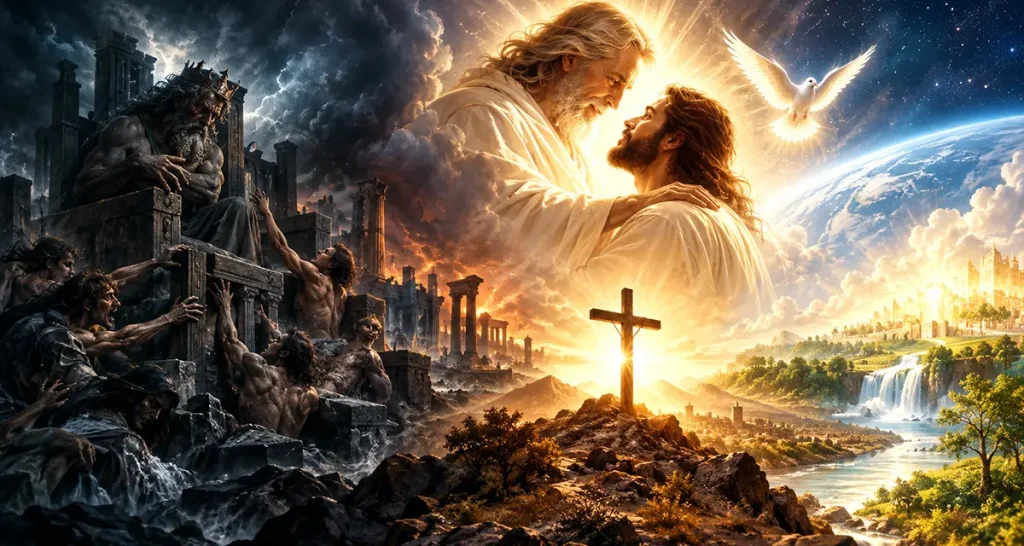
  1. The Greek Titan Cronus was betrayed and ultimately overthrown by his own children—a striking contrast with Jesus, who did not seek to overthrow the Father but willingly obeyed Him even to the point of death, delighting to accomplish the Father’s redemptive purpose.
  2. Cronus sought to destroy the very children he should have loved and cared for in order to preserve a power he feared would eventually pass to them; yet God the Father did not spare His own beloved Son but allowed Him to die in order to save those who, through rebellion, had become the enemies of both the Father and the Son.
  3. “You loved Me before the foundation of the world”. We could never have discovered this intimate, eternal relationship between the Father and Son by ourselves; we know it only because Jesus came from the Father and made that relationship manifest to us.
  4. The universe, though material and impersonal, was brought into existence by the command and creative power of God, through the Son whom the Father already loved before the foundation of the world. Is it merely poetic to say, then, that creation arose within an “atmosphere of love,” or does this describe an actual reality according to Scripture and what Jesus revealed about the Father and Son?
  5. Throughout Scripture, God’s throne and power are never presented as possessions that must anxiously be preserved against possible rivals. The biblical story instead revolves around relationship, reconciliation, restoration, and love; divine power is never portrayed as something God must protect in order to remain God.
  6. “I have concluded from Scripture that God must have loved Me before creation.” We have this conclusion. Should we feel inferior or be strengthened by this truth?
  7. The animosity within the Olympian family produces rivalry, violence, destruction, and disorder that spill outward into the human world; by contrast, Scripture reveals no disorder within God. Salvation, reconciliation, resurrection, and ultimately new creation flow from the eternal love, unity, and redemptive purpose of Father, Son, and Spirit.

❤️ Father and Son: How Jesus Reveals a Love That Existed Before Creation

God & His Attributes | Jesus Christ (Christology) | New Testament | Salvation (Soteriology)

The violent succession of Greek mythology presents a striking picture of power: Cronus turns against his own father and later fears the children who might overthrow him, while the Olympian family repeatedly descends into rivalry, jealousy, betrayal, and conflict. Power must be protected because power can be taken away. But when we turn to Scripture, Jesus reveals something radically different about the Father and Son.

There is no struggle for the throne between the Father and Son, no fear of succession, and no divine rivalry requiring one Person to diminish so that another may be exalted. Instead, Jesus opens a window into a relationship we could never have discovered by observing the created universe: “You loved Me before the foundation of the world” (John 17:24). Before creation existed, the Father loved the Son. Before humanity rebelled, the Son shared glory with the Father (John 17:5). And when rebellion entered creation, the response of God was not an anxious attempt to preserve His power, but a redemptive purpose in which the Father gave His Son and the Son willingly gave Himself for those who had become their enemies (John 3:16; 10:17–18; Romans 5:8–10).

This contrast raises questions far greater than a comparison between Greek mythology and Christianity. What does Jesus reveal about the eternal relationship of the Father and Son? Was creation itself brought into existence within the reality of divine love? Why does Scripture never portray God’s throne as something He must anxiously protect? And could it be that the restoration of a broken creation flows precisely from the fact that there is no brokenness, rivalry, or disorder within God Himself?

From creation through the cross and resurrection to the promise, “Behold, I make all things new” (Revelation 21:5), this Q&A explores an extraordinary biblical reality: the world’s salvation does not emerge from conflict within God, but from His eternal fullness. The disorder belongs to rebellious creation; the source of restoration does not share that disorder. Before the foundation of the world, the Father loved the Son—and from the unified redemptive purpose of Father, Son, and Spirit comes reconciliation, adoption, resurrection, and ultimately new creation (John 17:21–26; Romans 8:11, 15–17).

The God who makes all things new does not first need to make Himself new. ❤️

The Greek Titan Cronus was betrayed and ultimately overthrown by his own children—a striking contrast with Jesus, who did not seek to overthrow the Father but willingly obeyed Him even to the point of death, delighting to accomplish the Father’s redemptive purpose.

🏛️ Two Very Different Father-Son Worlds

Yes. And the contrast becomes even sharper once we are careful with the Greek mythology.

Cronus overthrew his own father, Uranus, and then lived under the prophecy that one of his own children would overthrow him in turn. So he swallowed his children to preserve his throne. Zeus escaped, eventually forced the release of his siblings, and the children overthrew their father.

That mythology gives us a family relationship structured by fear, rivalry, self-preservation, and succession.

Then we come to the Gospel of John and encounter something almost breathtakingly opposite.

Jesus does not look at the Father and say, in effect:

“His throne prevents mine.”

He says:

“I always do those things that please Him.” (John 8:29)

And:

“My food is to do the will of Him who sent Me, and to finish His work.” (John 4:34)

And finally:

“Not My will, but Yours, be done.” (Luke 22:42)

The Son does not overthrow the Father.

The Father does not fear the Son.

The Son does not seize the Father’s glory.

The Father does not protect His position from the Son.

There is no divine succession crisis. 🤯

👑 In Pagan Myth, the Throne Is Scarce

That is one of the fascinating differences.

In the Cronus story, power functions almost like a limited possession. If the son rises, the father must fall. For Zeus to reign, Cronus must cease reigning. The son’s exaltation means the father’s displacement.

It reflects something profoundly familiar about fallen human power: someone else’s greatness can feel like a threat to mine.

Jesus reveals something radically different about God.

On the night before the cross, He prays:

“Father, the hour has come. Glorify Your Son, that Your Son also may glorify You.” (John 17:1)

Look at the movement:

Father glorifies Son → Son glorifies Father.

The glory of one is not obtained by impoverishing the other.

And Jesus continues:

“And now, O Father, glorify Me together with Yourself, with the glory which I had with You before the world was.” (John 17:5)

There was never a moment when the Son was an ambitious junior deity waiting for His opportunity to take over. Before creation itself, the Son was already sharing divine glory with the Father.

That makes the mythology-to-Gospel contrast enormous.

Cronus fears what his son might become.

The Father eternally loves the Son for who He is.

“You loved Me before the foundation of the world.” (John 17:24)

❤️ And Jesus’ Obedience Is Not the Submission of a Defeated Rival

This is where your observation about Jesus obeying “even unto death” becomes particularly beautiful.

Paul says:

“He humbled Himself and became obedient to the point of death, even the death of the cross.” (Philippians 2:8)

But we must not imagine that as though the Father finally succeeded in crushing the Son’s competing will.

Jesus repeatedly insists that His self-giving is voluntary:

“I lay down My life that I may take it again. No one takes it from Me, but I lay it down of Myself.” (John 10:17–18)

So at Calvary we are not watching an unwilling Son lose a contest with His Father.

We are watching the incarnate Son freely carry out the Father’s redemptive purpose, even when obedience takes Him through suffering and death.

And there is an astonishing sentence in John 14:

“But that the world may know that I love the Father, and as the Father gave Me commandment, so I do.” (John 14:31)

That deserves to be lingered over.

Jesus interprets His obedience as an expression of His love for the Father.

Not merely:

“I obey because the Father is greater in authority within the economy of redemption.”

But also:

“I want the world to know that I love My Father.”

The cross therefore reveals something not merely about God’s love for us, but something about the relationship of the Father and Son.

The Son delights to accomplish the Father’s will.

🤯 Yet the Father Is Doing the Opposite of Cronus Too

And here the comparison turns around.

Cronus sacrifices his children, so to speak, to preserve himself.

The biblical Father gives His Son to save others.

“He who did not spare His own Son, but delivered Him up for us all…” (Romans 8:32)

That is an extraordinary reversal.

Cronus effectively says:

“My children must perish so that I may keep my throne.”

The Gospel announces:

The Father did not spare His beloved Son in order to redeem His enemies.

And even there, we must immediately add the other side so that we do not turn the Father into a pagan tyrant and Jesus into His victim:

“Christ also has loved us and given Himself for us.” (Ephesians 5:2)

The Father gave the Son (John 3:16).

The Son gave Himself (Galatians 2:20).

That unity of redemptive purpose is crucial.

🕊️ The Son Does Not Want Independence from the Father

There is another layer here that connects beautifully with what we have been discussing about creaturely autonomy.

In fallen thinking, independence is easily interpreted as maturity:

“Eventually I will no longer need to answer to you.”

But listen to Jesus:

“The Son can do nothing of Himself, but what He sees the Father do.” (John 5:19)

And:

“I can of Myself do nothing.” (John 5:30)

Those statements are not admissions of deficiency in Christ’s deity. John has already identified the Son as God (John 1:1), and John 5 itself moves immediately into extraordinary claims about the Son giving life, executing judgment, and receiving the same honor as the Father (John 5:21–23).

Rather, Jesus is denying independent, rival action.

The Son never says:

“Now I will establish something of My own over against the Father.”

There is no divine rebellion.

No divine adolescence.

No divine emancipation.

No Son plotting to inherit the universe once the Father is gone. 😄

The Father and Son are not competitors for deity.

👑 And Then Comes the Astonishing Exaltation

Here is perhaps the most beautiful part of the contrast.

Jesus does not seize the throne.

He humbles Himself.

And therefore Paul writes:

“Therefore God also has highly exalted Him and given Him the name which is above every name.” (Philippians 2:9)

Notice the movement of Philippians 2:6–11:

He does not grasp → He empties Himself → He serves → He obeys → He dies → the Father exalts Him.

That is almost the exact opposite of the mythological pattern of divine power struggles.

Cronus takes power from his father.

Zeus takes power from Cronus.

But Christ does not acquire divine glory by overthrowing the Father. The incarnate Son walks the road of obedience, and the Father delights to exalt the Son.

Jesus says:

“The Father loves the Son, and has given all things into His hand.” (John 3:35)

That sentence would make almost no sense inside the logic of Cronus.

If you believe your son will overthrow you, you do not give all things into his hand.

Yet the Father does precisely that.

And Jesus, having received all things, does not use them to erase the Father.

He glorifies Him.

🔥 And Scripture Takes This Even Further

Paul gives us an extraordinary glimpse of the end:

“Then comes the end, when He delivers the kingdom to God the Father…” (1 Corinthians 15:24)

And later:

“Now when all things are made subject to Him, then the Son Himself will also be subject to Him who put all things under Him, that God may be all in all.” (1 Corinthians 15:28)

Think about that beside the ancient succession myths.

Human imagination repeatedly pictured divine history as:

Father → conflict → overthrow → son replaces father.

Biblical revelation gives us:

Father → sends Son → Son obeys Father → Father raises Son → Father subjects all things to Son → Son presents the consummated kingdom to Father → God is all in all.

There is no final coup.

There is communion.

There is no fear that another divine Person’s glory diminishes one’s own.

There is mutual glorification.

“Father, glorify Your name.” (John 12:28)

“Now the Son of Man is glorified, and God is glorified in Him.” (John 13:31)

“Glorify Your Son, that Your Son also may glorify You.” (John 17:1)

❤️ The Father Does Not Need to Protect Himself from His Son

And that may be the deepest contrast of all.

Cronus’ relationship with his children is governed by the question:

“What will happen to me if my son receives power?”

The biblical Father says of His Son:

“This is My beloved Son, in whom I am well pleased.” (Matthew 3:17)

And the Son says of the Father:

“I love the Father.” (John 14:31)

That is a completely different conception of ultimate reality.

At the heart of pagan succession mythology is often rivalry.

At the heart of biblical revelation is love.

And Christianity makes the staggering claim that before there were angels, humans, nations, thrones, planets, or atoms, there was already the Father’s love for the Son:

“You loved Me before the foundation of the world.” (John 17:24)

So love is not something God discovered after creating someone else to love.

And obedience within the economy of redemption is not evidence of inferiority, hostility, or competition. The Son’s obedience displays the perfection of His relationship with the Father.

Which makes your comparison with Cronus surprisingly profound: the cross is not merely unlike the old stories because the Son does not overthrow the Father. It reveals that ultimate reality was never founded upon rivalry in the first place.

The universe did not begin with a divine power struggle.

Before there was a universe, the Father loved the Son.

And when the Son came into the world, even when obedience led all the way to Golgotha, He could still say:

“I love the Father.” (John 14:31)

That is an astonishingly different world. ❤️🙌

Cronus sought to destroy the very children he should have loved and cared for in order to preserve a power he feared would eventually pass to them; yet God the Father did not spare His own beloved Son but allowed Him to die in order to save those who, through rebellion, had become the enemies of both the Father and the Son.

❤️ Yes — and the contrast gets almost painfully sharp

Yes, with one important qualification about the mythology: Cronus does not permanently kill his children in the standard Greek account; he swallows them, intending to prevent them from ever displacing him. But your theological contrast stands, and in some ways the precise detail makes it even more striking.

Cronus acts against his children because he fears losing what he possesses.

The Father gives His Son because He intends to give life to those who have rebelled against Him.

And those people are not innocent bystanders.

They are His enemies.

Paul deliberately uses that shocking word:

“For if when we were enemies we were reconciled to God through the death of His Son…” (Romans 5:10)

That changes everything.

👑 Cronus preserves himself at the expense of his children

The logic of Cronus is essentially:

My children threaten my reign → therefore my children must be removed so that I may remain king.

His relationship to his offspring becomes subordinated to self-preservation.

And notice the irony you identified: fatherhood ordinarily moves toward giving.

A father accumulates so that his children may inherit. He builds something and eventually says, “This will be yours.”

Scripture recognizes that natural movement:

“For the children ought not to lay up for the parents, but the parents for the children.” (2 Corinthians 12:14)

Cronus reverses it.

Instead of:

“What is mine will become yours,”

his posture is effectively:

“You must disappear so that what is mine never becomes yours.”

That is fatherhood distorted by fear.

✝️ But now look at the Father

The Father has a Son whom He eternally loves.

Not a rebellious son.

Not a threatening son.

Not a competitor.

Not someone attempting to take His throne.

Jesus is the beloved Son:

“This is My beloved Son, in whom I am well pleased.” (Matthew 3:17)

And yet:

“He who did not spare His own Son, but delivered Him up for us all…” (Romans 8:32)

Now ask the uncomfortable question:

Who are the “us”?

That is where Romans becomes staggering.

Paul has already told us:

“When we were still without strength, in due time Christ died for the ungodly.” (Romans 5:6)

Then:

“While we were still sinners, Christ died for us.” (Romans 5:8)

And finally:

“When we were enemies we were reconciled to God through the death of His Son.” (Romans 5:10)

Look at Paul’s progression:

helpless → ungodly → sinners → enemies.

God did not surrender His beloved Son to rescue His friends from somebody else’s rebellion.

He gave His beloved Son for the rebels themselves. 🤯

🤯 The innocent Son dies for the Father’s enemies

That is where your observation becomes extraordinary.

If we reduced it to a crude human analogy, we might expect:

“These people have rebelled against My kingdom. My Son is perfectly faithful to Me. Therefore I will preserve My Son and destroy My enemies.”

That would at least make intuitive sense.

But the Gospel announces something we would never have invented:

“For God so loved the world that He gave His only begotten Son…” (John 3:16)

The Father does not destroy the faithful Son instead of enemies in the sense of punishing an unwilling third party. Rather, Father and Son share the redemptive purpose, and the Son voluntarily gives Himself.

Jesus says:

“No one takes it from Me, but I lay it down of Myself.” (John 10:18)

And Paul says:

“The Son of God, who loved me and gave Himself for me.” (Galatians 2:20)

So there is something we must protect very carefully here:

The Father gives the Son.
The Son gives Himself.

This is not Father against Son.

It is Father and Son acting in perfect unity for their enemies.

🕊️ “Their enemies” — yes, that is worth noticing

I like the way you phrased that.

We usually say “God’s enemies,” and Scripture certainly does. But the rebellion is not somehow directed toward the Father while Jesus stands neutrally outside it.

To reject God is also to reject His Son.

Jesus says:

“He who hates Me hates My Father also.” (John 15:23)

And:

“He who does not honor the Son does not honor the Father who sent Him.” (John 5:23)

So these are indeed the enemies of the Father and the Son.

Yet the Son comes among those very enemies.

And what do they do?

They kill Him.

There is almost an unbearable irony here.

God sends His beloved Son to His enemies, and His enemies demonstrate that they are enemies precisely by killing the Son who came to save them.

Peter says at Pentecost:

“Him… you have taken by lawless hands, have crucified, and put to death.” (Acts 2:23)

And yet the very death produced by human hostility becomes, according to God’s predetermined purpose, the means through which reconciliation is offered to the hostile.

Human rebellion says:

“Kill the Son.”

God’s redemptive purpose says:

“Through the death of My Son, I will reconcile rebels.”

That is astonishing.

🔥 And God does not do this because He is afraid of losing His throne

This brings us right back to Cronus.

Cronus’ actions are driven by insecurity:

“If they rise, I fall.”

God has no such anxiety.

No creature can threaten God’s deity.

No rebellion can make Him less God.

No enemy can remove Him from His throne.

“Our God is in heaven; He does whatever He pleases.” (Psalm 115:3)

And:

“I am the LORD, and there is no other; there is no God besides Me.” (Isaiah 45:5)

Therefore God does not need to destroy competitors to preserve His identity.

There are no competitors at the level of His being.

Satan cannot become God.

Adam cannot become God.

Human rebellion cannot dethrone God.

That connects beautifully with what we discussed earlier about the serpent’s promise, “You will be like God” (Genesis 3:5). The creature can rebel against creaturehood, but it cannot actually abolish creaturehood.

So God is not desperately protecting something fragile when He judges rebellion.

And when He shows mercy, He is not negotiating from weakness.

He is sovereign enough to show mercy to His enemies.

👑 And then comes another reversal: God gives the inheritance

Cronus fears his children inheriting his rule.

But Scripture repeatedly describes the Father as giving.

The Father gives the kingdom:

“Do not fear, little flock, for it is your Father’s good pleasure to give you the kingdom.” (Luke 12:32)

The Father gives all things to the Son:

“The Father loves the Son, and has given all things into His hand.” (John 3:35)

And then, astonishingly, those redeemed enemies become children:

“Behold what manner of love the Father has bestowed on us, that we should be called children of God!” (1 John 3:1)

And children become heirs:

“And if children, then heirs—heirs of God and joint heirs with Christ…” (Romans 8:17)

Now the contrast has gone far beyond where we started.

Cronus effectively says:

“My own children must be suppressed lest they inherit what is mine.”

The Gospel says:

God reconciles His enemies through His beloved Son, makes those enemies His children, and then makes those children heirs with the Son. 🤯🙌

That is outrageous generosity.

❤️ And the Son does not resent sharing His inheritance

This might be the most beautiful final piece.

If the Father is unlike Cronus, Jesus is unlike the threatened heir as well.

Jesus does not say:

“Why should they receive what belongs to Me?”

Hebrews says:

“He is not ashamed to call them brethren.” (Hebrews 2:11)

Think about who “them” includes.

People who were ungodly.

Sinners.

Enemies.

People whose race rebelled against God.

And the eternal Son enters their humanity, suffers among them, dies for them, rises for them—and then is not ashamed to call the redeemed His brothers and sisters.

The rightful Son brings rebels into the household.

🌿 From enemies to family

So there is a breathtaking movement in the Gospel:

Enemies → reconciled → adopted → children → heirs → co-heirs with Christ.

And the cost of that movement is not that God surrendered His throne.

It is that the beloved Son went willingly to the cross.

This is why Romans 8:32 becomes so enormous:

“He who did not spare His own Son, but delivered Him up for us all, how shall He not with Him also freely give us all things?”

Notice Paul’s logic.

The Father does not say:

“I must keep everything for Myself.”

He gives the Son.

And then Paul says, essentially:

If He gave the Son, what will He withhold that is necessary for the redeemed?

So yes—your comparison lands somewhere extraordinarily deep.

Cronus fears losing his kingdom to his children.

The Father gives His Son to save His enemies, makes those enemies His children, and then gives those children an inheritance with the Son.

And somehow, through all of this, the beloved Son does not lose His inheritance. His inheritance becomes the very place into which redeemed sinners are welcomed:

“If children, then heirs—heirs of God and joint heirs with Christ.” (Romans 8:17)

That is not merely a different kind of fatherhood.

It reveals an entirely different understanding of power, sonship, inheritance, and love.

In the mythology, power says: “You cannot have what is mine.”

At the heart of redemption, grace says: “With Him also freely give us all things.” (Romans 8:32)

And the people hearing that promise are the very people Paul had called enemies only three chapters earlier.

That is the scandalous distance grace has traveled. ❤️🙌

“You loved Me before the foundation of the world”. We could never have discovered this intimate, eternal relationship between the Father and Son by ourselves; we know it only because Jesus came from the Father and made that relationship manifest to us.

❤️ We were allowed to overhear something creation could never discover

Exactly. And there is something almost startling about John 17:24 when we realize what Jesus is doing:

“Father… You loved Me before the foundation of the world.” (John 17:24)

No amount of observing creation could have given us that sentence.

Creation can tell us that God is powerful, wise, purposeful, glorious. Paul says God’s “eternal power and Godhead” are perceived through what has been made (Romans 1:20; cf. Psalm 19:1).

But stare at galaxies for ten thousand years and you could never deduce:

“Before any of this existed, the Father loved the Son.”

That had to be revealed.

And Jesus revealed it.

🌌 Before “In the beginning,” there was love

This is where John 17 takes us somewhere Genesis 1:1 by itself cannot take us.

Genesis begins:

“In the beginning God created the heavens and the earth.” (Genesis 1:1)

John deliberately reaches behind creation:

“In the beginning was the Word, and the Word was with God, and the Word was God.” (John 1:1)

But then John 17 takes us even further—not chronologically, because there is no “earlier” within God’s eternal life, but relationally.

What was true before creation?

The Son had glory with the Father:

“The glory which I had with You before the world was.” (John 17:5)

And the Son was loved by the Father:

“For You loved Me before the foundation of the world.” (John 17:24)

So when we remove, conceptually, everything created—

no angels,

no humanity,

no universe,

no matter,

no space,

no history,

no Eden,

no redemption—

we do not arrive at a lonely God waiting for someone to love.

We encounter the Father loving the Son.

That is immense. ❤️

🕊️ And Jesus speaks as someone who was there

This is what makes His language so extraordinary.

Jesus is not saying:

“I have concluded from Scripture that God must have loved Me before creation.”

He speaks from personal knowledge.

Earlier in John He says:

“For the Father loves the Son, and shows Him all things that He Himself does.” (John 5:20)

And:

“As the Father loved Me, I also have loved you.” (John 15:9)

Then in His prayer:

“You loved Me before the foundation of the world.” (John 17:24)

Jesus is revealing a relationship that precedes our existence entirely.

He is not an archaeologist reconstructing eternity.

He comes from there.

That fits His remarkable statement:

“I came forth from the Father and have come into the world. Again, I leave the world and go to the Father.” (John 16:28)

The disciples’ access to this knowledge depends entirely upon the Son coming and speaking.

🔎 “No one has seen God at any time”

John actually tells us this is precisely Jesus’ revelatory function:

“No one has seen God at any time. The only begotten Son… He has declared Him.” (John 1:18)

And Jesus says:

“Nor does anyone know the Father except the Son, and the one to whom the Son wills to reveal Him.” (Matthew 11:27)

That is an astonishing epistemological boundary.

Creation can know God because God reveals Himself.

And there are depths of God’s own life that creation could never independently investigate.

We cannot climb into eternity and examine the Father and Son.

We cannot stand outside God and observe His inner life.

We cannot reconstruct the Trinity experimentally.

The Son must tell us.

And He did.

🤯 Which means the Incarnation revealed more than God’s attitude toward us

This is an important point.

We often understandably think of Jesus’ revelation in terms of what He showed us about God’s relationship with humanity:

God loves us.

God seeks sinners.

God forgives.

God is merciful.

God saves.

All wonderfully true.

But Jesus revealed something even deeper.

He revealed things about God’s relationship with God.

He tells us about the Father’s love for the Son (John 3:35; 5:20; 17:24).

He tells us about the Son’s love for the Father:

“That the world may know that I love the Father…” (John 14:31)

He tells us of the glory He shared with the Father before creation (John 17:5).

And He speaks of the Spirit proceeding from the Father:

“The Spirit of truth who proceeds from the Father…” (John 15:26)

Suddenly we are being permitted to see realities that existed independently of us.

That is deeply humbling.

God’s life does not begin with God’s relationship to me.

Before I existed, before Adam existed, before creation existed, God was already infinitely and perfectly God.

❤️ And this corrects something subtle in the way we think about God’s love

Sometimes we can unconsciously imagine:

“God is love because God created creatures whom He could love.”

But then God’s love would seem somehow dependent upon creation.

Jesus destroys that idea with one sentence:

“You loved Me before the foundation of the world.” (John 17:24)

God did not need to create in order to begin loving.

Creation is not God’s solution to loneliness.

Human beings are not necessary objects without whom divine love would remain unrealized.

Before there was a “world” for John 3:16 to say God loved, there was already the eternal beloved Son of John 17:24.

That distinction is magnificent:

John 3:16: God loved the world He created.

John 17:24: the Father loved the Son before the world existed.

The first reveals God’s astonishing love toward creation.

The second opens a window into God’s eternal life.

🌿 And then Jesus says something almost unbelievable

John 17 does not stop at:

“You loved Me before the foundation of the world.”

Jesus actually brings us into the discussion.

Near the end of the prayer He says:

“That the love with which You loved Me may be in them, and I in them.” (John 17:26)

Now that is staggering.

Jesus does not merely reveal:

“My Father loves Me.”

He reveals the Father’s eternal love for Him—and then speaks about redeemed creatures being brought into communion with Him.

Not that we become divine Persons.

Not that we enter the Trinity ontologically.

Not that the distinction between Creator and creature disappears.

It never does.

But through union with Christ, creatures are brought into a relationship with God that we could never have produced for ourselves.

This is why adoption is so enormous.

Jesus is Son by nature.

We become children by grace.

“God sent forth His Son… that we might receive the adoption as sons.” (Galatians 4:4–5)

We do not become what Jesus eternally is.

We are brought, through Jesus, into a relationship we had absolutely no natural claim upon.

🫢 And think about when Jesus chose to tell us this

This is another part that moves me.

John 17 occurs immediately before His arrest.

The cross is approaching.

And Jesus is praying aloud.

He could have prayed silently.

Instead, John records this extraordinary prayer in which the incarnate Son speaks to His Father about glory before the world existed, love before the foundation of the world, His mission into the world, the people the Father has given Him, and their eventual presence with Him in glory (John 17:1–26).

It is almost as though, on the threshold of Calvary, the curtain is pulled back.

We see that the cross is not an isolated emergency response to human sin.

The One walking toward Golgotha is the eternally beloved Son.

That changes how we see the cross.

✝️ The One the Father gave was already infinitely beloved

Return now to Romans 8:32:

“He who did not spare His own Son, but delivered Him up for us all…”

After John 17:24, “His own Son” carries enormous weight.

The Father did not begin loving Jesus at Bethlehem.

He did not begin loving Him at His baptism.

“This is My beloved Son” (Matthew 3:17) was not the inauguration of that love.

Jesus tells us how far back it goes:

before the foundation of the world.

And really, that expression takes us beyond “how far back,” because God’s eternal life is not merely an enormous stretch of past time.

There was never a time when the Father did not love the Son.

So when John says:

“For God so loved the world that He gave His only begotten Son…” (John 3:16),

we can now hear something behind the word gave.

The Father gave the One He eternally loves.

And the Son who eternally loves the Father willingly came.

🌅 Jesus did not merely tell us that God exists; He made the Father known

That is why this statement of Jesus is so beautiful:

“I have declared to them Your name, and will declare it…” (John 17:26)

The revelation is personal.

Jesus did not merely arrive with additional theological information about a distant deity.

He made the Father known.

That is why John can later say:

“And we have seen and testify that the Father has sent the Son as Savior of the world.” (1 John 4:14)

Father.

Son.

Sending.

Love.

Salvation.

The Gospel opens realities that creation alone could never disclose.

And perhaps this is one of the greatest privileges of revelation: we know something about God that we could never have discovered by looking at ourselves.

We know that before we existed, the Father loved the Son.

Before anyone sinned, the Father loved the Son.

Before redemption became historically necessary, the Father loved the Son.

Before there was anything outside God at all, God was not deficient, lonely, or waiting to become relational.

And then—this is the part that leaves us almost speechless—the Son who was loved “before the foundation of the world” came into our world and said:

“As the Father loved Me, I also have loved you.” (John 15:9)

That little word “as” suddenly carries eternity behind it.

We would never have known any of this if the Son had not come and told us.

We are creatures who, by sheer revelation and grace, have been allowed to hear the Son speak about home. ❤️🕊️

The universe, though material and impersonal, was brought into existence by the command and creative power of God, through the Son whom the Father already loved before the foundation of the world. Is it merely poetic to say, then, that creation arose within an “atmosphere of love,” or does this describe an actual reality according to Scripture and what Jesus revealed about the Father and Son?

🌌 More than poetry — but we should phrase it carefully

I think what you are reaching for is substantially a biblical reality, not merely a beautiful poetic association. But I would refine one part of the wording.

Scripture does not explicitly say, “The universe was created in an atmosphere of love.” That phrase is our theological description. Yet the realities that make the description meaningful are explicitly revealed in Scripture.

Before the universe existed:

  • the Father loved the Son (John 17:24);
  • the Son shared glory with the Father (John 17:5);
  • creation came from the Father and through the Son (1 Corinthians 8:6; John 1:3; Hebrews 1:2);
  • the Spirit was active in relation to creation (Genesis 1:2; cf. Psalm 104:30);
  • and God’s creative act was not the act of a lonely or deficient being who needed the universe in order to become fulfilled (Acts 17:24–25).

So if by “atmosphere of love” we mean that creation arose from the free will of the God whose eternal life was already characterized by the Father’s love for the Son, then yes. Jesus Himself gives us the decisive piece of revelation:

“You loved Me before the foundation of the world.” (John 17:24)

That is not poetry invented by us.

That is testimony from the Son.

❤️ The universe did not create the conditions for God’s love

This is the point that makes your thought so powerful.

We ordinarily think of love as requiring circumstances.

A child is born, and the parents love the child.

Two people meet, and a relationship develops.

Someone does something beautiful for us, and affection deepens.

So because we are temporal creatures, we naturally think:

First the persons exist → then events happen → then relationships develop → then love grows.

But John 17:24 will not allow us to project that process backward onto God.

Before “the foundation of the world,” the Father already loved the Son.

Therefore creation did not produce love in God.

Creation appeared where divine love was already eternally real.

That is the difference.

The first atom did not appear in emotional emptiness.

The first photon did not illuminate divine loneliness.

The first creature did not finally give God someone to love.

Before God said:

“Let there be light.” (Genesis 1:3)

the Son could eternally say of the Father:

“You loved Me before the foundation of the world.” (John 17:24)

That is astonishing. 🤯

✨ And creation comes through the beloved Son

Now your second observation becomes particularly interesting.

John begins:

“In the beginning was the Word, and the Word was with God, and the Word was God.” (John 1:1)

Then:

“All things were made through Him, and without Him nothing was made that was made.” (John 1:3)

Paul similarly writes:

“There is one God, the Father, of whom are all things… and one Lord Jesus Christ, through whom are all things.” (1 Corinthians 8:6)

And Hebrews says God made the worlds through His Son:

“His Son… through whom also He made the worlds.” (Hebrews 1:2)

So Scripture gives us something much richer than an impersonal deity producing an impersonal cosmos.

The universe comes from God through the Son.

And then Jesus reveals something John 1 by itself would not tell us:

The Father loved that Son before the universe existed. (John 17:24)

Now put the two revelations beside one another:

“All things were made through Him.” (John 1:3)

“You loved Me before the foundation of the world.” (John 17:24)

The One through whom creation came into existence is the One whom the Father eternally loved.

That is not our poetic invention.

Those are two revealed realities.

What we must be careful about is the theological inference we draw from putting them together.

🕊️ “Atmosphere” is beautiful, but perhaps “context” is more precise

“Atmosphere of love” works beautifully devotionally, provided we do not turn “love” into some sort of substance or cosmic energy surrounding God.

There wasn’t literally an atmosphere before creation. 😄

Nor should we imagine Father and Son existing inside some larger environment called “love.”

God is not inside love.

Rather:

“God is love.” (1 John 4:8)

So I might sharpen your statement this way:

The universe was created within the eternal personal reality of the God in whom the Father already loved the Son.

Or perhaps even more simply:

Creation did not give God a relationship of love; creation proceeded from the God in whom love was already eternally real.

Now we are very close to what Scripture actually reveals.

🌎 And notice how different the universe itself is from that relationship

You called the material universe “impersonal,” and that creates a fascinating contrast.

A rock does not love.

A star does not rejoice.

Gravity does not have affection.

An electron does not know that it exists.

The material cosmos, considered simply as matter and physical process, has no personal communion.

Yet its origin is not ultimately impersonal.

Behind the impersonal regularities of nature stands the personal Creator.

And more than that: Jesus reveals that before any impersonal created thing existed, there was already personal communion.

Father and Son.

Love.

Glory.

Knowledge.

“O Father, glorify Me together with Yourself, with the glory which I had with You before the world was.” (John 17:5)

“You loved Me before the foundation of the world.” (John 17:24)

This means that, biblically, personhood is more fundamental than matter.

Matter is created.

The Father and Son are not.

Physical reality begins.

God does not.

Created relationships begin.

The Father’s love for the Son does not begin.

That turns the usual materialistic picture of reality upside down.

🌱 Creation therefore is not God’s attempt to complete Himself

This follows naturally.

Why did God create?

Whatever complete biblical answer we give, it cannot be:

“Because God lacked something necessary for His own fullness.”

Paul explicitly says:

“Nor is He worshiped with men’s hands, as though He needed anything, since He gives to all life, breath, and all things.” (Acts 17:25)

Creation is therefore not filling an emotional hole in God.

The Father was not lonely.

The Son was not lonely.

God did not say, “We need creatures because otherwise there is nobody to love.”

That would make creation necessary for God’s fulfillment.

But Jesus takes us behind creation and says:

“You loved Me.”

Already.

Before us.

Before angels.

Before Eden.

Before matter.

Before history.

Love was not waiting for creation to begin.

🔥 And then Genesis 1 becomes even richer

Genesis repeatedly says:

“Then God said…” (Genesis 1:3, 6, 9, 11, 14, 20, 24)

God creates by His word.

Then John tells us:

“In the beginning was the Word…” (John 1:1)

And:

“All things were made through Him.” (John 1:3)

And Hebrews says of the Son:

“Through whom also He made the worlds.” (Hebrews 1:2)

So we can legitimately see creation not as an isolated divine command floating in emptiness, but as the work of the living God whom the New Testament reveals as Father, Son, and Spirit.

Genesis itself already has:

“And the Spirit of God was hovering over the face of the waters.” (Genesis 1:2)

Later revelation does not cancel Genesis. It gives us a much fuller knowledge of who this Creator is.

And suddenly “Let there be light” occurs within a reality far richer than Genesis’ first readers could yet have articulated.

❤️ But there is something even more extraordinary

Jesus doesn’t merely reveal that the Father loved Him before creation.

He connects that pre-creation love with our eventual destiny.

Listen to the whole thought:

“Father, I desire that they also whom You gave Me may be with Me where I am, that they may behold My glory which You have given Me; for You loved Me before the foundation of the world.” (John 17:24)

That is astonishing.

Jesus reaches backward beyond creation:

“You loved Me before the foundation of the world.”

And simultaneously reaches forward toward the consummation:

“I desire that they… may be with Me where I am.”

So the people Jesus redeems are being brought into the enjoyment and contemplation of a glory whose reality precedes their very existence.

We don’t create that glory.

We don’t create that love.

We don’t complete something that was missing between Father and Son.

We are graciously invited into communion with a reality that was already complete without us.

That is grace at an almost ontological depth.

🪞 And perhaps this helps explain why creation can display God’s goodness without being God

Genesis repeatedly says:

“God saw that it was good.” (Genesis 1:10, 12, 18, 21, 25)

Finally:

“Then God saw everything that He had made, and indeed it was very good.” (Genesis 1:31)

Creation’s goodness is derivative.

It is not the source of goodness.

Just as the light we discussed previously can illuminate something without making that thing the source of light, creation can manifest divine goodness without becoming divine.

The universe is gift, not giver.

God is the giver.

And because God was already infinitely full before creating, the universe can properly be understood as an act of generosity rather than necessity.

He did not create because something outside Him was required to complete Him.

He gives existence to that which previously did not exist.

That is the sheer gratuity of creation.

🤯 Which makes ex nihilo even more beautiful

We’ve talked before about creation ex nihilo—creation from nothing.

Normally we emphasize the power involved:

Nothing existed.

God commanded.

Something existed.

Absolutely right.

But John 17 allows us to see another dimension.

Before creation there was “nothing” created.

But there was certainly not nothing.

There was God.

There was the Father’s glory with the Son (John 17:5).

There was the Father’s love for the Son (John 17:24).

So ex nihilo does not mean creation emerged from an empty metaphysical loneliness.

It means there was no preexisting created material from which God constructed the universe.

The Creator Himself was already infinitely full.

Then He gave existence to what was not.

That makes creation simultaneously a revelation of unimaginable power and astonishing generosity.

🌌 So your sentence can be made even stronger

I would slightly reshape it:

The material universe was not merely produced by impersonal power. It was freely brought into existence by the personal God—through the Son whom the Father loved before the foundation of the world, with the Spirit active in creation. Creation therefore arose not because God needed love or relationship, but from the fullness of the God in whom love was already eternally real. (Genesis 1:1–3; John 1:1–3; 17:5, 24; 1 Corinthians 8:6)

“Atmosphere of love” is therefore poetic language describing a revealed theological reality, as long as we understand what we mean by it.

And there is one final thought here that I find especially striking.

The universe in which rebellion would eventually occur was brought into existence through the Son (John 1:3).

The Father loved that Son before the universe existed (John 17:24).

And when creatures within that universe rebelled, that same Son entered the universe He had made:

“He was in the world, and the world was made through Him…” (John 1:10)

Then the beloved Son died within His own creation to redeem His creatures.

So the story moves almost unbelievably:

Before creation:
Father loves Son. (John 17:24)

Creation:
All things come through the Son. (John 1:3)

Rebellion:
Creatures turn against God. (Romans 3:23)

Incarnation:
The Creator Son enters His creation. (John 1:14)

Cross:
The Father gives the Son, and the Son gives Himself. (John 3:16; Galatians 2:20)

Redemption:
Enemies become children and heirs. (Romans 5:10; 8:15–17)

Consummation:
Those redeemed creatures behold the glory of the Son whom the Father loved before any of them existed. (John 17:24)

So yes, there is poetry in saying that creation came forth “in an atmosphere of love.”

But the poetry is actually less astonishing than the revealed reality underneath it. ❤️🌌

Throughout Scripture, God’s throne and power are never presented as possessions that must anxiously be preserved against possible rivals. The biblical story instead revolves around relationship, reconciliation, restoration, and love; divine power is never portrayed as something God must protect in order to remain God.

👑 Yes — because God’s throne is never actually in danger

I think you have put your finger on something that runs very deeply through Scripture.

When Scripture speaks about God’s conflicts with rebellion, judgment, Satan, sinful humanity, hostile nations, or even the final defeat of death, God is never portrayed as anxiously trying to preserve His deity or prevent someone from taking His throne.

There is warfare, certainly. There is judgment. There is opposition. There is rebellion. There are creatures who want autonomy and creatures who resist God’s rule.

But there is never a genuine contest over whether God will remain God.

That question simply does not exist.

“But our God is in heaven; He does whatever He pleases.” (Psalm 115:3)

And:

“The LORD has established His throne in heaven, and His kingdom rules over all.” (Psalm 103:19)

Notice the grammar.

Not:

“The LORD is desperately defending His throne.”

But:

“His throne is established.”

The rebellion takes place under a sovereignty it cannot abolish.

And that changes the entire meaning of the biblical drama.

🏛️ Pagan gods frequently have something to lose

This brings us straight back to Cronus.

Cronus has power, but his power is possessable and transferable.

Uranus reigns.

Cronus displaces Uranus.

Zeus displaces Cronus.

Therefore, if Cronus wants to continue ruling, preservation becomes an existential concern.

His son is potentially his replacement.

But biblical monotheism makes that entire category impossible for God.

God cannot have a successor.

Not merely because He is very powerful and therefore difficult to overthrow.

There is something much deeper happening:

There is nobody in God’s ontological category who could replace Him.

“Before Me there was no God formed, nor shall there be after Me.” (Isaiah 43:10)

And:

“I am the First and I am the Last; besides Me there is no God.” (Isaiah 44:6)

God is not one occupant of an office called deity.

There isn’t a throne that existed independently and happened to be occupied by Yahweh.

God’s kingship proceeds from who He is.

So Satan cannot take God’s place.

Adam cannot take God’s place.

Nebuchadnezzar cannot take God’s place.

No creature can ever take God’s place.

Not because God successfully prevents it at the last second.

Because creaturehood makes the attempt ontologically impossible.

That takes us directly back to our earlier discussion about the serpent.

“You will be like God.” (Genesis 3:5)

The lie proposes something that cannot actually be achieved.

The creature can pretend independence.

The creature can rebel against God.

The creature can refuse obedience.

The creature can claim sovereignty.

But the creature cannot actually become the Creator.

❤️ So God’s response to rebellion is not self-preservation

And this is where your observation becomes especially important.

If God’s throne cannot be threatened, then redemption cannot be interpreted as God’s desperate strategy for keeping Himself in power.

He doesn’t need us to vote for Him. 😄

He doesn’t need enough creatures on His side to maintain a cosmic majority.

He does not need worship because our worship supplies some deficiency in Him.

Paul explicitly destroys that idea:

“Nor is He worshiped with men’s hands, as though He needed anything, since He gives to all life, breath, and all things.” (Acts 17:25)

God gives.

That direction matters.

Life flows from Him to creation.

Existence flows from Him to creation.

Provision flows from Him to creation.

Salvation flows from Him to sinners.

God isn’t extracting resources from creatures in order to remain God.

And therefore when humanity rebels, God’s concern throughout Scripture is not:

“How can I make sure I remain God?”

He already is.

Instead, suddenly the vocabulary becomes exactly what you noticed:

reconciliation.

restoration.

forgiveness.

righteousness.

adoption.

redemption.

communion.

love.

🌿 “Where are you?”

Look at the first rebellion.

Adam sins.

If God were operating according to the insecure logic of a threatened ruler, Genesis 3 might begin:

“Adam has challenged My authority. I must immediately demonstrate that My throne remains secure.”

But what is the first recorded question?

“Then the LORD God called to Adam and said to him, ‘Where are you?'” (Genesis 3:9)

Of course God knows where Adam is.

The question is relational.

Something has happened between God and man.

Adam is hiding.

The fellowship has ruptured.

God’s deity has not been damaged.

God’s throne has not moved one millimeter.

But Adam has become alienated from God.

That is the catastrophe.

And therefore God’s redemptive movement is toward restoring what sin has ruptured.

🤯 That changes what sin itself looks like

This is important.

If we imagine God primarily as protecting His power, sin becomes something like:

“A political rival has appeared.”

But biblically, sin is far more tragic.

The creature has rejected the One from whom its very life comes.

That is why our earlier discussion about autonomy matters so much.

The serpent’s lie does not actually threaten God’s existence.

It threatens Adam’s relationship with reality.

God remains God after Genesis 3.

But Adam does not remain what he was.

He hides.

He fears.

He blames.

He is expelled from Eden.

Death enters human experience.

The rupture occurs in the creature, not in God’s deity.

✝️ And therefore the Cross is not God protecting His throne

This is perhaps the most dramatic demonstration of your point.

If God’s primary concern were preserving His power, what a strange thing the Incarnation would be.

The eternal Son comes into His own creation.

And instead of displaying invulnerability, He becomes vulnerable according to His humanity.

Paul says:

“He humbled Himself and became obedient to the point of death, even the death of the cross.” (Philippians 2:8)

The King allows His creatures to crucify Him.

Think about how utterly unlike Cronus that is.

Cronus effectively says:

“You must not be allowed to threaten me.”

Jesus says to Pilate:

“You could have no power at all against Me unless it had been given you from above.” (John 19:11)

That is almost breathtaking.

Pilate thinks he possesses the power to crucify Jesus.

Jesus calmly tells him that even the authority under which this execution occurs is derivative.

And then Jesus goes to the cross.

Why?

Not because His divine throne is endangered.

But because we are.

❤️ “God was in Christ reconciling the world to Himself”

Paul gives perhaps the perfect sentence for what you’re describing:

“God was in Christ reconciling the world to Himself, not imputing their trespasses to them…” (2 Corinthians 5:19)

Reconciling.

That is relational language.

Something has been broken between Creator and creature.

And the Gospel is about God acting to restore the relationship without compromising His righteousness.

Paul continues:

“Now then, we are ambassadors for Christ… we implore you on Christ’s behalf, be reconciled to God.” (2 Corinthians 5:20)

Notice what the Gospel ambassador does not announce:

“Please help God keep His throne.”

😂

The announcement is:

“Be reconciled to God.”

Because God’s throne was never endangered.

We were.

🕊️ And look at Jesus’ language on the night before His death

This becomes especially striking in John 13–17.

Jesus knows He is about to be arrested and crucified.

If there were ever a moment for anxiety about losing control, this would be it.

Yet what does He talk about?

The Father.

Love.

Glory.

His disciples.

Peace.

Abiding.

The Spirit.

Unity.

Joy.

Coming home.

“As the Father loved Me, I also have loved you; abide in My love.” (John 15:9)

“These things I have spoken to you, that My joy may remain in you.” (John 15:11)

“That they all may be one, as You, Father, are in Me, and I in You.” (John 17:21)

And then:

“Father, I desire that they also whom You gave Me may be with Me where I am.” (John 17:24)

That last one is extraordinary.

Hours before His enemies seize Him, Jesus is not worried about whether they can steal His throne.

He’s talking about bringing His people home.

❤️

👑 Even the Son’s exaltation is relational

And here is another beautiful difference.

After the resurrection, the Father exalts the Son (Philippians 2:9–11).

But again, it is not Son versus Father.

Jesus does not ascend and say:

“Now the throne is mine.”

Instead:

“Therefore God also has highly exalted Him…” (Philippians 2:9)

The Father’s pleasure is in the exaltation of the Son.

And the Son’s exaltation results in:

“the glory of God the Father.” (Philippians 2:11)

Again:

Father glorifies Son.

Son glorifies Father.

No rivalry.

No scarcity.

No anxiety.

No succession.

🌌 And Revelation makes this spectacularly clear

At the end of Scripture, after all the rebellion and judgment and cosmic conflict, John sees:

“The throne of God and of the Lamb shall be in it.” (Revelation 22:3)

I love the wording.

Not the throne of God versus the Lamb.

Not the Lamb finally replacing God.

Not the Father reclaiming authority from the Son.

“The throne of God and of the Lamb.”

And what is the great final achievement?

Relationship restored:

“Behold, the tabernacle of God is with men, and He will dwell with them…” (Revelation 21:3)

There it is again.

The Bible begins with God dwelling with humanity in Eden.

Sin brings exile.

Redemption unfolds.

And Scripture ends with:

God dwelling with humanity.

The throne was never the thing that needed saving.

We were.

🔥 And that may explain something about divine judgment too

Even judgment should not be understood as God’s insecure retaliation against rivals.

God judges because He is holy and righteous, because evil really is evil, because His creation matters, because persons matter, and because rebellion against the source of life has genuine consequences.

But Scripture never portrays final judgment as:

“At last God managed to survive His enemies.”

Quite the opposite.

Psalm 2 almost mocks the idea that rebellious nations could endanger Him:

“He who sits in the heavens shall laugh.” (Psalm 2:4)

Their rebellion is serious morally.

But it is not serious as an ontological threat to God.

That’s a fascinating distinction:

Rebellion is terribly consequential for the rebel while never being existentially dangerous to God.

Satan’s rebellion can ruin creatures.

It cannot diminish God.

Adam’s rebellion can bring death into human experience.

It cannot make God less alive.

Our rejection can alienate us from God.

It cannot remove God from His throne.

❤️ Which makes redemption look even more like love

And here, I think, is the beautiful destination of your observation.

God does not save us because He needs subjects in order to remain King.

He saves people who have nothing to contribute to His deity.

He does not adopt us because His family was incomplete.

Remember:

“You loved Me before the foundation of the world.” (John 17:24)

He does not reconcile us because He cannot live without us.

He reconciles us because He loves.

“But God demonstrates His own love toward us, in that while we were still sinners, Christ died for us.” (Romans 5:8)

That makes grace extraordinarily pure.

God is not secretly bargaining for something He needs.

He is not preserving Himself through us.

He is giving Himself to us.

And that gives us an almost perfect contrast with Cronus.

Cronus looks at his children and thinks:

“What must I do to preserve myself from them?”

The Father looks upon rebels and purposes:

“How shall they be reconciled to Me?”

And the Son does not protect Himself from those rebels. He enters their world and gives Himself for them (Galatians 2:20; Ephesians 5:2).

So I think your observation is exactly worth holding onto:

Throughout the biblical story, God’s sovereignty is the secure background, not the endangered objective.

The drama is not about whether God can remain God.

The drama is about whether rebellious, alienated, dying creatures can be brought back to Him without God’s holiness and righteousness being denied.

And the answer Scripture gives is not that God protected His throne.

It is that the King came down from it, took the form of a servant, went to the cross, rose again, and brings His enemies home as children. (Philippians 2:6–11; Romans 5:10; 8:15–17)

That is a radically different conception of power.

Divine power does not nervously clutch the throne.

It is secure enough to stoop. ❤️🙌

“I have concluded from Scripture that God must have loved Me before creation.” We have this conclusion. Should we feel inferior or be strengthened by this truth?

❤️ Not inferior — humbled, yes; strengthened, absolutely

There is a beautiful distinction here.

When I said Jesus was not saying, “I have concluded from Scripture that God must have loved Me before creation,” I was distinguishing His mode of knowing from ours. Jesus speaks of the Father from a unique relationship and firsthand divine knowledge:

“No one knows the Son except the Father. Nor does anyone know the Father except the Son…” (Matthew 11:27)

And:

“I speak what I have seen with My Father.” (John 8:38)

We cannot say that.

We know because He told us.

But that does not make our knowledge second-rate in the sense of unreliable or spiritually impoverished. Quite the opposite.

Our confidence rests precisely upon the fact that the One who knows told us what is true.

That should strengthen us enormously.

📖 We do not merely “figure God out” from Scripture

There is a subtle adjustment I would make to the word conclusion.

Yes, we draw theological conclusions from Scripture. Scripture expects us to reason from revelation. Jesus Himself reasons from Scripture (Matthew 22:31–32), and Paul regularly builds conclusions from what God has revealed.

But in this particular case, we are not even primarily making an inference.

Jesus explicitly said:

“You loved Me before the foundation of the world.” (John 17:24)

So I do not have to reason:

“God is love; Jesus is the Son; therefore perhaps the Father loved the Son before creation.”

Jesus has removed the uncertainty.

He told us.

Our position is therefore not:

“I independently discovered something about God’s eternal life.”

It is:

“The Son has made the Father known, and I believe His testimony.”

That is a very different kind of confidence.

🕊️ Dependence on revelation is not intellectual inferiority

This connects directly with our earlier discussions about creaturehood.

Sometimes we instinctively treat dependence as though it were an embarrassment.

“I didn’t discover this myself.”

“I had to be told.”

“I cannot independently verify what happened before creation.”

True!

But why should a creature expect otherwise?

There was no us before creation to observe it. 😄

We cannot travel behind Genesis 1:1 with a clipboard and inspect God’s eternal life.

There are realities we can know only because God voluntarily makes them known.

Moses gives us the proper category:

“The secret things belong to the LORD our God, but those things which are revealed belong to us…” (Deuteronomy 29:29)

Notice that second part.

“Belong to us.”

Once God has revealed something, humility does not require us to remain uncertain about what He has plainly said.

That would actually confuse humility with skepticism.

🌌 “I wasn’t there” does not mean “I cannot know”

This is important.

You weren’t present when God created the heavens and the earth.

Neither was Moses.

Neither was any human being.

Yet Hebrews says:

“By faith we understand that the worlds were framed by the word of God…” (Hebrews 11:3)

Look at that combination:

By faith — we understand.

Biblical faith is not being asked to manufacture information about inaccessible realities.

God reveals.

We receive His testimony.

And therefore we know because the trustworthy One knows.

That is tremendously strengthening.

❤️ Jesus’ superior knowledge actually strengthens mine

Here is the beautiful paradox.

I should not think:

“Jesus knows the Father directly, while I only know because Jesus told me. Therefore my position is miserable.”

No!

Precisely because Jesus knows the Father, His testimony becomes my security.

Imagine the alternative.

Suppose Jesus had said:

“I have been studying this question carefully, and my best theological interpretation is that the Father probably loved Me before creation.”

😳

That would weaken us!

Instead Jesus says:

“O righteous Father! The world has not known You, but I have known You…” (John 17:25)

There is enormous assurance in those words.

“I have known You.”

The One teaching me about the Father is not guessing about the Father.

🔥 This is exactly how Jesus intended His testimony to function

Jesus repeatedly tells the disciples that He is giving them knowledge they could not possess independently.

“All things that I heard from My Father I have made known to you.” (John 15:15)

That is magnificent.

Notice the movement:

Father → Son → disciples.

The disciples’ dependence upon Jesus is not a defect in their knowledge.

It is the means by which they possess true knowledge.

And Jesus prays:

“I have manifested Your name to the men whom You have given Me out of the world.” (John 17:6)

Then:

“I have given to them the words which You have given Me; and they have received them…” (John 17:8)

This is revelation being handed down.

And Jesus regards their reception of His words positively.

🌱 Creaturely knowledge was always supposed to work this way

Go all the way back to Eden.

Adam wakes into a world he did not create.

How does Adam know what the world means?

God tells him.

God tells him who he is.

God tells him what he may eat.

God tells him what he must not eat.

God gives him his vocation.

Adam’s original dependence upon God’s word was not caused by the Fall.

That’s important.

Even sinless Adam needed revelation.

So dependence upon revelation is not evidence of damaged humanity.

It belongs to creaturehood itself.

The creature receives reality.

The creature receives life.

And the creature receives God’s self-disclosure.

The problem begins when the creature says:

“I will determine reality independently of what God has said.”

And suddenly we are standing before the tree again.

🐍 In fact, the serpent attacked precisely this confidence

Think about Genesis 3:1:

“Has God indeed said…?”

The attack was not initially:

“God does not exist.”

It was an attack upon the creature’s confidence in revealed truth.

God had spoken.

Adam and Eve had not independently established the consequences of eating from the tree.

They had to trust God’s knowledge of reality.

Then the serpent offered an alternative interpretation:

“You will not surely die.” (Genesis 3:4)

And:

“God knows…” (Genesis 3:5)

Suddenly the creature is invited to stand over revelation and decide whether God’s account of reality is acceptable.

That is why our dependence upon Christ’s revelation is not humiliating in the negative sense.

It is actually a restoration of proper creaturely posture:

He knows.
He speaks.
I receive.
Therefore I know.

🤯 And this rescues us from an impossible burden

Imagine if God said:

“You may believe only those things about Me that you can independently verify.”

We would be finished.

How would you verify independently that the Father loved the Son before creation?

How would you verify God’s eternal purpose?

How would you independently investigate the resurrection hope?

How would you prove experimentally that nothing can separate us from the love of God in Christ?

We cannot stand outside God and audit Him.

But Christianity does not ask us to.

It gives us the testimony of God.

John says:

“If we receive the witness of men, the witness of God is greater.” (1 John 5:9)

🛡️ And now this becomes profoundly strengthening

Suppose tomorrow your emotions say:

“Perhaps God has changed.”

Revelation answers:

“I am the LORD, I do not change.” (Malachi 3:6)

Suppose suffering says:

“Perhaps everything has escaped His control.”

Scripture answers:

“The LORD has established His throne in heaven, and His kingdom rules over all.” (Psalm 103:19)

Suppose guilt says:

“Perhaps Christ’s work isn’t sufficient.”

Scripture answers:

“It is finished.” (John 19:30)

Suppose death says:

“This is the end.”

Jesus says:

“I am the resurrection and the life.” (John 11:25)

In every one of those situations, I am depending upon Someone else’s knowledge and faithfulness.

And that is precisely why I can rest.

❤️ We are not strengthened by knowing independently of Jesus

We are strengthened because we do not have to.

That is the reversal.

Our modern instinct often says:

“I will feel secure once I can establish everything for myself.”

Jesus offers another kind of security:

“If you abide in My word, you are My disciples indeed. And you shall know the truth…” (John 8:31–32)

The truth is not weakened because I received it.

The source determines its reliability.

If Jesus Christ tells me:

“You loved Me before the foundation of the world.” (John 17:24)

I can confess with confidence:

Before creation, the Father loved the Son.

Not:

“I was there.”

Not:

“I independently verified it.”

Not:

“My intellect penetrated God’s eternal being.”

But:

“The Son who was there has told us.”

🕯️ Humility and certainty can therefore live together

This is perhaps the distinction you’re reaching toward.

Humility says:

“I could never have discovered this by myself.”

Faith says:

“But because God has revealed it, I truly know it.”

Humility does not say:

“Therefore perhaps it isn’t true.”

And certainty does not say:

“Therefore I figured it out myself.”

Biblical knowledge beautifully holds both:

I am completely dependent upon revelation, and I can be completely confident in what God has revealed.

Paul captures something of that posture:

“For now we see in a mirror, dimly, but then face to face. Now I know in part…” (1 Corinthians 13:12)

Real knowledge.

But not exhaustive knowledge.

That distinction matters enormously.

We can know God truly without knowing God exhaustively.

🌌 And there is something wonderfully tender about our position

Earlier we said that in John 17 we are almost being allowed to overhear the Son speaking about home.

I would keep that image.

We were not there before the foundation of the world.

But Jesus was.

And He says:

“The Father loved Me.”

So we sit thousands of years later with John’s Gospel open before us and know something that no telescope could discover, no particle accelerator could measure, no philosopher could establish by unaided reason:

Before the universe existed, the Father loved the Son.

We know because the Son told us.

That should not make us feel inferior.

It should make us marvel at the privilege of revelation.

🙌 And perhaps this is the safest place a creature can stand

We have spent so much time in our previous discussions talking about the temptation toward autonomy:

“I must possess life in myself.”

“I must determine good and evil myself.”

“I must establish reality myself.”

But here Christianity gives us another posture:

I do not need to be the source of truth in order to possess truth.

That is liberating.

Just as I do not need to create life in order to live, I do not need to originate revelation in order to know.

I receive both.

Life from God.

Truth from God.

Salvation from God.

And ultimately eternal life itself is described by Jesus relationally:

“And this is eternal life, that they may know You, the only true God, and Jesus Christ whom You have sent.” (John 17:3)

So no, I would not call our position inferior.

Dependent? Absolutely.

Finite? Certainly.

Derivative? Completely.

But those are not insults to a creature. They describe what it means to receive from an inexhaustible God.

And here is the wonderful irony:

The moment I stop demanding that certainty originate in me, I can rest my certainty upon Someone infinitely more reliable than me.

Jesus did not say:

“Try to work out what the Father might be like.”

He said:

“He who has seen Me has seen the Father.” (John 14:9)

And He did not ask us to speculate whether love existed before creation.

He told us:

“You loved Me before the foundation of the world.” (John 17:24)

Our humility says, “I never could have known.”

Our faith answers, “But now He has told me.”

And our confidence says, “Therefore I know.” ❤️📖🙌

The animosity within the Olympian family produces rivalry, violence, destruction, and disorder that spill outward into the human world; by contrast, Scripture reveals no disorder within God. Salvation, reconciliation, resurrection, and ultimately new creation flow from the eternal love, unity, and redemptive purpose of Father, Son, and Spirit.

🌌 Yes — with one important distinction, that contrast is remarkably fruitful

I think you have now reached the deepest point of the comparison. We just need to keep the Greek mythology on its own terms rather than make it say more than it actually says.

The Olympian myths portray a divine family repeatedly marked by rivalry, succession, jealousy, deception, violence, and competition. That disorder spills outward into the human world because the gods themselves participate in disorder.

Biblical revelation presents something fundamentally different.

The new creation does not arise because conflict within God finally gets resolved.

There was never conflict within God to resolve.

Rather, redemption flows from a perfect unity that was already there:

“You loved Me before the foundation of the world.” (John 17:24)

The Father loves the Son.

The Son loves the Father (John 14:31).

The Father sends the Son (John 3:16–17).

The Son willingly comes to accomplish the Father’s will (John 6:38).

The Spirit proceeds from the Father and is sent in relation to the Son’s mission (John 15:26; 16:7).

And from that divine unity comes the rescue of a creation whose relationships have become disordered.

That is an extraordinary contrast.

⚔️ In Olympus, disorder is above us

This is one of the disturbing features of Greek mythology when viewed through this lens.

If the gods themselves are jealous, deceptive, sexually predatory, vindictive, competitive, and violent toward one another, then human beings cannot ultimately appeal above the gods to some perfectly holy personal reality.

The disorder goes all the way up.

Zeus defeats Cronus.

Cronus had defeated Uranus.

Divine generations struggle against divine generations.

Different gods favor different human factions. In the Iliad, for example, the conflict among humans is accompanied by conflicts and rival allegiances among the gods.

So the human world can become, in the mythology, an extension of divine rivalry.

That produces a rather frightening universe:

If the highest beings themselves are disordered, where does one go for an absolutely trustworthy standard of goodness?

There is nowhere higher within that pantheon.

❤️ Scripture gives us exactly the opposite movement

Humanity is disordered.

Creation is groaning.

Nations fight.

Families fracture.

Humans deceive one another.

Satan rebels.

Death reigns.

But when Scripture takes us all the way up, so to speak, we do not eventually discover another layer of conflict.

We arrive at God.

And there the chain of disorder stops.

“God is light and in Him is no darkness at all.” (1 John 1:5)

That is enormously important.

Evil is not an eternal ingredient within God.

Sin does not originate from some conflict between Father and Son.

The Father does not deceive the Son.

The Son does not rebel against the Father.

The Spirit does not compete with either.

There is no darker deity behind God.

There is no higher court to which God Himself must answer.

The disorder belongs to creation, not to the Creator.

🕊️ And therefore salvation can actually come from above

That may be one of the most profound implications.

If the source itself were corrupted, how could corruption ever finally be healed?

But Scripture presents God as the One from whom restoration can come precisely because He does not share our disorder.

James says:

“Every good gift and every perfect gift is from above, and comes down from the Father of lights…” (James 1:17)

Notice that direction again:

from above → downward.

Not corruption coming downward from a dysfunctional divine household.

Goodness coming downward from God.

And James immediately adds:

“With whom there is no variation or shadow of turning.” (James 1:17)

The source is stable.

Therefore the gift can be trusted.

✝️ And then salvation reveals the harmony within God

Look at how the New Testament describes redemption.

The Father:

“God so loved the world that He gave His only begotten Son…” (John 3:16)

The Son:

“Christ also has loved us and given Himself for us…” (Ephesians 5:2)

And the Spirit:

“According to His mercy He saved us, through the washing of regeneration and renewing of the Holy Spirit.” (Titus 3:5)

We should be careful not to divide salvation into three independent projects, as though each Person were running a separate department. 😄

The remarkable thing is precisely the opposite.

One redemptive purpose.

The Father sends.

The Son comes.

The Son accomplishes redemption.

The Spirit applies and gives life.

Jesus says:

“He will glorify Me, for He will take of what is Mine and declare it to you.” (John 16:14)

And then:

“All things that the Father has are Mine.” (John 16:15)

Look at the relational movement.

Father → Son → Spirit → us.

And yet Jesus can say:

“All things that the Father has are Mine.”

There is no anxiety about possession.

No divine Person is clutching something and saying:

“Mine, not Yours.”

🤯 Which connects directly with our conversation about the throne

This is where yesterday’s observation becomes even more powerful.

In Olympus, power is something that can be taken.

Therefore power must be protected.

Uranus can lose it to Cronus.

Cronus can lose it to Zeus.

But within the biblical revelation of Father and Son, Jesus can say:

“All things that the Father has are Mine.” (John 16:15)

And the Father:

“has given all things into His hand.” (John 3:35)

Yet the Father loses nothing by giving to the Son.

And the Son does not use what He receives to overthrow the Father.

Instead:

“The Son Himself will also be subject to Him who put all things under Him, that God may be all in all.” (1 Corinthians 15:28)

The biblical movement is not:

possession → fear → rivalry → overthrow.

It is:

love → giving → receiving → glorifying → communion.

That’s an entirely different universe.

🌱 And yes — from this comes the new creation

This is where your formulation becomes especially beautiful.

The New Testament connects the resurrection of Jesus directly with new creation.

Christ rises as:

“the firstfruits of those who have fallen asleep.” (1 Corinthians 15:20)

And Paul says:

“If anyone is in Christ, he is a new creation.” (2 Corinthians 5:17)

Then Revelation eventually declares:

“Behold, I make all things new.” (Revelation 21:5)

But notice what lies behind the Son’s redemptive mission.

Jesus says:

“Therefore My Father loves Me, because I lay down My life that I may take it again.” (John 10:17)

And:

“That the world may know that I love the Father, and as the Father gave Me commandment, so I do.” (John 14:31)

This is astonishing.

At the heart of the event from which resurrection and new creation emerge, Jesus explicitly speaks about love between Father and Son.

The Father loves the Son.

The Son loves the Father.

The Father sends.

The Son obeys.

The Son lays down His life.

The Father raises and glorifies the Son (Acts 2:24, 32–33; Philippians 2:9).

And the Spirit gives life:

“He who raised Christ from the dead will also give life to your mortal bodies through His Spirit who dwells in you.” (Romans 8:11)

So yes:

new creation emerges historically from the unified redemptive action of Father, Son, and Spirit.

❤️ But there is an even more beautiful dimension

The new creation doesn’t merely come from divine love.

The redeemed are being brought into communion with God.

Jesus’ prayer in John 17 becomes breathtaking here:

“That they all may be one, as You, Father, are in Me, and I in You…” (John 17:21)

And:

“That the love with which You loved Me may be in them, and I in them.” (John 17:26)

We need to preserve the Creator-creature distinction completely. Jesus is not saying redeemed humans become members of the Trinity or share God’s essence.

But He is saying something magnificent:

The reconciliation accomplished by God brings creatures into fellowship with the God whose own life is eternally characterized by love.

That means salvation is not merely:

God repairs the damaged humans and sends them away.

It is reconciliation.

Adoption.

Communion.

Dwelling.

🏡 And look where Revelation ends

This is where the entire biblical story becomes beautiful.

Genesis begins with God and humanity dwelling together.

Sin produces alienation.

Adam hides.

Humanity is exiled.

Death enters.

History becomes filled with the consequences of rebellion.

Then redemption unfolds.

And what is the great announcement near the end?

“Behold, the tabernacle of God is with men, and He will dwell with them, and they shall be His people.” (Revelation 21:3)

Relationship restored.

Then:

“They shall see His face.” (Revelation 22:4)

Remember Genesis 3?

Adam hides from God’s presence.

Revelation 22?

They see His face.

That is the enormous arc of redemption.

Hiding → seeing His face.

Exile → dwelling with God.

Enemies → children.

Death → resurrection.

Old creation groaning → new creation.

🌳 And the new creation is not God’s recovery from some divine catastrophe

This distinction is crucial.

Christian redemption is not the story of God healing Himself.

God was never fractured.

The Trinity was never damaged.

Father, Son, and Spirit did not need reconciliation.

We did.

That is why Paul writes:

“When we were enemies we were reconciled to God through the death of His Son.” (Romans 5:10)

The direction of repair is important.

God does not need to be restored to wholeness.

Creation does.

Humanity does.

And because the source of salvation is Himself perfectly whole, He can actually restore what has become fractured.

🌌 So we end up with two radically different movements

Not as though Greek mythology and Christianity are simply two versions of the same story—they are not—but your comparison illuminates the difference wonderfully.

In the Olympian stories:

family rivalry → fear of succession → violence → overthrow → further rivalry → disorder spilling into the human world.

In biblical revelation:

eternal love → creation → creaturely rebellion → divine mission → incarnation → self-giving → cross → resurrection → reconciliation → adoption → new creation.

And right at the beginning of that second movement stands something Jesus alone could reveal to us:

“You loved Me before the foundation of the world.” (John 17:24)

That sentence suddenly looks enormous.

Because before there was a creation to restore, there was already love.

Before there was rebellion, there was love.

Before there were enemies, there was love.

Before there was death, there was love.

Before there was a cross, there was the Father loving the Son.

And then the Son tells us:

“As the Father loved Me, I also have loved you.” (John 15:9)

There is the movement.

The love does not originate with us.

We encounter something that preceded us.

And salvation brings rebellious creatures into fellowship with the God whose love did not begin when He decided to save them.

So I would sharpen your beautiful statement just slightly:

The Olympian family stories repeatedly project divine rivalry downward into a troubled world. Scripture reveals the opposite: the disorder is in rebellious creation, while above it stands the undisturbed holiness, unity, and love of God—and from that divine fullness comes reconciliation, resurrection, and ultimately a new creation.

Or even more simply:

Olympus cannot heal the world’s disorder because Olympus shares it.

The God of Scripture can make all things new because the disorder never originated in Him.

And that makes Revelation 21:5 almost thunderous:

“Behold, I make all things new.”

The One saying it does not first need to make Himself new.

He is, and eternally has been, whole. ❤️🙌🕊️