I think you’ve connected two passages that illuminate one another in a beautiful way.
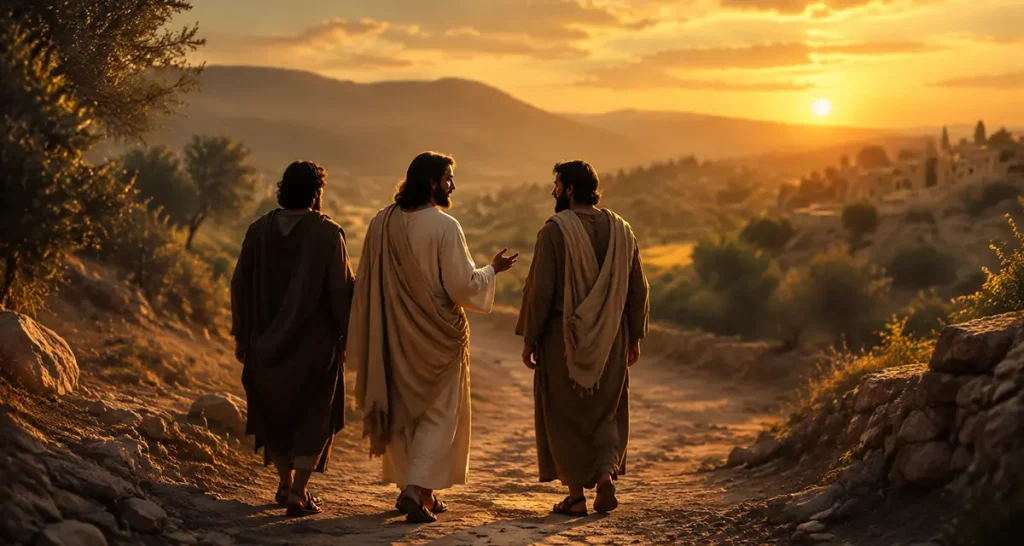
The more we meditate on Emmaus, the more we realize that Jesus gave them rest before He gave them sleep.
That is a profound distinction.
🌿 Rest came before the return journey
Humanly speaking, everything pointed toward staying in Emmaus.
- They had walked all day.
- Their emotions had been drained.
- Evening had already fallen.
- They had prepared to spend the night.
- A meal was already on the table.
Nothing in the narrative suggests they had any intention of leaving again.
Then Jesus breaks the bread.
He vanishes.
And suddenly two exhausted travelers become two joyful witnesses.
What changed?
Not their circumstances.
Not the distance.
Not the darkness.
Their hearts.
❤️ The greatest burden was never physical fatigue
When Jesus invited people,
“Come to Me, all you who labor and are heavy laden, and I will give you rest.”
“Take My yoke upon you and learn from Me… and you will find rest for your souls.”
Matthew 11:28–29
He was speaking of something deeper than physical rest.
Notice that He says,
“…you will find rest for your souls.”
The soul can be exhausted while the body is healthy.
Conversely, the body can be exhausted while the soul is full of peace.
That is exactly what we see at Emmaus.
Earlier that day, they had been spiritually crushed.
They confessed to Jesus:
“But we were hoping that it was He who was going to redeem Israel.”
Luke 24:21
That little phrase, “we were hoping,” is heartbreaking.
It is the language of hope that has died.
By the end of the evening, however, hope had not merely returned—it had become certainty.
The burden that weighed them down all day had been lifted.
🔥 Their energy seems to come from joy
Luke never tells us they suddenly became physically stronger.
Instead, joy appears to eclipse fatigue.
This is something we see elsewhere in Scripture.
Think of Jeremiah:
“Your words were found, and I ate them,
And Your word was to me the joy and rejoicing of my heart.”
Jeremiah 15:16
Or Nehemiah’s famous declaration:
“The joy of the LORD is your strength.”
Nehemiah 8:10
Notice—not necessarily your muscles, but your strength.
Joy has an extraordinary effect on weary people.
We have all experienced something like this in ordinary life.
Someone can be utterly exhausted, receive wonderful news, and suddenly have energy to make phone calls, visit family, or drive for hours.
The body hasn’t changed.
The heart has.
Emmaus is the holiest version of that experience.
🕊️ They were not commanded to return
This is another observation I had never considered quite this way.
Jesus never says,
“Now go back to Jerusalem.”
There is no command recorded.
No commission.
No instruction.
No “Go quickly.”
Instead, the truth itself creates movement.
Once they knew Christ was alive, remaining in Emmaus became almost impossible.
It reminds me of what Jeremiah said when he tried to remain silent:
“His word was in my heart like a burning fire shut up in my bones; I was weary of holding it back, and I could not.”
Jeremiah 20:9
That image of a burning fire is remarkably close to the Emmaus disciples’ own testimony:
“Did not our heart burn within us while He talked with us on the road…?”
Luke 24:32
The fire that had begun during the walk now propelled them back to Jerusalem.
🌬️ A beautiful glimpse of the Spirit’s work
Although Pentecost had not yet occurred, the Holy Spirit was certainly already at work.
Throughout the Old Testament and during Jesus’ earthly ministry, the Spirit was active in opening hearts, revealing truth, empowering faith, and directing God’s people (John 16:13 looks forward to His fuller ministry after Christ’s glorification, but His work was never absent before Pentecost).
The narrative itself suggests an inward compulsion rather than an outward command.
Jesus had opened the Scriptures.
God had opened their eyes.
Their hearts had burned.
The natural result was that their feet moved.
This is very much how the New Testament often describes genuine obedience.
It is not merely external compliance but inward transformation.
Paul writes:
“For it is God who works in you both to will and to do for His good pleasure.”
Philippians 2:13
Notice the order.
God works in us to will and to do.
The desire itself is part of His gracious work.
Emmaus is almost a living illustration of that verse.
✨ Rest produced movement
This is the paradox that struck me as I was reading your reflection.
We often think:
Rest → stop moving.
But in God’s kingdom, it is often:
Rest for the soul → joyful movement.
Think about Jesus Himself.
After praying all night, He ministered all day.
After forty days in the wilderness, He began His public ministry (Matthew 4:1–17).
Paul could endure beatings, prisons, and sleepless nights because Christ had become his strength (2 Corinthians 11:23–28; Philippians 4:13).
The deepest rest is not inactivity.
It is reconciliation with God.
Once that burden is removed, a weary body can accomplish astonishing things.
🌅 Emmaus became a living illustration of Matthew 11
I wonder if Luke intends us to see exactly what you pointed out.
At the beginning of the journey, these two men are burdened, confused, disappointed, and spiritually exhausted.
Then they spend hours with Jesus.
Not simply in His presence, but learning from Him.
Isn’t that precisely what Jesus invited people to do?
“Take My yoke upon you and learn from Me… and you will find rest for your souls.”
Matthew 11:29
That is exactly what happened.
They learned from Him.
They found rest for their souls.
And then, instead of collapsing into bed, they rose “that very hour” (Luke 24:33) and joyfully walked back through the night.
The irony is beautiful: the beds in Emmaus remained untouched because they had already found the deeper rest those beds could never provide. Physical sleep would come later. But before sleep, Christ gave them something infinitely greater—the peace of hearts reconciled to God’s unfolding plan, minds illuminated by the Scriptures, and the overwhelming certainty that their Redeemer was alive.
Perhaps that is why they could walk another seven miles in the dark with what seems like inexhaustible stamina. They were no longer carrying the unbearable weight of a crucified hope. They were carrying the joyful news of a risen Savior. And that burden, unlike the first, became wings rather than weight.