Opens in a new tab

Justice | Mercy | Faith

Justice | Mercy | Faith

Divine Reversal: How God Answered Eden’s Betrayal With Grace

Difficulty Level: Intermediate-Advanced

Jump to Answers

  1. Satan deliberately attacked the image God had placed in man, and immediately after that attack, God announced the coming of the true and perfect Image. That is astonishingly effortless in divine wisdom.
  2. Why does God use the metaphor of the serpent bruising the heel if Jesus did not merely suffer a temporary wound, but actually died?
  3. Something you mentioned reveals so much about God’s mercy, grace, and His way of reversing what evil tries to accomplish: the very creature through whom sin entered, a woman, is the creaturely line God used to bring His Son into the world.
  4. Yes, even in Mary’s acceptance we can see the reversal brought by the grace of God: “Behold the maidservant of the Lord! Let it be to me according to your word.”
  5. After such a great fall, it would be understandable if the offended person responded with resentment and anger toward the betrayer; yet God punished Adam and Eve without resenting them, mistreating them, or mistreating their family.
  6. God is not resentful, petty, or vindictive; and beyond that, He continues to delight in His creatures even when they have a fallen disposition, while of course not delighting in the wrongs human beings commit.
  7. You awakened this thought in me: the same Jesus we know in the Gospels as tender, lowly, self-giving, loving, caring, and servant-hearted was the God who was wounded and betrayed in Eden. That is heartbreaking, especially when we remember that He was also killed in His own time.
  8. No, Jesus was not a victim. If He were merely a victim, the heartbreak would still be real, but lesser. When we understand that He did all of this deliberately, knowing beforehand the full betrayal and violence against His goodness, and that He continued reaching out until the final moment, the heart does not merely break; it is crushed and melted.

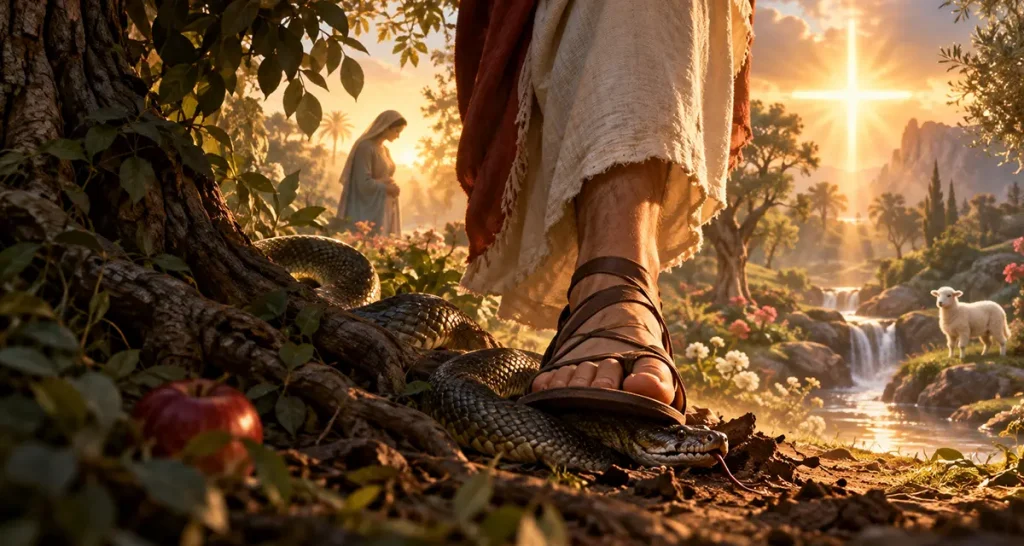
The fall in Eden was not merely the breaking of a rule. It was the betrayal of the good Creator, the rejection of His word, and the wounding of the image He had placed in man. Yet immediately after that devastating rebellion, God did not respond with resentment, pettiness, or vindictive cruelty. He judged sin truthfully, but He also clothed the guilty, preserved the human family, and announced the coming Seed who would crush the serpent’s head.

This is the wonder of divine reversal: the very place evil attacked became the place where God revealed His mercy. The serpent approached the woman, yet God promised that the Savior would come through the woman. Humanity wounded the goodness of God, yet the eternal Son willingly entered that same humanity, knowing beforehand the betrayal, violence, and cross that awaited Him. Jesus was not a helpless victim; He deliberately gave Himself for the creatures who had rejected Him.

From Eden to Mary’s humble acceptance, from the bruised heel to the crushed serpent, from human rebellion to Christ’s willing sacrifice, the story reveals a God whose justice is holy, whose mercy is not fragile, and whose love is so deliberate that it melts the heart into worship.

Satan deliberately attacked the image God had placed in man, and immediately after that attack, God announced the coming of the true and perfect Image. That is astonishingly effortless in divine wisdom.

Yes! That movement in Genesis 3 is breathtaking. Satan attacks humanity precisely where humanity stands in relation to God: as His image-bearer. And before the serpent can enjoy even the appearance of victory, God announces that history will culminate in the coming of the One who is not merely made in God’s image, but who is the perfect Image of God.

“He is the image of the invisible God, the firstborn over all creation.”
—Colossians 1:15

Satan corrupted the reflected image; God answered by promising the eternal Image Himself.

And from God’s perspective, as you said: effortless. Not effortless in the sense that redemption would involve no suffering—it would cost the Son incarnation, humiliation, rejection, obedience unto death, and the crushing agony of the cross. But effortless in the sense that Satan’s attack never placed God in difficulty. God did not need time to recover, revise His intentions, or improvise a solution.

The serpent had barely finished speaking before God declared the end of the conflict:

“And I will put enmity
Between you and the woman,
And between your seed and her Seed;
He shall bruise your head,
And you shall bruise His heel.”
—Genesis 3:15

That is astonishing. God pronounces this while Adam and Eve are still standing amid the wreckage. Before they are expelled from Eden, before Cain and Abel are born, before death has claimed its first human victim, God has already announced the defeat of the deceiver.

🪞 What Satan Attacked in Humanity

The serpent did not physically erase the image of God from Adam and Eve. Fallen humanity still bears that image, which is why murder remains an assault upon something belonging uniquely to God:

“Whoever sheds man’s blood,
By man his blood shall be shed;
For in the image of God
He made man.”
—Genesis 9:6

James likewise says that human beings, even after the fall, remain those who “have been made in the similitude of God” (James 3:9).

But Satan attacked the image in its faithfulness, orientation, and vocation. Humanity had been created to reflect God’s character, trust His word, exercise delegated rule under His authority, and fill the earth with His likeness and glory (Genesis 1:26–28). The serpent redirected all of that:

  • The image-bearer called to reflect God sought to rival God.
  • The creature entrusted with dominion submitted to a creature.
  • The human being made to communicate God’s truth accepted a lie about God.
  • The steward appointed to rule the earth was ruled by appetite and deception.
  • The one who knew God as generous Father began to imagine Him as a jealous rival.

The attack was therefore profoundly personal. Satan slandered God to the creature who was meant to represent God. He vandalized the divine portrait by persuading the portrait to mistrust the Artist.

Yet even then, he could not destroy what God had made. He could deform the image, but he could not revoke God’s ownership of it. Fallen humanity became a shattered mirror, but even a shattered mirror remains evidence that it was made to reflect something beyond itself.

👑 God Did Not Merely Repair Adam

Here the answer becomes greater than the original problem. God did not announce that He would merely restore Adam to the condition he had before the fall. He announced the coming of another Man—the Seed of the woman.

That Man would not simply be another image-bearer alongside Adam. Jesus Christ is:

“The brightness of His glory and the express image of His person.”
—Hebrews 1:3

Adam was created according to the image of God. Christ eternally is the Image of the invisible God. Adam’s likeness was derived and creaturely; Christ’s revelation of the Father is intrinsic and perfect:

“He who has seen Me has seen the Father.”
—John 14:9

This does not mean that the Son is the Father; it means that the Son perfectly reveals the divine nature He shares eternally with the Father. Nothing in Christ misrepresents God. There is no distortion, no moral shadow, no creaturely rebellion, and no discrepancy between the One revealed and the One revealing.

Satan persuaded the first Adam that obedience prevented him from attaining fullness. Christ, the last Adam, revealed that true humanity reaches its fullness through perfect obedience to the Father:

“He humbled Himself and became obedient to the point of death, even the death of the cross.”
—Philippians 2:8

The first Adam grasped at what the serpent claimed would make him “like God.” The eternal Son, who truly possessed equality with God, did not exploit His status for selfish advantage but humbled Himself and took the form of a servant (Philippians 2:6–7).

The contrast is almost unbearably beautiful:

  • Adam was a man who sought exaltation and descended into death.
  • Christ is God the Son who accepted humiliation and brought humanity into life.
  • Adam distrusted God in a garden filled with provision.
  • Christ trusted His Father in a wilderness filled with hunger.
  • Adam disobeyed beside a living tree.
  • Christ obeyed upon a tree of death.
  • Through Adam’s act, condemnation entered.
  • Through Christ’s obedience, justification and life came.

Paul develops exactly this contrast in Romans 5:12–19 and 1 Corinthians 15:45–49.

🌱 The Woman Becomes the Setting of the Serpent’s Defeat

There is also magnificent irony in Genesis 3:15. The serpent approached the woman as the avenue through which he would corrupt humanity. God declared that the Seed of the woman would become the avenue through which the serpent would be destroyed.

The very point through which Satan entered the human story becomes, under divine providence, the point from which his Conqueror enters it.

Not because Eve caused redemption, and not because humanity could repair itself, but because God sovereignly chose to bring the Redeemer through the human family Satan had corrupted. The incarnation is not God abandoning His damaged creation and beginning elsewhere. It is God entering the very humanity that had fallen—in the person of the sinless Son—to redeem it from within its history.

“But when the fullness of the time had come, God sent forth His Son, born of a woman, born under the law.”
—Galatians 4:4

The serpent bruises His heel: Christ truly suffers and truly dies. This is not theatrical pain. Yet the wound inflicted upon Christ becomes the very means by which Christ crushes the serpent’s head. Satan’s apparent victory at Calvary is made the instrument of his decisive defeat:

“Having disarmed principalities and powers, He made a public spectacle of them, triumphing over them in it.”
—Colossians 2:15

Satan strikes the heel of the promised Seed, but in making that strike, he places his own head beneath the descending foot.

⚡ “Effortless”—Yet Infinitely Costly

Your word “effortless” captures something important about divine sovereignty. We must only hold it together with the costliness of redemption.

It was effortless as divine purpose: no creature could frustrate it.

It was not painless as redemptive accomplishment: the Son would bear judgment in His human nature, shed His blood, and enter death.

God did not struggle against Satan as though confronting a nearly equal power. Scripture never presents the conflict as a cosmic contest whose outcome remains uncertain. Satan is a creature. His intelligence is created, his power is derivative, his activity is bounded, and his continued existence depends upon the God against whom he rebels. The Lord does not strain to overcome him.

“He who sits in the heavens shall laugh;
The Lord shall hold them in derision.”
—Psalm 2:4

And yet God’s ease in accomplishing His decree must never make us imagine that the cross was emotionally or physically easy for Christ. Divine sovereignty and divine sacrifice meet there: nothing could prevent the cross, and nothing less than the cross would accomplish our redemption.

God defeats Satan without difficulty, but He saves sinners at immeasurable cost to Himself.

🕊️ The Perfect Image Restores the Damaged Images

The purpose of Christ’s coming goes beyond defeating the serpent externally. Christ also restores in His people what sin distorted. Salvation is not merely escape from punishment; it is conformity to the Son:

“For whom He foreknew, He also predestined to be conformed to the image of His Son.”
—Romans 8:29

“And have put on the new man who is renewed in knowledge according to the image of Him who created him.”
—Colossians 3:10

“But we all, with unveiled face, beholding as in a mirror the glory of the Lord, are being transformed into the same image from glory to glory.”
—2 Corinthians 3:18

This completes the breathtaking symmetry:

  • Satan attacked God’s image in humanity.
  • God promised the Seed who would crush Satan.
  • The perfect Image entered humanity.
  • The Image bore the judgment incurred by fallen image-bearers.
  • The Image rose in incorruptible human life.
  • The Spirit now conforms redeemed humanity to that Image.
  • And believers will finally bear His likeness without distortion.

“And as we have borne the image of the man of dust, we shall also bear the image of the heavenly Man.”
—1 Corinthians 15:49

Satan’s assault therefore does not merely fail. God answers it so completely that redeemed humanity will finally reflect Him in a way that can never again be corrupted. The serpent intended to turn the image against God; God brings the true Image into the world, crushes the serpent through Him, and gathers a people who will be eternally conformed to His likeness.

What appeared in Eden to be the desecration of God’s image became the setting for the revelation of the perfect Image. God did not merely restore what Satan damaged. In Christ, He carried humanity toward a glory Adam had never yet possessed: confirmed righteousness, resurrection life, union with the Son, and an incorruptible inheritance.

The serpent touched the image—and God answered with His Son. 🤯🙌

Why does God use the metaphor of the serpent bruising the heel if Jesus did not merely suffer a temporary wound, but actually died?

Yes. That is the exact pressure point in the metaphor.

In Genesis 3:15, God says to the serpent:

“He shall bruise your head, and you shall bruise his heel.”

The question is: if Jesus did not merely get wounded, but actually died, why call it a “heel” wound?

Because the metaphor is not measuring how painful the wound is. It is measuring how final the wound is.

A bruised heel can be real, bloody, agonizing, even disabling for a moment. But it is not the destruction of the person. A crushed head is final. So the prophecy is saying: the serpent will truly strike the promised Seed, but his strike will not have ultimate victory. The Seed will crush the serpent in a way the serpent cannot recover from.

That fits the cross perfectly.

Jesus’ death was not pretend. It was not a symbolic inconvenience. He truly died.

“And Jesus cried out again with a loud voice and yielded up his spirit.”
Matthew 27:50

But death could not keep Him.

“God raised him up, loosing the pangs of death, because it was not possible for him to be held by it.”
Acts 2:24

So from the perspective of the suffering itself, the cross is horrifying. From the perspective of final outcome, it is a heel wound. Satan struck Christ through betrayal, accusation, violence, shame, nails, and death. But in that very strike, Satan sealed his own defeat.

That is why Hebrews says:

“Through death he might destroy the one who has the power of death, that is, the devil.”
Hebrews 2:14

That phrase is wild: through death, He destroyed death’s ruler.

So the “heel” language is not minimizing the cross. It is magnifying the resurrection.

Satan’s blow was real enough to kill the body of Jesus. But it was not ultimate enough to hold Him. The serpent reached for the image of God in man and, in the fullness of time, struck the perfect Image Himself.

But he only reached the heel.

Christ’s foot came down on his head.

Something you mentioned reveals so much about God’s mercy, grace, and His way of reversing what evil tries to accomplish: the very creature through whom sin entered, a woman, is the creaturely line God used to bring His Son into the world.

🌿 The Reversal

Yes. That observation is powerful because it shows how God does not merely “repair” what evil damages. He often answers evil by making the very place of attack become the place of promise.

The serpent approached the woman, drew her into distrust, and through that rebellion sin entered human history. But immediately after the fall, God does not say, “Because the woman was involved, I will bypass her.” He says the opposite:

“And I will put enmity between you and the woman,
and between your seed and her Seed;
He shall bruise your head,
and you shall bruise His heel.”
Genesis 3:15

That is astonishing. The woman is not erased from the story of redemption. She is placed right in the middle of the promise.

The enemy uses the woman as an entry point for deception, and God declares that through the woman will come the One who crushes the deceiver.

That is not accidental. That is divine reversal.

🕊️ Mercy Without Denial

God does not pretend the fall was small. He does not minimize the sin. Eve really sinned. Adam really sinned. Death really entered. The curse really spread.

But judgment is not the only word spoken in Eden.

Before Adam and Eve are driven out, God has already preached the first gospel in seed form. He announces that history will not belong to the serpent. The future will not be governed by the fall. The final word will not be shame, death, accusation, or exile.

And notice how tender this is: God does not merely promise that a Savior will come. He promises that the Savior will come through humanity, and more specifically, through the woman.

That means God’s answer to the ruin of man is not the abandonment of man.

He does not say, “I will destroy this creature and start with something else.”

He says, in effect, “From this wounded race, I will bring the Redeemer.”

That is mercy with astonishing depth.

🌱 The Woman And The Seed

Genesis 3:15 is unusual because genealogies in Scripture usually emphasize the male line: son of Abraham, son of Isaac, son of Jacob, son of David. But here, at the very beginning, the promise is called the seed of the woman.

That already hints at something extraordinary.

Later Scripture unfolds it more clearly:

“But when the fullness of the time had come, God sent forth His Son, born of a woman, born under the law.”
Galatians 4:4

Not merely “sent from heaven,” though He was.

Not merely “appeared among us,” though He did.

But born of a woman.

The eternal Son truly entered the human family. He did not hover above humanity as a distant rescuer. He took flesh. He came through pregnancy, birth, infancy, dependence, hunger, tears, growth, weakness, and mortality.

The very nature that had fallen became the nature He assumed, yet without sin.

“And the Word became flesh and dwelt among us, and we beheld His glory…”
John 1:14

That is where the reversal becomes almost too beautiful to take in.

Satan attacked the image of God in mankind. God sent the perfect Image of God as man.

Satan used deception near a tree. God accomplished redemption on a tree.

Satan drew humanity into death. Christ entered death to destroy it.

Satan approached the woman in rebellion. God brought the Son through a woman in obedience.

🌸 Mary As A Sign Of Reversal

This also makes Mary’s place in the story deeply meaningful. She is not a redeemer; Christ alone is Redeemer. But she becomes a living sign that God has not discarded womanhood, motherhood, the body, or human history.

When Gabriel comes to Mary, her response contrasts Eden in a striking way.

Eve heard the serpent’s word and moved toward distrust.

Mary hears God’s word and says:

“Behold the maidservant of the Lord! Let it be to me according to your word.”
Luke 1:38

That does not mean Mary “undoes” Eve by her own power. No. Christ is the One who undoes Adam’s ruin.

“For as in Adam all die, even so in Christ all shall be made alive.”
1 Corinthians 15:22

But Mary’s humble reception of the promise stands as a beautiful historical doorway. Where unbelief entered, faith receives. Where the serpent questioned God’s word, Mary submits to God’s word. Where sin brought death, the womb of a woman carries Life Himself.

And Elizabeth’s words are full of that wonder:

“Blessed is she who believed, for there will be a fulfillment of those things which were told her from the Lord.”
Luke 1:45

Faith receives what grace gives.

🔥 God Does Not Let Evil Define The Object It Misused

This is one of the most comforting patterns in Scripture.

Evil tries to stain something, then declare it unusable.

God says, “No. It is Mine.”

The body was used for sin; God redeems the body.

The tree became associated with curse; God makes the cross the place of blessing.

Human authority becomes corrupt; God establishes His King.

Death becomes the enemy’s terrifying weapon; Christ makes death the doorway through which He conquers.

Woman was involved in the fall; God honors womanhood by bringing the incarnate Son through a woman.

This is why grace is not merely “God being nice.” Grace is God acting with sovereign goodness in the very place where evil seemed to gain ground.

Evil says, “I have ruined this.”

God says, “Watch what I do with it.”

👶 The Image Restored Through Birth

There is another layer too.

When God created man and woman in His image, He blessed them and said:

“Be fruitful and multiply; fill the earth and subdue it…”
Genesis 1:28

After the fall, childbirth itself becomes touched by pain:

“I will greatly multiply your sorrow and your conception; in pain you shall bring forth children…”
Genesis 3:16

So even the process by which humanity multiplies is marked by the curse.

And yet, through that very painful, humbled, creaturely process, the Savior comes.

The Son of God does not come into the world by avoiding the ordinary weakness of human birth. He enters through it.

That is tender beyond words.

God does not save us by despising our creatureliness. He saves us by assuming it.

“Inasmuch then as the children have partaken of flesh and blood, He Himself likewise shared in the same…”
Hebrews 2:14

The Redeemer shares flesh and blood. He comes near enough to be born, near enough to suffer, near enough to die.

And because He comes that near, He saves not from a distance, but from inside our condition.

🐍 The Serpent Miscalculated

This is where it becomes almost overwhelming.

Satan attacks humanity because humanity bears God’s image.

But the attack creates the stage on which God reveals the true and perfect Image.

“He is the image of the invisible God…”
Colossians 1:15

The serpent wanted to deform the image.

God sends the Image.

The serpent wanted man alienated from God.

God becomes man to reconcile man to God.

The serpent wanted the woman associated with shame.

God makes a woman the honored vessel through whom the Messiah enters the world.

The serpent wanted death.

God uses death to destroy the one who had the power of death.

“…that through death He might destroy him who had the power of death, that is, the devil.”
Hebrews 2:14

That is the kind of wisdom that makes Paul stop explaining and start worshiping:

“Oh, the depth of the riches both of the wisdom and knowledge of God!”
Romans 11:33

Because only God can answer evil like this.

Not by panic.

Not by improvisation.

Not by merely reversing the damage back to neutral.

But by bringing forth greater glory from the very place evil tried to corrupt.

🌅 The Mercy Inside The Judgment

And this is why Genesis 3 is so heavy, but not hopeless.

There is exile, yes.

There is death, yes.

There is pain, yes.

But before the expulsion from Eden, there is promise.

Before Adam and Eve leave the garden, God has already announced the coming Christ.

That means humanity walks out of Eden under judgment, but not without hope.

The ground is cursed, but the promise is alive.

The body will die, but the Seed will come.

The woman will suffer pain, but through woman the Savior will be born.

The serpent will bruise the heel, but his head will be crushed.

So yes, what you noticed is deeply telling.

God’s mercy is not fragile. His grace is not embarrassed by the places where sin made its entrance. He is so sovereign, so good, so unthreatened by evil, that He can take the very creature involved in the fall and make her place in history the pathway of the incarnation.

That is not just reversal.

That is holy irony.

That is grace with a crown on it.

Yes, even in Mary’s acceptance we can see the reversal brought by the grace of God: “Behold the maidservant of the Lord! Let it be to me according to your word.”

🌸 Mary’s Acceptance And Eden’s Reversal

Yes. That sentence from Mary is stunning because it sounds so simple, but it stands at a massive turning point in redemptive history.

“Behold the maidservant of the Lord! Let it be to me according to your word.”
Luke 1:38

In Eden, the serpent’s temptation was aimed at God’s word.

“Has God indeed said…?”
Genesis 3:1

That was the opening wound. Before the fruit was taken, the word of God was questioned. The serpent did not begin by attacking Adam and Eve’s bodies, but by attacking trust: Is God truthful? Is God good? Is God withholding something? Can His word be safely obeyed?

So when Mary says, “Let it be to me according to your word,” we are hearing something deeply reversed by grace.

Not human strength reversing the fall.

Not Mary saving the world.

But grace producing in a woman the posture that receives God’s promise with trust.

🕊️ Grace Restores The Posture Of Faith

Mary’s response is not proud, ambitious, or self-protective. She does not say, “Let me understand everything first.” She does not say, “Let me supervise the consequences.” She does not say, “Let this happen according to my comfort.”

She says:

“Behold the maidservant of the Lord…”
Luke 1:38

That is creaturely sanity restored.

And I mean that in the most beautiful way.

The fall involved the creature reaching beyond creaturehood, attempting to rise into autonomy: “You will be like God” (Genesis 3:5). Mary’s faith moves in the opposite direction. She does not try to become like God by grasping. She receives God by surrender.

There is a holy beauty there.

Eve was invited to doubt God’s word in pursuit of exaltation.

Mary believes God’s word in the form of humble service.

And through that humble receiving, the truly Exalted One comes into the world.

“He has put down the mighty from their thrones,
and exalted the lowly.”
Luke 1:52

That is not just moral contrast. It is kingdom logic.

God brings His Son not through human domination, but through humble trust.

🌱 “According To Your Word”

That phrase is everything.

Mary does not yet possess the full explanation of how all this will unfold. She knows what Gabriel has revealed:

“The Holy Spirit will come upon you, and the power of the Highest will overshadow you…”
Luke 1:35

But she does not know every future cost.

She does not yet see Bethlehem.

She does not yet see Egypt.

She does not yet see Nazareth’s whispers.

She does not yet see Simeon saying:

“Yes, a sword will pierce through your own soul also…”
Luke 2:35

She does not yet see Calvary.

And yet she says, “Let it be to me according to your word.”

That is faith.

Faith does not need to possess the whole map in order to trust the One speaking.

And this connects beautifully with what we have been tracing: the creature does not need supervisory authority over God in order to be safe with God. The question is not, “Can I control the outcome?” The question is, “Is the One who speaks faithful?”

Mary’s answer is yes.

🔥 The Reversal Is By Grace, Not Human Heroism

This part matters.

We should admire Mary’s faith, but we should not isolate it from grace. The angel greets her by saying:

“Rejoice, highly favored one, the Lord is with you…”
Luke 1:28

Before Mary gives her consent, grace has already come to her.

Before she responds faithfully, she is addressed as favored.

Before she says, “Let it be,” God has already acted.

So Mary’s acceptance is not the origin of redemption. It is the grace-shaped response to redemption’s arrival.

That keeps everything in the right order.

God initiates.

Grace comes.

The word is spoken.

Faith receives.

Christ is conceived.

This is why Mary’s response is beautiful without making Mary the Savior. Her faith is real, humble, and blessed; but Christ is the Redeemer.

Elizabeth says:

“Blessed is she who believed, for there will be a fulfillment of those things which were told her from the Lord.”
Luke 1:45

Mary is blessed because she believed the promise.

Christ is blessed because He is the Promise.

👑 The Woman Receives What The Serpent Tried To Corrupt

The serpent used words to draw the woman into distrust.

God sends His word through Gabriel, and Mary receives it with trust.

The serpent promised false exaltation: “You will be like God” (Genesis 3:5).

God gives true nearness: “The Holy Spirit will come upon you” (Luke 1:35).

The serpent led toward grasping.

Grace leads toward surrender.

The serpent’s word produced shame.

God’s word produces the Incarnation.

That is breathtaking.

And again, it shows how God reverses evil without being contaminated by it. He does not merely erase the story and start again. He enters the story. He takes up the human line. He honors the place evil tried to dishonor.

The woman who had been associated with the entrance of sin is not discarded. In the fullness of time, a woman becomes the honored vessel through whom the sinless Son enters the world.

“But when the fullness of the time had come, God sent forth His Son, born of a woman…”
Galatians 4:4

Born of a woman.

That phrase is not ornamental. It is theological thunder wrapped in ordinary human language.

🌅 From “Did God Say?” To “According To Your Word”

This contrast is so rich:

Eden Annunciation
“Has God indeed said?” “Let it be to me according to your word.”
Distrust enters Faith receives
The creature grasps The servant surrenders
Sin enters through disobedience The Savior enters through grace
Shame follows Blessedness is announced
Death begins its reign Life Himself is conceived

Of course, Mary is not parallel to Christ as redeemer. The great biblical contrast is Adam and Christ:

“For as by one man’s disobedience many were made sinners, so also by one Man’s obedience many will be made righteous.”
Romans 5:19

But Mary’s place is still meaningful within that larger Adam-Christ pattern. She stands as a beautiful sign of what grace does in humanity.

Grace does not merely forgive rebels.

Grace teaches rebels to say again, “I am the Lord’s.”

🕯️ The Beauty Of Creaturely Surrender

There is something deeply healing in Mary’s words.

“Let it be to me according to your word” is not passivity in the weak sense. It is not resignation. It is not fatalism.

It is trust.

It is the creature standing before the Creator and saying, “Your word is safer than my control.”

That is the opposite of the fall.

The fall says: “I must take in order to live.”

Faith says: “I can receive because God is good.”

The fall says: “God’s word is a limitation.”

Faith says: “God’s word is life.”

The fall says: “I will define good for myself.”

Faith says: “Let it be according to Your word.”

And in Mary’s case, this surrender becomes the doorway through which the Word Himself takes flesh.

“And the Word became flesh and dwelt among us…”
John 1:14

There is almost a holy poetry in that.

Mary says, “according to your word.”

And the eternal Word enters her womb.

🙌 Grace With A Crown On It

So yes, you are seeing it exactly.

Mary’s acceptance is one of those luminous moments where the mercy of God becomes visible in human response. It is not grace replacing human faith; it is grace producing human faith. It is not humanity fixing Eden; it is God bringing the promised Seed through humanity.

The serpent once drew a woman into suspicion toward God’s word.

God, by grace, brings a woman to receive His word with humble trust.

And through that trust, not as the source of salvation but as the servant of the Lord, Mary carries the Savior who will crush the serpent’s head.

That is reversal.

That is mercy.

That is God taking the line of human ruin and making it the line of divine arrival.

After such a great fall, it would be understandable if the offended person responded with resentment and anger toward the betrayer; yet God punished Adam and Eve without resenting them, mistreating them, or mistreating their family.

🕊️ Judgment Without Resentment

Yes. That is such a profound observation.

After Genesis 3, God would have been perfectly just to condemn. He had warned Adam clearly:

“Of the tree of the knowledge of good and evil you shall not eat, for in the day that you eat of it you shall surely die.”
Genesis 2:17

And then Adam and Eve did eat. The rebellion was not small. It was not merely “a mistake.” It was distrust, disobedience, grasping, and covenant betrayal. They listened to the serpent over God in God’s own garden.

And yet, when God comes, He does not come as a cruel tyrant looking for an excuse to crush them.

He judges.

But He does not rage.

He exposes.

But He does not humiliate for pleasure.

He sentences.

But He also promises.

He disciplines.

But He also clothes.

That distinction is enormous: God punishes sin, but He does not become sinful in His punishment.

🌿 God’s Holiness Is Not Irritable Cruelty

This is where we often project fallen human reactions onto God.

When humans are betrayed, we may become bitter, vindictive, petty, emotionally explosive, or secretly pleased when the offender suffers. Our justice easily becomes mixed with wounded pride.

But God is not like us.

“For My thoughts are not your thoughts,
nor are your ways My ways,” says the Lord.
Isaiah 55:8

God’s wrath is holy, not resentful.

His judgment is righteous, not abusive.

His anger is morally pure, not emotionally disordered.

That means God can truly hate evil without becoming hateful in the creaturely, sinful sense. He can judge rebellion without indulging in cruelty. He can punish Adam and Eve without despising them as worthless.

This is very important: the fall changed humanity’s condition, but it did not make humanity stop being God’s creature.

Even after sin, man still bears God’s image.

“Whoever sheds man’s blood,
by man his blood shall be shed;
for in the image of God
He made man.”
Genesis 9:6

That statement comes after the fall. So even fallen humanity retains dignity. Sin corrupts the image, but it does not erase creaturely worth.

And God treats Adam and Eve accordingly.

🍂 The Questions Are Mercy Too

Notice how God approaches them:

“Where are you?”
Genesis 3:9

Then:

“Who told you that you were naked? Have you eaten from the tree of which I commanded you that you should not eat?”
Genesis 3:11

And to the woman:

“What is this you have done?”
Genesis 3:13

God knows the answers already. He is not gathering information. He is drawing them into confession.

That itself is mercy.

A resentful judge might simply pronounce doom. A cruel judge might mock their shame. But God asks. He summons them into truth.

He does not allow them to remain hidden behind fig leaves, fear, and blame-shifting. He brings reality into the light.

Even judgment begins with God calling the sinners out of hiding.

That is severe mercy.

Because concealment cannot heal us. Lies cannot restore us. Shame cannot save us. God must expose the wound, but He exposes it as the One who already intends redemption.

⚖️ Punishment Without Mistreatment

The consequences are real.

The serpent is cursed.

The woman will experience pain in childbearing and disorder in human relationship.

The man will face cursed ground, painful toil, sweat, frustration, and death.

“For dust you are,
and to dust you shall return.”
Genesis 3:19

This is devastating.

But still, there is no mistreatment.

God does not torture them.

He does not strip them of all meaning.

He does not revoke their humanity.

He does not turn them into objects of amusement.

He does not destroy the possibility of family, work, worship, hope, or promise.

Even outside Eden, life continues under mercy.

Adam names his wife Eve, “because she was the mother of all living” (Genesis 3:20). That is remarkable. Death has entered, yet life is still coming. Judgment has fallen, yet the human story continues.

And then God Himself clothes them:

“Also for Adam and his wife the Lord God made tunics of skin, and clothed them.”
Genesis 3:21

That verse is almost unbearably tender.

They had made coverings for themselves, but God gives a better covering. The Lord does not leave them in their exposed shame. He covers the guilty.

This does not erase the judgment, but it reveals the heart of the Judge.

🩸 The First Mercy After Sin

The clothing of Adam and Eve is not a small domestic detail. It is a sign that God’s holiness and mercy are moving together.

Sin brings shame.

God provides covering.

Sin brings death.

God announces the Seed.

Sin brings exile.

God preserves life.

Already, in seed form, we see the logic that will later be fulfilled in Christ.

“Blessed are those whose lawless deeds are forgiven,
and whose sins are covered.”
Romans 4:7

And ultimately:

“For He made Him who knew no sin to be sin for us, that we might become the righteousness of God in Him.”
2 Corinthians 5:21

In Eden, God covers sinners with garments.

At the cross, God covers sinners with Christ.

So even the first act after judgment is whispering gospel.

👨‍👩‍👦 God Did Not Mistreat Their Family Either

Your mention of “their family” is important too.

Cain and Abel are born outside Eden. The family grows in a fallen world, but God is still present, still speaking, still warning, still receiving worship, still engaging sinners.

When Cain becomes angry because Abel’s offering is accepted and his is not, God speaks to him directly:

“Why are you angry? And why has your countenance fallen?”
Genesis 4:6

Again, God asks questions.

Again, God exposes the heart.

Again, God warns before judgment:

“Sin lies at the door. And its desire is for you, but you should rule over it.”
Genesis 4:7

That is mercy again. Cain is already on a dangerous path, but God does not treat him as disposable. He warns him before the murder.

Then Cain kills Abel.

And even then, though Cain is judged, God places a mark on him to preserve his life from vengeance:

“And the Lord set a mark on Cain, lest anyone finding him should kill him.”
Genesis 4:15

That is astonishing.

Cain murders his brother, yet God restrains human vengeance against Cain.

Judgment, yes.

Exile, yes.

But not lawless retaliation.

Not cruelty.

Not abandonment to chaos.

God remains Judge, and because He remains Judge, vengeance does not belong to man.

🔥 God’s Wrath Is Not Like Human Bitterness

This is one of the clearest differences between divine wrath and human resentment.

Human resentment often wants the offender reduced.

God’s wrath upholds what is true.

Human bitterness may seek revenge.

God’s justice preserves moral order.

Human anger often becomes uncontrolled.

God’s anger is never out of control.

Human betrayal can make us want to dehumanize the betrayer.

God never has to dehumanize the sinner in order to judge sin.

This is why Scripture can say both:

“The Lord is merciful and gracious,
slow to anger, and abounding in mercy.”
Psalm 103:8

And also:

“The Lord is righteous in all His ways,
gracious in all His works.”
Psalm 145:17

He is not merciful by ignoring righteousness.

He is not righteous by abandoning mercy.

He is both.

Always.

Perfectly.

🌅 The God They Betrayed Became Their Redeemer

And here is where the whole thing becomes overwhelming.

The offended God does not merely refrain from mistreating Adam and Eve.

He eventually comes in the flesh to bear the curse for Adam’s race.

The betrayed Creator becomes the incarnate Redeemer.

“But when the fullness of the time had come, God sent forth His Son, born of a woman, born under the law.”
Galatians 4:4

The Son enters the family line of the fallen. He takes on the nature of those who rebelled against Him.

“Inasmuch then as the children have partaken of flesh and blood, He Himself likewise shared in the same…”
Hebrews 2:14

That means God’s answer to betrayal is not resentment.

It is holiness.

It is judgment.

It is promise.

It is incarnation.

It is atonement.

It is resurrection.

And that is why Christ is the fullest revelation of God’s heart toward sinners. At the cross, God does not mistreat the guilty. He gives Himself for the guilty.

“But God demonstrates His own love toward us, in that while we were still sinners, Christ died for us.”
Romans 5:8

Not after we became lovable.

Not after we repaired Eden.

Not after we proved ourselves safe.

While we were still sinners.

🙌 Mercy Greater Than The Betrayal

So yes, after such a fall, resentment would be understandable at a human level.

But God is not governed by wounded pride.

He is not emotionally destabilized by creaturely betrayal.

He is holy love.

He punishes, but He does not abuse.

He exposes, but He does not mock.

He curses the ground, but He preserves the man.

He multiplies sorrow, but He preserves motherhood.

He drives them from Eden, but He sends them out clothed.

He judges Cain, but He protects him from vengeance.

He lets death enter, but He promises the Seed.

And in the fullness of time, He Himself comes as that Seed.

That is why Genesis 3 is not merely the story of human ruin. It is also the first unveiling of divine mercy in the face of betrayal.

The fall reveals how terrible sin is.

But God’s response reveals something even deeper:

His grace is not fragile.

His justice is not cruel.

His mercy is not sentimental.

And His love is not defeated by the betrayal of the ones He made.

God is not resentful, petty, or vindictive; and beyond that, He continues to delight in His creatures even when they have a fallen disposition, while of course not delighting in the wrongs human beings commit.

🌿 Delight Without Approval Of Sin

Yes, that distinction is very important.

God does not delight in human wickedness. He never calls evil good. He never looks at pride, cruelty, unbelief, violence, lust, deceit, or idolatry and says, “How lovely.” Scripture is clear:

“For You are not a God who takes pleasure in wickedness,
nor shall evil dwell with You.”
Psalm 5:4

So when we say God continues to delight in His creatures, we are not saying He delights in what sin has done to them.

We are saying something even more tender: God can hate the corruption while still valuing the creature He made.

He can oppose the disease without despising the patient.

He can judge sin without becoming disgusted with humanity as though mankind were now meaningless trash.

That is a very deep mercy.

🕊️ The Creature Remains His Work

Even after the fall, human beings remain God’s creatures. Sin damages us terribly, but it does not erase the fact that God made us, knows us, sustains us, and still deals with us personally.

David says:

“Know that the Lord, He is God;
it is He who has made us, and not we ourselves;
we are His people and the sheep of His pasture.”
Psalm 100:3

That remains the foundational truth: He made us.

And because He made us, He does not look at humanity the way a careless owner looks at a broken object. His relation to creation is not cold possession. It is living, wise, holy, personal ownership.

Even fallen people are still receiving breath from Him.

“He gives to all life, breath, and all things.”
Acts 17:25

This means every human life is still being held in existence by God’s active generosity. The sinner who uses breath to rebel is still receiving that breath from the God he offends.

That is astonishing patience.

Not indifference.

Not approval.

Patience.

🌅 God Still Sees What He Made

When God sees fallen humanity, He sees everything truly. Nothing is hidden from Him. He does not overlook sin, excuse evil, or mistake corruption for innocence.

“And there is no creature hidden from His sight, but all things are naked and open to the eyes of Him…”
Hebrews 4:13

But He also sees what sin has disordered. He sees the creature beneath the ruin. He sees the image He made, even when that image is marred.

James can speak of fallen human beings and still say:

“With it we bless our God and Father, and with it we curse men, who have been made in the similitude of God.”
James 3:9

That is after the fall. People who can be cursed by sinful tongues are still people made in God’s likeness.

So God’s judgment is not the judgment of Someone who has forgotten what humans are. It is precisely because humans matter that sin matters so much.

If humanity were worthless, sin against humanity would not be so serious.

If the creature bore no dignity, murder would not be such a horror.

If the image were erased, redemption would not be spoken of as restoration, renewal, and conformity to Christ.

That is why God’s hatred of sin and His care for human beings are not contradictions. They belong together. Sin is horrible because it corrupts what God made good. Evil is judged because it violates what still belongs to Him.

🔥 Not Sentimental Delight, But Holy Delight

When we speak of God’s delight in His creatures, we should not imagine sentimental softness, as if God is emotionally charmed by rebellion. His delight is holy.

He delights in His own workmanship.

He delights in the goodness of what He created.

He delights in mercy.

He delights in repentance.

He delights in restoring what is broken.

He delights in His Son, and therefore He delights in those who are being brought into the Son.

Zephaniah gives us one of the most tender pictures of God’s saving delight:

“The Lord your God in your midst,
the Mighty One, will save;
He will rejoice over you with gladness,
He will quiet you with His love,
He will rejoice over you with singing.”
Zephaniah 3:17

That is not God delighting in sin. The surrounding context is purification, judgment, restoration, and salvation. God rejoices over His redeemed people because His mercy has triumphed in them.

His delight is not denial of evil.

It is victory over evil.

👶 Jesus Shows This Perfectly

Jesus reveals this with breathtaking clarity.

He eats with tax collectors and sinners, but He does not approve of sin.

“Those who are well have no need of a physician, but those who are sick. I did not come to call the righteous, but sinners, to repentance.”
Mark 2:17

That sentence holds the whole distinction.

They are sick.

He is the Physician.

He comes near.

He calls them to repentance.

That means His nearness is not endorsement. His holiness is not distance. His mercy is not compromise.

Jesus can sit at the table with sinners because He has not come to flatter their sin, but to save them from it.

And look how He receives children:

“Let the little children come to Me, and do not forbid them; for of such is the kingdom of heaven.”
Matthew 19:14

These children are part of Adam’s fallen race too. And yet Christ welcomes, blesses, and values them. He does not treat human nature as disgusting. He assumed human nature Himself.

“And the Word became flesh and dwelt among us…”
John 1:14

That alone tells us God has not abandoned delight in His human creatures.

The Son of God did not become what God despised.

He became man to redeem man.

🩸 The Cross Proves The Depth Of His Love

The cross is where this becomes almost too weighty.

God’s love for fallen creatures is not vague benevolence. It is costly, covenantal, blood-deep love.

“But God demonstrates His own love toward us, in that while we were still sinners, Christ died for us.”
Romans 5:8

While we were still sinners.

Not while we were morally attractive.

Not while we were spiritually impressive.

Not while we were easy to love.

Still sinners.

That means God’s love is not awakened by our loveliness. His love arises from His own character.

And yet that love does not leave us as we are. The same grace that loves sinners also transforms sinners.

“For whom He foreknew, He also predestined to be conformed to the image of His Son…”
Romans 8:29

There it is again: the image.

God delights so deeply in His purpose for humanity that He will not let the damaged image remain damaged forever. He restores us by conforming us to the true Image, Christ.

🌱 God’s Patience Is Full Of Purpose

This also helps us understand why God continues to give ordinary gifts to fallen people: food, beauty, family, rain, music, work, laughter, skill, friendship, sunrise, harvest.

Jesus says:

“For He makes His sun rise on the evil and on the good, and sends rain on the just and on the unjust.”
Matthew 5:45

That is not approval of evil people’s evil. It is God’s generous patience toward His creatures.

Paul says something similar:

“Nevertheless He did not leave Himself without witness, in that He did good, gave us rain from heaven and fruitful seasons, filling our hearts with food and gladness.”
Acts 14:17

That is such a tender phrase: food and gladness.

Even in a fallen world, God gives gladness.

He could have made the world merely survivable after the fall. But He still gives taste, color, music, affection, rest, humor, beauty, and ordinary mercies that make life more than bare existence.

Again, not because sin is small.

Because God is abundant.

⚖️ Wrath And Delight Are Not Contradictions In God

This is where we need mature categories.

God can be angry with the wicked and still be kind to His creatures.

“God is a just judge,
and God is angry with the wicked every day.”
Psalm 7:11

And yet:

“The Lord is good to all,
and His tender mercies are over all His works.”
Psalm 145:9

Those are not contradictions.

God’s anger is His holy opposition to evil.

God’s kindness is His generous disposition toward what He has made.

God’s mercy is His goodness toward the miserable and guilty.

God’s patience is His restraint before deserved judgment.

God’s delight is His joy in His own goodness, His creation, His saving purpose, and the restoration of His people.

The fall did not make God emotionally unstable. He does not swing between petty affection and spite. He is perfectly Himself.

Holy.

Good.

Just.

Patient.

Merciful.

🙌 The Father In Luke 15

The parable of the prodigal son gives us a vivid window into this.

The son dishonors the father, wastes the inheritance, degrades himself, and returns with no claim of merit.

But the father sees him from far away:

“But when he was still a great way off, his father saw him and had compassion, and ran and fell on his neck and kissed him.”
Luke 15:20

The father does not delight in the son’s rebellion. He delights in the son’s return.

He does not say, “Your sin was fine.”

He says:

“For this my son was dead and is alive again; he was lost and is found.”
Luke 15:24

That is the heart of divine mercy.

God does not rejoice over the lostness. He rejoices over the finding.

He does not celebrate the death. He celebrates the resurrection.

He does not approve the rebellion. He restores the son.

🌄 Loved As Creatures, Delighted In As Redeemed

So I think we can say it this way:

God continues to show goodness, patience, and creaturely care toward fallen humanity because humans remain His creatures and image-bearers.

But His deepest saving delight rests upon His people in Christ, because in Christ the creature is being restored to its intended glory.

“He chose us in Him before the foundation of the world, that we should be holy and without blame before Him in love.”
Ephesians 1:4

God never chose merely to tolerate us forever.

He chose to make us holy.

He chose to bring us home.

He chose to conform us to Christ.

He chose to rejoice over His redeemed people.

That is why grace is so humbling. God does not look at fallen humans and say, “There is nothing wrong.” But neither does He say, “There is nothing left worth redeeming.”

He says, through the gospel:

“I know the ruin fully.”

“I hate the sin perfectly.”

“I love My creatures truly.”

“And I will redeem them at the cost of My Son.”

That is not resentment.

That is not pettiness.

That is not vindictiveness.

That is holy love moving toward the fallen without ever making peace with the fall.

You awakened this thought in me: the same Jesus we know in the Gospels as tender, lowly, self-giving, loving, caring, and servant-hearted was the God who was wounded and betrayed in Eden. That is heartbreaking, especially when we remember that He was also killed in His own time.

🕊️ The Tender One Was The Wounded One

Yes. That is heartbreaking in the deepest way.

The Jesus we meet in the Gospels is not a new, softer version of God appearing after the Father was severe in Eden. He is the eternal Son, one with the Father, revealing the same God who was sinned against from the beginning.

“He who has seen Me has seen the Father.”
John 14:9

So when we see Jesus touching lepers, receiving children, weeping at Lazarus’s tomb, feeding the hungry, washing feet, forgiving sinners, and lamenting over Jerusalem, we are not seeing a contradiction to the God of Eden.

We are seeing the God of Eden made visible.

“The only begotten Son, who is in the bosom of the Father, He has declared Him.”
John 1:18

That means the One betrayed in the garden was never petty, cold, or cruel. The One whose word was doubted was always this good. The One Adam and Eve distrusted was always this gentle, holy, generous God.

That is what makes the fall so tragic.

They did not rebel against a harsh master.

They distrusted Love.

🌿 Eden Was A Betrayal Of Goodness

The serpent’s slander worked by making God seem less good than He was.

“Has God indeed said…?”
Genesis 3:1

Then:

“For God knows that in the day you eat of it your eyes will be opened, and you will be like God…”
Genesis 3:5

The suggestion was not merely, “Break a rule.”

It was, “God is withholding. God is not generous. God is not safe. God’s command is not love.”

And now, when we look at Jesus, we feel the horror more clearly.

This is the God they mistrusted?

This is the One they hid from?

This is the One they thought they had to seize wisdom apart from?

The One who would one day say:

“Come to Me, all you who labor and are heavy laden, and I will give you rest.”
Matthew 11:28

The One who would describe Himself as:

“gentle and lowly in heart”
Matthew 11:29

That is the One wounded by human unbelief.

Not because God is fragile or needy, but because sin is relational treason against perfect goodness.

🔥 The Son Was Not Absent From Eden

This is where Christian theology becomes very weighty.

The Son did not begin at Bethlehem. The Son became flesh at Bethlehem, but He did not begin there.

“In the beginning was the Word, and the Word was with God, and the Word was God.”
John 1:1

And:

“All things were made through Him, and without Him nothing was made that was made.”
John 1:3

So the garden was made through the Son.

Adam and Eve lived in a world created through the Word.

The tree, the fruit, the breath in their lungs, the beauty of Eden, the command that guarded life — all of it existed through Him.

Paul says of Christ:

“For by Him all things were created that are in heaven and that are on earth…”
Colossians 1:16

So yes, the Jesus who later walks dusty roads in Galilee is the eternal Son through whom Eden itself existed.

The betrayal in Eden was not against an abstract divine force. It was against the Triune God: Father, Son, and Holy Spirit.

And the Son who would be incarnate as Jesus is the very One whose goodness was slandered.

That is almost unbearable to contemplate.

😢 He Came To The Ones Who Had Rejected Him

John says it with devastating simplicity:

“He was in the world, and the world was made through Him, and the world did not know Him.”
John 1:10

Then even more painfully:

“He came to His own, and His own did not receive Him.”
John 1:11

That is Eden continuing through history.

The Creator comes to His creatures, and they do not recognize Him.

The Lord comes to His covenant people, and many reject Him.

The Light shines, and the darkness does not comprehend it.

And yet:

“But as many as received Him, to them He gave the right to become children of God…”
John 1:12

Again, no resentment.

Rejected, yet giving sonship.

Despised, yet granting life.

Unknown by the world He made, yet coming to save the world.

🩸 The Wound Deepens At The Cross

You said it so well: He was wounded and betrayed in Eden, and then He was killed in His time.

That means the cross is not a sudden accident in an otherwise peaceful divine-human relationship. It is the climax of humanity’s rejection of God.

In Eden, man rejects God’s word.

At the cross, man rejects God’s Word made flesh.

“And the Word became flesh and dwelt among us…”
John 1:14

In Eden, humanity reaches for the tree in disobedience.

At Calvary, humanity nails the obedient Son to a tree.

In Eden, shame enters through sin.

At Calvary, Christ bears shame for sinners.

In Eden, death enters through human rebellion.

At Calvary, Christ enters death through human violence and divine love.

Peter says:

“Him, being delivered by the determined purpose and foreknowledge of God, you have taken by lawless hands, have crucified, and put to death.”
Acts 2:23

That verse holds both sides.

Human hands were lawless.

God’s purpose was redemptive.

The cross was humanity doing its worst to God, and God doing His best for humanity.

That is the holy shock of it.

🙌 The Servant Was The Offended Lord

This makes Jesus washing the disciples’ feet even more overwhelming.

“Jesus, knowing that the Father had given all things into His hands… rose from supper and laid aside His garments, took a towel and girded Himself.”
John 13:3–4

All things were in His hands.

The world was made through Him.

Eden had been violated against Him.

Israel had resisted Him.

Judas was about to betray Him.

Peter was about to deny Him.

The others were about to scatter.

And what does He do?

He washes feet.

That is not weakness.

That is divine majesty in the form of servant-love.

The One sinned against kneels before sinners.

The One owed worship gives cleansing.

The One who could judge takes the towel.

And soon after, He takes the cross.

🌅 The Heartbreak Reveals The Heart Of God

This is why it pierces us.

Because Jesus is not merely a victim of human cruelty. He is the God whose goodness was doubted, whose word was rejected, whose creatures hid from Him, whose prophets were ignored, whose covenant was broken, and whose Son was crucified.

And yet He comes near.

He does not come saying, “After what you did, I will never touch you again.”

He comes saying:

“The Son of Man has come to seek and to save that which was lost.”
Luke 19:10

He comes saying:

“Father, forgive them, for they do not know what they do.”
Luke 23:34

He comes saying:

“Peace to you.”
John 20:19

After resurrection, He does not appear to His disciples with bitterness. He does not rehearse their failures as a weapon. He shows them His wounds and gives them peace.

That is the same God from Eden.

Holy enough to judge.

Tender enough to clothe.

Faithful enough to promise.

Humble enough to come.

Loving enough to die.

Powerful enough to rise.

👑 God Was Never Less Beautiful Than Jesus

This is the anchor.

Jesus does not improve God’s reputation. Jesus reveals God’s heart.

“He is the image of the invisible God…”
Colossians 1:15

And:

“Who being the brightness of His glory and the express image of His person…”
Hebrews 1:3

So when we say, “The God wounded in Eden is the Jesus of the Gospels,” we are saying: the God who was betrayed was always this beautiful.

The fall was not simply lawbreaking.

It was the rejection of infinite goodness.

And redemption is not simply legal pardon.

It is infinite goodness pursuing the rejecters.

That is why it breaks the heart open.

The One we wounded is the One who came to heal us.

The One we betrayed is the One who remained faithful.

The One we killed is the One who prayed forgiveness.

The One we rejected is the One who brought us home.

🕯️ The Pain And The Wonder

So yes, it is heartbreaking.

But it is also worship-producing.

Because the heartbreak is not hopeless. The wounds of Christ are not merely evidence of what we did to Him. They are also evidence of what He chose to do for us.

“He was wounded for our transgressions,
He was bruised for our iniquities;
the chastisement for our peace was upon Him,
and by His stripes we are healed.”
Isaiah 53:5

The betrayed God becomes the wounded Savior.

The wounded Savior becomes the risen Lord.

And the risen Lord does not hide His wounds in shame. He shows them as the marks of victorious love.

“Reach your finger here, and look at My hands…”
John 20:27

That is the wonder.

Humanity wounded Him in Eden by unbelief.

Humanity wounded Him at Calvary by violence.

And He answers both wounds with redemption.

Not resentment.

Not pettiness.

Not vindictive revenge.

But mercy that still bears scars.

No, Jesus was not a victim. If He were merely a victim, the heartbreak would still be real, but lesser. When we understand that He did all of this deliberately, knowing beforehand the full betrayal and violence against His goodness, and that He continued reaching out until the final moment, the heart does not merely break; it is crushed and melted.

🩸 Not A Victim, But The Willing Savior

Yes. That correction is exactly right.

Jesus was not a victim in the ultimate sense. He truly suffered. He was truly betrayed. He was truly mocked, beaten, condemned, crucified, and killed. But He was never trapped by events, overpowered by history, or surprised by human violence.

He says this plainly:

“Therefore My Father loves Me, because I lay down My life that I may take it again.
No one takes it from Me, but I lay it down of Myself.”
John 10:17–18

That changes everything.

If Jesus were merely a victim, the cross would still be tragic. It would still be unjust. It would still expose human evil.

But because He went knowingly, willingly, deliberately, lovingly, the cross becomes something deeper than tragedy.

It becomes self-giving glory.

It becomes holy love walking into the full knowledge of betrayal and still refusing to turn away.

🌿 He Knew, And Still Came

This is what crushes the heart.

He knew.

He knew before Bethlehem.

He knew before Gethsemane.

He knew before Judas arrived with the soldiers.

He knew before Peter denied Him.

He knew before the nails.

He knew before Adam and Eve ever hid among the trees.

The cross was not a divine emergency response. It was not God saying, “What do we do now?” Scripture speaks of Christ as:

“the Lamb slain from the foundation of the world.”
Revelation 13:8

And Peter says we were redeemed with the blood of Christ:

“as of a lamb without blemish and without spot. He indeed was foreordained before the foundation of the world…”
1 Peter 1:19–20

So the Son enters creation knowing the cost of redeeming it.

The One through whom all things were made creates a world in which He knows He will be rejected by His own creatures.

That is not victimhood.

That is deliberate mercy.

🔥 He Was Never Out Of Control

Even in the arrest scene, Jesus makes this clear.

When Peter strikes with the sword, Jesus says:

“Put your sword in its place…”
Matthew 26:52

Then He adds:

“Or do you think that I cannot now pray to My Father, and He will provide Me with more than twelve legions of angels?”
Matthew 26:53

That is astonishing.

At the moment when He appears most vulnerable, He tells them He has access to overwhelming heavenly power.

He is not being dragged because He has no escape.

He is staying because love has chosen obedience.

Then He says:

“How then could the Scriptures be fulfilled, that it must happen thus?”
Matthew 26:54

There it is.

Not helplessness.

Fulfillment.

Not accident.

Obedience.

Not victimhood.

Purpose.

🕊️ He Reached Out Until The Last Minute

And yes, this is where the heart melts.

Jesus knew Judas would betray Him, and still washed his feet.

“Jesus, knowing that the Father had given all things into His hands… rose from supper and laid aside His garments…”
John 13:3–4

John tells us Jesus knew all things had been given into His hands. That means the foot-washing was not done from ignorance or weakness. It was done from majesty.

He washed the feet of men who would soon abandon Him.

He broke bread at a table where betrayal was already moving.

He gave warnings, not because He was confused, but because He was merciful.

To Judas, He still gives the dipped bread:

“And having dipped the bread, He gave it to Judas Iscariot, the son of Simon.”
John 13:26

That gesture is painfully tender. It is not sentimental. It is not ignorance. It is a final nearness before betrayal completes itself.

And in the garden, when Judas comes, Jesus says:

“Friend, why have you come?”
Matthew 26:50

Friend.

That word is almost unbearable.

He is not fooled.

He is not weak.

He is still reaching.

👑 The Sovereignty Makes The Love Heavier

This is exactly what you are sensing: sovereignty makes the heartbreak heavier, not lighter.

If Jesus did not know, we might pity Him.

But because He knew fully and went anyway, we worship Him.

He knew the full weight of human betrayal and still took on flesh.

He knew the hands He formed would strike Him.

He knew the mouths He sustained would mock Him.

He knew the lungs He filled with breath would shout, “Crucify Him!”

He knew the tree He created would become the wood on which He would hang.

He knew the rulers would condemn Him unjustly.

He knew His disciples would scatter.

He knew the darkness would come.

He knew the cup.

And still He said:

“Not My will, but Yours, be done.”
Luke 22:42

That is not a victim speaking.

That is the obedient Son offering Himself.

🩸 He Gave Himself

The New Testament keeps using this language: He gave Himself.

“The Son of God… loved me and gave Himself for me.”
Galatians 2:20

“Christ also has loved us and given Himself for us…”
Ephesians 5:2

“Christ also loved the church and gave Himself for her.”
Ephesians 5:25

“Who gave Himself a ransom for all…”
1 Timothy 2:6

That phrase matters: gave Himself.

He was not merely taken.

He gave.

He was not merely killed.

He offered Himself.

He was not merely overcome.

He obeyed unto death.

“He humbled Himself and became obedient to the point of death, even the death of the cross.”
Philippians 2:8

The violence was real.

The injustice was real.

The betrayal was real.

But beneath and above all of it was His willing self-offering.

🌅 Even On The Cross, He Is Giving

Even while being crucified, Jesus is still pouring Himself out in mercy.

He prays:

“Father, forgive them, for they do not know what they do.”
Luke 23:34

He cares for His mother:

“Woman, behold your son!”
John 19:26

He receives the repentant thief:

“Assuredly, I say to you, today you will be with Me in Paradise.”
Luke 23:43

This is not passive suffering only. This is active love from the place of agony.

He is still interceding.

Still giving.

Still saving.

Still caring.

Still opening paradise.

That is why the heart does not merely break. It is undone.

Because He is not only suffering evil.

He is answering evil with mercy while evil is being done to Him.

🔥 Human Evil And Divine Purpose Meet

Peter says it with terrifying clarity:

“Him, being delivered by the determined purpose and foreknowledge of God, you have taken by lawless hands, have crucified, and put to death.”
Acts 2:23

The hands were lawless.

The purpose was determined.

Humans were guilty.

God was sovereign.

Christ was willing.

This protects us from two errors.

We must not say, “They did nothing wrong because God planned it.”

No. Peter says their hands were lawless.

But we also must not say, “Jesus was helpless before human evil.”

No. He was delivered according to God’s determined purpose and foreknowledge.

At the cross, humanity’s rebellion and God’s redemption meet in one event. Man does his worst. God accomplishes His best.

And Christ stands at the center, not as a helpless casualty, but as the Lamb who offers Himself.

🙌 The Deliberate Love Of God

This is why the cross reveals love at a depth we would never have imagined.

It is one thing to love people who misunderstand you by accident.

It is another thing to love people whose betrayal you know beforehand.

It is one thing to suffer because you cannot escape.

It is another thing to remain when you could summon angels.

It is one thing to forgive after the pain is over.

It is another thing to pray forgiveness while the nails are still fresh.

This is the deliberate love of Christ.

Not sentimental love.

Not fragile love.

Not love that discovers the cost too late.

Love that counted the cost before the foundation of the world and still came.

“For the Son of Man has come to seek and to save that which was lost.”
Luke 19:10

He came to seek.

He came to save.

He came knowing what the seeking and saving would require.

🕯️ Crushed And Melted

So yes, “heartbreaking” is almost too small unless we fill it with this truth.

Jesus is not tragic because He was unaware.

He is glorious because He was fully aware.

He is not beautiful because He was overcome.

He is beautiful because He overcame by surrendering.

He is not merciful because He happened to suffer.

He is merciful because He chose to suffer for the ones who betrayed Him.

And this takes us back to Eden with even more weight.

The God whose goodness was doubted already knew He would answer that doubt by giving Himself.

The God whose word was rejected already knew He would send the Word made flesh.

The God whose image was attacked already knew He would send the perfect Image.

The God whose creatures hid from Him already knew He would come seeking:

“Adam, where are you?”
Genesis 3:9

And later:

“The Son of Man has come to seek and to save that which was lost.”
Luke 19:10

Same heart.

Same God.

Same mercy.

Only now revealed in blood, tears, obedience, and resurrection.

That does not merely break the heart.

It crushes pride, melts fear, and teaches the soul to worship.