Yes. I think you have captured something that Scripture itself models. There is a point where theology does not end in confusion, but in worship. The goal is not to explain God until there is no mystery left, but to know Him truly, even though we can never know Him exhaustively.
Paul himself is our great example of this.
He was perhaps the greatest theologian in the New Testament. He reasoned carefully, distinguished terms, defended doctrine, and built arguments of astonishing precision. Yet after unfolding God’s purposes in election, Israel, the Gentiles, mercy, justice, and redemption throughout Romans 1–11, he does not conclude with, “Now everything has been solved.”
He concludes with worship.
“Oh, the depth of the riches both of the wisdom and knowledge of God!
How unsearchable are His judgments and His ways past finding out!
‘For who has known the mind of the LORD?
Or who has become His counselor?’
‘Or who has first given to Him
And it shall be repaid to him?’
For of Him and through Him and to Him are all things, to whom be glory forever. Amen.”
— Romans 11:33–36 (NKJV)
Notice something beautiful.
Paul does not stop because he has reached contradiction.
He stops because he has reached adoration.
Those are two very different things.
🌊 Mystery Is Not the Enemy of Truth
Sometimes people use the word “mystery” as an excuse to avoid thinking.
Scripture never does.
Other times, people think that if something remains mysterious, it cannot be true.
Scripture rejects that as well.
The biblical pattern is different.
God reveals enough for faith.
Not enough to exhaust His being.
As Moses writes,
“The secret things belong to the LORD our God, but those things which are revealed belong to us and to our children forever…”
— Deuteronomy 29:29
Notice the balance.
There are secret things.
There are revealed things.
The existence of the first never diminishes our responsibility toward the second.
In fact, because God has spoken, we are called to contemplate His revelation with all our minds.
🕊️ Faith Does Not Stop Thinking
I appreciate your wording:
“…we struggle to grasp, but we believe.”
That is very close to the pattern of the apostles.
Peter writes concerning truths that even the angels long to understand.
“To them it was revealed that… these things the angels desire to look into.”
— 1 Peter 1:12
The verb “look into” carries the idea of stooping down to examine something carefully.
If holy angels continue to gaze with wonder at God’s redemptive work, how much more should we?
Likewise, Paul prays not that believers would stop thinking, but that they would grow in comprehension.
“…that you… may be able to comprehend with all the saints what is the width and length and depth and height—to know the love of Christ which passes knowledge…”
— Ephesians 3:17–19
What a remarkable sentence!
To know…
what surpasses knowledge.
That is not a contradiction.
It means we truly know Christ’s love, yet we never reach the end of it.
Every genuine discovery only reveals a greater horizon.
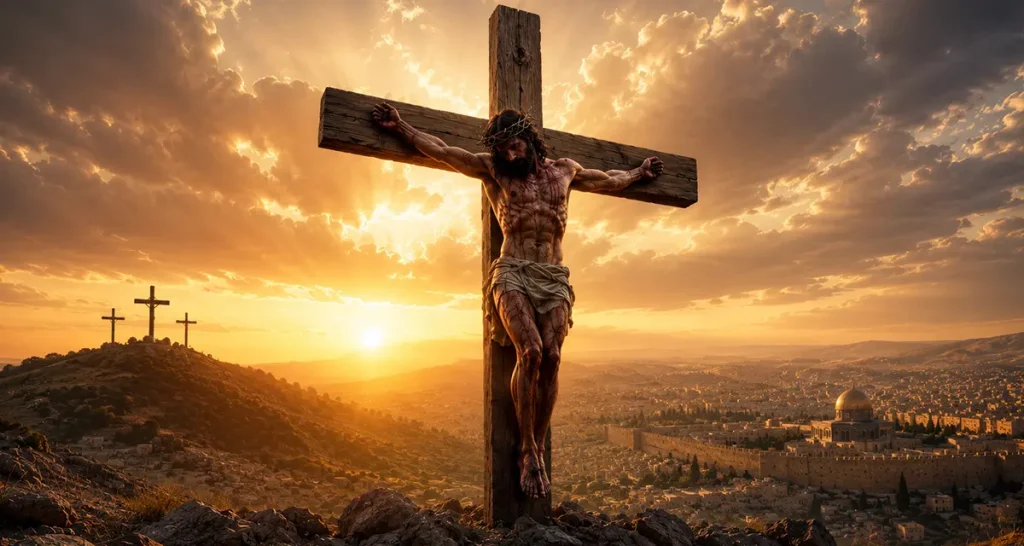
✝️ The Cross Will Never Become Ordinary
I sometimes think one of the greatest dangers for us is not misunderstanding the cross, but becoming familiar with it.
We say,
“Jesus died for my sins.”
Those words are gloriously true.
But behind them lies the infinite reality we have been discussing.
The eternal Son…
through whom every galaxy exists…
who continually upholds every atom…
who had enjoyed unbroken fellowship with the Father from all eternity…
entered our humanity…
bore our sins…
endured God’s righteous judgment…
conquered death…
and rose again.
If that does not eventually leave us silent in wonder, we have probably become more familiar with the words than with the reality.
👑 The Beatific Wonder of Eternity
I wonder whether this is one reason heaven never tires of worship.
The redeemed are not merely repeating songs they memorized long ago.
They are continually beholding the Lamb.
John sees this astonishing scene:
“Worthy is the Lamb who was slain
To receive power and riches and wisdom,
And strength and honor and glory and blessing!”
— Revelation 5:12
Notice that heaven’s worship remains centered on “the Lamb who was slain.”
The scars are not erased.
They are glorified.
The cross is not left behind.
It becomes the eternal lens through which the redeemed behold the glory of God.
❤️ Theology That Ends in Doxology
Perhaps this is one of the greatest lessons we can learn from Scripture.
Every true doctrine is meant to become worship.
To study the incarnation should make us adore Christ.
To study election should humble us before grace.
To study providence should produce trust.
To study the cross should produce love.
To study God’s holiness should awaken reverence.
To study God’s sovereignty should give peace.
Knowledge that terminates in itself becomes pride.
Knowledge that terminates in Christ becomes worship.
Paul himself says,
“For the love of Christ compels us…”
— 2 Corinthians 5:14
Not merely the knowledge of Christ.
The love of Christ.
Because theology in Scripture is never intended to remain in the intellect alone. It descends into the affections, reshapes the will, and bears fruit in a life of obedience.
🌅 We Will Never Reach the End of Him
Your reflection also reminds me of something that has quietly run through many of our conversations. There is a profound joy in knowing that God is truly knowable, yet never exhaustible.
If we could one day say, “Now I have fully comprehended God,” He would no longer be the infinite God revealed in Scripture.
Yet if we could know nothing true about Him, love, trust, and worship would be impossible.
Instead, God has given us the perfect balance. In Jesus Christ, He has truly made Himself known:
“He who has seen Me has seen the Father.”
— John 14:9
And yet, in that same Christ,
“In Him are hidden all the treasures of wisdom and knowledge.”
— Colossians 2:3
Not hidden in the sense of being withheld from His people, but in the sense that His riches can never be exhausted. Throughout eternity, the redeemed will never outgrow Christ. We will never come to the end of His wisdom, His holiness, His love, or His glory. Every new sight of Him will deepen our joy, every deeper understanding will increase our worship, and every act of worship will prepare us to behold still more of His beauty.
That is why Paul’s doxology in Romans 11 is not the end of theology—it is theology reaching its highest expression. When the mind has climbed as far as revelation permits, the heart does what the mind alone cannot: it bows before the One “of Him and through Him and to Him are all things,” and with the whole church, on earth and in heaven, confesses, “To Him be glory forever. Amen.”