Opens in a new tab

Justice | Mercy | Faith

Justice | Mercy | Faith

Christian Stewardship: Generosity, Scarcity, and God as Our Source

Difficulty Level: Intermediate-Advanced

Jump to Answers

  1. “The generous soul will be made rich, and he who waters will also be watered himself. The people will curse him who withholds grain, but blessing will be on the head of him who sells it”. At first, this seems almost like a spiritual tit-for-tat: I give, and therefore I receive in return. How should we understand this apparent reciprocity alongside Jesus’ command, “Freely you have received, freely give”, without turning generosity into a transaction?
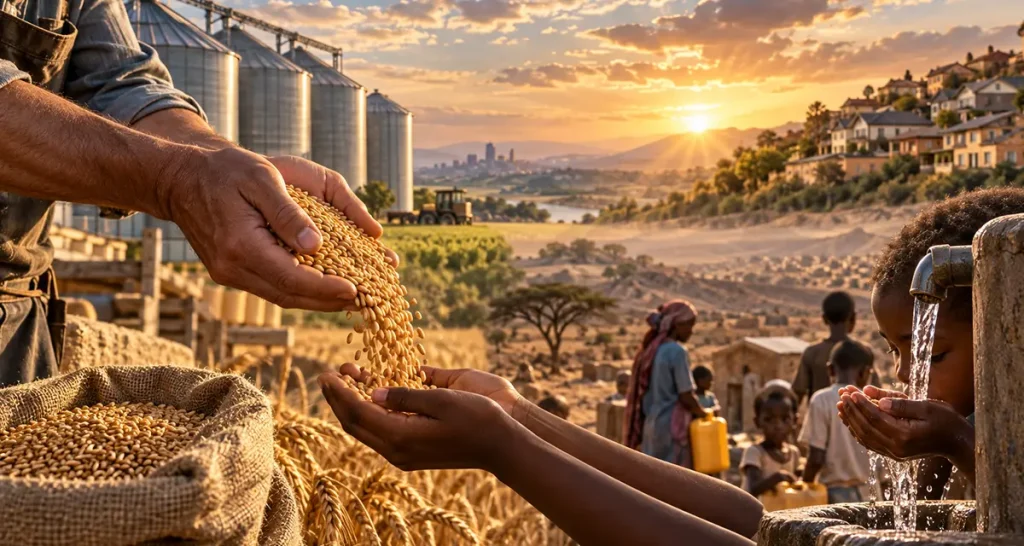
  2. And this brings us back to our discussion about filled silos: grain that could feed people is sometimes neither sold nor given away because of greed, politics, bureaucracy, or other human interests, even while people elsewhere are hungry and the grain is eventually left to rot. 
  3. World hunger and the lack of potable water are alarming, especially when the earth, by the grace and provision of God, possesses tremendous capacity to sustain billions of human lives. How does Scripture understand this painful discrepancy between God’s generous provision through creation and the hunger and thirst that remain throughout the world?
  4. “Because the One from whom I received has not ceased to be my Source.” I think we need to let this truth settle much more firmly into our shaking hearts.
  5. Let’s consider a difficult hypothetical. Suppose I have silos full of grain that I produced intending to sell, but because of politics, paperwork, regulations, or some other human bureaucracy, I am prevented from selling it and know that eventually it will spoil. At the same time, I know that people in my own country or even my own neighborhood could make good use of that grain. I don’t want to oversimplify the legal, economic, or practical difficulties involved, because situations like this really do happen. What should I do?
  6. But the grain really is mine. I raised it with my resources, labor, investment, and risk, intending its sale to provide income for the continuation of my business and perhaps the production of the next harvest. Even though that production will be lost anyway.
  7. Specialists warn that, as the world’s population grows, the earth may not have sufficient accessible resources in the future to sustain the number of people who will inhabit it. Those warnings should not be dismissed, nor should they diminish human responsibility for what we have already done—and continue to do—with the natural resources God has provided. Yet the ultimate Source of life is not creation itself, but God. 
  8. “Woe to those who join house to house; they add field to field, till there is no place…” We can see an unsettling contemporary parallel in the housing crisis in the United States, where, in some markets, corporations, developers, and well-capitalized investors can acquire houses and lots for profit, sometimes offering terms or amounts that ordinary families cannot realistically match, only for those properties to become increasingly expensive assets. That’s business, and yet shameful.
  9. I don’t want to end this discussion merely by identifying hunger, thirst, wasted resources, closed hands, or unjust accumulation; it needs the complementary reality that people need both to help and to be helped. With hunger and lack of potable water becoming increasingly serious in parts of the world, especially in regions of Africa and the Middle East, what practical resources are available for those who want to give food, water, money, expertise, or other assistance—and what resources are available for those who themselves need to receive help?

Christian Stewardship: Generosity, Scarcity, and God as Our Source

Biblical Themes | Christian Living & Ethics | God & His Attributes | Sin & Human Nature | Suffering & God's Providence

“The generous soul will be made rich, and he who waters will also be watered himself” (Proverbs 11:25). At first, the proverb can sound strangely transactional: give and you will receive; water others and you will be watered. How does that fit with Jesus’ command, “Freely you have received, freely give” (Matthew 10:8)?

That question opens into something much larger than personal generosity. What happens when grain fills our silos while people are hungry? What if political or economic barriers prevent food from being sold and it will simply rot? Is a farmer obligated to give away a harvest produced with his own labor and resources when that income was intended to sustain his business? What should Christians make of warnings about future shortages of food, water, and other natural resources? And what happens when houses, land, food, and other necessities increasingly become instruments of accumulation while others struggle to obtain what they need?

These questions eventually bring us to Christian stewardship: What does it mean to possess something that truly belongs to us while recognizing that everything ultimately comes from God?

Scripture neither condemns ownership nor romanticizes poverty. It recognizes labor, property, commerce, saving, planning, and legitimate profit. Yet it also repeatedly confronts hoarding, exploitation, waste, injustice, and indifference toward the needy. The man in Proverbs 11:26 is not condemned for possessing grain, but for withholding it. Isaiah pronounces woe upon those who “join house to house” and “add field to field, till there is no place” (Isaiah 5:8). Jesus warns against placing our security in increasingly larger barns (Luke 12:16–21), while also teaching us to trust the Father who already knows what we need (Matthew 6:31–33).

At the heart of all these questions lies a truth that our anxious hearts find difficult to believe:

The gift is not the Source.

Food, water, land, money, businesses, houses, harvests, and natural resources are real provisions, and we are responsible for stewarding them wisely. But none of them is the ultimate source of life. God is.

And therefore another truth follows:

Because the One from whom we received has not ceased to be our Source, we are free to open our hands.

That does not eliminate prudence, responsibility, legitimate ownership, or concern for tomorrow. Nor does it mean that giving will never cost us dearly. Rather, it places ownership within the larger reality of creaturehood: we are receivers before we are possessors, stewards even when we truly own, and participants in a providence whose Source remains God.

This Q&A explores that tension—from generosity and scarcity to grain silos, world hunger, potable water, housing, economic power, and practical ways to give and receive help—and asks a question that becomes increasingly personal along the way:

What does faithful stewardship look like when what God has placed in our hands could become life for someone else?

“The generous soul will be made rich, and he who waters will also be watered himself. The people will curse him who withholds grain, but blessing will be on the head of him who sells it”. At first, this seems almost like a spiritual tit-for-tat: I give, and therefore I receive in return. How should we understand this apparent reciprocity alongside Jesus’ command, “Freely you have received, freely give”, without turning generosity into a transaction?

🌿 Generosity Without Transaction

Yes — if Proverbs 11:25–26 is read as a transaction formula, it can sound almost like spiritual tit-for-tat:

I water others → God waters me.
I release what I have → blessing comes back to me.

And that could seem to sit awkwardly beside Jesus:

“Freely you have received, freely give.”
— Matthew 10:8

But I think the tension disappears once we distinguish the motive for generosity from God’s response to generosity.

The Gospel says: Do not give in order to get.

Proverbs says: Do not imagine that giving leaves you impoverished under God’s government.

Those are quite different claims.

💧 “He Who Waters Will Also Be Watered”

In Proverbs 11:25, the generous person is not bargaining:

“The generous soul will be made rich,
And he who waters will also be watered himself.”
— Proverbs 11:25

Notice the order. He is already a generous soul. His generosity does not appear to be a technique for obtaining the second blessing.

Rather, the proverb describes the surprising economy of God’s world: the person who pours himself out does not ultimately escape God’s provision.

Paul develops almost exactly this idea:

“He who sows sparingly will also reap sparingly, and he who sows bountifully will also reap bountifully.”
— 2 Corinthians 9:6

That sounds transactional too — until Paul immediately clarifies the heart:

“So let each one give as he purposes in his heart, not grudgingly or of necessity; for God loves a cheerful giver.”
— 2 Corinthians 9:7

And then comes something very important:

“And God is able to make all grace abound toward you, that you, always having all sufficiency in all things, may have an abundance for every good work.”
— 2 Corinthians 9:8

Ah! There is the cycle. 😊

God gives → I receive → I give → God supplies → I can give again.

The returned blessing is not necessarily the payment for my generosity. It is often the provision that sustains further generosity.

That makes Proverbs 11:25 remarkably compatible with “freely you have received, freely give” (Matthew 10:8).

🌾 Withholding the Grain

And verse 26 makes this even clearer:

“The people will curse him who withholds grain,
But blessing will be on the head of him who sells it.”
— Proverbs 11:26

Interestingly, the righteous man here doesn’t even give the grain away. He sells it.

The contrast is not primarily free versus commercial. It is release versus withholding.

The wicked behavior is hoarding something others desperately need, presumably waiting for scarcity to increase its value. The blessed man allows what he possesses to flow outward into the community rather than exploiting others’ need.

So perhaps the deeper principle connecting Proverbs and the Gospel is:

God’s gifts are not meant to terminate in us.

🤲 Receiving and Giving as Creatures

That is very close to what we have been discussing about creaturehood and participation.

I receive because I am a creature.

I give because God has made me a participant.

And when God supplies me again, even that renewed supply is not evidence that I have become self-sufficient. It makes further participation possible.

There is actually something beautifully anti-transactional about this.

If I say:

“I gave to God, therefore God owes me.”

I have turned grace into wages.

But if I say:

“Everything I had to give was received from Him in the first place.”

then even my generosity begins with indebtedness to grace:

“What do you have that you did not receive?”
— 1 Corinthians 4:7

And Jesus pushes this even further:

“When you have done all those things which you are commanded, say, ‘We are unprofitable servants. We have done what was our duty to do.’”
— Luke 17:10

❤️ Reciprocity Without Commerce

So there can be reciprocity without commerce.

A child may receive from his father, give generously from what he received, and then receive still more from his father. There is a genuine movement back and forth, but it would be absurd for the child to conclude:

“Excellent. I have discovered how to make my father indebted to me.” 😂

He was living from the father’s provision the entire time.

And I think that helps us hear Proverbs correctly.

“He who waters will also be watered” is not God handing us a business strategy. It is reassurance to the generous creature: You need not hoard as though everything depended upon you.

😟 The Fear Beneath Hoarding

That strikes directly at the fear underneath stinginess:

“If I pour out, what will be left for me?”

God’s answer throughout Scripture is not:

“Give because you can manipulate Me into giving you more.”

It is closer to:

“Give because you received from Me freely. And do not be afraid to give, because after you have poured out, I am still your Source.”

Jesus makes precisely this connection between generosity and confidence in the Father’s provision. He tells His disciples not to live anxiously asking what they will eat, drink, or wear, because:

“Your heavenly Father knows that you need all these things.”
— Matthew 6:32

The alternative to hoarding, then, is not irresponsible disregard for our needs. It is confidence that our needs do not make us autonomous providers of our own existence.

🌊 The Source Remains Full

And this may be the deepest connection with our earlier discussions about creaturehood.

When I give away something I possess, I diminish my supply.

When God gives, He does not diminish Himself.

That asymmetry matters enormously.

I am a reservoir that must continually be filled. God is the Source from whom the water comes in the first place. Therefore, Proverbs does not invite the reservoir to pretend that it is the spring. It invites the reservoir not to dam up what it has received out of fear that the Spring will cease to flow.

That is why Christian generosity can be genuinely free.

I do not have to squeeze repayment out of the recipient.

I do not have to turn generosity into leverage over God.

I do not even have to make my generosity ultimately dependent upon the recipient’s gratitude.

“Freely you have received, freely give.”
— Matthew 10:8

Why can I give freely?

Because I received freely.

And why can I continue giving?

Because the One from whom I received has not ceased to be my Source.

✨ Proverbs Is Promise, Not Payment

So I would make the distinction this way:

Payment says: “Because I gave, God owes me.”

Promise says: “Because God is faithful, I need not be afraid to give.”

Proverbs 11:25 belongs much more naturally to the second category.

The Gospel does not abolish the principle of Proverbs 11:25. It purifies our reason for trusting it.

The generous person does not say, “If I give, I can force God to replenish me.”

He can say instead:

“Because God is my Source, I am free to let what He has entrusted to me flow through my hands rather than clutching it as though my life depended upon keeping it.”

And perhaps that is precisely why “he who waters will also be watered.” The water was never ultimately his to begin with. 🌿

And this brings us back to our discussion about filled silos: grain that could feed people is sometimes neither sold nor given away because of greed, politics, bureaucracy, or other human interests, even while people elsewhere are hungry and the grain is eventually left to rot.

Yes. And that takes Proverbs 11:26 from something that can sound like an ancient marketplace proverb and makes it painfully contemporary.

🌾 Grain Has a Purpose Beyond the Silo

“The people will curse him who withholds grain,
But blessing will be on the head of him who sells it.”
— Proverbs 11:26

The verse does not condemn storing grain. Scripture actually gives us a famous example of enormous grain storage under Joseph, precisely to preserve life during famine (Genesis 41:33–36, 47–49).

So the moral issue cannot simply be:

grain stored = greed.

The question is why it is being stored, and toward what end.

Joseph fills the storehouses because famine is coming. The storage serves life.

But Proverbs describes someone withholding grain while people need it. The grain exists. The need exists. The possibility of distribution exists. Yet something stands between the provision and the hungry person.

That is where the moral problem begins.

🏚️ When Preservation Becomes Hoarding

And the scenario you describe makes the contrast particularly disturbing: silos full while people are hungry, with grain eventually spoiling rather than reaching them.

Of course, in real situations the reasons can be complicated: transportation failures, war, sanctions, unsafe distribution routes, market structures, spoilage, inadequate storage, government policies, contractual obligations, price controls, or deliberate economic decisions. We should be careful not to call every case of undistributed food “greed.”

But once the situation really is:

We possess food → people need food → we could make it available → but we deliberately withhold it for selfish advantage until it is wasted

then Proverbs 11:26 becomes extraordinarily direct.

The horror is not merely that the grain rotted.

It is that something created to sustain life was prevented from fulfilling that purpose while human beings needed it.

💰 The Sin Is Not Selling It

There is an important detail in the proverb that protects us from oversimplification:

“But blessing will be on the head of him who sells it.”
— Proverbs 11:26

The text does not say, “Blessed is the man who gives all his grain away.”

That surprised us earlier, but now it becomes very useful.

Commerce itself is not being condemned. The merchant may legitimately recover his costs and earn from his labor. The contrast is between circulation and calculated withholding.

In other words, the grain merchant does not have to cease being a merchant in order to love his neighbor.

But he must not look at starving people and think:

“Their desperation increases the value of what I possess.”

At that point another person’s suffering has become an economic opportunity to exploit.

Amos gives us a frightening picture of precisely that mentality. He condemns those eagerly waiting for religious observances to finish so they can resume selling grain, while manipulating measures and prices and exploiting the poor (Amos 8:4–6).

🏛️ And Politics Does Not Make the Moral Question Disappear

This becomes even more sobering when the withholding is institutional rather than individual.

A single farmer can hoard grain. A merchant can manipulate scarcity. But governments, corporations, military powers, political factions, and economic systems can also make decisions that affect whether food reaches people.

The biblical principle does not require us to pretend every such situation is simple or to assign guilt without evidence. Political and economic circumstances have to be examined case by case.

But neither does complexity erase the moral question.

Jesus’ description of the hungry remains astonishingly personal:

“I was hungry and you gave Me food.”
— Matthew 25:35

And later:

“Inasmuch as you did it to one of the least of these My brethren, you did it to Me.”
— Matthew 25:40

Whatever debates we may have about the precise scope of that passage, Scripture repeatedly treats the treatment of vulnerable people as something God Himself notices (Deuteronomy 15:7–11; Isaiah 58:6–10; James 2:15–16).

🫙 The Silo Can Reveal a Theology

And here our discussion becomes deeper than economics.

The filled silo can say:

“There may not be enough tomorrow, so I must keep everything I can today.”

That is understandable at one level. Prudence is biblical. Joseph himself stored for tomorrow.

But greed takes prudence and turns it into something else:

“My security ultimately resides in what I have accumulated.”

Now we are back to creaturehood.

The creature receives from God, but then tries to convert the received gift into independence from the Giver.

Jesus tells the parable of a man whose fields produced abundantly. His problem was not that his harvest was good or even simply that he had barns. His response was:

“I will pull down my barns and build greater, and there I will store all my crops and my goods.”
— Luke 12:18

And then:

“Soul, you have many goods laid up for many years; take your ease; eat, drink, and be merry.”
— Luke 12:19

That is the crucial movement.

The gift has become his imagined guarantee of life.

And God’s answer destroys the illusion:

“Fool! This night your soul will be required of you.”
— Luke 12:20

The barns were full.

But the man still did not possess tomorrow.

🍞 The Tragedy of Bread That Never Becomes Bread for Someone

There is something especially poignant about grain rotting in storage while someone goes hungry.

The grain fulfilled every biological process necessary to become food. Soil received the seed. Rain fell. Sunlight came. The plant grew. The field produced. Human beings harvested it. It was transported and stored.

And then, at the very last stage:

it stopped.

It never reached the table.

That gives us a striking picture of what we were saying before:

God’s gifts are not meant merely to terminate in us.

Paul says:

“Let him who stole steal no longer, but rather let him labor, working with his hands what is good, that he may have something to give him who has need.”
— Ephesians 4:28

That is remarkable. Work does not merely move:

need → work → possession.

Paul extends it:

need → work → possession → generosity.

Possession is real. Stewardship is real. Prudence is real. Saving can be wise (Proverbs 6:6–8). But possession is not necessarily the final purpose of what has been entrusted to us.

🌊 The Silo and the River

So perhaps we can sharpen our earlier image.

God does not necessarily condemn the silo. Sometimes He commands us to fill it.

What He opposes is turning the silo into a dead end.

Joseph’s silos were full, and then when famine came, they opened (Genesis 41:53–57).

That may be one of the clearest contrasts imaginable:

A godly storehouse preserves abundance so that it can serve life when scarcity comes.

A greedy storehouse uses scarcity to make abundance serve the possessor.

The same silo.
The same grain.
The same act of storing.

But an entirely different relationship to God, neighbor, possession, and life.

And that brings us beautifully back to Proverbs:

“He who waters will also be watered himself.”
— Proverbs 11:25

The question is not merely “How much has God put into my hands?”

It is also:

“When the time comes for what He has entrusted to me to flow outward, will I open my hands?” 🌾

World hunger and the lack of potable water are alarming, especially when the earth, by the grace and provision of God, possesses tremendous capacity to sustain billions of human lives. How does Scripture understand this painful discrepancy between God’s generous provision through creation and the hunger and thirst that remain throughout the world?

Yes. And Scripture gives us a remarkably serious framework for this discrepancy. It does not treat hunger merely as proof that God made an inadequate world. Again and again, the biblical story presents creation as generous, while locating much of the tragedy in sin, injustice, failed stewardship, conflict, oppression, and our unwillingness to share God’s gifts rightly.

At the same time, Scripture does not reduce all hunger or scarcity to someone’s personal greed. We live in a creation subjected to futility, where drought, disaster, disease, and death are also realities (Romans 8:20–22). So there are several layers.

🌍 Creation Begins With Abundance, Not Deficiency

The Bible’s first picture of the world is striking:

“See, I have given you every herb that yields seed… and every tree whose fruit yields seed; to you it shall be for food.”
— Genesis 1:29

And after surveying His creation:

“Then God saw everything that He had made, and indeed it was very good.”
— Genesis 1:31

Humanity begins not by manufacturing existence for itself but by receiving.

Land, seed, water, fertility, sunlight, animals, human intelligence, and the ability to cultivate are already gifts.

Psalm 104 portrays God this way:

“He causes the grass to grow for the cattle,
And vegetation for the service of man,
That he may bring forth food from the earth.”
— Psalm 104:14

Psalm 65 similarly describes God watering the earth and enriching it so that grain may grow (Psalm 65:9–13).

So the biblical starting point is not:

“God created hungry creatures and forgot to provide for them.”

It is:

“God created dependent creatures inside a world whose fruitfulness is itself His gift.”

That fits beautifully with our discussions about creaturehood.

🍎 But Genesis 3 Changes the Human Experience of Creation

After the Fall, the earth remains God’s good creation, but humanity no longer experiences its fruitfulness without frustration:

“Cursed is the ground for your sake;
In toil you shall eat of it
All the days of your life.”
— Genesis 3:17

And Paul later describes creation as having been:

“subjected to futility.”
— Romans 8:20

Therefore, Scripture does not teach that every instance of hunger means someone somewhere must have stolen another person’s meal.

There are droughts. Famines occur. Crops fail. Natural disasters happen. Human bodies become sick. Creation itself awaits liberation (Romans 8:19–23).

But that still isn’t the whole explanation.

Because Scripture repeatedly shows human sin making creaturely vulnerability much worse.

⚖️ God Repeatedly Connects Poverty With Injustice

The prophets are relentless here.

Isaiah condemns people who accumulate property at the expense of others:

“Woe to those who join house to house;
They add field to field,
Till there is no place…”
— Isaiah 5:8

Amos condemns economic exploitation:

“Hear this, you who swallow up the needy,
And make the poor of the land fail.”
— Amos 8:4

Ezekiel’s description of Sodom is particularly uncomfortable:

“She and her daughter had pride, fullness of food, and abundance of idleness; neither did she strengthen the hand of the poor and needy.”
— Ezekiel 16:49

Notice that combination:

“fullness of food” + “poor and needy.”

That is remarkably close to the discrepancy you’re describing.

The problem is not simply absence of resources.

There is abundance over here and deprivation over there.

And God notices the gap.

🌾 God’s Law Actually Built Provision for the Vulnerable Into Israel’s Economy

This becomes even clearer in the Law.

God explicitly forbade Israel from maximizing extraction from every field:

“You shall not wholly reap the corners of your field… You shall leave them for the poor and the stranger.”
— Leviticus 19:9–10

That is fascinating economically.

God effectively says:

Do not harvest everything you technically have the right to harvest.

Why?

Because ownership under God is stewardship, not absolute autonomy.

The landowner truly possesses his field. Yet God’s claim upon both landowner and land means that another person’s need places a moral claim upon some of the field’s abundance.

Deuteronomy makes it even more explicit:

“You shall not harden your heart nor shut your hand from your poor brother.”
— Deuteronomy 15:7

And then:

“You shall open your hand wide to him.”
— Deuteronomy 15:8

That image — the closed hand and the open hand — may summarize much of what we have been discussing.

💧 Water Makes the Question Even More Fundamental

Food requires cultivation, labor, transportation, preservation, and distribution.

But water exposes our creaturehood at an even deeper level.

Nobody manufactures water ex nihilo. We capture it, pump it, purify it, transport it, desalinate it, manage it — but the substance itself belongs to a creation we received.

Scripture naturally speaks of rain as divine provision:

“He gives rain on the earth,
And sends waters on the fields.”
— Job 5:10

Jesus even appeals to rain as evidence of God’s indiscriminate generosity:

“He makes His sun rise on the evil and on the good, and sends rain on the just and on the unjust.”
— Matthew 5:45

That does not eliminate the enormous technical problems involved in making water safely drinkable. But it establishes something theological:

We are managers of water before we are its owners.

The rain was falling before any human government, company, nation, or individual could claim it.

🏚️ Scarcity Can Be Real, Yet Scarcity Can Also Be Manufactured or Intensified

This is where Scripture gives us a necessary balance.

There is creational scarcity in a fallen world: drought, famine, disaster, ecological difficulty.

But there is also humanly intensified scarcity: hoarding, exploitation, warfare, corruption, unjust distribution, neglect of the vulnerable, and the deliberate withholding we encountered in Proverbs 11:26.

The Bible refuses to collapse those into one explanation.

Joseph encounters a genuine famine (Genesis 41:53–57).

But Amos encounters people exploiting scarcity (Amos 8:4–6).

Both realities exist in Scripture.

That distinction matters enormously whenever we examine a particular modern famine or water crisis. We cannot simply point at suffering and declare, “Greed caused this.” The actual causes have to be established.

But neither may we look at an abundance existing alongside desperate need and automatically say, “Well, that’s simply scarcity.”

Scripture permits — and sometimes demands — the harder question:

What happened between God’s provision and our neighbor’s empty stomach?

🍞 Jesus Makes the Question Intensely Personal

The feeding of the multitudes is fascinating in this context.

The disciples see thousands of hungry people and naturally see a logistical impossibility:

“Where shall we buy bread, that these may eat?”
— John 6:5

There is a little food available:

“There is a lad here who has five barley loaves and two small fish.”
— John 6:9

And then Christ supplies abundantly.

But notice what happens afterward:

“Gather up the fragments that remain, so that nothing is lost.”
— John 6:12

That little sentence becomes quite striking in light of our discussion.

Divine abundance does not justify human wastefulness.

Jesus can multiply bread miraculously — and still commands His disciples not to waste the leftovers.

Abundance and stewardship belong together.

🤲 The Early Church Makes the Principle Visible

Acts gives us perhaps the most striking New Testament picture:

“Nor was there anyone among them who lacked.”
— Acts 4:34

Why?

Not because poverty had miraculously disappeared from the Roman Empire.

Rather:

“Distribution was made to each as anyone had need.”
— Acts 4:35

That language is crucial.

There was possession, but there was also distribution according to need.

And Acts explicitly says that the result within that community was:

“there was not anyone among them who lacked.”

That echoes Deuteronomy 15:4, where God’s covenant ideal was that there should be no poor among Israel, while the same chapter realistically acknowledges the continuing presence of poverty and therefore commands open-handed generosity (Deuteronomy 15:7–11).

😔 James Makes the Discrepancy Almost Unbearably Concrete

James imagines precisely the situation we’re discussing:

“If a brother or sister is naked and destitute of daily food, and one of you says to them, ‘Depart in peace, be warmed and filled,’ but you do not give them the things which are needed for the body, what does it profit?”
— James 2:15–16

Notice that the problem isn’t that the believer cannot help.

The scandal is that he encounters need, possesses the capacity to respond, speaks piously — and allows the need to remain untouched.

John is even more severe:

“Whoever has this world’s goods, and sees his brother in need, and shuts up his heart from him, how does the love of God abide in him?”
— 1 John 3:17

There again is our closed hand.

Possession + visible need + ability to help + deliberate withholding creates a moral problem.

🌎 The Problem Is Not Simply That Earth Has Too Little

And I think this brings your observation into theological focus.

We should be careful with the empirical claim that the earth presently has enough accessible food and potable water to supply every person equally, because food production, safe-water infrastructure, geography, transportation, conflict, spoilage, and distribution are complicated questions.

But Scripture gives us something even more fundamental:

Creation was given by God for life, and human beings were appointed as stewards within it (Genesis 1:26–30; 2:15).

Therefore, whenever one part of humanity possesses enormous abundance while another lacks necessities, Scripture does not permit us merely to shrug and call the discrepancy morally meaningless.

It asks questions about stewardship, justice, mercy, generosity, oppression, waste, and love of neighbor.

🌾 And Here the Rotting Grain Becomes a Terrible Symbol

Think again about those silos from our previous discussion.

If grain exists but rots while people starve, something profoundly disordered has happened.

Not necessarily at the level of agricultural production.

Perhaps not even primarily at the level of nature.

The failure may lie somewhere between gift and recipient.

God gave earth.

God gave rain.

God gave seed.

God gave fertility.

God gave human intelligence.

God gave the capacity to cultivate.

God gave the capacity to build roads, ships, reservoirs, purification systems, irrigation networks, markets, governments, and communities.

And yet the neighbor remains hungry or thirsty.

That makes the question much more searching than:

“Why didn’t God provide?”

Sometimes Scripture turns the question back upon humanity:

“What did you do with what God provided?”

That is essentially the question behind Matthew 25:35:

“I was hungry and you gave Me food; I was thirsty and you gave Me drink.”

Jesus does not say merely, “There were hungry people somewhere.”

He places Himself startlingly on the receiving side of human stewardship.

🌊 From God’s Hand, Through Our Hands

And here everything we’ve been discussing about participation comes together beautifully.

God could provide for every hungry person without involving another human being. The manna proves the point (Exodus 16).

Yet ordinarily He chooses to make human beings participants in His providence.

The farmer grows.

The engineer purifies water.

The trucker transports food.

The merchant distributes it.

The government builds infrastructure.

The neighbor shares.

The church gives.

The thirsty person drinks.

And behind the entire chain stands God:

“You open Your hand
And satisfy the desire of every living thing.”
— Psalm 145:16

Yet astonishingly, the open hand of God intends to produce open human hands.

That may be one of the deepest biblical explanations for the discrepancy that troubles us.

The tragedy of hunger amid abundance is not necessarily evidence that God’s hand is closed.

Very often Scripture asks whether ours are.

And that takes us right back to Proverbs 11:

“The generous soul will be made rich,
And he who waters will also be watered himself.”
— Proverbs 11:25

The world was never meant to consist of billions of autonomous creatures each desperately securing enough life for himself.

It was created as a world of received life, dependent life, shared life, stewardship, and participation.

God gives.

We receive.

And because we received, we are free to open our hands. 🌿

“Because the One from whom I received has not ceased to be my Source.” I think we need to let this truth settle much more firmly into our shaking hearts.

Yes. ❤️ And I think the reason that sentence needs to sink much deeper is that we can affirm “God is my Source” doctrinally while still living emotionally as though every gift from Him were the last shipment.

We receive something, and immediately the frightened creature starts calculating:

“How do I make sure I don’t lose this?”

🌿 The Gift Is Not the Source

This distinction may be one of the hardest lessons of creaturehood:

What God gives me is not God.

Food is provision.
Money is provision.
Employment is provision.
Health is provision.
Other people can be provision.
A harvest is provision.

But none of these is the Source.

Israel had to learn this in the wilderness. God deliberately gave manna in such a way that they could not convert today’s provision into independence from tomorrow’s Provider.

“Let no one leave any of it till morning.”
— Exodus 16:19

Some tried anyway.

“Notwithstanding they did not heed Moses. But some of them left part of it until morning, and it bred worms and stank.”
— Exodus 16:20

That is extraordinary in light of our discussion.

They had received God’s provision and then attempted to make the provision itself their security.

The manna effectively said:

“I can feed you today. I cannot become your God for tomorrow.”

Tomorrow they would have to receive again.

🫨 Our Hearts Shake Because We Are Creatures

And perhaps we should not be too surprised that our hearts shake.

To be a creature means that I genuinely do not contain tomorrow’s provision within myself.

Jesus does not pretend otherwise:

“Do not worry about tomorrow, for tomorrow will worry about its own things.”
— Matthew 6:34

That command can sound almost frightening when taken seriously.

“But Lord, tomorrow is exactly what I’m worried about!” 😅

I can see today’s bread.

I can count today’s money.

I can inspect today’s harvest.

I can measure today’s water.

But tomorrow is inaccessible to me.

And that is where faith becomes more than theological agreement.

Faith says:

“Tomorrow is inaccessible to me, but it is not inaccessible to my Father.”

🍞 “Give Us This Day”

This makes the Lord’s Prayer almost startling:

“Give us this day our daily bread.”
— Matthew 6:11

Not:

“Give me enough resources that I will eventually cease needing to ask You.”

But:

“Give us this day…”

Tomorrow, I come again.

And the day after that, again.

Not because God reluctantly gives us tiny installments, but because dependence itself belongs to the Creator-creature relationship.

Even if I had enough money stored away for fifty years, I would still have to pray for daily bread.

Because money cannot guarantee that I will wake tomorrow.

Money cannot make soil fertile.

Money cannot command rain.

Money cannot guarantee political stability.

Money cannot keep my body functioning.

Money cannot give me breath.

And ultimately money cannot give me life.

“In Him we live and move and have our being.”
— Acts 17:28

My dependence was never actually eliminated by the size of my silo.

It was merely hidden from me.

🏚️ The Full Barn Creates a Powerful Illusion

This is exactly what makes the rich fool’s mistake in Luke 12 so profound.

His land produces abundantly. He builds larger barns. Then he tells himself:

“Soul, you have many goods laid up for many years; take your ease; eat, drink, and be merry.”
— Luke 12:19

Notice what happened.

He moved psychologically from:

“I have provision”

to:

“I possess security.”

But God says:

“Fool! This night your soul will be required of you.”
— Luke 12:20

The man’s grain was real.

His wealth was real.

His barns were real.

His conclusion was false.

He had confused accumulated provision with the continuing Source of his existence.

💧 “He Who Waters Will Also Be Watered”

Now Proverbs 11:25 becomes much more profound:

“He who waters will also be watered himself.”
— Proverbs 11:25

Perhaps the frightening moment is exactly between those two clauses.

He waters…

Now there is less water in his vessel.

And before:

“…will also be watered himself,”

there is a moment in which faith must speak.

That is where our shaking hearts live.

“I gave some away.”

“I opened the silo.”

“I helped someone.”

“I surrendered something.”

“I stopped clutching.”

“Now what about me?”

And the answer is not primarily:

“Don’t worry; your container is still pretty full.”

That would merely redirect our confidence back toward the container.

The deeper answer is:

“Your Father knows that you need these things.”
— Matthew 6:32

The Source is still there.

🌊 I Can Empty a Cup; I Cannot Empty God

And perhaps this is the truth we need to sit with.

I can exhaust what God has given me without exhausting the God who gave it.

The distinction is enormous.

My resources are finite because I am finite.

God’s sufficiency does not diminish when He provides for His creatures:

“Every good gift and every perfect gift is from above, and comes down from the Father of lights.”
— James 1:17

This does not mean God promises to replenish every possession we give away in precisely the same form. Scripture gives us no prosperity formula saying, “Give $100 and God must return $1,000.” Paul knew both abundance and deprivation (Philippians 4:11–13).

Sometimes God’s provision may even look radically different from what we expected.

But Christian confidence rests somewhere deeper:

The loss of a particular provision does not mean the loss of the Provider.

That is something our hearts desperately need to learn.

❤️ “The Lord Is My Shepherd”

Maybe that is why Psalm 23 begins where it does.

“The LORD is my shepherd;
I shall not want.”
— Psalm 23:1

David does not begin:

“My pasture is enormous; therefore I shall not want.”

He does not say:

“My water supply is secure.”

He says:

“The LORD is my shepherd.”

Then come the pasture and water:

“He makes me to lie down in green pastures;
He leads me beside the still waters.”
— Psalm 23:2

The order matters.

Shepherd → pasture.

Shepherd → water.

Not:

pasture → therefore security.

The sheep’s confidence ultimately cannot rest in yesterday’s patch of grass. The flock must move. Today’s pasture may disappear behind them.

Its security is that the Shepherd remains when the pasture changes.

🕊️ Perhaps This Is Where Peace Actually Begins

We often ask God to give us enough that we will finally stop being afraid.

And sometimes He graciously gives abundance.

But abundance cannot cure the fundamental fear of creaturehood because no finite amount can answer the question:

“But what about after that?”

There is always an after that.

Ten dollars invites the question.

Ten thousand dollars invites the question.

Ten million dollars ultimately invites the same question.

“What if it runs out?”

Only an inexhaustible Source can finally answer a creature whose needs continually return.

And that is why Jesus does not ultimately give His disciples a technique for securing life.

He gives them the Father:

“Your heavenly Father knows that you need all these things.”
— Matthew 6:32

There it is.

My heart wants God to give me something sufficiently large that I can finally say:

“Now I am safe because I have enough.”

The Gospel patiently teaches me something far better:

“You are not secure because you have finally accumulated enough from God. You are secure because the One from whom you received has not ceased to be your Source.”

The provision may change.

The pasture may change.

The amount in the silo may change.

The circumstances certainly will change.

The Source has not.

“Jesus Christ is the same yesterday, today, and forever.”
— Hebrews 13:8

And perhaps our shaking hearts do not need first to learn how to stop shaking.

They need to discover, again and again, where to rest while they shake:

“My flesh and my heart fail;
But God is the strength of my heart and my portion forever.”
— Psalm 73:26

Not merely:

God gives me my portion.

But astonishingly:

God is my portion. ❤️

Let’s consider a difficult hypothetical. Suppose I have silos full of grain that I produced intending to sell, but because of politics, paperwork, regulations, or some other human bureaucracy, I am prevented from selling it and know that eventually it will spoil. At the same time, I know that people in my own country or even my own neighborhood could make good use of that grain. I don’t want to oversimplify the legal, economic, or practical difficulties involved, because situations like this really do happen. What should I do?

Yes — and I appreciate the way you framed it, because the moment we make the hypothetical concrete, the moral tension becomes much harder. There may be laws, contracts, food-safety requirements, ownership claims, debts, export restrictions, permits, taxation, liability, or other obligations. Scripture does not give us permission simply to pretend those things do not exist.

But suppose the essential facts really are these:

I lawfully possess edible grain. I cannot sell it through the intended channel. I know it will otherwise spoil. There are genuinely hungry people nearby who could use it. I have some lawful means of getting it to them.

Then I think Scripture gives us a fairly strong direction.

🌾 First, the Grain’s Commercial Value Is Not Its Highest Value

Originally I intended:

grain → sale → income.

Now circumstances have blocked the sale.

One temptation would be to conclude:

“If I cannot obtain its commercial value, then it has no value to me.”

But that is plainly false.

It is still food.

And that distinction matters enormously.

The market value may have collapsed to zero for me, while the grain’s creational purpose remains intact:

it can feed someone.

This is where our discussion of stewardship becomes very practical. The question changes from:

“How can I recover what this grain was supposed to earn me?”

to:

“Lord, what can this grain still do before it perishes?”

🤲 Giving It Away Can Become Rational Stewardship

If it is legally permissible and practically safe to distribute it, giving it away would not necessarily be economic foolishness.

The alternatives are now different:

A. I cannot sell it → it spoils → nobody benefits.

B. I cannot sell it → I distribute it → others eat.

The financial return may be identical in both cases: zero.

But the human return is radically different.

In one case, grain becomes rot.

In the other, grain becomes bread.

Suddenly Jesus’ words become extraordinarily concrete:

“I was hungry and you gave Me food.”
— Matthew 25:35

And John’s question becomes uncomfortable:

“Whoever has this world’s goods, and sees his brother in need, and shuts up his heart from him, how does the love of God abide in him?”
— 1 John 3:17

If I am genuinely free to give it, the fact that I cannot profit from it is hardly a compelling Christian reason to let it perish instead.

⚖️ But “It’s Mine, So I’ll Give It Away” May Not Be Enough

Here is where we should resist oversimplification.

Suppose the grain is collateral for a loan.

Suppose other investors own part of it.

Suppose employees or suppliers have legal claims connected with it.

Suppose regulations prohibit distribution because contamination has been discovered.

Suppose giving it away would circumvent a quarantine designed to stop an agricultural disease.

Suppose contractual obligations mean it is not entirely mine to dispose of.

Then generosity toward one group could actually become injustice toward another.

Biblical stewardship doesn’t mean:

“A charitable intention makes every action righteous.”

Paul says:

“Render therefore to all their due.”
— Romans 13:7

And Scripture repeatedly condemns dishonest handling of other people’s property and obligations (Leviticus 19:11–13; Proverbs 11:1).

So before opening the silo doors, I need to ask:

Do I actually have the authority to dispose of this grain? Is it safe? Would giving it away violate legitimate obligations to someone else?

🏛️ What If Bureaucracy Is the Only Obstacle?

Now your hypothetical becomes sharper.

Suppose the grain is safe.

It genuinely belongs to me.

Nobody else’s legitimate property rights would be violated.

People need it.

But some bureaucratic rule prevents me from selling it.

Notice something important:

A prohibition against selling is not necessarily a prohibition against donating.

Before concluding that the grain must rot, I would exhaust legitimate alternatives.

Could it be donated?

Could a food bank receive it?

Could a church or charity distribute it?

Could it be transferred to farmers for animal feed if human distribution isn’t permitted?

Could it be processed into another permissible form?

Could an emergency exemption be obtained?

Could another licensed organization take possession?

Could local authorities authorize distribution because spoilage is imminent?

That effort itself can be an expression of love.

Christian generosity doesn’t necessarily mean dramatically throwing open the silo doors and yelling, “Come get it!” 😄

Wisdom may accomplish far more good than impulsiveness.

Jesus told His disciples to be:

“wise as serpents and harmless as doves.”
— Matthew 10:16

🚧 What If the Law Actually Forbids Giving It Away?

Now we reach the genuinely difficult case.

Scripture ordinarily commands Christians to respect governing authorities (Romans 13:1–7; 1 Peter 2:13–17). So we should not casually convert:

“I think this regulation is stupid”

into:

“Therefore God authorizes me to break it.”

That would be dangerous reasoning.

There are countless reasons food-distribution laws exist, including food safety, disease prevention, traceability, property rights, and public health.

But Scripture also establishes that civil authority is not absolute.

When human authorities directly commanded the apostles to disobey God, Peter answered:

“We ought to obey God rather than men.”
— Acts 5:29

Yet that principle must be applied carefully. Not every frustrating regulation creates an Acts 5 situation.

There is a substantial moral difference between “The government commands me to deny Christ” and “The government has an infuriating agricultural regulation that results in waste.”

So I would be very hesitant to jump directly from wasted food to civil disobedience.

💡 But I Would Not Be Passive Either

And this, I think, is important.

Obedience to legitimate authority does not require moral indifference.

If I know that hundreds of tons of edible grain are about to be destroyed while people nearby lack food, I can petition.

I can appeal.

I can contact authorities.

I can seek an exemption.

I can work with charities.

I can involve lawyers or agricultural organizations.

I can make the impending waste publicly known through lawful means.

I can ask officials directly:

“What lawful mechanism exists for getting this food to people rather than destroying it?”

And if the system itself is unjust, Christians are certainly permitted to advocate for its reform. Biblical prophets repeatedly spoke against structures and practices that harmed the poor (Isaiah 10:1–2; Amos 5:11–15).

There is a huge moral territory between quietly letting the grain rot and recklessly breaking the law.

Love should make us energetic inside that territory.

🌱 And Then Comes the Painful Part: I May Have to Absorb the Loss

Suppose I finally find a lawful way to distribute the grain.

Now another voice speaks:

“But I paid for that grain.”

Yes.

“I expected income from it.”

Yes.

“Giving it away means I lose a great deal of money.”

Yes.

Christian generosity does not require us to pretend sacrifice isn’t sacrifice.

David once said:

“Nor will I offer burnt offerings to the LORD my God with that which costs me nothing.”
— 2 Samuel 24:24

Giving away a commercially valuable harvest may hurt terribly.

And this brings us directly back to the sentence that started our discussion.

❤️ “The One From Whom I Received Has Not Ceased to Be My Source”

Imagine standing beside those silos.

Months of work are in there.

Money is in there.

Plans are in there.

Perhaps next year’s security seems to be in there.

And hungry people are outside.

Opening those silos may suddenly make everything we’ve been discussing about creaturehood stop being theology on paper.

My shaking heart says:

“But if I give this away, what happens to me?”

And faith does not answer:

“Nothing. You’ll certainly get all the money back.”

We have no biblical authority to promise that.

The answer is deeper:

“Your heavenly Father knows that you need all these things.”
— Matthew 6:32

I may really suffer financial loss.

My business may genuinely be wounded.

I may have to restructure.

I may need help myself.

Christian faith does not magically convert sacrifice into non-sacrifice.

But I can still say:

“This grain is not my god.”

“This silo is not my source.”

“This harvest did not create me.”

“And the God from whom this provision originally came has not ceased to be God because this particular provision is leaving my hands.”

🌾 Joseph’s Silos Were Built to Be Opened

And suddenly Joseph becomes relevant again.

He accumulated enormous quantities of grain:

“Joseph gathered very much grain, as the sand of the sea.”
— Genesis 41:49

But then famine came:

“Joseph opened all the storehouses.”
— Genesis 41:56

That sentence is beautiful in this context.

He opened them.

The purpose of the filled storehouse was finally revealed when there was need outside it.

Of course, Joseph’s economic circumstances were different from our hypothetical, and Genesis 47 raises its own questions about how the famine economy subsequently developed. But the basic image remains powerful:

A storehouse is successful not merely because it becomes full, but because what was preserved inside it can serve life when the time comes.

🕊️ Perhaps the Question Changes

So if I were the hypothetical owner, after exhausting questions of safety, law, contractual obligations, and alternative commercial uses, I think the Christian question would eventually cease to be merely:

“How much money am I going to lose?”

It would become:

“Lord, since I cannot preserve the economic purpose I intended for this grain, how can I still serve Your purposes with what remains in my hands?”

And if the real alternatives finally become:

let edible grain rot

or

freely place it into hungry hands, lawfully and safely, while accepting the loss,

then I find it very difficult to imagine the biblical ethic pointing toward the rotting grain.

“Do not withhold good from those to whom it is due,
When it is in the power of your hand to do so.”
— Proverbs 3:27

And there is our entire hypothetical in one extraordinary phrase:

“when it is in the power of your hand.”

Perhaps sometimes stewardship means carefully filling the silo.

And sometimes stewardship means having the faith to open it. 🌾❤️

But the grain really is mine. I raised it with my resources, labor, investment, and risk, intending its sale to provide income for the continuation of my business and perhaps the production of the next harvest. Even though that production will be lost anyway.

Exactly. And that correction matters. We should not spiritualize away your ownership, labor, investment, or legitimate expectation of return merely because someone else needs the grain.

The fact that the grain may spoil does not suddenly mean, “Well, it wasn’t really yours anyway.” Scripture takes property, labor, wages, and economic responsibility seriously.

🌾 It Really Is Your Grain

Biblical stewardship does not mean ownership is imaginary.

Peter’s words to Ananias are surprisingly important here:

“While it remained, was it not your own? And after it was sold, was it not in your own control?”
— Acts 5:4

The sin in Acts 5 was not that Ananias failed to surrender all his property. Peter explicitly acknowledges both ownership and control.

Similarly, Scripture recognizes the legitimacy of benefiting from one’s labor:

“The hardworking farmer must be first to partake of the crops.”
— 2 Timothy 2:6

And:

“The laborer is worthy of his wages.”
— Luke 10:7

So in our hypothetical, we shouldn’t say casually:

“People are hungry, therefore you have no meaningful claim upon the grain.”

No. You invested land, seed, equipment, fuel, labor, storage, perhaps employees’ wages, financing, insurance, transportation, and months of risk into producing it.

And importantly, as you said, the sale of this crop may be what allows you to produce the next crop.

That changes the moral calculation considerably.

🚜 The Business Itself Can Serve the Neighbor

This is easy to overlook.

Suppose I tell the farmer:

“Give everything away. Hungry people need it.”

That sounds compassionate.

But if doing so bankrupts him, next year there may be no crop at all.

A functioning farm is itself a social good.

The farmer feeds his family.

He employs workers.

He purchases goods from suppliers.

He pays people who transport the harvest.

He produces food for thousands of people.

He buys next year’s seed.

He maintains machinery.

He pays debts.

He prepares another harvest.

So keeping a business economically viable is not necessarily greed. It can be responsible stewardship.

Paul’s principle that one should work so as to have something to give (Ephesians 4:28) actually presupposes sustainable productive activity.

There must ordinarily be production before there can be distribution.

💰 Profit Is Not Automatically the Enemy of Generosity

This is where Proverbs 11:26 itself protects us:

“The people will curse him who withholds grain,
But blessing will be on the head of him who sells it.”
— Proverbs 11:26

He sells it.

That’s tremendously important.

The proverb does not say:

“Blessed is the grain merchant who realizes that because people need food, charging money for grain is immoral.”

Quite the opposite. Selling grain makes it available while allowing the merchant to sustain his economic activity.

That can be good for both parties.

So commercial value isn’t something we should disparage. In an ordinary functioning economy, commercial value helps coordinate production, distribution, investment, labor, and future production.

😔 But Now Our Hypothetical Becomes Truly Painful

Because your situation isn’t ordinary.

You produced grain to sell it.

You need the proceeds to continue your business.

You did nothing wrong in expecting that.

Then some external obstacle prevents the sale.

Now you know:

The crop will spoil.

At this point, saying, “Just give it away!” can be morally shallow because the loss has not disappeared merely because somebody receives the grain.

Someone still absorbs it.

And in this hypothetical:

you do.

That deserves to be acknowledged.

The hungry family receives food.

But you may lose $100,000.

Your employees may be affected.

Your loan may still be due.

Your machinery still needs maintenance.

Your seed supplier still needs payment.

Your family still needs provision.

And next year’s planting still requires capital.

Giving the grain away does not magically erase those realities.

🤲 Generosity Does Not Mean Pretending Cost Doesn’t Exist

This is where Christian generosity becomes much more serious than sentimentality.

Paul says of the Macedonian believers:

“In a great trial of affliction the abundance of their joy and their deep poverty abounded in the riches of their liberality.”
— 2 Corinthians 8:2

But Paul also gives an important qualification:

“For I do not mean that others should be eased and you burdened.”
— 2 Corinthians 8:13

That verse belongs right in the middle of our hypothetical.

Christian generosity does not mean:

“Your neighbor’s need automatically requires your ruin.”

Paul actually rejects that formulation.

His concern is a genuine sharing of burdens, not simply transferring the entire burden from one suffering person onto another.

⚖️ So Your Own Need Belongs in the Moral Equation

Suppose your $100,000 crop is going to spoil.

You could distribute it.

But losing that $100,000 means you cannot plant next year.

Now we cannot describe the situation merely as:

“Food versus greed.”

It may actually be:

hungry people today versus your ability to produce food tomorrow.

Or:

their immediate need versus your employees’ livelihoods.

Or:

giving away the crop versus defaulting on legitimate debts.

Those are genuine competing goods.

Christian ethics requires wisdom precisely because love has multiple neighbors.

The hungry person is my neighbor.

But so is my employee.

My creditor has a legitimate claim.

My spouse and children are entrusted to my care (1 Timothy 5:8).

My customers next year matter too.

🌾 But Then Comes the Strange Fact: The Grain Will Be Lost Anyway

And this is the part that keeps pressing on us.

If there were some way of preserving the grain until the restriction ended, keeping it could be prudent.

If another buyer could be found, pursue that.

If it could be processed, repurposed, exported lawfully elsewhere, converted to animal feed, insured, or otherwise used to preserve some economic value, those possibilities matter.

But your hypothetical deliberately removes those exits.

The grain will spoil anyway.

Now the choice isn’t really:

Keep my $100,000

versus

Give away my $100,000.

The $100,000 economic loss has already effectively been imposed upon me by circumstances.

The remaining choice is closer to:

Lose the crop and nobody eats it

or

lose the crop and somebody eats it.

And that changes the moral question dramatically.

❤️ Giving It Away Does Not Mean Saying the Loss Doesn’t Matter

This distinction is crucial.

If I open the silo, I am not saying:

“This grain had no legitimate economic value to me.”

I am saying:

“Its economic value to me has become unrecoverable, but its usefulness to my neighbor has not.”

Those are very different statements.

And perhaps that is the point at which generosity can enter after the economic tragedy has already occurred.

I am not necessarily sacrificing the sale by giving the grain away; the sale has already been prevented.

I am deciding what happens to the physical good after my commercial loss has become unavoidable.

😢 And I Am Still Allowed to Grieve the Loss

I think this matters spiritually too.

Sometimes Christian language makes generosity sound almost painless:

“Just trust God.”

“Just give it away.”

“God will provide.”

Those statements can all contain truth while being used rather cheaply.

If that harvest represented a year of your labor, you may weep while opening the silo.

Faith does not require pretending:

“It doesn’t matter.”

It matters enormously.

The Psalms certainly do not teach us to disguise loss as happiness.

Habakkuk imagines economic devastation:

“Though the fig tree may not blossom,
Nor fruit be on the vines;
Though the labor of the olive may fail,
And the fields yield no food…”
— Habakkuk 3:17

And only then does he say:

“Yet I will rejoice in the LORD,
I will joy in the God of my salvation.”
— Habakkuk 3:18

The “yet” matters.

The loss is real.

And God remains God.

🌱 And Now Our Earlier Sentence Becomes Much More Costly

This brings us back to:

“Because the One from whom I received has not ceased to be my Source.”

It sounds beautiful when the silo is full.

It becomes faith when the crop is lost.

And we must be careful what we mean by it.

It does not mean:

“Give the grain away and God guarantees an equally profitable harvest next year.”

Scripture gives us no such contract.

It means:

“Even if this provision fails, the failure of this provision does not mean that my Provider has failed to exist.”

That is much harder.

The farmer can legitimately say:

“Lord, this was mine. You allowed me to produce it through my labor. I intended to sell it honestly. I needed that income. I have obligations. This loss hurts. I don’t understand why You permitted it.”

There is nothing faithless about that prayer.

And then perhaps:

“But if I truly cannot preserve its economic value, and it must leave my hands one way or another, do not let my grief over what I have lost prevent someone else from receiving what usefulness remains.”

That, to me, is much richer than simply saying, “Give it away because people are hungry.”

🌾 Loss Can Still Become Provision

And there is something almost cruciform about the situation — not because the farmer’s suffering is equivalent to Christ’s cross, but because Christianity repeatedly confronts us with the possibility that something genuinely lost by one person may nevertheless become life for another.

The farmer doesn’t have to pretend:

“I didn’t lose anything.”

He can say:

“I lost something substantial. But since I cannot recover it, I refuse to insist that its usefulness must die with my profit.”

That is a very different posture.

The grain can be economically lost to me without becoming useless to everyone else.

And perhaps there is an unexpectedly beautiful stewardship principle hiding there:

When I can no longer preserve the purpose I had for something God entrusted to me, I can still ask whether God has another good purpose for it before it passes away.

Not because it wasn’t really mine.

Not because my business doesn’t matter.

Not because profit is evil.

Not because my family’s future doesn’t matter.

But precisely because it was mine, I still have one final opportunity to decide what its loss will mean.

It can become rot.

Or, where lawful and safe, my unavoidable loss can become somebody else’s bread.

And I think there is something profoundly Christian in that. ❤️

Specialists warn that, as the world’s population grows, the earth may not have sufficient accessible resources in the future to sustain the number of people who will inhabit it. Those warnings should not be dismissed, nor should they diminish human responsibility for what we have already done—and continue to do—with the natural resources God has provided. Yet the ultimate Source of life is not creation itself, but God.

Yes. And I think we need to hold those truths together very carefully, because either one isolated from the other can distort our theology.

There are legitimate questions about population, freshwater availability, arable land, soil degradation, energy, fisheries, climate, biodiversity, and how much consumption existing systems can sustain. Scripture gives us no warrant to dismiss such warnings with, “God will provide, so resources don’t matter.”

But neither does Scripture permit us to move from “created resources are finite” to “therefore the ultimate Source of life is running out.”

Those are profoundly different statements.

🌍 Creation Is Finite; God Is Not

This goes straight back to our discussion of creaturehood.

The earth is not God.

Its resources are not infinite. Forests can be destroyed. Soil can be exhausted. Water tables can fall. Harvests can fail. Animals can be driven to extinction. Human beings can consume foolishly and manage disastrously.

Genesis itself gives humanity responsibility:

“Then the LORD God took the man and put him in the garden of Eden to tend and keep it.”
— Genesis 2:15

So biblical confidence in God must never become an excuse for careless stewardship.

But there is an equally important distinction:

The resources through which God presently sustains life are finite.
The God who sustains life through those resources is not.

That changes the theological horizon enormously.

🌱 God Normally Provides Through Created Means

We should not imagine God’s provision as normally bypassing nature.

God feeds us through soil.

Through rain.

Through photosynthesis.

Through farmers.

Through microorganisms.

Through pollination.

Through rivers and aquifers.

Through human knowledge, technology, transportation, markets, families, communities, and governments.

Psalm 104 beautifully celebrates precisely this mediated providence:

“He causes the grass to grow for the cattle,
And vegetation for the service of man,
That he may bring forth food from the earth.”
— Psalm 104:14

The bread comes from the earth, yet the psalmist says God causes it.

There is no competition between those explanations.

The natural process is itself an instrument of providence.

🚜 Therefore, “God Will Provide” Is Not Permission to Destroy the Means of Provision

Suppose someone says:

“God is our Source, so it doesn’t matter if we destroy the soil. He can make more food.”

That would resemble Satan’s temptation of Jesus:

“If You are the Son of God, throw Yourself down.”
— Matthew 4:6

The reasoning is essentially:

God has promised care → therefore I may behave irresponsibly → God must compensate for my irresponsibility.

Jesus refuses:

“You shall not tempt the LORD your God.”
— Matthew 4:7

Trust in providence is therefore not presumption.

The farmer who trusts God still plants.

Joseph trusted God and nevertheless spent seven years storing grain for the coming famine (Genesis 41:46–49).

No contradiction existed between:

“God has revealed that He will preserve life”

and

“We had better build enormous granaries.”

In fact, building the granaries was part of God’s provision.

🧠 Human Ingenuity Is Also a Resource God Gave

And here’s another dimension that predictions about future resources cannot perfectly quantify.

Human beings are not merely mouths consuming resources.

They are also creatures capable of discovering, cultivating, inventing, adapting, conserving, recycling, irrigating, desalinating, breeding crops, improving sanitation, developing new energy sources, restoring soil, reducing waste, and finding uses for things previously considered useless.

That does not guarantee that technology will solve every future problem. It certainly does not excuse reckless consumption.

But human intelligence itself belongs inside the category of God’s provision.

God told humanity:

“Be fruitful and multiply; fill the earth and subdue it; have dominion…”
— Genesis 1:28

The human mind that discovers a better way to irrigate a field is no less creaturely than the rain that falls upon it.

Both are received.

📉 Predictions About the Future Therefore Have Limits

A specialist can reasonably say:

“If population reaches X, consumption remains Y, agricultural productivity follows Z, freshwater availability follows this trajectory, and our technology and behavior remain within these assumptions, we will face serious shortages.”

That can be extremely valuable information.

It can even function somewhat like Joseph’s warning about famine:

“Something dangerous is coming. Act wisely now.”

What such analysis cannot establish scientifically is:

“God will no longer be able to sustain the human beings who exist.”

That isn’t a scientific conclusion at all. It is a metaphysical one.

Science can measure the resources presently accessible to us and model plausible futures.

It cannot measure the resources of God.

“The earth is the LORD’S, and all its fullness.”
— Psalm 24:1

🍞 Scripture Has Some Astonishing Examples of This Distinction

Israel stands in the wilderness and asks:

“Can God prepare a table in the wilderness?”
— Psalm 78:19

Humanly speaking, it is an excellent logistical question.

Hundreds of thousands of people are in a place incapable of naturally supporting them.

The wilderness really doesn’t have enough food.

That assessment is correct.

The mistake lies in moving from:

“The wilderness cannot sustain us”

to:

“Therefore God cannot sustain us.”

Those are not equivalent propositions.

God gives manna (Exodus 16).

Likewise, when thousands surround Jesus, the disciples calculate the food problem:

“Two hundred denarii worth of bread is not sufficient for them, that every one of them may have a little.”
— John 6:7

Again, their arithmetic isn’t necessarily wrong.

Given the available resources, there isn’t enough.

Andrew looks at five loaves and two fish and asks:

“But what are they among so many?”
— John 6:9

That may be one of Scripture’s great questions of scarcity.

What are these resources compared with this population?

And Jesus does not criticize Andrew’s mathematics.

He reveals that the available resources are not identical with the capacity of the Source.

🥖 But Jesus Still Says, “Gather the Fragments”

And here Scripture wonderfully prevents us from abusing the miracle:

“Gather up the fragments that remain, so that nothing is lost.”
— John 6:12

I love this detail for our discussion.

The One who can create abundance from five loaves says:

Don’t waste the leftovers.

There could hardly be a stronger biblical union of divine abundance and human stewardship.

Jesus could multiply bread indefinitely.

Yet that does not make bread disposable.

So:

God is inexhaustible → therefore trust Him.

But:

Created resources are entrusted to us → therefore steward them carefully.

Both are true simultaneously.

🌾 The Problem May Sometimes Be Less “Not Enough” Than “What Are We Doing With Enough?”

And this returns us to our discussion about silos.

When evaluating claims about future scarcity, we have to distinguish several different problems:

actual physical limits, unequal access, waste, overconsumption, poor infrastructure, war, corruption, mismanagement, environmental destruction, and deliberate withholding are not the same phenomenon.

Scripture would not permit us to call every shortage greed.

But neither would it allow us to call every hungry stomach proof that creation simply produced too little.

Proverbs asks about the man withholding grain (Proverbs 11:26).

Isaiah asks about injustice (Isaiah 58:6–10).

James asks about someone possessing goods while another lacks necessities (James 2:15–16).

John asks what happens when someone:

“has this world’s goods, and sees his brother in need, and shuts up his heart from him.”
— 1 John 3:17

Before humanity concludes, “There isn’t enough,” Scripture sometimes forces another question:

“What happened to what there was?”

💧 And Yet We Must Accept Creaturely Limits

There is another danger on the opposite side.

We shouldn’t say:

“Because God is infinite, the earth must contain physically infinite resources.”

It doesn’t.

Creaturehood includes limitation.

A field has a maximum yield under given conditions.

A reservoir contains a measurable quantity of water.

A forest can be cut faster than it regrows.

A fish population can be harvested faster than it reproduces.

Recognizing these limits is not unbelief.

It is recognizing creation as creation.

In fact, trying to force finite creation to behave as though it were infinite may itself be another form of refusing creaturehood.

That’s an interesting reversal.

Our consumer culture can implicitly demand:

infinite consumption from a finite creation.

Only God is inexhaustible.

Creation is not.

❤️ So Where Does Our Confidence Finally Rest?

Not in the proposition:

“There will always be enough oil.”

Or:

“There will always be enough freshwater in precisely the places we currently obtain it.”

Or:

“Agricultural productivity must always increase.”

Or even:

“Human technology will certainly solve everything.”

Those would simply substitute different created things for God.

Our confidence is:

“For of Him and through Him and to Him are all things.”
— Romans 11:36

God remains the Source.

And because He remains the Source, we can take resource problems more seriously, not less seriously.

We don’t have to hoard from panic.

We don’t have to consume from fatalism.

We don’t have to dismiss scientific warnings to protect our faith.

We don’t have to imagine technology is our savior.

And we don’t have to conclude that a projection of future scarcity means God’s pantry is becoming empty.

🌿 The Creator-Creature Distinction Saves Us From Both Extremes

Perhaps we can put the whole discussion this way:

Creation is finite, so steward it.

Human beings are fallible, so plan wisely.

Sin is real, so examine injustice and greed.

Future conditions are uncertain, so take credible warnings seriously.

Human ingenuity is a gift, so cultivate it.

Our neighbor is precious, so share rather than waste.

God alone is inexhaustible, so do not make creation carry the burden of being your ultimate Source.

That last point may be the deepest.

If we expect the earth to be inexhaustible, we are asking creation to be God.

If we exploit the earth because God is inexhaustible, we are presuming upon the Creator.

But if we recognize that the earth is finite and God is inexhaustible, then stewardship and trust finally take their proper places.

We carefully tend the garden because it is His gift.

We responsibly plan for tomorrow because He gave us wisdom.

We share because our neighbor is His creature.

We refuse waste because His gifts are precious.

And after we have planted, conserved, calculated, distributed, invented, worked, and done everything faithful stewardship requires, we can still confess:

“These all wait for You,
That You may give them their food in due season.
What You give them they gather in;
You open Your hand, they are filled with good.”
— Psalm 104:27–28

The earth is not our Source.

It is one magnificent means through which the Source provides.

And perhaps that distinction is exactly what allows us to care deeply for the earth without asking it to be God. 🌎❤️


“Woe to those who join house to house; they add field to field, till there is no place…” We can see an unsettling contemporary parallel in the housing crisis in the United States, where, in some markets, corporations, developers, and well-capitalized investors can acquire houses and lots for profit, sometimes offering terms or amounts that ordinary families cannot realistically match, only for those properties to become increasingly expensive assets. That’s business, and yet shameful.

I think Isaiah 5:8 becomes deeply uncomfortable when we put it beside modern housing—not because every developer, landlord, investor, or corporation is automatically condemned by the verse, but because Isaiah identifies a pattern of accumulation that can remain perfectly intelligible economically while becoming morally grotesque.

“Woe to those who join house to house;
They add field to field,
Till there is no place…”
— Isaiah 5:8

🏠 The Problem Is Not Simply Owning More Than One House

We should make that distinction first.

Scripture recognizes private property, buying and selling, inheritance, investment, construction, and profit. Abraham acquired land (Genesis 23:16–20). Proverbs 31 describes the virtuous woman evaluating and purchasing a field (Proverbs 31:16).

So Isaiah’s complaint cannot simply be:

“Someone bought another property. Therefore, sin.”

Look at the endpoint Isaiah emphasizes:

“Till there is no place…”

The accumulation of one person is occurring alongside the displacement or exclusion of others.

The next phrase intensifies it:

“That they may dwell alone in the midst of the land!”
— Isaiah 5:8

That is chilling.

More and more becomes concentrated here, while less and less remains available there.

💰 Something Can Be Legal Business and Still Raise a Moral Question

This is where your phrase, “That’s business, and yet shameful,” gets at something important.

“It’s business” tells us what kind of transaction occurred.

It does not, by itself, tell us whether the transaction was just, merciful, neighbor-loving, or socially beneficial.

Those are different questions.

The prophet Amos describes people conducting business. They buy. They sell. They use measures. They participate in markets.

And yet God condemns how they conduct that commerce because the economic activity has become a means of exploiting vulnerable people (Amos 8:4–6).

The Bible therefore refuses a very convenient equation:

legal transaction = morally righteous transaction.

Nor does it teach the opposite:

profitable transaction = exploitation.

We have to ask what is actually happening to the neighbor.

🏘️ And There Really Is a Modern Parallel Worth Examining Carefully

There is evidence behind the concern you’re describing, although the national picture needs qualification.

HUD research has found that large corporate and institutional investors can compete with prospective individual buyers through advantages such as cash purchases, and that concentrated investor activity can put upward pressure on home prices and rents in affected markets. (HUD User)

At the same time, we shouldn’t describe institutional investors as owning most American houses. A 2026 GAO study of six metropolitan areas found institutional investors owned roughly 1–3% of all single-family homes in those markets in 2024, though their ownership was more concentrated in certain neighborhoods and their holdings had increased. (GAO)

That qualification actually makes the biblical analysis better. We don’t need to exaggerate the statistics to ask the moral question.

The problem is especially acute where concentrated purchasing power changes what ordinary families can realistically obtain.

💵 Two Buyers May Not Actually Be Competing on Equal Terms

Imagine a family trying to buy its first home.

They have saved for years.

They need mortgage approval.

Their down payment is limited.

They need an inspection.

They may have contingencies.

They have calculated the maximum monthly payment they can safely carry.

Then another buyer arrives with far greater capital, perhaps cash, fewer contingencies, and the ability to absorb a higher price because the property is one asset among hundreds or thousands.

Formally, we can say:

“Both submitted offers. The seller chose the better offer.”

True.

But Isaiah invites another question:

What happens when superior purchasing power repeatedly converts necessities used by ordinary households into increasingly concentrated assets?

That question cannot be answered simply by saying:

“The highest bidder won.”

🌾 And Suddenly We’re Back at the Grain Silo

This is remarkably similar to our previous discussion.

Grain has economic value.

But grain is also food.

Water has economic value.

But water is also necessary for life.

A house has economic value.

But a house is also a place for human beings to live.

That does not mean these things cannot be sold. Proverbs 11:26 explicitly praises the person who sells grain rather than withholding it.

The moral danger appears when we begin treating the exchange value of something as though it exhausted its meaning.

A house can be:

an asset worth $450,000

and simultaneously:

the place where somebody raises children, sleeps safely, welcomes friends, cares for aging parents, and belongs to a neighborhood.

Both descriptions are true.

But they are not equally comprehensive descriptions of what a house is for.

🧱 “Till There Is No Place”

And that phrase from Isaiah keeps returning:

“Till there is no place…”
— Isaiah 5:8

Suppose accumulation reaches the point where people with enormous capital can continually acquire houses, while people who actually want one house in which to live are repeatedly priced out.

The biblical question becomes difficult to avoid:

At what point has legitimate acquisition become accumulation that harms the neighbor?

Scripture doesn’t give us a numerical answer:

“Three houses good; four houses sinful.”

That would be wonderfully convenient. 😄

Instead, Scripture examines the heart and the effect upon others.

“Let each of you look out not only for his own interests, but also for the interests of others.”
— Philippians 2:4

That “also” matters.

Christianity doesn’t require me to pretend I have no legitimate economic interests.

But it absolutely refuses to let my interest be the only interest visible to me.

📈 “But I Didn’t Force Anyone”

And here things become morally subtle.

The investor can say:

“I didn’t steal the house.”

True.

“The seller voluntarily accepted my offer.”

True.

“I paid the agreed price.”

True.

“I followed the law.”

Perhaps entirely true.

And still the Christian ethical inquiry isn’t finished.

Jesus’ standard of neighbor-love goes far beyond merely refraining from theft:

“You shall love your neighbor as yourself.”
— Matthew 22:39

That means Christian morality asks more than:

“Was I entitled to do this?”

It can also ask:

“What does repeatedly exercising this entitlement do to my neighbors?”

That’s a much more uncomfortable question.

🏡 A House Can Become Like the Grain

And this connects beautifully—and painfully—with Proverbs 11.

The man who possesses grain can say:

“It’s my grain.”

We agreed: yes, it genuinely is.

The property owner can likewise say:

“It’s my house.”

Yes.

The investor can say:

“It’s my money.”

Yes.

Biblical stewardship does not require denying any of that.

But ownership never answers every moral question about use.

That was precisely our conclusion with the silo:

“It belongs to me” establishes a real right. It does not establish that every possible exercise of that right is equally loving, wise, or just.

❤️ The Deeper Danger Is When Wealth Stops Serving Life

There is nothing inherently shameful about building houses for profit. In fact, developers who add genuinely needed housing can perform an important social good.

There is nothing inherently shameful about renting houses. Rental housing serves people who cannot or do not want to buy.

There is nothing inherently shameful about investing capital in housing.

We need those distinctions, otherwise our criticism becomes simplistic.

The biblical concern begins when accumulation itself becomes the governing end, especially when vulnerable people’s need becomes merely another mechanism for increasing returns.

Then the person standing before me is no longer primarily:

my neighbor who needs somewhere to live.

He becomes:

demand.

The house becomes:

inventory.

His inability to afford it becomes:

market pressure.

My increasing wealth becomes:

success.

None of those economic terms is inherently wrong. But they can become morally anesthetizing if they make the human being disappear.

Isaiah brings the person back into view.

🌳 Naboth’s Vineyard May Be Even More Disturbing

There is another biblical story hovering behind this conversation.

King Ahab wants Naboth’s vineyard because it is conveniently located beside his palace:

“Give me your vineyard, that I may have it for a vegetable garden, because it is near, next to my house.”
— 1 Kings 21:2

Ahab even offers compensation:

“I will give you a vineyard better than it; or, if it seems good to you, I will give you its worth in money.”
— 1 Kings 21:2

On the surface, that’s a perfectly recognizable real-estate proposal.

But Naboth refuses because the land is his ancestral inheritance (1 Kings 21:3).

Then power enters the transaction.

And once power overwhelms the weaker person’s ability to retain what is his, the whole situation becomes monstrous (1 Kings 21:7–16).

Our modern circumstances are obviously not identical to Naboth’s murder, and we should not pretend they are. But Scripture repeatedly makes us sensitive to something important:

economic power is still power.

And God cares about how the powerful exercise it.

🌿 “Mine” Is True—but It Is Not the Highest Truth

This brings us right back to creaturehood.

The Christian can genuinely say:

“This is my house.”

“This is my land.”

“This is my company.”

“This is my investment.”

Just as our hypothetical farmer could say:

“This is my grain.”

But before God there is always another sentence beneath it:

“The earth is the LORD’S, and all its fullness.”
— Psalm 24:1

So “mine” is real horizontally, between human beings.

But “His” is ultimate vertically, between creature and Creator.

And that prevents ownership from becoming absolute.

I am owner relative to my neighbor.

I am steward relative to God.

That distinction changes everything.

Because someday the question before God will not merely be:

“Did you acquire it legally?”

Scripture keeps pressing further:

What did you do with what passed through your hands?

Did your abundance become somebody else’s deprivation?

Did you use power merely because you possessed it?

Did the neighbor remain visible when profit became possible?

And perhaps Isaiah’s terrifying image is precisely what happens when enough people stop asking those questions:

“They add field to field,
Till there is no place…”
— Isaiah 5:8

The tragedy is not simply that someone became wealthy.

It is that eventually someone else had nowhere left to stand.

I don’t want to end this discussion merely by identifying hunger, thirst, wasted resources, closed hands, or unjust accumulation; it needs the complementary reality that people need both to help and to be helped. With hunger and lack of potable water becoming increasingly serious in parts of the world, especially in regions of Africa and the Middle East, what practical resources are available for those who want to give food, water, money, expertise, or other assistance—and what resources are available for those who themselves need to receive help?

Absolutely. That is a fitting way to complete this discussion: not merely by diagnosing closed hands, wasted grain, or unequal access, but by opening our own hands—and by making clear that receiving help is not shameful either.

The need is substantial. For example, UNICEF’s 2026 Middle East and North Africa appeal reports 75.7 million people lacking access to safe water, while current humanitarian programs across Africa are addressing overlapping problems of hunger, displacement, conflict, drought, flooding, and unsafe water. (UNICEF)

🍞 If You Want to Help With Hunger

For severe hunger and humanitarian emergencies, the World Food Programme provides food assistance and cash-based assistance where markets can function. Its current Middle East response describes displacement, rising food prices, disrupted supply routes, and widening food insecurity. (World Food Programme)

World Vision is another option, particularly for someone who wants a Christian humanitarian organization. Its programs combine emergency food assistance with nutrition treatment, agricultural support, clean water, sanitation, and longer-term efforts to improve families’ food security. In Africa specifically, it reports working on food assistance, malnutrition, water and sanitation, agricultural training, and land rehabilitation. (World Vision)

That last part is important. Helping the hungry need not mean only sending a meal. It can also mean helping a farmer produce tomorrow’s meal.

💧 If You Want to Help With Clean Water

UNICEF operates water, sanitation, and hygiene programs, commonly called WASH, including emergency work where conflict or disaster has damaged water and sanitation systems. That matters because unsafe water and malnutrition compound one another, especially among children. (UNICEF)

World Vision’s clean-water work operates across numerous countries in East, West, and Southern Africa as well as Iraq, Jordan, Lebanon, Syria, and other regions. Its programs include water access together with sanitation and hygiene rather than treating a well or pump as an isolated intervention. (World Vision)

That distinction matters too: potable water is not merely finding water. Sustainable help may require wells or boreholes, purification, pumps, maintenance, sanitation, local management, and protection of the water source.

💵 Sometimes Money Is Better Than Shipping Things

This may sound less emotionally satisfying than filling a box with food, but in many international crises, giving money to a capable organization can be far more useful than personally shipping food or bottled water overseas.

Why? A humanitarian organization may be able to purchase food closer to the affected population, use existing distribution networks, provide cash or vouchers where markets still operate, or purchase exactly the nutritional supplies that are needed.

That also respects something we emphasized throughout this discussion: the goal isn’t merely moving our surplus somewhere. It is meeting the neighbor’s actual need effectively.

Jesus’ command is not fulfilled merely because something left my hand.

“For I was hungry and you gave Me food; I was thirsty and you gave Me drink.”
— Matthew 25:35

The object is that the hungry person eats and the thirsty person drinks.

🔎 Give Generously, but Also Give Wisely

Generosity and careful evaluation belong together.

Before giving, look for financial transparency, independent audits, evidence of actual programs on the ground, clear reporting of outcomes, and reasonable explanations of how donations are used.

GiveWell is useful if your priority is rigorous evidence about cost-effectiveness. It evaluates programs according to evidence, transparency, room for additional funding, and expected impact rather than simply recommending organizations with compelling advertising. Its current top recommendations focus heavily on high-impact global health interventions. (GiveWell)

And this is worth saying explicitly: don’t be embarrassed to investigate a charity before giving.

Stewardship applies to the gift as much as to the money before it was given.

🤝 Don’t Forget the Hungry Person Nearby

Our concern for Africa or the Middle East should never make the person across town invisible.

In the United States, Feeding America lets people locate food banks by ZIP code. Local food banks connect people with food pantries, meal programs, mobile distributions, programs for children and seniors, and assistance applying for SNAP. (Feeding America)

And here our silo discussion becomes wonderfully practical.

If someone actually has commercial quantities of usable food that otherwise may be wasted, don’t simply show up at a small pantry with a truckload. 😄 Contact the regional food bank first. Large food-bank networks have warehousing, logistics, refrigeration where necessary, distribution partners, and food-safety procedures that an individual congregation or pantry may not have.

Feeding America specifically says its partner food banks work with local organizations, schools, and houses of worship to host distributions. (Feeding America)

That could turn our hypothetical:

“I have food I cannot sell”

into the much more useful question:

“Who already has the infrastructure to get this safely into thousands of hands?”

🫴 And If You Are the One Who Needs Help, Receive It

I especially don’t want us to finish this discussion speaking only to the giver.

There is another person in the biblical picture:

the receiver.

And sometimes that person is us.

If someone in the United States needs food now, Feeding America’s food finder connects people with local food banks and pantries. Feeding America explicitly says that people needing temporary help can use these services. (Feeding America)

211 can also connect people with local food programs and other assistance; calling 211 reaches a local service specialist in participating areas. (211)

And I would want to say something theological here.

Receiving is not failure.

That is particularly important after everything we’ve said about creaturehood.

We can romanticize ourselves as generous people who always give to others while quietly finding it humiliating when we need to receive.

But that too can become pride.

“Bear one another’s burdens, and so fulfill the law of Christ.”
— Galatians 6:2

“One another” means that sometimes I carry you, and sometimes you carry me.

If I am hungry today and you feed me, perhaps tomorrow God will put something in my hands with which I can serve someone else.

⛪ Churches Can Become Places Where the Flow Happens

And I think churches have an especially beautiful opportunity here.

Not merely:

“We collected money and sent it somewhere.”

But developing a culture in which people actually know one another’s needs.

A congregation can support reputable international relief organizations while simultaneously maintaining a food pantry, helping a family with groceries, assisting a farmer or small business facing catastrophic loss, paying a water bill, supporting refugees, organizing food recovery from businesses, or connecting surplus food with organizations capable of distributing it safely.

The early church did something remarkably practical:

“Then the disciples, each according to his ability, determined to send relief to the brethren dwelling in Judea.”
— Acts 11:29

Notice:

according to his ability.

Not everyone gives the same amount.

Not everyone possesses the same resources.

But everyone can participate.

🌾 And Perhaps This Is How Our Whole Discussion Ends

We began with:

“The generous soul will be made rich,
And he who waters will also be watered himself.”
— Proverbs 11:25

Then came the man withholding grain.

Then our silos.

Then hunger.

Then water.

Then land and houses.

Then our fear that if we open our hands, perhaps there won’t be enough left for us.

And underneath all of it we kept encountering the same truth:

The gift is not the Source.

Perhaps now we can add its necessary companion:

I am not always the giver.

Sometimes God’s provision reaches another person through my hands.

Sometimes God’s provision reaches me through theirs.

The farmer needs the consumer.

The hungry person needs the farmer.

The farmer in disaster may need the community.

The wealthy person needs the labor of countless people.

The thirsty village may need an engineer it has never met.

And someday that engineer may desperately need something another person possesses.

That is creaturehood lived together.

“The eye cannot say to the hand, ‘I have no need of you.'”
— 1 Corinthians 12:21

So perhaps the final response to the world’s hunger should not merely be:

“Someone should do something.”

Nor should it be:

“I must somehow solve this enormous problem.”

That burden would crush us.

It can begin much more simply:

What has God placed within my reach?

Money? Give wisely.

Food? Share it safely.

Expertise? Offer it.

Land? Steward it.

Influence? Use it for your neighbor.

A business? Ask how it can serve life as well as produce income.

A church? Organize people.

A need? Let somebody help you.

And when our hands tremble—whether because we’re opening them to give or opening them to receive—we return to the truth that has followed us throughout this entire discussion:

The One from whom all of us receive has not ceased to be our Source. ❤️

“You open Your hand
And satisfy the desire of every living thing.”
— Psalm 145:16