Justice | Mercy | Faith

Justice | Mercy | Faith

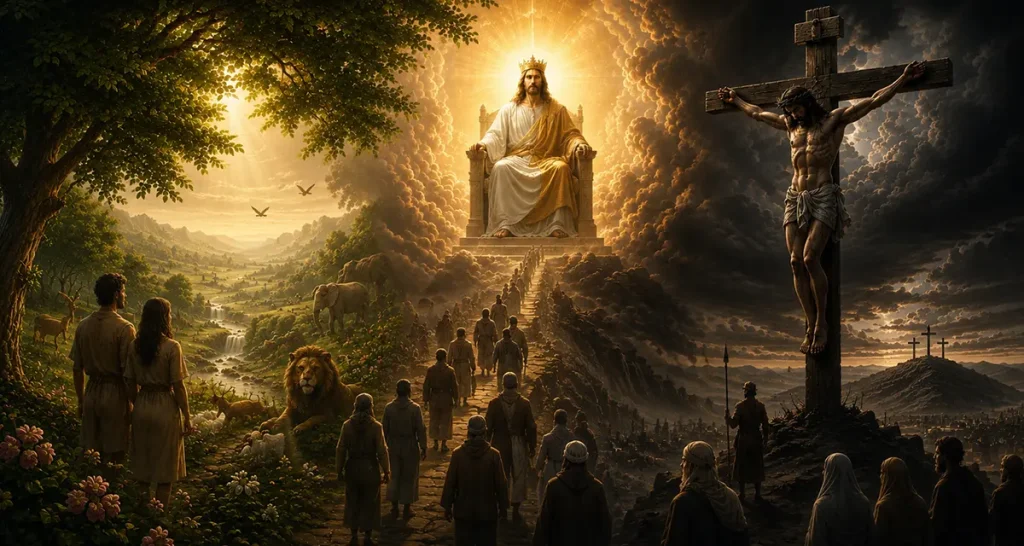
✨ Christ and the Purpose of Creation: From Adam to “God All in All”

Difficulty Level: Advanced

Jump to Answers

  1. You said, “Because God’s eternal purpose was ultimately to gather redeemed humanity under one Representative Man—the Son Himself.” And that takes us from Genesis 1–3 directly into Ephesians 1:9–10, where God’s purpose is described as gathering “all things in Christ.” I think that is worth unraveling. 
  2. You said that if humanity had not been constituted representatively, “Adam’s guilt could not reach us… but neither could Christ’s righteousness.” Someone might respond, “But then we would not have received Adam’s sin, and therefore we would not have needed a Savior.” Yet that seems to assume that no one besides Adam and Eve was capable of committing sin.
  3. The development you are unraveling makes me see a pattern: Adam is to Christ, functionally, somewhat as the Son is to the Father. As Jesus will ultimately surrender everything to God, could it be that, had there been no sin in human history, Adam would one day have surrendered everything entrusted to him to Jesus? If so, Jesus is not merely God’s response to a failure in creation but the fulfillment of creation in His own Person. Does that make sense?
  4. You said, “Functionally, in terms of kingdom stewardship, your observation becomes very compelling.” Scripture says, “For of Him and through Him and to Him are all things”. God creates Adam and entrusts stewardship to him, but eventually that progression must reach its proper end: “to Him.” It appears that the devil’s temptation and its success in Adam interrupted that progression—not that I am suggesting the devil understood God’s eternal plan. And apart from the wisdom of God, once Adam failed, the intended movement of dominion from Adam to the Son would appear to have been broken, and the final purpose that “God may be all in all” would not come to pass. Again, I am not suggesting that the fulfillment of God’s purpose ever depended partially upon Adam, because in Jesus we see that the Son needed no assistance from Adam to accomplish the Father’s purpose.
  5. Before going any further with all of this, there is an even more fundamental question: Why would anyone willfully go against God—YHWH—and how could a creature even do so?

✨ Christ and the Purpose of Creation: From Adam to “God All in All”

Biblical Themes | Jesus Christ (Christology) | Kingdom of God | Sin & Human Nature | Types of Christ

Why did God place humanity under one representative man? Why should Adam’s failure affect those who came after him—and why should the righteousness of another Man, Jesus Christ, be able to become ours?

Those questions open into something much larger than the doctrine of original sin.

Beginning with Adam’s representative role, this discussion follows a thread running from Genesis to the New Testament: humanity receives dominion from God, yet Scripture ultimately places that dominion under Jesus Christ, the Last Adam. What initially appears to be God’s response to humanity’s failure begins to reveal something deeper—Christ was not merely introduced into the story because Adam sinned. All things were created through Him and for Him (Colossians 1:16).

This raises a remarkable possibility for understanding the biblical story. Was Adam’s stewardship always intended to reach its fulfillment in Christ? Was creation always moving from God, through His appointed order, and ultimately back “to Him” (Romans 11:36), until the Son delivers the kingdom to the Father and “God may be all in all” (1 Corinthians 15:24–28)?

From there comes an even more fundamental question: if YHWH is the source of every good thing, how could a creature ever willfully choose against Him in the first place?

The following Q&A explores that progression—from Adam and representation, to Christ and the purpose of creation, to the Fall, Satan’s disruption of human stewardship, the wisdom of God in the Last Adam, and finally the strange irrationality at the heart of sin itself.

At the center of the entire discussion is one question:

Is Christ primarily God’s answer to what went wrong in creation—or was Christ the goal toward which creation was moving from the very beginning?

You said, “Because God’s eternal purpose was ultimately to gather redeemed humanity under one Representative Man—the Son Himself.” And that takes us from Genesis 1–3 directly into Ephesians 1:9–10, where God’s purpose is described as gathering “all things in Christ.” I think that is worth unraveling.

Yes. And I think this takes us into something much larger than simply asking, “Why did Adam’s sin affect me?” Once we arrive at Ephesians 1, we begin to see that Adam was never the final destination of God’s purpose for humanity.

Adam was a representative man, but Christ is the Representative Man.

And that changes the entire perspective.

🌿 Adam Was the Beginning, Not the Goal

Genesis begins with God creating humanity in Adam:

“Then God said, ‘Let Us make man in Our image, according to Our likeness; let them have dominion…'”
Genesis 1:26

Notice the movement:

“man” → “them.”

God creates one man, and from that one man comes humanity.

Eve herself comes from Adam (Genesis 2:21–23), and every subsequent human being comes through that original human family. So humanity begins with a remarkable kind of corporate unity.

Paul later describes this very simply:

“And He has made from one blood every nation of men to dwell on all the face of the earth…”
Acts 17:26

So Adam is not merely the first individual in a long sequence of unrelated individuals.

Humanity is in Adam, historically, naturally, and representatively.

That is precisely why Paul can say:

“For as in Adam all die, even so in Christ all shall be made alive.”
1 Corinthians 15:22

There are two humanities in that sentence.

In Adam.

In Christ.

And suddenly Genesis begins pointing forward.

👤 Adam Was a “Type of Him Who Was to Come”

Paul actually tells us this explicitly:

“Nevertheless death reigned from Adam to Moses… Adam, who is a type of Him who was to come.”
Romans 5:14

That is an astonishing statement.

Adam is τύπος — typos, a pattern, figure, or prototype.

Of whom?

Christ.

That means God’s arrangement of humanity under Adam was not some unfortunate constitutional structure that God later had to work around.

The very principle of one man representing many was already pointing toward Christ.

Romans 5 deliberately builds the comparison:

“For if by the one man’s offense many died, much more the grace of God and the gift by the grace of the one Man, Jesus Christ, abounded to many.”
Romans 5:15

Then:

“For as by one man’s disobedience many were made sinners, so also by one Man’s obedience many will be made righteous.”
Romans 5:19

There it is.

One man → many.

Adam’s disobedience affects those represented in him.

Christ’s obedience affects those represented in Him.

So the principle that initially seems terribly uncomfortable when we look backward at Adam becomes the very principle upon which our salvation rests when we look forward to Christ.

And this connects beautifully with what we were discussing before about not having been present to “vote” for Adam. 🤭

If God had established humanity upon the principle that nothing another person does may ever be credited to you unless you personally participated in doing it, then Adam’s guilt could not reach us…

but neither could Christ’s righteousness.

The gospel itself depends upon representation.

✨ But Christ Does Much More Than Undo Adam

And here is where Ephesians takes us beyond Romans 5.

It would already be glorious if Christ simply restored everything Adam lost.

We might imagine:

Adam → Fall → Christ → back to Eden.

But that isn’t actually the biblical trajectory.

It is:

Adam → Fall → Christ → something infinitely greater than Adam ever possessed.

Christ doesn’t merely return humanity to Genesis 2.

He brings humanity into union with the Son of God Himself.

And now Ephesians 1:9–10 becomes enormous:

“having made known to us the mystery of His will, according to His good pleasure which He purposed in Himself, that in the dispensation of the fullness of the times He might gather together in one all things in Christ, both which are in heaven and which are on earth—in Him.”
Ephesians 1:9–10

The expression translated “gather together in one” is extraordinarily interesting.

Paul uses the Greek verb ἀνακεφαλαιόω — anakephalaiōō.

It carries the idea of summing up, bringing together under a head, or recapitulating something.

And the word contains kephalē — “head.”

God’s purpose is to bring the fractured creation together under one Head: Christ.

That means the story of Scripture is not merely:

How will God forgive sinners?

It is much larger:

How will God bring His entire created order to its intended unity under His Son?

Forgiveness is indispensable to that purpose.

Redemption is indispensable.

Resurrection is indispensable.

But all of them serve something even larger:

“all things in Christ.”

🌎 The Fall Fragmented What God Had Created in Unity

Look at what happens immediately after Adam’s rebellion.

Before the fall there is harmony:

God and humanity.

Man and woman.

Humanity and creation.

Humanity within itself.

Then sin enters.

And everything fractures.

Adam hides from God:

“I heard Your voice in the garden, and I was afraid… and I hid myself.”
Genesis 3:10

Adam turns against Eve:

“The woman whom You gave to be with me, she gave me of the tree…”
Genesis 3:12

Creation itself becomes hostile:

“Cursed is the ground for your sake…”
Genesis 3:17

Then Cain kills Abel (Genesis 4:8).

Human violence spreads (Genesis 6:5, 11).

At Babel even human language and society fracture (Genesis 11:7–9).

Sin produces disintegration.

And then Ephesians announces God’s mystery:

God is bringing everything back together—

in Christ.

👑 But Notice: God Does Not Gather Everything Back Under Adam

This is crucial.

God doesn’t repair Adam and put creation back underneath him.

The head of the restored creation is Christ Himself.

Paul says:

“And He put all things under His feet, and gave Him to be head over all things to the church, which is His body…”
Ephesians 1:22–23

And here something breathtaking happens.

The One under whom creation is gathered is not merely the eternal Son as God.

He is the incarnate, crucified, risen, glorified Man Jesus Christ.

Paul emphasizes this elsewhere:

“For He has put all things under His feet.”
1 Corinthians 15:27

That quotation comes from Psalm 8, which itself goes back to humanity’s Genesis vocation:

“You have made him to have dominion over the works of Your hands; You have put all things under his feet.”
Psalm 8:6

Genesis 1 said humanity would rule creation.

Psalm 8 celebrates that calling.

Hebrews 2 then looks at the world and essentially says:

We don’t see it yet.

“But now we do not yet see all things put under him. But we see Jesus…”
Hebrews 2:8–9

That transition is magnificent.

We don’t yet see humanity exercising the dominion Genesis promised.

But we see Jesus.

The human vocation has finally been fulfilled in one Man.

🧬 Christ Becomes the Beginning of a New Humanity

This is why Scripture calls Him:

“the last Adam”
1 Corinthians 15:45

And:

“the second Man”
1 Corinthians 15:47

Those expressions are incredibly precise.

Why last Adam?

Because there will never be another representative head after Him.

Why second Man?

Because God is beginning humanity again in Him.

Adam heads the old humanity.

Christ heads the new.

And therefore salvation isn’t merely God improving individuals.

It is God transferring people from one humanity into another.

Paul says:

“For as in Adam all die, even so in Christ all shall be made alive.”
1 Corinthians 15:22

And elsewhere:

“Therefore, if anyone is in Christ, he is a new creation…”
2 Corinthians 5:17

That phrase “in Christ” now becomes much richer.

It isn’t merely “Christ helped me.”

It is corporate identity.

I once belonged to the humanity whose head was Adam.

Now I belong to the humanity whose Head is Christ.

🫂 And Here the Church Suddenly Makes Sense

This is why Ephesians moves naturally from Christ as Head to the Church as His body.

“And He put all things under His feet, and gave Him to be head over all things to the church, which is His body…”
Ephesians 1:22–23

God is already forming the new humanity around Christ.

Paul makes that explicit in Ephesians 2.

Speaking of Jew and Gentile—the enormous human division running through biblical history—Paul says Christ’s purpose was:

“so as to create in Himself one new man from the two, thus making peace.”
Ephesians 2:15

Notice the wording.

Not merely:

“two groups getting along.”

But:

“one new man.”

That is Adamic language.

Humanity is being recreated in Christ.

And therefore divisions that characterized fallen humanity begin losing their ultimate authority:

“There is neither Jew nor Greek, there is neither slave nor free, there is neither male nor female; for you are all one in Christ Jesus.”
Galatians 3:28

Not because those distinctions cease to exist in every earthly sense, but because none of them constitutes the fundamental identity of the new humanity.

The fundamental identity is:

Christ.

🌌 And Then the Scope Becomes Cosmic

Now we can appreciate why Ephesians 1:10 doesn’t merely say God will gather people in Christ.

It says:

“all things… which are in heaven and which are on earth.”

Because Adam’s fall did not affect humanity alone.

Paul tells us:

“For the creation was subjected to futility…”
Romans 8:20

And:

“the whole creation groans and labors with birth pangs together until now.”
Romans 8:22

So Christ’s work must ultimately address creation itself.

Colossians gives almost the same vision as Ephesians:

“For by Him all things were created that are in heaven and that are on earth…”
Colossians 1:16

Then only a few verses later:

“and by Him to reconcile all things to Himself… whether things on earth or things in heaven.”
Colossians 1:20

Notice the symmetry:

All things created through Him.

All things reconciled through Him.

All things gathered under Him.

Creation begins through the Son.

Creation reaches its intended goal in the Son.

🔥 And Here We Reach Something Even Deeper

This makes me hesitant to describe Christ merely as God’s solution to Adam’s problem.

That is true, but it is too small.

Because Ephesians says God’s purpose in Christ existed according to:

“His good pleasure which He purposed in Himself”
Ephesians 1:9

And earlier:

“He chose us in Him before the foundation of the world…”
Ephesians 1:4

Christ is not Plan B.

The incarnation is not God frantically repairing an experiment that Adam ruined.

Redemption certainly answers the fall. The cross truly deals with sin. But the destination of God’s eternal purpose is larger than merely reversing Adam’s failure.

The destination is Christ Himself.

That gives us a fascinating possibility for how to understand Adam:

Adam wasn’t merely the man who came before Christ chronologically.

Adam was deliberately constructed by God as a pattern pointing toward Christ.

One man.

A humanity contained in him.

A bride taken from him.

A vocation to rule creation.

Humanity bearing God’s image.

Creation placed under his dominion.

And then the New Testament reveals the reality toward which all of that was moving:

Christ, the true Image of God (Colossians 1:15).

Christ, the Last Adam (1 Corinthians 15:45).

Christ, the Bridegroom of the Church (Ephesians 5:25–32).

Christ, the Head of the body (Colossians 1:18).

Christ, the Man under whose feet everything is finally placed (Hebrews 2:8–9).

And that raises an even deeper question.

Perhaps God’s ultimate purpose was never simply to have Adam’s humanity living forever in Eden.

Perhaps humanity was always destined to reach its fullness in the incarnate Son.

In other words, Eden may not have been the finished product.

It may have been the beginning of the road toward Christ.

And if we follow that thread, we arrive at an enormous theological question:

Would the Son have become Man even if Adam had never sinned?

Because if God’s eternal purpose really is to sum up all things in Christ, rather than merely to use Christ to repair Adam’s failure, then the incarnation begins to look like something much bigger than an emergency response to Genesis 3.

You said that if humanity had not been constituted representatively, “Adam’s guilt could not reach us… but neither could Christ’s righteousness.” Someone might respond, “But then we would not have received Adam’s sin, and therefore we would not have needed a Savior.” Yet that seems to assume that no one besides Adam and Eve was capable of committing sin.

Exactly. That objection quietly assumes something we have no reason to assume: that if Adam’s sin had not been imputed to his descendants, everyone else would therefore have remained sinless.

Those are two completely different claims.

Adam’s representative sin explains why humanity is constituted as fallen in Adam. It does not mean Adam and Eve were the only humans who could possibly rebel against God.

🌳 Adam Was Not Created With Some Unique Capacity to Sin

Before the fall, Adam and Eve were good, innocent creatures, but they were not immutably holy.

Only God is holy in such a way that evil is impossible to His nature:

“God cannot be tempted by evil, nor does He Himself tempt anyone.”
James 1:13

Adam was capable of obedience, but also capable of disobedience. And presumably their unfallen descendants, considered merely as creatures, would have shared that creaturely condition unless God brought them into some confirmed state of righteousness.

So imagine, for the sake of the argument, the alternative system:

No representation whatsoever. Every human being stands entirely on his or her own.

Adam sins.

God judges Adam alone.

Eve sins.

God judges Eve alone.

Then Cain is born somehow unaffected by their sin.

Cain receives his own probation.

Cain can obey or sin.

Then Abel.

Then Seth.

Then their children.

Then billions of human beings.

Every single person gets an independent moral probation.

What reason do we have to think none of them would ever sin?

None.

In fact, once even one independently created or unfallen person sins, that person needs redemption.

So removing Adamic representation doesn’t remove the possibility of the fall.

It merely individualizes the falls.

🤔 And It Actually Creates a Strange Humanity

Suppose Adam’s act affected Adam alone.

Then humanity could theoretically become a mixture of fallen and unfallen people.

Adam sins.

Perhaps Abel doesn’t.

Cain does.

Seth doesn’t.

One of Seth’s children does.

Another doesn’t.

And so forth.

You could eventually have two categories of humanity living side by side:

fallen humans needing salvation
and
unfallen humans who do not.

And then things become even stranger.

Could an unfallen person marry a fallen person?

What would be the status of their children?

Would children inherit anything from their parents at all?

Would each child begin morally untouched and receive an independent probation?

Would every person effectively have his own miniature Garden of Eden test?

We quickly discover that saying, “Adam’s sin should have affected Adam alone,” does not necessarily produce a more coherent human race.

It produces humanity as essentially billions of isolated moral units.

But that isn’t how God created humanity.

🧬 God Created a Human Race, Not Billions of Independent Creations

This goes back to something important in Genesis.

God could have created ten thousand unrelated human beings simultaneously.

He didn’t.

He created one man.

“And the LORD God formed man of the dust of the ground…”
Genesis 2:7

Then even the woman was not separately formed from the dust.

God deliberately took her from the man:

“And the rib which the LORD God had taken from man He made into a woman…”
Genesis 2:22

And Adam immediately recognizes the significance:

“This is now bone of my bones and flesh of my flesh…”
Genesis 2:23

Then every other human comes through them.

Paul makes the theological significance explicit:

“And He has made from one blood every nation of men to dwell on all the face of the earth…”
Acts 17:26

Human solidarity isn’t something God imposed after the fall so that He could blame everybody for Adam.

It is built into creation itself.

We are one humanity.

That’s why Adam can function representatively.

⚖️ But Then Someone Might Push Back Again

They could say:

“Fine. Perhaps other people could have sinned. But why not let each person prove it individually? Maybe some would never have sinned.”

Now we’re at the stronger version of the objection.

And here I think we need to be careful.

Scripture doesn’t tell us what percentage of independently tested unfallen humans would eventually rebel. So we shouldn’t claim:

“Every single one definitely would have sinned anyway.”

We don’t know that counterfactual.

But we do know something much more important.

God did not choose to constitute humanity that way.

And Romans 5 tells us why the structure He actually chose becomes extraordinarily significant:

“For as by one man’s disobedience many were made sinners, so also by one Man’s obedience many will be made righteous.”
Romans 5:19

The same architecture operates in both directions:

one man’s act → many

But there is an enormous asymmetry.

Paul repeatedly says:

“much more…”
Romans 5:15, 17

Grace doesn’t merely equal the damage.

It surpasses it.

✨ Because Christ Gives Us Something Better Than “Another Chance”

This is where the hypothetical independent-probation system begins to look much less attractive than it initially sounds.

Suppose God said:

“You won’t be represented by Adam. You get your own chance.”

Wonderful.

Now my eternal destiny depends upon me never doing what Adam did.

Ever.

I stand before God upon the record of my own obedience.

And if I fail?

I have my own fall.

That initially sounds “fairer” because nobody else’s disobedience counts against me.

But follow the logic consistently:

then nobody else’s obedience can count for me either.

That includes Christ’s.

If absolute moral individualism is the principle, I cannot object:

“Adam’s action must remain Adam’s alone!”

and then later say:

“But please credit Christ’s obedience to me.”

The gospel gives us something radically different:

“For He made Him who knew no sin to be sin for us, that we might become the righteousness of God in Him.”
2 Corinthians 5:21

And:

“But of Him you are in Christ Jesus, who became for us wisdom from God—and righteousness and sanctification and redemption.”
1 Corinthians 1:30

God’s answer is not:

“I’ll give everyone another Adamic probation.”

It is:

“I will put you in My Son.”

That is incomparably safer.

🛡️ Adam Could Fall. Christ Cannot.

And this is where our previous discussion about the Last Adam becomes so important.

Suppose God merely restored me to Adam’s original condition.

I’m innocent again.

Wonderful.

But am I secure?

Adam was innocent too.

And Adam fell.

Restoration to Adamic innocence would therefore not necessarily be the final salvation Scripture describes.

But the believer isn’t ultimately placed back in Adam.

We are placed in Christ.

And Christ is not merely another innocent human being undergoing probation.

He has already obeyed.

He has already been tested.

He has already conquered.

He has already died.

He has already risen.

“Christ, having been raised from the dead, dies no more. Death no longer has dominion over Him.”
Romans 6:9

And our life is now bound to His life:

“For you died, and your life is hidden with Christ in God.”
Colossians 3:3

That is astonishingly different from:

“Good luck. Here’s your garden. Don’t touch your tree.” 😄

The first Adam gives humanity a righteousness capable of being lost because the representative himself is mutable.

The Last Adam brings His people into a righteousness already accomplished through obedience and into resurrection life beyond death’s dominion.

🌱 Which Makes Eden Look Even More Like a Beginning

And this brings us right back to Ephesians 1.

Perhaps the alternative we instinctively imagine is:

No Adamic representation → everyone remains innocent → everyone lives happily in Eden forever.

But Scripture never actually tells us that perpetual Adamic innocence was God’s ultimate goal.

God’s purpose is described much more magnificently:

“that in the dispensation of the fullness of the times He might gather together in one all things in Christ…”
Ephesians 1:10

The destination isn’t merely innocent humanity.

It is humanity in Christ.

Not merely creatures who haven’t sinned.

But sons brought into glory:

“For it was fitting for Him… in bringing many sons to glory, to make the captain of their salvation perfect through sufferings.”
Hebrews 2:10

Not merely Adam standing in a garden.

But redeemed humanity conformed to the image of God’s Son:

“For whom He foreknew, He also predestined to be conformed to the image of His Son, that He might be the firstborn among many brethren.”
Romans 8:29

So yes: saying, “Without Adam’s imputed sin we wouldn’t need a Savior” moves far too quickly.

At most we could say:

We wouldn’t need a Savior because of Adam’s sin.

That does not establish:

We would never need a Savior.

And even deeper, it assumes that God’s purpose for Christ was merely to become a Savior after something went wrong.

Ephesians is beginning to challenge that assumption altogether.

Because God’s ultimate purpose isn’t merely to rescue humanity from Adam.

It is to bring humanity into Christ.

And I think that distinction gives us the doorway into the question we ended with before: Is the incarnation fundamentally about solving sin, or was humanity’s union under the incarnate Son somehow already the goal toward which creation was moving?

The development you are unraveling makes me see a pattern: Adam is to Christ, functionally, somewhat as the Son is to the Father. As Jesus will ultimately surrender everything to God, could it be that, had there been no sin in human history, Adam would one day have surrendered everything entrusted to him to Jesus? If so, Jesus is not merely God’s response to a failure in creation but the fulfillment of creation in His own Person. Does that make sense?

Yes—with one important qualification, I think that makes very good theological sense. And you have put your finger on a distinction that changes how we read the whole story:

Christ does not merely rescue creation from its failed beginning. Christ is the One toward whom creation was moving from its beginning.

The Fall profoundly changes how creation reaches that destination—through incarnation, suffering, atonement, death, resurrection, and reconciliation—but it need not mean that the destination itself was invented because of the Fall.

🌱 Adam receives; Christ inherits

Your proposed pattern is fascinating:

Adam → Christ → Father

And there really is biblical architecture supporting something like that.

God gives Adam dominion:

“Let them have dominion…”
Genesis 1:26

And:

“You have made him to have dominion over the works of Your hands; You have put all things under his feet.”
Psalm 8:6

But the New Testament takes precisely that “all things under his feet” language and ultimately locates its fulfillment not in Adam, but in Christ:

“But now we do not yet see all things put under him. But we see Jesus…”
Hebrews 2:8–9

That’s remarkable.

Adam receives creation as a stewardship, but the human being in whom that dominion actually reaches its intended fullness is Jesus.

And then Paul takes us one step further:

“Then comes the end, when He delivers the kingdom to God the Father…”
1 Corinthians 15:24

Eventually:

“when all things are made subject to Him, then the Son Himself will also be subject to Him who put all things under Him, that God may be all in all.”
1 Corinthians 15:28

So there really is a movement:

Creation entrusted to humanity → everything subjected to Christ → Christ presents the kingdom to the Father → God all in all.

That is very close to what you are seeing.

👑 Adam as vice-regent under the Son

I would modify one part of the analogy slightly.

I wouldn’t make Adam’s relationship to Christ identical to the Son’s relationship to the Father.

The eternal Father-Son relationship is unique. The Son shares the divine nature and eternal glory of the Father (John 1:1; 17:5; Hebrews 1:3). Adam obviously doesn’t stand in an analogous ontological relationship to Christ.

But functionally, in terms of kingdom stewardship, your observation becomes very compelling.

Adam receives dominion from God, but Christ is the One for whom creation ultimately exists:

“All things were created through Him and for Him.”
Colossians 1:16

That little phrase “for Him” is enormous here.

If all things were created for the Son, then even before we introduce Genesis 3, Adam cannot possibly be creation’s final destination.

Adam’s kingdom was already Christ’s.

Adam simply hadn’t yet delivered it to Him.

Or perhaps better:

Adam was entrusted with cultivating a world that ultimately belonged to the Son.

That means Adam’s commission:

“Be fruitful and multiply; fill the earth and subdue it…”
Genesis 1:28

wasn’t merely about producing billions of people and developing civilization indefinitely.

Humanity was developing God’s creation toward its Christological goal.

🌎 This changes the meaning of “all things in Christ”

Now Ephesians 1:9–10 becomes even more interesting.

God’s purpose is:

“that… He might gather together in one all things in Christ, both which are in heaven and which are on earth—in Him.”
Ephesians 1:10

Notice that Paul doesn’t introduce this merely as God’s solution to sin.

He calls it:

“the mystery of His will, according to His good pleasure which He purposed in Himself.”
Ephesians 1:9

That’s what makes your observation so significant.

There is a difference between saying:

God always knew Adam would fail, so He planned Christ as the remedy beforehand

and saying:

God’s purpose was Christ from the beginning; redemption became the form that purpose took in a fallen creation.

Those aren’t identical ideas.

The second one makes Christ not merely the answer to Genesis 3.

It makes Christ the answer to Genesis 1.

🤯 And Colossians says almost exactly that

Look again at the sequence in Colossians 1.

Christ is:

“the image of the invisible God, the firstborn over all creation.”
Colossians 1:15

Then:

“All things were created through Him and for Him.”
Colossians 1:16

Then:

“He is before all things, and in Him all things consist.”
Colossians 1:17

Only after establishing that does Paul introduce Christ as:

“the head of the body, the church… the firstborn from the dead”
Colossians 1:18

and then reconciliation through the blood of His cross (Colossians 1:20).

That’s significant.

Christ’s cosmic supremacy precedes Paul’s discussion of redemption.

He is not Lord of creation because He rescued it.

He rescues creation because creation already belongs to Him.

The Cross restores something whose ultimate purpose was already Christ.

🌿 So imagine Genesis without Genesis 3

Now we’re entering speculative theology, so we should distinguish what Scripture explicitly teaches from what we are inferring.

Suppose Adam never falls.

He obeys.

Eve obeys.

Their descendants remain faithful.

Humanity fills the earth.

The image of God spreads throughout creation.

Human beings cultivate the earth and exercise righteous dominion over it exactly as commanded in Genesis 1:28.

What happens when that mission is complete?

Scripture doesn’t tell us.

But if Colossians 1:16 is true—

everything was created “for Him”

then it seems strange to imagine Adam simply ruling forever as creation’s ultimate human head while the incarnate Son never enters the picture.

Your suggestion gives us another possibility:

At the fulfillment of humanity’s vocation, Adam hands the completed human kingdom to the One for whom it was always intended.

And then Christ brings everything to the Father.

In conceptual form:

Father → gives creation through the Son

Son → entrusts earthly dominion to humanity

Adam → cultivates creation under God

Humanity → fills creation with God’s image

Adam/humanity → yields completed dominion to Christ

Christ → gathers everything in Himself

Son → presents everything to the Father

God → “all in all”

Compare Genesis 1:26–28; Psalm 8:4–6; Ephesians 1:9–10; Colossians 1:15–17; and 1 Corinthians 15:24–28.

That produces a beautiful circular movement:

Everything comes from God through the Son, and everything returns to God through the Son.

Paul actually speaks remarkably similarly:

“For of Him and through Him and to Him are all things, to whom be glory forever.”
Romans 11:36

✨ And then the Incarnation becomes much bigger

This is the part of your observation I find especially important.

If this trajectory is right, the Incarnation cannot be understood merely as:

“Something went wrong, so God had to become human.”

The atoning death of Christ is certainly because of sin. Scripture is explicit about that:

“Christ died for our sins according to the Scriptures.”
1 Corinthians 15:3

His suffering is redemptive (Isaiah 53:5–6; 1 Peter 2:24).

His blood is shed for forgiveness (Matthew 26:28).

But that doesn’t automatically prove that the union of humanity and the Son of God was itself conceived only as an emergency response to sin.

And here we must be careful because Christians have historically disagreed on precisely this question.

Scripture never simply says:

“The Son would have become incarnate even if Adam had never sinned.”

So I wouldn’t turn it into a doctrine Scripture requires us to affirm.

But Scripture does unquestionably say something very close to the larger point you are making:

Creation’s ultimate purpose is Christ, not Adam.

“All things were created through Him and for Him.”
Colossians 1:16

And:

“that in all things He may have the preeminence.”
Colossians 1:18

And:

“all things in Christ.”
Ephesians 1:10

Therefore, even if we leave the hypothetical question of a sinless-world Incarnation unresolved, we can confidently say:

Jesus Christ is not merely God’s response to the failure of creation.

He is creation’s goal.

🔥 And that makes the Fall almost an interruption inside a larger story

Not an interruption that surprised God, of course.

But an interruption conceptually.

We normally tell the story:

Creation → Fall → Redemption

And because we tell it that way, redemption can accidentally become the purpose of creation.

But Ephesians seems to invite a larger structure:

Creation → Christ

with the Fall creating the necessity for:

Creation → Fall → Redemption → Christ

The Cross therefore doesn’t invent creation’s destination.

The Cross brings a fallen creation to the destination God had purposed in Christ.

And this connects powerfully with something we discussed earlier: God doesn’t merely patch the landscape after sin. His purpose precedes the landscape’s distortion.

Which means your sentence is worth preserving almost exactly:

Jesus is not a response to a failure in creation but the fulfillment of creation in His own Person.

I would only add:

The crucified Jesus is God’s response to sin; the cosmic Christ is God’s purpose for creation. And because the One is the same Person as the other, redemption becomes the astonishing road by which fallen creation reaches the destination for which it was always made.

And now something else becomes visible that I think takes this even further: Revelation doesn’t actually end by taking us back to Eden. It ends with humanity, creation, kingship, the dwelling of God, and the Lamb all brought together in a reality far greater than Genesis 2 (Revelation 21:1–5, 22–23; 22:1–5).

The Bible begins with God and humanity in a garden.

It ends with God and humanity united around the throne of God and the Lamb in a garden-city.

And standing at the center isn’t Adam.

It is the Lamb—the God-Man.

You said, “Functionally, in terms of kingdom stewardship, your observation becomes very compelling.” Scripture says, “For of Him and through Him and to Him are all things”. God creates Adam and entrusts stewardship to him, but eventually that progression must reach its proper end: “to Him.” It appears that the devil’s temptation and its success in Adam interrupted that progression—not that I am suggesting the devil understood God’s eternal plan. And apart from the wisdom of God, once Adam failed, the intended movement of dominion from Adam to the Son would appear to have been broken, and the final purpose that “God may be all in all” would not come to pass. Again, I am not suggesting that the fulfillment of God’s purpose ever depended partially upon Adam, because in Jesus we see that the Son needed no assistance from Adam to accomplish the Father’s purpose.

Yes. I think the distinction you make at the end is essential. There was a genuine creaturely stewardship entrusted to Adam, and therefore a genuine historical failure of that stewardship, without God’s eternal purpose ever becoming dependent upon Adam for its eventual accomplishment.

That lets us say something stronger than “Adam failed, so Jesus took over.” The biblical pattern seems closer to:

Adam’s dominion was always received, never possessed independently. It came from God, was exercised under God, and ultimately could only reach its proper end in God.

“For of Him and through Him and to Him are all things” (Romans 11:36) gives us exactly that movement.

🌿 “Of Him” — Adam begins as recipient

Adam originates nothing.

God creates him (Genesis 2:7).

God plants the garden (Genesis 2:8).

God places Adam there (Genesis 2:15).

God gives him his vocation (Genesis 1:28).

God gives him the woman (Genesis 2:22).

God gives him the earth and its creatures to govern (Genesis 1:26–30).

Even Adam’s authority is gift.

So from the very beginning, human dominion isn’t autonomous sovereignty. Adam is something like a royal steward. Psalm 8 captures this beautifully:

“You have made him to have dominion over the works of Your hands; You have put all things under his feet.”
Psalm 8:6

Notice: You made him. You gave him. You put things under him.

Adam possesses nothing independently of God.

Everything is “of Him.”

👑 “Through Him” — Adam’s stewardship has a purpose

Then comes the commission:

“Be fruitful and multiply; fill the earth and subdue it; have dominion…”
Genesis 1:28

Adam isn’t simply told to sit in Eden and enjoy immortality.

There is movement.

Fill.

Subdue.

Rule.

Cultivate.

Something entrusted to humanity is supposed to develop toward fulfillment.

And this is where your observation becomes especially interesting. If everything was created not merely through the Son but “for Him” (Colossians 1:16), then Adam’s stewardship could never have terminated in Adam.

Whatever humanity accomplished under Genesis 1:28 ultimately belonged to Christ.

Adam could say, in effect:

“What was given to me has reached its appointed fullness; it belongs to You.”

And Christ ultimately brings everything to the Father.

That produces the progression you’re describing:

God → Adam → Christ → God

Not because God ever ceases owning creation, but because creation passes through an entrusted creaturely stewardship and returns in fulfilled submission.

And then:

“that God may be all in all.”
1 Corinthians 15:28

🐍 Then Genesis 3 really does attack the movement

This is where I think your observation about Satan is especially fruitful.

We don’t need to suppose Satan understood God’s eternal plan. Scripture doesn’t tell us that.

But look at what the temptation actually accomplishes.

Adam had received everything from God, was supposed to exercise it under God, and ultimately creation existed for God.

The serpent introduces another possibility:

“you will be like God…”
Genesis 3:5

In other words, instead of:

from God → under God → to God

sin says:

from God → mine.

That’s the rupture.

The creature receives something from the Creator and then attempts to make himself its terminus.

That’s essentially what sin does.

Paul describes fallen humanity in Romans 1 in remarkably similar terms. Humanity receives creation from God but refuses the movement back toward Him:

“although they knew God, they did not glorify Him as God, nor were thankful…”
Romans 1:21

And:

“who exchanged the truth of God for the lie, and worshiped and served the creature rather than the Creator…”
Romans 1:25

Creation stops moving “to Him.”

It curls inward upon the creature.

💥 And Adam’s failure is especially catastrophic because he is the steward

This gives another dimension to the Fall.

Adam doesn’t merely break a moral rule.

He corrupts the office through which earthly creation was supposed to be governed.

The one appointed to bring creation into increasingly ordered submission to God himself becomes disordered.

Now the steward who was supposed to rule creation is himself ruled by sin.

And eventually death rules him:

“death reigned from Adam to Moses…”
Romans 5:14

That’s almost an inversion of Genesis 1.

Adam was supposed to reign.

Instead, death reigns over Adam’s humanity.

And Hebrews 2 recognizes precisely this failure. After quoting Psalm 8’s declaration that everything has been placed under humanity, it says:

“But now we do not yet see all things put under him.”
Hebrews 2:8

Something has gone terribly wrong.

Humanity was given dominion.

Look at humanity now.

We don’t see Genesis 1:28 fulfilled.

And then comes one of the most beautiful turns in Scripture:

“But we see Jesus…”
Hebrews 2:9

There He is.

✨ The purpose doesn’t depend upon Adam

And this is exactly where your qualification becomes necessary.

We shouldn’t picture God watching Adam fail and thinking:

“Now the plan cannot reach Me because Adam was an indispensable link.”

No.

Adam’s stewardship was real.

Adam’s obedience mattered.

Adam’s failure had real consequences.

But Adam was never the foundation upon which God’s eternal purpose depended.

Christ was.

Paul says:

“For no other foundation can anyone lay than that which is laid, which is Jesus Christ.”
1 Corinthians 3:11

And concerning God’s cosmic purpose:

“He chose us in Him before the foundation of the world…”
Ephesians 1:4

The purpose is centered in Christ before Adam ever draws breath.

So Adam can fail his vocation without God’s purpose failing.

And now the wisdom of God becomes astonishing.

🧠 God’s wisdom doesn’t merely repair the broken route

This is where I think what you’re saying becomes especially profound.

Suppose the intended movement was:

Adam receives dominion → Adam faithfully exercises it → humanity fills the earth → creation reaches its appointed fullness under humanity → everything is subjected to Christ → Christ presents the kingdom to the Father → God all in all.

Then Satan succeeds in corrupting Adam.

From within history, it appears catastrophic.

The representative human has failed.

The steward is dead.

The human race is corrupted.

Creation itself is subjected to futility (Romans 8:20).

The road toward Psalm 8 appears closed.

And God’s answer is extraordinary:

The Son Himself becomes Adam.

Not literally Adam the individual, of course, but the Last Adam:

“The first man Adam became a living being. The last Adam became a life-giving spirit.”
1 Corinthians 15:45

God doesn’t abandon the human vocation.

He doesn’t say, “Humanity failed; therefore I’ll accomplish this without humanity.”

That would surrender Genesis 1:26–28.

Instead, the eternal Son becomes Man.

That is why Hebrews 2 is so powerful.

God promised dominion to humanity.

Humanity lost dominion.

But God doesn’t solve the problem by bypassing humanity.

“We see Jesus.”

The Son enters the human race and fulfills the human vocation as Man.

👑 The kingdom still passes through Man

This connects beautifully with our earlier discussion about the resurrection and Christ’s continuing humanity.

Jesus doesn’t accomplish the Father’s purpose by saying:

“Adam failed, so as God I’ll simply exercise divine omnipotence and finish this.”

He becomes the obedient Man.

Where Adam disobeyed, He obeys:

“by one Man’s obedience many will be made righteous.”
Romans 5:19

Where Adam succumbed to temptation, Christ withstands temptation (Matthew 4:1–11).

Where Adam grasped, Christ empties Himself:

“He humbled Himself and became obedient to the point of death, even the death of the cross.”
Philippians 2:8

And then comes dominion:

“Therefore God also has highly exalted Him…”
Philippians 2:9

Until:

“every knee should bow…”
Philippians 2:10

And:

“every tongue should confess that Jesus Christ is Lord, to the glory of God the Father.”
Philippians 2:11

There again is the movement:

Everything → Christ → Father.

The devil hasn’t prevented the “to Him.”

He has unwittingly become part of the history through which God’s wisdom brings it about.

🔥 And perhaps this is part of the “manifold wisdom of God”

Ephesians eventually says something startling:

“to the intent that now the manifold wisdom of God might be made known by the church to the principalities and powers in the heavenly places, according to the eternal purpose which He accomplished in Christ Jesus our Lord.”
Ephesians 3:10–11

That’s very relevant here.

The powers witness something they could never have produced.

Humanity falls.

The human ruler fails.

Death enters.

The kingdom appears compromised.

And God’s eternal purpose doesn’t merely survive.

It emerges through Christ with a glory that the unfallen Adam never possessed.

The serpent strikes humanity.

God answers by joining humanity to His Son.

Death takes Adam’s children.

The Son enters death and destroys its claim from inside:

“that through death He might destroy him who had the power of death, that is, the devil.”
Hebrews 2:14

That’s divine wisdom of an extraordinary order.

The enemy’s apparent success becomes the very arena in which Christ’s supremacy is revealed.

🌌 And now 1 Corinthians 15 becomes the destination of Genesis

This is where I think your thought really lands.

Paul writes:

“Then comes the end, when He delivers the kingdom to God the Father…”
1 Corinthians 15:24

Christ reigns until every enemy is under His feet (1 Corinthians 15:25).

The final enemy—death itself—is destroyed (v. 26).

Then:

“when all things are made subject to Him, then the Son Himself will also be subject to Him who put all things under Him, that God may be all in all.”
1 Corinthians 15:28

So Genesis 3 did not cancel the trajectory.

It transformed the history through which that trajectory would be fulfilled.

And there is an exquisite irony here:

Adam was supposed to rule a world in which there was no death.

Christ receives a world full of death and rules until death itself is abolished.

Adam received an uncursed garden.

Christ receives a kingdom surrounded by enemies and places every enemy beneath His feet.

Adam’s obedience would have developed what God entrusted to him.

Christ’s obedience recovers what Adam lost, defeats what Adam unleashed, fulfills what Adam was commissioned to do, and then carries humanity beyond Adam’s original condition altogether.

Then He delivers the kingdom to the Father.

So I think we can express what you’re seeing this way:

Adam’s participation in God’s purpose was genuinely necessary as a vocation, but Adam personally was never indispensable to the success of God’s eternal purpose.

Because the vocation belonged ultimately to Man, and when the first man failed, the eternal Son became the Last Adam and fulfilled humanity’s vocation Himself.

And that may explain something remarkable about God’s wisdom: God does not accomplish His purpose by pretending Adam never mattered. He accomplishes it by fulfilling Adam’s calling in Christ.

The devil doesn’t get to say, “Human stewardship failed, therefore God’s purpose through humanity failed.”

God’s answer is standing bodily at His right hand:

a Man.

The kingdom will still come through Man.

Creation will still be placed under Man.

Humanity will still bear God’s image perfectly.

The kingdom will still be rendered to God.

And God will still be “all in all.”

Only now the Man through whom it finally happens is God the Son Himself (1 Corinthians 15:45–49; Hebrews 2:5–9; Colossians 1:15–20).

That makes the title “Last Adam” much larger than “Jesus fixes Adam’s sin.” It means, in a very real sense, Jesus completes Adam’s unfinished vocation.

Before going any further with all of this, there is an even more fundamental question: Why would anyone willfully go against God—YHWH—and how could a creature even do so?

Yes. Before asking how God repairs the rupture, there is an even more primitive and disturbing question:

How can the rupture exist at all?

If YHWH is the source of being, goodness, life, wisdom, beauty, joy—if “of Him and through Him and to Him are all things” (Romans 11:36)—then sin seems almost incomprehensible.

Why would a creature ever say No to the One from whom the creature receives literally everything?

And perhaps Scripture’s answer is partly that sin really is irrational. It can be explained in terms of its mechanism and desire, but it cannot finally be made reasonable, because if we could give a sufficient rational justification for rebellion against God, it would cease to be sin.

🤔 First: evil cannot offer something God lacks

This is important.

Satan could not come to Eve and truthfully say:

“God possesses goodness A, but I possess goodness B, which God cannot give you.”

There is no independent reservoir of goodness outside God.

“Every good gift and every perfect gift is from above, and comes down from the Father of lights…”
James 1:17

David says:

“You are my Lord, my goodness is nothing apart from You.”
Psalm 16:2

So evil cannot create an alternative good.

It must take something that is good in God, detach it from its proper relationship to God, and offer the creature possession of it apart from God.

That’s exactly what happens in Genesis 3.

The tree is not evil.

Wisdom isn’t evil.

Knowledge isn’t evil.

Being like God isn’t even intrinsically evil—humanity was already created in God’s image (Genesis 1:26–27).

The poison lies elsewhere.

🐍 “You will be like God”

This is why the serpent’s temptation is so sophisticated.

“For God knows that in the day you eat of it your eyes will be opened, and you will be like God, knowing good and evil.”
Genesis 3:5

The temptation isn’t fundamentally:

“Would you like something wicked?”

It’s closer to:

“Would you like something good without receiving it from God?”

That is much deeper.

God says:

Receive life from Me.
Receive wisdom from Me.
Receive identity from Me.
Receive dominion from Me.
Receive your understanding of good and evil from Me.

The serpent introduces:

Why receive? Take.

And suddenly we are looking at the heart of sin.

🌳 The creature attempts to become its own reference point

The issue isn’t simply eating fruit.

God had established the meaning of reality:

“of the tree of the knowledge of good and evil you shall not eat…”
Genesis 2:17

The serpent challenges God’s interpretation:

“You will not surely die.”
Genesis 3:4

Now Eve stands between two words.

God says: this leads to death.

The serpent says: this leads to elevation.

And then something remarkable happens:

“So when the woman saw that the tree was good for food, that it was pleasant to the eyes, and a tree desirable to make one wise…”
Genesis 3:6

Notice the shift.

God had already pronounced what was good throughout Genesis 1.

“God saw that it was good.”

But now:

“the woman saw…”

She evaluates reality independently of God’s word.

That doesn’t mean seeing or reasoning is sinful. God gave humanity those capacities. The problem is that the creature has begun treating its own perception as the final court of appeal over God’s revelation.

God says death.

She sees desirability.

And she chooses what she sees.

That’s terrifyingly recognizable.

🧠 But how could she even do that?

Now we reach your “how.”

How can a creature whose entire existence depends upon God choose against God?

Because ontological dependence does not entail willing submission.

A creature can depend upon God for the very power with which it resists Him.

That sounds paradoxical, but we experience analogous things constantly.

A child can use the strength his parents’ food helped sustain to run away from them.

But with God it is infinitely more radical.

Paul tells the Athenians:

“for in Him we live and move and have our being.”
Acts 17:28

Therefore, even the sinner’s rebellion occurs while the sinner remains dependent upon God for existence.

The creature cannot become metaphysically independent.

But the creature can will independence.

And that may be one of the deepest absurdities of sin:

The creature attempts existentially what can never be true ontologically.

It says:

“Mine.”

while every atom of its existence says:

“Gift.”

👑 Perhaps the possibility lies precisely in genuine creaturehood

God didn’t create extensions of Himself.

Adam isn’t God operating a human puppet.

Angels aren’t divine thoughts incapable of willing anything except what God directly wills.

God creates genuine creatures—real secondary agents possessing intellect and will.

Adam receives a command precisely because Adam can actually obey it:

“Of every tree of the garden you may freely eat…”
Genesis 2:16

And God can address him morally:

“Have you eaten from the tree of which I commanded you that you should not eat?”
Genesis 3:11

Adam is accountable because Adam genuinely acts.

But this creates an important distinction.

Being able to choose is good.

Choosing evil is not therefore good.

God is not deficient because He cannot sin.

“God… cannot lie.”
Titus 1:2

And:

“God cannot be tempted by evil…”
James 1:13

Therefore, the highest freedom cannot mean maximum ability to choose contrary possibilities, because by that definition fallen humans would possess a freedom that God lacks.

Biblically, perfected freedom appears to be something much greater:

the unhindered ability to act according to perfect goodness.

That’s where redeemed humanity is going.

We will not spend eternity nervously wondering whether Revelation 21 eventually becomes Genesis 3 all over again. 😄

The glorified saints are brought into a condition in which righteousness is no longer precarious (Revelation 21:27; 22:3–5).

So Adam’s original condition wasn’t the highest conceivable state of human freedom.

He was righteous and innocent—but mutable.

He could fall.

Christ brings humanity ultimately into something greater.

💔 But this still doesn’t tell us why the first sinful desire arose

And here I think we need theological humility.

We can trace temptation.

We can describe pride.

We can describe unbelief.

We can describe the desire for autonomy.

But if we ask:

“Yes—but why did a perfectly created creature first desire something contrary to God?”

eventually explanation reaches a wall.

Scripture tells us that the devil:

“sinned from the beginning.”
1 John 3:8

Jesus says of him:

“He was a murderer from the beginning, and does not stand in the truth…”
John 8:44

But Scripture doesn’t give us a psychological documentary showing how the first evil volition arose inside a good creature.

And there may be a reason.

If we keep asking “why?” looking for a sufficient cause, eventually we risk locating the cause of evil either in God or in something God created as evil.

Scripture rejects both.

God’s creation was:

“very good.”
Genesis 1:31

And:

“God cannot be tempted by evil, nor does He Himself tempt anyone.”
James 1:13

So evil doesn’t have an ultimate positive cause in the same way creation does.

God creates things.

But evil isn’t really a thing God needed to create.

It is a corruption, distortion, deprivation, or misuse of what is good.

A lie requires truth to distort.

Hatred requires persons who ought to be loved.

Pride requires a genuinely good self whose importance becomes disordered.

Idolatry requires something created by God that is elevated above God.

Sexual immorality corrupts a good created sexuality.

Greed corrupts possession and provision.

Even Satan cannot manufacture goodness.

He can only misdirect it.

🔥 And that may explain why sin begins with a lie

Jesus calls Satan:

“a liar and the father of it.”
John 8:44

That seems incredibly significant.

For a creature knowingly to reject God as God, reality itself must somehow be misrepresented.

Look at Genesis 3 again.

The serpent doesn’t begin:

“God is infinitely good. Everything you possess comes from Him. His command exists entirely for your flourishing. Now rebel against Him.”

That isn’t very persuasive. 😄

Instead:

“Has God indeed said…?”
Genesis 3:1

Then:

“You will not surely die.”
Genesis 3:4

Then:

“God knows…”
Genesis 3:5

The insinuation is:

God is withholding something.

And once the goodness of God becomes suspect, rebellion begins to look reasonable.

That’s enormously important.

The serpent cannot change who God is.

So he changes the creature’s perception of who God is.

God becomes, in Eve’s perception, not the generous Creator who gave her everything, but the restrictive authority preventing her fulfillment.

Once that lie is believed, the absurd becomes psychologically plausible:

“Perhaps I would be better off apart from the One from whom all goodness comes.”

🪞 And this brings us remarkably close to the essence of sin

Romans 1 describes fallen humanity like this:

“although they knew God, they did not glorify Him as God, nor were thankful…”
Romans 1:21

That word thankful matters enormously in the discussion we’re having.

Thanksgiving recognizes:

I am recipient.

Sin says:

I am owner.

Worship says:

from Him.

Faith says:

through Him.

Thanksgiving says:

everything I have is gift.

Glory says:

to Him.

But sin interrupts the movement:

from Him → through Him → mine.

That is why idolatry follows immediately in Romans 1:23–25.

The creature tries to redirect toward creation what belongs ultimately “to Him.”

And now Genesis 3 connects directly to the larger structure we’ve been discussing.

Adam was given dominion.

The temptation wasn’t merely to make Adam behave badly while retaining the same orientation.

It turned the steward inward.

Instead of creation being received from God and governed toward God’s purpose, the steward himself attempts to become the terminus.

✨ Which makes Christ’s obedience even more beautiful

Now compare Adam with Jesus.

The serpent essentially tells humanity:

Take what belongs to God.

But of Christ Paul says:

“who, being in the form of God, did not consider it robbery to be equal with God, but made Himself of no reputation…”
Philippians 2:6–7

There is an astonishing reversal there.

Adam is a creature who reaches upward.

Christ is God who stoops downward.

Adam receives everything and grasps for more.

Christ possesses everything and gives Himself.

Adam says through his act:

“Not Your will, but mine.”

Christ says:

“nevertheless not My will, but Yours, be done.”
Luke 22:42

That may be one of the deepest Adam/Christ contrasts in Scripture.

And then Philippians tells us where Christ’s self-surrender leads:

“Therefore God also has highly exalted Him…”
Philippians 2:9

The serpent’s gospel was:

Grasp → become like God.

God’s order revealed in Christ is:

Trust → obey → receive from the Father.

Jesus refuses to seize even what truly belongs to Him.

And the Father gives Him everything.

🌌 So why would anyone willfully go against YHWH?

Not because there is actually something better outside Him.

There isn’t.

Not because evil possesses some good that God lacks.

It doesn’t.

Not because independence from God is actually possible.

It isn’t.

The creature rebels when gift becomes possession, dependence is experienced as limitation, God’s word is displaced by creaturely judgment, and God’s goodness is disbelieved sufficiently that autonomy begins to appear preferable to communion.

And that’s why sin has an element of madness to it.

Jeremiah captures it extraordinarily well:

“For My people have committed two evils:
They have forsaken Me, the fountain of living waters,
And hewn themselves cisterns—broken cisterns that can hold no water.”
Jeremiah 2:13

That may be one of Scripture’s clearest answers to your question.

Why abandon an infinite fountain for an empty broken container?

There is no ultimately rational answer.

That’s what makes sin sin.

And perhaps this also explains why salvation requires more than God giving us better information. Our fundamental problem isn’t simply that nobody explained God clearly enough. Something has happened to the creature’s desires, perception, trust, and will (Ephesians 4:17–18; Romans 8:7; John 3:19–21).

Which takes us right back to Christ: He doesn’t merely come to forgive Adam’s rebellious humanity. He comes to produce a humanity whose relationship to God is finally what Adam’s should have been—receiving everything from the Father, living entirely through God, and joyfully returning everything to Him.

And in Christ, astonishingly, that movement can never be broken again.