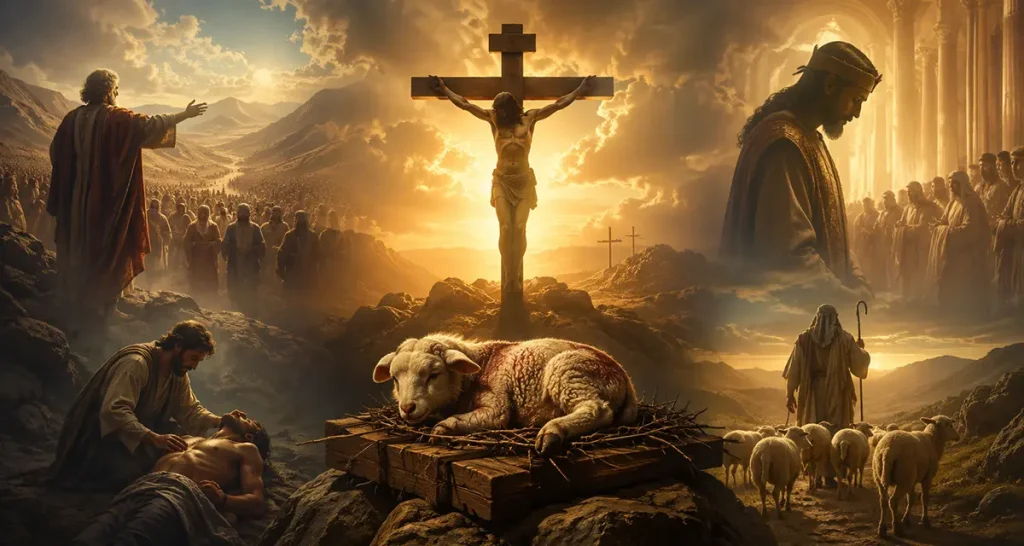
Yes. And I think your question reaches beneath the usual answer, “Jesus could be our substitute because He was sinless.” Sinlessness explains why He was an acceptable sacrifice, but it does not by itself explain why His life could stand for ours.
After all, an innocent angel might be sinless, but an angel could not simply say, “I will die instead of humanity.” There has to be a real basis upon which Christ can represent us.
I think Scripture gives several layers to that basis: creation, incarnation, solidarity, divine appointment, and covenant headship.
🧬 First, He actually became one of us
This is perhaps the closest Scripture comes to the “biological” dimension of your question.
“Inasmuch then as the children have partaken of flesh and blood, He Himself likewise shared in the same.”
— Hebrews 2:14
And then:
“Therefore, in all things He had to be made like His brethren…”
— Hebrews 2:17
That language is striking. The Son does not redeem humanity while remaining outside humanity. He enters the human family.
Jesus is not merely God wearing a human appearance. He is genuinely human, born of a woman (Galatians 4:4), descended from David according to the flesh (Romans 1:3), possessing real flesh and blood (Hebrews 2:14).
There is therefore genuine human solidarity.
Hebrews even says:
“For both He who sanctifies and those who are being sanctified are all of one, for which reason He is not ashamed to call them brethren.”
— Hebrews 2:11
So there is something almost startlingly concrete about redemption:
God did not substitute something foreign for humanity. God the Son entered humanity and acted from within it.
But biology alone still isn’t enough.
If Jesus were merely another human individual, even a perfectly righteous one, we would still have to ask: Why should His death count as mine?
That takes us deeper.
👑 Jesus is not merely a member of humanity; He is appointed its representative
This is where Romans 5 becomes enormously important.
Paul does not ultimately structure salvation as:
Adam → billions of unrelated individuals → Jesus saves some of them
He structures it around two representative men:
Adam → humanity in Adam
Christ → the new humanity in Christ
“For as by one man’s disobedience many were made sinners, so also by one Man’s obedience many will be made righteous.”
— Romans 5:19
And:
“For as in Adam all die, even so in Christ all shall be made alive.”
— 1 Corinthians 15:22
Paul therefore calls Jesus:
“the last Adam”
— 1 Corinthians 15:45
That title is crucial.
Jesus doesn’t merely substitute for isolated individuals. He stands before God as the head of a humanity.
That is something no ordinary human being can simply volunteer himself into.
I cannot announce tomorrow:
“From now on, I represent the human race before God.”
I have no authority to establish that relationship.
And this gets very close to what you suggested: God Himself establishes Christ as our representative.
“For He made Him who knew no sin to be sin for us, that we might become the righteousness of God in Him.”
— 2 Corinthians 5:21
Notice the subject:
“He made Him…”
The substitution is not a private arrangement Jesus invented independently of the Father. It belongs to God’s own saving purpose.
📜 So yes, there is a divine decree behind substitution
But I would hesitate to call it an arbitrary decree.
God does not simply declare:
“I have decided that Person A’s death will count for Person B.”
There is a profound fitness to what God establishes.
The Father appoints the Son.
The Son willingly gives Himself.
The Son becomes genuinely human.
He joins Himself to the humanity He represents.
And believers are subsequently united to Him.
This last element is especially important.
Paul doesn’t merely say Christ died instead of us. He repeatedly says something even stranger:
“If One died for all, then all died.”
— 2 Corinthians 5:14
And:
“I have been crucified with Christ.”
— Galatians 2:20
And:
“Our old man was crucified with Him.”
— Romans 6:6
That begins to move substitution beyond the picture of a courtroom where an unrelated person simply pays someone else’s fine.
Christ can act for us because God has established a real representative union between Christ and His people.
His death becomes our death.
His resurrection becomes the beginning of our resurrection.
His righteousness becomes the ground of our justification.
His sonship becomes the sphere into which we are adopted.
His inheritance becomes ours.
This is why Paul’s favorite expression is so often simply:
“in Christ.”
🌱 There is an even deeper reason: humanity already belongs to Him
This may be the deepest layer of all.
Jesus does not enter creation as a stranger attempting to rescue someone else’s creatures.
John says:
“All things were made through Him, and without Him nothing was made that was made.”
— John 1:3
Paul says:
“All things were created through Him and for Him.”
— Colossians 1:16
And Hebrews says that God made the worlds through the Son (Hebrews 1:2).
So think about the astonishing movement:
The One through whom humanity was created becomes human.
The Creator enters the nature He created.
That means Christ has a relationship to humanity that no angel, prophet, priest, or merely righteous individual could ever possess.
There is something wonderfully fitting about John’s formulation:
“He came to His own…”
— John 1:11
We were already His.
And then He became one of us in order to bring us back to God.
🩸 This also explains why an angel could not substitute for us
Hebrews makes exactly this distinction:
“For indeed He does not give aid to angels, but He does give aid to the seed of Abraham.”
— Hebrews 2:16
An angel belongs to another order of creature.
But the Redeemer says, in effect:
“I will share their flesh and blood.”
That is why Hebrews connects incarnation directly with His priesthood and atoning work (Hebrews 2:14–18).
There is a principle here that runs through biblical priesthood:
The representative must belong to those whom he represents.
The high priest was taken “from among men” and appointed “for men in things pertaining to God” (Hebrews 5:1).
Christ fulfills that principle perfectly.
He is from us, because He became man.
Yet He is also from God, because He is the eternal Son.
And suddenly the uniqueness of the mediator becomes breathtakingly appropriate:
“For there is one God and one Mediator between God and men, the Man Christ Jesus.”
— 1 Timothy 2:5
He belongs on both sides of the mediation.
He is truly God.
He is truly man.
🤝 But His determination matters too
You mentioned Christ’s own determination, and Scripture absolutely includes it.
Jesus says:
“I lay down My life… No one takes it from Me, but I lay it down of Myself.”
— John 10:17–18
So substitution is neither something imposed upon an unwilling Son nor something the Son independently imposes upon the Father.
The Father sends.
The Son comes.
The Father gives the Son.
The Son gives Himself.
“Christ… has loved us and given Himself for us, an offering and a sacrifice to God.”
— Ephesians 5:2
There is therefore divine appointment and voluntary self-offering simultaneously.
And because Father and Son are one in divine will, salvation originates within God Himself rather than being a transaction between competing parties.
🌿 But I think there is one more beautiful dimension
Your question reminds me strongly of our previous discussions about union with Christ.
We often imagine substitution almost exclusively as:
Jesus took my place so that I don’t have to go there.
That is true, but incomplete.
The New Testament gives us something richer:
Jesus took our place so that He could bring us into His place.
He doesn’t merely exchange positions with us and disappear.
He gathers us into Himself.
This is why Peter writes:
“Christ also suffered once for sins, the just for the unjust, that He might bring us to God.”
— 1 Peter 3:18
There is the destination again that we have been circling around in these discussions:
“that He might bring us to God.”
Substitution serves reconciliation and union.
So if we strip away Christ’s sinlessness for a moment, as your question asks, I would say His right to represent us rests upon several realities working together:
- Ontological: He is the Creator through whom humanity exists (John 1:3; Colossians 1:16).
- Human: He genuinely became flesh and blood, sharing our nature (Hebrews 2:14–17).
- Representative: God constituted Him the last Adam, head of a new humanity (Romans 5:12–21; 1 Corinthians 15:45).
- Covenantal: the Father appointed Him to accomplish redemption (John 6:38–40; Hebrews 10:5–10).
- Voluntary: the Son freely gave Himself (John 10:17–18; Galatians 2:20).
- Unitive: those He saves are joined to Him, so His death and resurrection become theirs (Romans 6:3–8; Colossians 3:1–4).
And then His perfect holiness and obedience establish that this representative has no debt of His own and can actually offer Himself for others (Hebrews 4:15; 7:26–27).
So I wouldn’t reduce the answer to “God decreed it”, although ultimately God’s appointment is indispensable.
It is more beautiful than an arbitrary decree:
God appointed as humanity’s representative the very Son through whom humanity was created; the Son truly entered that humanity, took its flesh and blood, voluntarily assumed its cause, and became its new Head.
In Adam, humanity had a head who dragged his descendants into death.
God did not merely send us assistance.
He gave humanity another Man.
And this Man, unlike Adam, is simultaneously our Brother, our Creator, our Lord, and our Head.
That makes Paul’s phrase “the last Adam” (1 Corinthians 15:45) almost unimaginably weighty. Jesus does not merely repair something Adam damaged. God begins humanity again in Him.