Justice | Mercy | Faith

Justice | Mercy | Faith

Christ at the Center: Why Everything Depends on Jesus

Difficulty Level: Intermediate-Advanced

Jump to Answers

  1. Christ invites the weary in Matthew 11:28—”Come to Me, all you who labor and are heavy laden, and I will give you rest”—and then, in John 17, He opens His heart before the Father and reveals where that invitation ultimately leads: “Father, I desire that they also whom You gave Me may be with Me where I am, that they may behold My glory which You have given Me; for You loved Me before the foundation of the world”.
  2. In what sense were we enemies of God when most people do not consciously experience animosity toward Him and, in fact, seem to possess some inclination toward Him? Adam did not become God’s enemy after the Fall in the sense of consciously hating Him. Likewise, throughout nations and cultures, people have sought God—even without knowing Scripture and even when seeking Him wrongly. So  what exactly is the enmity with God that Scripture is describing?
  3. “Without Jesus, there is no Christian category of salvation left to speak about.” If that line of thought is true, then we must go even further: there is no Christian category of creation that can exist without Jesus either. 
  4. If “enemy” is not primarily describing an emotion such as, “I wake up every morning hating God,” but instead describes a relationship of opposition, that can feel cruel and exhausting: “I want God. I don’t want to be His enemy. And yet, I fail miserably and find myself ‘unwillingly’ in opposition to Him because of sin’s grip.” 
  5. Christ invites the weary in Matthew 11:28—”Come to Me, all you who labor and are heavy laden, and I will give you rest”—and then, in John 17, He opens His heart before the Father and reveals where that invitation ultimately leads: “Father, I desire that they also whom You gave Me may be with Me where I am, that they may behold My glory which You have given Me; for You loved Me before the foundation of the world”.

Christ at the Center: Why Everything Depends on Jesus

Biblical Themes | Jesus Christ (Christology) | New Testament | Salvation (Soteriology) | Sin & Human Nature

There are words Christians use so frequently that we can begin to think of them as independent theological concepts: repentance, forgiveness, reconciliation, justification, life, death, condemnation, salvation, and even creation itself. But what happens when we ask whether any of these realities can actually be understood apart from Jesus Christ?

That question opened a much larger conversation about Christ at the center of everything.

If repentance is necessary, what makes repentance lead to reconciliation rather than merely leaving us conscious of our guilt? If God forgives, how can forgiveness remain consistent with His perfect justice? If humanity is described as being at enmity with God, what does that mean when human beings throughout history have sought God, prayed, worshiped, and longed for the divine? And what do we make of the believer who genuinely wants God while painfully discovering that sin still produces resistance within?

Following those questions eventually takes us beyond salvation itself.

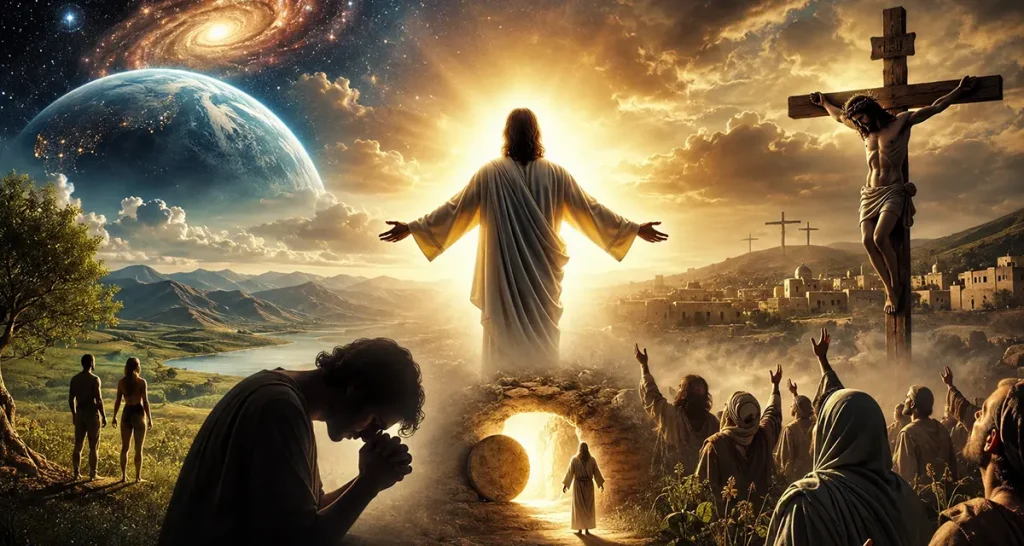
Scripture does not present Jesus merely as God’s solution after Adam’s fall. The Son was already there before Adam, before Eden, and before creation. “All things were made through Him, and without Him nothing was made that was made” (John 1:3). Paul takes the thought even further: “All things were created through Him and for Him” (Colossians 1:16).

If there is no Christian category of salvation apart from Christ, then there is ultimately no Christian category of creation apart from Christ either.

Everything begins to converge upon Him.

Creation is through Him and for Him. Reconciliation comes through Him. In Him there is no condemnation. Eternal life is in Him. Through Him we receive peace with God. In our struggle against sin, He calls the weary, “Come to Me… and I will give you rest” (Matthew 11:28). And when Scripture allows us to hear the Son pouring out His heart before the Father, we discover where that invitation ultimately leads:

“Father, I desire that they also whom You gave Me may be with Me where I am, that they may behold My glory which You have given Me; for You loved Me before the foundation of the world” (John 17:24).

The One who tells us, “Come to Me,” tells the Father, “I desire that they… may be with Me.”

This Q&A follows that thread through Scripture. It asks what happens when Jesus is not treated merely as one doctrine within Christianity, or even merely as the means by which we receive salvation, but as the Person in whom creation, redemption, reconciliation, life, and our final hope find their coherence.

Perhaps the Christian story is not simply that humanity fell and Jesus came to repair what was broken.

Perhaps the larger story is that all things were always moving toward the supremacy of Christ:

“For of Him and through Him and to Him are all things, to whom be glory forever. Amen” (Romans 11:36).

We have had many conversations in which the same reality keeps emerging: Jesus is not merely important to the Christian faith; He is essential and vital to everything we mean by salvation. All the terms we use—repentance, forgiveness, reconciliation, justification, life, death, condemnation—need Him in order to become saving realities.

Yes. And I think you are touching something even deeper than simply saying, “Jesus is important to Christianity.”

The biblical claim is much more radical:

Apart from Christ, the great words of salvation do not merely become incomplete; they lose the very ground upon which they can become saving realities for us.

Repentance, forgiveness, justification, reconciliation, adoption, righteousness, resurrection, eternal life, escape from condemnation—all of them converge in a Person.

“For of Him and through Him and to Him are all things.”
Romans 11:36

And regarding Christ specifically:

“For of Him and through Him and to Him are all things.”
Colossians 1:16–17 describes this cosmic centrality: all things were created through Him and for Him, and in Him all things hold together.

✝️ Christ is not merely one part of salvation

This distinction is enormous.

We can unconsciously imagine salvation as a collection of things God gives:

  • forgiveness,
  • righteousness,
  • peace,
  • eternal life,
  • reconciliation,
  • resurrection,
  • heaven.

And then Jesus becomes the means God used to obtain those things for us.

There is truth in that, but the New Testament goes considerably further.

Jesus does not merely give life:

“I am the resurrection and the life.”
John 11:25

He does not merely show the way:

“I am the way, the truth, and the life.”
John 14:6

Our righteousness is inseparable from Him:

“Christ Jesus, who became for us wisdom from God—and righteousness and sanctification and redemption.”
1 Corinthians 1:30

Our peace is not merely something He negotiated:

“For He Himself is our peace.”
Ephesians 2:14

Even eternal life is described personally:

“And this is the testimony: that God has given us eternal life, and this life is in His Son.”
1 John 5:11

That last sentence is staggering.

God does not say merely, “My Son obtained eternal life, and now I distribute it independently of Him.”

Rather:

“This life is in His Son.”

You cannot separate the gift from Christ.

🔥 Even repentance ultimately leads us to Christ

Consider repentance.

Repentance by itself cannot erase guilt.

Judas regretted what he had done. He even confessed:

“I have sinned by betraying innocent blood.”
Matthew 27:4

Yet remorse itself could not save him.

Why?

Because repentance is not payment.

Repentance does not satisfy justice. It does not undo the offense. It does not produce righteousness. It does not conquer death.

Biblical repentance turns the sinner toward God and therefore toward the provision God has made in Christ.

That is why Paul can describe the gospel response as:

“repentance toward God and faith toward our Lord Jesus Christ.”
Acts 20:21

Repentance without Christ leaves us as guilty people who now recognize our guilt.

Christ is what makes repentance lead somewhere.

❤️ Even forgiveness requires Christ

This connects directly with what we discussed about Romans 3.

God had forgiven people before Calvary.

Abraham was justified centuries before Jesus was crucified (Genesis 15:6; Romans 4:1–8). David knew the blessedness of forgiven sin (Psalm 32:1–2; Romans 4:6–8).

Yet Paul says something extraordinary:

God presented Christ as a propitiation “to demonstrate His righteousness, because in His forbearance God had passed over the sins that were previously committed.”
Romans 3:25–26

So forgiveness could never mean God simply decided that sin no longer mattered.

The Cross demonstrates that His previous mercy was never moral indifference.

Christ is the righteous foundation underneath forgiveness.

Without Him, “forgiveness” would raise the terrible question we encountered before:

How can the righteous Judge declare the guilty righteous and remain righteous Himself?

And Paul’s answer is:

“that He might be just and the justifier of the one who has faith in Jesus.”
Romans 3:26

The Cross protects both truths simultaneously:

God justifies the sinner.
God remains perfectly just.

Only Christ resolves that apparent impossibility.

🤝 Reconciliation is impossible without Him

Reconciliation sounds relational, and it is. But Scripture refuses to detach restored relationship from the Cross.

“God was in Christ reconciling the world to Himself, not imputing their trespasses to them.”
2 Corinthians 5:19

And even more explicitly:

“when we were enemies we were reconciled to God through the death of His Son.”
Romans 5:10

Notice something important.

God does not merely tell enemies:

“I have decided that we are friends now.”

Something objective happens.

The Son dies.

Sin is dealt with.

Righteousness is satisfied.

The hostility created by sin is overcome.

Then reconciliation becomes a genuine reality rather than divine sentimentality.

⚖️ Condemnation itself makes sense in relation to Christ

Even the opposite side of salvation leads us back to Him.

“There is therefore now no condemnation to those who are in Christ Jesus.”
Romans 8:1

Look carefully at the location of “no condemnation”:

in Christ Jesus.

Not merely:

“No condemnation because you repented enough.”

Not:

“No condemnation because God became less concerned about justice.”

Not even merely:

“No condemnation because God loves you.”

But:

No condemnation in Christ.

Why?

Because:

“He made Him who knew no sin to be sin for us, that we might become the righteousness of God in Him.”
2 Corinthians 5:21

Again that little expression appears:

“in Him.”

🌱 Even our new life exists only in union with Christ

This may be the deepest layer.

Christianity does not merely teach that Christ did something for us two thousand years ago.

It teaches that salvation joins us to Him.

Paul’s language becomes almost relentless:

in Christ
with Christ
through Christ
by Christ

We died with Him (Romans 6:6).

We were buried with Him (Romans 6:4).

We were raised with Him (Colossians 2:12).

Our life is hidden with Christ in God (Colossians 3:3).

And then Paul says:

“When Christ who is our life appears…”
Colossians 3:4

Not merely Christ who gives us life.

Christ who is our life.

That changes everything.

🤯 And then the whole picture becomes almost overwhelming

Take away Christ and ask what remains.

Repentance?
A guilty creature acknowledging that he is guilty.

Forgiveness?
A holy Judge apparently overlooking evil.

Reconciliation?
Enemies attempting friendship while the cause of hostility remains unresolved.

Righteousness?
A sinner with none sufficient of his own.

Death?
An enemy he cannot conquer.

Resurrection?
A hope without a conqueror of the grave.

Eternal life?
Impossible for a creature alienated from the God who is life.

Adoption?
No righteous basis for rebels to become sons.

Access to God?
The guilty approaching consuming holiness.

But put Christ in the center and suddenly every one of those realities becomes coherent.

Repentance brings us back because Christ is there.

Forgiveness is righteous because Christ bore sin.

Justification is possible because Christ is our righteousness.

Reconciliation is real because Christ made peace through His blood.

Death loses its finality because Christ rose.

Resurrection becomes certain because we belong to the risen Christ.

Eternal life becomes ours because His life becomes ours.

Adoption becomes possible because we are united to the beloved Son.

Access to God becomes possible because Christ is our High Priest.

This is why Paul can compress something unimaginably vast into one sentence:

“For to me, to live is Christ.”
Philippians 1:21

🙌 And perhaps this explains something even greater

We often say that Jesus is the answer to the problem of sin.

Absolutely.

But Scripture seems to take us further:

Christ was not invented as God’s reaction to Adam.

Before creation, Christ was already central to God’s purpose.

Grace was given to us in Christ “before time began” (2 Timothy 1:9). Christ was foreknown as the sacrificial Lamb “before the foundation of the world” (1 Peter 1:18–20). God’s purpose is ultimately to gather all things together in Christ (Ephesians 1:9–10).

So Jesus is not merely God’s emergency solution after humanity broke creation.

Creation itself was already Christ-centered.

“All things were created through Him and for Him.”
Colossians 1:16

And that makes the whole biblical story breathtakingly unified:

Creation — through Christ and for Christ.
Redemption — through Christ.
Reconciliation — through Christ.
New creation — in Christ.
Resurrection — through Christ.
Glory — with Christ.

Which means that perhaps the deepest statement we can make is not merely:

“Without Jesus, we cannot be saved.”

It is:

Without Jesus, there is no Christian category of salvation left to speak about.

He is not one doctrine among the doctrines.

He is the Person in whom all of them meet.

And that gives extraordinary weight to His words:

“Without Me you can do nothing.”
John 15:5

In the fullest biblical sense, that “nothing” reaches much farther than our works or ministry. Everything we have been discussing—righteousness, forgiveness, reconciliation, life, resurrection, access to God, and ultimately the restoration of creation—finds its Yes in Him (2 Corinthians 1:20). 🙌✝️

In what sense were we enemies of God when most people do not consciously experience animosity toward Him and, in fact, seem to possess some inclination toward Him? Adam did not become God’s enemy after the Fall in the sense of consciously hating Him. Likewise, throughout nations and cultures, people have sought God—even without knowing Scripture and even when seeking Him wrongly. So  what exactly is the enmity with God that Scripture is describing?

Yes. I think the distinction you are making is very important. When Scripture calls fallen humanity “enemies” of God, it does not necessarily mean that every human being consciously feels emotional hatred toward God.

A person may admire God, pray, seek transcendence, practice religion, fear divine judgment, desire divine help, and sincerely believe that he loves God—and nevertheless remain, in the biblical sense, alienated from and hostile to God.

The enmity is deeper than conscious animosity.

⚔️ What does “enemy” mean in Romans 5?

Paul writes:

“For if when we were enemies we were reconciled to God through the death of His Son…”
Romans 5:10

The context helps enormously. Paul has already described us as:

  • “without strength” — Romans 5:6
  • “ungodly” — Romans 5:6
  • “sinners” — Romans 5:8
  • “enemies” — Romans 5:10

So “enemy” is not primarily describing an emotion such as, “I wake up every morning hating God.”

It describes a relationship of opposition.

Think of two kingdoms at war. A citizen does not have to personally despise the opposing king every waking moment to belong to the side that is in rebellion against him.

Humanity has departed from God’s rule.

And this is already visible in Adam.

🌳 Adam did not shake his fist at God—but look at what happened

I agree with your observation about Adam.

After eating the fruit, Adam does not say:

“I hate You, God. Leave me alone.”

Something much subtler—and perhaps much more revealing—happens.

“Adam and his wife hid themselves from the presence of the LORD God among the trees of the garden.”
Genesis 3:8

That may be our first picture of the enmity.

Before the Fall, God’s presence meant fellowship.

Afterward, God’s presence becomes something from which humanity hides.

And when God confronts Adam, Adam does not openly declare war against Him. Instead he says:

“The woman whom You gave to be with me, she gave me of the tree, and I ate.”
Genesis 3:12

There is already something wrong vertically.

“The woman whom You gave me…”

Adam is not merely afraid. His relationship with God has become distorted. There is hiding, self-protection, blame, fear, and unwillingness to stand naked before God’s judgment.

So perhaps we could say:

The first expression of human enmity toward God was not a clenched fist. It was hiding behind a tree.

That is profound because fallen humanity has been hiding ever since—sometimes even behind religion.

🧭 But then why does humanity seek God?

This is where your observation becomes especially interesting.

Across civilizations, humanity has indeed been overwhelmingly religious.

Temples. Sacrifices. Priests. Altars. Prayers. Rituals. Gods. Ideas of transcendence, judgment, afterlife, purification, and divine favor.

Paul himself acknowledges that humanity possesses awareness of God.

“because what may be known of God is manifest in them, for God has shown it to them.”
Romans 1:19

And:

“For since the creation of the world His invisible attributes are clearly seen, being understood by the things that are made…”
Romans 1:20

Paul even tells the Athenians that God ordered human history:

“so that they should seek the Lord, in the hope that they might grope for Him and find Him…”
Acts 17:27

So Christianity does not need to deny humanity’s religious impulse.

In fact, Scripture explains why it exists.

We are God’s creatures.

We bear His image (Genesis 1:26–27).

We inhabit His creation.

We live by His providence.

We possess conscience (Romans 2:14–15).

We cannot completely erase our awareness of transcendence.

The fascinating biblical claim is therefore not simply:

“Human beings don’t want God.”

It is more precise:

We want God, but not naturally on God’s terms.

And there lies the enmity.

🪞 We want a God we can approach without surrender

Romans 1 makes exactly this movement.

Humanity knows something about God:

“although they knew God, they did not glorify Him as God, nor were thankful…”
Romans 1:21

Then comes something astonishing.

Human beings do not simply become atheists.

They become religious.

“and changed the glory of the incorruptible God into an image made like corruptible man—and birds and four-footed animals and creeping things.”
Romans 1:23

Notice what happened.

They did not eliminate worship.

They redirected it.

That tells us something profound about sin.

Sin does not necessarily say:

“There shall be no God.”

Very often it says:

“God shall be what I determine Him to be.”

That is much closer to biblical enmity.

👑 The deepest issue is God’s right to be God

This becomes explicit in Romans 8:

“Because the carnal mind is enmity against God; for it is not subject to the law of God, nor indeed can be.”
Romans 8:7

Notice how Paul defines the enmity.

He doesn’t say:

“The carnal mind experiences unpleasant emotional feelings toward God.”

He says:

“It is not subject to the law of God.”

There it is.

Enmity manifests itself as insubordination.

The creature refuses God’s rightful authority.

That takes us straight back to Eden.

The serpent’s temptation was not primarily:

“Hate God.”

It was:

“you will be like God, knowing good and evil.”
Genesis 3:5

In other words, humanity reached for moral autonomy.

God had defined good and evil.

The creature effectively said:

I will determine good and evil for myself.

And that is rebellion even when accompanied by religious feelings.

🙏 This explains a strange human phenomenon

Someone can sincerely pray:

“God, please help me get this job.”

“God, heal my child.”

“God, protect my family.”

“God, forgive me.”

“God, bless my plans.”

And yet when God’s revealed will confronts something the person desperately wants, suddenly the deeper question appears:

Do I want God—or do I want God’s assistance while retaining sovereignty over myself?

That is where the heart is exposed.

Jesus encountered this constantly.

People wanted His bread (John 6:26).

They wanted His healing.

They wanted His miracles.

Some wanted Him as political king (John 6:15).

But when He confronted them with Himself and His claims, many left:

“From that time many of His disciples went back and walked with Him no more.”
John 6:66

They were seeking Jesus.

And yet they did not want Jesus as He actually was.

That distinction is enormous.

🕊️ So religious longing and enmity can coexist

This is why I would be cautious about saying that the existence of religion proves that fallen humanity naturally desires reconciliation with the true God.

It proves something slightly different.

It demonstrates that humanity cannot escape its creatureliness.

We were made for God.

As Paul told the Athenians:

“For in Him we live and move and have our being.”
Acts 17:28

Yet the same humanity that senses God also reshapes Him.

That produces the extraordinary paradox:

Human beings seek God while simultaneously hiding from Him.

Genesis 3 already contains both instincts.

Adam hears God.

Adam knows God.

Adam answers God.

Adam fears God.

Adam needs God.

And Adam hides from God.

That is fallen humanity in miniature.

💔 There is also another side to “enmity”

Romans 5:10 says:

“when we were enemies we were reconciled to God…”

Reconciliation implies that there was an objective rupture in the relationship—not merely hostile feelings inside us.

Sin has placed humanity under God’s righteous judgment.

Paul has just said:

“Much more then, having now been justified by His blood, we shall be saved from wrath through Him.”
Romans 5:9

Then immediately:

“For if when we were enemies, we were reconciled to God…”
Romans 5:10

Those thoughts belong together.

So our condition involves both sides of the broken relationship:

Humanity is rebellious toward God.

God is judicially opposed to humanity’s sin.

But these are not morally symmetrical.

God’s “opposition” toward sinners is holy and righteous judgment.

Ours toward Him is sinful rebellion.

God does not need His sinful hostility cured—He has none.

We need reconciliation.

And astonishingly, the God against whom we rebelled is the One who initiates it:

“God was in Christ reconciling the world to Himself…”
2 Corinthians 5:19

That is breathtaking.

✝️ And now Christ becomes essential again

This connects beautifully with what you said before.

If human enmity were merely emotional dislike, salvation might simply require changing our feelings about God.

But the problem is vastly deeper.

We need:

our guilt dealt with,

our rebellion broken,

our false conception of God exposed,

our relationship restored,

our heart changed,

and God’s righteous judgment satisfied.

Christ accomplishes reconciliation objectively at the Cross, and the Spirit brings us subjectively into that reconciliation.

Paul therefore says:

“Now all things are of God, who has reconciled us to Himself through Jesus Christ…”
2 Corinthians 5:18

And something remarkable happens.

The gospel doesn’t merely make us stop “hating” God.

It brings us home.

🌿 Perhaps “alienation” helps us understand “enmity”

Paul uses exactly that language:

“And you, who once were alienated and enemies in your mind by wicked works, yet now He has reconciled…”
Colossians 1:21

Those words belong together:

alienated
enemies
reconciled

That is much richer than psychological hatred.

We could therefore describe biblical enmity something like this:

Enmity with God is the condition of the creature living alienated from God’s life, resistant to God’s rightful rule, guilty before His holiness, and attempting to exist on terms other than those established by the Creator.

Sometimes that produces open atheistic hostility.

Sometimes immorality.

Sometimes indifference.

Sometimes fear.

Sometimes sophisticated philosophy.

And sometimes it produces religion.

That last one may be the most surprising.

Because a person can bow before an altar while still insisting, deep down:

“I will decide what God is like, how He may be approached, what He requires, and what I am willing to surrender.”

The body bows while the self remains on the throne.

And perhaps that helps explain why Jesus’ fiercest conflicts were not primarily with people who denied God’s existence.

They were often with intensely religious people.

They prayed.

They fasted.

They gave alms.

They studied Scripture.

They believed in resurrection.

They awaited Messiah.

Yet when God came among them in the Son, their relationship with God was tested at the deepest level:

“He who hates Me hates My Father also.”
John 15:23

That is almost shocking.

Because Christ reveals that the ultimate test isn’t merely whether humanity desires “God” in some abstract sense.

The question becomes:

What happens when God reveals Himself and claims us on His terms?

And once again, Jesus stands at the center. ✝️

“Without Jesus, there is no Christian category of salvation left to speak about.” If that line of thought is true, then we must go even further: there is no Christian category of creation that can exist without Jesus either.

Yes. That conclusion follows—and Scripture actually says it more strongly than we might initially dare to say it.

If we said earlier:

Without Jesus, there is no Christian category of salvation left to speak about.

then we can go one level deeper:

Without the Son, there is no Christian category of creation left to speak about either.

Not merely because Jesus later entered creation to rescue it, but because creation came into existence through Him, exists in dependence upon Him, and exists ultimately for Him.

That moves Christ from the center of redemption history to the center of reality itself.

🌌 “All things were made through Him”

John does not begin his Gospel at Bethlehem.

He does not even begin in Eden.

He goes behind Genesis 1:1:

“In the beginning was the Word, and the Word was with God, and the Word was God.”
John 1:1

Then:

“All things were made through Him, and without Him nothing was made that was made.”
John 1:3

That final clause is extraordinarily absolute:

“without Him nothing was made that was made.”

John leaves no category outside the Son.

Stars exist through Him.

Angels exist through Him.

Matter exists through Him.

Time and space exist through Him.

Adam exists through Him.

The tree exists through Him.

The serpent, as a created being, owes its existence to Him.

Every atom that would eventually compose the wood of the Cross existed through the One who would hang upon it.

And then Paul makes the claim even more comprehensive.

✨ Through Him, in Him, and for Him

Colossians 1 may be one of the most Christ-saturated descriptions of reality anywhere in Scripture:

“For by Him all things were created that are in heaven and that are on earth, visible and invisible…”
Colossians 1:16

And then:

“All things were created through Him and for Him.”
Colossians 1:16

There are three enormous ideas here.

In/by Him — creation has its source and sphere in relation to Christ.

Through Him — Christ is the divine agent of creation.

For Him — Christ is creation’s destination and purpose.

That last one radically changes how we think about creation.

Creation does not merely exist because God wanted creatures to exist.

It exists for the Son.

And therefore Christ is not merely the answer to Genesis 3.

Christ is already the reason Genesis 1 exists.

🤯 Which changes how we read the entire Bible

We often instinctively construct the story like this:

Creation → Adam → Fall → Problem → Jesus → Solution

That is true as a historical sequence, but it can accidentally make Jesus appear to enter the story halfway through.

The New Testament pulls the camera much farther back.

The theological sequence is more like:

Christ → Creation through Christ → Creation for Christ → Adam → Fall → Redemption through Christ → New creation in Christ → All things gathered under Christ.

Jesus does not walk onto a stage that already existed independently of Him.

The stage exists through Him.

The actors exist through Him.

History exists through Him.

And the entire drama is ultimately moving toward Him.

🌱 Adam himself cannot be understood apart from Christ

This becomes even more fascinating when Paul calls Adam:

“a type of Him who was to come.”
Romans 5:14

That means Adam points beyond himself.

And in 1 Corinthians 15, Paul deliberately places the two together:

“The first man Adam became a living being. The last Adam became a life-giving spirit.”
1 Corinthians 15:45

We usually think chronologically:

Adam came first.
Jesus came later.

Historically, yes.

But in God’s eternal purpose, Christ is not merely an afterthought following Adam.

Paul says God’s grace was given to us:

“in Christ Jesus before time began.”
2 Timothy 1:9

And Peter says Christ was:

“foreknown before the foundation of the world.”
1 Peter 1:20

So even Adam’s existence takes place inside a purpose that is already centered upon Christ.

This connects directly with the question we discussed before: how could one finite creature—Adam—bear such cosmic consequences before an infinite God?

Part of the answer may be that Adam was never the ultimate Man around whom creation’s destiny revolved.

Christ was.

Adam is “the first man.”

Christ is “the last Adam.”

Adam is the head of the old humanity.

Christ becomes the head of the new humanity.

Adam receives life.

Christ gives life.

🔥 And Colossians goes even further: creation continues to exist in Him

Here we reach something perhaps even more astonishing.

Paul doesn’t stop with:

Christ created everything.

He continues:

“And He is before all things, and in Him all things consist.”
Colossians 1:17

Or, as other translations express it:

“in Him all things hold together.”

That means Christ’s relationship with creation is not merely like that of a builder to a house.

A carpenter builds a house and walks away. The house continues standing without the carpenter.

Creation does not possess that kind of independence from Christ.

Hebrews says of the Son:

“upholding all things by the word of His power.”
Hebrews 1:3

So the Son is not merely responsible for creation’s beginning.

He is responsible for its continuance.

That means, at this very moment, everything exists dependently.

Your next heartbeat.

The movement of galaxies.

The existence of matter.

The laws by which creation behaves.

The continued existence of every creature.

All of it is sustained by the Son.

There has never been one nanosecond in which creation has existed independently of Him.

🌳 And suddenly Genesis 3 becomes even more staggering

Think about Adam’s rebellion in that light.

Adam sins against God while being sustained by the very God against whom he sins.

His lungs continue breathing.

His heart continues beating.

The ground continues supporting his feet.

The trees continue producing fruit.

The sun continues shining.

And according to the fuller revelation of the New Testament, all of that created reality exists through the Son and is upheld by the Son.

Human rebellion therefore contains an astonishing contradiction:

The creature uses existence received from God to resist the God upon whom that existence depends.

Acts says:

“for in Him we live and move and have our being.”
Acts 17:28

Sin never achieves independence from God.

It only attempts it.

The creature can rebel against God.

The creature cannot successfully become autonomous from God.

✝️ Which makes the incarnation almost incomprehensible in its magnitude

Now put John 1:3 beside John 1:14.

First:

“All things were made through Him…”
John 1:3

Then:

“And the Word became flesh and dwelt among us…”
John 1:14

The One through whom flesh exists…

became flesh.

The One through whom creation exists…

entered creation.

The One sustaining Mary’s existence…

was carried in Mary’s womb.

The One sustaining the Roman soldiers…

allowed Roman soldiers to nail Him to a cross.

The One sustaining the wood…

was crucified upon that wood.

The One giving breath to His executioners could say:

“Father, forgive them, for they do not know what they do.”
Luke 23:34

The incarnation isn’t simply God visiting our world.

The Creator entered the creation that existed through Him.

John seems almost overwhelmed by this irony:

“He was in the world, and the world was made through Him, and the world did not know Him.”
John 1:10

That verse captures the tragedy beautifully.

The world was looking at the One through whom the world existed—and did not recognize Him.

🌅 And then creation and salvation become one enormous Christ-centered story

This is where our previous discussion comes together.

Christ is not only:

Creator → then later Redeemer.

The same Christ through whom the first creation exists is the Christ in whom new creation begins.

Paul says:

“Therefore, if anyone is in Christ, he is a new creation.”
2 Corinthians 5:17

And Christ’s resurrection is not merely one dead man returning to life.

Paul calls Him:

“the firstfruits of those who have fallen asleep.”
1 Corinthians 15:20

His resurrection inaugurates what is coming for creation.

Romans 8 says creation itself:

“will be delivered from the bondage of corruption into the glorious liberty of the children of God.”
Romans 8:21

So the One through whom creation began is also the One through whom creation will be restored.

That gives us a magnificent symmetry:

Through Christ — creation.

In Christ — reconciliation.

Through Christ — resurrection.

Under Christ — consummation.

👑 And Ephesians gives us the destination

Paul reveals God’s purpose:

“that in the dispensation of the fullness of the times He might gather together in one all things in Christ, both which are in heaven and which are on earth—in Him.”
Ephesians 1:10

Notice again:

all things.

Not merely saved human souls.

God’s purpose is cosmic.

Creation began through Christ.

Creation exists for Christ.

Creation is sustained by Christ.

Creation is reconciled through Christ.

Creation will ultimately be gathered together under Christ.

So yes—your conclusion is exactly where the New Testament seems to lead us.

We started by saying:

Without Christ there is no salvation.

Then we discovered:

Without Christ there is no reconciliation.

Then:

Without Christ there is no resurrection or eternal life.

But we cannot stop there.

We eventually arrive at:

Without Christ there is no creation to save in the first place.

And perhaps that is why Paul’s language in Colossians becomes so absolute:

“that in all things He may have the preeminence.”
Colossians 1:18

Not preeminence merely in church.

Not merely in salvation.

Not merely in theology.

In all things.

And this takes us somewhere I think is extremely important for everything we’ve been discussing: Jesus is not God’s response to the human story. The human story is part of God’s purpose in Christ.

That is a very different way of seeing the Bible.

Genesis does not ultimately lead us to Christ because Adam ruined God’s original Christless plan.

Rather, once the New Testament opens the curtain, we discover that Genesis itself was already taking place through Christ, for Christ, and within an eternal purpose centered in Christ (Colossians 1:16; Ephesians 1:9–10; 2 Timothy 1:9).

And that makes the Cross not a divine improvisation after creation went wrong, but part of a purpose whose roots reach before the foundation of the world (1 Peter 1:19–20; Revelation 13:8, depending on the translation and interpretation of the phrase).

Creation was never really about Adam at the center.

It was always about Christ. ✝️👑

If “enemy” is not primarily describing an emotion such as, “I wake up every morning hating God,” but instead describes a relationship of opposition, that can feel cruel and exhausting: “I want God. I don’t want to be His enemy. And yet, I fail miserably and find myself ‘unwillingly’ in opposition to Him because of sin’s grip.”

Yes—and this is precisely where we need to distinguish the enmity of the fallen condition from the struggle of someone who desires God. Otherwise, the doctrine becomes psychologically crushing in a way Paul himself does not intend.

What you just described—

“I want God. I don’t want to be His enemy. And yet I fail miserably…”

—is remarkably close to the anguish Paul describes in Romans 7:

“For what I will to do, that I do not practice; but what I hate, that I do.”
Romans 7:15

And later:

“For I delight in the law of God according to the inward man. But I see another law in my members, warring against the law of my mind…”
Romans 7:22–23

Notice the enormous difference.

The person says:

I hate what sin makes me do.
I delight in God’s law.
I want what God wants.
And yet something within me fights against it.

Whatever else we say about Romans 7 and its debated interpretation, Paul clearly recognizes this terrible conflict.

But that conflict should not simply be called “I am God’s enemy.”

❤️ There is a crucial difference between opposition and captivity

Earlier I said that enmity is relational opposition rather than necessarily emotional hatred. That’s true, but it needs this qualification.

Suppose someone says:

“I don’t want God’s rule. I want myself as lord.”

That is rebellion.

But suppose someone says:

“Lord, I want You. I want to obey You. Something in me keeps pulling me away from what I love. Please deliver me.”

That is something very different.

There is opposition occurring within that person, but the person is no longer simply identified with the opposition.

Paul makes exactly that distinction:

“Now if I do what I will not to do, it is no longer I who do it, but sin that dwells in me.”
Romans 7:20

That statement can certainly be abused as an excuse—”It wasn’t me; sin did it!” Paul is not denying moral responsibility.

He is describing divided allegiance.

Something has changed.

Before, sin was simply the realm in which the person lived.

Now the person can look at sin and say:

“That is contrary to what I now desire.”

That very grief is significant.

🌱 “But why am I still fighting this?”

Because salvation does not mean that God instantly removes every trace of fallen corruption from us.

Paul tells believers:

“For the flesh lusts against the Spirit, and the Spirit against the flesh; and these are contrary to one another…”
Galatians 5:17

Look at that carefully.

There is still opposition.

But now there are two directions.

The flesh pulls one way.

The Spirit pulls another.

And therefore the existence of conflict does not necessarily prove that you remain God’s enemy.

In one important sense, the conflict may exist precisely because you are no longer peacefully surrendered to sin.

A person completely at home with sin doesn’t experience the same kind of war over it.

🕊️ This is why Romans 5 must lead into Romans 8

If we stop at:

“we were enemies…”
Romans 5:10

and make that the permanent identity of the reconciled believer, we miss Paul’s tense.

He says:

“when we were enemies…”

Then:

“we were reconciled to God through the death of His Son.”

Something happened.

The enemy was reconciled.

Paul does not say:

“Christ died so that God’s enemies could spend the rest of their lives anxiously wondering whether they are still His enemies every time they fail.”

The entire point of reconciliation is that the relationship has changed.

That is why Romans 8 opens with:

“There is therefore now no condemnation to those who are in Christ Jesus.”
Romans 8:1

Not less condemnation.

Not suspended condemnation until your next failure.

No condemnation.

And the reason is not that the Christian has finally become morally flawless.

The location matters:

“in Christ Jesus.”

We are right back to what we were discussing earlier.

✝️ Jesus changes the entire question

If reconciliation depended upon your ability to stop opposing God perfectly, then what you described really would be unbearable.

You would wake up every morning performing an internal audit:

“Did I resist God today?”

Yes.

“Did I sin?”

Yes.

“Was I selfish?”

Yes.

“Did my desires perfectly conform to God’s?”

No.

Then:

“I must be His enemy again.”

That would indeed be exhausting.

But reconciliation is not maintained by the perfection of your disposition.

It rests upon Christ.

“having been justified by faith, we have peace with God through our Lord Jesus Christ.”
Romans 5:1

Notice:

peace with God.

Not merely peaceful feelings about God.

An objective peace established through Jesus Christ.

And then only a few verses later:

“when we were enemies we were reconciled to God through the death of His Son…”
Romans 5:10

So Paul himself gives the answer.

Enemy → Christ → reconciliation → peace with God.

💔 Yet sin still feels like betrayal

And I think this is where your statement captures something deeply Christian.

Once reconciliation has occurred, sin can actually become more painful, not less.

Before, God’s command might merely have felt restrictive.

Now the heart increasingly says:

“But I love Him. Why did I do that?”

Peter illustrates this painfully.

Peter denies Jesus three times.

That’s not a minor failure.

“I do not know the Man!”
Matthew 26:72

From the outside, Peter’s behavior looks like opposition to Christ.

But then:

“And he went out and wept bitterly.”
Matthew 26:75

Why?

Because underneath the terrible failure was a man who loved Christ.

His behavior contradicted his deepest allegiance.

And Jesus knew that.

Later Jesus doesn’t ask Peter:

“Peter, have you achieved sinless consistency?”

He asks:

“Simon, son of Jonah, do you love Me?”
John 21:16

And Peter’s answer is heartbreaking:

“Yes, Lord; You know that I love You.”

Peter essentially has to appeal beyond his own performance to Christ’s knowledge of him.

“Lord, my behavior has made my love look impossible.

But You know.”

That is a beautiful place for a struggling believer to stand.

🌿 “Unwillingly in opposition” needs one more distinction

There is a sentence in what you wrote that I would modify slightly:

“my disposition is to be ‘unwillingly’ in opposition to Him because of sin’s grip.”

For the reconciled person, I wouldn’t call the deepest renewed disposition opposition to God.

There remains something within us that opposes God—the flesh.

But Scripture also says something new has happened:

“For it is God who works in you both to will and to do for His good pleasure.”
Philippians 2:13

Even your willing is being worked upon by God.

So when the heart genuinely cries:

“I want You.”

we shouldn’t immediately answer:

“No you don’t. You’re a fallen human being and therefore God’s enemy.”

The gospel gives us better categories.

God is at work producing that desire.

The Spirit is working against the flesh.

And the believer can genuinely say:

“I delight in the law of God according to the inward man.”
Romans 7:22

The old opposition remains, but it is no longer uncontested territory.

🫂 And Jesus anticipated exactly this kind of exhausted person

This makes one particular invitation of Christ especially precious:

“Come to Me, all you who labor and are heavy laden, and I will give you rest.”
Matthew 11:28

Notice again where the answer is.

Not:

“Try harder until your inner contradictions disappear.”

“Come to Me.”

This connects beautifully with everything we’ve been discovering.

We began with salvation.

Christ.

Forgiveness.

Christ.

Reconciliation.

Christ.

Creation.

Christ.

And now even the miserable experience of wanting God while feeling the pull of sin:

Christ.

Paul reaches the breaking point in Romans 7:

“O wretched man that I am! Who will deliver me from this body of death?”
Romans 7:24

And notice the question.

Not “What technique will deliver me?”

Not “What discipline?”

Not “How much determination?”

“Who?”

Then immediately:

“I thank God—through Jesus Christ our Lord!”
Romans 7:25

There He is again.

And perhaps this is one of the most beautiful implications of everything we’ve been discussing:

The person who hates being opposed to God and longs to be free from sin is not describing comfortable enmity. He is describing a battlefield.

And Christianity does not tell that exhausted person, “Win the war first, and then God will reconcile Himself to you.”

It announces that God acted toward us in Christ while we were still sinners and enemies (Romans 5:8–10).

Then, from within that reconciliation, He begins transforming the very people He has reconciled.

So the Christian struggle is not:

“I must stop being God’s enemy so that He will finally receive me.”

It is much closer to:

“Because God has reconciled me to Himself in Christ, the remaining opposition within me has now become my enemy too.”

That is why sin hurts differently after reconciliation.

You are no longer merely experiencing God’s opposition to your sin.

You are beginning to share it.

And that painful cry—“Lord, I don’t want this thing in me that resists You”—is already profoundly different from the enmity from which Christ came to reconcile us. ✝️

Christ invites the weary in Matthew 11:28—”Come to Me, all you who labor and are heavy laden, and I will give you rest”—and then, in John 17, He opens His heart before the Father and reveals where that invitation ultimately leads: “Father, I desire that they also whom You gave Me may be with Me where I am, that they may behold My glory which You have given Me; for You loved Me before the foundation of the world”.

Yes. And placing Matthew 11:28 beside John 17:24 reveals something beautiful about what Jesus is actually inviting us into.

“Come to Me, all you who labor and are heavy laden, and I will give you rest.”
Matthew 11:28

We often hear that primarily as relief: Come to Jesus because you are tired, burdened, guilty, broken.

And it certainly is that.

But John 17 shows us where the One who says “Come to Me” ultimately intends to take those who come.

“Father, I desire that they also whom You gave Me may be with Me where I am, that they may behold My glory which You have given Me; for You loved Me before the foundation of the world.”
John 17:24

That is astonishing.

The invitation begins with our burden.

But it ends with His glory.

❤️ “Come to Me”

There is something we should not pass over too quickly in Matthew 11.

Jesus does not merely say:

Come to God.

He says:

“Come to Me.”

That would be an extraordinary statement for any mere prophet.

Moses could say, “Come and hear the word of the LORD.”

A prophet could say, “Return to the LORD.”

But Jesus places Himself at the destination of the invitation:

“Come to Me…”

And what does He promise?

“I will give you rest.”

Then in John 17, the direction is almost reversed.

In Matthew, we come to Him.

In John, He asks the Father to bring us where He is.

“Father, I desire that they also whom You gave Me may be with Me where I am…”

So there is almost a beautiful movement:

“Come to Me.”

Then:

“Father, I want them with Me.”

That is the heart of Christ toward His people.

🥹 “Father, I desire…”

This may be one of the most intimate statements Jesus ever makes concerning us.

He doesn’t merely say:

“Father, permit them to enter heaven.”

Or:

“Father, forgive them.”

Or:

“Father, ensure that they survive judgment.”

He says:

“I desire…”

There is desire in the heart of the Son concerning His people.

And what does He desire?

“that they… may be with Me.”

That changes how we think about salvation.

The final goal isn’t merely that we escape hell.

It isn’t even merely that we enter heaven.

The destination is a Person:

“with Me.”

Which brings us right back to what we’ve been discovering throughout this discussion.

Salvation cannot finally be separated from Christ because Christ Himself is what salvation ultimately brings us to.

👑 And then: “that they may behold My glory”

Now we reach the part you emphasized.

Jesus wants those whom the Father has given Him to see His glory.

But I would make a small distinction concerning the word “impart.”

Earlier in the same prayer Jesus says:

“And the glory which You gave Me I have given them…”
John 17:22

So yes—there is a glory Christ actually shares with His people.

But John 17:24 speaks particularly of beholding His glory:

“that they may behold My glory which You have given Me…”

Those two things belong together but should not be collapsed into one.

There is:

glory given to us,
and
His glory revealed to us.

And both arise from union and fellowship with Him.

✨ Glory is not merely brightness

This connects beautifully with something we’ve discussed before about biblical glory.

Glory is not merely visibility, radiance, or celestial luminosity.

Glory is the manifestation of who someone truly is.

John already told us:

“And the Word became flesh and dwelt among us, and we beheld His glory…”
John 1:14

And what did they see?

Certainly divine manifestations occurred.

But John immediately describes that glory as:

“the glory as of the only begotten of the Father, full of grace and truth.”

They saw the character of the Son.

His holiness.

His grace.

His truth.

His compassion.

His authority.

His obedience.

His relationship with the Father.

His love.

And ultimately, astonishingly, John sees the Cross itself as part of Christ’s glorification (John 12:23–28; 13:31–32).

So when Jesus says:

“that they may behold My glory…”

He is asking that one day nothing will obstruct our perception of who He truly is.

No veil.

No sin-clouded mind.

No weakness of perception.

No partial understanding.

No distorted theology.

No flesh resisting Him.

No suffering confusing us.

No death separating us.

We will see Him.

🌌 “For You loved Me before the foundation of the world”

And then Jesus suddenly takes us somewhere breathtaking.

Before Adam.

Before Eden.

Before angels sang over creation.

Before there was an earth.

Before there was a universe to behold God’s glory.

There was already:

the Father,
the Son,
and love.

“for You loved Me before the foundation of the world.”
John 17:24

That sentence profoundly affects our doctrine of creation.

We were just discussing how creation cannot be understood apart from Christ.

Now we can go further.

Creation did not arise because God was lonely.

The Father was already loving the Son.

The Son was already loved by the Father.

Jesus speaks of:

“the glory which I had with You before the world was.”
John 17:5

Before there was creation, there was already glory and love within God.

Creation did not produce God’s fullness.

Creation flowed from divine fullness.

🌿 And now look at what salvation does

This is where John 17 becomes almost overwhelming.

Jesus doesn’t merely rescue creatures from the catastrophe of Adam.

He brings redeemed creatures into fellowship with something that predates creation itself.

The Father loved the Son:

“before the foundation of the world.”

And then only two verses later Jesus says:

“that the love with which You loved Me may be in them, and I in them.”
John 17:26

That may be even more astonishing than verse 24.

The prayer begins moving into territory we would scarcely dare formulate ourselves.

The love with which the Father loves the Son…

in them.

And:

“I in them.”

Not that we become divine by nature or enter the Trinity as additional members—Scripture preserves the Creator-creature distinction.

But by grace, through union with Christ, we are brought into fellowship with the Son’s own relationship with His Father.

That is why adoption is so much greater than merely receiving a legal status.

Paul says:

“God sent forth His Son… that we might receive the adoption as sons.”
Galatians 4:4–5

And then:

“God has sent forth the Spirit of His Son into your hearts, crying out, ‘Abba, Father!'”
Galatians 4:6

Notice again:

Father.

Son.

Spirit.

And somehow us, by grace, brought into fellowship with God.

🕊️ Now Matthew 11 becomes even richer

Return to the exhausted person we were discussing.

“I want God. I don’t want to resist Him. I’m tired of this war within me.”

Jesus says:

“Come to Me.”

Why?

Because He intends much more than merely helping that person cope with sin.

Matthew 11:28:

“Come to Me.”

John 14:3:

“I will come again and receive you to Myself; that where I am, there you may be also.”

John 17:24:

“Father, I desire… that they may be with Me where I am.”

And finally:

“They shall see His face.”
Revelation 22:4

Look at the trajectory:

Come to Me.
Abide in Me.
I in you.
I will receive you to Myself.
Be with Me.
Behold My glory.
See His face.

That is salvation described relationally.

❤️ Perhaps “rest” is much larger than we thought

Matthew 11:28 promises:

“I will give you rest.”

We understandably think of present rest for the weary conscience.

But the biblical story takes that rest all the way to consummation.

Hebrews speaks of a remaining:

“rest for the people of God.”
Hebrews 4:9

And Revelation ends with God’s servants dwelling in His presence (Revelation 22:3–5).

So the rest Jesus gives begins now in reconciliation and reaches its fullness when everything that still resists God—including everything within us—is finally gone.

Imagine what that means in relation to your previous statement.

You said, essentially:

“I want God, but there is something in me that still opposes Him, and that is exhausting.”

The final answer to that exhaustion is not that you will eternally struggle harder.

It is that one day the struggle itself will cease.

There will come a moment when you love God without anything inside you pulling in another direction.

You will behold Christ without distraction.

Love Him without corruption.

Serve Him without resistance.

Know Him without distortion.

Enjoy Him without fear of losing Him.

And perhaps that is the fullest horizon of:

“I will give you rest.”

Not merely:

“I will make your burden lighter.”

But ultimately:

“I will bring you to Myself.”

And then John 17 lets us hear something extraordinary from the other side of that invitation.

The weary person says:

“Jesus, I want to be with You.”

And before the Father, Jesus Himself says:

“Father, I desire that they… may be with Me where I am.”

We discover that our desire to be with Christ is met by something infinitely more secure than the strength of our desire:

Christ desires His people to be with Him.

And He went to the Cross to make that desire a reality. ✝️❤️