Opens in a new tab

Justice | Mercy | Faith

Justice | Mercy | Faith

🌿 Biblical Obedience: When the Heart Struggles to Do the Father’s Will

Difficulty Level: Intermediate-Advanced

Jump to Answers

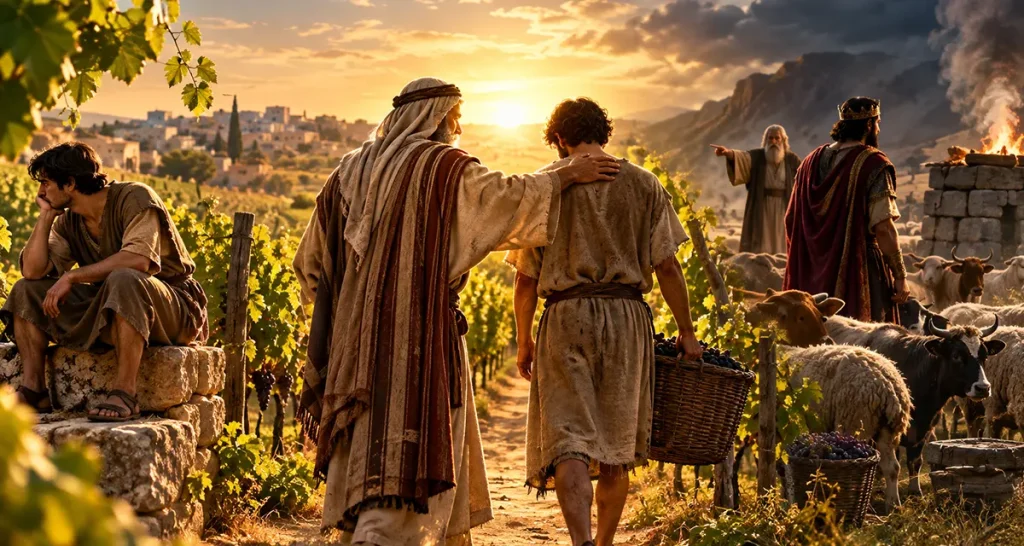
  1. In Jesus’ parable of the two sons, the first son initially refuses his father’s command to work in the vineyard but later regrets his refusal and goes, while the second son agrees to go but never does (Matthew 21:28–31). In the Christian life, when we find ourselves unwilling to obey God, should we obey Him anyway? If our heart is resistant while our actions comply, wouldn’t that make the obedience hypocritical? What exactly is the dynamic within us in such a situation?
  2. Doing the will of the Father must involve more than mechanical compliance, doesn’t it? Shouldn’t true obedience reach the heart rather than consist merely of performing the correct outward action?
  3. I know we should not compare our spiritual journey with that of others, even though we can certainly learn from them and imitate what is worthy of imitation. Yet some people seem, from the moment of conversion, to find obedience to God much easier than others do. Is that genuinely the case, or are we simply observing the outward obedience without seeing the struggle that may be taking place within them?
  4. But how can love or affection for someone be commanded? Unless biblical love is not based primarily on affection, even though affection remains a genuine ingredient of love.
  5. Samuel declares, “To obey is better than sacrifice”. Yet sacrifice itself was an ordinance commanded by God, meaning that properly offered sacrifice was already an act of obedience. So what kind of obedience was Samuel contrasting with sacrifice in his confrontation with Saul?
  6. But where in our sane minds do we seriously debate between obeying the will of our Creator and Father and following the desires of our fleeting emotional heart? 🤣🙄😂 I think even Freud might struggle to explain why we do this—and yet the Bible does explain it. 🤔☺️
  7. How deeply attuned Samuel must have been to God. He could understand the same circumstances that Saul and the people were seeing and the interpretation they apparently believed to be true. Yet Samuel went surgically to the heart of the problem.
  8. Yet it is so easy to be swept along by strong and overwhelming currents and, for a moment, forget what the Lord explicitly commanded us. 😫 
  9. “You cannot offer God the product of your disobedience and call the offering obedience.” That hurts. Once the implications of that statement are truly understood, it is frightening. 
  10. From Jesus’ two sons in the New Testament to Saul, Israel’s first king, what should we take away from this entire discussion about the nature of biblical obedience?
  11. So both sons were wrong and, in different ways, hurt their father. But one of them, by grace, turned back toward his father.

🌿 Biblical Obedience: When the Heart Struggles to Do the Father’s Will

Christian Living & Ethics | Discipleship & Growth | Law & Grace | Sin & Human Nature

Biblical obedience is easy to describe until the heart does not want what God commands. Jesus told of two sons: one openly refused his father but afterward regretted it and went, while the other respectfully promised to go but never did (Matthew 21:28–31). Which one obeyed? The question opens something much deeper than outward compliance. Does doing the will of the Father require willing affection? Is obedience genuine when our emotions resist it? Can love even be commanded? And if our actions appear religious, can they still conceal a heart that has refused to listen?

The same questions emerge with startling force in the life of Saul. God gave Israel’s first king an explicit command, yet Saul altered it, preserved what God had told him not to preserve, and then intended to offer part of it back to God as sacrifice. Samuel’s answer cuts through every religious justification: “To obey is better than sacrifice” (1 Samuel 15:22). Sacrifice itself was a divine ordinance, so the problem was not sacrifice versus obedience. The problem was attempting to substitute one religious act for the particular obedience God had required. Saul eventually exposed the deeper issue himself: “I feared the people and obeyed their voice” (1 Samuel 15:24).

From Jesus’ two sons to Samuel’s confrontation with Saul, Scripture takes us beneath conduct into the heart. Biblical obedience involves hearing God’s voice, trusting His character, submitting our will to His revealed will, and acting accordingly—even when our emotions initially pull in another direction. Yet God does not intend to leave His children in perpetual reluctant compliance. He works in them “both to will and to do for His good pleasure” (Philippians 2:13), progressively bringing desire, affection, will, and action into agreement with Him.

This discussion explores that difficult and deeply personal territory: why unwilling obedience is not necessarily hypocrisy, why religious activity cannot compensate for disobedience, how powerful emotional and social currents can make an explicit command of God temporarily lose its governing force, and why repentance is such an extraordinary gift of grace. The first son could not erase his initial “I will not,” but his refusal did not have to become his final word. He turned and went. In that movement—from resistance to repentance, from competing voices to hearing the Father again—we begin to see biblical obedience not as mechanical compliance, but as the redeemed heart learning to say with increasing freedom and delight, “I delight to do Your will, O my God” (Psalm 40:8).

In Jesus’ parable of the two sons, the first son initially refuses his father’s command to work in the vineyard but later regrets his refusal and goes, while the second son agrees to go but never does (Matthew 21:28–31). In the Christian life, when we find ourselves unwilling to obey God, should we obey Him anyway? If our heart is resistant while our actions comply, wouldn’t that make the obedience hypocritical? What exactly is the dynamic within us in such a situation?

Yes. Sometimes in the Christian life, we should obey God precisely when we do not feel willing to obey Him. And no, that is not necessarily hypocrisy.

In fact, the parable you quoted gives us a remarkably sharp distinction between willingness, obedience, repentance, and hypocrisy.

Jesus asks:

“Which of the two did the will of his father?”

The answer is the first son (Matthew 21:28–31).

Notice how strange that is. The first son’s initial will was opposed to his father’s will:

“I will not.”

Yet afterward, something changed. He regretted his refusal and went.

The second son’s words were beautifully aligned with the father:

“I go, sir.”

Respectful. Agreeable. Apparently obedient.

And useless.

He never went.

Jesus therefore locates obedience not merely in what the person felt, said, or initially wanted, but in what he ultimately did in response to the father’s command (Matthew 21:28–31).

🤔 But isn’t doing what I don’t want to do hypocrisy?

Not by itself.

Hypocrisy is not simply acting contrary to your present feelings. If it were, nearly every act of mature Christian obedience would occasionally be hypocritical.

Suppose I am angry with someone. Christ commands me to forgive (Colossians 3:13). I don’t feel forgiving.

If I say:

“Since forgiveness isn’t arising spontaneously from my heart, forgiving would be hypocritical.”

I have done something dangerous: I have made my present emotional state the authority that determines whether God’s command should be obeyed.

Scripture does not tell us to wait until every internal inclination becomes righteous before acting righteously.

Quite the opposite:

“I discipline my body and bring it into subjection…” (1 Corinthians 9:27)

And:

“Walk in the Spirit, and you shall not fulfill the lust of the flesh.” (Galatians 5:16)

There is conflict within Christian experience. Paul explicitly describes the flesh and Spirit as opposing one another (Galatians 5:17).

So sometimes genuine obedience sounds less like:

“Wonderful! This is exactly what I want to do!”

and more like:

“Lord, I don’t want to do this. But You are right, and I will obey You.”

That can actually be a profound expression of faith.

❤️ The crucial question is what I am doing with my unwillingness

This is where the dynamic gets fascinating.

There is a major difference between:

“I don’t want to obey, therefore I won’t.”

and:

“I don’t want to obey, but I want God more than I want my present desire.”

The second person has an internal conflict, but the conflict itself does not prove hypocrisy.

Think about Jesus in Gethsemane. We have to speak carefully here because there was absolutely no sinful rebellion in Christ. Yet His human experience makes an important distinction visible:

“O My Father, if it is possible, let this cup pass from Me; nevertheless, not as I will, but as You will.” (Matthew 26:39)

Jesus did not pretend that the cross was naturally desirable to His human experience. Hebrews says He endured the cross (Hebrews 12:2).

There is therefore a difference between desiring an experience and willing obedience to God through that experience.

I may genuinely say:

“Father, everything in me recoils from this, but because You command it, I will do it.”

That isn’t hypocrisy.

That is submission.

🪞 In fact, hypocrisy can occur in the opposite direction

This makes the second son especially interesting.

He says:

“I go, sir.”

His profession exceeds his obedience.

That is much closer to the hypocrisy Jesus repeatedly condemns: presenting an outward appearance of devotion that one’s actual life contradicts (Matthew 23:3–7, 27–28).

The first son has almost the reverse problem:

His mouth begins badly, but his feet eventually go in the right direction.

😂

And Jesus asks which one actually did the father’s will.

The answer tells us something enormously important:

God would rather have repentance that becomes obedience than religious language that never becomes obedience.

🌱 But God wants more than reluctant obedience

Here we need the other half of the truth.

God does not merely want to drag unwilling Christians through life while they grit their teeth and perform commands externally.

He cares about the heart.

David prays:

“Create in me a clean heart, O God, and renew a steadfast spirit within me.” (Psalm 51:10)

And Paul describes God’s work in believers this way:

“For it is God who works in you both to will and to do for His good pleasure.” (Philippians 2:13)

That wording is wonderful for your question.

God works in us:

to will
and
to do.

Sometimes, however, our doing seems to get ahead of our feelings.

I may obey while simultaneously praying:

“Lord, change what I want.”

That is entirely different from pretending that I already want what God wants.

There is actually considerable honesty in saying:

“I am obeying You because You are Lord, but my affections have not caught up with my obedience. Please bring them into conformity with You.”

Psalm 119 contains something remarkably similar:

“Incline my heart to Your testimonies…” (Psalm 119:36)

The psalmist doesn’t merely command his own heart to behave. He asks God to change its inclination.

🔥 This changes how we understand obedience

There seem to be several possible states:

  1. I don’t want God’s will, and I refuse it.
  2. I say I want God’s will, but I don’t do it.
  3. I don’t presently desire what God commands, but I obey because I trust Him.
  4. I obey and increasingly delight in what God desires.

Christian maturity moves toward the fourth.

But we should not despise the third.

The third may actually be the road by which God leads us toward the fourth.

Hebrews speaks of mature believers whose powers of discernment have been “trained by constant practice” (Hebrews 5:14). Obedience itself can participate in the reshaping of our habits and affections.

And this protects us from a subtle modern idea:

“To be authentic, I must act according to what I currently feel.”

Scripture gives us a radically different center.

My deepest authenticity as a Christian is not faithfulness to every desire arising within me. It is faithfulness to the God to whom I belong.

🙌 “But Lord, I still don’t want to!”

And perhaps this is where the first son becomes surprisingly comforting.

He initially says:

“I will not.”

That is ugly.

But it isn’t the end of his story.

“Afterward he regretted it and went.” (Matthew 21:29)

Repentance creates the possibility that my last word does not have to be my first word.

I can wake up unwilling.

I can struggle.

I can complain.

I can discover desires in myself that are embarrassingly contrary to God’s will.

And then I can say:

“Nevertheless, because You have spoken, I will go.”

And perhaps while walking toward the vineyard, I can pray:

“Father, don’t merely make my feet obedient. Make my heart love where my feet are going.”

That, I think, captures the dynamic beautifully.

The goal of grace is not merely that my behavior eventually contradicts my rebellion, but that God progressively brings my will, affections, and actions into joyful agreement with His will (Ezekiel 36:26–27; Philippians 2:12–13).

Until that work is complete, however, we should never make perfect willingness a prerequisite for obedience.

Sometimes faithfulness means going to the vineyard while asking God to change the heart of the son who is walking there. ❤️

Doing the will of the Father must involve more than mechanical compliance, doesn’t it? Shouldn’t true obedience reach the heart rather than consist merely of performing the correct outward action?

Absolutely. And this is the necessary qualification to what we just discussed. Biblical obedience cannot finally be reduced to mechanical compliance. God certainly cares that the first son actually went into the vineyard (Matthew 21:28–31), but Scripture never presents God’s ultimate aim as merely getting the creature’s body into the correct location.

He wants the person.

Jesus brings this into focus when He identifies the great commandment:

“You shall love the LORD your God with all your heart, with all your soul, and with all your mind.” (Matthew 22:37; cf. Deuteronomy 6:5)

That command is extraordinary because love itself is commanded. God’s will therefore concerns not merely what my hands do, but what my heart loves.

This gives us an important distinction:

Obedience can be genuine before it is joyful, but obedience is not complete merely because it is external.

🌱 The first son’s heart actually does change

There’s a small detail in the parable that becomes important here.

The first son doesn’t simply say, “I will not,” and then mechanically go anyway. Jesus says:

“But afterward he regretted it and went.” (Matthew 21:29)

Something happens inside him before the external action.

The Greek verb is metamelomai, carrying the idea of regret or a change of concern. And Jesus is using the story in the context of repentance: tax collectors and prostitutes believed John’s message, while the religious leaders, even after seeing this, “did not afterward relent and believe him” (Matthew 21:31–32).

So the contrast isn’t simply:

Son 1: actions
versus
Son 2: words.

It goes deeper:

Son 1: unwillingness → inner change → obedience
Son 2: profession → no corresponding obedience.

The first son’s obedience eventually expresses a changed response toward his father.

🫀 God has never been satisfied with mere external conformity

This runs through Scripture.

Israel could perform religious actions while their hearts remained distant:

“These people draw near with their mouths and honor Me with their lips, but have removed their hearts far from Me.” (Isaiah 29:13; cf. Matthew 15:7–9)

They were doing religious things. The problem wasn’t necessarily absence of activity. The activity had become disconnected from the heart’s relationship to God.

Samuel’s confrontation with Saul is even sharper:

“To obey is better than sacrifice.” (1 Samuel 15:22)

Saul had something religious to present to God. But religious performance could not substitute for submission to God.

And this connects beautifully with something we discussed recently about morality: right conduct does not manufacture righteousness simply by being externally correct.

God’s concern reaches the source from which conduct proceeds.

🤔 Then what happens when my heart doesn’t want to obey?

Here’s where the distinction becomes really important.

Suppose God commands me to forgive someone, and I say:

“I will forgive because Christ commands me to, but right now I don’t want to forgive.”

There are two very different possibilities hiding inside that sentence.

One is:

“I don’t care what God wants. I’ll perform the required behavior so that He leaves me alone.”

That’s approaching mechanical compliance.

But the other is:

“Lord, my emotions are fighting Your command. I confess that. Yet because I trust You, love You, and acknowledge Your authority, I choose Your will over the desire presently fighting inside me.”

Now something remarkable has happened.

My heart is already involved in the obedience, even though all my desires are not yet aligned with it.

That’s the distinction I think we need.

The heart doesn’t have to be emotionally unanimous for obedience to be heartfelt.

⚔️ A divided heart can still genuinely choose God

This explains much of Christian experience.

Paul describes an actual conflict:

“For the flesh lusts against the Spirit, and the Spirit against the flesh; and these are contrary to one another.” (Galatians 5:17)

If genuine obedience required every impulse within me to agree before I acted, this conflict would make obedience practically impossible.

Instead, the question becomes:

Which desire governs me?

I may simultaneously experience:

“I want revenge.”

and:

“I want to belong to Christ more than I want revenge.”

The second desire can govern the first without instantly making the first disappear.

That is not hypocrisy. That is spiritual conflict in which allegiance to Christ is prevailing.

🌿 And God intends eventually to reach the “want”

This is where the New Covenant promise becomes magnificent.

God doesn’t merely say, “I will give you better rules.”

He says:

“I will give you a new heart and put a new spirit within you… I will put My Spirit within you and cause you to walk in My statutes.” (Ezekiel 36:26–27)

And Jeremiah says:

“I will put My law in their minds, and write it on their hearts.” (Jeremiah 31:33)

That’s much more radical than compliance.

Under grace, God is not merely moving the hands while leaving the heart untouched. He is progressively bringing the person’s inner life into correspondence with His own will.

And that’s why Philippians 2:13 is so profound:

“For it is God who works in you both to will and to do for His good pleasure.”

There they are again.

To will.
To do.

God cares about both.

🕊️ Obedience may begin before delight arrives

And I think this protects us from two opposite errors.

One says:

“Feelings don’t matter. Just obey.”

That’s inadequate. God wants the heart.

The other says:

“Unless I genuinely feel like obeying, my obedience isn’t authentic.”

That is also inadequate. It makes our fluctuating desires sovereign.

Scripture gives us something richer:

Obey God because He is worthy of obedience, while bringing the unwilling heart honestly to Him and asking Him to transform it.

Psalm 119 expresses precisely this kind of dependence:

“Incline my heart to Your testimonies.” (Psalm 119:36)

What a fascinating prayer! The psalmist wants God’s commandments, yet apparently recognizes that even his wanting needs God’s help.

So Christian obedience can sometimes look like:

“Father, I don’t want what I ought to want. But I want to want what You want. Therefore I will obey You—and I ask You to change me.”

That is far from mechanical.

In fact, there may be more genuine submission in that painful obedience than in an action that happens to coincide effortlessly with what I already wanted to do.

❤️ From “I will not” to “I delight”

And perhaps that’s the larger trajectory.

The first son begins with:

“I will not.”

Then comes regret.

Then obedience.

But God’s transforming work aims still farther:

“I delight to do Your will, O my God, and Your law is within my heart.” (Psalm 40:8)

That’s the destination.

Not merely:

“I do Your will.”

But:

“I delight to do Your will.”

And yet we shouldn’t reverse the order and say, “Until delight arrives, I won’t obey.” Often we obey while asking God to produce the delight that is still lacking.

So perhaps we can sharpen our earlier statement:

Doing the Father’s will is neither mere external compliance nor waiting for perfect internal willingness. It is the whole person increasingly brought under God’s will—actions genuinely submitted to Him, the heart honestly turned toward Him, and even our reluctant desires progressively transformed by His grace.

The Father doesn’t merely want workers in the vineyard.

He wants sons whose hearts come to agree with their Father about why the vineyard is worth entering. ❤️

I know we should not compare our spiritual journey with that of others, even though we can certainly learn from them and imitate what is worthy of imitation. Yet some people seem, from the moment of conversion, to find obedience to God much easier than others do. Is that genuinely the case, or are we simply observing the outward obedience without seeing the struggle that may be taking place within them?

I think you’ve put your finger on an important distinction. It may genuinely be easier for one Christian to obey God in a particular area than for another. Scripture gives us no reason to assume that conversion instantly makes every believer’s internal struggles identical.

At the same time, what we observe from outside is extraordinarily incomplete. We usually see someone’s obedience, but not the entire interior history behind it.

Someone may appear to say, “Yes, Lord,” and simply go. Meanwhile I am somewhere behind them arguing, wrestling, repenting, praying, getting up again… 😫😂

And I may conclude, “Something must be wrong with me.”

But Scripture gives us a much more nuanced picture.

🧬 Grace does not erase our individual histories

When God regenerates a person, He truly makes that person new:

“If anyone is in Christ, he is a new creation.” (2 Corinthians 5:17)

But regeneration does not mean that every feature of our previous formation disappears overnight.

People enter the Christian life with different temperaments, habits, histories, weaknesses, fears, patterns of thought, and particular temptations. One person’s long-established sin may barely attract another person at all.

That’s why James can say:

“Each one is tempted when he is drawn away by his own desires and enticed.” (James 1:14)

There is individuality even in temptation.

So imagine two believers confronted with the same command.

For one, obedience may require very little internal struggle because that command already corresponds fairly closely with his temperament.

For the other, the same command may cut directly across twenty years of habits and desires.

Their external actions could eventually be identical while their internal journeys are dramatically different.

And here’s the important part:

ease is not necessarily a measurement of holiness.

🤯 Sometimes what looks like greater obedience is simply less resistance in that particular area

Suppose generosity comes naturally to someone. Giving $500 may genuinely bring him joy.

Another believer has spent his entire life terrified of financial insecurity. Giving $50 may produce an internal earthquake.

From the outside:

$500 versus $50.

From inside the heart:

God may be doing profound work in that trembling $50.

Jesus’ observation of the widow’s two mites should make us extremely cautious about measuring spiritual realities merely by visible quantities (Mark 12:41–44).

The same applies beyond money.

One person naturally avoids conflict and finds gentleness relatively easy. Another has a fierce temper and must repeatedly bring angry impulses under Christ.

One person has little attraction to a particular temptation. Another fights it daily.

One person is naturally disciplined. Another struggles enormously with consistency.

So we cannot simply conclude:

“That person obeys effortlessly; therefore he loves God more.”

We don’t have enough information.

👀 And then there is the enormous problem of visibility

We see people after they come out of the wrestling room. 😂

We don’t necessarily see what happened inside.

Someone may give you a peaceful answer on Sunday:

“The Lord has been teaching me to trust Him.”

Beautiful.

What you didn’t see was Tuesday night:

“LORD, WHAT ARE YOU DOING?!?” 😫

Psalm 73 is wonderfully reassuring in this respect. Asaph eventually arrives at magnificent confidence in God:

“Whom have I in heaven but You? And there is none upon earth that I desire besides You.” (Psalm 73:25)

Wonderful.

But read the road he traveled to get there. Earlier he admits:

“But as for me, my feet had almost stumbled; my steps had nearly slipped.” (Psalm 73:2)

If we encountered only verse 25, we might imagine effortless spirituality.

The whole psalm reveals the struggle behind it.

🌾 Jesus actually warns Peter about comparison

There is a wonderfully human moment at the end of John’s Gospel.

Jesus tells Peter something difficult about Peter’s own future. Peter immediately notices John and asks:

“But Lord, what about this man?” (John 21:21)

😂 That is us.

“Okay, Lord, I heard what You said about me. But what about HIM?”

Jesus answers:

“If I will that he remain till I come, what is that to you? You follow Me.” (John 21:22)

Jesus doesn’t say John’s journey is irrelevant. Peter himself will later minister alongside other believers and learn from them.

But Jesus refuses to let another disciple’s path become the measuring instrument for Peter’s discipleship.

Peter’s assignment is:

“You follow Me.”

🌿 Yet imitation is biblical

And this preserves the distinction you made.

Comparison and imitation are not identical.

Paul actually says:

“Imitate me, just as I also imitate Christ.” (1 Corinthians 11:1)

And Hebrews tells believers to imitate those who through faith and patience inherit the promises (Hebrews 6:12; cf. Hebrews 13:7).

So I can look at another Christian and say:

“That person’s patience teaches me something about Christ. I want to learn from it.”

That’s healthy.

But something changes when I say:

“That person’s patience proves that my sanctification should look exactly like theirs.”

Now I’ve turned another Christian’s journey into my measuring stick.

🔥 There is another possibility we shouldn’t overlook

Sometimes obedience really does become easier through sanctification.

This is important.

Not every act of obedience must remain a lifelong battle.

Repeated obedience forms us. Hebrews speaks of those whose faculties have been:

“exercised to discern both good and evil.” (Hebrews 5:14)

Something that once required enormous conscious effort may eventually become almost instinctive.

A new Christian might wrestle intensely:

“Should I forgive this person?”

After decades of walking with Christ, perhaps the reflex increasingly becomes:

“Of course I must forgive. How can I, forgiven so greatly by Christ, refuse?” (Ephesians 4:32)

That doesn’t necessarily mean the older believer has an easier personality.

It may mean grace has trained him.

And that is beautiful.

🪴 But sanctification is remarkably uneven

This is perhaps the part that prevents despair.

A Christian may be astonishingly mature in one area and painfully immature in another.

Peter could boldly confess:

“You are the Christ, the Son of the living God.” (Matthew 16:16)

and shortly afterward rebuke Jesus for talking about the cross (Matthew 16:22).

Later he courageously preaches Christ publicly (Acts 2:14–41), and years afterward Paul still has to confront him over conduct inconsistent with the gospel concerning Gentile believers (Galatians 2:11–14).

That’s Peter.

An apostle.

Sanctification isn’t a smooth graph going ↗️↗️↗️ forever. 😂

God may have brought me remarkably far regarding one thing while exposing something surprisingly primitive in another.

❤️ And this returns us beautifully to the vineyard

Perhaps yesterday’s discussion gives us a way to think about it.

One Christian hears:

“Son, go work in My vineyard.”

And answers almost immediately:

“Yes, Father.”

Another initially feels:

“I really don’t want to.”

Then comes conviction.

Prayer.

Struggle.

Repentance.

And eventually:

“Yes, Father. I’m going.”

We should rejoice over the first without condemning the second.

And the second should learn from the first without pretending to have the first person’s journey.

Because ultimately, the question Jesus asks isn’t:

“Which son found obedience easiest?”

It is:

“Which of the two did the will of his father?” (Matthew 21:31)

That shifts the focus dramatically.

🕊️ Perhaps even our struggle can teach us dependence

There is something else here that I find especially significant.

If obedience came effortlessly to me in every area immediately after conversion, I might very easily begin believing that I am naturally quite good at Christianity. 😏

But when I repeatedly encounter places where I have to say,

“Lord, unless You work in me, I simply don’t have this,”

Philippians 2:13 stops being theological decoration:

“For it is God who works in you both to will and to do for His good pleasure.”

Even the willing needs grace.

So when I encounter another believer whose obedience seems easier, I can thank God for what His grace has produced in that person. I can imitate whatever genuinely reflects Christ. I can even ask them how God taught them.

But I don’t need to turn around and accuse myself because my road to the same obedience involved more wrestling.

The important question becomes less:

“Why isn’t my journey like theirs?”

and more:

“Father, what are You doing in me through this particular struggle?”

And perhaps, after looking sideways at John for a moment, we hear Jesus gently bring our attention back:

“What is that to you? You follow Me.” (John 21:22)

Not follow Me as quickly as John does.

Not follow Me with Peter’s temperament.

Not follow Me with somebody else’s battles.

Just:

“You follow Me.”

And even when following Him involves a wrestling heart, if that wrestling heart keeps turning toward Christ, getting up, repenting, obeying, and asking Him to reshape its desires, that struggle itself may be one of the places where He is teaching us what dependence actually means. 🌱

But how can love or affection for someone be commanded? Unless biblical love is not based primarily on affection, even though affection remains a genuine ingredient of love.

I think you’ve found the tension hidden inside the command:

“You shall love the LORD your God with all your heart, with all your soul, and with all your strength.” (Deuteronomy 6:5; cf. Matthew 22:37)

If love meant simply spontaneous affectionate feeling, the command would indeed seem peculiar. You can command me to walk across a room. But can you command me to feel fondness?

Try it:

“Be delighted. Right now.” 😂

The command itself cannot simply manufacture the emotion.

So biblical love must be larger and deeper than affection, although affection genuinely belongs to mature love.

🧭 Love involves the orientation of the whole person

When Scripture commands love, it isn’t merely commanding an emotional sensation. It is calling the whole person toward another:

will, loyalty, desire, valuation, trust, action, and affection.

That’s why Deuteronomy doesn’t merely say “love God” and leave it floating abstractly. Immediately afterward:

“And these words which I command you today shall be in your heart.” (Deuteronomy 6:6)

And that love expresses itself concretely in allegiance and obedience (Deuteronomy 10:12–13).

Jesus makes the relationship explicit:

“If you love Me, keep My commandments.” (John 14:15)

But we have to be careful here. Jesus does not thereby define love as nothing more than commandment-keeping.

Otherwise we would be right back at mechanical compliance.

Rather, obedience is one of love’s characteristic expressions.

💓 And yet affection really does matter

This keeps us from swinging too far in the opposite direction and saying:

“Biblical love isn’t a feeling; it’s just an action.”

That’s too thin as well.

Scripture absolutely speaks about affection for God.

“As the deer pants for the water brooks, so pants my soul for You, O God.” (Psalm 42:1)

And:

“Whom have I in heaven but You? And there is none upon earth that I desire besides You.” (Psalm 73:25)

And:

“Oh, taste and see that the LORD is good.” (Psalm 34:8)

Those are not merely decisions.

There is delight, longing, desire, affection.

Peter even describes Christians as loving Christ whom they have not seen:

“Whom having not seen you love.” (1 Peter 1:8)

So affection isn’t optional debris around biblical love. God intends our affections to be involved.

But perhaps we can say:

Affection is an important dimension of love without being the entire definition of love.

🌱 Then how can God command the affection?

Now it gets really interesting.

God can command something that I cannot instantaneously produce because the command describes what I ought to be, not merely what I can switch on at a moment’s notice.

“Love the LORD your God” reveals the proper orientation of the creature toward the Creator.

My inability to summon perfect love does not make the command unreasonable. It reveals something disordered in me.

Imagine saying:

“I cannot make myself delight perfectly in God.”

Christianity answers:

Exactly.

That’s part of our problem.

Sin hasn’t merely made us people who sometimes do wrong things. It has disordered what we want and love.

Paul describes people as:

“lovers of pleasure rather than lovers of God.” (2 Timothy 3:4)

Notice the diagnosis.

It isn’t merely:

doing pleasure instead of doing God.

It is loving wrongly.

🔥 This makes salvation much deeper than behavioral correction

If my problem were merely behavioral, God could hand me commandments and say:

“Do these.”

But if my loves themselves are disordered, I need something done to me at a much deeper level.

And that’s exactly where the New Covenant promises become astonishing:

“I will give you a new heart and put a new spirit within you.” (Ezekiel 36:26)

God doesn’t merely correct the actions produced by the heart.

He goes after the heart.

And Paul says something very close to this:

“The love of God has been poured out in our hearts by the Holy Spirit who was given to us.” (Romans 5:5)

So the command and grace fit together.

God says:

“Love Me.”

And the sinner eventually discovers:

“I cannot produce the kind of love You deserve from myself.”

And God does not lower the command to accommodate our disorder. He transforms the person.

🤯 Which means “I don’t feel it” cannot settle the matter

This connects directly with our previous discussion.

Suppose I wake up tomorrow and don’t feel particularly affectionate toward God.

Has my obligation to love Him disappeared?

No.

But neither should I manufacture emotional theater:

“Oh Lord, I am overflowing with affection!” 😇

when I’m not.

That would indeed approach hypocrisy.

Instead, biblical love permits astonishing honesty:

“Why are you cast down, O my soul?” (Psalm 42:5)

The psalmist’s affections are not where he wants them to be.

So what does he do?

He speaks truth to them:

“Hope in God.” (Psalm 42:5)

That’s fascinating.

The believer doesn’t merely obey his affections. He shepherds them.

🐑 We can cultivate affection without manufacturing it

I cannot simply command myself:

“Feel tremendous affection for God in three… two… one… GO!” 😂

But I can place myself before the realities that properly awaken affection.

I can remember what God has done.

I can contemplate Christ.

I can pray.

I can hear His Word.

I can recount His faithfulness.

I can worship even when my emotional temperature is low.

This pattern appears repeatedly in the Psalms:

“Bless the LORD, O my soul, and forget not all His benefits.” (Psalm 103:2)

David is essentially speaking to himself.

Remember.

Why?

Because remembering God’s goodness affects the heart’s disposition toward Him.

The affection isn’t manufactured arbitrarily. It responds to an apprehended reality.

💡 And that may be the key to commanded love

God doesn’t say:

“Produce affection for an arbitrary object.”

He reveals Himself and commands the creature to respond appropriately to who He actually is.

That’s very different.

If God is truly infinitely good, holy, beautiful, faithful, gracious, and worthy, then loving Him isn’t inventing a feeling that has no basis.

It is the heart increasingly seeing reality correctly and responding appropriately to it.

John gives us perhaps the simplest formulation:

“We love Him because He first loved us.” (1 John 4:19)

There is both command and cause.

God’s love precedes ours.

His love becomes known.

Our love responds.

❤️ And this explains something about human love too

Think about marriage.

If love were simply affection, then on a morning when affection is weak, love would have temporarily disappeared.

But covenant love can say:

“Today I don’t feel particularly warm toward you, but I am still yours. I will seek your good. I will remain faithful. I will treat you according to the commitment I have made.”

And wonderfully, faithful action often helps affection recover.

But marriage without affection altogether would also be tragically diminished.

So neither extreme works:

Love = feelings is too unstable.

Love = duty without affection is too mechanical.

Biblical love integrates allegiance, valuation, desire, affection, and action.

🌿 This also changes how we understand obedience

We’ve been moving toward this through the whole discussion.

At first we asked:

“Should I obey when I don’t want to?”

Yes.

Then:

“But doesn’t God want the heart?”

Absolutely.

Then:

“Why does obedience seem easier for some?”

Because sanctification includes the transformation of our desires, and that work unfolds differently.

And now we’ve reached something deeper:

God isn’t merely teaching us to do what we don’t want forever. He is transforming what we want.

That’s why Philippians 2:13 keeps becoming more significant:

“For it is God who works in you both to will and to do for His good pleasure.”

Not merely the doing.

The willing.

The Christian life is therefore not supposed to remain permanently:

God commands → I hate it → I grit my teeth → I comply.

There will certainly be moments like that because of remaining sin.

But grace is moving us toward:

God commands → I recognize His goodness → I trust Him → I increasingly desire what He desires → I obey.

And ultimately toward:

“I delight to do Your will, O my God, and Your law is within my heart.” (Psalm 40:8)

That is something much richer than compliance.

Perhaps we could put the distinction this way:

Love does not begin and end with affection. Love gives allegiance to the beloved, values the beloved as worthy, seeks the beloved’s good, acts faithfully toward the beloved, and increasingly delights in the beloved.

And in relation to God there is an even deeper wonder: He commands from us a love that His own grace is at work producing in us.

So when I discover that my affection for God is weaker than it ought to be, I don’t have to pretend.

I can actually bring that poverty to Him:

“Lord, You deserve to be loved more than I presently love You. I cannot command my emotions into existence, but I can turn myself toward You. Show me more of Yourself. Correct what I value wrongly. Incline my heart toward You. Teach me not merely to obey You, but to delight in You.”

That prayer itself is already evidence of something profound:

the heart that mourns that it does not love God enough already values loving Him. ❤️

Samuel declares, “To obey is better than sacrifice”. Yet sacrifice itself was an ordinance commanded by God, meaning that properly offered sacrifice was already an act of obedience. So what kind of obedience was Samuel contrasting with sacrifice in his confrontation with Saul?

Yes! And that’s precisely what makes Samuel’s statement so penetrating. Sacrifice itself was commanded by God. Saul wasn’t contrasting obedience with an inherently illegitimate religious activity. He was appealing to something God Himself had ordained.

So when Samuel says:

“Has the LORD as great delight in burnt offerings and sacrifices, as in obeying the voice of the LORD? Behold, to obey is better than sacrifice, and to heed than the fat of rams.” (1 Samuel 15:22)

he cannot mean:

“Obedience is better than keeping God’s commandments.”

Sacrifice was commanded.

Rather, Samuel is distinguishing between obedience to what God has actually commanded in this situation and performing another commanded religious act as a substitute for that obedience.

And that distinction is enormous.

🎯 What exactly had Saul been commanded to do?

Samuel had given Saul a specific command concerning Amalek:

“Now go and attack Amalek, and utterly destroy all that they have, and do not spare them.” (1 Samuel 15:3)

Whatever broader theological questions we might ask about that judgment, the narrative’s immediate point is unambiguous: Saul knew what God had commanded.

But Saul and the people spared Agag and the best livestock (1 Samuel 15:8–9).

When Samuel confronts him, Saul initially says something almost astonishing:

“Blessed are you of the LORD! I have performed the commandment of the LORD.” (1 Samuel 15:13)

Samuel basically responds:

Then why do I hear sheep? 😐🐑

“What then is this bleating of the sheep in my ears, and the lowing of the oxen which I hear?” (1 Samuel 15:14)

The sheep become audible evidence that Saul’s definition of obedience and God’s command are not matching.

🤔 But Saul has a religious explanation

And this is where your observation becomes crucial.

Saul says:

“The people spared the best of the sheep and the oxen, to sacrifice to the LORD your God.” (1 Samuel 15:15)

Ah!

Now Saul’s argument becomes much more sophisticated than simply:

“I disobeyed.”

It’s closer to:

“Yes, technically we didn’t do exactly what God commanded—but look what we’re going to do with what we kept! We’re going to worship God with it.”

That is precisely where Samuel strikes:

“To obey is better than sacrifice.” (1 Samuel 15:22)

In other words:

You cannot use one divine ordinance to nullify another divine command.

Even more sharply:

You cannot offer God the product of your disobedience and call the offering obedience.

🔥 Saul is attempting to choose the form of obedience

And I think this is the deeper issue.

God said, effectively:

“Do A.”

Saul did something else and proposed:

“I’ll give You B instead—and B is something You commanded elsewhere!”

But the servant doesn’t determine what obedience will consist of.

That belongs to the Lord.

This makes Samuel’s next words especially significant:

“Because you have rejected the word of the LORD, He also has rejected you from being king.” (1 Samuel 15:23)

Notice Samuel’s definition of Saul’s offense:

“You have rejected the word of the LORD.”

So the obedience in verse 22 is fundamentally hearing and submitting to God’s spoken command.

That’s why the parallelism is beautiful:

“to obey”
“to heed”

The Hebrew verb behind “obey” (shama) fundamentally carries the idea of hearing/listening, and depending on context, hearing in the sense of responding obediently.

Samuel is essentially saying:

God wants you to listen to Him.

Not merely perform religious activity for Him.

🫀 And now we’re back to the heart

This connects beautifully with the question you asked earlier.

Saul’s problem wasn’t simply that he performed the wrong external action.

Something deeper had happened.

God spoke.

Saul evaluated what God said.

Saul modified it.

Saul substituted his own judgment.

And then Saul attempted to religiously sanctify the modification.

That is why Samuel immediately connects the matter with rebellion:

“For rebellion is as the sin of witchcraft, and stubbornness is as iniquity and idolatry.” (1 Samuel 15:23)

Those are heart words.

The sheep are merely the visible evidence.

The fundamental problem is that Saul’s will has positioned itself over God’s word rather than under it.

💡 So sacrifice can be obedience — or disobedience

This is the fascinating conclusion.

If God commands:

“Offer this sacrifice,”

and the worshiper offers it according to God’s command, then sacrifice is obedience.

But if God commands:

“Destroy these animals,”

and Saul says:

“No, I’ll preserve them so I can sacrifice them to You,”

then sacrifice becomes an act associated with disobedience.

The physical action “sacrifice” has no autonomous moral value apart from its relationship to God’s will.

That is remarkably important.

It means we cannot simply classify actions:

Prayer = good.
Sacrifice = good.
Fasting = good.
Giving = good.
Worship = good.

Their spiritual character also involves whether they arise from faith and submission to God.

Isaiah later gives an even more shocking example. God tells Israel:

“Bring no more futile sacrifices; incense is an abomination to Me.” (Isaiah 1:13)

But God had commanded sacrifices and incense!

The problem isn’t that the ordinances suddenly became intrinsically evil. The people’s religious performance had become detached from covenant faithfulness and righteousness (Isaiah 1:11–17).

⚠️ And here is the subtle danger Samuel exposes

We can sometimes use obedience in one area to protect disobedience in another.

That’s much more sophisticated than simply rejecting God.

For example:

“Yes, I refuse to forgive him—but I serve faithfully at church.”

“Yes, I’m treating this person unjustly—but I give generously.”

“Yes, I know what Scripture says here—but look how much I pray.”

Those other things may genuinely be commanded by God.

But they cannot function as currency with which we purchase exemption from another command.

Saul essentially attempts to say:

“Look at the worship I will give You with what I refused to surrender.”

And Samuel says:

No. God wanted you to listen.

🪞 And Saul eventually exposes what was underneath it

Later he admits:

“I have sinned, for I have transgressed the commandment of the LORD and your words, because I feared the people and obeyed their voice.” (1 Samuel 15:24)

There it is.

And notice the language!

Samuel has been talking about hearing/obeying the voice of the LORD.

Saul says, effectively:

I obeyed another voice.

That is the heart of the matter.

The issue wasn’t ultimately sheep.

It was whose voice governs Saul.

God’s?

The people’s?

His own judgment?

And now “to obey is better than sacrifice” becomes far richer than a slogan about ritual versus morality.

❤️ God doesn’t want something from Saul instead of Saul

This may be the deepest theological movement in the passage.

Saul wants to bring God sheep.

God wants Saul’s submission.

Saul effectively says:

“Look what I brought You.”

God’s command asks:

“But did you listen to Me?”

And that connects directly with everything we’ve been discussing about love, heart, affection, and obedience.

God isn’t primarily assembling a collection of correct religious behaviors.

He is Lord.

Therefore obedience is fundamentally relational submission of the creature to the Creator’s revealed will.

Sacrifice was good because God commanded it. But the moment Saul uses sacrifice to override God’s present command, he has detached the ordinance from the very Lord who gave the ordinance.

There is almost an irony in it:

Saul tries to worship God with something he obtained by refusing to listen to God.

🐑

And God says, through Samuel:

“To obey is better than sacrifice, and to heed than the fat of rams.” (1 Samuel 15:22)

So I would sharpen Samuel’s meaning this way:

“To obey” here means receiving God’s revealed word as authoritative over my own judgment, desires, pressures, and religious substitutions—and acting accordingly because He is the Lord.

And suddenly this connects directly with our original vineyard question. The deepest question isn’t merely:

“Did I perform something religious?”

It isn’t even merely:

“Did I perform an action that God commands somewhere?”

It is:

“When my Father spoke to me, did I actually let Him be the Father?”

That is why obedience reaches so much deeper than mechanical compliance. ❤️

But where in our sane minds do we seriously debate between obeying the will of our Creator and Father and following the desires of our fleeting emotional heart? 🤣🙄😂 I think even Freud might struggle to explain why we do this—and yet the Bible does explain it. 🤔☺️

😂 The absurdity is part of the biblical diagnosis

Exactly! When you state the alternatives plainly, the competition sounds almost ridiculous:

The will of the eternal Creator, who gave me existence, sustains me at this very moment, knows all things, loves me as Father, and cannot lie

versus

whatever my emotional state happens to be suggesting at 2:37 this afternoon.

And somehow the heart says:

“Hmm… difficult decision.” 🤔🤣

Scripture’s explanation is much deeper than mere lack of information. The biblical problem is not principally that human beings don’t have enough evidence to calculate correctly. Something has happened to our loves, desires, judgment, and allegiance.

Paul describes it startlingly:

“Although they knew God, they did not glorify Him as God, nor were thankful, but became futile in their thoughts…” (Romans 1:21)

Notice: they knew, and nevertheless their thinking became futile.

The problem isn’t simply informational.

🌳 Eden already exposes the irrationality

Genesis 3 is almost astonishing when viewed from this angle.

Adam and Eve have:

God.

Life.

Provision.

Fellowship.

A garden prepared for them.

Freedom to eat from every tree except one.

A clear warning about the consequence.

And then the creature looks at the forbidden tree:

“The woman saw that the tree was good for food, that it was pleasant to the eyes, and a tree desirable to make one wise…” (Genesis 3:6)

There it is.

God has spoken.

But immediate perception and desire begin competing with God’s word.

“I see it.”

“I desire it.”

“It seems good to me.”

And suddenly what appears desirable to the creature becomes a rival interpretation of reality to what the Creator has said.

That’s extraordinary.

🤯 Sin is irrational precisely because God is God

If God were merely another creature with limited knowledge, debating Him could be reasonable.

“God thinks A. I think B. Let’s examine the evidence.”

But Scripture doesn’t give us that relationship.

“For with You is the fountain of life; in Your light we see light.” (Psalm 36:9)

God isn’t another observer standing beside me looking at reality.

He is the Creator of the reality we’re discussing.

And even more fundamentally, I exist because He continually gives me existence:

“In Him we live and move and have our being.” (Acts 17:28)

So the creature uses life received from God to contemplate whether God’s judgment should be trusted.

😂🤦‍♂️

There’s something almost comically tragic about it.

🪞 But Scripture gives the uncomfortable explanation: we want autonomy

The serpent’s temptation is revealing:

“You will be like God, knowing good and evil.” (Genesis 3:5)

As we’ve discussed before, Adam and Eve could never actually abolish creaturehood. That possibility doesn’t exist.

But they could attempt to live as though creaturehood did not define their relationship to God.

And this is where sin becomes more than choosing a forbidden fruit.

The creature effectively says:

“I will determine for myself whether what God has called good is actually good.”

That’s the madness.

Not simply:

“I want fruit.”

But:

“My perception of the fruit will adjudicate God’s word concerning the fruit.”

The creature becomes its own little court of appeal.

❤️ And our desires aren’t neutral judges

This is where the biblical anthropology becomes extraordinarily perceptive.

We often imagine the process like this:

Reason examines options → reaches conclusion → desire follows.

Scripture knows we’re much messier than that.

Our desires influence what we are willing to believe.

James says:

“Each one is tempted when he is drawn away by his own desires and enticed.” (James 1:14)

And Jeremiah gives the famous diagnosis:

“The heart is deceitful above all things, and desperately wicked; who can know it?” (Jeremiah 17:9)

The frightening thing about deception is that the deceived person experiences the false thing as plausible.

So the heart doesn’t usually announce:

“Attention! I am about to propose something utterly irrational that contradicts the Creator of the universe.” 📢😂

It says:

“But this seems reasonable…”

“Surely God understands…”

“Just this once…”

“I need this…”

“Maybe the command doesn’t really apply here…”

And suddenly Saul’s sheep are bleating in the background again. 🐑🤣

🐑 Saul is a perfect case study

God’s command was clear (1 Samuel 15:3).

Saul disobeys.

Samuel confronts him.

And Saul initially says:

“I have performed the commandment of the LORD.” (1 Samuel 15:13)

That’s psychologically remarkable.

The sheep are literally making noise.

Samuel can hear the contradiction between Saul’s statement and reality.

Yet Saul has apparently constructed an interpretation in which his modified obedience still counts as obedience.

That’s what sin can do.

It doesn’t merely say:

“God is right and I’m choosing wrong.”

It frequently goes further:

“Let me explain why what I’m doing is actually reasonable.”

🧠 Paul describes a disorder of reasoning itself

Romans 1 keeps returning to this.

“Professing to be wise, they became fools.” (Romans 1:22)

Paul isn’t attacking intelligence.

He’s describing intelligence operating from a false center.

A brilliant mind can reason brilliantly from a disordered fundamental allegiance.

That’s why Scripture’s category of foolishness is much deeper than low intelligence.

Psalm 14:1 says:

“The fool has said in his heart, ‘There is no God.'”

Notice again:

“in his heart.”

Biblically, thinking and loving aren’t hermetically sealed departments.

What I worship affects how I reason.

🔥 And this makes regeneration astonishing

God’s answer isn’t merely:

“Let Me give you better arguments.”

We need truth, certainly. Christianity is full of proclamation, teaching, evidence, remembrance, reasoning, and persuasion.

But something deeper must happen:

“I will give you a new heart and put a new spirit within you.” (Ezekiel 36:26)

And:

“Do not be conformed to this world, but be transformed by the renewing of your mind.” (Romans 12:2)

Notice how comprehensive salvation becomes.

Heart.

Mind.

Will.

Desires.

Actions.

God is restoring the creature’s ability to live according to reality.

☺️ And then obedience slowly begins to look sane again

This might be one of the beautiful effects of sanctification.

At first obedience can feel like:

“God commands this, but everything in me wants that.”

As we mature, increasingly we begin to see:

“Wait. Why exactly am I arguing with God?” 🤔

Not because every desire disappears.

But because faith increasingly perceives reality correctly.

God knows.

I don’t.

God sees tomorrow.

I don’t.

God created me.

I didn’t.

God sustains me.

I cannot sustain myself.

God has demonstrated His love in Christ.

I have no rational ground for treating Him as my enemy.

God cannot lie.

My own heart has fooled me approximately nine billion times. 😂

And still the heart occasionally walks into the courtroom and announces:

“Your Honor, I’d like to appeal God’s decision.”

🤣

🙌 Perhaps this is why trust becomes so central

We keep arriving here from different directions in our discussions.

Providence brought us here.

Ownership brought us here.

Morality brought us here.

Obedience has brought us here again.

Eventually the creature encounters the limits of his understanding and must answer:

“Can I trust God when I cannot supervise Him?”

Proverbs puts the alternative beautifully:

“Trust in the LORD with all your heart, and lean not on your own understanding.” (Proverbs 3:5)

It doesn’t say don’t understand.

It says don’t lean on your understanding.

That’s different.

Use your mind.

Ask questions.

Study.

Wrestle.

Seek wisdom.

But don’t make your finite understanding the foundation upon which God’s trustworthiness must stand.

Because then we have inverted the entire order of reality.

❤️ And perhaps obedience is sanity returning to the creature

I think that’s where your observation ultimately leads.

Sin says:

“I know what God said, but let me determine whether His will deserves my compliance.”

Faith increasingly says:

“Because He is God, His word is more reliable than my present perception—even when I don’t yet understand it.”

And mature love begins saying something even sweeter:

“I don’t merely submit because He outranks me. I have learned something of who my Father is.”

Then obedience stops looking merely like the defeat of my will.

It begins looking like the liberation of my will from the insanity of trying to be its own god.

Jesus says:

“If you abide in My word, you are My disciples indeed. And you shall know the truth, and the truth shall make you free.” (John 8:31–32)

So yes… Freud could have had quite an afternoon with Adam, Eve, Saul, and the rest of us. 🤣

But Scripture takes the diagnosis all the way down:

The fundamental human problem isn’t simply that our emotions occasionally overpower our reason. It is that sin disorders the whole person so profoundly that the dependent creature can experience independence from the Creator as desirable.

And grace does something equally profound.

It doesn’t destroy our creaturely will.

It progressively brings the will back into agreement with reality.

Until increasingly the creature can look at the Father, look at his own fleeting desires, smile at the absurd comparison, and say:

“Whom have I in heaven but You? And there is none upon earth that I desire besides You.” (Psalm 73:25) ❤️

How deeply attuned Samuel must have been to God. He could understand the same circumstances that Saul and the people were seeing and the interpretation they apparently believed to be true. Yet Samuel went surgically to the heart of the problem.

Yes. And I think “surgically” is exactly the right word for what happens in 1 Samuel 15.

Samuel was standing in the same historical situation as Saul. He could understand Saul’s reasoning. He knew sacrifice was commanded. He knew the people could plausibly describe preserving the best animals as something religiously useful.

Yet Samuel was not captivated by the plausibility of their explanation because his reference point was the word God had spoken.

That’s what makes his discernment so striking.

Saul saw:

valuable animals → potential sacrifices → worship of God.

Samuel saw:

God spoke → His word was altered → disobedience.

Same sheep. Same sacrifice. Same religious vocabulary.

Different interpretation of reality.

👂 Samuel had learned very early: “Speak, LORD, for Your servant hears”

And there is something beautiful about tracing this all the way back to Samuel’s childhood.

When God first calls him, Eli eventually teaches him to respond:

“Speak, LORD, for Your servant hears.” (1 Samuel 3:9)

Then Scripture tells us:

“So Samuel grew, and the LORD was with him and let none of his words fall to the ground.” (1 Samuel 3:19)

That little boy’s posture becomes almost the defining posture of his prophetic ministry:

God speaks → Samuel listens.

And decades later Saul’s problem is precisely the opposite:

God speaks → Saul modifies.

That contrast is remarkable.

Samuel doesn’t need to invent an ethical system on the spot in chapter 15. He has spent a lifetime learning that when God speaks, the creature’s proper posture is hearing.

So when Saul presents his explanation, Samuel has a fixed reference point from which to evaluate it.

🐑 And Saul’s argument really was superficially plausible

This deserves emphasis because otherwise we can make Saul cartoonishly stupid.

Imagine Saul’s defense:

“Samuel, look. We carried out God’s judgment. Yes, we preserved the best animals, but we’re not keeping them merely for ourselves. We’re going to sacrifice them to Yahweh! We’re actually turning the spoils into worship.”

Religiously, that has enough plausibility to deceive someone who has already decided what he wants to do.

But Samuel sees the fatal flaw immediately:

“Why then did you not obey the voice of the LORD?” (1 Samuel 15:19)

That question cuts through everything.

Not:

“Are sacrifices good?”

Yes.

Not:

“Is worship good?”

Of course.

Not even:

“Can animals legitimately be sacrificed to Yahweh?”

Certainly.

Samuel asks:

“What did God tell you to do with THESE animals?”

Surgery. 🩺

All the religious decoration falls away.

🔪 And Samuel keeps cutting until he reaches the governing allegiance

First Saul says:

“I have performed the commandment of the LORD.” (1 Samuel 15:13)

Samuel exposes that as false (1 Samuel 15:14).

Then Saul says:

“The people spared the best…” (1 Samuel 15:15)

Samuel doesn’t accept the displacement of responsibility.

Then Saul insists:

“But I have obeyed the voice of the LORD…” (1 Samuel 15:20)

And eventually the truth comes out:

“I have sinned, for I have transgressed the commandment of the LORD and your words, because I feared the people and obeyed their voice.” (1 Samuel 15:24)

There!

That’s the incision reaching the diseased tissue.

🐑 The sheep weren’t ultimately the problem.

🔥 The sacrifice wasn’t ultimately the problem.

👥 Even the people weren’t ultimately the problem.

Whose voice governed Saul?

Samuel finally brings Saul to acknowledge:

“I obeyed their voice.”

And that makes Samuel’s earlier words even more powerful:

“Behold, to obey is better than sacrifice, and to heed than the fat of rams.” (1 Samuel 15:22)

The entire chapter is about hearing the right voice.

🧠 Samuel could understand Saul without adopting Saul’s framework

And this is where I think your observation about Samuel’s attunement to God becomes especially important.

Spiritual discernment doesn’t require being unable to understand the alternative.

Samuel could presumably follow Saul’s reasoning perfectly well.

But understanding an argument is not the same as surrendering your categories to it.

Samuel’s mind had been formed by God’s revelation sufficiently that he could enter Saul’s explanation and still ask:

“But what did the LORD actually say?”

That’s a tremendously important kind of discernment.

We sometimes imagine discernment as having some mysterious feeling:

“Something about this doesn’t feel right…”

Samuel has something much firmer.

A word from God against which interpretations can be measured.

🧭 His compass wasn’t recalibrated by the crowd

And notice the social pressure.

This wasn’t merely Saul privately inventing an interpretation. He eventually says he feared the people (1 Samuel 15:24).

Apparently there was enough collective agreement around the decision that it became psychologically persuasive.

That’s another very human phenomenon:

When enough people agree that something is reasonable, reasonableness itself can begin to feel like truth.

But Samuel stands there essentially saying:

“You can all agree with one another. What did God say?”

That requires extraordinary spiritual stability.

Not stubbornness for stubbornness’ sake.

Not independence.

Actually the opposite:

Samuel can resist dependence upon the crowd because he is dependent upon God’s word.

❤️ And there is something humbling here for us

We sometimes imagine that if we know Scripture well enough, every moral decision will feel obvious.

Samuel suggests something subtler.

Sometimes the alternative interpretation will sound reasonable.

Sometimes it will have religious vocabulary.

Sometimes other believers may approve it.

Sometimes it may even involve something God genuinely commands in another context.

And nevertheless the question remains:

“Am I hearing what God has actually said, or am I finding a way to make what I already want sound obedient?”

Ouch. 😬

That’s where Samuel’s discernment becomes uncomfortable for us.

Because Saul didn’t apparently wake up thinking:

“Today I’m going to rebel against God.”

He could say:

“Blessed are you of the LORD! I have performed the commandment of the LORD.” (1 Samuel 15:13)

That may be one of the most frightening sentences in the chapter.

A person can be disobedient while narrating his own behavior to himself as obedience.

🔦 This is why Scripture must illuminate us from outside ourselves

Our earlier discussion suddenly comes together here.

If my heart can deceive me (Jeremiah 17:9), then I cannot use my heart as the final instrument for diagnosing my heart.

I need revelation.

“Your word is a lamp to my feet and a light to my path.” (Psalm 119:105)

And:

“The entrance of Your words gives light; it gives understanding to the simple.” (Psalm 119:130)

Even more strikingly:

“For the word of God is living and powerful, and sharper than any two-edged sword… and is a discerner of the thoughts and intents of the heart.” (Hebrews 4:12)

There’s your surgical imagery almost literally.

God’s Word doesn’t merely tell me whether the sheep should live or die.

It exposes why I wanted to keep the sheep in the first place.

🌿 And Samuel himself remained a servant under that Word

Perhaps that’s the most beautiful thing.

Samuel’s discernment did not come from placing himself above Saul as though:

“I am naturally wiser than you.”

Samuel himself was under authority.

His whole prophetic identity was built around receiving rather than inventing:

“Speak, for Your servant hears.” (1 Samuel 3:10)

And perhaps that is the safest place for discernment.

Not:

“I understand everything.”

But:

“Lord, speak. I am listening.”

Saul’s great failure was not lack of religious activity. He had plenty of that.

It was that somewhere between God’s voice and Saul’s action, Saul permitted his own judgment, the people’s pressure, and an attractive religious justification to rewrite what God had said.

Samuel refused to participate in the rewriting.

And so while everyone else could look at those beautiful animals and see future sacrifices, Samuel could hear their bleating and recognize the sound of disobedience. 🐑

That is indeed remarkable attunement to God: not merely knowing God’s words, but having one’s perception of reality so formed by them that a convincing substitute can still be recognized as a substitute. ❤️

Yet it is so easy to be swept along by strong and overwhelming currents and, for a moment, forget what the Lord explicitly commanded us. 😫

It really is. 😫 And I think this makes Saul’s situation more instructive than simply looking at him and thinking, “How could you possibly do that?”

Because once we recognize the current, we recognize ourselves.

A clear word from God can be standing on the shore, while fear, urgency, majority opinion, opportunity, emotion, circumstances, and apparently reasonable arguments all begin flowing in one direction. Suddenly what was perfectly clear yesterday becomes strangely negotiable today.

Not necessarily because God’s word became unclear.

The current became loud.

👥 Saul tells us exactly where the current came from

Eventually he confesses:

“I feared the people and obeyed their voice.” (1 Samuel 15:24)

That’s revealing.

God had spoken.

Then the people spoke.

And apparently the second voice became experientially more powerful than the first.

Why?

Because the people were there.

Their pressure was immediate. Their desires were visible. The animals were valuable. The opportunity was present. The social consequences of resisting them could be felt now.

God’s command, meanwhile, required Saul to stand against the current on the basis of something previously spoken.

That requires faith.

🧠 We don’t necessarily “forget” by losing the information

This distinction matters.

Saul probably hadn’t suffered an information failure:

“Wait… what did Samuel say again?” 🤔

He knew enough to keep insisting that he had obeyed (1 Samuel 15:13, 20).

There is another kind of forgetting in Scripture: truth can remain in memory while losing its governing force over us.

Israel repeatedly does this.

Moses warns:

“Beware that you do not forget the LORD your God by not keeping His commandments…” (Deuteronomy 8:11)

They weren’t likely to suffer collective amnesia and forget that Yahweh existed.

Rather, prosperity could make God’s reality cease functioning as the controlling reality of their lives:

“Then you say in your heart, ‘My power and the might of my hand have gained me this wealth.'” (Deuteronomy 8:17)

They still possess theological information.

But another interpretation of reality has taken control.

That is a frighteningly recognizable form of forgetting.

🌊 The immediate can overwhelm the ultimate

And I think this is one of our great creaturely vulnerabilities.

What is present feels enormous.

What is visible feels certain.

What is emotionally intense feels authoritative.

What everyone around me believes feels normal.

Meanwhile God’s word may be one quiet sentence I read yesterday.

And yet ontologically the proportions are exactly backward! 😂

The crowd is temporary.

My emotion may be different tomorrow morning.

The circumstances will change.

The opportunity will disappear.

I will disappear from this earth.

But:

“The word of our God stands forever.” (Isaiah 40:8)

And somehow the temporary thing can feel more substantial than the permanent thing.

That’s the power of the current.

⚓ This helps explain why Scripture constantly says “remember”

I’ve always found this fascinating.

God repeatedly commands His people to remember.

“And you shall remember the LORD your God…” (Deuteronomy 8:18)

“Remember the wonders He has done…” (1 Chronicles 16:12)

“Bless the LORD, O my soul, and forget not all His benefits.” (Psalm 103:2)

Jesus gives the disciples the Supper:

“Do this in remembrance of Me.” (Luke 22:19)

Peter says he intends to keep reminding believers of truths they already know (2 Peter 1:12–15).

Why so much repetition?

Because apparently one of our problems isn’t merely:

“I don’t know.”

It is:

“I know, but at the critical moment something else becomes more vivid than what I know.”

😫

🪨 Samuel seems anchored precisely where Saul was drifting

That’s what makes their contrast so powerful.

Both men experience the same political situation.

Both know the people.

Both understand the value of the animals.

Both know sacrifice is legitimate worship.

But Samuel has one immovable reference point:

“What did the LORD say?”

That’s an anchor.

The purpose of an anchor isn’t to make the sea stop moving.

It doesn’t remove the current.

It doesn’t eliminate the waves.

It prevents the current from determining where the vessel ends up.

That’s a beautiful picture of God’s word in the Christian life.

❤️ And perhaps this changes what we mean by being “strong”

Sometimes we imagine spiritual strength as reaching a point where the current no longer feels strong.

But Scripture often portrays faithfulness differently.

The current may remain enormous.

Faithfulness says:

“Nevertheless…”

Habakkuk gives us one of the great biblical examples:

“Though the fig tree may not blossom, nor fruit be on the vines… yet I will rejoice in the LORD.” (Habakkuk 3:17–18)

The “though” doesn’t disappear.

The “yet” answers it.

Jesus in Gethsemane gives us the supreme expression:

“Nevertheless, not as I will, but as You will.” (Matthew 26:39)

Again, the pressure isn’t imaginary.

The submission is real within the pressure.

🕊️ And this makes dependence absolutely necessary

Perhaps we sometimes approach obedience with too much confidence in ourselves:

“God has made this clear. I’ve got it.”

Peter thought he had it:

“Even if all are made to stumble because of You, I will never be made to stumble.” (Matthew 26:33)

A few hours later, the environment changed dramatically.

Courtyard.

Danger.

Questions.

Fear.

And suddenly Peter was being carried by a current he had been absolutely certain could never move him (Matthew 26:69–75).

That should make us humble.

Not terrified—but dependent.

“Therefore let him who thinks he stands take heed lest he fall.” (1 Corinthians 10:12)

And immediately afterward:

“God is faithful…” (1 Corinthians 10:13)

That’s significant.

Our confidence shifts from:

“I know myself. I would never.”

to:

“I know Him. Lord, keep me.”

🙏 Perhaps the prayer isn’t merely “Show me Your will”

Sometimes He already has.

Then the prayer becomes:

“Lord, keep what You have said more real to me than the current surrounding me.”

That’s different.

Because tomorrow I may not need additional revelation.

I may need remembrance.

I may need the Holy Spirit to bring Christ’s words to remembrance (John 14:26).

I may need another believer to say, like Samuel:

“Wait. What did the Lord actually say?”

I may need Scripture to interrupt the narrative I’ve constructed around what I want.

And sometimes I may simply need to stop before moving with everybody else.

🐑 Because the sheep will always have an explanation

That’s perhaps the lesson I don’t want to lose from Saul. 😂

The current rarely announces:

“Come commit blatant rebellion!”

It says:

“This makes sense.”

“Everyone agrees.”

“There’s a good reason.”

“Look at the benefits.”

“We can even use this for God.”

🐑 Baaaa.

And somewhere underneath all that noise remains the quiet question:

“What did the Lord say?”

That is why Samuel’s lifelong posture becomes increasingly beautiful to me:

“Speak, for Your servant hears.” (1 Samuel 3:10)

Maybe spiritual maturity isn’t becoming a person who can never be swept by a current.

Perhaps it is increasingly becoming a person who knows where to reach for the anchor when the current becomes strong.

And when we realize we’ve already drifted, the answer isn’t to pretend we haven’t. It is repentance: turn again toward the One whose word never moved.

The current moves.

The anchor doesn’t. ⚓❤️

“You cannot offer God the product of your disobedience and call the offering obedience.” That hurts. Once the implications of that statement are truly understood, it is frightening.

😔 Yes. Because it removes one of our favorite escape routes

It does hurt. And I think it frightens us because the statement doesn’t merely expose Saul. Once understood, it reaches into the sophisticated ways we can use good things to avoid surrendering something God actually asked of us.

Saul’s sheep make the problem almost painfully visible.

God said, in that specific judgment:

“Do not keep them.” (1 Samuel 15:3)

Saul kept them.

Then came the religious justification:

“The people spared the best of the sheep and the oxen, to sacrifice to the LORD your God.” (1 Samuel 15:15)

The terrifying possibility is this:

Something can end up on God’s altar that God never wanted us to obtain by disobeying Him.

The altar doesn’t retroactively sanctify the rebellion.

🐑 “But Lord, look what I brought You”

That’s where Samuel’s response cuts so deeply.

Imagine Saul standing there with an enormous, impressive sacrifice.

These aren’t worthless leftovers. Scripture specifically says they preserved:

“the best of the sheep, the oxen, the fatlings, the lambs, and all that was good.” (1 Samuel 15:9)

From a purely religious spectacle, perhaps it could have looked magnificent.

But God could effectively answer:

“I didn’t ask you for these.”

😫

That changes everything.

Saul may be measuring the value of the gift.

God is addressing the origin of the gift.

And its origin is disobedience.

🔥 It means I cannot compensate God

This may be the frightening part you’re feeling.

We naturally think transactionally:

“I failed here, but I’ll do something really good over there.”

“I haven’t surrendered this, but look how faithfully I serve elsewhere.”

“I know I treated that person wrongly, but I give generously.”

“I won’t obey You concerning this particular thing, but I’ll give You additional devotion somewhere else.”

But God isn’t balancing a spreadsheet.

Ten obediences don’t purchase permission for one deliberate rebellion.

David understood something similar after his sin:

“For You do not desire sacrifice, or else I would give it… The sacrifices of God are a broken spirit, a broken and a contrite heart.” (Psalm 51:16–17)

David cannot say:

“How many sacrifices will settle this?”

The problem is relational and moral.

He must return to God.

🫀 Because God wants the place I’m withholding

And here it gets painfully personal.

Sometimes the thing I enthusiastically offer God may be precisely the thing that costs me less than what He is asking me to surrender.

That possibility should make us examine ourselves.

Cain brings an offering, but God addresses Cain himself and the sin crouching at the door (Genesis 4:3–7).

Israel multiplies religious activity, while God confronts injustice and tells them to “learn to do good; seek justice” (Isaiah 1:11–17).

The Pharisees carefully tithe tiny herbs while neglecting “the weightier matters of the law: justice and mercy and faith” (Matthew 23:23).

Again and again:

“Look what I’m giving You.”

And God brings the conversation back to:

“What about what I actually told you?”

😨 But we need one very important safeguard here

Otherwise this truth can become spiritually crushing.

The lesson of Saul is not:

“If you have ever disobeyed God, everything afterward is contaminated and God will never receive anything from you again.”

Absolutely not.

That would collide with the entire biblical doctrine of repentance and grace.

Peter denied Christ three times (Luke 22:54–62). Yet the risen Jesus restores Peter and says:

“Feed My sheep.” (John 21:17)

David’s sin had devastating consequences, but after confession he can pray:

“Restore to me the joy of Your salvation.” (Psalm 51:12)

And John writes to believers:

“If we confess our sins, He is faithful and just to forgive us our sins and to cleanse us from all unrighteousness.” (1 John 1:9)

So there is a gigantic difference between:

repenting of disobedience and afterward offering yourself to God

and

using an offering to rename the disobedience as obedience.

That distinction matters enormously.

🌿 Repentance doesn’t decorate the sheep — it admits what the sheep are

Saul’s appropriate response wasn’t:

“Let’s make these sheep into an even more impressive sacrifice!”

It was:

“I have sinned.”

And eventually he actually says that:

“I have sinned, for I have transgressed the commandment of the LORD and your words.” (1 Samuel 15:24)

Now at least the categories are becoming truthful.

Disobedience is being called disobedience.

That’s where restoration always has to begin.

Not:

“Lord, let me explain why this was actually obedience.”

But:

“Lord, You were right. I was wrong.”

That sentence can hurt terribly.

And yet it is extraordinarily freeing.

Because now I no longer have to maintain the elaborate machinery required to make my sheep look holy. 🐑

❤️ And the gospel makes this even more profound

Ultimately, Christianity doesn’t teach that I compensate God for my failures by bringing Him better sacrifices.

That would leave us permanently in Saul’s dilemma:

“What can I bring God to make this right?”

The gospel gives the shocking answer:

You cannot provide the sacrifice that finally reconciles you to God. God provides it.

“Behold! The Lamb of God who takes away the sin of the world!” (John 1:29)

“Christ also suffered once for sins, the just for the unjust, that He might bring us to God.” (1 Peter 3:18)

That changes the emotional atmosphere completely.

When God exposes my disobedience, I don’t have to scramble around looking for religious sheep to compensate Him.

I can confess it.

Repent.

Come to Christ.

Receive mercy.

And then obey.

🕊️ So the frightening sentence has a gracious counterpart

Yes:

You cannot offer God the product of your disobedience and call the offering obedience.

But equally:

You do not have to transform your disobedience into obedience before you can come back to God.

You can call it exactly what it is.

That’s what confession means.

“He who covers his sins will not prosper, but whoever confesses and forsakes them will have mercy.” (Proverbs 28:13)

And perhaps that’s why God’s surgical work, though painful, is ultimately merciful.

Samuel’s sword cuts through Saul’s explanations because God will not allow a lie to become the foundation of Saul’s relationship with Him.

The truth hurts:

“Those sheep are here because I didn’t obey.”

But once that is admitted, we no longer need to sacrifice the sheep to prove how religious we are.

We can come empty-handed and say:

“Father, I have nothing with which to justify what I did. You were right. Have mercy on me, cleanse me, and teach me to hear Your voice.”

And for the Christian, that confession does not fall into an empty courtroom.

It falls before the throne of grace:

“Let us therefore come boldly to the throne of grace, that we may obtain mercy and find grace to help in time of need.” (Hebrews 4:16)

The same Word that performs the surgery in Hebrews 4:12 leads us, only four verses later, to the throne of grace (Hebrews 4:16).

That is worth holding tightly.

The Surgeon who exposes the wound is also the High Priest who invites us to come for mercy. ❤️

From Jesus’ two sons in the New Testament to Saul, Israel’s first king, what should we take away from this entire discussion about the nature of biblical obedience?

I think these two passages illuminate each other remarkably well. In Matthew 21, Jesus asks which son did the father’s will. In 1 Samuel 15, Samuel asks why Saul did not obey the voice of the LORD.

Put them together, and Scripture gives us a very rich theology of obedience.

👣 1. God distinguishes profession from obedience

The second son says exactly the right thing:

“I go, sir,” but he did not go. (Matthew 21:30)

Saul does something surprisingly similar:

“I have performed the commandment of the LORD.” (1 Samuel 15:13)

Both make a profession that their conduct contradicts.

The second son’s words say yes, while his feet say no.

Saul’s mouth says I obeyed, while Samuel can literally hear evidence to the contrary:

“What then is this bleating of the sheep in my ears?” (1 Samuel 15:14)

Christian obedience therefore cannot be established merely by what I say about my relationship to God’s will.

Jesus asks:

“Which of the two did the will of his father?” (Matthew 21:31)

Ultimately, obedience must become actual.

❤️ 2. But obedience is more than mechanical compliance

Our discussion then forced us deeper.

The first son doesn’t merely perform the action while remaining internally defiant:

“Afterward he regretted it and went.” (Matthew 21:29)

Something happens within him.

Likewise, Samuel’s concern with Saul isn’t merely livestock management. Eventually Saul admits:

“I feared the people and obeyed their voice.” (1 Samuel 15:24)

The external act reveals an internal allegiance.

This means biblical obedience has both an outward and inward dimension:

the will submits, the heart turns, and the action follows.

God doesn’t merely want bodies located in vineyards.

He wants sons who respond to their Father.

😫 3. Unwillingness does not excuse disobedience

This was one of the most important discoveries from the two sons.

The first son initially doesn’t want to go.

Yet he goes.

Therefore:

“I don’t feel like obeying” is not the same thing as “I cannot genuinely obey.”

We don’t have to wait until every emotion agrees with God’s command.

There can be genuine obedience that says:

“Father, I don’t yet want what I ought to want, but because I trust You, I will do what You have said. And please change what I want.”

That isn’t hypocrisy.

Hypocrisy is much closer to the second son’s:

“Yes, sir!”

followed by refusal.

🌱 4. Yet God intends to transform our desires too

God doesn’t intend Christian maturity to remain permanently:

command → resentment → teeth-gritting compliance.

He works deeper:

“For it is God who works in you both to will and to do for His good pleasure.” (Philippians 2:13)

To will and to do.

That’s beautiful after everything we’ve discussed.

God wants obedience, but He also works upon the willing from which obedience proceeds.

The trajectory is toward:

“I delight to do Your will, O my God, and Your law is within my heart.” (Psalm 40:8)

So we obey even while our feelings lag behind, but we don’t become content with their disorder. We bring them to God for transformation.

👂 5. Obedience begins by letting God define obedience

And here Saul teaches us something the two sons don’t emphasize as strongly.

Saul didn’t simply replace obedience with some obviously evil activity.

He replaced God’s command with another religious activity.

Sacrifice!

That’s why Samuel’s words are so devastating:

“To obey is better than sacrifice, and to heed than the fat of rams.” (1 Samuel 15:22)

Sacrifice was commanded by God. But Saul could not choose one divine ordinance to substitute for what God had explicitly commanded in that situation.

This means:

I don’t get to decide what I will give God instead of what He has asked from me.

That is enormously important.

🐑 6. Good things cannot sanctify disobedience

And this produced perhaps the sharpest sentence of our discussion:

You cannot offer God the product of your disobedience and call the offering obedience.

Saul cannot say:

“Yes, Lord, I obtained these sheep by disregarding Your command—but look what I’m going to do with them for You!”

The sacrifice doesn’t reach backward and sanctify the rebellion that preserved the animals.

This protects us from a dangerous religious instinct: compensation.

I cannot say:

“I refuse God here, but I’ll serve Him more over there.”

“I won’t forgive, but I’ll give generously.”

“I know what He commanded, but I’ll compensate with prayer, ministry, fasting, sacrifice…”

God doesn’t barter with us for sovereignty over particular rooms of our lives.

🌊 7. The greatest danger may be another voice becoming louder than God’s

Saul eventually gives us his own diagnosis:

“I feared the people and obeyed their voice.” (1 Samuel 15:24)

And this takes us straight into our discussion about currents.

Sometimes God’s command isn’t unclear.

It simply becomes less psychologically immediate than everything surrounding us.

The crowd is loud.

The opportunity is attractive.

Our emotions are intense.

The reasoning sounds plausible.

The consequences of obedience feel immediate.

And God’s word, spoken clearly, can suddenly seem strangely distant.

This is why Scripture repeatedly tells God’s people to remember (Deuteronomy 8:11–18; Psalm 103:2).

Sometimes our problem isn’t:

“God, tell me what You want.”

Sometimes He already has.

Our prayer needs to become:

“Lord, don’t let anything become more authoritative to me than what You have already said.”

🧭 8. Spiritual discernment means interpreting circumstances through God’s Word

Samuel and Saul looked at exactly the same sheep.

Saul saw:

valuable animals → sacrifice → worship.

Samuel saw:

God commanded their destruction → they remain alive → disobedience.

Same circumstances.

Different governing framework.

Samuel’s lifelong posture had been:

“Speak, for Your servant hears.” (1 Samuel 3:10)

That is profound spiritual discernment.

Not necessarily possessing mysterious insight into everything, but being so formed by God’s revelation that when a persuasive alternative appears, we can still ask:

“But what did the Lord actually say?”

🪞 9. We must be especially suspicious when our explanation conveniently preserves what we want

This one hurts. 😬

Saul’s reasoning didn’t sound ridiculous from inside Saul’s reasoning.

That’s the danger.

Sin frequently doesn’t present itself as:

“I know this is rebellion and I don’t care.”

It can present itself as:

“Actually, considering the circumstances…”

And then comes an elaborate explanation.

Jeremiah warns:

“The heart is deceitful above all things…” (Jeremiah 17:9)

So one mark of spiritual maturity is allowing Scripture to challenge not only what I do, but the story I tell myself about why what I’m doing is acceptable.

Samuel doesn’t merely challenge Saul’s action.

He destroys Saul’s interpretation of his action.

🙏 10. When exposed, the answer is repentance — not better explanations

The first son gives us the beautiful alternative:

“Afterward he regretted it and went.” (Matthew 21:29)

That’s hope.

The first son was wrong.

His first response was rebellion:

“I will not.”

But his first response didn’t have to become his final response.

He turned.

He went.

That means failure itself doesn’t have to become the defining issue.

The decisive question becomes:

What do I do when God’s Word exposes me?

Do I become Saul, defending the sheep?

Or do I become the first son:

“I was wrong. I’m going.”

That is repentance moving into obedience.

✝️ 11. And when we fail, Christ prevents obedience from becoming a system of compensation

This is where the gospel protects the whole discussion from becoming crushing.

When I discover that I have disobeyed, Christianity doesn’t tell me:

“Quick! Find enough sacrifices to compensate God.”

Christ Himself is the sufficient sacrifice:

“Christ also suffered once for sins, the just for the unjust, that He might bring us to God.” (1 Peter 3:18)

Therefore I can confess without constructing a defense:

“If we confess our sins, He is faithful and just to forgive us our sins…” (1 John 1:9)

Grace doesn’t make obedience unnecessary.

Grace makes honest repentance possible.

I no longer have to call my disobedience obedience in order to survive God’s judgment. In Christ, I can say:

“Father, I disobeyed.”

And then return.

❤️ Perhaps the whole discussion comes down to this

The second son teaches us:

Don’t say yes and live no.

The first son teaches us:

Even after saying no, repentance can turn around and obey.

Saul teaches us:

Don’t redefine your no as a yes merely because you’ve decorated it with religion.

Samuel teaches us:

Let God’s voice determine what obedience means.

And Christ takes us deeper still:

“If you love Me, keep My commandments.” (John 14:15)

So obedience is neither mechanical compliance, nor emotional spontaneity, nor religious performance, nor self-selected service.

It is the creature, and even more beautifully the redeemed child, increasingly saying:

“Father, because You are who You are, Your voice has the right to govern me. When my feelings disagree, transform them. When the current carries me, anchor me. When I rationalize, expose me. When I disobey, bring me to repentance. And increasingly make what You will become what I also delight to will.”

Perhaps that is the movement from “I will not” (Matthew 21:29), through “Speak, for Your servant hears” (1 Samuel 3:10), toward:

“I delight to do Your will, O my God.” (Psalm 40:8)

Not merely obedient hands.

A heart being taught to agree with its Father. ❤️

So both sons were wrong and, in different ways, hurt their father. But one of them, by grace, turned back toward his father.

Both sons are wrong, though in different ways.

The first son wounds the relationship openly:

“I will not.” (Matthew 21:29)

He refuses his father’s expressed will. There is no attempt to make the rebellion pretty.

The second son gives the father the language of honor:

“I go, sir.” (Matthew 21:30)

The word translated “sir” is kyrios — “lord/sir.” His lips acknowledge authority, but his conduct denies it.

So one effectively says:

“No, Father” — and goes.

The other says:

“Yes, Lord” — and stays.

Neither beginning is right.

But only one trajectory ends in obedience.

🌱 The turning point is repentance

Matthew says of the first son:

“But afterward he regretted it and went.” (Matthew 21:29)

That little “afterward” contains enormous hope.

His “no” was real.

His disobedience was real.

But his rebellion did not have to have the last word.

Something changes within him, and then his feet change direction.

That’s why Jesus applies the parable to the tax collectors and prostitutes who believed John’s message, contrasting them with the religious leaders who, even after seeing what happened:

“did not afterward relent and believe him.” (Matthew 21:32)

Notice the parallel.

The scandalous sinners had lived a very audible:

“I will not.”

But then they turned and believed.

The religious leaders were surrounded by the vocabulary and appearance of:

“I go, sir.”

Yet they would not believe.

🙏 And yes — we can understand that turning as grace

Here I would add the nuance: the parable itself emphasizes repentance and believing rather than explicitly explaining the theological mechanism of grace behind that repentance.

But within the wider New Testament, yes, repentance itself is something God’s grace enables and grants.

Paul speaks of:

“the goodness of God” leading us to repentance. (Romans 2:4)

And elsewhere Scripture speaks of God granting repentance (Acts 11:18; 2 Timothy 2:25).

So we don’t need to imagine the first son as saying:

“I was rebellious, but fortunately I discovered sufficient moral resources within myself to repair myself.”

The larger biblical picture points us toward grace.

And that makes the story even more beautiful.

🫂 The first son doesn’t repair his first answer — he returns to the father

This is worth lingering over.

He cannot unsay:

“I will not.”

Those words have already been spoken.

He cannot go backward in time and become the son who immediately answered correctly.

All he can do is turn now.

And apparently, for the father, that matters.

Jesus says that this son:

“did the will of his father.” (Matthew 21:31)

That’s astonishing when you think about it.

Jesus doesn’t deny the son’s initial rebellion. But neither does He allow that initial rebellion to define the son’s entire story.

Repentance changes the trajectory.

That has enormous pastoral significance.

We sometimes torture ourselves because:

“I should have said yes immediately.”

Perhaps you should have.

“I shouldn’t have wandered this far.”

Perhaps you shouldn’t have.

“I should have trusted Him yesterday.”

Yes.

But none of those truths changes what obedience looks like today.

The first son cannot obey yesterday.

He can only get up now and go into the vineyard.

😔 And the second son gives us the more frightening possibility

The first son’s rebellion is ugly but visible.

The second son’s rebellion is religiously dressed.

And that takes us right back to Saul.

Saul says:

“I have performed the commandment of the LORD.” (1 Samuel 15:13)

Second-son language!

“I go, sir.”

Samuel effectively answers:

“Then why aren’t you in the vineyard?”

Or, in Saul’s case:

“What then is this bleating of the sheep in my ears?” (1 Samuel 15:14)

🐑

The terrifying danger isn’t merely saying no to God.

It is learning to say yes so convincingly that we no longer recognize the no expressed by our lives.

❤️ And perhaps grace makes the first son safer than he appears

Not because his rebellion is less serious.

But because eventually he stops defending it.

He doesn’t apparently return to his father with an elaborate explanation:

“Father, technically, when I said ‘I will not,’ what I actually meant was…” 😂

No.

He turns.

And goes.

That’s repentance in wonderfully concrete form.

The heart changes direction, and eventually the feet reveal it.

So yes, I think your formulation gets very close to the heart of the parable:

Both sons failed their father. One failed with an open “no”; the other with an empty “yes.” But by grace, the first son’s “no” did not become his final word. He turned, and his return became obedience.

And there is something wonderfully hopeful there for every Christian.

God is not asking us to rewrite yesterday so that we can claim we always said yes.

He calls us to repentance today.

The grace of repentance means I don’t have to defend yesterday’s “I will not.”

I can get up.

Turn toward my Father.

And go to the vineyard. 🌿❤️