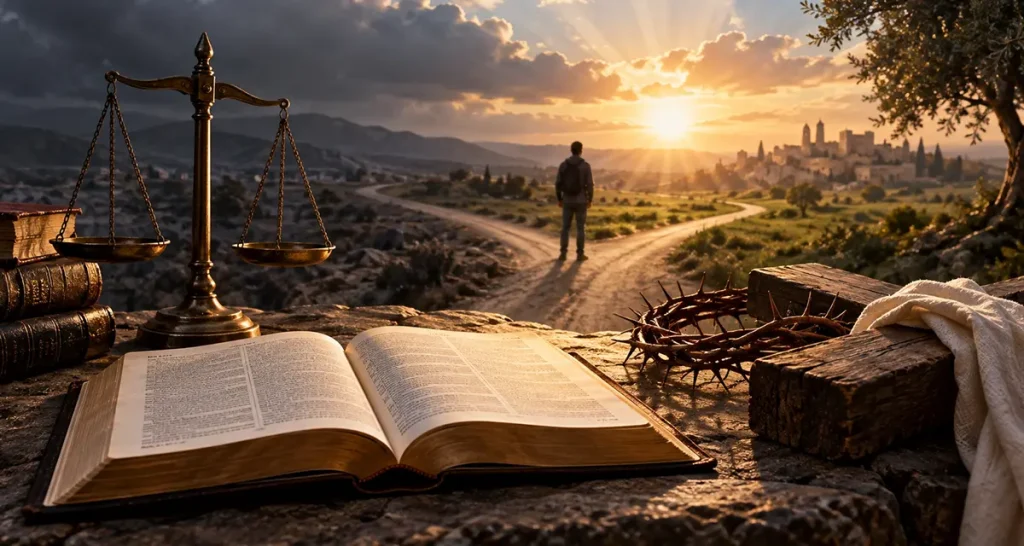
This is where the distinction we have been building becomes extremely important. If morality ultimately originates in God Himself, then society can change its moral judgments, but it cannot change moral reality.
Societies unquestionably change. Sometimes that change is genuinely good: practices once tolerated can be recognized as unjust. Sometimes change is morally destructive: practices once recognized as wrong can become normalized. And sometimes the situation is more complicated because a society is reconsidering how an enduring moral principle applies under new circumstances.
Scripture gives us categories for all three.
The key is not to assume either:
“Old = moral, new = immoral.”
or:
“New = progress, therefore new = better.”
Neither age nor novelty determines righteousness.
“Jesus Christ is the same yesterday, today, and forever.”
Hebrews 13:8
The question remains: What corresponds to God and to the order He has established?
🧭 Society Does Not Create Moral Reality
A society can change what it permits, prohibits, celebrates, condemns, or even what vocabulary it uses.
But Scripture never gives society ultimate jurisdiction over good and evil.
Isaiah warns:
“Woe to those who call evil good, and good evil;
Who put darkness for light, and light for darkness.”
Isaiah 5:20
That verse assumes something profound.
Calling evil “good” does not make it good.
Language can change.
Law can change.
Social approval can change.
Public shame can change direction.
But reality does not obediently rearrange itself around our vocabulary.
That takes us straight back to Genesis 3.
The serpent’s strategy was not primarily to alter physical reality. God’s world remained God’s world.
He offered another interpretation of reality:
“You will not surely die.”
Genesis 3:4
God had said:
“You shall surely die.”
Genesis 2:17
The creature is therefore confronted with two accounts of reality.
And Adam and Eve cannot make the serpent’s account true merely by preferring it.
🪞 Yet Societies Really Can Improve Morally
This qualification is essential.
If morality is absolute, someone might conclude:
“Then moral change must always be bad.”
Not at all.
The standard is absolute; human understanding and conformity to the standard are not.
That’s a huge distinction.
Imagine a fixed light shining on us. We may perceive something poorly, then increasingly clearly. The light did not change.
We did.
Scripture itself contains examples of societies—and God’s own people—being confronted with moral blindness.
The prophets repeatedly accuse Israel of becoming comfortable with practices contrary to God’s character:
“Seek justice,
Rebuke the oppressor;
Defend the fatherless,
Plead for the widow.”
Isaiah 1:17
The problem wasn’t that justice had recently been invented.
Israel had departed from it.
Likewise, when Josiah hears the rediscovered Book of the Law, he realizes how far Judah has departed from God’s requirements (2 Kings 22:8–13).
The standard wasn’t evolving.
Their recognition of their departure changed.
📏 Absolute Morality Does Not Mean Every Rule Has the Same Form Everywhere
Here we need another important distinction.
If morality originates in an absolute God, it doesn’t follow that every moral application must look identical under every circumstance.
Take love of neighbor.
“You shall love your neighbor as yourself.”
Leviticus 19:18; Matthew 22:39
That principle doesn’t change.
But what loving my neighbor requires may vary enormously.
If my neighbor is hungry, love may mean feeding him.
If he is falsely accused, love may mean defending him.
If he is doing evil, love may require confronting him.
If he is grieving, love may mean sitting quietly with him.
If he is trying to harm someone, love of the threatened person may require restraining him.
Unchanging principle does not mean mechanically identical application.
This is one reason biblical wisdom is necessary.
“The heart of the wise teaches his mouth,
And adds learning to his lips.”
Proverbs 16:23
Moral absolutes do not eliminate moral reasoning.
They make moral reasoning possible, because there is something stable toward which our reasoning is directed.
🧠 And Our Knowledge Is Not Absolute Merely Because Morality Is
This is perhaps one of the most important safeguards.
We can say:
“There is objective moral truth.”
But we cannot automatically proceed to:
“Therefore everything I presently believe about morality is objectively correct.”
Those are radically different statements.
God is infallible.
I am not.
God’s Word is true (John 17:17).
My interpretation requires humility, careful reading, wisdom, correction, and submission.
The Pharisees are a sobering example. They were very confident that they were defending God’s moral order while sometimes actually obscuring it.
Jesus tells them:
“You have made the commandment of God of no effect by your tradition.”
Matthew 15:6
Notice what happened.
They didn’t necessarily say:
“We reject morality.”
They could say:
“We are defending morality!”
And Jesus could still answer:
You have confused your tradition with God’s command.
That warning belongs to every generation—including conservative ones.
🏛️ Culture Is Therefore Neither Our Master Nor Automatically Our Enemy
This helps enormously when dealing with changing society.
Christians sometimes make one of two opposite mistakes.
One says:
“Society has progressed; therefore Scripture needs to catch up.”
The other says:
“Society has changed; therefore the change must be rebellion.”
Neither follows.
Culture must itself be judged.
Paul says:
“Test all things; hold fast what is good.”
1 Thessalonians 5:21
And:
“Do not be conformed to this world, but be transformed by the renewing of your mind, that you may prove what is that good and acceptable and perfect will of God.”
Romans 12:2
That produces a much healthier posture:
Neither automatic conformity nor automatic reaction.
Discernment.
🔍 “Society Accepts It Now” Is Not a Moral Argument
This is worth stating clearly.
Suppose someone says:
“People used to think X was wrong, but society now accepts X.”
That tells us something sociologically important.
It tells us almost nothing, by itself, about whether X is morally right.
But the reverse argument also fails:
“Society used to condemn X, therefore X must be wrong.”
Also insufficient.
In both cases we must go deeper:
What has God revealed?
What aspect of God’s character is involved?
What created relationship or order is involved?
Are we dealing with an explicit command, an enduring moral principle, a culturally particular expression, ceremonial legislation, civil legislation for Israel, wisdom, or something else?
Are we interpreting Scripture faithfully, or merely baptizing our inherited cultural assumptions?
Those are harder questions—but much safer ones.
🌳 This Takes Us Back to Creaturehood Again
There is something especially interesting here given our earlier discussions.
A society can collectively attempt what an individual creature attempted in Genesis 3:
“We will determine good and evil.”
That does not mean every societal moral development is such an attempt. As we just saw, societies can also recognize injustices they previously tolerated.
The decisive issue is authority.
There is an enormous difference between:
“We have discovered that our practice was inconsistent with what is actually right.”
and:
“We have decided that what is right will henceforth mean something different.”
The first is moral correction.
The second claims moral sovereignty.
And Scripture reserves ultimate sovereignty to God:
“There is one Lawgiver…”
James 4:12
The creature may discover.
The creature may reason.
The creature may apply.
The creature may repent.
The creature may grow in understanding.
But the creature cannot make God’s character become something else.
🌎 Why, Then, Do Moral Cultures Differ So Much?
Because objective reality doesn’t guarantee perfect human perception of it.
The same thing happens outside morality.
People have disagreed about astronomy. Their disagreement did not alter the stars.
People have disagreed about disease. Their disagreement did not change human biology.
Likewise, moral disagreement does not itself prove there is no moral reality.
Scripture expects human moral perception to be affected by sin:
“Their foolish hearts were darkened.”
Romans 1:21
But Scripture also recognizes conscience:
“Their conscience also bearing witness…”
Romans 2:15
That produces the strange world we actually inhabit.
Human cultures contain mixtures of:
truth and distortion, justice and injustice, insight and blindness, common grace and rebellion, inherited wisdom and inherited sin.
And therefore no human culture—not ancient Israel’s neighbors, first-century Rome, medieval Europe, modern America, or whatever culture comes after us—becomes the measure of God.
⚓ Absolute Does Not Mean Arbitrary
There is one more important point.
When we say morality is absolute because God is absolute, we don’t mean:
“God happens to have issued certain rules and possesses enough power to enforce them.”
That would make morality sound like cosmic authoritarianism.
Our whole previous discussion guards against that.
God’s commands arise from who God is and what He has created things to be.
“Good and upright is the LORD;
Therefore He teaches sinners in the way.”
Psalm 25:8
Notice the “therefore.”
God is good → therefore He teaches what is right.
His commands aren’t arbitrary intrusions into reality.
They correspond to reality because He is its Creator.
That means when God tells His creatures how to live, He isn’t an outsider imposing strange rules upon something He doesn’t understand.
He knows what human beings are because:
“It is He who has made us, and not we ourselves.”
Psalm 100:3
There is something wonderfully creaturely about that.
The One who tells me what human flourishing and righteousness mean is the One who knows what a human being is supposed to be.
✝️ Christ Becomes Our Anchor Again
And this is perhaps where the Christian answer becomes much richer than merely:
“Stick to the old morality.”
Christianity doesn’t ultimately anchor morality in the past.
It anchors morality in God.
And God’s fullest revelation comes to us in Christ:
“He who has seen Me has seen the Father.”
John 14:9
So the Christian question in a changing culture isn’t simply:
“What did people 100 years ago believe?”
Nor:
“What does society believe in 2026?”
But:
“What is true before God?”
And then:
“How do I faithfully embody that truth here, now, among these people, in love?”
That last part matters.
Standing upon moral absolutes does not authorize arrogance.
Peter joins conviction and gentleness:
“Always be ready to give a defense… with meekness and fear.”
1 Peter 3:15
Paul similarly tells us:
“Speaking the truth in love.”
Ephesians 4:15
Truth without love misrepresents the God who is love.
Love without truth misrepresents the God who is truth.
🕊️ So How Do We Live When the Moral Ground Around Us Keeps Moving?
Perhaps like this:
Don’t anchor yourself to the movement of society—but don’t anchor yourself merely to resistance against society either. Anchor yourself to God.
Then cultural change does not automatically frighten you.
If society recognizes something more faithfully aligned with justice, truth, human dignity, mercy, or love, you can rejoice and say, “That is good.”
If society moves away from what God has revealed, you can refuse to move with it without hating the people around you.
And if the issue is genuinely difficult, you can say, “I need to understand this better,” without fearing that humility somehow compromises objective truth.
Because there is a profound difference between the stability of truth and my certainty that I have understood every application of it perfectly.
And perhaps this is one of the freedoms that comes from believing morality ultimately rests in God:
I don’t have to make morality stable.
It already is.
My task is much more creaturely:
“He has shown you, O man, what is good…”
Micah 6:8
Receive. Learn. Discern. Obey. Repent when corrected. Love.
The world may change around us, and sometimes we ourselves will discover that we were the ones who needed changing. But neither society’s approval nor our own confidence establishes what is good.
God remains God.
And that is precisely why genuine moral growth is possible at all: there is an unchanging reality toward which a changing creature can actually grow. ❤️