Justice | Mercy | Faith

Justice | Mercy | Faith

πŸ“– The Angel of the LORD: Revelation, Testing, and the Humility of Biblical Interpretation

Difficulty Level: Intermediate-Advanced

Jump to Answers

  1. In Judges 13, we read Manoah’s wife’s response after their encounter with the Angel of the LORD: “If the LORD had desired to kill us, He would not have accepted a burnt offering and a grain offering from our hands, nor would He have shown us all these things, nor would He have told us such things as these at this time”. It seems almost unmistakably clear that, after the encounter, Manoah and his wife understood the messenger not merely as an angel, but as the LORD Himself. If that is so, why did God manifest Himself in this mysterious way throughout the Old Testament rather than simply presenting Himself openly as God?
  2. In Zechariah 1:12, “the Angel of the LORD speaks to the LORD…” This can be quite confusing until we begin to understand the rhythm of Scripture. How can someone who already fully knows the answer and the course of action genuinely ask such a question? We sometimes do something superficially similar when we speak to ourselves despite already knowing what we think or intend, but surely something much greater is taking place here.
  3. “We should distinguish between what the Old Testament explicitly says and the theological conclusion Christians draw from the whole canon.” That kind of restraint seems essential when handling Scripture. But why should we draw such conclusions at all if they are not explicitly spelled out in the Word? Is doing so wrong, or is careful theological inference actually part of discovering truths that are genuinely present within Scripture? How should we approach these dilemmas without either going beyond what is written or refusing to follow where the whole counsel of Scripture reasonably leads?
  4. John tells us concerning Jesus’ question to Philip, “He said this to test him, for he himself knew what he would do” (John 6:6). But Jesus knew not only what He Himself was about to do; He also knew what Philip and the other disciples would do, how they would respond, and what the outcome of the entire situation would be. If the One performing the test already knows the person, the response, the action, and the final outcome, what does it actually mean for God to “test” someone?
  5. What should we do when further evaluation, study, or discovery demonstrates that deductions and inferences we sincerely drew from Scripture were unintentionally wrong?

πŸ“– The Angel of the LORD: Revelation, Testing, and the Humility of Biblical Interpretation

Biblical Interpretation | Jesus Christ (Christology) | Old Testament | Types of Christ

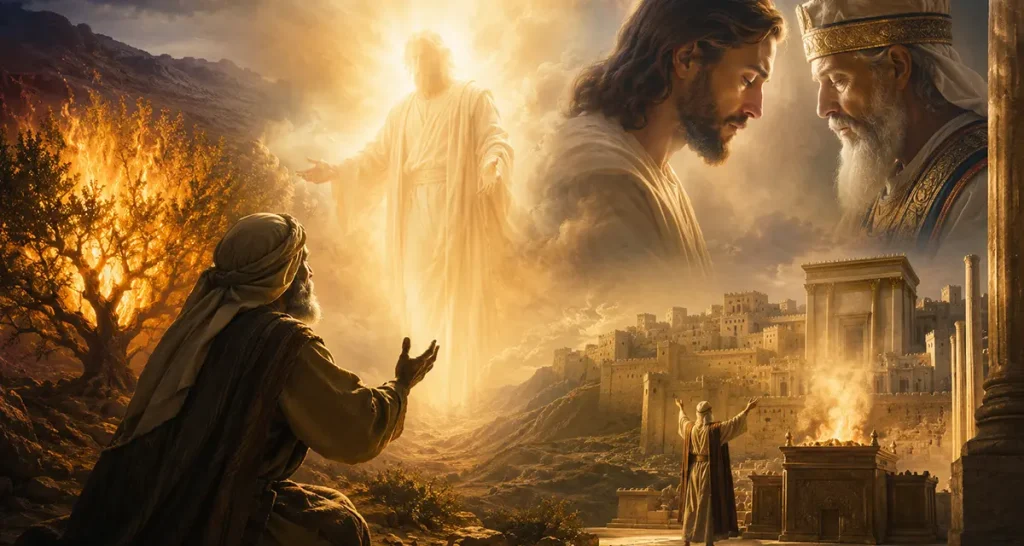
Some passages of Scripture seem straightforward until we stop and notice what the text is actually doing. Judges 13 is one of them. Manoah and his wife encounter the mysterious Angel of the LORD, yet by the end of the encounter Manoah declares, “We shall surely die, because we have seen God” (Judges 13:22). His wife does not dispute that conclusion; instead, she reasons that if the LORD intended to kill them, He would not have accepted their offering or revealed these things to them (Judges 13:23).

This raises a remarkable question: Who is the Angel of the LORD, and why does God reveal Himself this way in the Old Testament? The mystery deepens when other passages show the Angel speaking as God and being identified with God (Genesis 16:7–13; Exodus 3:2–6), while elsewhere the Angel of the LORD actually speaks to the LORD (Zechariah 1:12–13). Read in light of the New Testament revelation of the Father and the Son, these passages have long led Christians to ask whether we are seeing anticipations of Christ before His incarnation.

But that question opens an even larger discussion about how we discover truth in Scripture. When is a theological inference justified if the Bible does not explicitly state our conclusion? How should later revelation illuminate earlier revelation without allowing imagination to replace careful interpretation? And what should we do when further study proves that one of our deductions was wrong?

Even Jesus’ testing of Philip brings us into the same territory. John tells us that Jesus asked Philip where bread could be bought for the multitude “to test him, for he himself knew what he would do” (John 6:5–6). If Christ already knew what He would do, what Philip would answer, and how the entire event would unfold, what does divine testing actually accomplish?

From the Angel of the LORD, to the unfolding revelation of Christ, to God’s testing of His people, and finally to the possibility of our own mistaken interpretations, this discussion explores a fundamental principle of biblical study: God’s revelation is perfect, but our understanding of that revelation is still capable of growth and correction.

The goal, therefore, is neither to avoid theological inference nor to treat every inference as though it were explicitly written in Scripture. It is to learn to distinguish carefully between what the text says, what necessarily follows from it, what the whole canon strongly suggests, and what remains possible but uncertain. As we do, we can pursue deeper discoveries in Scripture without confusing our deductions with the Word of God itself.

“The sum of your word is truth, and every one of your righteous rules endures forever.”
β€” Psalm 119:160

In Judges 13, we read Manoah’s wife’s response after their encounter with the Angel of the LORD: “If the LORD had desired to kill us, He would not have accepted a burnt offering and a grain offering from our hands, nor would He have shown us all these things, nor would He have told us such things as these at this time”. It seems almost unmistakably clear that, after the encounter, Manoah and his wife understood the messenger not merely as an angel, but as the LORD Himself. If that is so, why did God manifest Himself in this mysterious way throughout the Old Testament rather than simply presenting Himself openly as God?

Yes. Judges 13 is one of those passages where the distinction between “the Angel of the LORD” and “the LORD” becomes so fluid that it is difficult to treat the Angel as merely an ordinary created angel carrying a message.

Manoah’s conclusion is striking:

“We shall surely die, because we have seen God.”
β€” Judges 13:22

And his wife does not correct his identification. She corrects his conclusion that they are going to die:

“If the LORD had meant to kill us, he would not have accepted a burnt offering and a grain offering at our hands…”
β€” Judges 13:23

So your question gets to something much larger: Why does God repeatedly reveal Himself in the Old Testament through this mysterious figure rather than simply appearing and saying, “I am God”?

I think the answer has several layers.

πŸ”₯ God reveals Himself while simultaneously veiling Himself

There is a tension throughout the Old Testament:

God wants to make Himself known, yet fallen humanity cannot simply encounter the unveiled fullness of His glory.

God tells Moses:

“You cannot see my face, for man shall not see me and live.”
β€” Exodus 33:20

Yet Scripture also says:

“Thus the LORD used to speak to Moses face to face, as a man speaks to his friend.”
β€” Exodus 33:11

At first that sounds contradictory.

But it points toward different degrees or modes of divine revelation. Moses truly encounters God, but not the unmediated fullness of God’s glory.

The Angel of the LORD fits remarkably well into this pattern.

God is genuinely present.

God genuinely speaks.

God genuinely receives worship or sacrifice.

And yet God is, in some sense, veiled.

This is almost the pattern of:

Presence without annihilation.

God comes near enough to be encountered, while concealing the fullness of the glory that fallen humanity cannot bear.

That may explain Manoah’s terror.

πŸ‘€ The strange identity of “the Angel of the LORD”

The Hebrew word mal’akh means “messenger.” It does not necessarily describe the nature of the being. It describes his function.

So “the Angel of the LORD” can literally mean:

the Messenger of Yahweh.

And this Messenger behaves very differently from ordinary angels.

Consider the burning bush:

“And the angel of the LORD appeared to him in a flame of fire out of the midst of a bush.”
β€” Exodus 3:2

But only two verses later:

“When the LORD saw that he turned aside to see, God called to him out of the bush…”
β€” Exodus 3:4

The Angel appears.

Then God speaks.

And He says:

“I am the God of your father, the God of Abraham, the God of Isaac, and the God of Jacob.”
β€” Exodus 3:6

Moses therefore:

“hid his face, for he was afraid to look at God.”
β€” Exodus 3:6

The narrative does not seem embarrassed by moving between:

Angel of the LORD β†’ LORD β†’ God.

We find the same phenomenon with Hagar. The Angel of the LORD speaks to her in Genesis 16:7–12, but afterward:

“So she called the name of the LORD who spoke to her, ‘You are a God of seeing.'”
β€” Genesis 16:13

Again:

The Angel speaks.
The LORD has spoken.
The person concludes that she has encountered God.

πŸ€” But there is an even stranger feature

The Angel of the LORD is not merely identified with God.

He is sometimes distinguished from God.

That is what makes these passages so important.

For example:

“The angel of the LORD said, ‘O LORD of hosts, how long will you have no mercy on Jerusalem…?'”
β€” Zechariah 1:12

Here the Angel of the LORD speaks to the LORD.

So we get something extraordinary in the Old Testament:

The Angel is God.

And yet:

The Angel is somehow distinguishable from God.

That sounds remarkably familiar once we reach the New Testament.

✝️ This is why Christians historically saw the pre-incarnate Christ here

We should distinguish between what the Old Testament explicitly says and the theological conclusion Christians draw from the whole canon.

Judges 13 never says:

“This was Jesus Christ.”

So we shouldn’t pretend the identification is explicitly stated there.

But once Christ is revealed in the New Testament, the earlier pattern becomes extraordinarily suggestive.

John says:

“No one has ever seen God; the only God, who is at the Father’s side, he has made him known.”
β€” John 1:18

And Jesus says:

“Not that anyone has seen the Father except he who is from God; he has seen the Father.”
β€” John 6:46

Yet Abraham, Hagar, Jacob, Moses, Joshua, Manoah and others apparently encounter God.

How?

The New Testament gives us a theological category that makes sense of this:

The invisible God makes Himself known through the Son.

Paul says of Christ:

“He is the image of the invisible God.”
β€” Colossians 1:15

And Hebrews says:

“He is the radiance of the glory of God and the exact imprint of his nature.”
β€” Hebrews 1:3

This raises a fascinating possibility:

The incarnation may not represent the first time the Son reveals the Father.

It is the climactic and permanent form of something the Son has always done.

🌿 The Old Testament appearances may therefore anticipate the Incarnation

This, I think, gets very close to the heart of your question.

Why doesn’t God simply present Himself as God?

Because God’s ultimate revelation of Himself is not merely:

God displaying divine power.

It is:

God making Himself known through the Son.

Jesus tells Philip:

“Whoever has seen me has seen the Father.”
β€” John 14:9

And John says:

“The Word became flesh and dwelt among us, and we have seen his glory.”
β€” John 1:14

The Angel of the LORD appearances could therefore be understood as temporary anticipations of the principle that becomes permanent in the Incarnation:

The invisible God makes Himself visible through the Son.

In Judges 13, the Messenger appears and then disappears.

In the incarnation, however:

“The Word became flesh.”
β€” John 1:14

That is fundamentally different.

The Son does not merely appear as a man.

He becomes man.

πŸ”₯ And Judges 13 contains an extraordinary hint of this mystery

Manoah asks the Angel:

“What is your name…?”
β€” Judges 13:17

The Angel answers:

“Why do you ask my name, seeing it is wonderful?”
β€” Judges 13:18

The Hebrew word translated “wonderful” or “beyond understanding” is related to the idea of something extraordinary, incomprehensible, wondrous.

Then Manoah offers the sacrifice:

“And when the flame went up toward heaven from the altar, the angel of the LORD went up in the flame of the altar.”
β€” Judges 13:20

At that moment:

“Manoah and his wife fell on their faces to the ground.”
β€” Judges 13:20

Then comes the realization:

“Then Manoah knew that he was the angel of the LORD.”
β€” Judges 13:21

And immediately:

“We shall surely die, because we have seen God.”
β€” Judges 13:22

The sequence seems intentional.

Messenger β†’ mysterious name β†’ sacrifice β†’ supernatural ascent β†’ worshipful prostration β†’ recognition β†’ “we have seen God.”

πŸ•ŠοΈ Perhaps “Messenger” is actually the point

This changes the way we hear the title.

We naturally hear “angel” and think:

lesser heavenly being.

But mal’akh fundamentally means messenger.

And what is the Son eternally doing in relation to God’s revelation?

He makes the Father known.

John begins his Gospel:

“In the beginning was the Word, and the Word was with God, and the Word was God.”
β€” John 1:1

That contains almost exactly the theological tension we noticed in the Angel of the LORD passages:

He is with God.
He is God.

The Old Testament gives us a mysterious figure who can be sent by Yahweh, distinguished from Yahweh, and yet speak and act as Yahweh.

The New Testament finally gives us the conceptual clarity to understand how such a distinction can exist within the identity of the one God.

And perhaps that is precisely why God did not flatten these encounters into a simple declaration of “I am God.”

The mystery itself was revelatory.

God was gradually teaching Israel something about Himself that they could not yet fully articulate:

The one God is not solitary in the simplistic sense we might assume.

The Father can send.

The Son can be sent.

The Son can reveal the Father.

And yet:

“The LORD is one.”
β€” Deuteronomy 6:4

What appears mysterious in Genesis, Exodus, Judges, and Zechariah becomes much clearer when John finally writes:

“No one has ever seen God; the only God, who is at the Father’s side, he has made him known.”
β€” John 1:18

So I would go one step further than saying God was merely disguising Himself in the Old Testament.

He may actually have been revealing something about Himself.

The veil was not only protection from divine glory.

The veil was also prophecy.

The God who repeatedly came near to humanity through His divine Messenger would ultimately come near in the fullest possible way:

“And the Word became flesh and dwelt among us.”
β€” John 1:14

And unlike the Angel who ascended in the flame and disappeared from Manoah’s sight, the Son entered our humanity permanently.

In Zechariah 1:12, “the Angel of the LORD speaks to the LORD…” This can be quite confusing until we begin to understand the rhythm of Scripture. How can someone who already fully knows the answer and the course of action genuinely ask such a question? We sometimes do something superficially similar when we speak to ourselves despite already knowing what we think or intend, but surely something much greater is taking place here.

Exactly. And I think your comparison with our own inner dialogue is useful as a starting point, provided we do not make it the explanation of what is happening within God.

When the Angel of the LORD says:

“O LORD of hosts, how long will you have no mercy on Jerusalem…?”
β€” Zechariah 1:12

the strange thing is precisely what you noticed: why ask a question whose answer is not hidden from Him? If the Angel participates in the divine identity, this cannot simply be a request for information.

πŸ•ŠοΈ The question is not necessarily seeking information

Scripture frequently presents divine questions whose purpose is not to acquire knowledge.

God asks Adam:

“Where are you?”
β€” Genesis 3:9

God knows where Adam is.

He asks Cain:

“Where is Abel your brother?”
β€” Genesis 4:9

Again, God is not gathering information.

Jesus asks Philip:

“Where are we to buy bread, so that these people may eat?”
β€” John 6:5

And John immediately explains:

“He said this to test him, for he himself knew what he would do.”
β€” John 6:6

So Scripture teaches us not to assume:

Question = ignorance.

A question can disclose, summon, intercede, teach, expose, invite, or enact a relationship.

That becomes especially important in Zechariah 1.

πŸ”₯ The Angel’s question is intercession

Notice what He actually asks:

“O LORD of hosts, how long will you have no mercy on Jerusalem and the cities of Judah…?”
β€” Zechariah 1:12

This sounds less like someone asking, “What is going to happen?” and more like someone pleading on behalf of God’s people.

And then:

“And the LORD answered gracious and comforting words to the angel who talked with me.”
β€” Zechariah 1:13

There is a relational movement:

The Angel intercedes β†’ the LORD answers β†’ mercy toward God’s people is announced.

If we read this christologically, it becomes extraordinarily significant because the New Testament eventually reveals the Son precisely in this role:

“Christ Jesus is the one who died… who was raised… who indeed is interceding for us.”
β€” Romans 8:34

And:

“He always lives to make intercession for them.”
β€” Hebrews 7:25

Christ’s intercession does not mean the Son knows something the Father doesn’t know.

Nor does it mean the Son must persuade an unwilling Father to become merciful.

Father and Son share the divine will.

Yet the Son genuinely intercedes.

That is the greater meaning you are sensing.

🀯 God can know His own will and still genuinely address God

Here our human analogy reaches its limit.

When I speak to myself, there is still only one person carrying on an internal dialogue.

Christian Trinitarian theology says something much greater about God:

One Being, three Persons.

The Father is not the Son.

The Son is not the Father.

Yet the Father and Son are not two Gods.

So when the Son addresses the Father, it is not God pretending to talk to Himself. There is real personal relationship within the one divine being.

John gives us perhaps the clearest window into this:

“Father, glorify me in your own presence with the glory that I had with you before the world existed.”
β€” John 17:5

That is astonishing.

Before creation existed, the Son had glory with the Father.

And later Jesus says:

“You loved me before the foundation of the world.”
β€” John 17:24

So before there was:

creation,
humanity,
sin,
redemption,
Israel,
or even time as we experience it,

there was already Father loving Son.

That means relationship is not something God began doing after creating other beings.

Relationship belongs eternally to who God is.

🌿 And this helps explain the “rhythm of Scripture”

I like your expression because Scripture does have a rhythm of revelation.

Early on, Scripture gives us things that seem almost deliberately unresolved.

God says:

“Let us make man in our image.”
β€” Genesis 1:26

Then:

“The LORD rained on Sodom and Gomorrah sulfur and fire from the LORD out of heaven.”
β€” Genesis 19:24

Then the Angel of the LORD appears, speaks as God, receives divine recognition, yet is also sent by and speaks to the LORD.

Then David writes:

“The LORD says to my Lord: ‘Sit at my right hand.'”
β€” Psalm 110:1

Then Isaiah speaks of the Servant upon whom God’s Spirit rests (Isaiah 42:1).

None of these passages by itself gives us the fully articulated doctrine of the Trinity.

But there is a pattern accumulating.

Then the New Testament opens the mystery much more fully:

“In the beginning was the Word, and the Word was with God, and the Word was God.”
β€” John 1:1

That single sentence preserves both things Scripture had been teaching us to hold together.

Distinction:
“The Word was with God.”

Divine identity:
“The Word was God.”

Suddenly, many of those strange Old Testament passages no longer feel like irregularities.

They feel like preparation.

✝️ And Christ’s prayers make the mystery even deeper

This is where your observation about asking something while already knowing becomes particularly powerful.

Jesus prays.

Jesus intercedes.

Jesus asks.

Yet He also says:

“I and the Father are one.”
β€” John 10:30

His prayer is not evidence of ignorance of God’s purpose. It expresses personal communion and, in His incarnation, the perfect human obedience of the Son to the Father.

Gethsemane is the supreme example:

“Not my will, but yours, be done.”
β€” Luke 22:42

There we must also account for the reality of the incarnation: the eternal Son has truly assumed human nature and a genuinely human will. His obedience is not theatrical. See also Philippians 2:6–8; Hebrews 5:7–9.

And yet the deeper pattern remains:

knowledge does not eliminate communion.

That is important.

We tend to think communication exists primarily because one person possesses information another lacks.

But within Scripture, communication can be much more than information transfer.

It can be love, communion, intercession, delight, agreement, obedience, glorification.

❀️ “You loved me before the foundation of the world”

That statement in John 17:24 may take us closest to the center.

The Son does not need to inform the Father.

The Father does not need to discover the Son’s thoughts.

Yet they speak.

The Son asks.

The Father answers.

The Son glorifies the Father.

The Father glorifies the Son.

The Father loves the Son.

The Son loves the Father.

And the Spirit searches “even the depths of God” (1 Corinthians 2:10–11) and is spoken of personally within this divine work (John 14:16–17, 26; 15:26).

So when we return to:

“O LORD of hosts, how long…?”
β€” Zechariah 1:12

the question begins to sound very different.

It may not be:

“Tell me something I don’t know.”

It is closer to:

“I stand before You on behalf of Your people, appealing for the mercy that accords with Your own purpose.”

And if the Angel of the LORD here is indeed understood as a pre-incarnate manifestation of the Son, then we are seeing something extraordinary long before Bethlehem:

the divine Messenger standing between afflicted humanity and God, interceding for God’s people.

Then the New Testament reveals the same pattern in its fullness:

“For there is one God, and there is one mediator between God and men, the man Christ Jesus.”
β€” 1 Timothy 2:5

So yes, there is a much greater meaning than divine self-questioning.

The strange conversations within the Old Testament may be giving us early glimpses of something humanity would only understand much later:

God’s unity does not mean divine solitude.

Within the one God there is eternal communion. And salvation itself draws us, astonishingly, into the benefits of that communion:

“Our fellowship is with the Father and with his Son Jesus Christ.”
β€” 1 John 1:3

That makes the mysterious dialogue of Zechariah much more than a theological curiosity. The One speaking to the LORD is speaking on behalf of people who cannot stand there for themselves. And that theme eventually blossoms into the New Testament revelation of Christ our Mediator and Intercessor.

“We should distinguish between what the Old Testament explicitly says and the theological conclusion Christians draw from the whole canon.” That kind of restraint seems essential when handling Scripture. But why should we draw such conclusions at all if they are not explicitly spelled out in the Word? Is doing so wrong, or is careful theological inference actually part of discovering truths that are genuinely present within Scripture? How should we approach these dilemmas without either going beyond what is written or refusing to follow where the whole counsel of Scripture reasonably leads?

I think this gets to something fundamental about how Scripture is meant to be read. The restraint matters, but restraint does not mean refusing to draw conclusions Scripture itself invites us to draw.

There are two opposite errors we can make.

One is to say more than Scripture warrants.

The other is to refuse to say anything Scripture does not state in a single explicit sentence.

The second can sound safer, but if applied consistently, it would actually prevent us from confessing many truths that Scripture teaches by accumulation, comparison, implication, and fulfillment.

πŸ“– Scripture teaches explicitly and cumulatively

Some doctrines are stated almost propositionally:

“God is love.”
β€” 1 John 4:8

Others emerge because many passages must be held together.

The Trinity is the obvious example.

There is no verse saying:

“God is one Being eternally existing in three coequal, coeternal Persons, Father, Son, and Holy Spirit.”

Yet Christians did not invent the Trinity because they wanted an elaborate theological system.

They were forced toward that conclusion because Scripture simultaneously teaches:

  • There is one God β€” Deuteronomy 6:4; Isaiah 45:5–6
  • The Father is God β€” 1 Corinthians 8:6
  • The Son is God β€” John 1:1; John 20:28; Hebrews 1:8
  • The Spirit is spoken of divinely β€” Acts 5:3–4; 1 Corinthians 3:16; 6:19
  • Father, Son, and Spirit are personally distinguishable β€” Matthew 3:16–17; John 14:16–17
  • They appear together under the singular “name” β€” Matthew 28:19

The doctrine is therefore not a sentence copied from Scripture.

It is an attempt to say:

“What must be true if all these Scriptures are true?”

That is legitimate theological reasoning.

πŸ”Ž So is identifying the Angel of the LORD with Christ legitimate?

Yes β€” as a theological conclusion, but we should state the level of certainty honestly.

For example, compare these statements:

“Judges 13 explicitly says that the Angel of the LORD is Jesus Christ.”

That goes beyond the text.

But:

“When Judges 13 is read within the whole canon, there are strong reasons for Christians to understand the Angel of the LORD as a pre-incarnate manifestation of the Son.”

That is quite different.

Now we are making an argument rather than claiming an explicit statement.

And Scripture itself encourages this kind of canonical reading.

Jesus does it.

After His resurrection:

“And beginning with Moses and all the Prophets, he interpreted to them in all the Scriptures the things concerning himself.”
β€” Luke 24:27

That verse is extremely important for this question.

Apparently, there were things concerning Christ in the Old Testament that the disciples had read many times without fully recognizing.

Later:

“Then he opened their minds to understand the Scriptures.”
β€” Luke 24:45

So there are realities genuinely present in earlier revelation whose significance becomes clearer through later revelation.

That isn’t imposing the New Testament upon the Old Testament.

It is allowing completed revelation to illuminate earlier revelation.

🌱 Revelation unfolds

Think about Abraham.

God tells him:

“In your offspring shall all the nations of the earth be blessed.”
β€” Genesis 22:18

Someone reading Genesis alone could understand something real from that promise.

But Paul later writes:

“Now the promises were made to Abraham and to his offspring… who is Christ.”
β€” Galatians 3:16

The later revelation doesn’t make Genesis false.

It reveals a depth within God’s promise that Abraham could not necessarily have articulated in full.

This happens repeatedly.

Passover is really about Israel’s deliverance from Egypt (Exodus 12).

But Paul can nevertheless say:

“Christ, our Passover lamb, has been sacrificed.”
β€” 1 Corinthians 5:7

The bronze serpent really was an event in Israel’s wilderness journey (Numbers 21:4–9).

Yet Jesus says:

“As Moses lifted up the serpent in the wilderness, so must the Son of Man be lifted up.”
β€” John 3:14

Melchizedek really was a historical figure encountered by Abraham (Genesis 14:18–20).

Yet Hebrews sees profound Christological significance in him (Hebrews 7:1–17).

So Scripture itself teaches us to read Scripture at more than one level without abandoning the historical meaning.

🧭 But this requires guardrails

This is where your concern about restraint becomes crucial.

Once we say, “There may be deeper meanings,” imagination can easily take over.

Suddenly every tent peg represents the cross, every number becomes prophetic mathematics, every tree symbolizes Christ, every direction has spiritual significance.

That isn’t biblical interpretation anymore.

The question therefore isn’t merely:

“Can I see Christ here?”

A better question is:

“Does Scripture itself give me sufficient reason to see Christ here?”

And there are several good tests.

πŸ“œ Does the interpretation arise from the text itself?

With the Angel of the LORD, we’re not beginning with nothing.

The text itself gives us the puzzle.

The Angel says:

“I am the God of your father…”
β€” Exodus 3:6

Hagar identifies the One speaking with her as the LORD:

“You are a God of seeing.”
β€” Genesis 16:13

Manoah concludes:

“We shall surely die, because we have seen God.”
β€” Judges 13:22

Yet the Angel can also speak to the LORD:

“O LORD of hosts…”
β€” Zechariah 1:12

So the theological question isn’t artificially imposed.

The text created the problem.

We are trying to understand it.

πŸ”— Does the rest of Scripture provide a category for it?

Then John tells us:

“No one has ever seen God; the only God, who is at the Father’s side, he has made him known.”
β€” John 1:18

And:

“The Word was with God, and the Word was God.”
β€” John 1:1

Now we possess a category that beautifully explains something previously mysterious:

One who is God, yet personally distinguishable from God, who reveals the invisible God.

That doesn’t mathematically prove every Angel-of-the-LORD appearance is Christ.

But the correspondence is substantial enough that it deserves theological consideration.

✝️ Does it fit the revealed character and work of Christ?

Christ is:

the Word who reveals God (John 1:18),

the image of the invisible God (Colossians 1:15),

the mediator (1 Timothy 2:5),

the intercessor (Romans 8:34),

the One sent by the Father (John 5:36–38).

So when we encounter a divine Messenger who is sent by God, speaks as God, reveals God, and sometimes intercedes before God, the Christological connection isn’t arbitrary.

There is a recognizable biblical pattern.

βš–οΈ I would therefore use different levels of confidence

This is perhaps the most useful practical habit.

We don’t have to classify every interpretation as simply:

true / false.

We can speak more carefully.

Explicit:
“Jesus is the Word made flesh.” β€” John 1:14

Necessary theological inference:
“The Son is eternally divine.” β€” drawn directly and strongly from passages such as John 1:1–3; John 17:5; Colossians 1:16–17; Hebrews 1:2–3.

Strong canonical inference:
“The Angel of the LORD may be, and I think is very plausibly, a pre-incarnate manifestation of the Son.”

Possible typological connection:
“This event may anticipate Christ.”

Speculation:
“Perhaps this detail symbolizes…”

Those shouldn’t all be preached with the same degree of certainty.

And I think that distinction protects both discovery and humility.

πŸ’‘ Theology itself is an exercise in discovering implications

There is a beautiful example in Jesus’ argument with the Sadducees.

They denied the resurrection. Jesus answers from God’s words to Moses:

“I am the God of Abraham, and the God of Isaac, and the God of Jacob.”
β€” Matthew 22:32; Exodus 3:6

Then Jesus concludes:

“He is not God of the dead, but of the living.”
β€” Matthew 22:32

Notice what Jesus did.

Exodus 3:6 does not explicitly say:

“Abraham, Isaac, and Jacob will be raised from the dead.”

Jesus derives the theological implication from what God said.

That is enormously instructive.

Jesus Himself demonstrates that faithful interpretation sometimes asks:

“If this statement of Scripture is true, what else must therefore be true?”

So inference isn’t the enemy of biblical faithfulness.

Uncontrolled inference is.

πŸ•ŠοΈ The Bereans give us the right posture

When Paul preached Christ to them:

“They received the word with all eagerness, examining the Scriptures daily to see if these things were so.”
β€” Acts 17:11

I love the combination.

They were neither cynical nor gullible.

Eagerness + examination.

That is probably the posture we want.

When we encounter something like the Angel of the LORD, we don’t have to say:

“Scripture doesn’t explicitly call Him Christ, therefore stop thinking.”

Nor should we say:

“I’ve discovered that this absolutely is Jesus, therefore anyone disagreeing is rejecting Scripture.”

Instead:

“There is something here. Let’s follow the textual pattern through Scripture and see where it leads.”

And sometimes that journey produces astonishing theological clarity.

πŸŒ„ The distinction I would preserve

There is a difference between:

what Scripture says

and

what I conclude from what Scripture says.

But that doesn’t mean the second category is illegitimate.

Some conclusions may be virtually unavoidable. Others may be strong. Others tentative. Others speculative.

Our responsibility is simply not to erase those distinctions.

Paul gives us a good boundary:

“Do not go beyond what is written.”
β€” 1 Corinthians 4:6

Yet Jesus also commands us to search, understand, compare, and recognize how the Scriptures testify concerning Him (John 5:39; Luke 24:27, 44–45).

So I would describe what we’re doing with the Angel of the LORD not as adding something to Scripture, but as trying to discover the coherence already present within Scripture.

The humility comes in saying:

“This is what the text explicitly says.”

“This is what I believe follows strongly from it.”

“This is possible, but I cannot insist upon it.”

That little distinction allows us to explore very deeply without quietly turning our theological deductions into additional verses of Scripture.

John tells us concerning Jesus’ question to Philip, “He said this to test him, for he himself knew what he would do” (John 6:6). But Jesus knew not only what He Himself was about to do; He also knew what Philip and the other disciples would do, how they would respond, and what the outcome of the entire situation would be. If the One performing the test already knows the person, the response, the action, and the final outcome, what does it actually mean for God to “test” someone?

Yes. That qualification actually makes the question sharper.

John says:

“He said this to test him, for he himself knew what he would do.”
β€” John 6:6

But if we take seriously who Jesus is, He did not merely know, “In a few minutes I will multiply the bread.” He knew Philip. He knew Andrew would speak. He knew the boy and the loaves were there. He knew the multitude would eat. He knew twelve baskets would remain. And ultimately He knew where this sign was going: toward the discourse about the Bread of Life and eventually toward the unbelief of many who had followed Him (John 6:9–13, 26–35, 60–66).

So what can “test” possibly mean when the Tester already knows the result?

πŸ”₯ A test does not have to discover something unknown to God

This is the crucial distinction.

We commonly think of testing as:

I don’t know the answer β†’ I perform a test β†’ the test gives me information.

But biblical testing frequently operates differently:

God knows β†’ God tests β†’ what is known to God becomes manifested within history and experienced by the person being tested.

The test is not necessarily for God’s discovery.

It is often for the creature’s disclosure, formation, and participation.

Philip is about to discover something about Philip.

And, more importantly, Philip is about to discover something about Jesus.

🧠 Consider what Jesus asks Philip

Jesus doesn’t initially say:

“Watch what I’m about to do.”

He asks:

“Where are we to buy bread, so that these people may eat?”
β€” John 6:5

Philip immediately calculates:

“Two hundred denarii worth of bread would not be enough for each of them to get a little.”
β€” John 6:7

That’s fascinating.

Jesus has placed Philip before an impossible situation.

And Philip responds according to the resources available within the situation.

Number of people.
Amount of money.
Amount of bread.
Insufficient resources.

Philip’s calculation isn’t even wrong!

That’s important.

His mathematics is probably perfectly reasonable.

The problem is that his calculation does not include Jesus.

That seems to be the test.

🍞 “What do you do when what you have is not enough?”

Andrew does slightly better:

“There is a boy here who has five barley loaves and two fish…”

But then he also reaches the same wall:

“…but what are they for so many?”
β€” John 6:9

Again, perfectly reasonable.

Philip says essentially:

We don’t have enough money.

Andrew says:

We don’t have enough food.

Jesus knows both things.

And He deliberately puts His disciples in a situation where the insufficiency of human resources becomes undeniable.

Then:

“Jesus then took the loaves, and when he had given thanks, he distributed them…”
β€” John 6:11

The test exposes the limitation.

The sign reveals the Person.

🌱 So the test is doing something to the disciple

This is where biblical testing becomes much richer than examination.

The Greek verb in John 6:6 is peirazō, which depending on context can mean to test, try, examine, or tempt.

God does not tempt people toward evil (James 1:13), but He does test.

And a divine test can accomplish several things simultaneously:

It reveals what is in us.
It makes us confront our limitations.
It exercises faith.
It teaches us something about God.
It prepares us for greater responsibility.
It transforms intellectual knowledge into lived knowledge.

That last distinction is especially important.

Philip already knew Jesus could do extraordinary things.

By John 6, the disciples had seen signs.

But there is a difference between:

knowing something about Jesus

and

being placed in a situation where you must act upon what you know about Jesus.

The test moves truth from abstraction into experience.

🏜️ This is exactly what God did with Israel

Deuteronomy gives us an extraordinarily useful explanation:

“And you shall remember the whole way that the LORD your God has led you these forty years in the wilderness, that he might humble you, testing you to know what was in your heart, whether you would keep his commandments or not.”
β€” Deuteronomy 8:2

At first glance, “to know what was in your heart” could sound as though God lacked information.

But Scripture elsewhere emphatically says:

“You know when I sit down and when I rise up; you discern my thoughts from afar.”
β€” Psalm 139:2

And:

“Even before a word is on my tongue, behold, O LORD, you know it altogether.”
β€” Psalm 139:4

So “to know” in the testing passages cannot simply mean God obtaining information He previously lacked.

Something hidden becomes historically manifested.

Israel’s heart comes out into the open.

And not merely for spectators.

Israel discovers Israel.

πŸͺž The test makes the invisible visible

That may be the simplest way of saying it.

God already knows the heart.

But the person often doesn’t.

Peter is perhaps the most painful example.

Peter says:

“Even if I must die with you, I will not deny you!”
β€” Matthew 26:35

I think Peter sincerely believes that.

Jesus knows otherwise:

“Before the rooster crows, you will deny me three times.”
β€” Matthew 26:34

Then the test comes.

Peter fails.

Jesus learned nothing new about Peter.

Peter learned something devastatingly new about Peter.

And that knowledge becomes part of Peter’s transformation.

After the resurrection, Jesus asks him three times:

“Do you love me?”
β€” John 21:15–17

The Peter answering those questions is not quite the Peter who confidently announced that everyone else might fall away but he never would (Matthew 26:33).

The test exposed him.

But it did not expose him merely to condemn him.

It prepared him to be restored.

🌳 This takes us all the way back to Abraham

Perhaps the most difficult example is:

“After these things God tested Abraham…”
β€” Genesis 22:1

God already knows what Abraham will do.

Yet after Abraham demonstrates his willingness to offer Isaac, the Angel of the LORD says:

“Now I know that you fear God, seeing you have not withheld your son, your only son, from me.”
β€” Genesis 22:12

“Now I know” is remarkable.

If we interpret that as acquisition of information, we immediately create enormous problems for everything Scripture teaches about God’s knowledge.

But if “know” here carries the sense of something becoming demonstrated, actualized, manifested within the covenant relationship, the passage becomes much more coherent.

Before Genesis 22, Abraham’s faith is known by God.

After Genesis 22, Abraham’s faith has been acted out in history.

There is now an event.

Something real has happened.

This distinction matters enormously.

⏳ God’s foreknowledge does not make history meaningless

This may be the deeper issue underneath your question.

If God already knows:

what Philip will say,

what Andrew will do,

what Jesus will do,

how much food will remain,

and what everyone will ultimately believe,

we might ask:

Why go through the process at all?

Because God’s knowledge of an event does not replace the event.

God knowing that Abraham will obey is not the same thing as Abraham obeying.

God knowing that Peter will deny Jesus is not the same thing as Peter denying Jesus.

God knowing that Philip will calculate the cost is not the same thing as Philip being confronted with his insufficiency.

And God knowing that Christ will die for us is not the same thing as Christ actually dying for us.

This is extremely important.

God’s foreknowledge does not turn history into unnecessary theater.

History is where God’s known purposes actually become accomplished.

Paul can say that Christ was:

“foreknown before the foundation of the world”

and yet:

“was made manifest in the last times for the sake of you.”
β€” 1 Peter 1:20

Known beforehand.

Manifested afterward.

Both are real.

🏺 Testing therefore isn’t primarily informational; it can be formative

This gives us a better definition.

When God tests someone, He may not be asking:

“What will this person do? I need to find out.”

Rather:

“What is within this person will now be brought into action, exposed, exercised, judged, strengthened, or transformed.”

There is a beautiful analogy in refining metal.

Scripture repeatedly uses this imagery:

“The crucible is for silver, and the furnace is for gold, and the LORD tests hearts.”
β€” Proverbs 17:3

The furnace doesn’t merely tell you something about gold.

It also does something to the gold.

Peter uses exactly that imagery for faith:

“the tested genuineness of your faithβ€”more precious than gold that perishes though it is tested by fire…”
β€” 1 Peter 1:7

Testing reveals.

But testing also refines.

✨ And John 6 may contain one more layer

Jesus isn’t merely testing whether Philip can come up with the correct theological answer.

The whole chapter eventually moves toward Jesus’ identity:

“I am the bread of life.”
β€” John 6:35

The disciples begin with the question:

Where will the bread come from?

Jesus eventually brings them to:

Who is the Bread?

That’s classic Johannine movement.

They think materially.

Jesus moves toward the spiritual reality signified by the material sign.

The Samaritan woman thinks about ordinary water; Jesus speaks of living water (John 4:10–14).

Nicodemus thinks about physical birth; Jesus speaks of birth from above/by the Spirit (John 3:3–8).

The crowd thinks about ordinary bread; Jesus reveals Himself as the Bread of Life (John 6:26–35).

So Philip’s test begins:

“Where are we to buy bread…?”
β€” John 6:5

But ultimately the answer isn’t really where.

It is Who.

πŸ•ŠοΈ And that changes how we understand God’s tests

Perhaps we often think:

God tests me so that He can see what I will do.

Biblically, it may be much closer to:

God tests me so that what He already knows about meβ€”and what I need to know about Himβ€”becomes real within my lived history.

That makes the tests of Scripture far more meaningful.

God did not need Genesis 22 to discover Abraham.

Abraham needed Genesis 22.

Jesus did not need John 6 to discover Philip.

Philip needed John 6.

Jesus did not need the courtyard to discover Peter.

Peter needed the courtyardβ€”and later the shore of Galilee.

And that may explain something profound about why an omniscient God works through processes at all. The outcome being eternally known by God does not make the journey unnecessary, because the journey is one of the means by which God brings that outcome into being in His creatures.

The test doesn’t complete God’s knowledge.

It participates in completing God’s work in the person being tested.

What should we do when further evaluation, study, or discovery demonstrates that deductions and inferences we sincerely drew from Scripture were unintentionally wrong?

Then we correct them. And I think Scripture actually gives us a healthy framework for doing that without treating every mistaken inference as a failure of faith.

The crucial distinction is this:

Scripture was not wrong. Our reading of Scripture was wrong.

That distinction allows us to hold Scripture firmly while holding our own deductions with appropriate humility.

πŸ“– Scripture can be certain while my interpretation remains corrigible

Paul says:

“All Scripture is breathed out by God…”
β€” 2 Timothy 3:16

But nowhere does Scripture say that my interpretation of Scripture is breathed out by God.

That sounds obvious, but it has enormous consequences.

We can become so convinced of an interpretation that psychologically the two begin to merge:

“The Bible says this”

quietly becomes:

“This is what I believe the Bible means.”

Those are not always identical statements.

That’s why it is useful to preserve the categories we were discussing:

The text explicitly says this.
This conclusion necessarily follows from it.
This seems to be the strongest explanation.
This is a plausible possibility.
This is speculation.

The further down that ladder we travel, the more loosely we should hold the conclusion.

πŸ” What happens when new evidence overturns an inference?

We go back to the text.

Not defensively.

Not trying to rescue our previous interpretation at all costs.

We ask:

Where did the reasoning go wrong?

Perhaps we misunderstood a word.

Perhaps we overlooked the historical context.

Perhaps another passage supplied information we had not considered.

Perhaps we treated a narrative description as a universal principle.

Perhaps we assumed two things were connected when Scripture never actually connected them.

Perhaps our theology caused us to read something into the passage.

Or perhaps the deduction was reasonable given the available evidence, but later evidence showed that another explanation fits the whole of Scripture better.

That is not necessarily theological disaster.

It is interpretive correction.

🧭 Acts gives us a wonderful example: Apollos

Apollos is described very positively:

“He was an eloquent man, competent in the Scriptures.”
β€” Acts 18:24

Even more remarkably:

“He had been instructed in the way of the Lord. And being fervent in spirit, he spoke and taught accurately the things concerning Jesus…”
β€” Acts 18:25

But then Luke adds:

“though he knew only the baptism of John.”
β€” Acts 18:25

So Apollos was:

knowledgeable,
sincere,
Scripturally competent,
fervent,
and even accurateβ€”

yet incomplete.

Then Priscilla and Aquila:

“took him aside and explained to him the way of God more accurately.”
β€” Acts 18:26

I love Luke’s language.

Apollos wasn’t humiliated for having incomplete understanding.

He received greater accuracy.

And then he became even more useful:

“he powerfully refuted the Jews in public, showing by the Scriptures that the Christ was Jesus.”
β€” Acts 18:28

Correction became growth.

🌱 Sometimes the wrong inference was actually a reasonable inference

This distinction matters too.

Not every wrong conclusion was foolish.

Imagine standing with the disciples before the resurrection.

They had good biblical reasons for believing the Messiah would reign.

Gabriel had said:

“The Lord God will give to him the throne of his father David…”
β€” Luke 1:32

So when Jesus starts talking about suffering and death, Peter encounters something that does not fit his existing messianic framework.

Peter’s conclusion is disastrously wrong:

“Far be it from you, Lord! This shall never happen to you.”
β€” Matthew 16:22

But notice what happened.

Peter possessed true pieces of revelation.

Messiah is King.

Messiah triumphs.

Messiah receives the kingdom.

The mistake was not necessarily in those propositions.

The mistake was in how Peter assembled them.

He had not understood that:

the road to the crown went through the cross.

Jesus therefore doesn’t discard the Old Testament promises of Messiah’s victory.

He corrects Peter’s understanding of how they are fulfilled.

This happens to us too.

Sometimes theological correction doesn’t mean:

“Everything I believed was false.”

It means:

“The pieces were real, but I assembled them incorrectly.”

🧩 This is especially important with theological systems

Theological systems are useful because Scripture contains thousands of statements across many books, authors, genres, covenants, and historical settings.

We naturally ask how they fit together.

That’s theology.

But eventually we construct a framework.

And then something dangerous can happen:

Instead of allowing Scripture to correct the framework, we begin forcing difficult passages into the framework.

That’s backwards.

Our system must remain servant to Scripture.

If one passage stubbornly refuses to fit our theology, we shouldn’t immediately dismiss it.

Sometimes that uncomfortable verse is precisely where further discovery begins.

The Bereans again provide the posture:

“examining the Scriptures daily to see if these things were so.”
β€” Acts 17:11

Even apostolic preaching was examined against Scripture.

πŸ€” But what if I taught the wrong conclusion?

Then there is an additional responsibility.

Correct it.

James warns:

“Not many of you should become teachers, my brothers, for you know that we who teach will be judged with greater strictness.”
β€” James 3:1

That doesn’t mean teachers must never make mistakes. If that were the standard, no human being could teach.

It means teachers have a particular responsibility toward truth.

So if I taught:

“This passage definitely means X,”

and later became convinced that X was wrong, intellectual integrity requires me to say:

“I previously understood this passage this way. After examining it further, I don’t think that interpretation can be sustained. Here is why.”

That doesn’t weaken credibility.

Persistent refusal to correct an error is far more damaging than admitting one.

⚠️ We should also resist the opposite danger

After discovering that we were wrong several times, we might become afraid to make any theological inference at all.

Then every discussion ends:

“We cannot know.”

But Scripture doesn’t call us to intellectual paralysis.

Paul tells Timothy:

“Think over what I say, for the Lord will give you understanding in everything.”
β€” 2 Timothy 2:7

Notice both sides.

“Think over what I say.”

Human reasoning is involved.

And:

“the Lord will give you understanding.”

Divine illumination is involved.

So thinking, comparing, reasoning, and drawing conclusions are not enemies of faith.

They are part of responsible engagement with revelation.

πŸ’‘ There is actually something beautiful about being corrected by Scripture

Suppose I begin with interpretation A.

I study further.

Then another passage causes difficulty.

I examine the language.

I compare Scripture with Scripture.

Eventually I realize interpretation B explains the evidence much better.

What happened?

I did not move farther from biblical truth merely because my original interpretation failed.

I moved closer to it because I allowed Scripture to defeat my interpretation.

That is precisely what we should want.

There is an important spiritual attitude behind this:

“The sum of your word is truth.”
β€” Psalm 119:160

Not merely my favorite verse.

Not merely the passage that supports my system.

The sum of God’s Word.

The whole counsel has to be heard.

πŸ•ŠοΈ “I don’t know” is also a legitimate theological conclusion

There are places where, after evaluating the evidence, we may simply have to say:

“I don’t know.”

That isn’t unbelief.

Moses says:

“The secret things belong to the LORD our God, but the things that are revealed belong to us and to our children forever…”
β€” Deuteronomy 29:29

There is a boundary between revelation and speculation.

And sometimes deeper study moves us from:

“I know exactly what this means”

to:

“There are two plausible interpretations, and I cannot confidently decide between them.”

That can actually represent progress in knowledge.

We have discovered the limits of the evidence.

🌿 And this returns us beautifully to the Angel of the LORD

We can now say something quite disciplined.

Judges 13 explicitly tells us that Manoah believed he had seen God (Judges 13:22).

The narrative closely identifies the Angel of the LORD with divine presence (Judges 13:15–23).

Other passages display the same remarkable phenomenon (Genesis 16:7–13; Exodus 3:2–6).

Other passages also distinguish the Angel from the LORD (Zechariah 1:12–13).

The New Testament reveals that the Son is God, is personally distinguished from the Father, and uniquely makes the invisible God known (John 1:1, 18; Colossians 1:15; Hebrews 1:3).

Therefore a pre-incarnate manifestation of the Son is a strong and ancient Christian explanation of the evidence.

But because Judges 13 never says, “The Angel was the Son,” we should not pretend that the final identification possesses exactly the same textual status as:

“The Word was God.”
β€” John 1:1

And if further study convinced us that another explanation accounted for all those passages better, we should follow the evidence.

We wouldn’t be abandoning Scripture. We would be abandoning our previous explanation of Scripture.

That distinction is enormously freeing.

❀️ Truth should matter more to us than being right

Perhaps this is the deepest safeguard.

There is a subtle difference between wanting my interpretation to be correct and wanting to understand what God has actually revealed.

The first makes correction threatening.

The second makes correction valuable.

Our deductions are tools. Our theological systems are tools. Commentaries are tools. Creeds are extraordinarily valuable summaries and guardrails, but even they derive their authority from the truth they faithfully confess from Scripture.

Only God’s Word occupies the place of final authority:

“Sanctify them in the truth; your word is truth.”
β€” John 17:17

So when further discovery overturns one of our deductions, perhaps the healthiest response is not embarrassment but gratitude:

“Good. Something I believed was standing between me and a clearer understanding of the text, and now I can correct it.”

We don’t need to be afraid of discovering that we were wrong.

We should be much more concerned about becoming so attached to being right that we can no longer be corrected.

And perhaps that is one of the great disciplines of studying Scripture: absolute confidence in God’s truth combined with permanent humility about our own understanding of it.