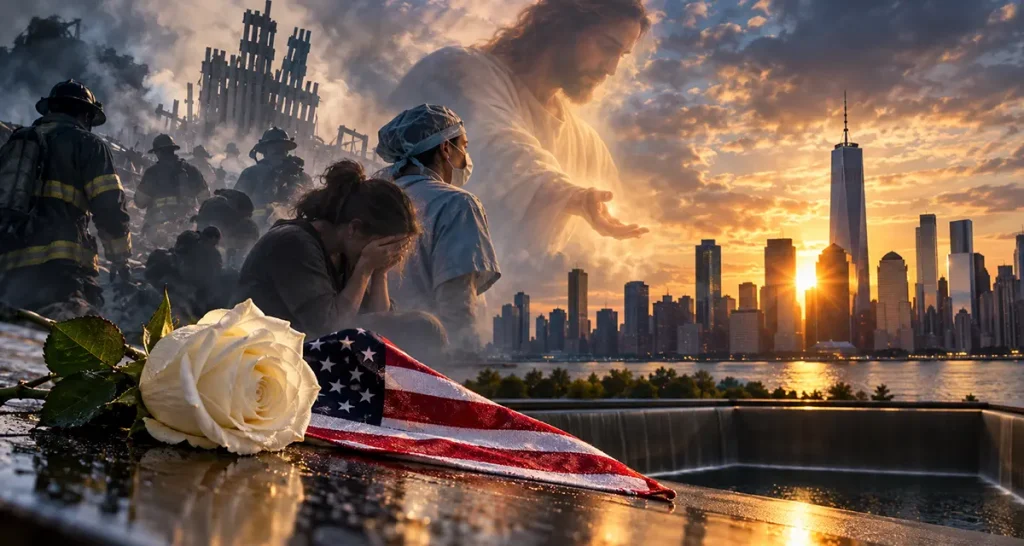
I think this belongs very near the center of our discussion, because the image of God gives us a theological foundation for addressing both persons without morally equating them: the innocent sufferer whose life has been violated, and the attacker who has violated another image-bearer.
That distinction is essential. Imago Dei does not flatten morality. It actually explains why the attack is so grievously evil and, simultaneously, why hatred of the attacker cannot become our final Christian posture.
🕊️ The image of God makes human life sacred
The foundational passage appears immediately after the Flood:
Genesis 9:6
“Whoever sheds man’s blood, by man his blood shall be shed; for in the image of God He made man.”
Notice God’s reasoning. Human life possesses a peculiar sanctity because the human being bears God’s image.
Therefore, murder is not merely the unauthorized termination of a biological organism. Something belonging uniquely to God has been assaulted.
James takes the same truth into ordinary human relationships:
James 3:9
“With it we bless our God and Father, and with it we curse men, who have been made in the similitude of God.”
James sees the contradiction immediately:
How can I honor God while cursing the creature who bears God’s likeness?
That question becomes devastating when applied to religious violence.
Someone may cry God’s name while murdering the person who bears God’s image.
The supposed act of devotion therefore contains a terrible contradiction: claiming zeal for the Creator while deliberately destroying His image-bearer.
💔 For the innocent victim, the image of God means: what happened to you matters
This is where I think imago Dei must first speak.
We should not begin by telling the wounded person, “But remember, your attacker is an image-bearer too.”
That is true, but said too quickly it can become almost cruel.
The first implication is:
You are God’s image-bearer. Therefore what was done to you matters profoundly.
Your murdered husband mattered.
Your daughter mattered.
Your father who ran into the building mattered.
Your body matters.
Your grief matters.
Your stolen years matter.
Your trauma is not an inconvenient obstacle that spirituality requires you to suppress.
When Jesus says:
“Are not five sparrows sold for two copper coins? And not one of them is forgotten before God… Do not fear therefore; you are of more value than many sparrows.” (Luke 12:6–7)
He gives us a profoundly personal vision of divine attention.
The sanctity of life means we are allowed to look directly at the atrocity and say:
This should not have happened.
Indeed, Christianity gives us unusually strong grounds for saying it. Human beings are not disposable material. They belong to God’s creation and bear His image.
That is why the Bible can contain cries such as:
“How long, O LORD? Will You forget me forever?” (Psalm 13:1)
and:
“How long, O Lord, holy and true, until You judge and avenge our blood…?” (Revelation 6:10)
The wounded person is permitted to cry for justice.
🔥 But suffering can produce another danger: hatred
And here Christianity becomes painfully demanding.
The innocent person may say:
“They murdered someone I loved. Why shouldn’t I hate them?”
We should understand that reaction before correcting it. There is an enormous difference between hatred arising in the heart of someone whose family has been murdered and calculated ideological hatred that sends someone out to murder strangers.
They are not morally equivalent.
Nevertheless, Christ does not want the original act of evil to gain another victory by gradually reshaping the victim into the likeness of the hatred that wounded him.
That is why Paul says:
Romans 12:17–21
“Repay no one evil for evil… Beloved, do not avenge yourselves… ‘Vengeance is Mine, I will repay,’ says the Lord… Do not be overcome by evil, but overcome evil with good.”
That final sentence is enormous.
Do not be overcome by evil.
The evil has already taken something from you.
Do not let it take you too.
Forgiveness and enemy-love therefore do not declare that the victim’s life was unimportant. Precisely the opposite: because both justice and the victim matter, judgment can be entrusted to God rather than being transformed into personal hatred.
The Christian does not say:
“There must be no judgment.”
The Christian says:
“Judgment belongs ultimately to Someone more righteous than I am.”
That creates room for grief without vengeance, anger without dehumanization, justice without hatred.
⚔️ Now turn toward the attacker
Here imago Dei becomes almost unbearably ironic.
The attacker believes he is defending God’s honor while killing someone God made in His image.
There is something profoundly disordered there.
God says of humanity:
“Let Us make man in Our image, according to Our likeness.” (Genesis 1:26)
The terrorist effectively says:
“This particular bearer of Your image does not deserve to live, and I claim authority to erase him in Your name.”
That is not merely hatred of another person.
It is an extraordinary presumption concerning God’s ownership of human life.
The attacker has taken three things upon himself:
God’s judgment, God’s timing, and God’s authority over life and death.
And religious language can disguise that presumption as submission.
That is exactly why Jesus’ warning we mentioned earlier is so chilling:
John 16:2–3
“The time is coming that whoever kills you will think that he offers God service. And these things they will do to you because they have not known the Father nor Me.”
“God service.”
That is the distortion in two words.
The person thinks he is giving something to God while destroying someone God created.
😔 Yet the attacker remains an image-bearer too
And now Christianity places us in the uncomfortable position you identified.
Sin terribly corrupts human beings, but it does not make them cease to be human.
James 3:9 is written after the Fall and still describes human beings as made in God’s likeness.
So even the murderer does not become subhuman.
And that matters tremendously because one of the easiest ways human beings prepare themselves to commit atrocities is by mentally stripping their enemies of humanity.
They’re vermin.
They’re animals.
They’re infidels.
They’re contaminants.
They’re the enemy.
Eventually the individual disappears behind the category.
Christian theology refuses to cooperate with that process.
The victim is an image-bearer.
And so is the murderer.
But—and this distinction must remain—
equal human dignity does not mean equal moral innocence.
One image-bearer may horribly violate another image-bearer. God’s image establishes the worth of both persons; it does not erase the moral distinction between victim and perpetrator.
✝️ And then comes Christ—the Image
There is an even deeper Christological dimension.
Paul calls Jesus:
“the image of the invisible God.” (Colossians 1:15)
Human beings are created in God’s image.
Christ is the perfect Image.
And look at what fallen humanity does when the perfect Image appears among us.
We kill Him.
There is Calvary.
The history of humanity’s violence against God’s image reaches its terrible climax when humanity lays hands upon the incarnate Son Himself.
And what does the Image do?
He does not become like His attackers.
1 Peter 2:23
“Who, when He was reviled, did not revile in return; when He suffered, He did not threaten, but committed Himself to Him who judges righteously.”
That verse might be one of the most important for our entire discussion.
Notice the two things held together:
He does not retaliate.
And:
He entrusts Himself to righteous judgment.
Love does not abolish justice.
Love refuses to become evil while waiting for justice.
That is exactly the tension faced by the innocent sufferer.
❤️ And here both image-bearers meet at the Cross
Not as moral equals in the particular crime.
Not as though victimhood and murder were interchangeable.
But as human beings standing before God.
To the wounded image-bearer, Christ says:
Your life has immeasurable value. I see what was done to you. You may bring your grief and cry for justice to Me. Do not allow your enemy’s hatred to reproduce itself inside you. Entrust judgment to Me.
To the violent image-bearer, Christ says:
The person you hate belongs to My creation. You have no authority to erase My image in My name. Repent. Lay down your hatred. You too need mercy.
And astonishingly, to both Christ can say:
I gave Myself for you.
That may be where the sanctity of life reaches its deepest Christian expression.
The Cross prevents me from saying of the victim:
“His life didn’t matter.”
And the Cross prevents me from saying of the murderer:
“His life doesn’t matter.”
But the Cross certainly does not prevent me from saying:
“What the murderer did was evil.”
It gives me the strongest possible grounds for saying all three simultaneously.
And perhaps that gives us a powerful theological framework for the whole 9/11 discussion:
The image of God explains why the innocent must never have been murdered.
The justice of God explains why their blood cries out.
The love of God explains why we must not surrender the murderer to our hatred.
And the Cross explains how God can condemn evil while still seeking the salvation of the evildoer.
That last part is extraordinarily difficult.
But it is precisely what God did with us.
“While we were enemies we were reconciled to God through the death of His Son.” (Romans 5:10)
The Christian answer to an enemy who destroys God’s image-bearers, therefore, cannot be to deny God’s image in him in return.
We condemn his evil. We defend the innocent. We pursue justice. We mourn those he harmed.
And, almost impossibly apart from grace, we pray that the enemy might repent and live.
Because that is the strange, holy victory of Christ: not pretending enemies are innocent, but turning enemies into sons. ❤️✝️