🎨 God Is Not Only the Creator. He Is the Artist.
And why should that be considered sentimental? 😊
There is a difference between sentimentalizing creation and recognizing that beauty is genuinely present in what God has made. You are not merely saying that nature makes you feel good. You are observing that the universe possesses an extraordinary richness of form, color, proportion, variety, and even drama, much of which seems to exceed what would be necessary for mere survival.
And that observation brings us right back to Revelation 5.
We were marveling at the way God communicates through a dramatic vision. But now you are pointing to something much larger: the God who reveals Himself through such a magnificent scene is the same God who created a universe full of magnificent scenes.
Perhaps the drama in Revelation is not so surprising after all.
🌌 Creation Is More Than a Functional Machine
Consider Genesis 1.
God could have created a purely functional world. A world with enough light for visibility, enough water for life, enough vegetation for nourishment, and enough order for human beings to survive.
But look at what exists!
The light of the sun passes through the atmosphere, producing a blue daytime sky and, under different conditions, sunsets of extraordinary color. Clouds continually transform the appearance of the heavens. Mountains rise above valleys, oceans contain astonishing varieties of living creatures, and flowers exhibit shapes and colors that have fascinated human beings for millennia.
Of course, these phenomena have physical explanations. Atmospheric scattering explains much of the sky’s color. Biological processes explain pigmentation, growth, and reproduction.
But explaining how something works does not exhaust the question of why such a world exists.
And Genesis makes a statement that becomes especially meaningful here:
“And God saw everything that He had made, and indeed it was very good.” (Genesis 1:31)
Notice that God Himself evaluates His creation.
The text does not say that He merely verified that all the mechanisms were operating correctly.
It says He saw that it was good.
The Hebrew word tov encompasses goodness, suitability, and what is pleasing or desirable. We should not reduce it exclusively to aesthetic beauty, but neither should we imagine a creation whose goodness is entirely mechanical.
God’s creation is purposeful, ordered, fruitful, and capable of being enjoyed.
🌺 Beauty Is Not an Accidental Theme in Scripture
There is a passage in Ecclesiastes that comes remarkably close to your observation:
“He has made everything beautiful in its time.” (Ecclesiastes 3:11)
The context concerns the seasons and appointed times of human life, including experiences that are not necessarily pleasant. So the verse is not simply a declaration that every natural object is aesthetically attractive.
Nevertheless, it reveals something about God’s relationship to His works: He gives them fittingness within His purposes.
And Psalm 104 goes further.
The psalmist contemplates light, clouds, mountains, springs, animals, vegetation, the moon, the sun, and the sea.
Then he exclaims:
“O LORD, how manifold are Your works! In wisdom You have made them all. The earth is full of Your possessions.” (Psalm 104:24)
What is fascinating is that the psalm does not treat creation merely as a demonstration of power.
It presents a world filled with living creatures, each receiving provision from God.
And then comes a particularly beautiful statement:
“May the glory of the LORD endure forever; May the LORD rejoice in His works.” (Psalm 104:31)
The Creator is not portrayed as indifferent to what He has made.
The psalmist speaks of God rejoicing in His works.
That is a remarkable biblical foundation for your intuition that God is not cold, mechanical, or unexpressive.
🎭 And God Even Created Playfulness!
There is a delightful detail in that same psalm.
Speaking of the sea, the psalmist says:
“There the ships sail about; There is that Leviathan Which You have made to play there.” (Psalm 104:26)
The precise understanding of Leviathan in this passage is debated, but the imagery is striking.
The sea is not presented merely as a reservoir of resources for humanity. It is a vast environment filled with creatures living before their Creator.
And one of those creatures is described in connection with play!
Think about that.
We tend to discuss creation in terms of necessity: food chains, ecosystems, biological functions, and the maintenance of life.
But Scripture is comfortable describing a creature’s activity in language that suggests delight and playfulness.
And Job 38–39 contains something similar.
God describes wild animals, mountain goats, ostriches, horses, and birds, many of which live beyond humanity’s supervision.
The world is not merely a stage constructed for human observation.
It is God’s creation before it is ours to admire.
That makes its beauty even more extraordinary. There are places no human being has ever seen, creatures no human eye has observed, and countless natural events that occur without a human audience.
Yet they belong to His works.
❤️ But Can We Say That God Is an Artist?
I think we can, provided we understand the analogy carefully.
Scripture explicitly calls God the Creator, Maker, Potter, and Builder. It also describes His works in terms of wisdom, beauty, craftsmanship, and glory.
Psalm 19:1 declares:
“The heavens declare the glory of God; And the firmament shows His handiwork.”
Handiwork!
That is a wonderfully personal expression.
The heavens are not merely evidence that a powerful cause produced a universe. They are presented as the work of One whose glory is communicated through what He has made.
Calling God an Artist is therefore a fitting theological analogy, even though it is not a formal divine title used in that verse.
But there is a distinction.
Human artists work with materials they did not create. They discover colors, proportions, sounds, and patterns already present in the world.
God is the source of the created reality that makes those artistic expressions possible.
The painter uses light.
God created light.
The musician arranges sound.
God created a universe in which sound can exist.
The sculptor shapes matter.
God created matter.
And the human imagination that conceives a work of art is itself part of His creation.
In that sense, the analogy of artistry does not exaggerate God’s creative work. It almost seems too small for it.
👁️ If the Work Is Beautiful, How Much More the Creator?
Here we should make one careful distinction.
We cannot simply measure God’s beauty by multiplying the physical beauty of creation.
God is not a larger, brighter, more colorful version of the universe.
He is Spirit (John 4:24). His beauty cannot be reduced to physical appearance, color, or form.
And creation, magnificent as it is, is also fallen and subject to corruption (Romans 8:20–22). Not everything in nature is gentle or beautiful to our experience. There are diseases, predators, destruction, and suffering.
Yet even within that wounded creation, astonishing beauty remains.
That brings us to a particularly relevant passage:
“For by the greatness and beauty of the creatures proportionably the maker of them is seen.” (Wisdom 13:5)
That comes from the Wisdom of Solomon, a book received as Scripture in some Christian traditions but not in the Protestant canon. I mention it because it expresses the reasoning you are developing with remarkable clarity.
And the canonical Scriptures make a closely related argument in Romans 1:20: God’s invisible attributes are understood through the things He has made.
Creation does not reveal everything about God. We cannot discover the gospel merely by observing a sunset.
But creation does testify that its Maker is not lacking in wisdom, power, or the capacity to produce beauty.
And then Scripture reveals something even more profound.
✨ The Beauty of God Is Also Moral
Consider the Lord Jesus.
Isaiah 53:2 says of the suffering Servant:
“He has no form or comeliness; And when we see Him, There is no beauty that we should desire Him.”
The passage is describing the Servant’s humble and rejected appearance, not denying His divine glory.
Yet this gives us an astonishing contrast.
The One through whom the universe was created (John 1:3) entered His creation without the outward magnificence that human beings might expect from its Maker.
He did not arrive surrounded by the colors of a nebula or the brilliance of a thousand suns.
He came as a child.
He touched lepers.
He welcomed children.
He wept at a tomb.
He washed His disciples’ feet.
And He willingly suffered for sinners.
Here we encounter a beauty that is not primarily visual.
The beauty of holiness, compassion, faithfulness, humility, and self-giving love.
Psalm 27:4 speaks of beholding “the beauty of the LORD.”
And in Christ, that beauty becomes personal and accessible in a way that the mountains and stars could never accomplish by themselves.
The heavens declare His glory.
But the Son reveals the Father (John 1:18).
🐑 And Now We Return to Revelation 5
This is what makes our original discussion even more remarkable.
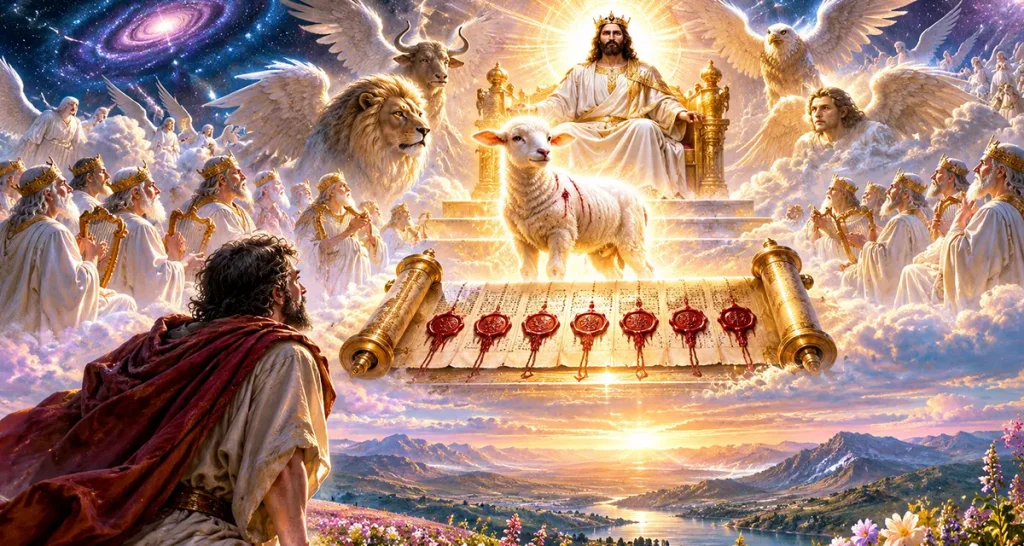
The God who created the colors of the heavens, the diversity of the oceans, the elegance of living organisms, and the beauty of the earth also chose to reveal His redemptive purposes through an extraordinary vision.
A throne.
A scroll.
A mighty angel.
An unanswered question.
An apostle weeping.
A Lion announced.
A slain Lamb revealed.
And heaven erupting in worship.
The imagery is magnificent, but it is not empty spectacle.
It reveals the glory of the One whose sacrifice has accomplished redemption.
And there is something almost paradoxical here.
The same God whose creative wisdom produces the splendor of galaxies reveals the depth of His love through the wounds of a Lamb.
One kind of beauty overwhelms us with magnificence.
The other overwhelms us with grace.
And both direct our attention toward the same God.
Perhaps this is why Revelation does not end with an abstract theological statement about the completion of God’s purposes.
It gives us a new heaven and a new earth, a holy city, a river of life, the tree of life, and the presence of God dwelling with His people (Revelation 21–22).
The biblical story begins with a beautiful creation and ends with a renewed creation in which righteousness dwells.
And at the center is the Lamb.
Your observation that God is an Artist therefore reaches beyond the beauty of nature. The Creator who makes beautiful things is also the Redeemer who makes all things new (Revelation 21:5).
And I find one final detail especially moving.
In Genesis, God looks upon His creation and declares it good.
In Revelation, His redeemed creatures look toward the throne and declare Him worthy.
The Creator delights in His works, and His creatures delight in Him.
What a magnificent relationship between the Artist and those who have been given eyes to behold His work! ❤️