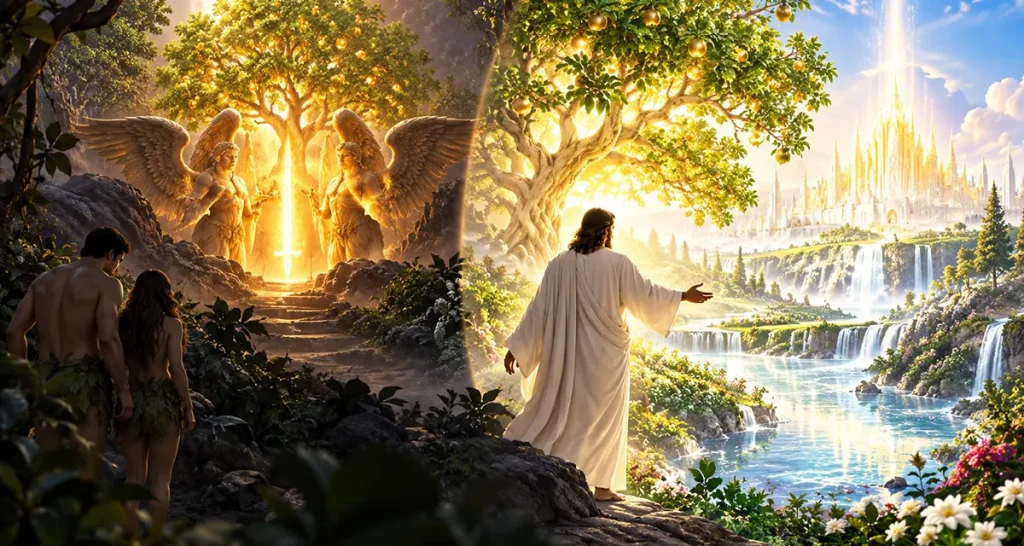
You have identified a genuine tension in Revelation 22:2, and it becomes even more striking when we read the verse alongside the promises immediately surrounding it.
John writes:
“The leaves of the tree were for the healing of the nations.” (Revelation 22:2)
But only a few verses earlier, he has already declared:
“And God will wipe away every tear from their eyes; there shall be no more death, nor sorrow, nor crying. There shall be no more pain, for the former things have passed away.” (Revelation 21:4)
And immediately after mentioning the healing leaves, John says:
“And there shall be no more curse.” (Revelation 22:3)
So what exactly remains to be healed?
If Christ has already accomplished redemption, if His people have been raised incorruptible, and if the curse itself has disappeared, it would seem contradictory to imagine the nations still suffering from illnesses that require treatment.
I think the answer lies partly in what John means by healing, but also in how we understand the tree of life in the completed New Creation.
🌿 1. Healing does not necessarily imply the continuing presence of disease
The Greek word translated healing in Revelation 22:2 is θεραπεία (therapeia).
It is related to the English word therapy, and its range of meaning includes care, treatment, and healing. In other contexts, related Greek usage can also concern service or attendance.
In Revelation 22:2, however, the natural meaning is healing. We should not simply replace it with “service” to make the theological difficulty disappear.
But there is an important distinction between healing as the removal of an existing disease and healing as the establishment or expression of complete well-being.
Consider the difference between a physician curing a sick person and the continuing condition of health that follows.
We ordinarily associate healing with a disease that must first exist. Yet the result of healing is precisely the absence of disease.
Could John’s language be describing the completed restoration of the nations rather than a perpetual medical process?
I think that is a strong possibility.
In that reading, the leaves do not imply that diseases continue to arise in eternity. They represent the healing and restoration that God has accomplished.
The nations are no longer wounded, divided, corrupted, or subject to the curse.
They have been made whole.
And the tree stands as a visible testimony to that wholeness.
However, we must recognize that Revelation does not explicitly explain whether the leaves symbolize accomplished restoration or serve some continuing positive function in the life of the nations.
We should not claim certainty where John has left the mechanism unexplained.
🌍 2. Why does John say “nations” rather than simply “people”?
This is especially interesting.
John does not say that the leaves are for the healing of individual believers.
He says they are for the healing of the nations.
The Greek word is ethnōn, from ethnos, commonly referring to nations or peoples.
And the nations have already appeared in Revelation 21:
“And the nations of those who are saved shall walk in its light, and the kings of the earth bring their glory and honor into it.” (Revelation 21:24)
Notice that these are not nations continuing in rebellion against God.
They walk in the light of the New Jerusalem.
And Revelation 21:27 explicitly excludes everything that defiles, causes an abomination, or makes a lie.
Only those written in the Lamb’s Book of Life enter.
Therefore, when John speaks of the healing of the nations, we should not imagine sinful political societies continuing to wage wars, spread disease, and oppress one another while receiving periodic treatments from the tree of life.
That would contradict the surrounding description.
Instead, the expression may point to something much larger than individual bodily health.
Throughout human history, the nations have been marked by violence, idolatry, injustice, alienation, and death.
Even Israel, the nation chosen to bear God’s revelation, experienced these realities.
But Revelation presents a final order in which the nations walk together in God’s light.
The divisions produced by sin no longer govern their relationships.
Their healing is complete.
And this connects beautifully with Revelation 7:9, where John sees a multitude from every nation, tribe, people, and tongue standing before the throne and before the Lamb.
The nations are not erased from God’s redemptive purpose.
Their peoples are gathered into worship.
The healing of the nations may therefore describe the complete restoration of humanity in its communal existence, not merely the absence of physical illness.
There is a distinction worth preserving here: Scripture does not explicitly tell us that every historical nation-state continues as a separate political institution in eternity. The language of nations can communicate the redeemed diversity of humanity without requiring us to imagine the continuation of present governmental structures.
🌳 3. The tree of life is not presented as an emergency medical facility
Here we return to our earlier discussion about the tree of life in Eden.
In Genesis 3, God prevented Adam from eating from the tree and living forever.
In Revelation 22, the tree is accessible, bearing fruit continually, with leaves for the healing of the nations.
But consider the condition of the redeemed.
Paul writes:
“For this corruptible must put on incorruption, and this mortal must put on immortality.” (1 Corinthians 15:53)
The resurrection does not merely extend mortal life indefinitely.
It transforms the condition of the redeemed.
And Paul declares:
“So when this corruptible has put on incorruption, and this mortal has put on immortality, then shall be brought to pass the saying that is written: ‘Death is swallowed up in victory.’” (1 Corinthians 15:54)
If the redeemed have already put on immortality, it would be strange to suppose that their immortality depends upon repeated medical intervention.
Their life is secure in Christ.
The tree cannot be a backup system designed to prevent God’s promise from failing. 😄
Neither can the leaves possess some independent power necessary to maintain what Christ has already accomplished.
That would return us to the difficulty you raised about Genesis 3:22.
A created tree cannot be the ultimate guarantor of everlasting life.
God alone sustains His creation, and the eternal life of His children is grounded in Christ.
Therefore, the tree’s presence in Revelation should be understood within the abundance and completeness of God’s provision, not as evidence of deficiencies in redemption.
📖 4. Ezekiel helps explain why John uses this imagery
There is a particularly important Old Testament background to Revelation 22.
In Ezekiel 47, the prophet sees a river flowing from the temple, bringing life wherever it goes.
Along its banks grow trees whose leaves do not wither and whose fruit does not fail.
God says:
“Their fruit will be for food, and their leaves for medicine.” (Ezekiel 47:12)
Does that sound familiar?
John’s vision of the river of life and the tree of life draws heavily upon Ezekiel’s imagery.
But there is an important difference between the two visions.
Ezekiel describes waters bringing healing to a devastated landscape, including the healing of waters associated with the Dead Sea (Ezekiel 47:8–9).
The vision portrays God’s life-giving presence transforming what had been barren and lifeless.
John takes up that imagery in Revelation, but places it within the completed New Creation.
And in Revelation, the curse is gone.
The river proceeds from the throne of God and of the Lamb.
The tree of life flourishes.
The nations are healed.
We should therefore consider the possibility that John is using the prophetic language of healing to communicate the final accomplishment of what Ezekiel anticipated.
Ezekiel sees life overcoming devastation. John sees a creation in which devastation has been overcome.
This does not require every detail of Ezekiel’s vision to function identically in Revelation. John’s vision develops the imagery within the greater revelation of the Lamb and the New Jerusalem.
✨ 5. Does “healing” describe an ongoing process or an accomplished condition?
Here is the central interpretive difficulty.
Revelation 22:2 says the leaves are for the healing of the nations.
The wording expresses their purpose or function.
It does not explicitly say that the nations are continually becoming sick and then being cured.
Nor does it explicitly say that the leaves are merely commemorative symbols of healing already completed.
Both conclusions go beyond the wording if stated absolutely.
But the surrounding context gives us strong reasons to reject the idea of recurring sickness.
Revelation 21:4 says there will be no more pain.
Revelation 22:3 says there will be no more curse.
And Revelation 21:27 excludes all defilement.
These declarations govern how we understand the healing imagery.
Whatever the leaves accomplish or signify, they cannot reasonably be understood as remedies for a continuing cycle of disease, suffering, and decay in the completed New Creation.
That would make the final restoration less complete than Scripture declares it to be.
One possibility is that the leaves signify the perpetual fullness of the health and peace that God has established.
Another is that John describes the final restoration of the nations through an image of healing, without intending us to construct a chronological sequence in which redeemed nations first enter the New Creation still diseased and only afterward become healthy.
I find the second possibility particularly compelling because Revelation frequently presents realities through overlapping visions rather than a strictly sequential description of every event.
The healing imagery can portray the completed work of restoration even while the vision depicts the means and blessings associated with that restoration.
❤️ 6. The New Creation is not a place where Christ’s redemption needs supplementation
This, I think, is the theological concern at the center of your question.
If the nations still need healing because they remain afflicted, what has become of Christ’s completed work?
And if the redeemed still depend upon a created tree to avoid illness or death, what does that imply about the eternal life God has already granted them?
We must not explain Revelation 22 in a way that diminishes Revelation 21.
The promise is not that God will continually treat our suffering.
The promise is that suffering itself will cease.
Not that God will continually rescue us from death.
Death itself will be no more.
Not that the curse will become manageable.
The curse will be removed.
The tree of life belongs to that completed reality.
Its leaves do not compete with Christ’s work. They appear within the world made new through His victory.
And here is something especially beautiful.
In Revelation 22:1, the river of life proceeds from the throne of God and of the Lamb.
The life-giving imagery is explicitly connected to God’s sovereign presence and the Lamb’s reign.
Nothing suggests that life originates independently in the tree.
The river, the tree, the fruit, and the leaves all belong to the abundance of life under God.
The center of the vision is not botanical immortality.
It is the throne of God and of the Lamb.
🌅 7. Perhaps “healing” is the language of a world that remembers what it has overcome
There is one final thought, though I would present it as a theological reflection rather than something Revelation explicitly states.
The word healing carries meaning because something was once broken.
The nations of the New Creation have a history.
Humanity has known rebellion, violence, disease, oppression, and death.
But the final vision does not erase the significance of redemption.
It presents a world in which everything that once corrupted human life has been overcome.
Perhaps the leaves of the tree of life communicate that reality: the nations that once suffered under the curse now enjoy complete restoration.
Not because they remain sick.
But because they have been healed.
And this distinction is important.
A healed person does not have to remain wounded in order for the healing to be real.
Indeed, the absence of the wound is evidence of the healing.
In the same way, the nations do not need to remain afflicted for Revelation’s language to be meaningful.
Their restored condition is the testimony.
Yet the tree of life remains, bearing fruit continually.
God’s provision is not exhausted.
His generosity does not diminish.
And His redeemed creation does not return to the conditions from which it was delivered.
So I would resist interpreting Revelation 22:2 as teaching that illness survives into eternity. The immediate context strongly opposes that reading.
Rather, John presents the healing of the nations as part of the fullness of the New Creation, drawing upon the prophetic imagery of Ezekiel and the tree of life in Genesis.
There is no contradiction between the nations being healed and the declaration that there will be no more pain, sickness, or curse.
The healing belongs to the accomplishment of that very promise.
And perhaps the most remarkable detail is that the tree of life, once inaccessible to fallen humanity, now appears in a city whose gates are never shut (Revelation 21:25).
The tree is no longer guarded against the redeemed.
The nations are no longer alienated.
The curse is no longer present.
And the Lamb, who accomplished their redemption, reigns forever.
The leaves are not evidence that redemption remains unfinished. They belong to the vision of a redemption so complete that nothing remains to be cursed.