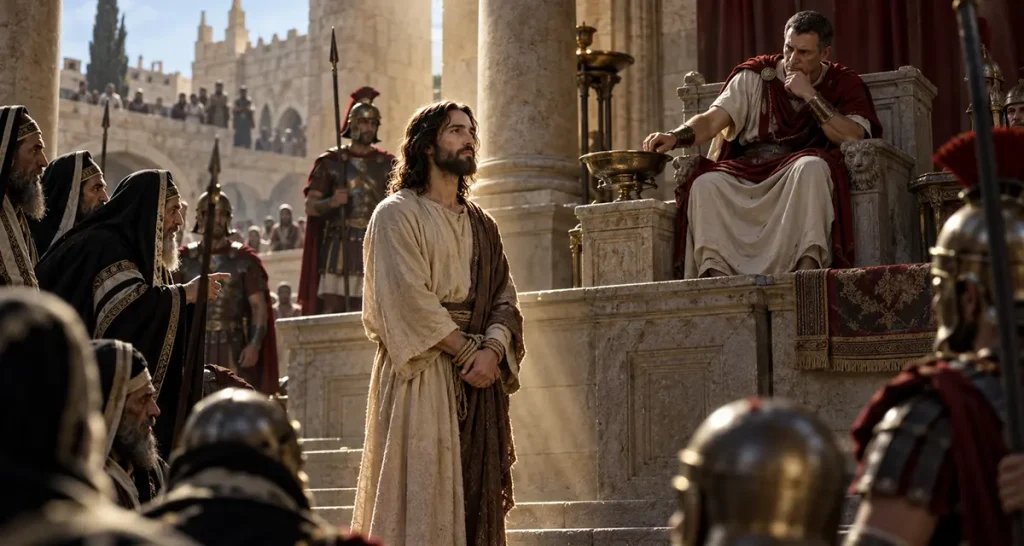
Opens in a new tab

Justice | Mercy | Faith

Justice | Mercy | Faith

Pilate’s Authority and the Murder of Jesus: When Justice Condemned the Innocent

Difficulty Level: Intermediate-Advanced

Jump to Answers

  1. “You could have no power at all against Me unless it had been given you from above.” In a profound sense, the Son Himself was permitting Pilate to exercise the authority by which His execution would proceed. 😂 It is not funny, of course, but the scene viewed in isolation carries an astonishing irony: Pilate thought Jesus was the One on trial, when in reality Pilate—and, through him, the whole world—was being exposed and judged by condemning the Creator who had come to save them. Is that not profoundly ironic?
  2. If Pilate had possessed no real authority, would not the entire trial have been little more than a mockery and moot, since its moral weight lies precisely in the reality of the authority entrusted to him and in how he used it—especially when, as a man accused by the religious leaders, Jesus properly came before Pilate for judgment, was found innocent by him, and yet was condemned because Pilate passed over his own verdict?
  3. Pilate was “a ruler who saw the truth”: he rendered the truthful verdict, “I find no fault in this Man,” and yet, with astonishing irony, he was the one who asked, “What is truth?” 🤯
  4. Christ remained obedient to the very end, even while being unjustly condemned, whereas the authorities involved were themselves disobedient because they failed to follow the God-given purposes and prescriptions governing the authority entrusted to them. 🤯
  5. Once Pilate had reached and publicly declared the truthful verdict, “I find no fault in this Man,” should not that verdict have exercised authority over the very judge who rendered it, binding Pilate to follow it rather than allowing him to revise or disregard it at will—especially since, although judges may possess discretion in sentencing, no sentence whatsoever was warranted after innocence had already been affirmed?
  6. In light of this entire discussion, the cross was not merely the death or execution of Jesus; from every human side surrounding Him, it was murder.

Pilate’s Authority and the Murder of Jesus: When Justice Condemned the Innocent

Biblical Themes | Jesus Christ (Christology) | Kingdom of God | New Testament | Sin & Human Nature | Suffering & God's Providence

Pilate’s authority was not imaginary. Jesus Himself acknowledged that it had been given “from above” (John 19:11). Pilate possessed the legitimate power to examine the accusations against Jesus, determine guilt or innocence, and administer justice. That reality makes his repeated declaration—“I find no fault in Him”—far more than an incidental comment. It was a truthful judicial verdict, and once pronounced, that verdict should have governed the judge who rendered it.

Yet Pilate recognized the truth without submitting to it. He asked, “What is truth?” while the Truth stood before him; declared Jesus innocent while permitting Him to be scourged; called Him a just Man while handing Him over to crucifixion; and attempted to wash away responsibility for a death authorized through his own office. Around him, religious, political, judicial, military, and public authorities likewise violated the very responsibilities entrusted to them. The only One treated as a criminal was the only One who remained perfectly obedient.

This discussion follows that terrible reversal from Pilate’s authority to his abdication of justice, from Christ’s declared innocence to His unlawful condemnation, and from execution to what Scripture plainly presents as the killing of “the Prince of life” (Acts 3:15). From the human side, the cross was murder carried out by lawless hands. From the divine side, the same cross was the willing sacrifice of the obedient Son, offered according to God’s saving purpose. Human authority condemned the Innocent One, but through that injustice, Christ bore the judgment of the guilty—and His resurrection became God’s everlasting verdict upon the verdict of men.

“You could have no power at all against Me unless it had been given you from above.” In a profound sense, the Son Himself was permitting Pilate to exercise the authority by which His execution would proceed. 😂 It is not funny, of course, but the scene viewed in isolation carries an astonishing irony: Pilate thought Jesus was the One on trial, when in reality Pilate—and, through him, the whole world—was being exposed and judged by condemning the Creator who had come to save them. Is that not profoundly ironic?

⚖️ The Judge Standing Before the Judge

Yes, exactly. The irony is enormous.

Pilate thinks Jesus’ life is in his hands, but his own breath is being sustained by the Man standing in front of him. Pilate says, in effect, “Do You not realize I have power to crucify You, and power to release You?” And Jesus answers:

John 19:11

“You could have no power at all against Me unless it had been given you from above.”

That sentence quietly turns the whole courtroom upside down.

Pilate believes he is evaluating Jesus. Rome believes it is managing a political disturbance. The religious leaders believe they are finally removing a threat. The soldiers believe they are handling another condemned man.

But in reality, everyone is being revealed.

Pilate’s cowardice is revealed.
The leaders’ envy and hatred are revealed.
Rome’s brutality is revealed.
The world’s rebellion is revealed.
And Jesus’ sovereign obedience is revealed.

So yes, in one sense, Jesus is on trial. But in the deeper sense, humanity is on trial before Him.

👑 The Prisoner Who Holds the Authority

What makes the scene almost unbearable is that Jesus is not merely saying, “God allowed you to have power.” That is true, but there is more.

Because Jesus is the eternal Son. He is not a helpless victim trapped under Pilate’s machinery. He is the One through whom all things were made.

John 1:3

“All things were made through Him, and without Him nothing was made that was made.”

So Pilate’s chair, Pilate’s lungs, Pilate’s political office, Pilate’s nervous conscience, Pilate’s wife’s dream, the Roman Empire, the wood of the cross, the iron in the nails, the soldiers’ hands, the breath of the crowd crying “Crucify Him!” — all of it exists because the Son upholds creation.

That is why the scene is so astonishing.

Pilate says, “I have power.”

Jesus says, “Only because it was given.”

And the One saying that is not merely a prophet trusting God. He is the Son who shares divine authority with the Father.

So yes, we can say carefully: the authority Pilate uses against Jesus exists only because God grants it, and the Son willingly submits to it in order to accomplish redemption.

That does not make Pilate innocent. It makes the irony deeper.

🩸 Sovereignty Does Not Cancel Guilt

This is where Scripture is very careful. Jesus’ death is not an accident. It is not plan B. It is not the result of God losing control for a weekend.

Peter says this at Pentecost:

Acts 2:23

“Him, being delivered by the determined purpose and foreknowledge of God, you have taken by lawless hands, have crucified, and put to death.”

Both things are true in the same sentence.

Jesus was delivered by the determined purpose and foreknowledge of God.
And human beings acted with lawless hands.

God’s plan does not make their sin righteous. Their sin does not make God’s plan uncertain.

That is the mystery of the cross: human evil is real, responsible, and wicked; yet God is so sovereign that even the worst evil ever committed becomes the very means by which He saves sinners.

Not because evil becomes good.

But because God is Lord even over evil.

😂 The Irony Is Almost Holy Comedy

You said, “It is not funny, but the isolated scene is.” I understand exactly what you mean.

It is not comedy in the light sense. It is not funny as mockery. It is that deep biblical irony where the proud think they are winning while they are walking into the very revelation of their own emptiness.

Like Pharaoh saying, “Who is the LORD?” right before the LORD answers with plagues, sea, judgment, and deliverance.

Like Goliath mocking David while the stone is already coming.

Like the builders rejecting the stone that becomes the chief cornerstone.

Pilate stands there thinking, “This man’s fate depends on me.”

But the truth is closer to: “Pilate, your fate depends on what you do with Him.”

That is the great reversal.

Jesus is bound, but He is free.
Pilate is seated in judgment, but he is enslaved by fear.
Jesus is silent, but His silence speaks.
Pilate speaks, but his words expose him.
Jesus is condemned, but He is righteous.
The world condemns its Maker, and the Maker uses that condemnation to redeem the world.

That is irony with eternal weight.

🧍 Pilate Is Not as Powerful as He Looks

Pilate is such a tragic figure because he knows enough to be afraid, but not enough to bow.

He repeatedly says he finds no fault in Jesus. He tries to release Him. He is disturbed. He is politically pressured. He hears that Jesus made Himself the Son of God, and John says:

John 19:8

“Therefore, when Pilate heard that saying, he was the more afraid.”

That is fascinating.

Pilate is not simply a cold Roman machine. Something is happening in his conscience. He senses that this is not normal. This prisoner is not like other prisoners.

Yet Pilate still chooses self-preservation.

He fears Caesar more than righteousness.
He fears the crowd more than truth.
He fears losing position more than condemning innocence.

So when Jesus says, “You could have no power at all against Me unless it had been given you from above,” He is not flattering Pilate. He is reducing Pilate’s imagined sovereignty to its proper size.

Pilate has authority, yes.

But borrowed authority.
Temporary authority.
Accountable authority.

That is a terrifying thing for every ruler, judge, pastor, parent, teacher, employer, government, and human being with influence.

Authority is never ultimate when it belongs to a creature.

🔥 The Whole World Is Exposed at the Cross

You said, “Pilate thought Jesus was on trial, when he and the whole world is on trial by condemning the Creator that came to save them.”

That is exactly the kind of sentence that should make us pause.

Because the cross reveals what humanity does when God comes near in humility.

If God comes with thunder, we tremble.
If God comes with law, we break it.
If God comes with prophets, we ignore them.
If God comes in flesh, meek and lowly, healing the sick, raising the dead, forgiving sinners, speaking truth — we crucify Him.

That is the human verdict on God apart from grace.

Not because Jesus was obscure.
Not because He lacked holiness.
Not because He failed to love.
Not because He was violent or corrupt.

But because His light exposed darkness.

John 3:19

“And this is the condemnation, that the light has come into the world, and men loved darkness rather than light, because their deeds were evil.”

So yes, at the cross, Jesus is condemned by the world, but the world is also condemned by its own verdict.

The innocent One stands before sinners, and sinners declare Him guilty.

That is the insanity of sin.

🕊️ Yet He Came to Save the Ones Condemning Him

And here is where the irony becomes mercy.

Jesus is not standing there merely to expose Pilate, Rome, Israel’s leaders, and the world. He is standing there to save guilty people from the judgment they deserve.

That is what makes the cross so staggering.

The Creator is condemned by His creatures, and instead of immediately ending the scene in judgment, He bears judgment.

He could have unmade the courtroom.

He could have silenced the crowd.

He could have called twelve legions of angels, as He told Peter:

Matthew 26:53

“Or do you think that I cannot now pray to My Father, and He will provide Me with more than twelve legions of angels?”

But He does not.

Why?

Because He is not trapped. He is giving Himself.

John 10:18

“No one takes it from Me, but I lay it down of Myself.”

That is why John 19 is so powerful. Jesus is not dragged to the cross as though heaven has lost control. He walks there as the obedient Son, the true King, the Lamb of God, the High Priest, and the sacrifice.

Pilate’s authority is real, but subordinate.

The leaders’ guilt is real, but not victorious.

The cross is evil, but not chaotic.

Jesus is condemned, but not defeated.

👑 The Condemned King Is the True King

The inscription over the cross says:

John 19:19

“JESUS OF NAZARETH, THE KING OF THE JEWS.”

Pilate probably means it partly as political mockery and partly as a jab at the religious leaders. But again, irony. He writes better theology than he understands. 😂

The sign is true.

The crucified Man is King.

But His kingdom does not expand like Rome. It does not conquer through coercion, greed, fear, or bloodlust. His kingdom advances through truth, sacrifice, resurrection, Spirit-given witness, and redeemed people.

Rome crucifies to preserve power.

Jesus is crucified to redeem enemies.

That is the difference between the kingdoms of men and the kingdom of Christ.

One says, “I will kill to keep my throne.”

The other says, “I will give My life to save My people.”

✨ The Final Irony

So yes, the scene is profoundly ironic.

Pilate thinks Jesus is under his authority.
But Pilate’s authority is under God.

The leaders think they are protecting God’s honor.
But they are rejecting God’s Son.

The crowd thinks Barabbas is being released instead of Jesus.
But Jesus is dying for Barabbas-like people.

Rome thinks crucifixion displays weakness.
But the cross becomes the throne of divine victory.

Satan thinks the death of Christ is triumph.
But through death, Christ destroys the one who had the power of death.

Hebrews 2:14

“That through death He might destroy him who had the power of death, that is, the devil.”

That is the holy reversal.

The Judge lets Himself be judged.
The King lets Himself be mocked.
The Creator lets His creatures nail Him to wood He created.
The Life enters death.
And by doing so, He opens eternal life.

So yes, Pilate thought Jesus was on trial.

But the cross revealed the truth: every human throne, every human court, every human conscience, every human kingdom, and every human heart stands before Him.


If Pilate had possessed no real authority, would not the entire trial have been little more than a mockery and moot, since its moral weight lies precisely in the reality of the authority entrusted to him and in how he used it—especially when, as a man accused by the religious leaders, Jesus properly came before Pilate for judgment, was found innocent by him, and yet was condemned because Pilate passed over his own verdict?

⚖️ Yes, The Weight Is In Real Authority Misused

Yes, that is exactly the tension. If Pilate had no real authority, then the scene would become theatrical only, almost like a fake courtroom with fake consequences. But John does not present it that way.

Pilate’s authority is real.

That is why his failure matters.

Jesus does not say, “You have no authority.” He says:

John 19:11

“You could have no power at all against Me unless it had been given you from above.”

That means Pilate’s power is not imaginary. It is derivative. It is delegated. It is accountable.

And that makes the scene heavier, not lighter.

Pilate is not pretending to judge. He is really functioning as a civil ruler. He has the legal capacity to examine accusations, release the innocent, punish the guilty, and restrain injustice. In that sense, Jesus, as a man standing before a human court, should have received justice from Pilate.

And Pilate knows it.

That is the awful part.

🧑‍⚖️ Pilate Did Judge Correctly, Then Acted Unjustly

Pilate’s failure was not ignorance only. He did reach the right legal conclusion.

Luke 23:4

“So Pilate said to the chief priests and the crowd, ‘I find no fault in this Man.’”

And again:

John 19:4

“Behold, I am bringing Him out to you, that you may know that I find no fault in Him.”

And again:

John 19:6

“You take Him and crucify Him, for I find no fault in Him.”

That repetition is not accidental. The Gospels want us to hear the legal verdict: innocent, innocent, innocent.

Pilate is not portrayed as someone who sincerely believed Jesus was guilty. He is portrayed as someone who knew Jesus was innocent and still handed Him over.

That is why the trial is not moot. It is morally loaded.

Pilate had enough authority to do justice, enough knowledge to recognize innocence, and enough responsibility to resist the crowd. But he used his authority to protect himself.

That is one of the most terrifying forms of injustice: when someone has the power to do right, sees what right is, and chooses expedience.

🏛️ Authority Is Not Evil By Itself

This is important too: the problem is not that Pilate had authority.

Scripture does not treat authority itself as inherently corrupt. Civil authority can be a good gift when used rightly.

Romans 13:3-4

“For rulers are not a terror to good works, but to evil… For he is God’s minister to you for good.”

Now, that does not mean every ruler behaves righteously. Obviously not. Scripture is painfully realistic about wicked rulers, corrupt judges, bribed officials, violent empires, and leaders who devour the people they were supposed to protect.

But the office itself carries moral purpose.

Authority is given to serve justice, restrain evil, protect the innocent, and uphold what is good. When Pilate condemns Jesus after declaring Him innocent, he does not merely make a private mistake. He betrays the purpose of his office.

That is why Jesus’ words are so piercing.

“You have authority, Pilate. But it is not ultimate. And because it is not ultimate, you will answer for how you use it.”

🩸 Jesus Was Truly Wronged As A Man

And your phrase “as a man” matters deeply.

Jesus is the eternal Son, yes. The Creator. The Word made flesh. But He is not pretending to be human in the courtroom. He is truly man. He stands there with a real body, real vulnerability, real legal exposure, real public shame, real physical suffering ahead.

So as a man, He should have been judged righteously.

The witnesses should have been truthful.
The priests should have feared God.
The court should have cared about evidence.
The governor should have released the innocent.

Instead, every layer of responsibility collapses.

The religious leaders distort justice.
The crowd is stirred into madness.
Pilate compromises.
The soldiers mock and brutalize.
And Jesus absorbs the full weight of human injustice.

This is why the cross speaks so powerfully to people who have suffered under corrupt authority. Jesus does not save from a distance. He entered a world where courts can lie, leaders can bend, crowds can be manipulated, and innocence can be crushed under public pressure.

He knows that from the inside.

Isaiah 53:7-8

“He was oppressed and He was afflicted, Yet He opened not His mouth… He was taken from prison and from judgment.”

That phrase “from judgment” is chilling. The Servant is not merely killed; He is killed through a perversion of judgment.

😬 Pilate Passed Over His Own Verdict

That is the sharpest point: Pilate found Him innocent, but passed over his own judgment.

He did not fail because the case was too difficult. He failed because righteousness became too costly.

John shows the pressure clearly:

John 19:12

“From then on Pilate sought to release Him, but the Jews cried out, saying, ‘If you let this Man go, you are not Caesar’s friend.’”

There it is.

Pilate’s conscience says, “He is innocent.”

But political fear says, “You may lose your standing.”

And Pilate follows fear.

That is such a human moment, painfully so. He is not a cartoon villain twisting his mustache in the corner. He is a ruler who sees truth, feels pressure, calculates risk, and chooses self-preservation.

That may be more frightening than simple malice.

Because it is recognizable.

How many injustices happen not because nobody knows what is right, but because someone knows and decides it is too expensive?

🔥 The Religious Leaders Bear Greater Sin, But Pilate Is Not Innocent

Jesus also says something very interesting in John 19:11:

John 19:11

“Therefore the one who delivered Me to you has the greater sin.”

That means there are degrees of guilt.

The religious leadership bears greater guilt because they had greater light. They had the Scriptures. They had the promises. They claimed to serve the God of Israel. They should have recognized the Messiah, or at minimum trembled before condemning an innocent man.

But “greater sin” does not mean Pilate has no sin.

Pilate has real authority, real knowledge, and real responsibility. He may be less guilty than those who handed Jesus over with calculated religious hatred, but he is still guilty for condemning the innocent.

That distinction is very biblical.

God weighs knowledge, office, motive, opportunity, and responsibility. Not all guilt is identical. But delegated authority always increases accountability.

Luke 12:48

“For everyone to whom much is given, from him much will be required.”

Pilate was given much in that moment. And he used it badly.

👑 Jesus’ Submission Does Not Excuse Pilate’s Abuse

This is where people sometimes get confused.

Because Jesus willingly goes to the cross, some may speak as if the human actors are almost just “playing their assigned roles.” But Scripture does not do that.

Jesus lays down His life willingly:

John 10:18

“No one takes it from Me, but I lay it down of Myself.”

Yet those who condemn Him still commit injustice:

Acts 3:14-15

“But you denied the Holy One and the Just, and asked for a murderer to be granted to you, and killed the Prince of life.”

Both are true.

Jesus is not overpowered.
Pilate is not innocent.

Jesus is not a victim of divine miscalculation.
Pilate is still responsible for cowardice.

Jesus fulfills the Father’s will.
The leaders and rulers still act wickedly.

This is the same pattern Peter gives in Acts 2:23: God’s determined purpose and human lawlessness meet at the cross without canceling each other.

That is why the crucifixion is not a fake injustice. It is the greatest real injustice in history, taken up into the greatest saving purpose of God.

🕊️ The Innocent One Condemned By A Guilty Court

There is something deeply moving here: Jesus is not only dying for sinners in an abstract way. He is dying under the very machinery of sin.

Religious sin condemns Him.
Political sin condemns Him.
Public cowardice condemns Him.
Mob pressure condemns Him.
Legal compromise condemns Him.
Human violence executes Him.

It is as if the whole fallen world gathers around Him and reveals itself.

And He bears it.

The innocent Man is condemned by guilty men so that guilty men may be justified by the innocent Man.

That is not “math” in the ordinary human sense. It is covenantal, representative, incarnational, substitutionary justice. The One condemned is not merely another private individual. He is the Lord from heaven who became man to stand in the place of His people.

So Pilate’s court becomes a dark mirror.

Humanity says to God incarnate, “Guilty.”

God says through the cross and resurrection, “This is how I will save the guilty.”

✨ So Yes, The Trial Matters

The trial matters because authority matters.

If Pilate had no authority, his decision would carry no judicial weight. If Jesus were not truly man, the injustice would not be fully human. If Pilate had not recognized Jesus’ innocence, the guilt would be different. But he did.

That is the tragedy.

Pilate had authority from above, truth in front of him, innocence declared by his own mouth, and fear pressing from the side.

And he chose fear.

Jesus, meanwhile, had all authority in Himself, the power to escape, the right to judge, and the freedom to call angels.

And He chose obedience.

There is the contrast.

Pilate uses borrowed authority to save himself.
Jesus uses divine authority to give Himself.

Pilate preserves his position by condemning the innocent.
Jesus secures salvation by bearing condemnation.

Pilate sits on the judgment seat, but Jesus is the true Judge.
Jesus stands accused, but He is the only innocent One in the room.

That is why the scene is not moot at all.

It is one of the most morally serious scenes in human history.

Pilate was “a ruler who saw the truth”: he rendered the truthful verdict, “I find no fault in this Man,” and yet, with astonishing irony, he was the one who asked, “What is truth?” 🤯

🧑‍⚖️ The Man Who Asked “What Is Truth?” While Truth Stood Before Him

Yes. That is the irony inside the irony. 🤯

Pilate asks:

John 18:38

“What is truth?”

And then, immediately after asking that, he goes out and says:

John 18:38

“I find no fault in Him at all.”

That is almost unbearable.

He asks, “What is truth?” while the Truth is standing in front of him.

Then he speaks truth about the Truth without submitting to the Truth.

That is Pilate’s tragedy in one sentence.

He can recognize a true verdict, but he will not obey it.

🕯️ Truth Was Not Absent, Pilate Was Avoiding It

Pilate’s question can sound philosophical, like a ruler reflecting on the nature of truth. But in the scene, it feels more evasive than sincere.

Jesus had just told him:

John 18:37

“For this cause I was born, and for this cause I have come into the world, that I should bear witness to the truth. Everyone who is of the truth hears My voice.”

That is not vague. Jesus is not merely discussing truth as an idea. He is confronting Pilate with truth as allegiance.

Truth is not only something to define. Truth is something to hear, receive, obey, and belong to.

So when Pilate says, “What is truth?” he may be doing what many people still do: turning a moral demand into an abstract discussion.

Because if truth remains abstract, I can debate it.

But if Truth is standing before me, innocent, holy, and commanding my conscience, then I must respond.

That is harder.

Much harder.

⚖️ Pilate Had Enough Truth To Be Responsible

Pilate did not understand everything.

He did not understand the kingdom of God.
He did not understand the incarnation.
He did not understand the Lamb of God.
He did not understand that the Man before him was the eternal Son.

But he knew enough.

He knew Jesus was not guilty of the charges being used to justify execution. He knew the religious leaders were driven by envy, as Matthew tells us:

Matthew 27:18

“For he knew that they had handed Him over because of envy.”

That is important. Pilate is not morally blind in the total sense. He sees through the accusation. He recognizes manipulation. He discerns innocence. He declares the verdict.

“I find no fault in Him.”

So Pilate’s guilt is not that he failed to solve every theological mystery in one morning.

His guilt is that he refused the truth he did see.

That is sobering.

God does not hold people responsible only for what they fully understand. He also holds them responsible for what they are willing to suppress, avoid, or betray.

😬 The Verdict Was True, But Pilate Was Not True

This is such a sharp distinction.

Pilate’s statement was true:

“I find no fault in Him.”

But Pilate himself was not acting truthfully.

A person can say something true and still be false in the way he lives.

That sounds strange, but it is everywhere in Scripture. The demons can confess Jesus’ identity and remain demons. Caiaphas can prophesy better than he understands. Pilate can pronounce innocence and still condemn the Innocent.

Truth on the lips is not the same as truth ruling the heart.

That is why John’s Gospel is so deep. Truth is not treated as a bare fact floating in the air. Truth is bound to light, life, witness, obedience, and the person of Christ.

John 14:6

“I am the way, the truth, and the life. No one comes to the Father except through Me.”

Jesus does not merely say, “I teach truth,” though He does.

He says, “I am… the truth.”

So Pilate’s question is tragic because he is not missing access to truth. He is resisting the One who is Truth.

🏛️ Political Truth Versus Moral Truth

Pilate seems to live in a world where “truth” is whatever survives power.

That is the world of empire.

Rome knows order.
Rome knows law.
Rome knows punishment.
Rome knows public spectacle.
Rome knows how to keep the machinery moving.

But Jesus brings another kind of authority: a kingdom “not of this world” (John 18:36), not because it is unreal, but because it does not arise from the same source, use the same methods, or serve the same ends.

Pilate hears “kingdom” and thinks threat.

Jesus speaks of “truth” and reveals a kingdom where authority is bound to righteousness.

Pilate’s world says, “What will keep me safe?”
Jesus’ kingdom asks, “What is righteous before God?”

Pilate’s world says, “What will Caesar think?”
Jesus’ kingdom says, “What has the Father given Me to do?”

Pilate’s world says, “Can I survive this politically?”
Jesus’ kingdom says, “For this cause I was born.”

That contrast is devastating.

🔥 Pilate Asked The Right Question In The Wrong Spirit

“What is truth?” is not a bad question.

It is one of the greatest questions a human being can ask.

But there is a way to ask it humbly, and there is a way to ask it as an escape hatch.

A humble version says, “Lord, show me truth. I want to receive it even if it corrects me.”

Pilate’s version seems closer to: “Truth? Who can really say? Anyway, back to managing this crisis.”

And that is the danger.

Sometimes cynicism protects us from obedience.

If I can say, “Everything is complicated,” then I do not have to do the clear thing in front of me.

If I can say, “Who knows what truth is?” then I can avoid the truth I already know.

If I can say, “Politics is messy,” then I can justify condemning the innocent.

That is why Pilate is so modern. He belongs in every age.

🩸 The Truth He Avoided Became The Truth That Saved Sinners

And then the mercy of God makes the scene even more astonishing.

Pilate’s failure is folded into God’s saving purpose. Not excused. Not softened. Not made righteous. But overruled.

Pilate asks, “What is truth?”

The answer is eventually displayed publicly on a cross.

Truth is not merely a proposition.
Truth is God revealed in Christ.
Truth is holiness refusing to lie.
Truth is love bearing judgment.
Truth is righteousness exposed by human injustice.
Truth is the innocent One dying for the guilty.

The cross says the truth about God: He is holy, just, merciful, faithful.

The cross says the truth about humanity: we can condemn the innocent, protect ourselves, fear man, and suppress light.

The cross says the truth about salvation: sinners are not rescued by pretending sin is small, but by the Son of God bearing judgment in righteousness and love.

So Pilate’s “What is truth?” becomes one of the most tragic questions in Scripture because the answer was not far away.

The answer was bound, bruised, silent, and standing in front of him.

✨ He Saw Truth, Spoke Truth, And Betrayed Truth

That is the terrible sequence.

Pilate saw enough truth to know Jesus was innocent.

He spoke truth when he said, “I find no fault in Him.”

Then he betrayed truth by handing Jesus over.

And Jesus, who is Truth, allowed Himself to be betrayed, falsely judged, and crucified so that liars, cowards, sinners, and compromisers could be saved.

That includes people like Pilate.

And honestly, that is where the scene stops being merely ironic and becomes personal.

Because Pilate is not only “that bad ruler back then.” He is a mirror of every moment when truth becomes costly and the heart starts looking for a way around it.

Truth stood before Pilate.

And Pilate tried to wash his hands.

Christ remained obedient to the very end, even while being unjustly condemned, whereas the authorities involved were themselves disobedient because they failed to follow the God-given purposes and prescriptions governing the authority entrusted to them. 🤯

⚖️ The Obedient One Surrounded By Disobedient Authorities

Yes. That is exactly the staggering contrast. 🤯

At the trial of Jesus, the only One being treated as a criminal is the only One fully obeying God.

The religious authorities disobey the God whose Law they claim to defend.
Pilate disobeys the moral purpose of the authority given to him.
The crowd disobeys truth by demanding blood over justice.
The soldiers disobey human dignity by turning punishment into mockery.

And Jesus obeys.

That is the awful beauty of the scene: the obedient Son stands calmly in the middle of institutional disobedience.

Philippians 2:8

“And being found in appearance as a man, He humbled Himself and became obedient to the point of death, even the death of the cross.”

Not merely obedient until misunderstood.
Not merely obedient until betrayed.
Not merely obedient until falsely accused.
Obedient to the point of death.

Even the death of the cross.

🧑‍⚖️ Authority Has A Prescription, Not Just Permission

That phrase you used is very strong: “not following the prescriptions of the given authority.”

Yes. Authority is not a blank check.

When God gives authority, He gives it with moral purpose. Authority is not merely the ability to make things happen. It is responsibility before God.

A judge is not authorized merely to issue verdicts. He is authorized to judge justly.

A priest is not authorized merely to control religious space. He is authorized to teach, guard, intercede, and serve faithfully.

A ruler is not authorized merely to keep order. He is authorized to punish evil and protect good.

So when Pilate condemns Jesus after repeatedly saying, “I find no fault in Him,” he is not merely making a bad political choice. He is violating the very purpose of his office.

Proverbs 17:15

“He who justifies the wicked, and he who condemns the just, Both of them alike are an abomination to the LORD.”

That verse lands heavily at Jesus’ trial.

Barabbas, the guilty man, is released.
Jesus, the Just One, is condemned.

The pattern is precisely reversed.

🩸 The Leaders Claimed Law While Breaking Its Heart

The religious leaders’ disobedience is especially painful because they are not pagans who know nothing of Israel’s God. They are the guardians of Israel’s Scriptures, ceremonies, sacrifices, and promises.

They know the command:

Deuteronomy 16:19

“You shall not pervert justice; you shall not show partiality, nor take a bribe…”

They know false witness is forbidden:

Exodus 20:16

“You shall not bear false witness against your neighbor.”

They know the innocent must not be condemned:

Exodus 23:7

“Keep yourself far from a false matter; do not kill the innocent and righteous. For I will not justify the wicked.”

Yet in the trial of Jesus, the machinery of religion is used against the Righteous One.

That is terrifying.

It is possible to use biblical language while resisting the God of the Bible. It is possible to defend “truth” as a system while rejecting Truth as a Person. It is possible to protect religious authority while condemning the Lord of glory.

That is why the trial of Jesus is not only a political scandal. It is a religious scandal too.

👑 Jesus Obeys As Son, Servant, King, And Sacrifice

Jesus’ obedience is not passive weakness. It is active submission to the Father.

He is not merely “letting things happen.” He is fulfilling the will of God.

John 18:11

“Shall I not drink the cup which My Father has given Me?”

That one sentence explains so much.

Jesus does not see Pilate as ultimate.
He does not see the priests as ultimate.
He does not see the soldiers as ultimate.
He sees the Father’s cup.

And that cup includes betrayal, false judgment, mockery, scourging, crucifixion, wrath-bearing, and death.

But He receives it in obedience.

This is why His silence before His accusers is so powerful. It is not the silence of defeat. It is the silence of the Lamb.

Isaiah 53:7

“He was oppressed and He was afflicted, Yet He opened not His mouth; He was led as a lamb to the slaughter.”

The authorities are loud, frantic, manipulative, defensive, fearful.

Jesus is steady.

They are trying to preserve power.

He is giving Himself.

🔥 The Law Condemned By Its Own Misuse

There is another layer here: the authorities use the appearance of law to murder the Lawgiver.

That is almost too much to hold.

The One who gave the moral order is condemned by moral disorder.
The One who entrusted judgment to rulers is condemned by unjust judgment.
The One who gave Israel the Law is rejected by those claiming zeal for the Law.
The One who sustains Pilate’s breath is sentenced by Pilate’s mouth.

And still, He obeys.

That does not make the injustice less unjust. It makes His obedience more glorious.

Because Jesus does not obey in ideal circumstances. He obeys inside the worst distortion of justice the world has ever seen.

🕊️ The Cross Reveals Two Kinds Of “Authority”

At the cross, we see corrupted authority and holy authority side by side.

Corrupted authority says, “I will sacrifice truth to protect myself.”

Holy authority says, “I will sacrifice Myself to uphold truth and save sinners.”

Corrupted authority washes its hands while remaining guilty.

Holy authority has innocent hands and lets them be pierced.

Corrupted authority fears losing status.

Holy authority lays aside glory and takes the form of a servant.

Philippians 2:6-7

“Who, being in the form of God, did not consider it robbery to be equal with God, but made Himself of no reputation, taking the form of a bondservant.”

That is the contrast.

Pilate uses office to avoid suffering.

Jesus uses divine freedom to enter suffering.

The leaders use religion to eliminate a threat.

Jesus fulfills Scripture to save His enemies.

🧍‍♂️ This Makes Jesus’ Humanity Shine More, Not Less

Sometimes we rush so quickly to “Jesus is God” that we do not sit long enough with “Jesus obeyed as man.”

But Scripture wants us to see both.

As God the Son, He has all authority.
As true man, He renders perfect obedience.

That matters because Adam disobeyed in a garden of abundance. Jesus obeyed in betrayal, injustice, agony, and abandonment.

Adam reached for what was forbidden.
Jesus refused to grasp what was His by right and humbled Himself.

Adam listened to the serpent and brought death.
Jesus obeyed the Father and passed through death to bring life.

Romans 5:19

“For as by one man’s disobedience many were made sinners, so also by one Man’s obedience many will be made righteous.”

That is why your observation is so strong. The trial is not only “unjust authorities versus innocent victim.” It is also the obedient Man standing where disobedient humanity is exposed.

Jesus is the true human in the middle of false judgment.

✨ The Obedience Of Christ Judges All Disobedience

Jesus’ obedience exposes every other failure in the room.

His truth exposes Pilate’s compromise.
His innocence exposes the leaders’ envy.
His silence exposes the crowd’s rage.
His dignity exposes the soldiers’ cruelty.
His submission exposes every abuse of authority.

And yet His obedience is not merely condemnation against them.

It is salvation for people like them.

That is the miracle.

The same cross that reveals the guilt of unjust authorities becomes the place where guilty people may be forgiven. The rulers disobeyed the prescriptions of their authority, but Christ obeyed the Father’s will to the end.

They used authority to condemn the innocent.

He used obedience to redeem the guilty.

They failed their office.

He fulfilled His mission.

And the resurrection is the Father’s public answer: the condemned One was righteous, the rejected Stone is chosen, and the obedient Son is exalted above every name.

Once Pilate had reached and publicly declared the truthful verdict, “I find no fault in this Man,” should not that verdict have exercised authority over the very judge who rendered it, binding Pilate to follow it rather than allowing him to revise or disregard it at will—especially since, although judges may possess discretion in sentencing, no sentence whatsoever was warranted after innocence had already been affirmed?

⚖️ Yes — Once Innocence Is Declared, The Verdict Should Govern The Judge

Yes. That is the moral and judicial force of it.

A judge has authority to examine a case, weigh accusations, and render judgment. But once the judge reaches the truthful verdict, that verdict is not supposed to become clay in his hands. He is now bound by the truth he has recognized.

That is the difference between authority and arbitrariness.

Pilate had authority to judge the case.
But he did not have righteous authority to ignore his own judgment.

Once he declared, “I find no fault in Him,” justice required release, not negotiation.

Luke 23:4

“So Pilate said to the chief priests and the crowd, ‘I find no fault in this Man.’”

That should have ended the matter, at least from Pilate’s side.

If there is no fault, there is no sentence.
If there is no guilt, there is no punishment.
If there is no crime, there is no crucifixion.

Exactly as you said: judges may have discretion over sentencing, but sentencing belongs after guilt, not after innocence.

Pilate did not merely choose a harsh sentence. He imposed a sentence where no sentence was owed.

That is not discretion. That is injustice.

🧑‍⚖️ A Verdict Is Not A Personal Mood

This is why true judgment is such a serious thing in Scripture. A verdict is not supposed to be the ruler’s mood, convenience, political calculation, or fear dressed up as law.

A verdict is meant to correspond to truth.

In biblical terms, judgment is righteous when it conforms to reality before God. The judge does not create righteousness by speaking. He is supposed to recognize righteousness and bear witness to it.

That is why Scripture condemns both sides of corrupt judgment:

Proverbs 17:15

“He who justifies the wicked, and he who condemns the just, Both of them alike are an abomination to the LORD.”

Pilate does both.

He releases Barabbas, a guilty man.
He condemns Jesus, the Just One.

So the legal reversal is complete.

The verdict of innocence is spoken, but then treated as disposable.

And once truth becomes disposable, authority becomes dangerous.

🏛️ Pilate’s Authority Was Ministerial, Not Absolute

This is the key distinction.

Pilate’s authority was real, but it was ministerial. Meaning, he was supposed to serve justice through his office. His authority was not ultimate ownership over truth.

He did not have the right to say, “I find no fault in Him, but I will crucify Him anyway because the crowd is loud and Caesar may hear about this.”

That is not judging.

That is surrendering justice to pressure.

Even in Romans 13, where Paul speaks of governing authority as ordained by God, the ruler’s office has a moral purpose:

Romans 13:3-4

“For rulers are not a terror to good works, but to evil… For he is God’s minister to you for good.”

“Minister” is important. The ruler is not God. He is accountable to God.

So when the ruler punishes good and protects evil, he is contradicting the purpose of the authority entrusted to him.

Pilate still has the political ability to do it. That is why Jesus can actually be crucified.

But moral ability and political ability are not the same thing.

He can do it in the sense of capacity.

He cannot do it in the sense of righteousness.

🔥 The Verdict Should Have Ruled Pilate

Your instinct is right: the verdict should have had authority over Pilate.

Not because words have magic power, but because a true verdict binds the one who gives it. Once Pilate has officially acknowledged innocence, he is no longer simply “deciding what to do.” He is obligated by truth.

This is why his handwashing is so hollow.

Matthew 27:24

“When Pilate saw that he could not prevail at all, but rather that a tumult was rising, he took water and washed his hands before the multitude, saying, ‘I am innocent of the blood of this just Person. You see to it.’”

But he is not innocent.

He calls Jesus “this just Person,” then hands Him over.

That is almost a confession against himself.

He does not say, “I am unsure.”
He does not say, “The evidence demands death.”
He says, in effect, “He is just, and I am sending Him to die.”

Water cannot wash that.

The verdict should have governed his action. Instead, fear governed his action.

🩸 Innocence Declared, Punishment Inflicted

There is a terrible pattern in the Passion narratives: Jesus’ innocence keeps being announced, but His suffering keeps increasing.

Pilate says, “I find no fault.”

Then Jesus is scourged.

Pilate presents Him again.

The crowd cries, “Crucify Him!”

Pilate says again, “I find no fault in Him.”

Then Jesus is handed over.

So the Gospels make the injustice painfully clear. This is not a case where the reader is supposed to wonder, “Maybe Pilate saw something we don’t.” No. The text closes that door.

Pilate knows.

The innocence of Jesus is judicially declared before the crucifixion.

That means the cross is not only a death. It is an officially recognized injustice.

The legal system itself, through its representative, says “innocent,” then proceeds as if He were guilty.

👑 And This Makes The Substitution Even More Piercing

Here is where the theology becomes breathtaking.

Jesus is not merely innocent in a private moral sense. His innocence is publicly, legally, repeatedly declared, and then He is condemned anyway.

The innocent One is treated as guilty.

That is exactly what happens at the cross in the deepest sense.

2 Corinthians 5:21

“For He made Him who knew no sin to be sin for us, that we might become the righteousness of God in Him.”

Jesus knew no sin.

Pilate unknowingly bears witness to that in the courtroom.

“I find no fault in Him.”

And yet the faultless One is handed over to bear the judgment of the faulty.

That does not make Pilate righteous, of course. Pilate is not consciously performing atonement theology. He is acting unjustly. But God, in His sovereignty, is accomplishing redemption through that injustice.

Humanly: a corrupt verdict.

Divinely: a saving substitution.

Humanly: innocence ignored.

Divinely: innocence offered.

😬 The Scourging Makes It Even Worse

And there is another layer. In John 19, Pilate has Jesus scourged before the final handover.

John 19:1

“So then Pilate took Jesus and scourged Him.”

But on what grounds?

He has already said, “I find no fault in Him.”

So the scourging itself is unjust. It may have been Pilate’s attempt to satisfy the crowd without crucifying Jesus, but that does not make it righteous. It means Pilate tried to compromise with injustice by injuring an innocent man.

That is a dreadful thing: using partial violence as a political solution.

“I will not kill Him yet, but I will have Him beaten.”

That is not mercy.

That is cowardice wearing the costume of compromise.

🕊️ The True Judge Lets Himself Be Misjudged

This is the holy reversal again.

The earthly judge refuses to submit to his own true verdict.

The heavenly Judge submits to an unjust human sentence.

Pilate will not obey truth when truth costs him.

Jesus obeys the Father when obedience costs Him everything.

And this is why Jesus’ silence is so majestic. He is not silent because there is no injustice. He is silent because He has chosen to bear it.

1 Peter 2:23

“Who, when He was reviled, did not revile in return; when He suffered, He did not threaten, but committed Himself to Him who judges righteously.”

That verse fits perfectly.

Pilate judges unrighteously.

Jesus commits Himself to the One who judges righteously.

So Jesus is not trusting the earthly court to get it right. He is trusting the Father while the earthly court gets it wrong.

✨ The Verdict Pilate Ignored Becomes God’s Witness

Pilate’s verdict remains important even though he disobeys it.

“I find no fault in Him” becomes a witness in the Gospel record. It tells us that Jesus was not crucified because He was guilty. He was crucified because sinners rejected the Righteous One.

The verdict should have released Him.

Instead, Pilate redressed it at will, under pressure, and turned justice into performance.

So yes: the verdict had more moral authority than Pilate’s later decision. Once innocence was declared, Pilate was no longer free to improvise punishment. He was bound to justice.

And that is precisely the horror.

The judge had authority to judge.

But the true verdict had authority over the judge.

Pilate betrayed that authority.

Jesus fulfilled a higher obedience.

And the cross stands as the place where human justice failed completely, while divine justice and mercy were accomplished perfectly.

In light of this entire discussion, the cross was not merely the death or execution of Jesus; from every human side surrounding Him, it was murder.

🩸 Yes — The Cross Was Murder, Not Merely “A Death”

Yes. That is the bluntness we have to allow the text to have.

The cross was not merely “Jesus died.”
It was not merely “Jesus was executed.”
It was not merely “Jesus became a victim of unfortunate circumstances.”

From the human side, it was murder.

And not just murder in the raw physical sense, but murder wrapped in religion, politics, public pressure, legal failure, cowardice, envy, mockery, and violence. That is why the cross is so morally heavy. It gathers many forms of human sin into one event.

Peter says it directly:

Acts 3:14-15

“But you denied the Holy One and the Just, and asked for a murderer to be granted to you, and killed the Prince of life.”

“Killed the Prince of life.”

That phrase is almost too much. The Author of life is murdered by those whose lives He sustains.

⚖️ Murder Through A Courtroom

This is where your point is especially sharp.

We sometimes separate murder from legal process, as if murder is only when someone secretly takes a weapon and kills unlawfully in the street. But Scripture shows something even darker: murder can happen through institutions when authority is used against truth.

Jesus was not simply dragged into an alley and killed. He was moved through proceedings, accusations, questioning, verdicts, crowd appeals, political calculations, flogging, sentencing, and crucifixion.

That means the machinery of judgment was used to commit injustice.

Pilate declared Him innocent:

John 19:6

“You take Him and crucify Him, for I find no fault in Him.”

But then he handed Him over.

That makes the trial not a shield against murder, but the mechanism by which murder was carried out.

That is chilling.

The verdict should have protected Jesus. Instead, the authority of the court became the instrument of His death.

🧑‍⚖️ Murder By Abdicated Authority

Pilate’s sin was not that he personally drove the nails. But he authorized the death of a Man he knew to be innocent.

That is why he cannot wash his hands clean.

Matthew 27:24

“I am innocent of the blood of this just Person. You see to it.”

But the sentence itself exposes him. He calls Jesus “this just Person,” then transfers Him to death. His mouth says “just,” his office says “crucify,” and his hands reach for water as if water can cleanse a verdict.

It cannot.

There is such a thing as murder by command, murder by permission, murder by cowardly surrender, murder by refusing to protect the innocent when protecting the innocent is precisely your duty.

Pilate did not merely fail to stop a death. He gave legal space for it.

That is why he is guilty.

🕍 Murder With Religious Language

The religious leaders’ guilt is also dreadful because their murder wears holy clothing.

They are not saying, “We hate righteousness.” They are claiming to defend God, Moses, the Law, the nation, the temple, truth, order.

But Jesus tells them earlier in John:

John 8:40

“But now you seek to kill Me, a Man who has told you the truth which I heard from God.”

That is one of the clearest diagnoses.

Why do they seek to kill Him?

Not because He lied.

Because He told them the truth.

This is murder of the Truth-Teller by people who claimed to guard truth.

That is why religious sin can become so terrifying. When pride, envy, fear, or self-preservation attaches itself to religious language, people can begin to call evil “zeal,” cruelty “faithfulness,” and murder “service to God.”

Jesus had warned His disciples of this:

John 16:2

“Yes, the time is coming that whoever kills you will think that he offers God service.”

At the cross, that darkness is already visible.

👥 Murder By Crowd

Then there is the crowd.

The crowd may not have held the official office. The crowd may not have drafted the accusation. The crowd may not have commanded the soldiers.

But the crowd participates.

Luke 23:18

“And they all cried out at once, saying, ‘Away with this Man, and release to us Barabbas.’”

There is a terrible social dimension to the cross. Sin becomes communal. Rage becomes contagious. People repeat what is shouted around them. The noise of the crowd begins to feel like truth.

That is why public pressure is dangerous. A crowd can make evil feel normal.

Pilate’s cowardice needs the crowd’s pressure.
The leaders’ envy uses the crowd’s voice.
The soldiers’ violence follows the sentence.
Everyone has a role.

So yes, murder all around.

Not everyone has the same guilt. Jesus Himself says, “the one who delivered Me to you has the greater sin” (John 19:11). But differing degrees of guilt do not erase shared guilt.

🪖 Murder Through Mockery And Brutality

The soldiers also participate in the moral horror.

They are carrying out orders, yes, but Scripture does not present their cruelty as neutral.

Matthew 27:28-30

“And they stripped Him and put a scarlet robe on Him… Then they spat on Him, and took the reed and struck Him on the head.”

This is more than execution procedure. This is humiliation. They turn suffering into entertainment. They parody kingship. They mock the crown. They weaponize shame.

That matters because murder is not only the ending of biological life. Human beings can degrade, dehumanize, and savor the suffering of the innocent on the way to death.

The cross exposes not only human violence, but human contempt.

🕊️ And Yet Jesus Says, “Father, Forgive Them”

This is what makes the cross almost impossible to fully take in.

The cross is murder all around, and from the cross Jesus prays:

Luke 23:34

“Father, forgive them, for they do not know what they do.”

That prayer does not mean they are innocent.

If they were innocent, they would not need forgiveness.

It means their guilt is real, yet His mercy is greater than their blindness.

They know enough to be guilty, but they do not know the full depth of what they are doing. They know they are killing Jesus. They do not fully know they are murdering the Lord of glory.

Paul says something similar:

1 Corinthians 2:8

“For had they known, they would not have crucified the Lord of glory.”

That does not remove guilt. It reveals the terrifying blindness of sin.

They murder the Son of God and do not comprehend the full weight of their act.

🔥 The Cross Is Murder Taken Up Into Redemption

Now we have to say both things carefully.

From below, the cross is murder.

From above, the cross is sacrifice.

From below, men kill the Prince of life.

From above, the Son lays down His life.

From below, authority fails.

From above, God accomplishes redemption.

These do not cancel each other.

Acts 2:23

“Him, being delivered by the determined purpose and foreknowledge of God, you have taken by lawless hands, have crucified, and put to death.”

That verse holds the whole mystery together.

“Determined purpose and foreknowledge of God.”
“Lawless hands.”

The cross is not less murderous because God ordained it for salvation.

And God’s saving purpose is not less sovereign because men acted murderously.

That is the astonishing depth of the gospel: God did not redeem us by avoiding human evil, but by entering the very center of it and overcoming it from within.

👑 The Murdered One Is Also The Willing Lamb

We must not call the cross murder in a way that makes Jesus seem helpless.

Jesus is murdered by wicked men, yes.

But He is not overpowered.

John 10:17-18

“Therefore My Father loves Me, because I lay down My life that I may take it again. No one takes it from Me, but I lay it down of Myself.”

So the same event has two realities.

They take His life unlawfully.

He gives His life willingly.

They act in hatred, envy, fear, and violence.

He acts in love, obedience, righteousness, and mercy.

They murder.

He sacrifices.

That is not contradiction. That is the cross.

✨ Murder All Around, Mercy From The Middle

So yes, by this discussion, the cross was murder all around.

Religious murder.
Political murder.
Judicial murder.
Public murder.
Military murder.
Moral murder.

And in the middle of that murder stands the only innocent One, not screaming curses, not calling angels, not escaping the cup, but bearing sin.

The human verdict was: “He must die.”

The divine purpose was: “He will die for sinners.”

The human act was murder.

The divine gift was atonement.

And the resurrection is God’s answer to both.

To the murderers, it says: “You were wrong.”

To the Son, it says: “You are righteous.”

To sinners, it says: “Mercy is possible, even for bloodguilt, because the One you killed is the One who saves.”