🥖🐟 The Same Lord, on Both Sides of the Cross
Yes. And putting those two scenes beside each other makes John’s Gospel almost unbearably beautiful.
Before the Cross, Jesus washes their dirty, tired feet.
After the Cross and resurrection, Jesus feeds His wet, tired friends breakfast.
And what is remarkable is what doesn’t change.
His status has changed in the sense that the victory has now been accomplished. Death has been entered and defeated. The tomb has been emptied. The disciples are standing before the risen Christ.
But Jesus has not suddenly become too exalted to serve them.
If anything, the resurrection confirms that the servant they knew was not a temporary disguise hiding what God was really like.
This is what the Lord is like.
🦶 Before the Cross: “He… Began to Wash the Disciples’ Feet”
John carefully tells us something immediately before the foot washing that makes the act astonishing:
“Jesus, knowing that the Father had given all things into His hands, and that He had come from God and was going to God…” (John 13:3)
We talked about this passage before, and here it becomes important again.
John doesn’t say Jesus washed their feet because He momentarily forgot His dignity.
It is almost the opposite.
Knowing who He was…
knowing where He came from…
knowing where He was going…
knowing that all things had been given into His hands…
“He rose from supper and laid aside His garments, took a towel and girded Himself.” (John 13:4)
Those hands have all things in them.
And those hands wash feet.
That juxtaposition is deliberate.
Sovereignty and service are not competing qualities in Jesus.
We tend to think:
“If I were really important, someone else would do this.”
Jesus seems to say:
“Because I know exactly who I am, I am perfectly free to do this.”
There is no insecurity in Him requiring constant demonstrations of rank.
🔥 After the Cross: “Come and Eat Breakfast”
And then John gives us chapter 21.
The disciples have been fishing all night.
“That night they caught nothing.” (John 21:3)
So imagine them physically.
Cold perhaps. Wet. Hungry. Sleep-deprived. Frustrated. Their clothing smelling of lake water and fish. Their muscles tired from repeatedly working nets that had produced absolutely nothing.
Then this stranger on shore tells them:
“Cast the net on the right side of the boat, and you will find some.” (John 21:6)
Suddenly the net is so full they cannot draw it in.
John recognizes Him:
“It is the Lord!” (John 21:7)
Peter, being wonderfully Peter, goes straight into the water. 😂
So now Peter is literally wet.
He comes ashore, and what does the risen Lord of creation have waiting?
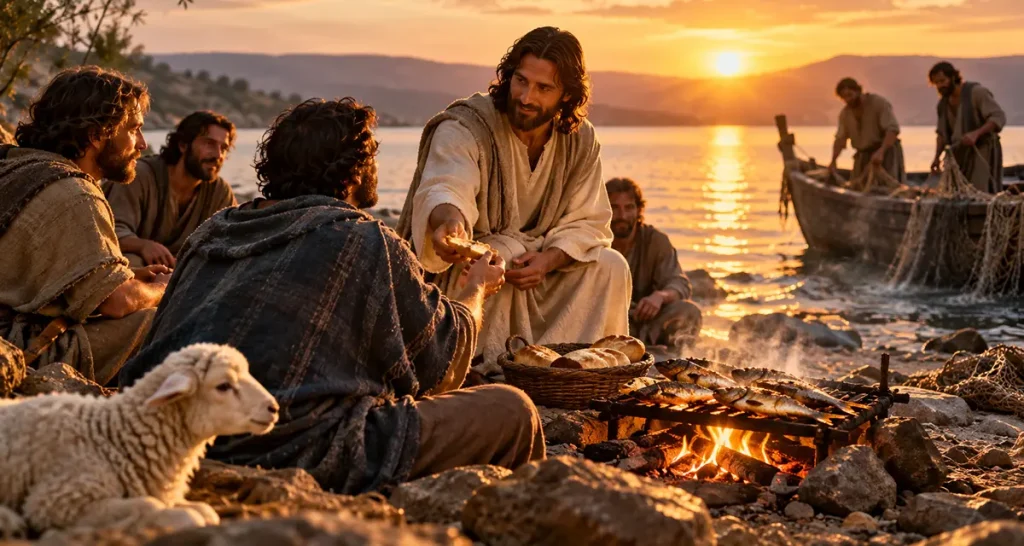
“A fire of coals there, and fish laid on it, and bread.” (John 21:9)
🔥 🐟 🥖
That image deserves to be allowed to remain ordinary.
Because its ordinariness is part of its glory.
👑 The Conqueror Is Cooking
That’s the thing that your observation really brings into focus.
The Conqueror is cooking breakfast.
Jesus has just accomplished something no human being has ever accomplished.
He has passed through death and come out the other side never to die again.
Lazarus had been restored to mortal life. Jesus has entered resurrection life. Paul will later say:
“Christ, having been raised from the dead, dies no more. Death no longer has dominion over Him.” (Romans 6:9)
Death no longer has dominion over the Man standing beside that charcoal fire.
And He is cooking fish.
😂🙌
If we had written the scene, we might have been tempted to make the resurrected Jesus permanently radiant, hovering six inches above the ground, speaking only in cosmic declarations.
John gives us Jesus saying:
“Come and eat breakfast.” (John 21:12)
There is something almost breathtakingly tender about that.
They don’t need a theological lecture first.
They need breakfast.
And He knows that.
🦶🔥 There Is Even a Charcoal Fire Connecting the Two Nights
And John gives us an even more painful connection.
The Greek expression translated “fire of coals” or “charcoal fire” (anthrakia) occurs only twice in the New Testament.
The first is John 18:18.
Peter is warming himself beside a charcoal fire while denying Jesus.
“Now the servants and officers who had made a fire of coals stood there, for it was cold, and they warmed themselves. And Peter stood with them and warmed himself.”
The second is John 21:9.
Jesus has made a charcoal fire for breakfast.
That is almost certainly meant to make us remember.
One charcoal fire: Peter denies Him.
Another charcoal fire: Jesus feeds Peter.
And shortly afterward comes the threefold:
“Simon, son of Jonah, do you love Me?” (John 21:15–17)
Three denials.
Three questions.
John doesn’t explicitly say, “Jesus created the charcoal fire to trigger Peter’s memory,” so we shouldn’t state that as something the text tells us. But John’s repetition of such an unusual detail is very hard to overlook.
Peter comes dripping out of the water toward the smell of charcoal.
Imagine what memories that smell might carry.
The last charcoal fire had witnessed his failure.
This charcoal fire witnesses the presence of the risen Christ.
And Jesus has not prepared punishment.
He has prepared breakfast.
That is extraordinary.
🐟 “Bring Some of the Fish Which You Have Just Caught”
And Jesus does something else wonderfully relational.
He already has fish on the fire.
But then He says:
“Bring some of the fish which you have just caught.” (John 21:10)
As we noticed earlier, this is almost humorous because Jesus is the reason they caught those fish in the first place.
They worked all night:
Nothing.
Jesus speaks:
153 large fish.
And then He says, essentially, Bring some of yours.
😂
That is grace without erasing participation.
He could have said, “You fellows clearly cannot fish anymore. Sit down.”
Instead, He receives what His own provision enabled them to bring.
There is that creaturely pattern again.
He provides, and then He lets them participate in what He provided.
🍞 “Jesus Then Came and Took the Bread and Gave It to Them”
Then John describes something that sounds strangely familiar:
“Jesus then came and took the bread and gave it to them, and likewise the fish.” (John 21:13)
Jesus takes bread and gives it.
John has used closely related language before in the feeding of the five thousand:
“And Jesus took the loaves, and when He had given thanks He distributed them to the disciples…” (John 6:11)
Again and again, Jesus is the giver.
And this happens after resurrection.
That’s important.
Resurrection has not changed Jesus from giver into someone who now merely demands homage.
Of course He is worthy of worship. Thomas has already confessed:
“My Lord and my God!” (John 20:28)
But the One Thomas calls “my Lord and my God” is, in the very next chapter, giving exhausted men bread and fish.
There is no contradiction for John.
Lord and servant are not opposites in Christ.
👑🧺 Perhaps We Have the Wrong Instinct About What a King Does
Our instinct says that the higher someone rises, the more others serve him.
The Gospel keeps reversing that expectation.
Jesus explicitly tells His disciples:
“For even the Son of Man did not come to be served, but to serve, and to give His life a ransom for many.” (Mark 10:45)
Notice He doesn’t merely say, “I occasionally serve.”
He describes His coming itself in those terms:
“The Son of Man did not come to be served, but to serve.”
And John 13 takes us even deeper. Jesus tells them:
“You call Me Teacher and Lord, and you say well, for so I am.” (John 13:13)
He doesn’t deny hierarchy.
That’s crucial.
Jesus doesn’t say, “Don’t call Me Lord; we’re all equals here.”
Quite the opposite:
You call Me Lord. Correct.
Then:
“If I then, your Lord and Teacher, have washed your feet, you also ought to wash one another’s feet.” (John 13:14)
His argument is not:
“I served you despite being Lord.”
It is closer to:
“Look at what your Lord does.”
That is a much deeper revelation.
🦶➡️✝️➡️🔥 The Towel Wasn’t a Temporary Costume
This is perhaps the connection between John 13 and John 21 that moves me most.
We might unconsciously interpret the foot washing as belonging to Jesus’ humiliation.
Incarnation → humility → suffering → Cross.
Then resurrection → glory → exaltation → no more towels.
But John 21 quietly destroys that assumption.
The Cross is finished.
Jesus is risen.
And metaphorically speaking, the towel is still there.
Not literally, of course. Now it’s a charcoal fire and breakfast.
But the disposition is the same.
Before His death:
“Let Me wash your feet.”
After His resurrection:
“Come and eat breakfast.”
The resurrection does not reveal that the servant Jesus was merely a temporary phase.
It vindicates Him.
This really is the Son.
This really is what divine greatness looks like.
❤️ And Notice Who Is Receiving the Breakfast
These aren’t exactly heroes returning triumphantly from battle.
They fled.
Peter denied Him.
Thomas doubted the testimony until he saw Him.
And now several of them have gone fishing and accomplished exactly zero fish during an entire night.
What a group. 😂
Yet Jesus doesn’t appear on shore saying:
“Gentlemen, before breakfast we need to discuss your performance over the last several days.”
He asks:
“Children, have you any food?” (John 21:5)
Then He supplies what they lack.
Then:
“Come and eat breakfast.”
Only after feeding Peter does Jesus begin that painful and restorative conversation:
“Simon, son of Jonah, do you love Me more than these?” (John 21:15)
I think the order matters.
Provision precedes commission.
Jesus feeds Peter before telling Peter:
“Feed My lambs.”
That is beautiful.
Peter will be commanded to give what he has just received.
You have been fed.
Now feed.
You have been served.
Now serve.
You have been restored.
Now care for My sheep.
🐑 The Man Who Was Fed Is Told to Feed
And suddenly our lamb-and-fish conversation comes together even more tightly.
Peter begins John 21 as a fisherman unable to catch fish.
Jesus fills his net.
Jesus feeds him fish.
Then Jesus says:
“Feed My lambs.”
🐟 → Peter → 🐑
The one who receives becomes a giver.
But never an independent giver.
Peter will never possess some self-generated spiritual pantry from which he can nourish Christ’s flock.
He remains dependent upon Christ.
That is why Jesus’ earlier words are so important:
“Without Me you can do nothing.” (John 15:5)
The man entrusted with Christ’s sheep is still the man whose net remained empty until Christ spoke.
That is an excellent qualification for ministry, actually.
Not:
“I am extraordinarily capable.”
But:
“I know where the fish came from.”
✨ And Perhaps This Tells Us Something Astonishing About God
There is a theological danger we sometimes fall into without noticing.
We can imagine that God’s tenderness is somehow a concession He makes to our weakness.
As though His “serious” attributes are sovereignty, omnipotence, holiness, majesty and authority, while kindness, service and tenderness are softer accommodations He puts on when dealing with fragile humans.
Jesus makes that very difficult to maintain.
Because He says:
“He who has seen Me has seen the Father.” (John 14:9)
The hands washing feet are showing us something true about God.
The hands breaking bread are showing us something true about God.
The risen Lord standing beside a charcoal fire cooking breakfast is showing us something true about God.
Not everything about God, certainly. God is also Judge. He is holy. He is consuming fire. Christ will return in judgment and glory. Scripture will not let us flatten Him into mere sentimentality.
But neither will Scripture let us imagine that service is beneath divine majesty.
That is the surprise.
Apparently infinite greatness does not need to keep announcing:
“Do you know who I am?”
Jesus knows exactly who He is.
John made sure we knew that before He picked up the towel:
“Knowing that the Father had given all things into His hands…” (John 13:3)
And because He knows who He is, He can kneel.
And after conquering death, He can cook.
🥖🐟 The Conqueror Who Still Serves
So your wording captures the scene wonderfully:
Now as Conqueror, He serves His wet, tired friends breakfast.
Not former friends who have now become insignificant subjects.
Friends.
Jesus had already told them:
“No longer do I call you servants… but I have called you friends.” (John 15:15)
And after everything that happened—the arrest, abandonment, denial, crucifixion, burial, resurrection—He meets them again beside an ordinary lake.
They smell smoke.
Their clothes are wet.
Their stomachs are empty.
And the One through whom “all things were made” (John 1:3) has bread and fish waiting.
There is something almost disarming about it.
We might expect resurrection glory to create greater distance between Christ and His disciples.
Instead, the risen Christ is standing close enough to hand them bread.
🦶 Before the Cross: Give Me your dirty feet.
🔥 After the resurrection: Come warm yourself.
🥖 Eat.
🐟 I have provided.
🐑 And when you are fed: Feed My lambs.
The towel, the Cross, and the breakfast fire are not three unrelated pictures. They reveal the same Person. Power has not displaced love; victory has not displaced service; glory has not made tenderness obsolete.
The Lamb conquered.
And the Conqueror still serves breakfast.