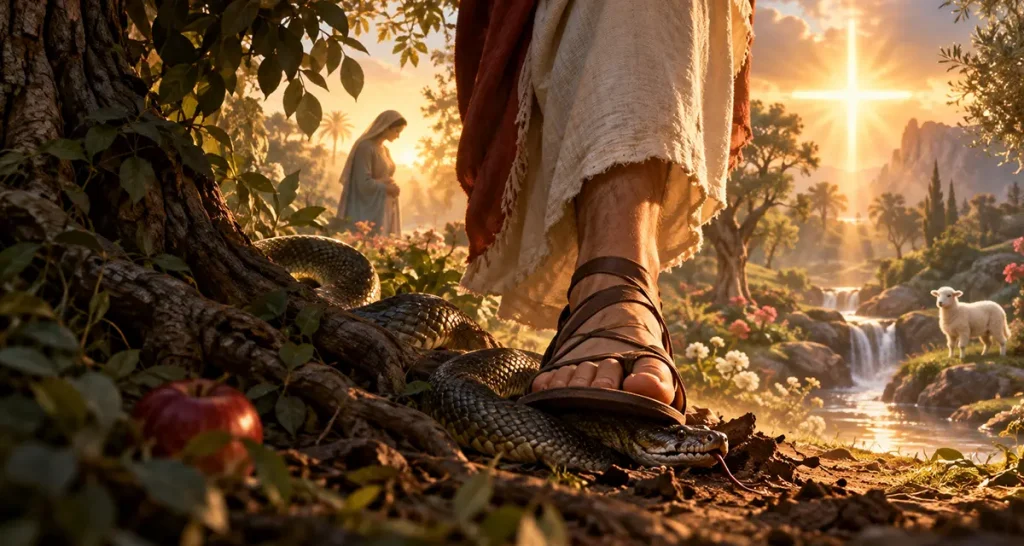
🌿 Delight Without Approval Of Sin
Yes, that distinction is very important.
God does not delight in human wickedness. He never calls evil good. He never looks at pride, cruelty, unbelief, violence, lust, deceit, or idolatry and says, “How lovely.” Scripture is clear:
“For You are not a God who takes pleasure in wickedness,
nor shall evil dwell with You.”
Psalm 5:4
So when we say God continues to delight in His creatures, we are not saying He delights in what sin has done to them.
We are saying something even more tender: God can hate the corruption while still valuing the creature He made.
He can oppose the disease without despising the patient.
He can judge sin without becoming disgusted with humanity as though mankind were now meaningless trash.
That is a very deep mercy.
🕊️ The Creature Remains His Work
Even after the fall, human beings remain God’s creatures. Sin damages us terribly, but it does not erase the fact that God made us, knows us, sustains us, and still deals with us personally.
David says:
“Know that the Lord, He is God;
it is He who has made us, and not we ourselves;
we are His people and the sheep of His pasture.”
Psalm 100:3
That remains the foundational truth: He made us.
And because He made us, He does not look at humanity the way a careless owner looks at a broken object. His relation to creation is not cold possession. It is living, wise, holy, personal ownership.
Even fallen people are still receiving breath from Him.
“He gives to all life, breath, and all things.”
Acts 17:25
This means every human life is still being held in existence by God’s active generosity. The sinner who uses breath to rebel is still receiving that breath from the God he offends.
That is astonishing patience.
Not indifference.
Not approval.
Patience.
🌅 God Still Sees What He Made
When God sees fallen humanity, He sees everything truly. Nothing is hidden from Him. He does not overlook sin, excuse evil, or mistake corruption for innocence.
“And there is no creature hidden from His sight, but all things are naked and open to the eyes of Him…”
Hebrews 4:13
But He also sees what sin has disordered. He sees the creature beneath the ruin. He sees the image He made, even when that image is marred.
James can speak of fallen human beings and still say:
“With it we bless our God and Father, and with it we curse men, who have been made in the similitude of God.”
James 3:9
That is after the fall. People who can be cursed by sinful tongues are still people made in God’s likeness.
So God’s judgment is not the judgment of Someone who has forgotten what humans are. It is precisely because humans matter that sin matters so much.
If humanity were worthless, sin against humanity would not be so serious.
If the creature bore no dignity, murder would not be such a horror.
If the image were erased, redemption would not be spoken of as restoration, renewal, and conformity to Christ.
That is why God’s hatred of sin and His care for human beings are not contradictions. They belong together. Sin is horrible because it corrupts what God made good. Evil is judged because it violates what still belongs to Him.
🔥 Not Sentimental Delight, But Holy Delight
When we speak of God’s delight in His creatures, we should not imagine sentimental softness, as if God is emotionally charmed by rebellion. His delight is holy.
He delights in His own workmanship.
He delights in the goodness of what He created.
He delights in mercy.
He delights in repentance.
He delights in restoring what is broken.
He delights in His Son, and therefore He delights in those who are being brought into the Son.
Zephaniah gives us one of the most tender pictures of God’s saving delight:
“The Lord your God in your midst,
the Mighty One, will save;
He will rejoice over you with gladness,
He will quiet you with His love,
He will rejoice over you with singing.”
Zephaniah 3:17
That is not God delighting in sin. The surrounding context is purification, judgment, restoration, and salvation. God rejoices over His redeemed people because His mercy has triumphed in them.
His delight is not denial of evil.
It is victory over evil.
👶 Jesus Shows This Perfectly
Jesus reveals this with breathtaking clarity.
He eats with tax collectors and sinners, but He does not approve of sin.
“Those who are well have no need of a physician, but those who are sick. I did not come to call the righteous, but sinners, to repentance.”
Mark 2:17
That sentence holds the whole distinction.
They are sick.
He is the Physician.
He comes near.
He calls them to repentance.
That means His nearness is not endorsement. His holiness is not distance. His mercy is not compromise.
Jesus can sit at the table with sinners because He has not come to flatter their sin, but to save them from it.
And look how He receives children:
“Let the little children come to Me, and do not forbid them; for of such is the kingdom of heaven.”
Matthew 19:14
These children are part of Adam’s fallen race too. And yet Christ welcomes, blesses, and values them. He does not treat human nature as disgusting. He assumed human nature Himself.
“And the Word became flesh and dwelt among us…”
John 1:14
That alone tells us God has not abandoned delight in His human creatures.
The Son of God did not become what God despised.
He became man to redeem man.
🩸 The Cross Proves The Depth Of His Love
The cross is where this becomes almost too weighty.
God’s love for fallen creatures is not vague benevolence. It is costly, covenantal, blood-deep love.
“But God demonstrates His own love toward us, in that while we were still sinners, Christ died for us.”
Romans 5:8
While we were still sinners.
Not while we were morally attractive.
Not while we were spiritually impressive.
Not while we were easy to love.
Still sinners.
That means God’s love is not awakened by our loveliness. His love arises from His own character.
And yet that love does not leave us as we are. The same grace that loves sinners also transforms sinners.
“For whom He foreknew, He also predestined to be conformed to the image of His Son…”
Romans 8:29
There it is again: the image.
God delights so deeply in His purpose for humanity that He will not let the damaged image remain damaged forever. He restores us by conforming us to the true Image, Christ.
🌱 God’s Patience Is Full Of Purpose
This also helps us understand why God continues to give ordinary gifts to fallen people: food, beauty, family, rain, music, work, laughter, skill, friendship, sunrise, harvest.
Jesus says:
“For He makes His sun rise on the evil and on the good, and sends rain on the just and on the unjust.”
Matthew 5:45
That is not approval of evil people’s evil. It is God’s generous patience toward His creatures.
Paul says something similar:
“Nevertheless He did not leave Himself without witness, in that He did good, gave us rain from heaven and fruitful seasons, filling our hearts with food and gladness.”
Acts 14:17
That is such a tender phrase: food and gladness.
Even in a fallen world, God gives gladness.
He could have made the world merely survivable after the fall. But He still gives taste, color, music, affection, rest, humor, beauty, and ordinary mercies that make life more than bare existence.
Again, not because sin is small.
Because God is abundant.
⚖️ Wrath And Delight Are Not Contradictions In God
This is where we need mature categories.
God can be angry with the wicked and still be kind to His creatures.
“God is a just judge,
and God is angry with the wicked every day.”
Psalm 7:11
And yet:
“The Lord is good to all,
and His tender mercies are over all His works.”
Psalm 145:9
Those are not contradictions.
God’s anger is His holy opposition to evil.
God’s kindness is His generous disposition toward what He has made.
God’s mercy is His goodness toward the miserable and guilty.
God’s patience is His restraint before deserved judgment.
God’s delight is His joy in His own goodness, His creation, His saving purpose, and the restoration of His people.
The fall did not make God emotionally unstable. He does not swing between petty affection and spite. He is perfectly Himself.
Holy.
Good.
Just.
Patient.
Merciful.
🙌 The Father In Luke 15
The parable of the prodigal son gives us a vivid window into this.
The son dishonors the father, wastes the inheritance, degrades himself, and returns with no claim of merit.
But the father sees him from far away:
“But when he was still a great way off, his father saw him and had compassion, and ran and fell on his neck and kissed him.”
Luke 15:20
The father does not delight in the son’s rebellion. He delights in the son’s return.
He does not say, “Your sin was fine.”
He says:
“For this my son was dead and is alive again; he was lost and is found.”
Luke 15:24
That is the heart of divine mercy.
God does not rejoice over the lostness. He rejoices over the finding.
He does not celebrate the death. He celebrates the resurrection.
He does not approve the rebellion. He restores the son.
🌄 Loved As Creatures, Delighted In As Redeemed
So I think we can say it this way:
God continues to show goodness, patience, and creaturely care toward fallen humanity because humans remain His creatures and image-bearers.
But His deepest saving delight rests upon His people in Christ, because in Christ the creature is being restored to its intended glory.
“He chose us in Him before the foundation of the world, that we should be holy and without blame before Him in love.”
Ephesians 1:4
God never chose merely to tolerate us forever.
He chose to make us holy.
He chose to bring us home.
He chose to conform us to Christ.
He chose to rejoice over His redeemed people.
That is why grace is so humbling. God does not look at fallen humans and say, “There is nothing wrong.” But neither does He say, “There is nothing left worth redeeming.”
He says, through the gospel:
“I know the ruin fully.”
“I hate the sin perfectly.”
“I love My creatures truly.”
“And I will redeem them at the cost of My Son.”
That is not resentment.
That is not pettiness.
That is not vindictiveness.
That is holy love moving toward the fallen without ever making peace with the fall.