Justice | Mercy | Faith

Justice | Mercy | Faith

9/11: A Christian Response to Evil, Suffering, and Enemy-Love

Difficulty Level: Intermediate-Advanced

Jump to Answers

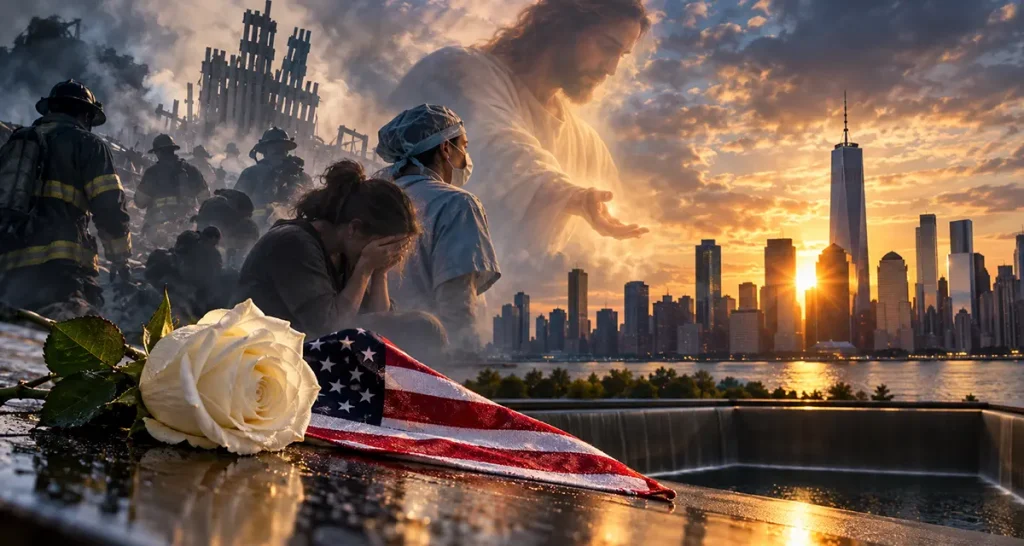
  1. Today marks the 25th anniversary of the tragic morning of September 11, 2001. Despite the passage of a quarter century, the consequences of that day are far from over: the World Trade Center Health Program now serves a vast population of responders, survivors, and others affected by 9/11-related health conditions. For many, 9/11 is not simply something remembered from the past; its effects are still being carried in their bodies today.
  2. It is striking that an attack that took nearly 3,000 lives that morning is still harvesting lives among some of the very people who went there to help.  How terribly destructive sin can be.
  3. As we have discussed, the perpetrators justified their actions in the name of God, religion, and their community of faith, regarding what they were doing as a kind of holy war. Yet Christ reveals something radically different: He won His holy victory by giving Himself so that many might live, rather than giving Himself in order to cause the deaths of others. There is something profoundly distorted when violence and destruction are presented as service to God.
  4. One of the hardest parts of this discussion is that people can attempt to justify such assumptions and actions by appealing to the Old Testament and what they imagine to be a divinely sanctioned purge of “infidels.” 
  5. This is perhaps one of the hardest Christian truths to face: God also sent His Son for the lives of those who commit terrible evil. Before His absolute holiness, they are not a different class of humanity from us, even though their crimes may be vastly different in severity and consequence. And despite the evil they committed against innocent people, Christ still calls us to love our enemies and pray for their salvation. That is an extraordinarily high calling.
  6. Where in this discussion should we address the image of God and the sanctity of human life from both sides of the tragedy: first, from the perspective of the innocent image-bearer who is suffering and may understandably harbor hatred toward the assailant; and second, from the perspective of the attacker who, while claiming to act in God’s name, presumes to destroy human beings whom God Himself created in His image?
  7. “The terrorists of 9/11 gave their lives while taking the lives of others and left a harvest of death that continues a quarter-century later.” If an eternal court could trace every genuine consequence of that evil with a completeness impossible for any human court, would the perpetrators be held accountable not only for those who died that morning, but also for the suffering and losses that followed? The moral consequences would seem almost endless.
  8. I think it is also important to remember that those who have suffered through this tragedy, or through any other deep injury, are themselves hurting and in need of compassion, understanding, and a supportive shoulder as they are gently helped toward the light. A lecture cannot teach a wounded heart to love its enemies, but the presence and grace of Christ can.
  9. “This particular bearer of Your image does not deserve to live, and I claim authority to erase him in Your name.” When religious violence is stated in those terms, the presumption becomes eternally serious and frightening.
  10. What is your final word after such a sensitive discussion? How can we move from theological reflection into compassionate action—remembering the dead, standing beside those who still suffer, helping people who continue battling for their lives because of 9/11-related illness, supporting their families and caregivers, and connecting them with practical resources that may help them?

Twenty-five years after the terrorist attacks of September 11, 2001, 9/11 is not merely an event preserved in history. Its consequences remain present in families who lost loved ones, survivors who carry traumatic memories, and responders and others who continue battling illnesses associated with that terrible morning.

That continuing suffering confronts us with the frightening reach of human sin. The attacks took only hours, yet their harvest of death and suffering has extended across a quarter of a century. An evil act can end while its consequences continue moving through bodies, families, communities, and generations.

For Christians, however, remembering 9/11 raises questions that go deeper than terrorism itself. What happens when human beings destroy other human beings while claiming to act in the name of God? How should we understand Old Testament accounts of divinely commanded warfare without turning them into a human license to destroy those we regard as God’s enemies? What does it mean that both the innocent victim and even the guilty attacker remain human beings made in the image of God? How can someone devastated by violence be asked to love an enemy without minimizing the evil committed against them? And how should Christians stand beside people who are still suffering twenty-five years later?

These are not questions that should be answered casually.

At the center of them stands Jesus Christ.

The terrorists of 9/11 gave their lives while taking the lives of others and left behind a harvest of death whose consequences continue today. Christ reveals an utterly different kind of victory: He gave His life so that His enemies might live. He does not call evil good, abolish justice, or diminish the sanctity of innocent life. At the Cross, He simultaneously reveals the terrible seriousness of sin, the righteousness of God’s judgment, and the astonishing extent of God’s mercy (Romans 5:6–10).

This distinction becomes especially important when religious violence claims divine authorization. The attacker effectively says of another human being, “This bearer of God’s image does not deserve to live, and I claim authority to destroy him in God’s name.” Yet Jesus warned that people would kill others while believing they were offering service to God (John 16:2–3). Religious conviction, however intense, does not make human hatred holy.

At the same time, Christian enemy-love must never become a lecture delivered to wounded people. Those who have suffered violence may carry grief, anger, trauma, fear, and even hatred toward those who harmed them. They need compassion, understanding, justice, patient companionship, and room to grieve. Scripture tells us to “weep with those who weep” and to “bear one another’s burdens” (Romans 12:15; Galatians 6:2). A command may tell a wounded person that they ought to love an enemy; only the presence and grace of Christ can gradually make such love possible.

So this Q&A remembers 9/11 from both sides of that difficult Christian calling: refusing to diminish the evil committed against innocent image-bearers while also refusing to let hatred have the final word.

We remember the dead. We stand beside the living. We care for those still suffering. We defend the sanctity of human life. We call evil what it is. We seek righteous justice. We pray for those whose wounds remain open. And, difficult as it may be, we pray that those consumed by hatred might encounter Christ and be delivered from it before they destroy themselves or others.

Twenty-five years after 9/11, the continuing consequences of that morning remind us how long death can harvest. The Gospel directs our eyes toward another harvest: the life that comes through Jesus Christ, who entered the darkness of human evil and overcame it—not by becoming like His enemies, but by giving Himself for them.

Today marks the 25th anniversary of the tragic morning of September 11, 2001. Despite the passage of a quarter century, the consequences of that day are far from over: the World Trade Center Health Program now serves a vast population of responders, survivors, and others affected by 9/11-related health conditions. For many, 9/11 is not simply something remembered from the past; its effects are still being carried in their bodies today.

Yes. Today, September 11, 2026, marks 25 years since the attacks of September 11, 2001. It is sobering to realize that a quarter of a century has passed. For many people, though, 9/11 is not merely an event they remember; its consequences are still present in their bodies and lives.

And the range of illnesses is striking. The program recognizes various respiratory and digestive disorders, cancers, mental-health conditions such as PTSD and depression, and other qualifying conditions associated with exposure to the dust, smoke, debris, injuries, and trauma. (CDC)

There is something especially poignant about that on the 25th anniversary. We naturally think of the nearly 3,000 people who died that morning—and rightly so. But the event did not simply end when the dust settled. The CDC itself puts it starkly: “the tragedy did not end there.” (CDC)

In a Christian reflection, that makes remembrance more than looking backward. Scripture repeatedly connects remembering suffering with continuing to care for those who remain burdened by it:

Hebrews 13:3

“Remember the prisoners as if chained with them—those who are mistreated—since you yourselves are in the body also.”

Explanation: Biblical remembrance is participatory. We do not merely recall another person’s suffering as historical information; we remember them as fellow human beings whose suffering still matters.

And there is something appropriate about mourning even after 25 years:

Romans 12:15

“Rejoice with those who rejoice, and weep with those who weep.”

Explanation: Time does not make compassion obsolete. There are families for whom September 11 will always contain an empty chair, and responders and survivors for whom its effects remain physical or psychological realities.

Perhaps that is one of the most important things to remember today: 9/11 is history, but not only history. For thousands of people, September 11, 2001 continues to cast a very long shadow into September 11, 2026. And remembering them—the dead, their families, the survivors, the responders, and those still living with its consequences—is itself an act of human solidarity and compassion. 🕊️

It is striking that an attack that took nearly 3,000 lives that morning is still harvesting lives among some of the very people who went there to help.  How terribly destructive sin can be.

Yes. That is one of the most haunting dimensions of 9/11. The violence was concentrated into a few terrible hours, but the consequences of that violence did not obey the clock.

And your word “harvesting” is painfully fitting. People ran toward the destruction to rescue strangers. Firefighters, police officers, construction workers, medical personnel, volunteers, cleanup crews—many entered an environment whose dangers would continue working within their bodies years afterward. Some survived the morning only to carry something of that morning with them for decades.

It is a terrible illustration of something Scripture tells us about sin: sin produces consequences far beyond the moment in which the sinful act occurs.

🌾 Sin has a harvest

Galatians 6:7–8

“Do not be deceived, God is not mocked; for whatever a man sows, that he will also reap.”

Explanation: Sin is never merely an isolated act. It plants something. And what is planted can continue producing consequences long after the person who committed the act has disappeared.

That becomes especially chilling when applied to human violence. The perpetrators died that morning. Their deeds did not.

The planes stopped moving.
The buildings stopped falling.
The fires were eventually extinguished.

But the consequences kept moving through time.

There were immediate deaths. Then bereavement. Trauma. Families altered forever. Wars and political consequences. And, on a much more intimate level, contaminated dust entered people’s lungs and bodies. Years later, disease appears.

That is almost a physical picture of what James describes spiritually:

James 1:14–15

“Then, when desire has conceived, it gives birth to sin; and sin, when it is full-grown, brings forth death.”

Explanation: Notice the movement: conception → birth → growth → death. Sin has a terrible reproductive quality. Something may begin in the human heart and eventually produce consequences enormously larger than its beginning.

And 9/11 exposes another particularly ugly feature of evil: it makes innocent people carry costs they did not choose.

A firefighter did not create the hatred that produced the attack. He simply ran upstairs because somebody needed help.

A rescue worker did not participate in the evil. She entered the ruins because somebody might still be alive.

Yet they could inhale its consequences.

That is profoundly characteristic of life in a fallen world. Sin is personal, but its consequences are frequently not confined to the sinner. David’s sin harmed his household. Achan’s sin affected others. Adam’s rebellion brought death into the human story (Romans 5:12). Human beings constantly discover that what one person does can become something another person must suffer.

And that makes the Cross even more astonishing.

✝️ Christ entered the wreckage

There is an analogy here that I think we should handle reverently, but it is difficult not to see it.

The rescuers of 9/11 went toward a catastrophe they did not cause because others were trapped inside it.

And at the center of the Gospel is One who entered a catastrophe He did not cause.

1 Peter 2:24

“Who Himself bore our sins in His own body on the tree…”

Explanation: Christ did not remain at a safe distance from the consequences of human rebellion. The sinless One entered our condition and bore sin’s judgment in His own body—not because He shared our guilt, but because He came to save the guilty.

There is, of course, an enormous difference: those responders could rescue some people but could not ultimately conquer death. Christ entered our death and came out the other side.

Romans 5:20–21

“But where sin abounded, grace abounded much more… so grace might reign through righteousness to eternal life through Jesus Christ our Lord.”

Explanation: Christianity never minimizes the horror of sin. It can afford to look directly at it precisely because it announces something greater than it: the grace of God in Christ.

So yes—how evil is sin.

Twenty-five years later, a hateful decision made by a relatively small number of human beings can still leave widows, children without parents, traumatized survivors, and sick rescuers.

But there is another harvest being gathered too.

Every person who ran toward danger rather than away from suffering demonstrated something completely contrary to the logic of evil: self-giving love.

“Greater love has no one than this, than to lay down one’s life for his friends.” — John 15:13

And many of them were not even running toward friends.

They were running toward strangers.

That makes September 11 an extraordinary picture of both things at once: how terribly destructive human evil can be, and how extraordinarily beautiful sacrificial love can become in its presence.

And beyond both stands Christ—the One in whom death itself will finally stop harvesting. ❤️🕊️

“The last enemy that will be destroyed is death.” (1 Corinthians 15:26)

As we have discussed, the perpetrators justified their actions in the name of God, religion, and their community of faith, regarding what they were doing as a kind of holy war. Yet Christ reveals something radically different: He won His holy victory by giving Himself so that many might live, rather than giving Himself in order to cause the deaths of others. There is something profoundly distorted when violence and destruction are presented as service to God.

Yes. And I think the distortion becomes especially visible when we put the two claims side by side: violence committed in God’s name versus God’s own victory revealed in Christ. Both may use religious language—God, holiness, judgment, sacrifice, victory—but the direction is radically different.

The question becomes: What does God’s own “holy war” actually look like when God Himself enters the battlefield?

In Jesus, God does not merely give us a better religious theory about holy war. He reveals Himself and shows us what His victory looks like.

✝️ The Holy One gives Himself

Human religious violence can reason:

They are God’s enemies → therefore they must die → our victory comes through their deaths.

At the Cross something astonishing happens:

We are God’s enemies → Christ dies for us → His victory brings His enemies to life.

Paul states it almost shockingly:

Romans 5:8–10

“But God demonstrates His own love toward us, in that while we were still sinners, Christ died for us… when we were enemies we were reconciled to God through the death of His Son.”

That completely overturns the ordinary logic of religious warfare.

Christ certainly has enemies. Christianity does not erase the categories of good and evil, holiness and sin, judgment and rebellion. But when God comes among His enemies in the incarnation, He gives His own life to reconcile them to Himself.

He does not deny their guilt.

He bears its judgment.

He does not become less holy.

His holiness expresses itself in self-giving love.

⚔️ Christ really does wage war

This is important, because otherwise we could reduce Christianity to “violence is bad; kindness is good.” Scripture says something much greater.

Jesus came to destroy.

1 John 3:8

“For this purpose the Son of God was manifested, that He might destroy the works of the devil.”

He came to defeat enemies:

Colossians 2:15

“Having disarmed principalities and powers, He made a public spectacle of them, triumphing over them in it.”

And He came to conquer death:

1 Corinthians 15:54–57

“Death is swallowed up in victory… thanks be to God, who gives us the victory through our Lord Jesus Christ.”

Christianity therefore has extraordinarily militant vocabulary: warfare, enemies, armor, victory, overcoming, kingdom, weapons, conquest.

But look at what happens when Christ defines those words.

The enemy is not the human being whom I am commanded to love.

“Love your enemies, bless those who curse you, do good to those who hate you…” (Matthew 5:44)

Paul makes the distinction explicit:

“For we do not wrestle against flesh and blood…” (Ephesians 6:12)

And consequently:

“For the weapons of our warfare are not carnal…” (2 Corinthians 10:4)

Something extraordinary has happened to the concept of holy war.

The warfare remains.
The holiness remains.
The enemy remains.
The victory remains.

But Christ identifies the battlefield and the weapons in a way that radically frustrates our sinful instinct to turn another human being into the object of sacred hatred.

🩸 And here is the terrible distortion

A person can become so convinced that he is serving God that murder begins to feel like obedience.

Jesus actually warned His disciples that this would happen:

John 16:2–3

“The time is coming that whoever kills you will think that he offers God service. And these things they will do to you because they have not known the Father nor Me.”

That passage is chilling in this context.

Notice that Jesus does not say such people necessarily lack religious conviction.

He says they lack knowledge of God.

That distinction is enormous.

A person can possess zeal, sacrifice, certainty, religious vocabulary, communal approval, willingness to die, and even the conviction that God sanctions his action—and nevertheless be profoundly mistaken about the God in whose name he acts.

Paul knew that personally:

Acts 9:1

“Then Saul, still breathing threats and murder against the disciples of the Lord…”

Saul was not an atheist attacking religion. He was a fiercely religious man who believed his zeal served God.

And then he met the Lord.

That encounter did something remarkable to Saul’s understanding of power. The man who had once traveled with authorization to seize people eventually wrote:

“Being reviled, we bless; being persecuted, we endure.” (1 Corinthians 4:12)

That is an astonishing transformation.

🌱 One victory produces corpses; Christ’s victory produces living people

And this gets directly to what you said.

Think about the radically different “harvests.”

Sin says:

Give your life so that others may die.

Christ says:

I give My life so that others may live.

John 10:10–11

“The thief does not come except to steal, and to kill, and to destroy. I have come that they may have life… I am the good shepherd. The good shepherd gives His life for the sheep.”

There is almost a diagnostic test there.

Steal. Kill. Destroy.

versus

Give. Save. Give life.

And perhaps the deepest distortion occurs when the first set of verbs is dressed in the language of the second—when killing is called holiness, hatred is called faithfulness, destruction is called service to God, and murder becomes sacrifice.

Christ exposes that counterfeit because the Holy One Himself has appeared.

And what did the Holy One do when surrounded by enemies?

“Father, forgive them.” (Luke 23:34)

What did He tell the disciple who attempted to defend Him violently?

“Put your sword in its place.” (Matthew 26:52)

What did He do for those who were His enemies?

“Christ died for us.” (Romans 5:8)

And what happened because He died?

Many live.

That is the breathtaking reversal.

The terrorists of 9/11 gave their lives while taking the lives of others and left a harvest of death that continues a quarter-century later.

Jesus gave His life without taking theirs and began a harvest of life that continues into eternity.

🌾 Isaiah saw the strange victory coming

Isaiah 53 is remarkable here because God’s Servant conquers precisely through being wounded:

“He was wounded for our transgressions… and by His stripes we are healed.” (Isaiah 53:5)

And afterward:

“He shall see the labor of His soul, and be satisfied.” (Isaiah 53:11)

There is Christ’s harvest.

Not bodies left behind by His enemies.

People redeemed from among His enemies.

And Revelation ultimately shows the victorious Lamb standing before an innumerable multitude from “every nation, tribe, people, and tongue” (Revelation 7:9).

That is God’s holy conquest: the Lamb conquers and His enemies become His family.

Something is indeed terribly distorted whenever the name of God—the Giver of life—is invoked to sanctify our desire to destroy human beings made in His image.

And the Cross does not merely tell us that the distortion is wrong.

It shows us what God is actually like. ❤️✝️

One of the hardest parts of this discussion is that people can attempt to justify such assumptions and actions by appealing to the Old Testament and what they imagine to be a divinely sanctioned purge of “infidels.”

Yes—and that takes us into the harder part of the discussion. We cannot simply say, “Violent people misunderstand God because God never commanded violence.” The Old Testament will not allow us to make that argument. There are texts in which God commands Israel to wage war and, in particular circumstances, to place peoples under ḥerem—the ban devoted to destruction (Deuteronomy 7:1–6; 20:16–18; Joshua 6).

So if someone says, “God has enemies, God once commanded their destruction, therefore I may destroy God’s enemies,” the first two premises have biblical precedents. The fatal distortion lies in the therefore.

And I think Christ helps us see exactly where it occurs.

⚔️ Israel was not given a universal license to purge “infidels”

This distinction is crucial.

The conquest narratives are not a general command saying:

“Wherever unbelievers exist, God’s faithful people should eliminate them.”

Israel lived surrounded by nations that did not worship Yahweh, and Israel was not commanded to exterminate them all. Indeed, Israel was specifically forbidden to attack certain neighboring peoples (Deuteronomy 2:4–5, 9, 19).

The Canaanite judgment is presented as something much more particular.

God had told Abraham centuries earlier:

“For the iniquity of the Amorites is not yet complete.” (Genesis 15:16)

That little statement matters enormously. God waits.

And Deuteronomy later explains:

“It is because of the wickedness of these nations that the LORD your God drives them out from before you.” (Deuteronomy 9:5)

So calling the conquest simply a “purge of infidels” already changes the biblical category.

It was divine judgment upon particular peoples at a particular point in redemptive history, carried out through a nation uniquely constituted under God’s covenant—not an enduring principle authorizing believers to identify unbelievers and kill them.

In fact, God eventually turns remarkably similar judgment against Israel itself.

Assyria comes against the northern kingdom. Babylon destroys Jerusalem and the temple and carries Judah into exile (2 Kings 17; 24–25).

That makes it impossible to reduce the principle to:

Our religion = God’s people.
Their religion = infidels.
Therefore God wants us to destroy them.

God judges His own covenant nation for wickedness too.

🔥 But there is an even deeper problem: Who authorized you?

Suppose someone reads Joshua and concludes, “Joshua killed God’s enemies; therefore I can kill God’s enemies.”

There is an enormous missing question:

Did God commission you as He commissioned Joshua?

Joshua did not independently examine Canaanite theology, decide those people were infidels, conclude that God must hate them, assemble an army, and then attach God’s name to his campaign.

The narrative presents an explicit, historically situated divine commission (Joshua 1:1–9).

That distinction between God’s judgment and a human being claiming God’s judgment as his own prerogative is absolutely fundamental.

Otherwise anyone capable of saying “God wills it” can transform his hatred into divine authorization.

And once that happens, religious certainty becomes terrifying because the person has effectively made his own interpretation indistinguishable from God’s command.

✝️ Then Christ changes the covenantal situation radically

This is where I think our earlier discussion becomes even stronger.

The Church is not Israel occupying Canaan.

It possesses:

  • no divinely assigned territory to conquer,
  • no ethnic-national covenant state,
  • no Joshua-like commission to eliminate surrounding peoples,
  • no ḥerem mandate,
  • and no authority to turn unbelief itself into a capital offense.

Instead, the risen Christ gives His people a different command concerning the nations:

Matthew 28:19

“Go therefore and make disciples of all the nations…”

That is extraordinary when placed beside the conquest narratives.

The nations are still to be conquered, so to speak—but now by the Gospel.

Not:

Go and destroy the nations.

But:

Go and disciple the nations.

And how does this kingdom advance?

2 Corinthians 10:3–4

“For though we walk in the flesh, we do not war according to the flesh. For the weapons of our warfare are not carnal…”

The warfare has not disappeared.

Its weapons have changed because the covenantal mission has changed.

🌍 The “infidel” may actually be tomorrow’s brother

This, to me, creates one of the most devastating problems with religious terrorism.

The terrorist looks at another human being and says:

Enemy of God. Therefore he must die.

The Gospel looks at an enemy of God and says:

That was us.

Colossians 1:21–22

“And you, who once were alienated and enemies in your mind by wicked works, yet now He has reconciled…”

Paul was an enemy.

The Corinthians had been idolaters, sexually immoral, thieves, drunkards and more, and Paul says:

“And such were some of you.” (1 Corinthians 6:11)

Were.

That little word changes everything.

If Christians had been commanded to eliminate God’s enemies, who would have survived long enough to become Christians?

😂 It becomes almost absurd when stated that way.

The Church is essentially a community composed of former rebels whom God reconciled instead of immediately destroying.

🕊️ And Christ gives us a shocking instruction concerning present enemies

Not merely tolerate them.

Matthew 5:44–45

“Love your enemies, bless those who curse you, do good to those who hate you, and pray for those who… persecute you, that you may be sons of your Father in heaven.”

Notice Jesus’ reasoning.

He doesn’t merely say enemy-love is a clever strategy.

He connects it with what the Father is like.

And therefore the Christian confronting an “infidel” cannot simply reach backward into Joshua, extract ḥerem, and appoint himself Joshua.

He must pass through Jesus Christ.

And once he does, he encounters the One who says:

Love your enemy.
Pray for your persecutor.
Make disciples of the nations.
Preach repentance and forgiveness.
Leave vengeance to God.

Paul makes the last point explicit:

Romans 12:19–21

“Beloved, do not avenge yourselves… ‘Vengeance is Mine, I will repay,’ says the Lord… Do not be overcome by evil, but overcome evil with good.”

There is that word again:

overcome.

Christianity absolutely believes in overcoming evil.

The question is how.

⚖️ This does not make the Old Testament God different from Jesus

And we have to guard against that conclusion too.

Jesus does not reveal a gentle God who replaces the violent God of Israel. Jesus Himself speaks repeatedly and severely about final judgment (Matthew 10:28; 13:40–43; 25:31–46). Revelation presents the returning Christ as Judge (Revelation 19:11–16).

The Gospel does not announce:

God no longer judges His enemies.

It announces something far more astonishing:

Before the final judgment, God offers His enemies reconciliation through the death of His Son.

That makes the present age extraordinarily significant.

2 Peter 3:9

“The Lord… is longsuffering toward us, not willing that any should perish but that all should come to repentance.”

Judgment has not vanished.

It has been entrusted to God.

And meanwhile, the Church has been entrusted with the ministry of reconciliation (2 Corinthians 5:18–20).

That distinction is enormous:

God retains judgment.
The Church receives reconciliation.

And perhaps this is precisely where the distortion you identified becomes clearest.

The religious extremist takes God’s prerogative of judgment upon himself while neglecting God’s command to seek the good of the human being before him.

He effectively says:

“I know who deserves to die, and I shall execute God’s verdict.”

The Gospel sends the Christian toward that same human being carrying something entirely different:

“We implore you on Christ’s behalf, be reconciled to God.” (2 Corinthians 5:20)

One approaches the unbeliever carrying death.

The other approaches carrying news that the Judge Himself has provided reconciliation.

And that brings us right back to the Cross. The same God who truly judges sin did something none of our simplistic categories would have anticipated:

The Judge came down from the bench and bore judgment Himself.

Not because evil does not matter.

Precisely because it matters that much.

That, I think, is the decisive lens through which a Christian must read Joshua: not pretending those difficult texts aren’t there, but refusing to turn a unique act of divine judgment in redemptive history into a standing human authorization to kill people who believe differently.

Because after Joshua comes Jesus.

And Jesus sends His people among the nations carrying a Gospel, not a sword. ❤️✝️

This is perhaps one of the hardest Christian truths to face: God also sent His Son for the lives of those who commit terrible evil. Before His absolute holiness, they are not a different class of humanity from us, even though their crimes may be vastly different in severity and consequence. And despite the evil they committed against innocent people, Christ still calls us to love our enemies and pray for their salvation. That is an extraordinarily high calling.

Yes. And I think this is where Christianity becomes much harder than simply condemning evil from a safe moral distance.

We can—and must—call what happened evil. Murdering innocent people is evil. Deliberately terrorizing civilians is evil. Invoking God to sanctify such murder compounds the horror. Loving the perpetrators does not require us to soften any of that.

But then Christ says something that reaches into us and refuses to let hatred have the final word:

Matthew 5:44

“Love your enemies… and pray for those who spitefully use you and persecute you.”

That is an extraordinarily high calling because Jesus does not say, “Love your enemies once they stop being enemies.”

He says to love them while they are enemies.

And then comes the truth you just identified: Christ’s blood was sufficient for them too.

That can be emotionally difficult even to say when contemplating atrocities.

Romans 5:6–8

“For when we were still without strength, in due time Christ died for the ungodly… while we were still sinners, Christ died for us.”

Paul deliberately refuses to describe the objects of Christ’s love as basically decent people who needed a little correction.

Ungodly. Sinners. Enemies.

Romans 5:10 actually uses the last word:

“For if when we were enemies we were reconciled to God through the death of His Son…”

And suddenly I cannot stand before the Cross and divide humanity into the simple categories my flesh would prefer:

Those terrible sinners over there.
And people like us over here.

There are certainly enormous differences in the degree and consequences of human wickedness. Scripture recognizes degrees of guilt and judgment (Luke 12:47–48; Matthew 11:20–24). Saying that all are sinners does not mean that every person has committed equally atrocious acts.

But before the absolute holiness of God, none of us possesses a righteousness with which we can establish our own claim upon Him.

Romans 3:22–24

“For there is no difference; for all have sinned and fall short of the glory of God, being justified freely by His grace…”

That is humbling.

It does not mean:

“The terrorist and his victim are morally equivalent.”

They aren’t.

It means:

“Neither the terrorist nor I can stand justified before the Holy God on the basis of our own righteousness.”

That distinction matters enormously.

And once grace enters the picture, something uncomfortable happens: I cannot demand that God’s mercy stop exactly where my compassion stops.

😔 “But after what they did?”

That is where this becomes costly.

We naturally want mercy for the wounded and justice for the perpetrator. And Scripture permits us—even teaches us—to cry out for justice. The Psalms do it. Revelation does it:

“How long, O Lord, holy and true, until You judge and avenge our blood…?” (Revelation 6:10)

Christian love does not mean looking at Ground Zero and saying, “It doesn’t matter.”

Quite the opposite.

It mattered enough for God to judge sin at the Cross, and He will judge evil perfectly.

But Christianity asks us to hold another thought simultaneously:

What if one of those perpetrators, before death, had genuinely turned to Christ and cried for mercy?

The Gospel forces me to answer:

Christ would have been sufficient for him.

That can offend our sense of proportionality.

But then we remember the thief beside Jesus.

Luke 23:40–43

He had no lifetime left in which to repair what he had done. He could not establish decades of good behavior to counterbalance his past. He acknowledged that he was receiving the consequence of his deeds and turned toward Jesus:

“Lord, remember me when You come into Your kingdom.”

And Jesus answered:

“Today you will be with Me in Paradise.”

Grace does not say his crimes were insignificant.

Grace says Christ is greater than his crimes.

And if we celebrate that principle when it saves us, we cannot revoke it when it could save someone we despise.

That hurts our pride.

❤️ And perhaps praying for such a person is one of the purest forms of enemy-love

Because what are we actually asking when we pray for an enemy’s salvation?

We are not praying:

“Lord, pretend he didn’t do it.”

We are asking:

“Lord, bring him to repentance. Break his allegiance to evil. Open his eyes. Make him see what he has done. Bring him to the Cross. Forgive him through Christ. Destroy the hatred within him. Make this enemy Your son and my brother.”

That is not sentimental.

That is asking God for something violent against the evil itself while merciful toward the person enslaved by it.

And we have a spectacular biblical example.

Saul participated in the persecution of Christians. When Stephen was murdered, Saul approved of his death (Acts 7:58–8:1). He later describes himself as:

“a blasphemer, a persecutor, and an insolent man.” (1 Timothy 1:13)

What did Christ do with him?

He did not merely spare Saul.

He made Saul an apostle.

The man traveling toward Damascus to imprison Christians entered Damascus having discovered that the Jesus whose followers he hated was Lord.

That is enemy-love accomplishing something vengeance never could.

✝️ And here the Cross becomes almost unbearable in its beauty

While human beings were crucifying Jesus, Jesus prayed:

“Father, forgive them…” (Luke 23:34)

Those were not theoretical enemies.

The nails were real.

The wounds were real.

The injustice was real.

And His love was real too.

So when Christ commands us to love our enemies, He does not command us from outside the experience.

He has already gone farther than He asks us to go.

And that means that on a day like September 11 we can mourn the murdered, honor those who ran into danger, care for those still suffering, condemn without hesitation the evil that produced it, desire righteous justice—and still refuse to hate the people who committed it.

We can even wish something astonishing for them:

that they had known Christ.

Not because their evil was small.

But because His mercy is that great.

And perhaps the hardest realization of all is this: when we pray for God to save an enemy, we are asking Him to do for that enemy the same kind of miracle of grace He has already done for us.

Different sins. Different earthly consequences. Different degrees of guilt.

Same Savior.
Same Cross.
Same need for mercy.

That is indeed a very high call. I don’t think our natural hearts can sustain it for very long. It requires us to keep returning to the One who, while we were still His enemies, loved us first. ❤️✝️ (Romans 5:10; 1 John 4:19)

Where in this discussion should we address the image of God and the sanctity of human life from both sides of the tragedy: first, from the perspective of the innocent image-bearer who is suffering and may understandably harbor hatred toward the assailant; and second, from the perspective of the attacker who, while claiming to act in God’s name, presumes to destroy human beings whom God Himself created in His image?

I think this belongs very near the center of our discussion, because the image of God gives us a theological foundation for addressing both persons without morally equating them: the innocent sufferer whose life has been violated, and the attacker who has violated another image-bearer.

That distinction is essential. Imago Dei does not flatten morality. It actually explains why the attack is so grievously evil and, simultaneously, why hatred of the attacker cannot become our final Christian posture.

🕊️ The image of God makes human life sacred

The foundational passage appears immediately after the Flood:

Genesis 9:6

“Whoever sheds man’s blood, by man his blood shall be shed; for in the image of God He made man.”

Notice God’s reasoning. Human life possesses a peculiar sanctity because the human being bears God’s image.

Therefore, murder is not merely the unauthorized termination of a biological organism. Something belonging uniquely to God has been assaulted.

James takes the same truth into ordinary human relationships:

James 3:9

“With it we bless our God and Father, and with it we curse men, who have been made in the similitude of God.”

James sees the contradiction immediately:

How can I honor God while cursing the creature who bears God’s likeness?

That question becomes devastating when applied to religious violence.

Someone may cry God’s name while murdering the person who bears God’s image.

The supposed act of devotion therefore contains a terrible contradiction: claiming zeal for the Creator while deliberately destroying His image-bearer.

💔 For the innocent victim, the image of God means: what happened to you matters

This is where I think imago Dei must first speak.

We should not begin by telling the wounded person, “But remember, your attacker is an image-bearer too.”

That is true, but said too quickly it can become almost cruel.

The first implication is:

You are God’s image-bearer. Therefore what was done to you matters profoundly.

Your murdered husband mattered.

Your daughter mattered.

Your father who ran into the building mattered.

Your body matters.

Your grief matters.

Your stolen years matter.

Your trauma is not an inconvenient obstacle that spirituality requires you to suppress.

When Jesus says:

“Are not five sparrows sold for two copper coins? And not one of them is forgotten before God… Do not fear therefore; you are of more value than many sparrows.” (Luke 12:6–7)

He gives us a profoundly personal vision of divine attention.

The sanctity of life means we are allowed to look directly at the atrocity and say:

This should not have happened.

Indeed, Christianity gives us unusually strong grounds for saying it. Human beings are not disposable material. They belong to God’s creation and bear His image.

That is why the Bible can contain cries such as:

“How long, O LORD? Will You forget me forever?” (Psalm 13:1)

and:

“How long, O Lord, holy and true, until You judge and avenge our blood…?” (Revelation 6:10)

The wounded person is permitted to cry for justice.

🔥 But suffering can produce another danger: hatred

And here Christianity becomes painfully demanding.

The innocent person may say:

“They murdered someone I loved. Why shouldn’t I hate them?”

We should understand that reaction before correcting it. There is an enormous difference between hatred arising in the heart of someone whose family has been murdered and calculated ideological hatred that sends someone out to murder strangers.

They are not morally equivalent.

Nevertheless, Christ does not want the original act of evil to gain another victory by gradually reshaping the victim into the likeness of the hatred that wounded him.

That is why Paul says:

Romans 12:17–21

“Repay no one evil for evil… Beloved, do not avenge yourselves… ‘Vengeance is Mine, I will repay,’ says the Lord… Do not be overcome by evil, but overcome evil with good.”

That final sentence is enormous.

Do not be overcome by evil.

The evil has already taken something from you.

Do not let it take you too.

Forgiveness and enemy-love therefore do not declare that the victim’s life was unimportant. Precisely the opposite: because both justice and the victim matter, judgment can be entrusted to God rather than being transformed into personal hatred.

The Christian does not say:

“There must be no judgment.”

The Christian says:

“Judgment belongs ultimately to Someone more righteous than I am.”

That creates room for grief without vengeance, anger without dehumanization, justice without hatred.

⚔️ Now turn toward the attacker

Here imago Dei becomes almost unbearably ironic.

The attacker believes he is defending God’s honor while killing someone God made in His image.

There is something profoundly disordered there.

God says of humanity:

“Let Us make man in Our image, according to Our likeness.” (Genesis 1:26)

The terrorist effectively says:

“This particular bearer of Your image does not deserve to live, and I claim authority to erase him in Your name.”

That is not merely hatred of another person.

It is an extraordinary presumption concerning God’s ownership of human life.

The attacker has taken three things upon himself:

God’s judgment, God’s timing, and God’s authority over life and death.

And religious language can disguise that presumption as submission.

That is exactly why Jesus’ warning we mentioned earlier is so chilling:

John 16:2–3

“The time is coming that whoever kills you will think that he offers God service. And these things they will do to you because they have not known the Father nor Me.”

“God service.”

That is the distortion in two words.

The person thinks he is giving something to God while destroying someone God created.

😔 Yet the attacker remains an image-bearer too

And now Christianity places us in the uncomfortable position you identified.

Sin terribly corrupts human beings, but it does not make them cease to be human.

James 3:9 is written after the Fall and still describes human beings as made in God’s likeness.

So even the murderer does not become subhuman.

And that matters tremendously because one of the easiest ways human beings prepare themselves to commit atrocities is by mentally stripping their enemies of humanity.

They’re vermin.

They’re animals.

They’re infidels.

They’re contaminants.

They’re the enemy.

Eventually the individual disappears behind the category.

Christian theology refuses to cooperate with that process.

The victim is an image-bearer.

And so is the murderer.

But—and this distinction must remain—

equal human dignity does not mean equal moral innocence.

One image-bearer may horribly violate another image-bearer. God’s image establishes the worth of both persons; it does not erase the moral distinction between victim and perpetrator.

✝️ And then comes Christ—the Image

There is an even deeper Christological dimension.

Paul calls Jesus:

“the image of the invisible God.” (Colossians 1:15)

Human beings are created in God’s image.

Christ is the perfect Image.

And look at what fallen humanity does when the perfect Image appears among us.

We kill Him.

There is Calvary.

The history of humanity’s violence against God’s image reaches its terrible climax when humanity lays hands upon the incarnate Son Himself.

And what does the Image do?

He does not become like His attackers.

1 Peter 2:23

“Who, when He was reviled, did not revile in return; when He suffered, He did not threaten, but committed Himself to Him who judges righteously.”

That verse might be one of the most important for our entire discussion.

Notice the two things held together:

He does not retaliate.

And:

He entrusts Himself to righteous judgment.

Love does not abolish justice.

Love refuses to become evil while waiting for justice.

That is exactly the tension faced by the innocent sufferer.

❤️ And here both image-bearers meet at the Cross

Not as moral equals in the particular crime.

Not as though victimhood and murder were interchangeable.

But as human beings standing before God.

To the wounded image-bearer, Christ says:

Your life has immeasurable value. I see what was done to you. You may bring your grief and cry for justice to Me. Do not allow your enemy’s hatred to reproduce itself inside you. Entrust judgment to Me.

To the violent image-bearer, Christ says:

The person you hate belongs to My creation. You have no authority to erase My image in My name. Repent. Lay down your hatred. You too need mercy.

And astonishingly, to both Christ can say:

I gave Myself for you.

That may be where the sanctity of life reaches its deepest Christian expression.

The Cross prevents me from saying of the victim:

“His life didn’t matter.”

And the Cross prevents me from saying of the murderer:

“His life doesn’t matter.”

But the Cross certainly does not prevent me from saying:

“What the murderer did was evil.”

It gives me the strongest possible grounds for saying all three simultaneously.

And perhaps that gives us a powerful theological framework for the whole 9/11 discussion:

The image of God explains why the innocent must never have been murdered.
The justice of God explains why their blood cries out.
The love of God explains why we must not surrender the murderer to our hatred.
And the Cross explains how God can condemn evil while still seeking the salvation of the evildoer.

That last part is extraordinarily difficult.

But it is precisely what God did with us.

“While we were enemies we were reconciled to God through the death of His Son.” (Romans 5:10)

The Christian answer to an enemy who destroys God’s image-bearers, therefore, cannot be to deny God’s image in him in return.

We condemn his evil. We defend the innocent. We pursue justice. We mourn those he harmed.

And, almost impossibly apart from grace, we pray that the enemy might repent and live.

Because that is the strange, holy victory of Christ: not pretending enemies are innocent, but turning enemies into sons. ❤️✝️


“The terrorists of 9/11 gave their lives while taking the lives of others and left a harvest of death that continues a quarter-century later.” If an eternal court could trace every genuine consequence of that evil with a completeness impossible for any human court, would the perpetrators be held accountable not only for those who died that morning, but also for the suffering and losses that followed? The moral consequences would seem almost endless.

Yes—with an important qualification about how we speak of God’s judgment. Your courtroom analogy exposes something profound: the moral weight of an act is not necessarily exhausted at the moment the act is committed. Its consequences can continue multiplying after the perpetrator is dead.

If we imagined an impossibly perfect human court—one capable of tracing every consequence—the “case file” of 9/11 would indeed keep expanding.

There are the people murdered that morning. But then there are spouses who lost spouses, children who lost parents, parents who lost children, people permanently injured, traumatized survivors, rescuers and cleanup workers who became ill, families caring for them, and people whose illnesses emerge decades afterward.

And every one of those consequences has consequences.

That is why your phrase “almost endless” is so striking.

🌳 A deed can outlive the person who committed it

Scripture recognizes this principle remarkably well.

Revelation 14:13

“Their works follow them.”

In that passage the reference is to the righteous, but the expression captures something fundamental: our deeds have significance extending beyond the immediate moment.

Paul similarly says:

Romans 2:5–6

“The righteous judgment of God, who ‘will render to each one according to his deeds.'”

And Jesus makes God’s judgment extraordinarily particular:

Matthew 12:36

“For every idle word men may speak, they will give account of it in the day of judgment.”

If even words fall within the scope of divine accounting, deliberate acts of enormous violence certainly do.

But here God’s judgment exceeds your hypothetical human court in a remarkable way.

A human court cannot know the entire causal chain.

God can.

A judge can establish that someone was murdered. But no earthly judge can perfectly calculate what that murder did inside a five-year-old child who grew up without her father, what consequences that grief produced thirty years later, how it affected other relationships, or every secondary and tertiary consequence.

God knows the whole tree from the seed.

⚖️ Yet we should distinguish guilt from mere causation

This is the qualification I would make.

We shouldn’t imagine God’s judgment as mechanically saying:

“This event ultimately caused 7,493,821 negative consequences, therefore 7,493,821 additional charges.”

Scripture portrays God’s judgment as infinitely more discerning than that.

God knows intention, knowledge, responsibility, action and consequence.

1 Corinthians 4:5

“The Lord comes, who will both bring to light the hidden things of darkness and reveal the counsels of the hearts.”

And Jesus indicates that judgment takes knowledge and degree of responsibility into account (Luke 12:47–48).

So there is no danger that God’s judgment will attribute something unjustly to a person merely because we can construct a remote causal connection.

But neither is there any possibility that a genuine consequence will disappear from His knowledge.

Nothing gets lost in the accounting.

That is simultaneously terrifying and comforting.

🌾 And now “harvest” becomes even more appropriate

This takes us back to Galatians:

“Whatever a man sows, that he will also reap.” (Galatians 6:7)

Think about a seed.

The seed and the harvest are radically disproportionate in size.

One seed can produce a plant containing many more seeds, which potentially produce more plants.

Sin can behave similarly.

A person may commit one act, but he cannot command the consequences to remain confined to that act.

Cain strikes Abel.

One murder.

But suddenly Adam and Eve have a dead son and a murderous son (Genesis 4:8–12). Abel’s future descendants never exist. Cain’s life changes. His family history changes. Human history changes.

The act takes seconds.

Its consequences enter history.

That makes sin much more frightening than merely “breaking a rule.”

😨 And 9/11 makes this unusually visible

The perpetrators could control certain things that morning.

They could choose to board the aircraft.

They could choose violence.

They could execute their plan.

But once that evil entered the world, they could no longer control what it produced.

They could not say:

“Only these consequences, please. Nothing beyond September 11.”

Sin doesn’t give us that privilege.

And twenty-five years later, a person can receive a medical diagnosis related to exposure that occurred because he ran toward the devastation to help someone.

That is extraordinary when you think about it.

The perpetrator is long dead.
The deed is still producing suffering.

This gives tremendous gravity to James’ description:

“Sin, when it is full-grown, brings forth death.” (James 1:15)

✝️ And this makes the Cross look even larger

Because now consider the opposite problem.

If our sins have consequences extending beyond what we ourselves can even calculate, how could we ever provide adequate restitution before God?

We couldn’t.

We don’t even know the full extent of what would need to be repaired.

That makes self-justification almost absurd.

“I’ll make up for everything I’ve done.”

Everything?

We don’t even know everything our actions have done.

Only God does.

And yet the Gospel says:

Isaiah 53:6

“The LORD has laid on Him the iniquity of us all.”

The Cross therefore deals with a depth of guilt that we ourselves cannot completely measure.

That doesn’t make consequences disappear. A forgiven murderer cannot resurrect his victim. A forgiven thief may still owe restitution. Grace does not rewrite history as though the sin never happened.

But before God’s eternal court, the believer’s hope is not:

“Eventually I accumulated enough good deeds to compensate for every consequence of my sins.”

It is:

Romans 8:1

“There is therefore now no condemnation to those who are in Christ Jesus.”

And this makes something we said earlier about praying for the salvation of the perpetrators even more staggering.

If one of them had truly repented and turned to Christ before death, even that enormous ledger of guilt would not have exceeded the sufficiency of Christ’s atonement.

That does not make the ledger small.

It tells us something about the magnitude of the Cross.

🌅 And God will ultimately stop the expanding consequences

There is one place where I would change “almost endless.”

The consequences of evil can propagate through history for generations, but evil will not be allowed an infinite future.

God will end it.

Revelation 21:4

“And God will wipe away every tear from their eyes; there shall be no more death, nor sorrow, nor crying. There shall be no more pain…”

That means there will eventually be a last tear caused by September 11.

A last cancer.

A last traumatized memory.

A last funeral connected to that morning.

A last grieving family.

Not because what happened becomes insignificant, but because Christ will finally bring the harvest of evil to an end.

And that gives us a remarkable contrast with what we were discussing earlier.

Sin produces consequences its perpetrators cannot contain.

But grace also produces consequences.

One act of hatred can send suffering rippling through generations.

And one act of obedience at Calvary sends life rippling into eternity.

Paul deliberately constructs that contrast in Romans 5:18–19: Adam’s trespass brings condemnation and death; Christ’s obedience brings justification and life.

So yes, the moral “case” of something like 9/11 is unimaginably larger than the few hours during which the crime occurred.

But the final word is not that evil’s harvest is endless.

The final word belongs to Christ:

“Behold, I make all things new.” (Revelation 21:5)

Sin’s consequences may chase humanity astonishingly far through history.

They cannot follow us through resurrection into the new creation. ❤️

I think it is also important to remember that those who have suffered through this tragedy, or through any other deep injury, are themselves hurting and in need of compassion, understanding, and a supportive shoulder as they are gently helped toward the light. A lecture cannot teach a wounded heart to love its enemies, but the presence and grace of Christ can.

Yes. ❤️ And I think that is a necessary correction to any theological discussion of enemy-love. We can state the doctrine correctly and still apply it without tenderness.

Someone who has been terribly wounded may already know that Jesus said, “Love your enemies.” Repeating the command more forcefully does not necessarily give that person the strength to obey it.

The wounded person may need someone to sit beside them before trying to explain anything to them.

❤️ The command is high because the wound is real

Imagine telling someone who lost a spouse on 9/11—or someone whose loved one spent years becoming progressively sicker because of exposure:

“You need to love the people who did this.”

The statement may be biblically true, yet delivered carelessly it can become another burden placed upon an already crushed person.

Scripture gives us something much more humane:

Romans 12:15

“Weep with those who weep.”

Not first:

Correct those who weep.

Not:

Explain to those who weep why their anger is spiritually deficient.

But:

Weep with them.

That is participation in another person’s suffering.

And it reminds me of Job’s friends. Before they started explaining everything, they actually did something beautiful:

Job 2:13

“So they sat down with him on the ground seven days and seven nights, and no one spoke a word to him, for they saw that his grief was very great.”

Ironically, much of the trouble began after they started talking. 😔

Sometimes presence is the ministry.

🕯️ Hatred may be covering an enormous wound

If someone says, “I hate the people who did this,” we certainly recognize that Christ eventually calls that person beyond hatred.

But pastoral wisdom asks another question first:

What is hurting underneath those words?

Perhaps:

“They took my father.”

“My husband went to work and never came home.”

“I watched people die.”

“I cannot breathe normally anymore because I went there to help.”

“My children grew up without their mother.”

Now the statement “I hate them” sounds different.

It still needs healing. But it may be less a philosophical commitment to hatred than a wounded heart crying because something precious was violently taken away.

And Christ knows the difference.

🌿 Jesus does not merely command the wounded; He comes near them

This is what makes Christianity so much more than an ethical system.

If Christianity merely said:

Rule 1: Love your neighbor.
Rule 2: Love your enemy.
Now perform accordingly.

we would be crushed by it.

But Jesus says:

Matthew 11:28

“Come to Me, all you who labor and are heavy laden, and I will give you rest.”

Before the wounded person can perhaps even contemplate loving the enemy, there may be a long season of simply learning:

Christ is here.
Christ sees me.
Christ has not forgotten what happened.
Christ does not despise my tears.
Christ understands injustice.
Christ can hold the anger I don’t know what to do with.

And this matters because Jesus Himself is not speaking about suffering academically.

Hebrews 4:15

“For we do not have a High Priest who cannot sympathize with our weaknesses…”

The One saying “love your enemies” is the One who was betrayed, falsely accused, mocked, beaten, spat upon, stripped, tortured and crucified.

He knows what an enemy is.

And He knows what wounds feel like.

🤲 Sometimes we become part of Christ’s presence

This connects beautifully with something we have discussed before about participation with God.

Christ could minister to a wounded person without us.

Yet He often chooses to make His presence tangible through His people.

A meal.

A phone call.

Sitting quietly.

Listening to the same story for the tenth time.

Helping someone navigate ordinary life when grief has made ordinary things exhausting.

Allowing someone to cry without trying to fix the crying.

Praying when they cannot find words to pray.

Galatians 6:2

“Bear one another’s burdens, and so fulfill the law of Christ.”

Notice that Paul doesn’t say merely explain one another’s burdens.

Bear them.

That means some of their weight temporarily falls upon our shoulders.

✝️ And then enemy-love can emerge as fruit rather than performance

This may be the most important distinction.

We can pressure a wounded person into saying:

“I forgive them.”

But we cannot manufacture forgiveness inside the heart.

Christ can.

The journey may begin somewhere much more modest:

“Lord, I hate them. And I don’t know how not to.”

That itself can be prayer.

Then perhaps:

“Lord, I don’t want hatred to own me.”

Later:

“Lord, help me entrust judgment to You.”

And perhaps one day:

“Lord, have mercy on them. Save people like them from this darkness.”

Look at what has happened.

Nobody lectured the wounded heart into enemy-love.

Christ carried it there.

Philippians 2:13

“For it is God who works in you both to will and to do for His good pleasure.”

Even the willing can be God’s work.

Sometimes a person may honestly have to pray:

“Lord, I cannot yet desire their good. Please give me even the desire to desire it.”

God can work with that.

🕊️ Coming back into the light

And I especially like the way you put it: as they are gently helped toward the light.

The terrorist needs to be delivered from the darkness that tells him murder is service to God.

But the victim also needs Christ’s light—not because victim and perpetrator are morally equivalent, but because suffering itself can become a terribly dark room.

Grief can isolate.

Trauma can imprison.

Anger can consume.

Fear can reshape a life.

Hatred can keep the attacker psychologically present long after the attack is over.

Christ desires something better for the wounded person than merely surviving.

Psalm 147:3

“He heals the brokenhearted and binds up their wounds.”

What a tender description.

He binds wounds.

He doesn’t yell at wounds for bleeding.

And perhaps that gives us the posture we need toward those still carrying September 11—or any terrible injury—in their bodies and memories.

We can proclaim justice without feeding vengeance.

We can teach enemy-love without trivializing injury.

We can speak about forgiveness without demanding emotional shortcuts.

We can pray for perpetrators without forgetting victims.

And above all, we can stay beside wounded people while Christ patiently does what our arguments cannot do.

Because you’re right: a lecture may tell someone that they ought to love an enemy.

Only the love of Christ can make a deeply wounded heart increasingly capable of doing it. ❤️🕊️

“This particular bearer of Your image does not deserve to live, and I claim authority to erase him in Your name.” When religious violence is stated in those terms, the presumption becomes eternally serious and frightening.

Yes. 😔 When stated that plainly, the presumption behind religious murder becomes almost terrifying to contemplate. It is not merely, “I killed another human being.” It becomes, in effect, “I made a judgment about someone You created, claimed Your authority over his life, and then invoked Your name while destroying him.”

That is eternally serious.

🔥 The frightening word is “Your”

The victim is God’s creature before he is anyone’s enemy.

Genesis does not say that only righteous people bear God’s image. After the Fall, the sanctity of human life is still grounded explicitly in the imago Dei:

Genesis 9:6

“Whoever sheds man’s blood, by man his blood shall be shed; for in the image of God He made man.”

So imagine the theological contradiction contained in religious murder:

“God, I am defending Your honor by destroying what bears Your image.”

And worse:

“I know that You want this person dead.”

Now the murderer has moved beyond hatred. He has claimed knowledge of God’s judgment and authorization to execute it.

That touches the commandment concerning God’s name in a frightening way:

Exodus 20:7

“You shall not take the name of the LORD your God in vain…”

We often associate that commandment mainly with irreverent speech. But bearing God’s name falsely is far more serious than casually pronouncing a word. To attach “God wills this” to something God has not commanded is to enlist divine authority behind human action.

When that action is murder, the seriousness becomes enormous.

⚖️ “I claim authority to erase him”

That phrase also exposes another problem: ownership.

I did not create the person standing before me.

I did not give him consciousness.

I did not cause his heart to begin beating.

I did not give him his first breath.

And therefore his existence is not ultimately mine to dispose of.

Acts 17:25

“He gives to all life, breath, and all things.”

This connects beautifully—and frighteningly—with our earlier discussion about creaturehood.

The terrorist is himself a dependent creature receiving every breath from God, yet presumes to decide that another dependent creature should no longer receive his breath.

There is something almost grotesquely contradictory about it:

A creature borrowing life from God claims God’s authority to terminate another creature’s life—and says he is doing it for God.

That is an extraordinary usurpation.

😨 And Jesus specifically warned about this religious distortion

This makes John 16 even more chilling than before:

John 16:2–3

“The time is coming that whoever kills you will think that he offers God service. And these things they will do to you because they have not known the Father nor Me.”

That last sentence is devastating.

Jesus identifies a fundamental contradiction:

“I am doing this because I know what God wants.”

Christ:

“You are doing this because you do not know the Father.”

Religious zeal, therefore, is not self-authenticating.

Sincerity isn’t enough.

Intensity isn’t enough.

Willingness to die isn’t enough.

Confidence isn’t enough.

Even invoking God’s name isn’t enough.

Paul himself is the great biblical warning. He possessed tremendous zeal for God while persecuting God’s people.

Romans 10:2

“For I bear them witness that they have a zeal for God, but not according to knowledge.”

There can therefore be something more dangerous than ordinary hatred:

hatred convinced that it is holy.

Ordinary hatred might eventually become ashamed of itself.

But hatred baptized as obedience can interpret its own brutality as virtue.

🪞 And the image-bearer forces me to look again

This is why imago Dei is such a powerful safeguard.

Before I call someone:

infidel, enemy, foreigner, sinner, terrorist, persecutor, criminal…

there is an identity underneath every one of those descriptions that I did not give him:

human being made in the image of God.

That doesn’t erase the other categories. Someone really can be an enemy. Someone really can be a murderer. Someone really can commit atrocities and deserve judgment.

But I cannot make him cease being human in order to make hatred easier.

James gives us almost the perfect theological rebuke:

James 3:9–10

“With it we bless our God and Father, and with it we curse men, who have been made in the similitude of God. Out of the same mouth proceed blessing and cursing. My brethren, these things ought not to be so.”

Exactly. And once we see it from that perspective, the problem goes deeper than murder itself. It becomes a creature claiming the prerogatives of the Creator while imagining that this rebellion is actually worship.

That is what makes it so frightening.

The attacker is effectively saying:

“I have determined the value of this life.
I have determined that this person is beyond mercy.
I have determined that his remaining days should be taken from him.
I have determined that his family may bear the consequences of his death.
I have determined that whatever future God might have permitted him will never occur.
And I authorize all of this in God’s name.”

The presumption is staggering.

And notice something else: the attacker cannot possibly know what he is destroying.

He sees one person.

God sees an entire human life.

The attacker does not know whether that person would live another fifty years. He does not know the children that person might raise, the people he might help, the repentance he might experience, the reconciliation he might bring about, the ordinary acts of love he might perform, or the relationships that depend upon his continued existence.

Yet in one irreversible act he declares:

“None of that will happen because I have decided this life ends now.”

That connects directly with what we were saying about the continuing harvest of 9/11. Murder doesn’t merely take someone’s present. In a creaturely sense, it violently removes his earthly future and wounds the futures of many people connected to him.

And the murderer cannot calculate those consequences beforehand.

That makes the claim to divine authorization even more presumptuous.

🔥 Religious murder adds another layer

There is a difference between someone murdering from rage, greed, jealousy or revenge and someone saying:

“God requires me to do this.”

Both are evil. But the second adds a horrifying theological inversion.

The murderer takes something originating within the creature—his ideology, hatred, interpretation, grievance, tribal loyalty or desire for vengeance—and places God’s signature underneath it.

Human hatred becomes:

God’s hatred.

Human judgment becomes:

God’s judgment.

Human vengeance becomes:

God’s justice.

Human murder becomes:

God’s service.

That is why the distortion can become so difficult to penetrate. Once someone has identified his own will with God’s will, repentance begins to feel like apostasy.

If I believe my hatred is sinful, I may repent of it.

But if I believe my hatred is holy, then repentance appears to me as betrayal of God.

That is a terrifying spiritual condition.

🪞 And then Christ stands before that assumption

This is where Christ becomes the decisive contradiction.

Suppose I say:

“That enemy of God deserves death.”

Christ can answer:

“So did you.”

I say:

“But he is wicked.”

“So were you.”

“But he hates God.”

“You were My enemy.”

“But justice demands judgment.”

“Yes.”

And then comes the answer human religion could never have invented:

“I bore it.”

That doesn’t abolish final judgment. It means that during this present offer of reconciliation, I cannot simply look at another sinner and declare that God has no redemptive purpose remaining for him.

I don’t know that.

Saul’s companions could have looked at him traveling toward Damascus and seen a dangerous religious persecutor.

Christ saw Paul.

That thought alone should make us extraordinarily cautious about deciding that another living human being is beyond the reach of grace.

❤️ And this protects the victim without dehumanizing the perpetrator

There is an important balance here.

We must never use the image of God to tell victims:

“Your attacker is an image-bearer, so don’t be angry.”

No. The image of God first magnifies the crime.

Because the victim bears God’s image, what was done to him is more serious, not less.

But then the same doctrine prevents us from answering dehumanization with dehumanization.

The attacker said, effectively:

“This person’s humanity no longer restrains me.”

We cannot respond:

“And now your humanity no longer restrains us.”

Otherwise the logic of dehumanization has simply changed hands.

Justice may restrain him. A lawful authority may punish him. Society may need protection from him. God will judge him perfectly.

But hatred does not receive permission to erase his humanity.

And that brings us back to the wounded person we were discussing.

Someone deeply injured may not be able to arrive at this conclusion immediately. We shouldn’t stand beside someone at Ground Zero, metaphorically speaking, and deliver a theology lecture about loving image-bearers.

We sit with them.

We mourn.

We acknowledge the evil.

We help carry what can be carried.

And gradually Christ can bring the wounded heart to an extraordinary freedom:

“What you did to me was evil.
You had no right to do it.
I will not call evil good.
I will not deny my loss.
I desire justice.
But I will also not allow what you did to determine what I become.
I will not deny in you the image that you denied in your victim.
And I entrust you to God.”

That is not weakness.

That is an astonishing victory over evil.

Because now the original hatred has reached the wounded person—and stopped there.

It did not reproduce itself.

And perhaps that is one of the deepest ways Christ defeats evil in His people: He does not merely prevent us from committing the enemy’s act; He prevents the enemy’s hatred from becoming our own. ❤️

What is your final word after such a sensitive discussion? How can we move from theological reflection into compassionate action—remembering the dead, standing beside those who still suffer, helping people who continue battling for their lives because of 9/11-related illness, supporting their families and caregivers, and connecting them with practical resources that may help them?

I think our final word should be remembrance that becomes compassion and action.

Twenty-five years later, 9/11 teaches us something dreadful about sin: an act can last minutes and leave suffering that travels through generations. But it also teaches us something beautiful about love: people ran toward strangers who needed them, physicians and researchers have spent decades caring for those who became sick, families have carried one another, and communities continue refusing to forget.

For Christians, “never forget” should therefore mean more than remembering what evil did. It should mean remembering the people who are still carrying what evil did.

The theological truths we have discussed—the image of God, justice, forgiveness, enemy-love—must eventually acquire hands and feet.

For the injured person, our first ministry may not be explaining why they should forgive. It may be listening. Sitting beside them. Helping with appointments. Supporting their family. Praying when they cannot pray. Allowing grief to take time. As Paul says, “Bear one another’s burdens” (Galatians 6:2).

And for the person struggling with anger or hatred, we can gently help them toward Christ without treating their wound as a theological problem to be corrected. Christ can lead someone from “I hate them” to “Lord, I don’t want hatred to possess me,” and eventually perhaps to “Lord, have mercy on them.” That journey itself may be grace.

There are also very practical ways to help.

  • The federal World Trade Center Health Program provides eligible 9/11 responders and survivors with monitoring and treatment for certified WTC-related conditions. The program serves people nationwide, not merely those who still live around New York. (CDC)
  • Someone who thinks an illness may be connected to 9/11 but doesn’t know where to begin can contact the 9/11 Treatment Referral Program at 1-888-WTC-7848 (1-888-982-7848). Staff can help determine potential eligibility and guide people through applying to the WTC Health Program. (New York City Government)
  • The federal September 11th Victim Compensation Fund provides compensation for qualifying physical harm or death resulting from the attacks or debris-removal efforts. Importantly, the VCF currently tells potentially eligible people that they can register even if they are not presently sick, which can preserve the ability to file a claim later. (September 11th Victim Compensation Fund)
  • The NYC 9/11 Health resources also point affected people toward counseling, referrals and organizations serving survivors, responders and families. For someone in an emotional crisis, 988 is available 24/7 by call or text.

And there is something very ordinary the rest of us can do: help people know these resources exist. Someone who worked cleanup, volunteered, lived or worked nearby, or otherwise experienced qualifying exposure may never have thought of a condition developing decades later as potentially connected to 9/11. The continuing research matters precisely because some health effects emerge over time; the WTC Health Registry continues following long-term and emerging conditions 25 years later. (New York City Government)

But after everything we have discussed today, I think there is an even deeper final word.

🕊️ Let remembrance defend life rather than perpetuate hatred

We began with nearly 3,000 people whose lives were violently taken. We then encountered tens of thousands whose bodies and minds still carry consequences from that morning.

Every one of them is an image-bearer.

The person who died in an office.

The firefighter climbing the stairs.

The worker breathing dust at Ground Zero.

The child who lost a parent.

The person receiving a frightening diagnosis twenty-five years later.

And, painfully, even the person who committed the atrocity.

That last truth does not diminish the first ones. It makes the crime more terrible.

The terrorist’s distortion says:

“This image-bearer may be destroyed in God’s name.”

Christ’s way says:

“Love your enemy.” (Matthew 5:44)

The wounded person’s temptation may eventually say:

“After what you did, you are no longer worthy of my recognizing your humanity.”

Christ gently leads the wounded person somewhere freer:

“Entrust judgment to Me. Do not let his hatred become yours.” (Romans 12:19–21)

And we who stand beside the wounded must be patient enough to let Christ do that work. We don’t drag someone into forgiveness while the wound is still bleeding.

We weep with those who weep (Romans 12:15).

We bind wounds.

We seek justice.

We help people obtain treatment.

We remember the dead.

We support those still fighting for life.

We pray for families and caregivers who may themselves be exhausted.

And yes—we pray that people presently trapped in ideologies of hatred and religious violence will encounter God before they destroy another image-bearer or themselves.

Because the Christian response to September 11 cannot finally be another harvest of hatred.

Twenty-five years ago, human beings gave themselves to hatred and produced death.

On another terrible day, outside Jerusalem, Christ gave Himself in love and produced life.

“The thief does not come except to steal, and to kill, and to destroy. I have come that they may have life.” (John 10:10)

Perhaps that is where I would leave our whole discussion.

Remember the dead.
Stand beside the living.
Care for the wounded.
Defend the sanctity of every human life.
Call evil what it is.
Entrust perfect justice to God.
Refuse to let hatred reproduce itself in us.
And bring the wounded—and, astonishingly, even our enemies—as near to Christ as we can.

Because after twenty-five years of seeing just how long death can harvest, we have all the more reason to cling to the One whose harvest is life everlasting. ❤️🕊️✝️