Justice | Mercy | Faith

Justice | Mercy | Faith

πŸ‘ The Lamb Who Was Slain: What He Reveals About the Heart of God

Difficulty Level: Intermediate-Advanced

Jump to Answers

  1. Why does heaven sing that Jesus is worthy to receive “power and riches and wisdom, and strength and honor and glory and blessing”, when none of these can add anything to His life or being, since God needs nothing? Is this song therefore directed toward Jesus particularly in His incarnate and mediatorial character?
  2. We certainly deserve none of this, but if Jesus as Man receives all things, and we are united to Himβ€”He being the Head and we His bodyβ€”what does His exaltation reveal about the position and destiny of the new humanity belonging to the Second and Last Adam? And why would God exalt the very humanity that once attempted to take His place? πŸ€”πŸ€―
  3. What is the significance of the declaration “the Lamb who was slain” becoming the very reason He is worthy to receive everything?Β 
  4. Despite the enormity of the Fallβ€”and the Fall is no small matterβ€”Scripture nowhere tells us that Adam was eternally lost; if anything, the biblical account points us in the opposite direction. And so Adam himself will ultimately receive in Christ, by grace, what he once tried to seize for himself apart from God. What extraordinary irony! How immeasurably generous and gracious God is.
  5. What an enormous task it was for a Man to reveal God the Father within the limitations of a genuinely human life. And yet Jesus accomplished that revelation teleΓ³-ly. πŸ™ƒ
  6. Can we therefore conclude that at the heart of God’s throne is the character revealed in the slain Lambβ€” in what the Lamb’s being slain reveals about God’s holy, self-giving love, mercy, faithfulness, justice, and His manner of dealing with His creation truly reveals the character of the God who reigns?
  7. Where, then, is the Lion by the end of Revelation? I ask because we tend naturally to love and prefer lions, sometimes to the detriment of lambs, sadly.Β 

πŸ‘ The Lamb Who Was Slain: What He Reveals About the Heart of God

Biblical Themes | God & His Attributes | Jesus Christ (Christology) | Kingdom of God | New Testament | Salvation (Soteriology)

Why does heaven proclaim that Jesus is worthy to receive “power and riches and wisdom, and strength and honor and glory and blessing” when, as the eternal Son of God, He lacks nothing? Why does Revelation repeatedly ground His worthiness in the striking declaration that He is “the Lamb who was slain” (Revelation 5:12)? And if the risen Christ receives all things as the glorified Man, what does His exaltation mean for the new humanity united to Him as its Head?

These questions lead surprisingly far. They take us from Adam’s attempt to grasp what God had not given, to the Last Adam who refused to grasp and instead humbled Himself unto death (Genesis 3:5–6; Philippians 2:6–9). They lead into the astonishing generosity of God, who gives in Christ what fallen humanity could never obtain independently. And ultimately they lead us to Jesus’ great work of revealing the Father: not merely telling us truths about God, but making the invisible God known through His own human life, character, obedience, suffering, death, resurrection, and glory (John 1:18; 14:9).

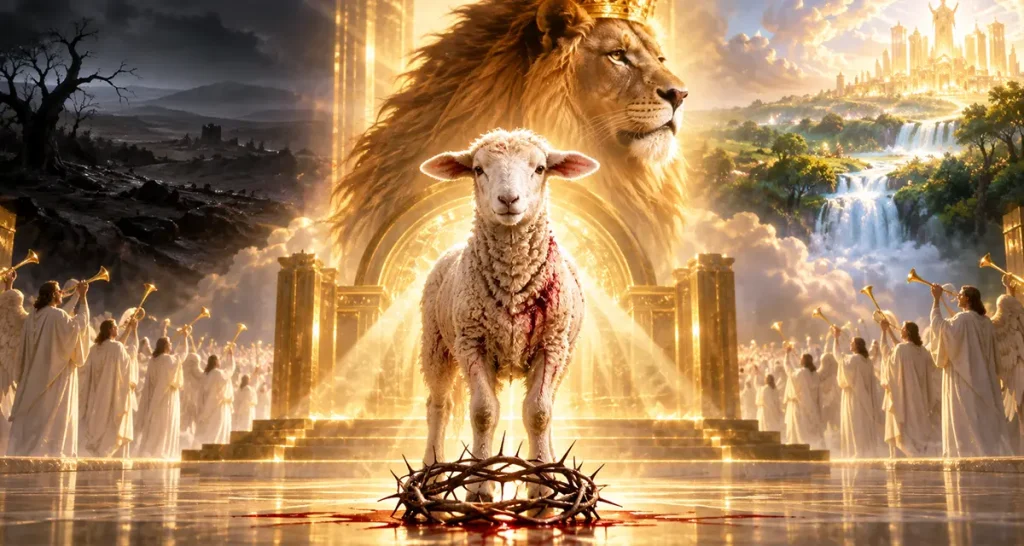
At the center of the discussion stands one extraordinary image: the Lamb who was slain standing in the midst of the throne (Revelation 5:6).

The Cross, then, is not merely something Jesus endured before moving on to His “real” glory. The slain Lamb reveals what divine glory, power, kingship, holiness, judgment, mercy, and love actually look like. The One entrusted with everything is the One who gave Himself for His creation.

And Revelation adds one final surprise. Christ is announced as the Lion of the tribe of Judah, but when John turns to see the victorious Lion, he sees a Lamb as though it had been slain (Revelation 5:5–6). The Lion is never named again in Revelation, while the Lamb remains before us all the way to the final chaptersβ€”even in the expression, “the throne of God and of the Lamb” (Revelation 22:1, 3).

Perhaps, then, we should not use the Lion to correct what appears too gentle about the Lamb. Perhaps we should allow the Lamb to correct what we have misunderstood about the Lion.

This Q&A explores that remarkable biblical movement: from the worthiness of the slain Lamb, through the exaltation of Christ and the new humanity in Him, to what the Lamb ultimately reveals about the heart of the God who sits upon the throne.

Why does heaven sing that Jesus is worthy to receive “power and riches and wisdom, and strength and honor and glory and blessing”, when none of these can add anything to His life or being, since God needs nothing? Is this song therefore directed toward Jesus particularly in His incarnate and mediatorial character?

Yes. And I think you have put your finger on the very tension that makes the song of Revelation 5 so magnificent.

When heaven sings,

“Worthy is the Lamb who was slain
To receive power and riches and wisdom,
And strength and honor and glory and blessing!”
β€” Revelation 5:12

it cannot mean that Jesus was previously deficient in power, riches, wisdom, strength, honor, glory, or blessing, and now needs creatures to supply them to Him. God needs nothing from creation.

“Nor is He worshiped with men’s hands, as though He needed anything, since He gives to all life, breath, and all things.”
β€” Acts 17:25

So “receive” must mean something richer than acquiring something He lacked.

πŸ‘ The key is: “Worthy is the Lamb who was slain”

Notice the title heaven uses.

It does not merely say, “Worthy is the eternal Son.”

It says:

Worthy is the Lamb who was slain.
β€” Revelation 5:12

That immediately places the song in the context of the incarnation, obedience, suffering, death, resurrection, and exaltation of Christ.

The eternal Son always possessed divine glory:

“And now, O Father, glorify Me together with Yourself, with the glory which I had with You before the world was.”
β€” John 17:5

He did not become omnipotent after the resurrection. He did not become wise after the Cross. He did not become glorious because angels sang to Him.

As God, all these things are eternally His.

But the astonishing thing is that the One who eternally possessed them laid aside the visible manifestation and privileges of His divine glory, took the form of a servant, became man, humbled Himself, and went to the Cross (Philippians 2:6–8).

And then Paul says:

“Therefore God also has highly exalted Him and given Him the name which is above every name.”
β€” Philippians 2:9

That “therefore” is enormously important.

There is an exaltation that belongs to Christ because of what He accomplished as the incarnate Son.

πŸ‘‘ He receives as Man what was eternally His as God

This is one of the beautiful mysteries of Christ.

As God, He owns everything.

As the incarnate Son, He receives everything.

Jesus Himself says:

“All authority has been given to Me in heaven and on earth.”
β€” Matthew 28:18

But surely the eternal Word was never without authority! John has already told us:

“All things were made through Him, and without Him nothing was made that was made.”
β€” John 1:3

So what happened?

The Son who possessed sovereign authority by nature as God now receives universal authority as the victorious God-Man, Messiah, and representative Head of redeemed humanity.

This is closely connected with Daniel’s vision:

“Then to Him was given dominion and glory and a kingdom,
That all peoples, nations, and languages should serve Him.”
β€” Daniel 7:14

The figure receiving the kingdom is “One like the Son of Man” (Daniel 7:13).

That is remarkably close to Revelation 5.

The Lamb has conquered through being slain:

“You are worthy to take the scroll,
And to open its seals;
For You were slain,
And have redeemed us to God by Your blood.

β€” Revelation 5:9

His worthiness here is explicitly connected with His redemptive accomplishment.

✨ So what does it mean for Him to “receive” glory?

Not:

“Jesus lacks glory; let us give Him some.”

Rather:

“Let every creature recognize, confess, celebrate, and ascribe to Him what rightfully belongs to Him.”

There is a difference between possessing glory and being publicly acknowledged as glorious.

God’s creatures cannot increase God’s intrinsic glory by one degree.

David understood this:

“Give unto the LORD the glory due to His name.”
β€” Psalm 29:2

We cannot add glory to God. We can give Him the glory due to Him by recognizing and proclaiming it.

In Revelation 5, creation is awakening, as it were, to the immeasurable worth of the Lamb.

And then the song expands.

First the elders sing (Revelation 5:9–10).

Then innumerable angels join them (Revelation 5:11–12).

Then suddenly John hears:

“Every creature which is in heaven and on the earth and under the earth and such as are in the sea, and all that are in them…”
β€” Revelation 5:13

And they say:

“Blessing and honor and glory and power
Be to Him who sits on the throne,
And to the Lamb, forever and ever!”
β€” Revelation 5:13

That is not God becoming greater.

That is creation finally recognizing how great He always was.

🀯 But there is something even deeper here

Your question about Christ’s humanity opens up something extraordinary.

The One being worshiped as the slain Lamb is not someone who temporarily became human and then discarded His humanity when His work was finished.

Jesus remains the incarnate Son.

The hands receiving the worship of heaven are the hands that were pierced.

The One seated upon the throne is the One who ate with His disciples, became tired beside a well, wept at Lazarus’s tomb, was beaten, crucified, buried, and raised bodily from the dead (John 4:6; 11:35; 20:27; Luke 24:39–43).

Human nature has been brought, in the person of Christ, into a glory we could scarcely have imagined.

Psalm 8 marvels:

“What is man that You are mindful of him,
And the son of man that You visit him?

You have crowned him with glory and honor.”
β€” Psalm 8:4–5

Hebrews then tells us where that ultimately reaches:

“But we see Jesus, who was made a little lower than the angels… crowned with glory and honor.”
β€” Hebrews 2:9

So yes: Revelation 5 is profoundly connected with Christ in His incarnate, mediatorial character.

But I would make one qualification to saying the song is addressed merely to “His humanity.” We cannot separate the humanity of Christ from His divine Person.

He is not a human person alongside the eternal Son.

The Lamb is the eternal Son made flesh.

The Person receiving this worship is divine; yet He receives it as the One who became man, was slain, rose, conquered, and now reigns as the glorified God-Man.

❀️ And that makes “worthy” much more moving

Jesus does not need riches.

He does not need strength.

He does not need our honor.

He does not need angels to tell Him that He is glorious.

And yet heaven cannot remain silent.

The song is not supplying a deficiency in Him.

The song is expressing a recognition in them.

They have seen the Lamb.

They have seen what He has done.

And now all creation responds:

He deserves everything.

That may actually be the force of the sevenfold expression: “power, riches, wisdom, strength, honor, glory, and blessing.” It sounds deliberately exhaustive. Everything creation could possibly recognize as valuable, magnificent, desirable, or worthy of praise belongs supremely to Him.

And there is a beautiful paradox at the center of it all:

The One who needs nothing receives everything.
The One who already possesses everything is declared worthy of everything.
And the reason given by heaven is astonishing: He was slain.

The Cross did not make the eternal Son intrinsically more glorious than He had always been. Rather, through the Cross, dimensions of who God eternally is became visible to creation in a way they had never been visible before.

The Lamb’s wounds do not compensate for some deficiency in His glory.

They reveal His glory.

That takes us very close to Jesus’ own words on the eve of the Cross:

“Now the Son of Man is glorified, and God is glorified in Him.”
β€” John 13:31

The throne reveals His majesty. The Cross reveals what kind of Majesty sits upon the throne. πŸ₯²

We certainly deserve none of this, but if Jesus as Man receives all things, and we are united to Himβ€”He being the Head and we His bodyβ€”what does His exaltation reveal about the position and destiny of the new humanity belonging to the Second and Last Adam? And why would God exalt the very humanity that once attempted to take His place? πŸ€”πŸ€―

Yes! 🀯 And this is where Revelation 5 opens into something almost staggering. If the glorified Jesus were simply an isolated Man receiving honor, that would already be astonishing. But He is the Head of a new humanity. What happens to the Head has consequences for the body united to Him.

Paul does not merely say Christ is exalted. He says of believers that God

“raised us up together, and made us sit together in the heavenly places in Christ Jesus.”
β€” Ephesians 2:6

That is extraordinary language. We certainly do not become divine, nor do we share God’s incommunicable sovereignty. But humanity in Christ is brought into a position Adam could never have seized for himself.

And that makes your second question wonderfully ironic:

Why would God exalt the creature who once tried to take His place?

Because the humanity God exalts is no longer humanity grasping after God’s place. It is humanity restored through the Man who refused to grasp.

🀯 The first Adam grasped; the Last Adam received

Look at the contrast.

The serpent’s temptation was:

“You will be like God.”
β€” Genesis 3:5

Humanity reached upward.

“I will take.”

Then Christ comes, and Paul deliberately describes Him in almost the opposite movement:

“who, being in the form of God, did not consider it robbery to be equal with God, but made Himself of no reputation, taking the form of a bondservant…”
β€” Philippians 2:6–7

The irony is breathtaking.

Adam was a man who attempted to rise toward equality with God.

Jesus was God and descended into the condition of man.

Adam grasped.

Christ emptied Himself.

Adam disobeyed.

Christ became “obedient to the point of death, even the death of the cross” (Philippians 2:8).

And therefore:

“Therefore God also has highly exalted Him…”
β€” Philippians 2:9

So God’s answer to humanity’s attempt at self-exaltation is not ultimately to crush humanity into permanent insignificance.

It is to create a humanity that can safely be exalted because its life is inseparable from the Son.

That changes everything.

πŸ‘‘ God gives in Christ what Adam tried to steal

There is something almost humorous in the divine generosity.

Adam effectively says:

“I want to be like God.”

God says, in effect:

“You have no idea what I intended to give humanity.”

The tragedy of Eden was not merely that Adam desired something too great. It was that he sought life, wisdom, and elevation independently of God.

The tree was “desirable to make one wise” (Genesis 3:6).

Yet Christ Himself becomes for us:

“wisdom from Godβ€”and righteousness and sanctification and redemption.”
β€” 1 Corinthians 1:30

Adam reached for wisdom.

God gives us Christ.

Adam reached for life.

God gives us Christ, who is “the life” (John 14:6).

Adam reached toward godlikeness.

God’s purpose for those in Christ is that they should be

“conformed to the image of His Son.”
β€” Romans 8:29

That distinction is enormous.

The gospel does not fulfill the serpent’s lie. We never become God.

But God does something infinitely better than autonomous godhood:

He brings human beings into communion with Himself through union with His Son.

Peter can therefore use the astonishing expression:

“partakers of the divine nature.”
β€” 2 Peter 1:4

Not possessors of deity. Not additional members of the Trinity. Not independent gods.

Partakers.

Recipients.

Participants.

Creatures brought into fellowship with God’s own life through Christ.

πŸ«‚ The Head does not arrive without His body

This is where your head-and-body observation becomes especially important.

Christ is

“the head of the body, the church.”
β€” Colossians 1:18

And Paul says something astonishing about God’s power toward Christ:

“He raised Him from the dead and seated Him at His right hand in the heavenly places, far above all principality and power…”
β€” Ephesians 1:20–21

Then only a few sentences later:

“and raised us up together, and made us sit together in the heavenly places in Christ Jesus.”
β€” Ephesians 2:6

Paul seems almost unwilling to contemplate Christ’s exaltation without immediately telling us where those united to Christ are located in relation to it.

The Head is enthroned.

Therefore the body is not abandoned in the grave.

This does not mean everything belonging uniquely to Christ becomes ours. He remains Lord, Creator, eternal Son, the object of our worship and the Head over us forever.

But His redeemed humanity is not a private achievement.

He is the Last Adam (1 Corinthians 15:45).

Adam represented one humanity.

Christ represents another.

“As we have borne the image of the man of dust, we shall also bear the image of the heavenly Man.”
β€” 1 Corinthians 15:49

That is the destiny of the new humanity.

🌱 And perhaps this explains why God can exalt us

Your question was: why promote the very creature who once attempted to take God’s place?

Because salvation does not merely put rebellious Adam back on the throne.

God brings Adam’s race through death and resurrection in Christ.

Something has happened to our old identity.

“Our old man was crucified with Him.”
β€” Romans 6:6

The gospel is not God saying:

“Your attempt at independence failed. Here is another opportunity.”

Quite the opposite.

The Cross is God’s judgment upon that entire project of autonomous humanity.

The old Adamic boast dies there.

And resurrection introduces a humanity whose defining principle is no longer:

life from myself.

It is:

“Christ lives in me.”
β€” Galatians 2:20

That connects beautifully with what we were discussing before about Jesus’ words:

“Without Me you can do nothing.”
β€” John 15:5

Now we can see that dependence is not merely a restriction placed upon humanity.

Dependence is precisely what makes humanity’s extraordinary exaltation safe.

God can give everything to the creature who has finally discovered that everything remains God’s gift.

πŸ”₯ The astonishing reversal

And this reaches even further.

Paul says:

“Do you not know that the saints will judge the world?”
β€” 1 Corinthians 6:2

And then:

“Do you not know that we shall judge angels?”
β€” 1 Corinthians 6:3

Jesus promises:

“To him who overcomes I will grant to sit with Me on My throne, as I also overcame and sat down with My Father on His throne.”
β€” Revelation 3:21

And Revelation later describes His servants:

“And they shall reign forever and ever.”
β€” Revelation 22:5

That is an astonishing conclusion to the Bible.

Genesis begins with humanity commissioned to rule under God (Genesis 1:26–28).

Humanity rebels because it wants independence from God.

And Revelation ends not with God abolishing humanity’s royal vocation, but with redeemed humanity reigning with Him forever.

God does not allow our rebellion to make Him abandon His original purpose.

That is magnificent.

❀️ And this tells us something remarkable about God

Perhaps the deepest surprise isn’t what this says about humanity.

It is what it says about God.

A human king confronted by subjects trying to seize his throne might make sure those subjects never came anywhere near it again.

God defeats His enemies…

and then, through Christ, makes them His children.

“Behold what manner of love the Father has bestowed on us, that we should be called children of God!”
β€” 1 John 3:1

He does not protect His greatness by keeping redeemed creatures eternally at arm’s length.

His greatness is so absolute that He can share without being diminished.

His glory does not become smaller because He glorifies us.

Jesus actually prays:

“And the glory which You gave Me I have given them, that they may be one just as We are one.”
β€” John 17:22

There it is.

“I have given them.”

Again, everything comes by reception.

And perhaps that is the final reversal of Eden.

The first humanity reached out its hand to take what God had not given.

The new humanity opens empty hands to receive everything from the Father through the Son.

And because everything is received in Christ, our exaltation does not compete with God’s glory.

It displays God’s glory.

Paul therefore describes the entire breathtaking destiny of believers as:

“heirs of God and joint heirs with Christ, if indeed we suffer with Him, that we may also be glorified together.”
β€” Romans 8:17

And then he speaks of

“the glory which shall be revealed in us.”
β€” Romans 8:18

So the creature who once said, “I will take God’s place” is redeemed until he can joyfully say:

“My place is in Christ.”

And God answers by giving him a place vastly higher than fallen humanity could ever have stolen.

Not instead of God.

Not apart from God.

Not equal to God.

But astonishingly, almost incomprehensibly…

with Christ, in Christ, under Christ, before the Father, forever.

And maybe that is why the new humanity can be entrusted with such glory: unlike Adam at the tree, it will finally know for all eternity where its life comes from. ❀️

What is the significance of the declaration “the Lamb who was slain” becoming the very reason He is worthy to receive everything?

Yes β€” because that phrase gives us the reason for the Lamb’s worthiness in Revelation 5. And the reason is surprising. Heaven does not say, “You are worthy because You created everything,” though He did (John 1:3; Colossians 1:16). It says:

“You are worthy to take the scroll,
And to open its seals;
For You were slain,
And have redeemed us to God by Your blood.

β€” Revelation 5:9

Then:

“Worthy is the Lamb who was slain
To receive power and riches and wisdom,
And strength and honor and glory and blessing!”
β€” Revelation 5:12

The Cross has somehow become the decisive public demonstration that this Man can be entrusted with everything.

πŸ‘ “Slain” reveals what He does with power

This may be the heart of it.

If God places all things into someone’s hands, the great question is:

What will he do with them?

John’s Gospel gives us an extraordinary answer.

“Jesus, knowing that the Father had given all things into His hands, and that He had come from God and was going to God…”
β€” John 13:3

We might expect the next sentence to describe Jesus ascending a throne.

Instead:

“He… took a towel and girded Himself.”
β€” John 13:4

Everything is in His hands β€” so those hands wash feet.

That is astonishingly close to Revelation 5.

The Lamb is worthy of universal dominion precisely because His self-giving reveals what kind of King He is.

He does not receive power so that power can finally serve Him.

Power is safe in His hands because He uses Himself to serve others.

Jesus had already told the disciples this:

“The Son of Man did not come to be served, but to serve, and to give His life a ransom for many.”
β€” Mark 10:45

And notice the context. The disciples were arguing about greatness and positions of authority (Mark 10:35–44).

Jesus completely redefines greatness.

The rulers of the nations “lord it over” others.

But the Son of Man exercises lordship by giving His life.

The Cross therefore doesn’t merely precede His enthronement.

It reveals the character of the One being enthroned.

πŸ‘‘ The Lamb conquers without becoming the dragon

This is especially important in Revelation.

Revelation is filled with competing powers: thrones, kingdoms, beasts, rulers, armies, Babylon, the dragon.

They acquire and maintain power through domination, deception, violence, exploitation, and fear.

Then God presents His champion.

John hears:

“Behold, the Lion of the tribe of Judah…”
β€” Revelation 5:5

Naturally we expect overwhelming power.

John turns.

And what does he see?

“A Lamb as though it had been slain.”
β€” Revelation 5:6

That transition from Lion to slain Lamb is one of Revelation’s great theological shocks.

The Lion conquers as the Lamb.

Christ does not defeat evil by becoming a greater version of evil.

He defeats hatred without hating.

He defeats violence without becoming morally corrupted by violence.

He defeats Satan through obedience.

He defeats sin through righteousness.

He defeats condemnation by bearing judgment.

He defeats death by entering death and rising from it.

As Paul says:

“Having disarmed principalities and powers, He made a public spectacle of them, triumphing over them in it.”
β€” Colossians 2:15

The scars of the Lamb are therefore not embarrassing remnants from before His glory.

They explain His glory.

❀️ “Slain” reveals the deepest character of God

And here I think we have to go even deeper than saying Jesus earned a reward for good behavior.

The Cross reveals God Himself.

Jesus said:

“He who has seen Me has seen the Father.”
β€” John 14:9

So when the Son gives Himself, we are not watching someone more loving than the Father persuade a reluctant God to become merciful.

Rather:

“God was in Christ reconciling the world to Himself.”
β€” 2 Corinthians 5:19

And:

“God so loved the world that He gave His only begotten Son…”
β€” John 3:16

Therefore, the slain Lamb reveals something that raw omnipotence alone could never show us.

Power can show that God can do anything.

Wisdom can show that God knows everything.

Creation can show that God possesses unimaginable greatness.

But Calvary shows us what this infinitely powerful God is like when His creatures become His enemies.

And the answer is breathtaking:

“God demonstrates His own love toward us, in that while we were still sinners, Christ died for us.”
β€” Romans 5:8

The Cross does not create God’s love.

The Cross makes God’s love visible in history.

🌎 But “slain” also means He actually accomplished something

We shouldn’t make Revelation 5 merely about Christ demonstrating beautiful character.

The Lamb did something objective.

The song itself tells us:

“For You were slain,
And have redeemed us to God by Your blood
Out of every tribe and tongue and people and nation.”
β€” Revelation 5:9

His death purchased a people.

And then comes something directly connected to our previous discussion:

“And have made us kings and priests to our God;
And we shall reign on the earth.”
β€” Revelation 5:10

So look at the movement:

The Lamb is slain β†’ people are redeemed β†’ a new humanity is created β†’ this humanity becomes a kingdom and priesthood β†’ the Lamb receives universal dominion.

This is Adamic language coming to fulfillment.

The first Adam received a world and lost dominion through disobedience.

The Last Adam enters the ruined world and recovers humanity’s destiny through obedience unto death (Romans 5:18–19; Philippians 2:8).

That makes Hebrews 2 especially powerful.

Humanity was created to have “all things” placed under its feet (Hebrews 2:6–8; Psalm 8:4–6).

But Hebrews admits:

“But now we do not yet see all things put under him.”
β€” Hebrews 2:8

Humanity’s vocation appears wrecked.

Then comes one of the great turns in Scripture:

But we see Jesus, who was made a little lower than the angels, for the suffering of death crowned with glory and honor…”
β€” Hebrews 2:9

There is the same pattern again:

death β†’ crown.

suffering β†’ glory.

humiliation β†’ dominion.

🀯 And now Philippians becomes almost unavoidable

Remember our previous contrast between Adam grasping and Christ receiving.

Christ:

“made Himself of no reputation…
humbled Himself and became obedient to the point of death, even the death of the cross.”
β€” Philippians 2:7–8

And immediately:

Therefore God also has highly exalted Him…”
β€” Philippians 2:9

That “therefore” corresponds beautifully to Revelation’s:

For You were slain…
β€” Revelation 5:9

This is the great divine reversal.

The first Adam essentially says:

“I will take.”

The Last Adam says:

“Not My will, but Yours, be done.”
(Luke 22:42)

And the Father responds to that perfect obedience by giving everything into His hands.

Jesus does not seize the kingdom.

He receives it.

“Ask of Me, and I will give You
The nations for Your inheritance,
And the ends of the earth for Your possession.”
β€” Psalm 2:8

That is almost the exact opposite of Eden.

πŸ”₯ The One who surrendered everything can receive everything

And perhaps now the sevenfold declaration of Revelation 5:12 becomes clearer:

power
riches
wisdom
strength
honor
glory
blessing

These are precisely the kinds of things fallen humanity desperately grasps.

We grasp power.

We accumulate riches.

We boast in wisdom.

We trust strength.

We crave honor.

We seek glory.

We desire blessing.

Jesus grasped none of them.

He surrendered Himself.

He became poor (2 Corinthians 8:9).

He accepted weakness and crucifixion (2 Corinthians 13:4).

He accepted dishonor (Hebrews 12:2).

He laid down His life voluntarily (John 10:17–18).

And therefore the universe cries:

Give Him everything.

Not because suffering by itself deserves sovereignty.

Not because death magically creates worthiness.

But because His being slain was the supreme act in which His perfect obedience, righteousness, love, faithfulness, victory over evil, redemption of humanity, and revelation of the Father’s character all converged.

The Cross tells the universe:

This is what Jesus does with Himself when everything is placed in His hands.

And resurrection and exaltation are the Father’s answer:

Then everything truly belongs in those hands.

That makes Revelation 5 extraordinarily beautiful. The center of God’s throne is not occupied by naked power.

John looks toward the throne and sees:

“a Lamb as though it had been slain.”
β€” Revelation 5:6

Omnipotence bears scars.

And perhaps that answers something from our previous discussion too. God can entrust the new humanity with astonishing glory because its Head is this Man. Our future reign is not independence from the Lamb; it is participation in His reign (Revelation 22:3–5).

The old humanity wanted God’s throne without God’s character.

The new humanity is united to the One whose character the Cross perfectly revealed.

So “the Lamb who was slain” is not an odd qualification attached to His kingship.

It is God’s explanation of His kingship.

The universe is being handed to Someone who would rather give Himself for His creatures than exploit His creatures for Himself.

No wonder heaven says:

“Worthy is the Lamb who was slain.”
β€” Revelation 5:12

Who else would you want to possess everything? ❀️

Despite the enormity of the Fallβ€”and the Fall is no small matterβ€”Scripture nowhere tells us that Adam was eternally lost; if anything, the biblical account points us in the opposite direction. And so Adam himself will ultimately receive in Christ, by grace, what he once tried to seize for himself apart from God. What extraordinary irony! How immeasurably generous and gracious God is.

Yes. There is a breathtaking irony there. 🀯 And I think your qualification matters: the Fall must never be made small in order to make grace large. Grace is astonishing precisely because the Fall was catastrophic.

On Adam personally, Scripture never explicitly narrates his final salvation or says in so many words, “Adam was saved.” So I would be careful about making his eternal destiny a doctrine where Scripture leaves it unstated. There are certainly features of the Genesis account that can be read hopefullyβ€”God seeks the fallen pair, promises the woman’s Seed, clothes their nakedness, and preserves them rather than immediately destroying them (Genesis 3:9, 15, 21). But the magnificent truth we can state explicitly is that God’s purpose for humanity was not defeated by Adam’s rebellion.

And that makes the irony you noticed enormous.

🌳 Adam tried to obtain apart from God what God intended to give in Christ

The serpent offered:

“You will be like God.”
β€” Genesis 3:5

And humanity reached out.

That reaching hand becomes almost symbolic of the whole tragedy: taking rather than receiving.

Yet look at God’s ultimate purpose for redeemed humanity:

“For whom He foreknew, He also predestined to be conformed to the image of His Son.”
β€” Romans 8:29

Adam wanted godlikeness independently.

God intends Christlikeness by union and grace.

Adam reached for wisdom:

“a tree desirable to make one wise.”
β€” Genesis 3:6

Yet God gives Christ,

“who became for us wisdom from Godβ€”and righteousness and sanctification and redemption.”
β€” 1 Corinthians 1:30

Adam reached toward life and lost access to the tree of life (Genesis 3:22–24).

Yet Christ says:

“I am the resurrection and the life.”
β€” John 11:25

And Revelation ends with redeemed humanity freely approaching:

“the tree of life.”
β€” Revelation 22:2

It is almost as though, at every point, redemption answers:

“What you attempted to obtain independently, God gives infinitely more abundantly through His Son.”

πŸ‘‘ And Adam wanted elevation β€” look where humanity ends up

This is perhaps the most staggering part.

Humanity fell by seeking an elevation that did not belong to it on its own terms.

What would we expect God to do?

Perhaps permanently reduce humanity’s position:

“You wanted too much. Now you will forever remain at the bottom.”

But that isn’t the biblical story.

Instead, the eternal Son becomes human.

“The Word became flesh and dwelt among us.”
β€” John 1:14

And He remains the Man Christ Jesus (1 Timothy 2:5).

That humanity is raised from death.

That humanity is glorified.

That humanity ascends.

That humanity sits at God’s right hand.

And those united to Him are described as having been

“raised… up together, and made… sit together in the heavenly places in Christ Jesus.”
β€” Ephesians 2:6

This is almost scandalously generous.

Humanity tried to climb toward God.

God came down to humanity.

Humanity tried to seize glory.

God united humanity to His glorious Son.

Humanity wanted life independently.

God gives His own Son as our life.

Humanity wanted to rule on its own terms.

God makes redeemed humanity reign with Christ (Revelation 22:5).

The answer to the Fall turns out to be far greater than merely restoring Eden.

❀️ God did not allow our rebellion to make Him stingy

This may be the part that moves me most in what you’re seeing.

Sin could make us imagine God saying:

“After what you did, I will never trust you with anything again.”

But listen to Paul:

“He who did not spare His own Son, but delivered Him up for us all, how shall He not with Him also freely give us all things?”
β€” Romans 8:32

“Freely give us all things.”

That sounds almost dangerous after Genesis 3! πŸ˜„

The creature who grasped for what was forbidden is eventually confronted by a God saying, in effect:

“Receive.”

Not because rebellion succeeded.

Quite the opposite.

The rebellious humanity must die with Christ:

“our old man was crucified with Him.”
β€” Romans 6:6

The independent Adamic project is condemned, not rewarded.

But God refuses to let our sin determine the measure of His generosity.

His grace is determined by who He is.

“Where sin abounded, grace abounded much more.”
β€” Romans 5:20

Not merely grace enough to undo the numerical damage.

“Much more.”

Paul repeatedly uses that language throughout Romans 5 (Romans 5:9, 15, 17, 20).

Adam’s trespass is enormous.

But Christ is greater than Adam.

🌱 And that may be the supreme irony of the two Adams

The first Adam grasped and became poor.

The Last Adam gave Himself and inherited everything.

And those belonging to the first Adam cannot rescue themselves.

But those belonging to the Last Adam receive an inheritance they could never have imagined:

“all things are yours… and you are Christ’s, and Christ is God’s.”
β€” 1 Corinthians 3:21, 23

Notice the order.

All things are yours.

That sounds almost like the serpent’s dream.

But then:

You are Christ’s.

There is the difference between Eden and redemption.

We receive everything without becoming autonomous owners of anything.

Everything is ours because we belong to Christ, and Christ brings us to the Father.

This connects beautifully with what we discussed earlier about Jesus coming from God and going to God (John 13:3). Salvation does not finally make us independent, self-sufficient beings with an enormous divine inheritance.

It brings us home.

🏠 The prodigal receives more than he could demand

There is something of Luke 15 here.

The younger son effectively says, “Give me what is mine so that I can have it apart from you” (Luke 15:12–13).

That is very Eden-like.

And eventually he returns wanting only:

“Make me like one of your hired servants.”
β€” Luke 15:19

He has lowered his expectations because of what he has done.

But the father does not measure his generosity by the son’s expectations:

“Bring out the best robe… put a ring on his hand and sandals on his feet.”
β€” Luke 15:22

The son’s sin was real.

The inheritance was squandered.

The repentance was necessary.

But the father’s generosity had not become small because the son had become sinful.

That tells us something precious about God.

We tend to think:

“After what humanity did, surely God’s original generosity must have been withdrawn.”

The gospel reveals something far more astonishing.

God does not merely bring humanity back from the far country.

He brings humanity into Christ.

And suddenly Paul’s language becomes almost unbelievable:

“If children, then heirsβ€”heirs of God and joint heirs with Christ.”
β€” Romans 8:17

Not because we deserved it.

Not because Adam’s grasping was somehow justified.

Not because God eventually conceded the serpent’s proposal.

But because God’s grace accomplishes through gift what human rebellion could never accomplish through grasping.

And perhaps that is one of the deepest lessons running from Genesis to Revelation:

The problem was never that God was unwilling to give.

The tragedy was that humanity distrusted the Giver and therefore tried to obtain life apart from Him.

The gospel exposes how unnecessary that distrust always was.

Look at the Father.

Look at the Son.

Look at the Cross.

Look at the inheritance.

“Fear not, little flock, for it is your Father’s good pleasure to give you the kingdom.”
β€” Luke 12:32

That verse suddenly sounds enormous.

“Your Father’s good pleasure to give…”

Adam’s hand reached out because humanity suspected that perhaps God was withholding something necessary for its flourishing.

At Calvary, God opens His own hand and gives His Son.

And in His Son, He ultimately gives us everything that can be given to a creature without the creature ceasing to be a creature.

So yesβ€”the irony is almost overwhelming:

Humanity tried to steal its way upward, and God determined to grace it far higher than it could ever have climbed.

Not because the Fall was insignificant.

But because Christ is greater than the Fall, and God’s generosity is greater than Adam ever imagined. ❀️

What an enormous task it was for a Man to reveal God the Father within the limitations of a genuinely human life. And yet Jesus accomplished that revelation teleΓ³-ly. πŸ™ƒ

πŸ™ƒ Yes β€” teleΓ³-ly is wonderfully appropriate here, because Jesus did not merely give humanity a good approximation of the Father. He brought the revelation to its intended fullness and completion.

John almost frames the entire incarnation around this enormous task:

“No one has seen God at any time. The only begotten Son, who is in the bosom of the Father, He has declared Him.”
β€” John 1:18

Think about the magnitude of that assignment.

How does the infinite God become known within a finite human life?

How does eternal holiness appear while walking dusty roads?

How does omnipotence reveal its character through human hands?

How does divine compassion become visible in a human face?

How does the invisible Father’s heart become understandable through words, gestures, meals, tears, confrontations, touches, silencesβ€”and finally death?

And Jesus says, essentially:

“He who has seen Me has seen the Father.”
β€” John 14:9

That is an astounding claim.

❀️ Not merely telling us about the Father

Jesus did not simply arrive with accurate theological information about God.

If that had been the task, a prophet could have done it.

Moses could say what God had told him. Isaiah could describe what he had seen. Angels could announce God’s messages.

But Jesus says:

“I and My Father are one.”
β€” John 10:30

And John says:

“The Word became flesh and dwelt among us, and we beheld His glory…”
β€” John 1:14

So Jesus reveals the Father by being Himself among us.

When He receives children, something of God becomes visible (Mark 10:13–16).

When He touches the leper, something of God becomes visible (Mark 1:40–42).

When He weeps beside Lazarus’s tomb, something of God becomes visible (John 11:33–36).

When He confronts hypocrisy with terrifying severity, something of God’s holiness becomes visible (Matthew 23:13–36).

When He forgives sins, God’s authority becomes visible (Mark 2:5–12).

When He washes His disciples’ feet, the character of divine greatness becomes visible (John 13:3–15).

And when He hangs on the Cross…

God has not suddenly become hidden.

Strangely, God is being revealed at extraordinary depth.

“God was in Christ reconciling the world to Himself.”
β€” 2 Corinthians 5:19

✨ And this brings us back to “the Lamb who was slain”

Our previous discussion becomes even richer here.

Why is the slain Lamb worthy to receive everything?

Because the Cross is not merely something Jesus accomplished for God.

It is also the climactic revelation of what God is like.

Jesus Himself connects His approaching death with glory:

“Now the Son of Man is glorified, and God is glorified in Him.”
β€” John 13:31

That sounds strange if glory means merely brilliance, majesty, overwhelming power, or heavenly splendor.

But if Jesus’ mission includes revealing the Father, suddenly it makes sense.

At Calvary we discover what divine power does with enemies.

What divine holiness does with sin.

What divine justice costs.

What divine mercy gives.

What divine love is willing to endure.

The Cross gathers these apparently incompatible realities together without compromising any of them.

And Jesus reveals them teleΓ³-ly. πŸ™ƒ

🩸 “It is finished”

Which makes Jesus’ final word in John’s Gospel particularly beautiful:

“It is finished!”
β€” John 19:30

Tetelestai.

Same great telos family of thought: completion, fulfillment, bringing something to its intended end.

That does not mean the Greek of John 19:30 is saying specifically, “I have finished revealing the Father.” His completed work is much larger than that.

But within John’s Gospel, the connection is difficult to miss.

Jesus had prayed:

“I have glorified You on the earth. I have finished the work which You have given Me to do.
β€” John 17:4

And immediately afterward:

“I have manifested Your name to the men whom You have given Me out of the world.”
β€” John 17:6

Then later:

“O righteous Father! The world has not known You, but I have known You… And I have declared to them Your name, and will declare it.”
β€” John 17:25–26

So there is a beautiful movement:

I revealed Your name.
I glorified You.
I finished the work You gave Me.
It is finished.

The human life of Jesus became the arena in which the invisible God was made known.

🀯 And He did this under the worst possible conditions

This is what makes the accomplishment even more extraordinary.

Jesus did not reveal the Father while surrounded exclusively by receptive, loving people.

He revealed God while being misunderstood.

Rejected.

Tempted.

Contradicted.

Betrayed.

Abandoned.

Mocked.

Tortured.

Crucified.

And nothing could make Him misrepresent the Father.

That is enormous.

We human beings can badly misrepresent God after someone merely irritates us before breakfast. πŸ˜…

But subject Jesus to the concentrated hostility of sinful humanity, and what comes out of Him?

“Father, forgive them, for they do not know what they do.”
β€” Luke 23:34

Pressure did not distort the revelation.

Pressure revealed its perfection.

This connects beautifully with Hebrews:

“Though He was a Son, yet He learned obedience by the things which He suffered. And having been perfected, He became the author of eternal salvation to all who obey Him.”
β€” Hebrews 5:8–9

“Perfected” there cannot mean that Jesus had previously been morally imperfect. Rather, through suffering He was brought to the complete fulfillment of His vocation as the incarnate Son and High Priest.

He went all the way.

🌿 And perhaps this is another dimension of “the Last Adam”

The first Adam was supposed to live as God’s image in creation (Genesis 1:26–27).

But Adam distorted that image through distrust and disobedience.

Then comes Jesus:

“He is the image of the invisible God.”
β€” Colossians 1:15

And:

“who being the brightness of His glory and the express image of His person…”
β€” Hebrews 1:3

Here at last is a Man in whom God is not misrepresented.

Not once.

Not partially.

Not approximately.

Jesus never makes the Father appear less holy than He is.

Never less compassionate.

Never less just.

Never less generous.

Never less truthful.

Never less loving.

Never less sovereign.

Humanity finally images God faithfully.

And what is particularly beautiful is that Jesus does not cease revealing the Father when circumstances become ugly.

Rather, the ugliest moment becomes the deepest revelation.

The Cross.

That connects directly with what we discussed earlier about glory: God’s glory can be hidden beneath an appearance that human eyes interpret as weakness, shame, failure, and ugliness.

Yet John says:

“We beheld His glory.”
β€” John 1:14

And Jesus says:

“He who has seen Me has seen the Father.”
β€” John 14:9

So yes. What an enormous vocation for a Man.

To place the invisible God before human eyes without distortion.

To translate, so to speak, eternal divine character into a genuinely human existence without reducing God or ceasing to be genuinely human.

And He did it teleΓ³-ly. πŸ™ƒ

So completely that when Philip says,

“Lord, show us the Father, and it is sufficient for us.”
β€” John 14:8

Jesus’ answer is almost heartbreaking:

“Have I been with you so long, and yet you have not known Me, Philip?”
β€” John 14:9

Philip was looking for something beyond Jesus.

Jesus gently turns his eyes back toward Himself.

“Philip, you have been watching the answer all along.”

And perhaps that is one of the grandest achievements of the incarnation: God lived a human life, and the human life did not conceal who God is. It revealed Him. ❀️

Can we therefore conclude that at the heart of God’s throne is the character revealed in the slain Lambβ€” in what the Lamb’s being slain reveals about God’s holy, self-giving love, mercy, faithfulness, justice, and His manner of dealing with His creation truly reveals the character of the God who reigns?

Yesβ€”with an important qualification, I think we can, and Revelation itself seems deliberately to lead us there.

Not that God is eternally suffering, weak, or literally slain. Rather, what the slain Lamb reveals about God’s character is not a temporary attitude God adopted for the emergency of redemption. The self-giving love, holiness, mercy, faithfulness, and willingness to bear the cost of reconciliation revealed at Calvary truly reveal who God is.

And Revelation places that Lamb astonishingly close to the very center of divine sovereignty.

“And I looked, and behold, in the midst of the throne and of the four living creatures, and in the midst of the elders, stood a Lamb as though it had been slain.”
β€” Revelation 5:6

That location matters.

πŸ‘ The Lamb is “in the midst of the throne”

John does not see the Lamb somewhere far beneath the throne as merely the servant who accomplished the unpleasant work necessary for God to reign.

He sees Him in the midst of the throne.

And later Revelation gives us this remarkable expression:

“For the Lamb who is in the midst of the throne will shepherd them and lead them to living fountains of waters.”
β€” Revelation 7:17

Think about those images together:

throne β€” Lamb β€” slain β€” shepherd.

Sovereignty.

Sacrifice.

Tenderness.

Authority.

They are not competing descriptions.

They meet in Christ.

And therefore the throne tells us not merely that God rules, but the Lamb tells us what the God who rules is like.

❀️ Calvary did not persuade God to become loving

This distinction is essential.

If we misunderstand the Cross, we could imagine something like:

The Father is fundamentally wrathful, but Jesus is compassionate, so Jesus sacrifices Himself and thereby persuades the Father to become merciful.

Scripture gives us almost the opposite movement:

“For God so loved the world that He gave His only begotten Son…”
β€” John 3:16

The Cross originates in God’s love.

And Paul says:

God was in Christ reconciling the world to Himself.”
β€” 2 Corinthians 5:19

The Lamb does not reveal a character different from the One sitting upon the throne.

He reveals Him.

That takes us straight back to Jesus:

“He who has seen Me has seen the Father.”
β€” John 14:9

Therefore, when we look at the slain Lamb, we are not seeing merely what Jesus is like while wondering whether the Father is somehow different.

We are seeing the heart of God expressed through the incarnate Son.

πŸ”₯ And this changes how we understand divine power

We often unconsciously imagine that God’s “real” nature is displayed most fully in omnipotence.

He creates galaxies.

Commands angels.

Raises the dead.

Judges nations.

Shakes heaven and earth.

Certainly these reveal God.

But the Cross tells us something that sheer power cannot tell us.

What will Omnipotence do with omnipotence?

That is the deeper question.

A tyrant might possess tremendous power.

The possession of power tells you very little about the character of its possessor.

Then John sees the One possessing universal authority:

“a Lamb as though it had been slain.”
β€” Revelation 5:6

Now we know something astonishing about divine omnipotence.

Infinite power belongs to infinite goodness.

There is no hidden monster behind God’s love.

There is no darker personality behind Jesus whom we will someday discover.

There is no point at which we get behind the Lamb and discover that God is actually less beautiful than Christ revealed Him to be.

Jesus is

“the brightness of His glory and the express image of His person.”
β€” Hebrews 1:3

That is tremendously comforting.

πŸ‘‘ The throne and the Cross interpret one another

And I think this may be one of the great theological revelations of Revelation.

If we had only the throne, we might know that God is sovereign.

If we had only the Cross, detached from the throne, we might imagine sacrificial love as noble but ultimately powerless.

Revelation joins them.

The One who gives Himself is sovereign.

And:

The Sovereign One is self-giving.

Neither truth cancels the other.

The Lamb has seven hornsβ€”symbolically perfect powerβ€”and seven eyes (Revelation 5:6). He is certainly not powerless.

Yet He remains:

“the Lamb who was slain.”
β€” Revelation 5:12

His sacrifice and His sovereignty belong to the same Person.

🌩️ But the slain Lamb is also the Judge

And here we need the qualification.

We should not turn “the heart of God is revealed in the slain Lamb” into the idea that God therefore never judges, opposes, or destroys evil.

Revelation absolutely will not allow that.

It gives us the startling expression:

“the wrath of the Lamb.”
β€” Revelation 6:16

At first that sounds almost contradictory.

Wrath… of a Lamb?

But it actually protects what we are saying.

The One who judges evil is the same One who was slain for sinners.

Therefore God’s judgment does not arise because He is indifferent to His creatures.

The Judge bears wounds.

The One executing judgment is the One who gave Himself for His enemies.

That makes His judgment more solemn, not less.

The Lamb shows us that God’s love is not sentimental permissiveness toward evil. His love is holy.

The God who loves His creation also opposes what destroys it.

🌱 Even His victory aims at restoration

And look where Revelation ultimately goes.

It does not end with God celebrating destruction.

It ends with:

“Behold, I make all things new.”
β€” Revelation 21:5

Notice:

Not merely, “I make new things.”

“I make all things new.”

The biblical story begins with God’s delight in creation:

“Then God saw everything that He had made, and indeed it was very good.”
β€” Genesis 1:31

And ends with creation healed, death abolished, curse removed, God dwelling with humanity:

“And God will wipe away every tear from their eyes; there shall be no more death…”
β€” Revelation 21:4

And:

“There shall be no more curse…”
β€” Revelation 22:3

And then comes that remarkable phrase:

“the throne of God and of the Lamb shall be in it.”
β€” Revelation 22:3

There it is again.

At the end of everything, the Lamb has not disappeared.

God does not say, “Redemption is finished; we no longer need this Lamb imagery. Now you may see what I am really like.”

The throne remains:

“the throne of God and of the Lamb.”

That is significant.

🀯 Perhaps this takes us even deeper

The Cross happened in history.

God is not eternally being crucified.

But the character revealed through the Cross is eternal.

Jesus did not become loving at Bethlehem.

He did not become self-giving at Calvary.

Calvary revealed in human history the love that belongs eternally to God.

John can therefore say simply:

“God is love.”
β€” 1 John 4:8

And immediately explain what that means:

“In this the love of God was manifested toward us, that God has sent His only begotten Son into the world…”
β€” 1 John 4:9

Notice the relationship:

God is love β†’ God sends the Son.

The event reveals the Being.

This means the slain Lamb gives us a window into something unimaginably deep:

Calvary is not an aberration in God’s character caused by our sin.

Our sin supplied the terrible historical circumstances in which that character was displayed.

But the love displayed there originates in God Himself.

❀️ So yes: the throne has the character revealed by the Lamb

I would phrase your conclusion something like this:

At the heart of God’s throne is not merely unlimited power, but the holy, self-giving love revealed in the slain Lamb. The Cross shows us the character of the One who possesses all power.

And that changes how we read almost everything.

When God creates β€” the Lamb tells us something about the Creator.

When God commands β€” the Lamb tells us something about the Lawgiver.

When God disciplines β€” the Lamb tells us something about the Father.

When God judges β€” the Lamb tells us something about the Judge.

When God reigns β€” the Lamb tells us what kind of King reigns.

We must allow all Scripture to tell us what God’s love, holiness, wrath, justice, and sovereignty mean. But we never need to move past Christ to discover the Father’s real character.

“He who has seen Me has seen the Father.”
β€” John 14:9

And perhaps that is why Revelation’s vision is so profound.

John looks toward the center of ultimate reality.

He sees the throne.

And in the midst of the throne he sees a Lamb bearing the marks of having been slain (Revelation 5:6).

The universe is not ultimately governed by arbitrary power.

It is governed by the God whose power has the character revealed at Calvary.

And this Lamb is not going to be replaced when redemption is over. At the end, when death is gone, tears are wiped away, the curse has disappeared, and creation has finally reached its intended fullness, John still calls it:

“the throne of God and of the Lamb.”
β€” Revelation 22:3

That is a remarkably beautiful answer to the question, “What is the heart of the God who sits upon the throne?” ❀️

Where, then, is the Lion by the end of Revelation? I ask because we tend naturally to love and prefer lions, sometimes to the detriment of lambs, sadly.

That is a remarkably perceptive observation. The answer is almost startling when you actually follow John’s imagery through Revelation:

The Lion is announced once. The Lamb remains all the way to the end.

And I think that matters enormously for precisely the reason you mentioned. We naturally admire the lion: strength, dominance, majesty, victory. The lamb looks vulnerable. Yet Revelation teaches us how God wants us to understand His strength.

John hears:

“Behold, the Lion of the tribe of Judah, the Root of David, has prevailed to open the scroll and to loose its seven seals.”
β€” Revelation 5:5

So John turns to see this Lion.

And then comes the surprise:

“And I looked, and behold, in the midst of the throne… stood a Lamb as though it had been slain.”
β€” Revelation 5:6

He hears Lion.

He sees Lamb.

That is not accidental.

🦁 Where did the Lion go?

In one sense, nowhere.

The Lion and the Lamb are the same Christ.

The title “Lion of the tribe of Judah” evokes Genesis 49:9–10 and identifies Jesus as the victorious royal Messiah from Judah. Jesus really is the Lion.

But after Revelation 5:5, something fascinating happens.

The title “Lion” is not used for Christ again in Revelation.

The Lamb, however, appears again and again.

The Lamb opens the seals (Revelation 6:1).

People fear “the wrath of the Lamb” (Revelation 6:16).

The redeemed stand before the Lamb (Revelation 7:9).

The Lamb shepherds them (Revelation 7:17).

The saints overcome through “the blood of the Lamb” (Revelation 12:11).

The Lamb stands on Mount Zion (Revelation 14:1).

The redeemed sing “the song of Moses… and the song of the Lamb” (Revelation 15:3).

The Lamb conquers His enemies:

“These will make war with the Lamb, and the Lamb will overcome them, for He is Lord of lords and King of kings.”
β€” Revelation 17:14

Then comes the marriage of the Lamb (Revelation 19:7, 9).

The apostles belong to the Lamb (Revelation 21:14).

The Lamb is the temple of the New Jerusalem (Revelation 21:22).

The Lamb is its light:

“The Lamb is its light.”
β€” Revelation 21:23

There is the book of life of the Lamb (Revelation 21:27).

And finally:

“The throne of God and of the Lamb shall be in it.”
β€” Revelation 22:3

And:

“the throne of God and of the Lamb shall be in it… They shall see His face.”
β€” Revelation 22:3–4

The Lion hasn’t ceased to exist.

Rather, John has learned what the Lion looks like.

He looks like the Lamb.

πŸ‘ We want the Lamb eventually to turn back into the Lion

And here your comment becomes painfully relevant.

We often prefer the Lion.

We like a Christianity of triumph, strength, victory, authority, conquest, kingship, dominion.

None of those things is wrong. They are biblical.

But we can quietly imagine that the Lamb is simply the temporary form Jesus needed during His humiliation.

Something like:

“Yes, yesβ€”the meek Jesus, suffering servant, crucifixion, turning the other cheek. But now He is resurrected. Now comes the Lion.”

Except Revelation does something almost exactly opposite.

It announces the Lion…

and then gives us the Lamb for the rest of the book.

Even when Christ conquers, He conquers as Lamb:

“the Lamb will overcome them.”
β€” Revelation 17:14

John could easily have written:

“Then the Lion will overcome them.”

He doesn’t.

The Lamb conquers.

That means lambness is not something Christ must eventually leave behind in order to become truly powerful.

πŸ‘‘ The Lamb is not the opposite of the Lion

This is crucial.

John is not replacing power with weakness.

Look at the Lamb of Revelation 5:

“having seven horns and seven eyes…”
β€” Revelation 5:6

The horn is a biblical symbol of power. Seven suggests fullness or completeness.

This Lamb possesses perfect power.

So Revelation isn’t saying:

Lion = power
Lamb = weakness
God chooses weakness instead of power.

It is doing something far more profound:

The Lamb reveals what divine power is like.

That’s exactly where our previous discussion about the throne leads.

We tend to define power first from lions, empires, armies, kings, corporations, politics, physical strengthβ€”and then bring that definition to God.

Revelation reverses the process.

Look at the Lamb, and learn what God’s power means.

πŸ’” And sadly, we do prefer lions

Your wording is painfully accurate: we can love lions to the detriment of lambs.

Because the lion fits fallen humanity’s instinct much more comfortably.

We understand:

dominate.

defeat.

impose.

win.

be stronger than the other person.

But the Lamb introduces another kind of victory:

“And they overcame him by the blood of the Lamb and by the word of their testimony, and they did not love their lives to the death.”
β€” Revelation 12:11

Look at how strange that victory is.

They overcome by being faithful even unto death.

The world may look at them and say:

“They lost.”

Revelation says:

“They overcame.”

Why?

Because they followed the pattern of the Lamb.

Jesus Himself had already said:

“Whoever desires to become great among you, let him be your servant.”
β€” Matthew 20:26

Our instincts say:

greatness β†’ ascend.

Jesus says:

greatness β†’ descend and serve.

Our instincts say:

preserve yourself.

Jesus says:

“Whoever loses his life for My sake will find it.”
β€” Matthew 16:25

Our instincts say:

make them pay.

The Lamb says:

“Father, forgive them.”
β€” Luke 23:34

This is not weakness.

It requires a strength fallen humanity scarcely understands.

πŸ”₯ Even the “wrath of the Lamb” remains Lamb-wrath

And this makes Revelation 6:16 even more fascinating:

“the wrath of the Lamb.”
β€” Revelation 6:16

John does not need to resurrect the Lion imagery to explain judgment.

The Lamb Himself judges.

That prevents us from dividing Jesus into two personalities:

Gentle Jesus during the Gospel era.
Terrifying Lion Jesus at the end.

No.

The Lamb who gave Himself for sinners is also the Lamb who judges evil.

His mercy is not softness toward evil, and His judgment does not cancel His self-giving character.

The Judge is the slain Lamb.

That is much more unsettlingβ€”and much more beautifulβ€”than simply replacing the Lamb with a roaring lion.

🌿 And look at what the Lamb does at the end

This might be my favorite part of the whole imagery.

When everything has been conquered, when evil has been defeated, when God’s enemies have been judged, when death itself is gone…

What does victorious Lamb-power finally produce?

A city full of life.

A river:

“a pure river of water of life… proceeding from the throne of God and of the Lamb.”
β€” Revelation 22:1

A tree:

“the tree of life… The leaves of the tree were for the healing of the nations.”
β€” Revelation 22:2

No curse:

“And there shall be no more curse.”
β€” Revelation 22:3

And communion:

“They shall see His face.”
β€” Revelation 22:4

This is what Lamb-power ultimately accomplishes.

Life. Healing. Communion. Restoration.

The Lamb does not conquer the world in order finally to stand over a wasteland saying, “I won.”

He conquers so thoroughly that death itself disappears (Revelation 21:4; 1 Corinthians 15:26).

❀️ Maybe we have misunderstood what a Lion truly looks like

There is therefore something almost playful in Revelation 5.

The elder tells John:

“Look! The Lion has conquered!”

John turns around expecting…

well, what we would expect.

And sees:

a slaughtered Lamb standing alive.

Perhaps Revelation is correcting not the elder, but our imagination.

We hear “Lion of Judah” and fill the title with our own ideas of strength.

John turns and shows us God’s definition.

This is the Lion.

The Lion’s courage is the courage of the Lamb.

The Lion’s strength is the strength of the Lamb.

The Lion’s victory is the victory of the Lamb.

The Lion’s kingship is the kingship of the Lamb.

The Lion’s judgment is the judgment of the Lamb.

So we shouldn’t use the Lion to correct what seems too gentle about the Lamb.

We should allow the Lamb to correct what we have misunderstood about the Lion.

And perhaps that is why, after Revelation 5:5, John no longer needs to call Him the Lion.

We have been told enough.

At the very end of Scripture, John does not show us a lion sitting beside God.

He gives us:

“the throne of God and of the Lamb.”
β€” Revelation 22:3

The Lamb was not merely God’s strategy for getting through Calvary.

The Lamb is how God has chosen to make His throne known to us forever. πŸ‘πŸ‘‘