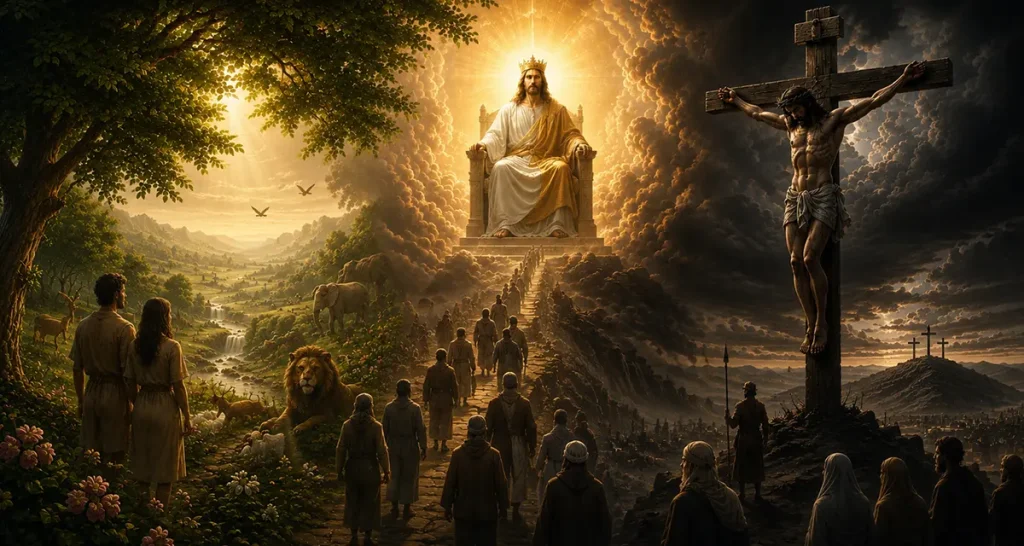
Yes. Before asking how God repairs the rupture, there is an even more primitive and disturbing question:
How can the rupture exist at all?
If YHWH is the source of being, goodness, life, wisdom, beauty, joy—if “of Him and through Him and to Him are all things” (Romans 11:36)—then sin seems almost incomprehensible.
Why would a creature ever say No to the One from whom the creature receives literally everything?
And perhaps Scripture’s answer is partly that sin really is irrational. It can be explained in terms of its mechanism and desire, but it cannot finally be made reasonable, because if we could give a sufficient rational justification for rebellion against God, it would cease to be sin.
🤔 First: evil cannot offer something God lacks
This is important.
Satan could not come to Eve and truthfully say:
“God possesses goodness A, but I possess goodness B, which God cannot give you.”
There is no independent reservoir of goodness outside God.
“Every good gift and every perfect gift is from above, and comes down from the Father of lights…”
James 1:17
David says:
“You are my Lord, my goodness is nothing apart from You.”
Psalm 16:2
So evil cannot create an alternative good.
It must take something that is good in God, detach it from its proper relationship to God, and offer the creature possession of it apart from God.
That’s exactly what happens in Genesis 3.
The tree is not evil.
Wisdom isn’t evil.
Knowledge isn’t evil.
Being like God isn’t even intrinsically evil—humanity was already created in God’s image (Genesis 1:26–27).
The poison lies elsewhere.
🐍 “You will be like God”
This is why the serpent’s temptation is so sophisticated.
“For God knows that in the day you eat of it your eyes will be opened, and you will be like God, knowing good and evil.”
Genesis 3:5
The temptation isn’t fundamentally:
“Would you like something wicked?”
It’s closer to:
“Would you like something good without receiving it from God?”
That is much deeper.
God says:
Receive life from Me.
Receive wisdom from Me.
Receive identity from Me.
Receive dominion from Me.
Receive your understanding of good and evil from Me.
The serpent introduces:
Why receive? Take.
And suddenly we are looking at the heart of sin.
🌳 The creature attempts to become its own reference point
The issue isn’t simply eating fruit.
God had established the meaning of reality:
“of the tree of the knowledge of good and evil you shall not eat…”
Genesis 2:17
The serpent challenges God’s interpretation:
“You will not surely die.”
Genesis 3:4
Now Eve stands between two words.
God says: this leads to death.
The serpent says: this leads to elevation.
And then something remarkable happens:
“So when the woman saw that the tree was good for food, that it was pleasant to the eyes, and a tree desirable to make one wise…”
Genesis 3:6
Notice the shift.
God had already pronounced what was good throughout Genesis 1.
“God saw that it was good.”
But now:
“the woman saw…”
She evaluates reality independently of God’s word.
That doesn’t mean seeing or reasoning is sinful. God gave humanity those capacities. The problem is that the creature has begun treating its own perception as the final court of appeal over God’s revelation.
God says death.
She sees desirability.
And she chooses what she sees.
That’s terrifyingly recognizable.
🧠 But how could she even do that?
Now we reach your “how.”
How can a creature whose entire existence depends upon God choose against God?
Because ontological dependence does not entail willing submission.
A creature can depend upon God for the very power with which it resists Him.
That sounds paradoxical, but we experience analogous things constantly.
A child can use the strength his parents’ food helped sustain to run away from them.
But with God it is infinitely more radical.
Paul tells the Athenians:
“for in Him we live and move and have our being.”
Acts 17:28
Therefore, even the sinner’s rebellion occurs while the sinner remains dependent upon God for existence.
The creature cannot become metaphysically independent.
But the creature can will independence.
And that may be one of the deepest absurdities of sin:
The creature attempts existentially what can never be true ontologically.
It says:
“Mine.”
while every atom of its existence says:
“Gift.”
👑 Perhaps the possibility lies precisely in genuine creaturehood
God didn’t create extensions of Himself.
Adam isn’t God operating a human puppet.
Angels aren’t divine thoughts incapable of willing anything except what God directly wills.
God creates genuine creatures—real secondary agents possessing intellect and will.
Adam receives a command precisely because Adam can actually obey it:
“Of every tree of the garden you may freely eat…”
Genesis 2:16
And God can address him morally:
“Have you eaten from the tree of which I commanded you that you should not eat?”
Genesis 3:11
Adam is accountable because Adam genuinely acts.
But this creates an important distinction.
Being able to choose is good.
Choosing evil is not therefore good.
God is not deficient because He cannot sin.
“God… cannot lie.”
Titus 1:2
And:
“God cannot be tempted by evil…”
James 1:13
Therefore, the highest freedom cannot mean maximum ability to choose contrary possibilities, because by that definition fallen humans would possess a freedom that God lacks.
Biblically, perfected freedom appears to be something much greater:
the unhindered ability to act according to perfect goodness.
That’s where redeemed humanity is going.
We will not spend eternity nervously wondering whether Revelation 21 eventually becomes Genesis 3 all over again. 😄
The glorified saints are brought into a condition in which righteousness is no longer precarious (Revelation 21:27; 22:3–5).
So Adam’s original condition wasn’t the highest conceivable state of human freedom.
He was righteous and innocent—but mutable.
He could fall.
Christ brings humanity ultimately into something greater.
💔 But this still doesn’t tell us why the first sinful desire arose
And here I think we need theological humility.
We can trace temptation.
We can describe pride.
We can describe unbelief.
We can describe the desire for autonomy.
But if we ask:
“Yes—but why did a perfectly created creature first desire something contrary to God?”
eventually explanation reaches a wall.
Scripture tells us that the devil:
“sinned from the beginning.”
1 John 3:8
Jesus says of him:
“He was a murderer from the beginning, and does not stand in the truth…”
John 8:44
But Scripture doesn’t give us a psychological documentary showing how the first evil volition arose inside a good creature.
And there may be a reason.
If we keep asking “why?” looking for a sufficient cause, eventually we risk locating the cause of evil either in God or in something God created as evil.
Scripture rejects both.
God’s creation was:
“very good.”
Genesis 1:31
And:
“God cannot be tempted by evil, nor does He Himself tempt anyone.”
James 1:13
So evil doesn’t have an ultimate positive cause in the same way creation does.
God creates things.
But evil isn’t really a thing God needed to create.
It is a corruption, distortion, deprivation, or misuse of what is good.
A lie requires truth to distort.
Hatred requires persons who ought to be loved.
Pride requires a genuinely good self whose importance becomes disordered.
Idolatry requires something created by God that is elevated above God.
Sexual immorality corrupts a good created sexuality.
Greed corrupts possession and provision.
Even Satan cannot manufacture goodness.
He can only misdirect it.
🔥 And that may explain why sin begins with a lie
Jesus calls Satan:
“a liar and the father of it.”
John 8:44
That seems incredibly significant.
For a creature knowingly to reject God as God, reality itself must somehow be misrepresented.
Look at Genesis 3 again.
The serpent doesn’t begin:
“God is infinitely good. Everything you possess comes from Him. His command exists entirely for your flourishing. Now rebel against Him.”
That isn’t very persuasive. 😄
Instead:
“Has God indeed said…?”
Genesis 3:1
Then:
“You will not surely die.”
Genesis 3:4
Then:
“God knows…”
Genesis 3:5
The insinuation is:
God is withholding something.
And once the goodness of God becomes suspect, rebellion begins to look reasonable.
That’s enormously important.
The serpent cannot change who God is.
So he changes the creature’s perception of who God is.
God becomes, in Eve’s perception, not the generous Creator who gave her everything, but the restrictive authority preventing her fulfillment.
Once that lie is believed, the absurd becomes psychologically plausible:
“Perhaps I would be better off apart from the One from whom all goodness comes.”
🪞 And this brings us remarkably close to the essence of sin
Romans 1 describes fallen humanity like this:
“although they knew God, they did not glorify Him as God, nor were thankful…”
Romans 1:21
That word thankful matters enormously in the discussion we’re having.
Thanksgiving recognizes:
I am recipient.
Sin says:
I am owner.
Worship says:
from Him.
Faith says:
through Him.
Thanksgiving says:
everything I have is gift.
Glory says:
to Him.
But sin interrupts the movement:
from Him → through Him → mine.
That is why idolatry follows immediately in Romans 1:23–25.
The creature tries to redirect toward creation what belongs ultimately “to Him.”
And now Genesis 3 connects directly to the larger structure we’ve been discussing.
Adam was given dominion.
The temptation wasn’t merely to make Adam behave badly while retaining the same orientation.
It turned the steward inward.
Instead of creation being received from God and governed toward God’s purpose, the steward himself attempts to become the terminus.
✨ Which makes Christ’s obedience even more beautiful
Now compare Adam with Jesus.
The serpent essentially tells humanity:
Take what belongs to God.
But of Christ Paul says:
“who, being in the form of God, did not consider it robbery to be equal with God, but made Himself of no reputation…”
Philippians 2:6–7
There is an astonishing reversal there.
Adam is a creature who reaches upward.
Christ is God who stoops downward.
Adam receives everything and grasps for more.
Christ possesses everything and gives Himself.
Adam says through his act:
“Not Your will, but mine.”
Christ says:
“nevertheless not My will, but Yours, be done.”
Luke 22:42
That may be one of the deepest Adam/Christ contrasts in Scripture.
And then Philippians tells us where Christ’s self-surrender leads:
“Therefore God also has highly exalted Him…”
Philippians 2:9
The serpent’s gospel was:
Grasp → become like God.
God’s order revealed in Christ is:
Trust → obey → receive from the Father.
Jesus refuses to seize even what truly belongs to Him.
And the Father gives Him everything.
🌌 So why would anyone willfully go against YHWH?
Not because there is actually something better outside Him.
There isn’t.
Not because evil possesses some good that God lacks.
It doesn’t.
Not because independence from God is actually possible.
It isn’t.
The creature rebels when gift becomes possession, dependence is experienced as limitation, God’s word is displaced by creaturely judgment, and God’s goodness is disbelieved sufficiently that autonomy begins to appear preferable to communion.
And that’s why sin has an element of madness to it.
Jeremiah captures it extraordinarily well:
“For My people have committed two evils:
They have forsaken Me, the fountain of living waters,
And hewn themselves cisterns—broken cisterns that can hold no water.”
Jeremiah 2:13
That may be one of Scripture’s clearest answers to your question.
Why abandon an infinite fountain for an empty broken container?
There is no ultimately rational answer.
That’s what makes sin sin.
And perhaps this also explains why salvation requires more than God giving us better information. Our fundamental problem isn’t simply that nobody explained God clearly enough. Something has happened to the creature’s desires, perception, trust, and will (Ephesians 4:17–18; Romans 8:7; John 3:19–21).
Which takes us right back to Christ: He doesn’t merely come to forgive Adam’s rebellious humanity. He comes to produce a humanity whose relationship to God is finally what Adam’s should have been—receiving everything from the Father, living entirely through God, and joyfully returning everything to Him.
And in Christ, astonishingly, that movement can never be broken again.