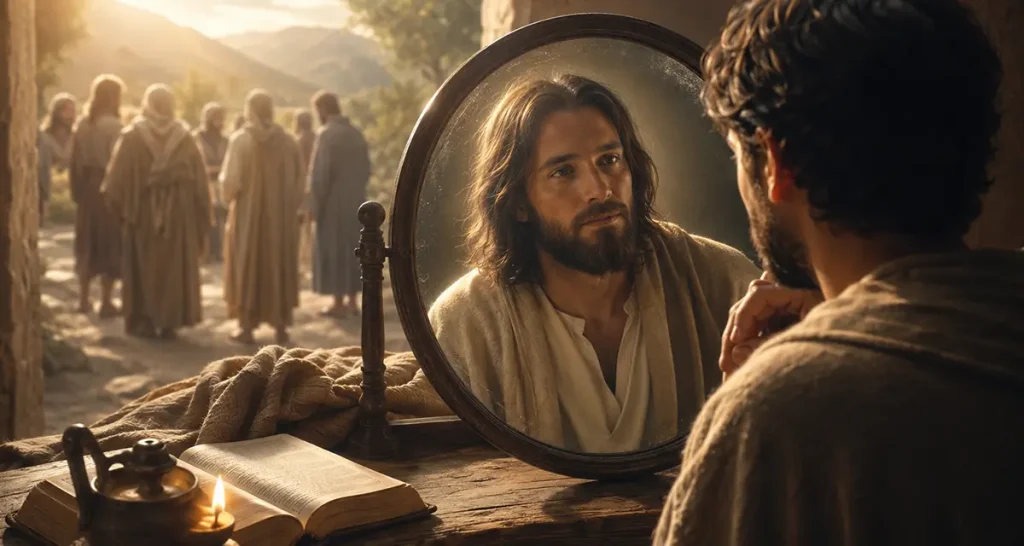
👀 “Looking unto Jesus”—What Does That Look Like in Practice?
That is one of the most practical questions a believer can ask.
When Scripture says,
“Looking unto Jesus, the author and finisher of our faith…”
Hebrews 12:2 (NKJV)
it is not describing a mystical technique or a mental exercise. It is describing the direction of the heart’s attention.
The question is: How do we direct our attention to Someone we cannot physically see?
Scripture gives us several answers.
📖 We look at Christ through His Word
Jesus told the religious leaders,
“You search the Scriptures, for in them you think you have eternal life; and these are they which testify of Me.”
John 5:39 (NKJV)
Notice that Jesus did not merely say the Scriptures contain information about Him. They testify of Him.
This means that reading the Bible is more than gathering doctrines or moral principles. It is coming to know the Person who stands at the center of the whole story.
For example, when you read about:
- Abraham offering Isaac, you see the Father who would not spare His own Son (Genesis 22; Romans 8:32).
- The Passover lamb, you see Christ, “our Passover,” sacrificed for us (Exodus 12; 1 Corinthians 5:7).
- David defeating Goliath, you ultimately see the greater King who defeats our greatest enemies.
- The High Priest entering the Holy of Holies, you see Jesus, our eternal High Priest (Hebrews 9).
We are learning facts, yes—but above all, we are seeing Christ.
🙏 We look to Christ by talking with Him
Reading without prayer easily becomes an academic exercise.
Prayer turns knowledge into communion.
Paul prayed,
“…that I may know Him…”
Philippians 3:10 (NKJV)
Not merely know about Him.
Sometimes the simplest prayer is enough:
“Lord, show me Yourself in this passage.”
That prayer changes how we read.
🪞 We look to Christ by comparing ourselves with Him, not with others
One of the dangers we discussed earlier is comparison.
When I compare myself to another believer, I may feel superior or inferior.
When I compare myself to Christ, something entirely different happens.
I see His patience.
My impatience.
His gentleness.
My harshness.
His purity.
My mixed motives.
Yet I also see His mercy toward sinners.
The comparison humbles me without crushing me, because the One who reveals my need is also the One who meets it.
❤️ We look to Christ by remembering the gospel daily
It is easy to think,
“I became a Christian by grace, but now I grow by my own effort.”
The New Testament never teaches that.
Paul asks the Galatians,
“Are you so foolish? Having begun in the Spirit, are you now being made perfect by the flesh?”
Galatians 3:3 (NKJV)
Looking to Jesus means remembering every day:
- He is my righteousness (1 Corinthians 1:30).
- He is my Advocate (1 John 2:1).
- He is my High Priest (Hebrews 4:14–16).
- He is my Shepherd (John 10:11).
- He is my Vine (John 15:5).
Our relationship with Him did not begin by grace and continue by self-reliance.
🚶 We look to Christ by asking, “What is He doing?”
This has become increasingly precious to me as I read the Gospels.
We often ask,
“What would Jesus do?”
That can be helpful.
But another question is,
“What is Jesus like?”
Watch Him.
See how He responds to interruptions.
To children.
To proud Pharisees.
To broken sinners.
To doubting disciples.
To Peter after his denial.
The more we observe Him, the more the Spirit forms those same attitudes within us.
Paul says,
“Let this mind be in you which was also in Christ Jesus.”
Philippians 2:5 (NKJV)
The mind of Christ is learned by watching Christ.
🌿 There is another dimension
I think there is something else that Scripture quietly teaches, and it connects beautifully with many of our previous discussions.
Looking to Jesus is not only studying Him.
It is recognizing Him in the ordinary moments of life.
When you fail and immediately remember His intercession (Hebrews 7:25), you are looking to Jesus.
When anxiety rises and you entrust your burden to Him because He cares for you (1 Peter 5:7), you are looking to Jesus.
When someone wounds you and you remember how He forgave His enemies (Luke 23:34; Ephesians 4:32), you are looking to Jesus.
When you receive an unexpected blessing and your heart turns to gratitude instead of self-congratulation, you are looking to Jesus.
In other words, looking to Christ is not confined to your devotional chair. It becomes the habitual direction of the soul throughout the day.
🌞 Like turning toward the sun
Perhaps an analogy can help.
Imagine a field of sunflowers.
They do not strain to manufacture light.
They simply turn toward the sun, and because they are facing the source of light, warmth, and energy, they flourish.
There is something similar in the Christian life.
Paul writes,
“But we all, with unveiled face, beholding as in a mirror the glory of the Lord, are being transformed into the same image from glory to glory, just as by the Spirit of the Lord.”
2 Corinthians 3:18 (NKJV)
Notice the order.
We behold.
The Spirit transforms.
Our part is not to produce the likeness of Christ by sheer determination. Our part is to keep turning our hearts toward Him—in His Word, in prayer, in worship, in obedience, and in the ordinary moments of life. His part is to do what only He can do: conform us to His image.
This also explains why the New Testament repeatedly calls us to abide rather than achieve.
Jesus did not say, “Produce fruit.”
He said,
“Abide in Me, and I in you… He who abides in Me, and I in him, bears much fruit; for without Me you can do nothing.”
John 15:4–5 (NKJV)
A branch does not constantly inspect its fruit to make it grow. It remains connected to the vine. Likewise, we do not grow by staring at ourselves, measuring our progress every hour. We grow by returning, again and again, to Christ Himself.
Perhaps that is one of the simplest tests we can ask ourselves throughout the day:
“Where is my gaze right now?”
Is it fixed on myself—my failures, my successes, my fears, my reputation?
Is it fixed on others—their faults, their approval, their progress?
Or is it fixed on Christ—His character, His promises, His present intercession, His finished work, and His coming kingdom?
Where the eyes of the heart rest, the life gradually follows. As the psalmist beautifully confessed,
“I have set the LORD always before me; Because He is at my right hand I shall not be moved.”
Psalm 16:8 (NKJV)
David was not describing a passing glance. He was describing a settled orientation of life. That is what it means to keep looking unto Jesus.