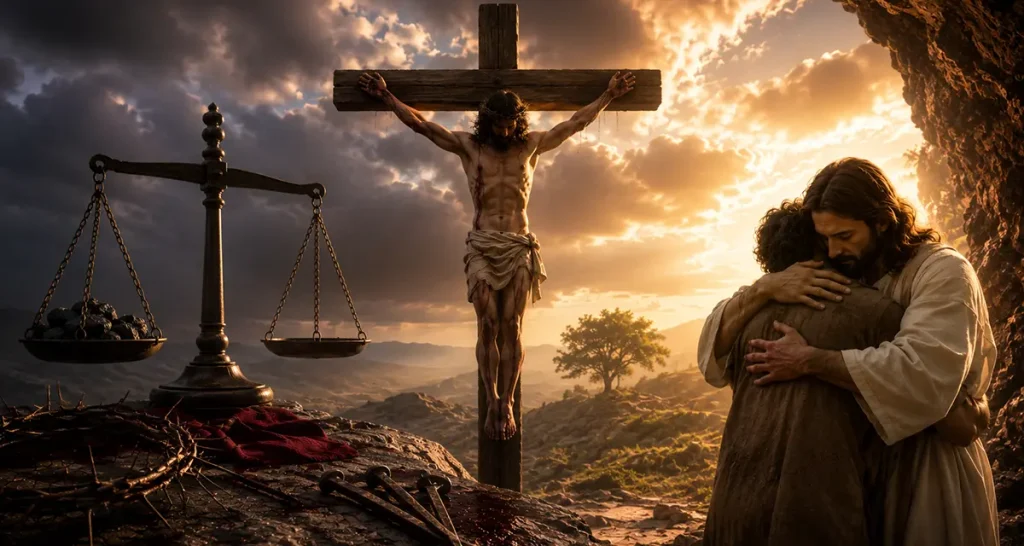
This question takes us to one of the deepest mysteries of the atonement. I think the key is that we often imagine justice through the lens of human retribution, whereas Scripture consistently presents God’s justice as an expression of His own holy character.
If we begin with the wrong picture of justice, the cross becomes difficult to understand. If we begin with God’s own nature, many pieces begin to fall into place.
⚖️ Justice is not something God invented
One thought from our previous discussions becomes very important here.
You once observed:
“Before anything… God. Love, justice, holiness, righteousness… God.”
I think that insight is profoundly biblical.
Justice is not an external law that God obeys.
Nor is it an arbitrary rule that God created and could change tomorrow.
Justice is what God’s holiness looks like when it encounters moral reality.
Paul says,
“He cannot deny Himself.” (2 Timothy 2:13)
God does not act justly because justice is above Him.
He acts justly because justice is who He is.
Likewise,
“God is light, and in Him is no darkness at all.” (1 John 1:5)
and
“God is love.” (1 John 4:8)
These are not merely descriptions of His actions; they reveal His very being.
So when sin appears, God does not decide whether to oppose it. His holiness necessarily opposes it, just as light necessarily dispels darkness.
🌿 The problem is relational before it is judicial
Here I think we sometimes reverse the order.
We often picture sin as first breaking a law.
The Bible first presents it as breaking communion.
In Genesis 3, what is the immediate consequence?
Adam and Eve hide.
Fear enters.
Shame enters.
Death begins.
Exile follows.
The legal dimension is real, but it exists because the relationship has been ruptured.
Sin separates us from the God who is life itself.
Isaiah says,
“Your iniquities have made a separation between you and your God.” (Isaiah 59:2)
This is not merely a courtroom statement.
It is an ontological one.
To be separated from the Source of life is to move toward death.
🔥 Why does suffering appear?
This is where your observation becomes very important.
You wrote:
“Spiritually, it also describes a life separated from God, who is the source of all goodness and well-being…”
Exactly.
Pain is not the essence of justice.
Separation from God is.
Pain is one of its consequences.
Death is its culmination.
Hell itself is ultimately exclusion from the gracious presence of God (2 Thessalonians 1:9), not because God delights in suffering, but because persistent rejection of the Giver of life leaves nothing else.
So suffering is not a currency that pays for sin.
It is one expression of what life apart from God actually is.
✝️ What did Jesus bear?
This is where Isaiah 53 becomes astonishing.
The cross is not simply Jesus enduring physical torture.
Thousands of people were crucified.
The uniqueness of the cross is that the sinless Son enters fully into the condition produced by human sin.
He experiences
- rejection,
- abandonment,
- shame,
- curse,
- death,
all without having committed sin Himself.
Paul writes,
“Christ redeemed us from the curse of the law by becoming a curse for us.” (Galatians 3:13)
Notice the language.
Not merely suffering.
Curse.
The covenant consequences of sin.
Likewise,
“My God, My God, why have You forsaken Me?” (Matthew 27:46)
This is not the Father ceasing to love the Son.
The eternal communion within the Trinity is never broken.
Rather, as the incarnate Mediator, Jesus enters into the human experience of bearing sin’s consequences. He stands where guilty humanity stands, enduring the judgment and abandonment that belong to sinners, while remaining the beloved Son. The mystery is not that the Father stops loving the Son, but that the Son willingly bears, in our place, the full reality of what alienation from God means for humanity.
❤️ Is God punishing someone He hates?
Here I think we reach the most beautiful part of the Gospel.
No.
The Father is not acting against an unwilling victim.
Jesus says,
“No one takes My life from Me, but I lay it down of My own accord.” (John 10:18)
The cross is not the Father against the Son.
Nor is it the Son persuading an angry Father to become loving.
Rather,
“God was in Christ reconciling the world to Himself.” (2 Corinthians 5:19)
The Judge Himself provides the Substitute.
That changes everything.
Imagine a human judge.
If he pays the fine himself, he is not acting vindictively.
He is satisfying justice at his own expense.
Now the analogy falls short because Christ’s work is infinitely greater than paying a fine, but the direction is helpful:
God does not stand outside justice demanding payment from someone else. God bears the cost Himself.
🌊 Why doesn’t God simply forgive?
This question naturally follows.
If God is love, why not simply declare everyone forgiven?
Because forgiveness is never merely a declaration.
Suppose someone destroys a family’s home.
If the victim forgives, the destruction does not disappear.
Someone still bears the loss.
Forgiveness transfers the cost from the offender to the one forgiving.
The cross reveals that God Himself absorbs the cost of reconciliation.
Justice is not ignored.
Justice is fulfilled through divine self-giving love.
✨ Is justice then satisfied by suffering?
I would actually answer no, or at least not by suffering considered in isolation.
This is where I would refine the statement.
Justice is not satisfied because a certain quantity of pain has been inflicted. If that were true, then more pain would always mean more justice, which is contrary to the biblical picture of God.
Justice is satisfied because, in Christ, the full moral reality of sin is addressed.
That includes:
- guilt being borne (Isaiah 53:6),
- condemnation being exhausted (Romans 8:3),
- the curse being carried (Galatians 3:13),
- death being entered and conquered (Hebrews 2:14–15),
- reconciliation being accomplished (2 Corinthians 5:18–21).
The suffering is indispensable, but not because suffering has intrinsic saving power. Rather, it is the historical expression of the Son’s complete obedience and self-offering under the judgment that sin deserves.
🌱 One thought that may bring these threads together
I wonder if we could express it this way:
God’s justice is not His desire to make someone suffer.
God’s justice is His unwavering commitment to uphold the truth of who He is and to restore what sin has corrupted.
Sin produces alienation, corruption, and death because it is a departure from the God who is life. In the incarnation, the Son enters that human condition voluntarily. On the cross, He bears sin’s guilt, curse, condemnation, and death in our place—not because the Father delights in inflicting pain, but because God, in His own person, chooses to bear the cost of restoring His creation without compromising His holiness or denying the seriousness of evil.
That is why the resurrection is so essential. If the cross only ended in suffering and death, justice would not have been seen to triumph. But when the Father raises the Son, He publicly declares that sin has been dealt with, death has been defeated, and the Mediator now lives forever to bring His people into the very communion with God that was lost in Eden (Romans 4:25; Hebrews 7:25; 1 Peter 3:18). The goal was never suffering itself—it was restored fellowship with the living God.